windshield wipers VOLVO XC90 TWIN ENGINE 2019 User Guide
[x] Cancel search | Manufacturer: VOLVO, Model Year: 2019, Model line: XC90 TWIN ENGINE, Model: VOLVO XC90 TWIN ENGINE 2019Pages: 697, PDF Size: 10.33 MB
Page 342 of 697

||DRIVER SUPPORT
340 that the right windshield has been
ordered and installed.
The same type of windshield wipers or
wipers approved by Volvo should be used
for replacement.
CAUTION If the windshield is replaced, the camera and
radar unit must be recalibrated by a workshop
to help ensure proper functioning of all of the
vehicle's camera and radar-based systems –
an authorized Volvo workshop is recom-
mended.
Related information
Camera (p. 337)
Page 439 of 697
STARTING AND DRIVING
* Option/accessory.437
Ignition modes
The vehicle's ignition can be put in various
modes (levels) to make different functions availa-
ble.
To enable the use of a limited number of func-
tions when the engine is not running, the ignition
can be put in one of three different levels: 0, I
and II. These levels are referred to as "ignition
modes" in the Owner's Manual.
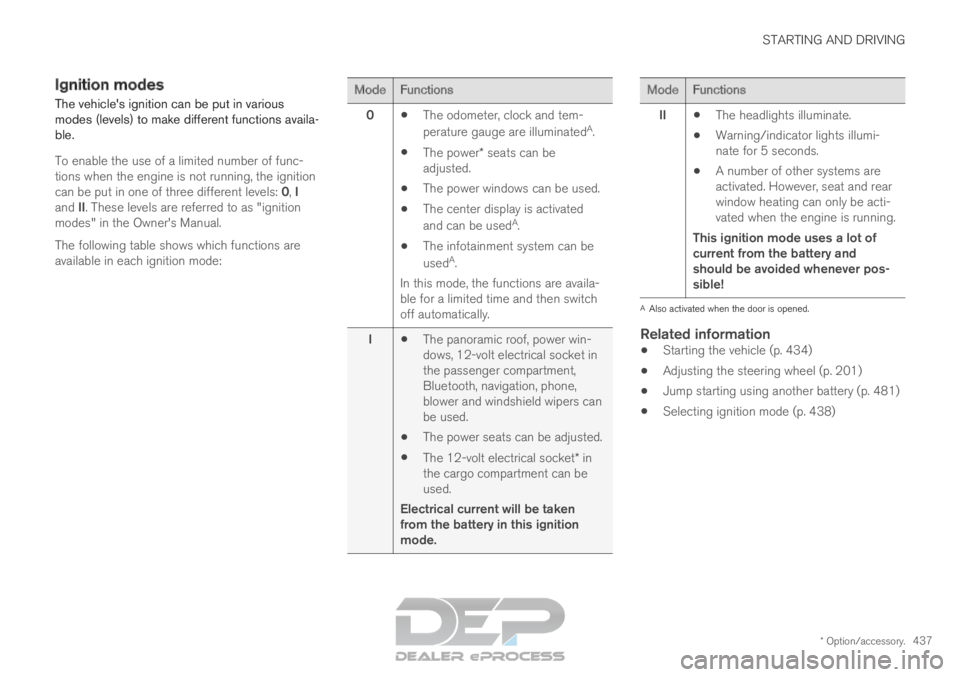
The following table shows which functions are
available in each ignition mode: Mode
Functions
0 The odometer, clock and tem-
perature gauge are illuminated A
.
The power* seats can be
adjusted.
The power windows can be used.
The center display is activated
and can be used A
.
The infotainment system can be
used A
.
In this mode, the functions are availa-
ble for a limited time and then switch
off automatically.
I The panoramic roof, power win-
dows, 12-volt electrical socket in
the passenger compartment,
Bluetooth, navigation, phone,
blower and windshield wipers can
be used.
The power seats can be adjusted.
The 12-volt electrical socket* in
the cargo compartment can be
used.
Electrical current will be taken
from the battery in this ignition
mode. Mode
Functions
II The headlights illuminate.
Warning/indicator lights illumi-
nate for 5 seconds.
A number of other systems are
activated. However, seat and rear
window heating can only be acti-
vated when the engine is running.
This ignition mode uses a lot of
current from the battery and
should be avoided whenever pos-
sible! A
Also activated when the door is opened.
Related information
Starting the vehicle (p. 434)
Adjusting the steering wheel (p. 201)
Jump starting using another battery (p. 481)
Selecting ignition mode (p. 438)
Page 475 of 697
STARTING AND DRIVING
473
Slippery driving conditionsFor optimal traction and roadholding, Volvo rec-
ommends using snow tires on all wheels when-
ever there is a risk of snow or ice on the road.
NOTECertain countries require use of winter tires
by law. Not all countries permit the use of
studded tires.
Practice driving on slippery surfaces under con-
trolled conditions to learn how the vehicle reacts.
Related information
Snow tires (p. 581)
Snow chains (p. 581)
Braking on salted roads (p. 441)
Braking on wet roads (p. 441)
Filling washer fluid (p. 662)
Start battery (p. 627)
Replacing windshield wiper blades (p. 660)
Changing rear window wipers (p. 659)
Refilling coolant (p. 625) Driving through standing water
Driving the vehicle through a deep pool of stand-
ing water on a water-covered roadway is called
fording. This must be done with great caution.
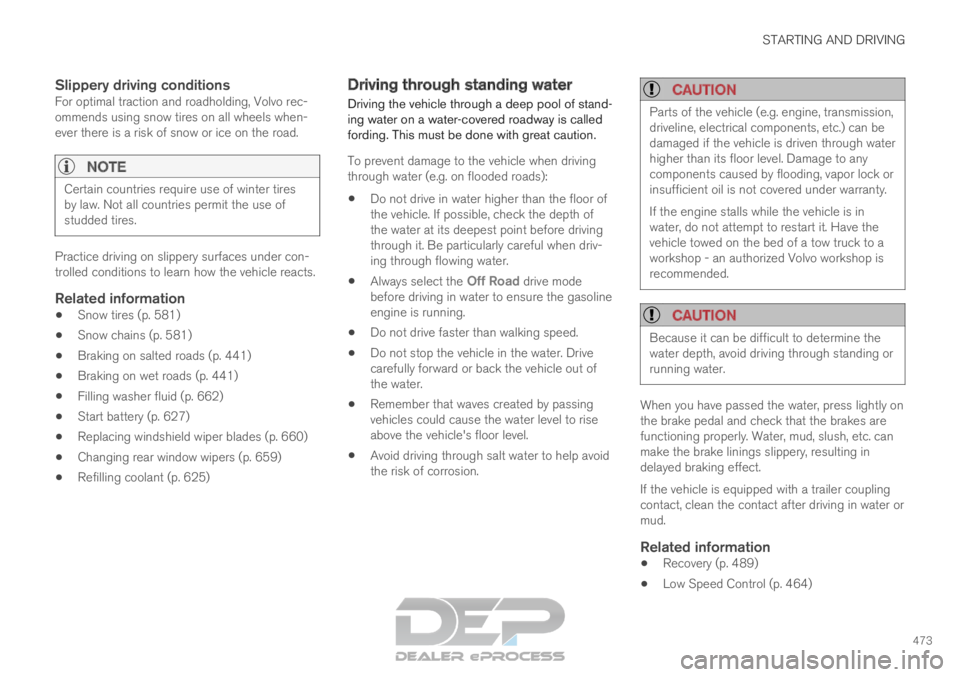
To prevent damage to the vehicle when driving
through water (e.g. on flooded roads):
Do not drive in water higher than the floor of
the vehicle. If possible, check the depth of
the water at its deepest point before driving
through it. Be particularly careful when driv-
ing through flowing water.
Always select the
Off Road drive mode
before driving in water to ensure the gasoline
engine is running.
Do not drive faster than walking speed.
Do not stop the vehicle in the water. Drive
carefully forward or back the vehicle out of
the water.
Remember that waves created by passing
vehicles could cause the water level to rise
above the vehicle's floor level.
Avoid driving through salt water to help avoid
the risk of corrosion.
CAUTION Parts of the vehicle (e.g. engine, transmission,
driveline, electrical components, etc.) can be
damaged if the vehicle is driven through water
higher than its floor level. Damage to any
components caused by flooding, vapor lock or
insufficient oil is not covered under warranty.
If the engine stalls while the vehicle is in
water, do not attempt to restart it. Have the
vehicle towed on the bed of a tow truck to a
workshop - an authorized Volvo workshop is
recommended.
CAUTION
Because it can be difficult to determine the
water depth, avoid driving through standing or
running water.
When you have passed the water, press lightly on
the brake pedal and check that the brakes are
functioning properly. Water, mud, slush, etc. can
make the brake linings slippery, resulting in
delayed braking effect.
If the vehicle is equipped with a trailer coupling
contact, clean the contact after driving in water or
mud.
Related information
Recovery (p. 489)
Low Speed Control (p. 464)
Page 482 of 697
||STARTING AND DRIVING
480
the vehicle safely and letting the engine idle
for a few minutes to let the transmission
cool.
If the vehicle begins to overheat, the air con-
ditioning may be temporarily switched off.
After a prolonged period of driving in
demanding conditions, do not turn off the
engine immediately after stopping.
NOTE It is normal for the engine's cooling fan to
operate for a short time after the engine is
switched off.
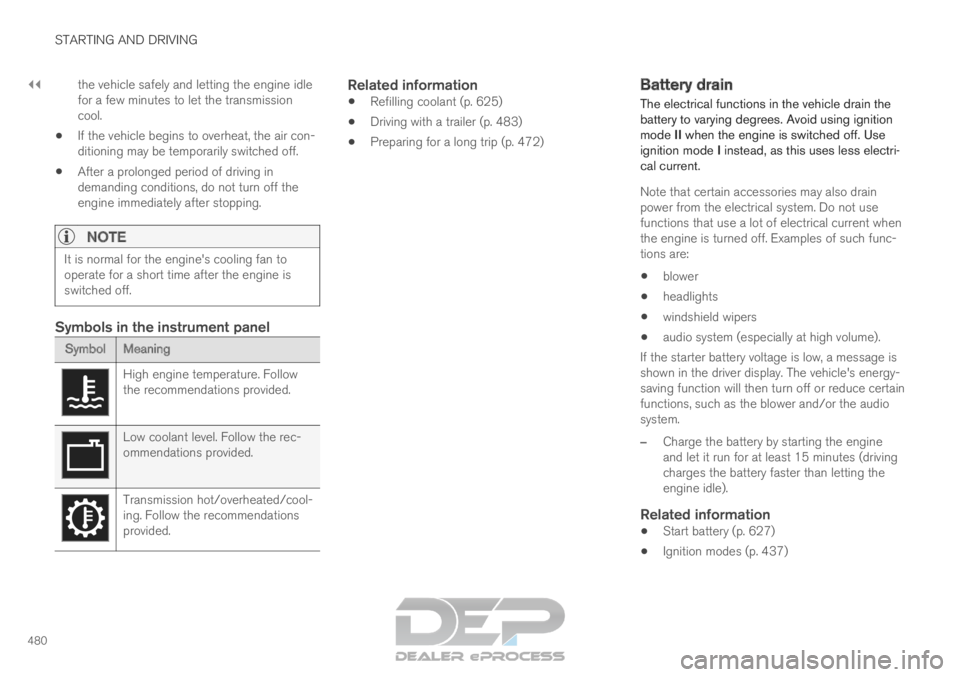
Symbols in the instrument panel
Symbol
Meaning High engine temperature. Follow
the recommendations provided.
Low coolant level. Follow the rec-
ommendations provided.
Transmission hot/overheated/cool-
ing. Follow the recommendations
provided.
Related information
Refilling coolant (p. 625)
Driving with a trailer (p. 483)
Preparing for a long trip (p. 472) Battery drain
The electrical functions in the vehicle drain the
battery to varying degrees. Avoid using ignition
mode II when the engine is switched off. Use
ignition mode I instead, as this uses less electri-
cal current.
Note that certain accessories may also drain
power from the electrical system. Do not use
functions that use a lot of electrical current when
the engine is turned off. Examples of such func-
tions are: blower
headlights
windshield wipers
audio system (especially at high volume).
If the starter battery voltage is low, a message is
shown in the driver display. The vehicle's energy-
saving function will then turn off or reduce certain
functions, such as the blower and/or the audio
system.
– Charge the battery by starting the engine
and let it run for at least 15 minutes (driving
charges the battery faster than letting the
engine idle).
Related information
Start battery (p. 627)
Ignition modes (p. 437)
Page 613 of 697
MAINTENANCE AND SERVICE
}}
611
Periodic maintenance helps minimize
emissions
NOTE
Refer to your Service and Warranty Book-
let for a comprehensive service and main-
tenance schedule up to 240,000 km
(150,000 miles). This program contains
inspections and services necessary for
the proper function of your vehicle and
includes components that affect vehicle
emissions.
The Warranty and Service Records Infor-
mation booklet also contains detailed
information concerning the warranties
that apply to your vehicle.
On-board Diagnostic SystemOBD II is part of your vehicle's computerized
engine management system. It stores diagnostic
information about your vehicle's emission con-
trols. It can light the Check Engine light (MIL) if it
detects an emission control "fault." A "fault" is a
component or system that is not performing
within an expected range. A fault may be perma-
nent or temporary. OBD II will store a message
about any fault.
Emission inspection readiness
How do states use OBD II for emission
inspections?
Many states connect a computer directly to a
vehicle's OBD II system. The inspector can then
read "faults." In some states, this type of inspec-
tion has replaced the tailpipe emission test.
How can my vehicle fail OBD II emission
inspection?
Your vehicle can fail OBD II emission inspection
for any of the following reasons:
If your Check Engine (MIL) light is lit, your
vehicle may fail inspection.
If your vehicle's Check Engine light was lit,
but went out without any action on your part,
OBD II will still have a recorded fault. Your
vehicle may pass or fail, depending on the
inspection practices in your area.
If you had recent service that required dis-
connecting the battery, OBD II diagnostic
information may be incomplete and "not
ready" for inspection. A vehicle that is not
ready may fail inspection.
How can I prepare for my next
OBD II
emission inspection?
If your Check Engine (MIL) light is lit or was
lit but went out without service, have your vehicle diagnosed and, if necessary, serviced
by a qualified Volvo technician.
If you recently had service for a lit Check
Engine light, or if you had service that
required disconnecting the battery, a period
of driving is necessary to bring the OBD II
system to "ready" for inspection. Two half-
hour trips of mixed stop-and-go/highway
driving are typically needed to allow OBD II to
reach readiness. Your Volvo retailer can pro-
vide you with more information on planning a
trip.
Maintain your vehicle in accordance with your
vehicle's maintenance schedule.
Owner maintenancePeriodic maintenance requirements and intervals
are described in your vehicle's Warranty and
Service Records Information booklet.
The following points can be carried out between
the normally scheduled maintenance services.
Each time the car is refueled:
Check the engine oil level.
Clean the windshield, windshield wipers,
headlights, and taillights.
Page 638 of 697
||MAINTENANCE AND SERVICE
* Option/accessory.
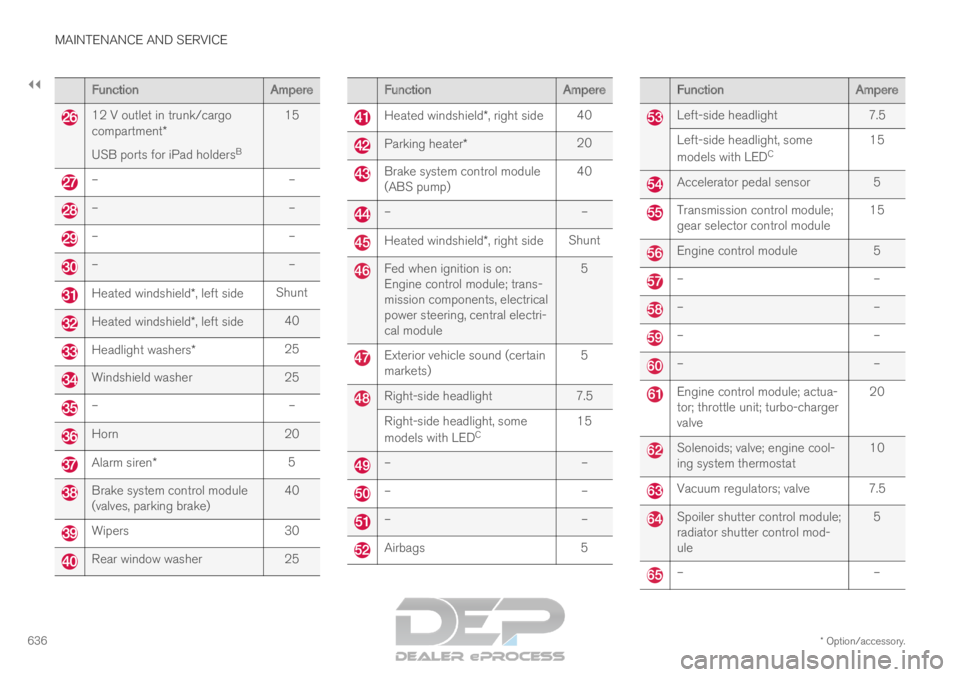
636 Function
Ampere12 V outlet in trunk/cargo
compartment*
USB ports for iPad holders
B15 –
––
––
––
–Heated windshield*, left side
ShuntHeated windshield*, left side
40Headlight washers*
25Windshield washer
25–
–Horn
20Alarm siren*
5Brake system control module
(valves, parking brake)
40Wipers
30Rear window washer
25 Function
Ampere Heated windshield*, right side
40 Parking heater*
20 Brake system control module
(ABS pump)
40 –
– Heated windshield*, right side
Shunt Fed when ignition is on:
Engine control module; trans-
mission components, electrical
power steering, central electri-
cal module
5 Exterior vehicle sound (certain
markets)
5 Right-side headlight
7.5
Right-side headlight, some
models with LED C 15 –
– –
– –
– Airbags
5 Function
Ampere Left-side headlight
7.5
Left-side headlight, some
models with LED C 15 Accelerator pedal sensor 5
Transmission control module;
gear selector control module
15 Engine control module
5 –
– –
– –
– –
– Engine control module; actua-
tor; throttle unit; turbo-charger
valve
20 Solenoids; valve; engine cool-
ing system thermostat
10 Vacuum regulators; valve 7.5
Spoiler shutter control module;
radiator shutter control mod-
ule
5 –
–
Page 661 of 697

MAINTENANCE AND SERVICE
659
Changing rear window wipers
The wiper blades help remove water from the
windshield and rear window. Along with the
washer fluid, they clean the glass and help
improve visibility while driving. The windshield
and rear window wiper blades can be replaced.
Changing rear window wipers Lift the wiper arm from the window and pull the lower
section of the blade to the right.
Grasp the center of the wiper blade and lift it
from the window to the stop position.
NOTE
When the wiper arm is halfway folded out, it
will stop in a locking position that helps pre-
vent the arm from falling back onto the rear
window. The wiper arm must be pulled past
the locking position stop in order to change
the wiper blade.
Grip the lower part of the blade and pull to
the right until the blade loosens from the
arm.3.
Press the new wiper blade until it clicks into
place. Check to make sure the blade is
securely in place.
4. Fold the wiper arm back toward the window.
CAUTION Check the blades regularly. Neglected main-
tenance shortens the life of the blades.
Related information
Using the rain sensor (p. 177)
Using the windshield and headlight washers
(p. 179)
Using automatic rear window wiping when
backing up (p. 181)
Using the rain sensor's memory function
(p. 178)
Using the rear window wiper/washer
(p. 180)
Filling washer fluid (p. 662)
Windshield wipers in the service position
(p. 661)
Replacing windshield wiper blades (p. 660)
Using the windshield wipers (p. 176)
Wiper blades and washer fluid (p. 176)
Page 662 of 697

MAINTENANCE AND SERVICE
660Replacing windshield wiper blades
The wiper blades help remove water from the
windshield and rear window. Along with the
washer fluid, they clean the glass and help
improve visibility while driving. The windshield
and rear window wiper blades can be replaced.
Replacing wiper blades Raise the wiper arms to the service position.
Service position is activated/deactivated via
the function view in the center display when
the car is stationary and the windshield wip-
ers are not on. Press the button on the wiper
blade attachment and pull the wiper blade
straight out, parallel with the wiper arm.
Slide in a new wiper blade until it clicks into
place.
3.
Check to make sure the blade is securely in
place.
4. Press the wiper blade back against the wind- shield.
Wiper blades come in varying lengths
NOTE When changing wiper blades, make sure that
the blades are of different lengths. The blade
on the driver's side is longer than the one on
the passenger side.
Related information
Using the rain sensor (p. 177)
Using the windshield and headlight washers
(p. 179)
Using automatic rear window wiping when
backing up (p. 181)
Using the rain sensor's memory function
(p. 178)
Using the rear window wiper/washer
(p. 180)
Filling washer fluid (p. 662)
Windshield wipers in the service position
(p. 661)
Changing rear window wipers (p. 659)
Using the windshield wipers (p. 176)
Wiper blades and washer fluid (p. 176)
Page 663 of 697

MAINTENANCE AND SERVICE
661
Windshield wipers in the service
position
The windshield wiper blades must be in the serv-
ice (vertical) position for certain operations, e.g.
replacing the blades. Windshield wipers in the service position.
The windshield wipers must be in the service
position when replacing, washing or lifting the
blades (e.g. to scrape ice or snow from the wind-
shield).
CAUTION Before placing the wipers in service position,
ensure that they have not frozen to the wind-
shield.
Activating/deactivating service positionThe service position can be activated/deactivated
when the vehicle is stationary and the windshield
wipers are switched off. Service position is acti-
vated/deactivated via Function view in the center
display:
Tap the Wiper ServicePosition button. The indicator
light in the button will illuminate
when service position is acti-
vated. The windshield wipers
will move to the vertical posi-
tion when service position is
activated. To deactivate the service position, tap
Wiper Service Position once. The indicator light
in the button will go out when service position is
deactivated. The wiper blades will also move out of service
position if:
The windshield wipers are turned on.
The windshield washers are turned on.
The rain sensor is activated.
The vehicle begins moving.CAUTION If the wiper arms in service position are raised
from the windshield, they must be folded back
against the windscreen before activating wip-
ing, washing or rain sensor as well as before
departure. This is to prevent scratching the
paint on the hood.
Related information
Using the rain sensor (p. 177)
Using the windshield and headlight washers
(p. 179)
Using automatic rear window wiping when
backing up (p. 181)
Using the rain sensor's memory function
(p. 178)
Using the rear window wiper/washer
(p. 180)
Filling washer fluid (p. 662)
Replacing windshield wiper blades (p. 660)
Changing rear window wipers (p. 659)
Using the windshield wipers (p. 176)
Wiper blades and washer fluid (p. 176)
Page 664 of 697
MAINTENANCE AND SERVICE
* Option/accessory.
662 Filling washer fluid
Washer fluid is used to keep the headlights,
windshield and rear window clean. Washer fluid
containing anti-freeze should be used in very
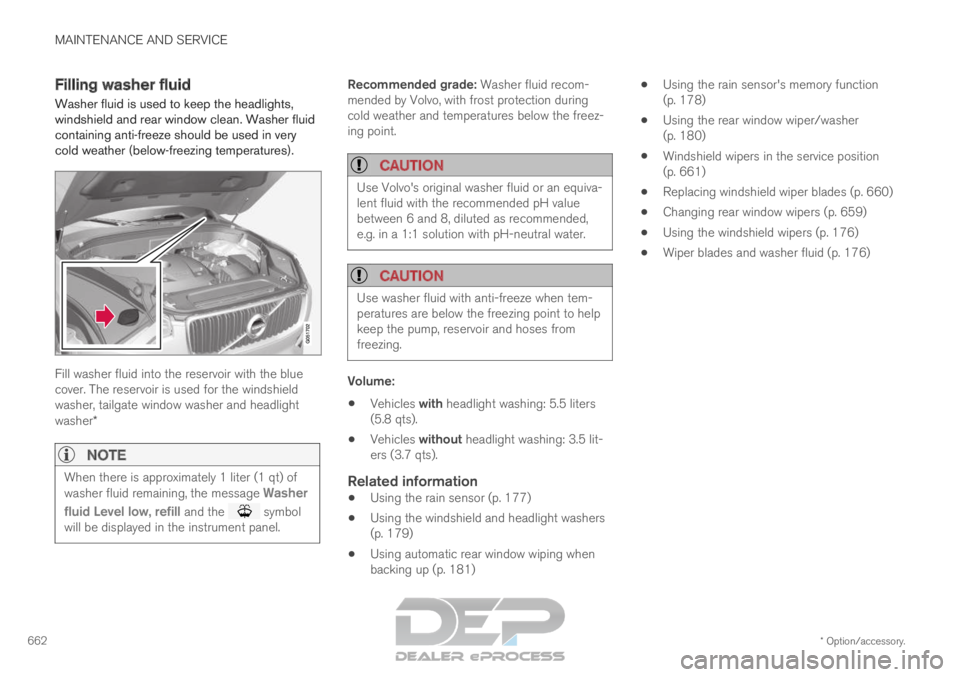
cold weather (below-freezing temperatures). Fill washer fluid into the reservoir with the blue
cover. The reservoir is used for the windshield
washer, tailgate window washer and headlight
washer*
NOTE
When there is approximately 1 liter (1 qt) of
washer fluid remaining, the message
Washer
fluid
Level low, refill and the symbol
will be displayed in the instrument panel. Recommended grade: Washer fluid recom-
mended by Volvo, with frost protection during
cold weather and temperatures below the freez-
ing point.
CAUTION
Use Volvo's original washer fluid or an equiva-
lent fluid with the recommended pH value
between 6 and 8, diluted as recommended,
e.g. in a 1:1 solution with pH-neutral water.
CAUTION
Use washer fluid with anti-freeze when tem-
peratures are below the freezing point to help
keep the pump, reservoir and hoses from
freezing.
Volume:
Vehicles with headlight washing: 5.5 liters
(5.8 qts).
Vehicles without headlight washing: 3.5 lit-
ers (3.7 qts).
Related information
Using the rain sensor (p. 177)
Using the windshield and headlight washers
(p. 179)
Using automatic rear window wiping when
backing up (p. 181)
Using the rain sensor's memory function
(p. 178)
Using the rear window wiper/washer
(p. 180)
Windshield wipers in the service position
(p. 661)
Replacing windshield wiper blades (p. 660)
Changing rear window wipers (p. 659)
Using the windshield wipers (p. 176)
Wiper blades and washer fluid (p. 176)