ECU VOLVO XC90 TWIN ENGINE 2019 Owner's Manual
[x] Cancel search | Manufacturer: VOLVO, Model Year: 2019, Model line: XC90 TWIN ENGINE, Model: VOLVO XC90 TWIN ENGINE 2019Pages: 697, PDF Size: 10.33 MB
Page 197 of 697

SEATS AND STEERING WHEEL
}}
* Option/accessory. 195
2.
Make sure that backrest and head restraint
do not come in contact with the seat in front
while the backrest is being folded down. Fold
the backrest down until it locks into position.
> The seat cushion will move downward/ forward when the backrest is folded down
and create a flat surface. The head
restraint folds down automatically when
the backrest is lowered.
WARNING Make sure the backrest is securely locked
into position after it is folded down.
To return the backrest to the upright position:
1.
Pull up and hold the handle on the side of
the seat while the backrest is being folded
up.
2. Make sure that backrest and head restraint do not come in contact with the seat in front
while the backrest is being folded up. Fold up
the backrest and release the handle.
3. Press the backrest until it locks into position.
4. Fold up the head restraint manually.
WARNING Make sure that the rear seat backrest and
head restraint are locked securely in place
after the seat is folded up.
The head restraints at the outer seats must
always be raised when there is a passenger in
one of these spots of the rear seat.
WARNING
The head restraints on the outboard second-
row seats must always be folded up when
there are passengers in the third row of
seats*.
Related information
Adjusting the second row head restraints
(p. 195)
Moving the second row seats forward/rear-
ward* (p. 197)
Adjusting the second row backrest tilt
(p. 197)
Getting into and out of the third row of
seats* (p. 198)
Folding the third row backrests* (p. 199) Adjusting the second row head
restraints
Adjust the center head restraint in the rear seat
to the seat occupant's height. Fold down the
outboard head restraints* to improve rear visibil-
ity.
Adjusting the center head restraint The center head restraint should be adjusted to
suit the passenger's height. The entire back of
the head should be covered if possible. Manually
move the restraint up or down as needed.
Page 199 of 697
SEATS AND STEERING WHEEL
}}
* Option/accessory. 197
Moving the second row seats
forward/rearward*
In vehicles with 7 seats*, the seats in the second
row can be moved forward or rearward individu-
ally to help optimize legroom for passengers in
the second and third rows. The second row
seats cannot be moved forward or backward in
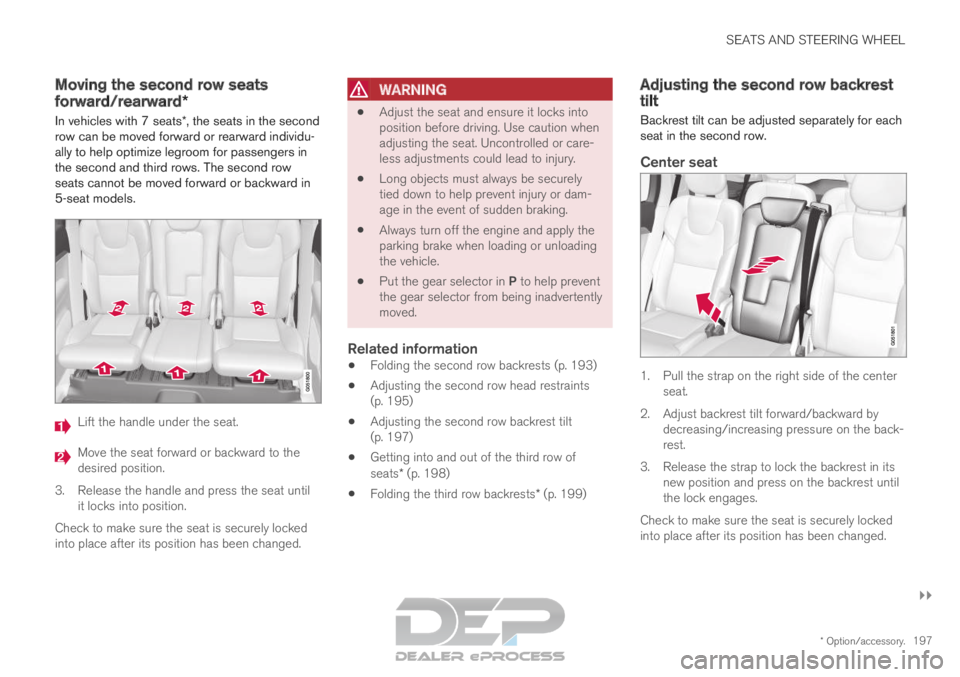
5-seat models. Lift the handle under the seat.
Move the seat forward or backward to the
desired position.
3.
Release the handle and press the seat until
it locks into position.
Check to make sure the seat is securely locked
into place after its position has been changed.
WARNING
Adjust the seat and ensure it locks into
position before driving. Use caution when
adjusting the seat. Uncontrolled or care-
less adjustments could lead to injury.
Long objects must always be securely
tied down to help prevent injury or dam-
age in the event of sudden braking.
Always turn off the engine and apply the
parking brake when loading or unloading
the vehicle.
Put the gear selector in P to help prevent
the gear selector from being inadvertently
moved.
Related information
Folding the second row backrests (p. 193)
Adjusting the second row head restraints
(p. 195)
Adjusting the second row backrest tilt
(p. 197)
Getting into and out of the third row of
seats* (p. 198)
Folding the third row backrests* (p. 199) Adjusting the second row backrest
tilt
Backrest tilt can be adjusted separately for each
seat in the second row.
Center seat 1. Pull the strap on the right side of the center
seat.
2.
Adjust backrest tilt forward/backward by
decreasing/increasing pressure on the back-
rest.
3. Release the strap to lock the backrest in its new position and press on the backrest until
the lock engages.
Check to make sure the seat is securely locked
into place after its position has been changed.
Page 200 of 697

||SEATS AND STEERING WHEEL
* Option/accessory.
198
Outboard seats 1. Pull the handle on the side of the seat
upward.
2.
Adjust backrest tilt forward/backward by
decreasing/increasing pressure on the back-
rest.
3. Release the handle to lock the backrest in its new position and press on the backrest until
the lock engages.
Check to make sure the seat is securely locked
into place after its position has been changed.
WARNING
Adjust the seat and ensure it locks into
position before driving. Use caution when
adjusting the seat. Uncontrolled or care-
less adjustments could lead to injury.
Long objects must always be securely
tied down to help prevent injury or dam-
age in the event of sudden braking.
Always turn off the engine and apply the
parking brake when loading or unloading
the vehicle.
Put the gear selector in P to help prevent
the gear selector from being inadvertently
moved.
Related information
Folding the second row backrests (p. 193)
Adjusting the second row head restraints
(p. 195)
Moving the second row seats forward/rear-
ward* (p. 197)
Getting into and out of the third row of
seats* (p. 198)
Folding the third row backrests* (p. 199) Getting into and out of the third row
of seats*
The second row of seats can be adjusted for
easier access to the third row of seats*. To fold down the backrest:
1.
Pull the handle on the upper side of the right
or left outboard second row seat upward/
forward.
2. Fold the backrest down and move the entire seat forward.
To return the seat to the upright position:
– Push the seat rearward to its end position.
The backrest should then easily return to the
correct position.
Page 201 of 697

SEATS AND STEERING WHEEL
}}
* Option/accessory. 199
NOTEIf a backrest in the second row of seats does
not lock back into the upright position after
being folded down (e.g. for getting in or out of
the third row of seats), it may need to be
pushed forward again and then pushed back
with more force.
WARNING
Make sure that the rear seat backrest and
head restraint are locked securely in place
after the seat is folded up.
The head restraints at the outer seats must
always be raised when there is a passenger in
one of these spots of the rear seat.
Related information
Folding the second row backrests (p. 193)
Adjusting the second row head restraints
(p. 195)
Moving the second row seats forward/rear-
ward* (p. 197)
Adjusting the second row backrest tilt
(p. 197)
Folding the third row backrests* (p. 199) Folding the third row backrests*
The third row has two individual seats. These
can be folded down separately.
CAUTION To fold down the third-row seat backrests, it
may be necessary to change the position/tilt
the seats in the second row.
1. Pull the handle on the upper side of the
backrest upward/forward. 2.
Make sure that backrest and head restraint
do not come in contact with the seat in front
while the backrest is being folded down. Fold
the backrest down.
> The seat cushion will move downward/ forward when the backrest is folded down
and create a flat surface. The head
restraint folds down automatically when
the backrest is lowered.
To return the seat to the upright position, fold the
backrest up manually until it locks into position.
Fold up the head restraint manually.
WARNING Make sure that the rear seat backrest and
head restraint are locked securely in place
after the seat is folded up.
The head restraints at the outer seats must
always be raised when there is a passenger in
one of these spots of the rear seat.
Related information
Folding the second row backrests (p. 193)
Adjusting the second row head restraints
(p. 195)
Moving the second row seats forward/rear-
ward* (p. 197)
Page 255 of 697
KEY, LOCKS AND ALARM
}}
* Option/accessory. 253
Red Key - restricted remote key*
A Red Key makes it possible for the vehicle
owner to set limitations for certain vehicle prop-
erties. The limitations are intended to promote
safe use of the vehicle, e.g. when it is loaned
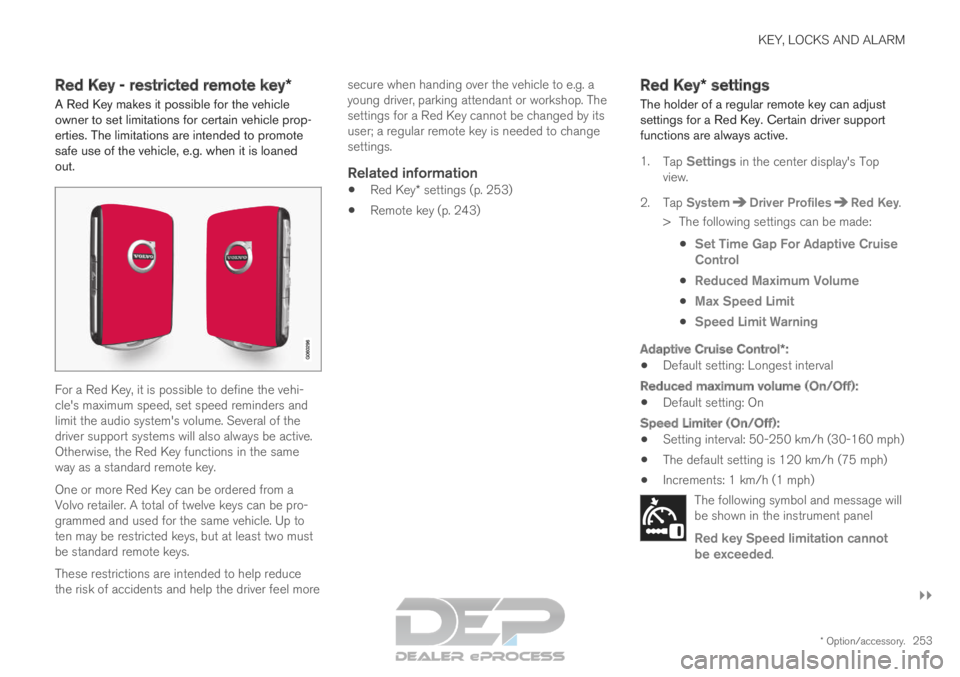
out. For a Red Key, it is possible to define the vehi-
cle's maximum speed, set speed reminders and
limit the audio system's volume. Several of the
driver support systems will also always be active.
Otherwise, the Red Key functions in the same
way as a standard remote key.
One or more Red Key can be ordered from a
Volvo retailer. A total of twelve keys can be pro-
grammed and used for the same vehicle. Up to
ten may be restricted keys, but at least two must
be standard remote keys.
These restrictions are intended to help reduce
the risk of accidents and help the driver feel more secure when handing over the vehicle to e.g. a
young driver, parking attendant or workshop. The
settings for a Red Key cannot be changed by its
user; a regular remote key is needed to change
settings.
Related information
Red Key* settings (p. 253)
Remote key (p. 243) Red Key*
settings
The holder of a regular remote key can adjust
settings for a Red Key. Certain driver support
functions are always active.
1. Tap Settings in the center display's Top
view.
2.
Tap System Driver Profiles Red Key
.
> The following settings can be made:
Set Time Gap For Adaptive Cruise
Control
Reduced Maximum Volume
Max Speed Limit
Speed Limit Warning
Adaptive Cruise Control*:
Default setting: Longest interval
Reduced maximum volume (On/Off):
Default setting: On
Speed Limiter (On/Off):
Setting interval: 50-250 km/h (30-160 mph)
The default setting is 120 km/h (75 mph)
Increments: 1 km/h (1 mph)
The following symbol and message will
be shown in the instrument panel
Red key Speed limitation cannot
be exceeded.
Page 274 of 697
KEY, LOCKS AND ALARM
* Option/accessory.
272 Activating and deactivating private
locking
Private locking is activated using the function
button in the center display and a PIN code.
NOTE For the valet lock function to be activated the
car must be in at least ignition mode I.
Entering security code before initial useThe first time the function is used, a security
code must be selected. This code can then be
used to deactivate private locking if the selected
PIN code has been lost or forgotten. The security
code functions as a PUK (security) code for all
PIN codes used for private locking.
Save the security code in a safe place.
To create a security code:
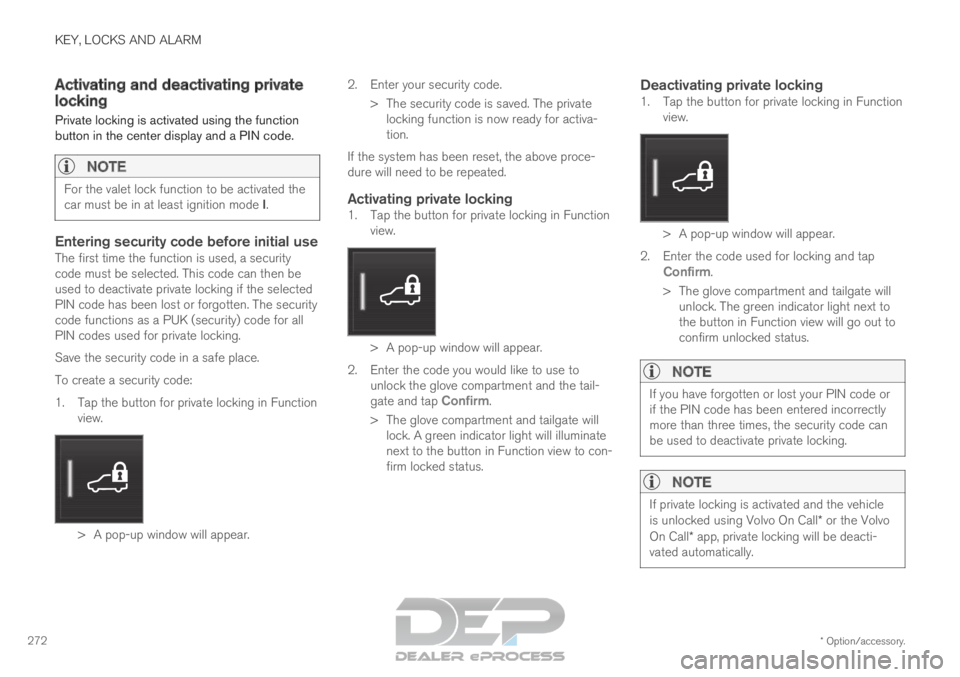
1. Tap the button for private locking in Function
view. > A pop-up window will appear. 2.
Enter your security code.
> The security code is saved. The private locking function is now ready for activa-
tion.
If the system has been reset, the above proce-
dure will need to be repeated.
Activating private locking1. Tap the button for private locking in Function view. > A pop-up window will appear.
2.
Enter the code you would like to use to
unlock the glove compartment and the tail-
gate and tap Confirm.
>
The glove compartment and tailgate will
lock. A green indicator light will illuminate
next to the button in Function view to con-
firm locked status.
Deactivating private locking1. Tap the button for private locking in Function view. > A pop-up window will appear.
2.
Enter the code used for locking and tap
Confirm.
>
The glove compartment and tailgate will
unlock. The green indicator light next to
the button in Function view will go out to
confirm unlocked status.
NOTE If you have forgotten or lost your PIN code or
if the PIN code has been entered incorrectly
more than three times, the security code can
be used to deactivate private locking.
NOTE
If private locking is activated and the vehicle
is unlocked using Volvo On Call* or the Volvo
On Call* app, private locking will be deacti-
vated automatically.
Page 424 of 697

HYBRID INFORMATION
422Charging cable temperature
monitoring
To help ensure the vehicle's hybrid battery is reli-
ably charged each time it is connected, charging
is stopped if the temperature in the charging
cable becomes too high and reaches a critical
limit.
CAUTION If charging is often inadvertently interrupted,
have the charging cable and the vehicle's
charging system inspected by a trained and
qualified Volvo service technician.
Related information
Charge cable (p. 419) Opening and closing the charging
socket cover
The cover for the hybrid battery's charging
socket opens manually. Unlock the vehicle using the remote key.
Press in the rear edge of the charger door
and release.
Open the door.
Remove the charging socket's protective
cover and secure it in the holder on the
inside of the charger door. Make sure the
cover's rubber stopper is bent downward to
prevent the cover from falling out of the
holder.
CAUTION Make sure the charging socket's protective
cover is positioned so it does not damage the
paint (in e.g., windy conditions).
Perform the following steps in reverse to close
the charger door.
NOTE
Since the hatch is locked during driving, the
vehicle must be unlocked again to be able to
open the hatch.
Related information
Initiating hybrid battery charging (p. 423)
Stopping hybrid battery charging (p. 429)
Charging the hybrid battery (p. 417)
Page 427 of 697

HYBRID INFORMATION
}}
425
Charging status in the vehicle's
charging socket
The charging status is indicated by an LED light
in the charging socket. Location of the LED indicator light in the vehicle's
charging socket.
The LED indicator light shows the current charge
status during charging. If the LED indicator light
is not illuminated, check to make sure the cable
is securely connected in the wall outlet and in the
outlet in the vehicle. A white, red or yellow light
illuminates when the passenger compartment
lighting is activated and will remain illuminated for
a short time after the passenger compartment
lighting has gone out. LED indicator
light's color
Meaning
White
Courtesy light.
Yellow Wait modeA
– waiting for
charging to start.
Flashing green Charging is in progress B
.
Green Charging completed C
.
Red Malfunction. A
E.g. after a door has been opened or if the charging cable han-
dle is not locked in place.
B The more slowly the light flashes, the closer the battery is to
being fully charged.
C The light will go out after a short time.
Related information
Charging the hybrid battery (p. 417)
Charging status in the instrument panel
(p. 427)
Charging status in the charging cable's
charging module (p. 425)
Stopping hybrid battery charging (p. 429) Charging status in the charging
cable's charging module
The red and blue lights in the charging module
indicate the status of ongoing and completed
charging. Charge module: 1. Red warning light, 2. Blue status indi-
cator
When the charge module is initially plugged into
a wall outlet, the red warning light will flash once
to indicate that a startup safety check has been
performed. When the safety check has been
completed, the blue status indicator will glow
steadily and the red warning light will be off. The
charger is now ready to be used. If the red warn-
ing light continues to flash or glows steadily, a
fault has been detected and the charger will not
deliver power to the vehicle. Contact a Volvo
retailer or a certified Volvo service technician.
Page 436 of 697
STARTING AND DRIVING
* Option/accessory.
434 Starting the vehicle
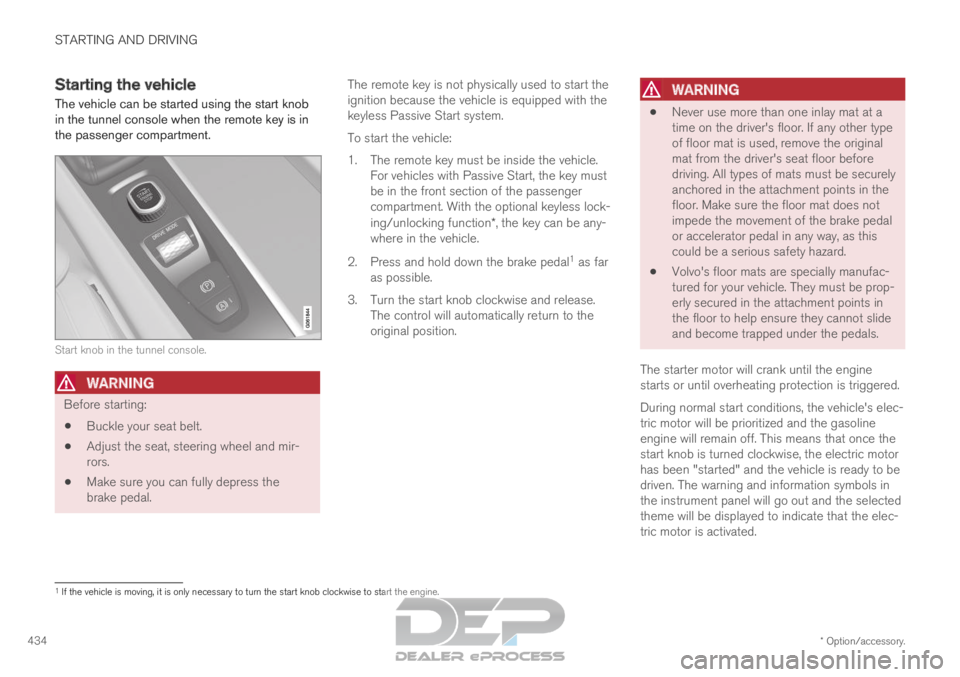
The vehicle can be started using the start knob
in the tunnel console when the remote key is in
the passenger compartment. Start knob in the tunnel console.
WARNING
Before starting:
Buckle your seat belt.
Adjust the seat, steering wheel and mir-
rors.
Make sure you can fully depress the
brake pedal. The remote key is not physically used to start the
ignition because the vehicle is equipped with the
keyless Passive Start system.
To start the vehicle:
1.
The remote key must be inside the vehicle.
For vehicles with Passive Start, the key must
be in the front section of the passenger
compartment. With the optional keyless lock-
ing/unlocking function*, the key can be any-
where in the vehicle.
2. Press and hold down the brake pedal 1
as far
as possible.
3. Turn the start knob clockwise and release. The control will automatically return to the
original position.
WARNING
Never use more than one inlay mat at a
time on the driver's floor. If any other type
of floor mat is used, remove the original
mat from the driver's seat floor before
driving. All types of mats must be securely
anchored in the attachment points in the
floor. Make sure the floor mat does not
impede the movement of the brake pedal
or accelerator pedal in any way, as this
could be a serious safety hazard.
Volvo's floor mats are specially manufac-
tured for your vehicle. They must be prop-
erly secured in the attachment points in
the floor to help ensure they cannot slide
and become trapped under the pedals.
The starter motor will crank until the engine
starts or until overheating protection is triggered.
During normal start conditions, the vehicle's elec-
tric motor will be prioritized and the gasoline
engine will remain off. This means that once the
start knob is turned clockwise, the electric motor
has been "started" and the vehicle is ready to be
driven. The warning and information symbols in
the instrument panel will go out and the selected
theme will be displayed to indicate that the elec-
tric motor is activated. 1
If the vehicle is moving, it is only necessary to turn the start knob cl\
ockwise to start the engine.
Page 463 of 697
STARTING AND DRIVING
}}
* Option/accessory. 461
Leveling control* and suspension
The vehicle's leveling control system adjusts the
suspension and shock absorbers automatically
to help provide good comfort and control while
driving. Leveling can also be controlled manually
to facilitate loading or getting in and out of the
vehicle.
Pneumatic suspension and shock
absorbers
The system is adapted to the selected drive
mode and vehicle speed. The pneumatic suspen-
sion reduces the vehicle's ground clearance at
higher speeds to reduce air resistance and
increase stability. The shock absorbers are nor-
mally set to provide the best possible comfort
and are adjusted continuously according to the
road surface and the vehicle's acceleration, brak-
ing and cornering. The instrument panel indicates
when the suspension level is
being adjusted.The following apply if a door or the tailgate is
opened:
If a door is opened, the level can only be
adjusted upwards.
If the tailgate is open, the level can only be
adjusted downwards.
ParkingWhen parking, make sure that there is adequate
space above and below the vehicle since ground
clearance may vary depending on e.g. ambient temperature, how the vehicle is loaded, if loading
mode is used, which drive mode is selected after
the engine is started, etc.
The level may also be adjusted a period after the
vehicle is parked. This is to compensate for any
height changes that may occur due to tempera-
ture changes in the air springs when the vehicle
cools.
TransportingWhen transporting the vehicle on a ferry, train or
truck, only secure (lash) the vehicle around the
tires, not using any other parts of the chassis.
Changes in the pneumatic suspension may occur
during transport, which could adversely affect the
lashing and result in damage.