battery VOLVO XC90 TWIN ENGINE 2019 Owner's Manual
[x] Cancel search | Manufacturer: VOLVO, Model Year: 2019, Model line: XC90 TWIN ENGINE, Model: VOLVO XC90 TWIN ENGINE 2019Pages: 697, PDF Size: 10.33 MB
Page 249 of 697
KEY, LOCKS AND ALARM
}}
247
Replacing the remote key's battery (p. 249)
Locking and unlocking with detachable key
blade (p. 255) Settings for remote and inside door
unlock
Several different sequences are available for
remote unlocking.
1. Tap Settings in the center display's Top
view.
2.
Tap My Car Locking Remote and
Interior Unlock .
3.
Select alternative:
All Doors
- unlocks all doors at the same time.
Single Door
- unlocks the driver's door. Press the remote
key unlock button twice to unlock all doors.
The settings made here also affect central lock-
ing using the inside door handle.
Related information
Locking and unlocking using the remote key
(p. 246)
Locking and unlocking from inside the vehi-
cle (p. 262) Unlocking the tailgate using the
remote key
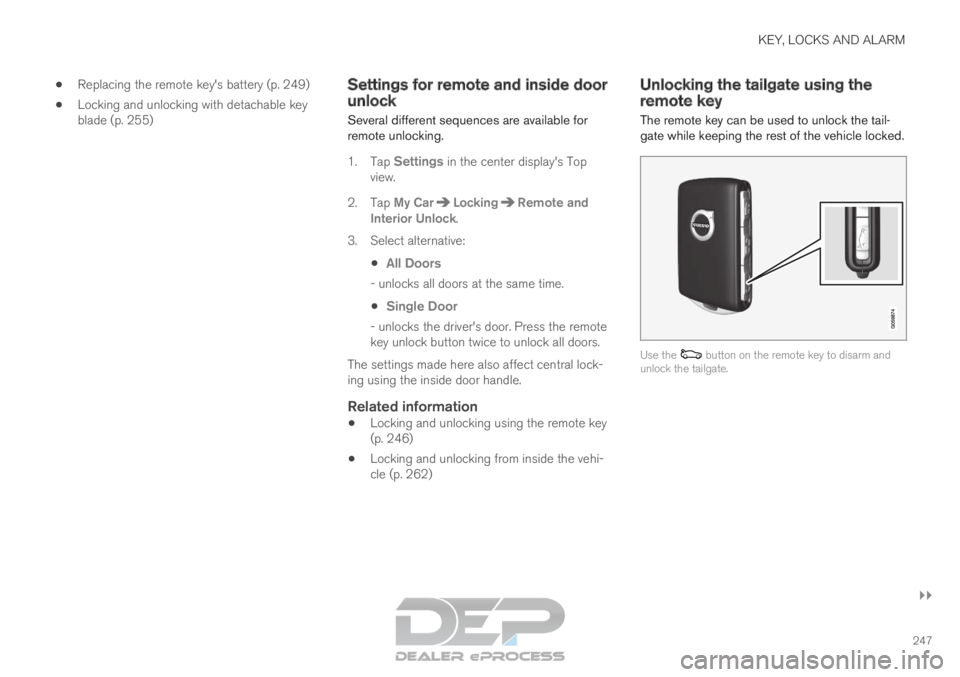
The remote key can be used to unlock the tail-
gate while keeping the rest of the vehicle locked. Use the button on the remote key to disarm and
unlock the tailgate.
Page 251 of 697
KEY, LOCKS AND ALARM
}}
* Option/accessory. 249
Related information
Remote key (p. 243)
Antenna locations for the start and lock sys-
tem (p. 262)
Keyless and touch-sensitive surfaces*
(p. 258) Replacing the remote key's battery
The battery in the remote key must be replaced
when it is discharged.
NOTE All batteries have a limited service life and
must eventually be replaced (does not apply
for Key Tag). The battery's service life varies
depending on how often the vehicle/key is
used.
The remote key battery should be replaced if:
the information symbol illuminates and
the message Vehicle key bat. low
See Owner's manual is displayed in
the instrument panel and/or
the locks do not react after several attempts
to lock or unlock the vehicle using the
remote key within approx. 20 meter (65 feet)
from the vehicle.
NOTE Move closer to the vehicle and try to unlock it
again. The battery in the smaller key without buttons
9
(the Key Tag) cannot be replaced. A new key can
be ordered from an authorized Volvo workshop.
CAUTION An end-of-life Key Tag must be turned in to
an authorized Volvo workshop. The key must
be deleted from the vehicle because it can
still be used to start the vehicle via backup
start.
9
This key is provided with vehicles equipped with keyless locking/unlocki\
ng (Passive Entry*).
Page 252 of 697
||KEY, LOCKS AND ALARM
250
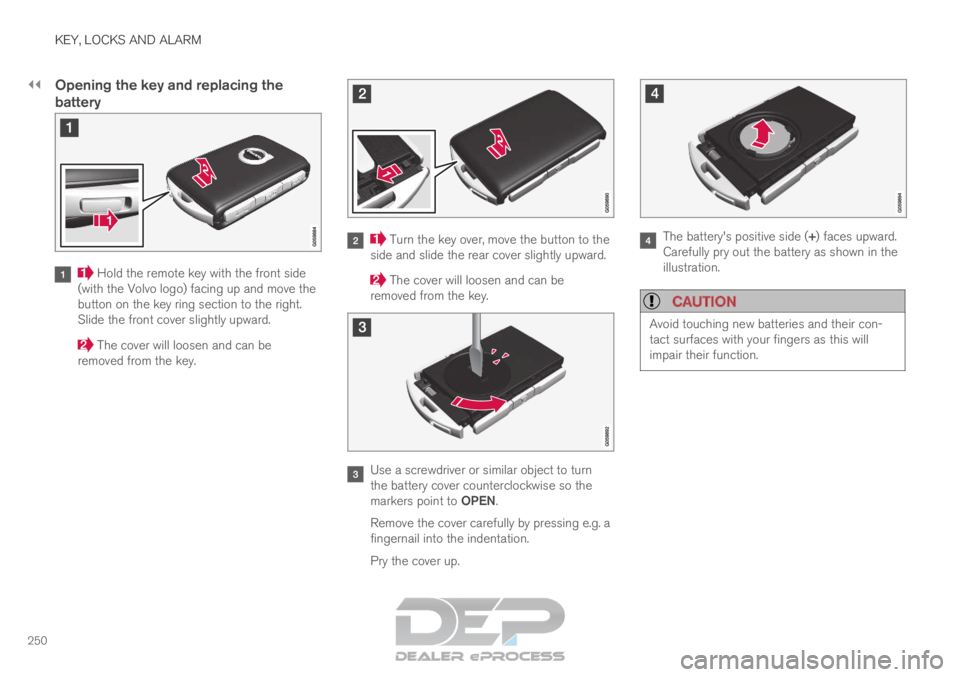
Opening the key and replacing the
battery
Hold the remote key with the front side
(with the Volvo logo) facing up and move the
button on the key ring section to the right.
Slide the front cover slightly upward. The cover will loosen and can be
removed from the key. Turn the key over, move the button to the
side and slide the rear cover slightly upward. The cover will loosen and can be
removed from the key. Use a screwdriver or similar object to turn
the battery cover counterclockwise so the
markers point to OPEN.
Remove the cover carefully by pressing e.g. a
fingernail into the indentation.
Pry the cover up. The battery's positive side (+) faces upward.
Carefully pry out the battery as shown in the
illustration.
CAUTION Avoid touching new batteries and their con-
tact surfaces with your fingers as this will
impair their function.
Page 253 of 697
KEY, LOCKS AND ALARM
}}
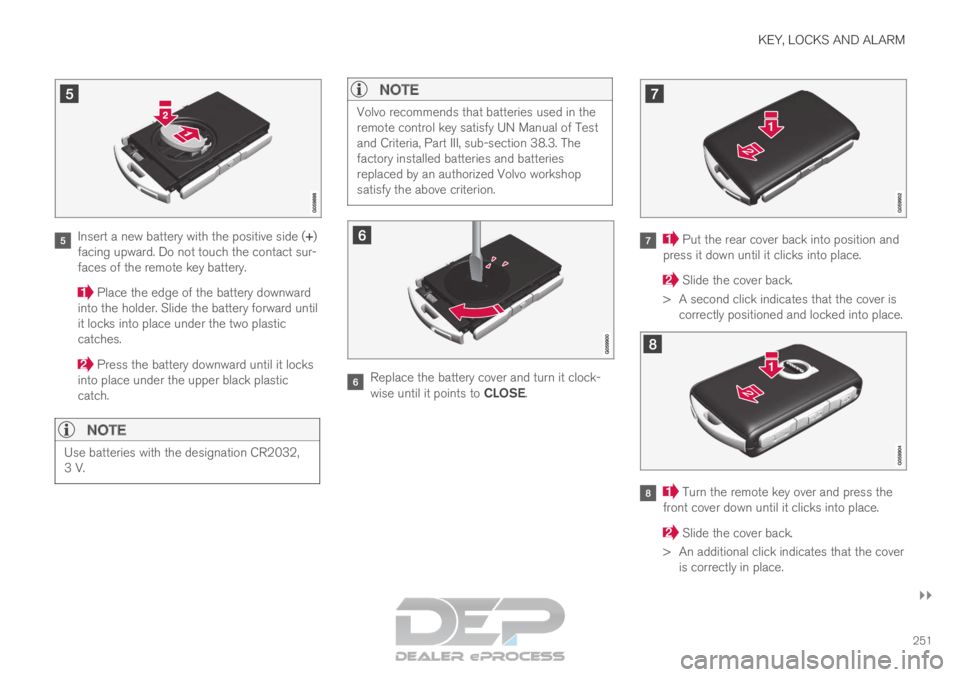
251 Insert a new battery with the positive side (+)
facing upward. Do not touch the contact sur-
faces of the remote key battery. Place the edge of the battery downward
into the holder. Slide the battery forward until
it locks into place under the two plastic
catches. Press the battery downward until it locks
into place under the upper black plastic
catch.
NOTE Use batteries with the designation CR2032,
3 V.
NOTE Volvo recommends that batteries used in the
remote control key satisfy UN Manual of Test
and Criteria, Part III, sub-section 38.3. The
factory installed batteries and batteries
replaced by an authorized Volvo workshop
satisfy the above criterion.
Replace the battery cover and turn it clock-
wise until it points to CLOSE. Put the rear cover back into position and
press it down until it clicks into place. Slide the cover back.
>
A second click indicates that the cover is
correctly positioned and locked into place. Turn the remote key over and press the
front cover down until it clicks into place. Slide the cover back.
>
An additional click indicates that the cover
is correctly in place.
Page 257 of 697
KEY, LOCKS AND ALARM
}}
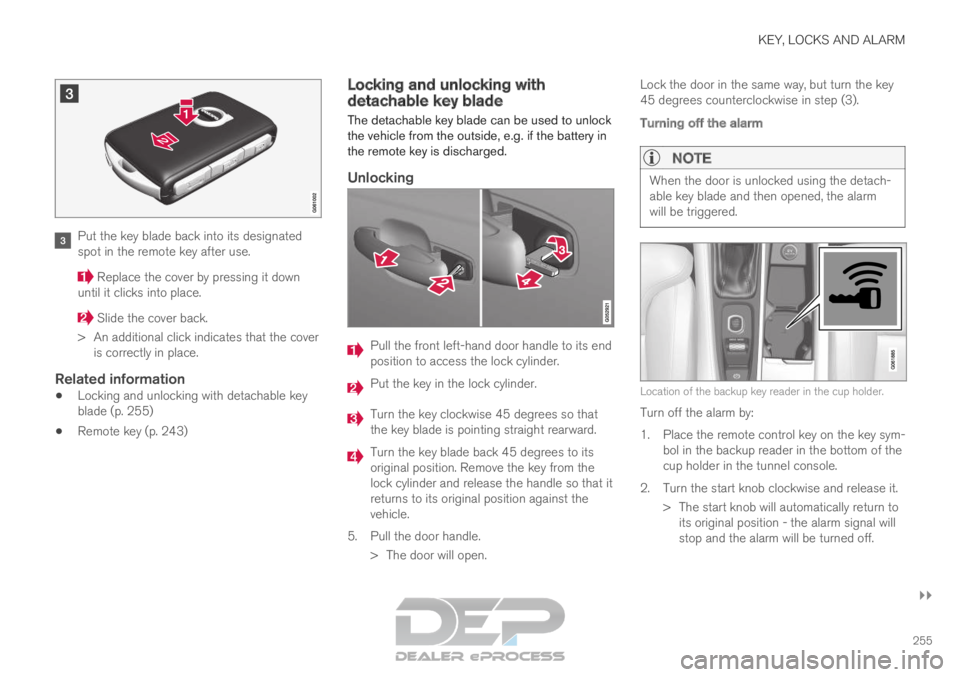
255 Put the key blade back into its designated
spot in the remote key after use.
Replace the cover by pressing it down
until it clicks into place. Slide the cover back.
>
An additional click indicates that the cover
is correctly in place.
Related information
Locking and unlocking with detachable key
blade (p. 255)
Remote key (p. 243) Locking and unlocking with
detachable key blade
The detachable key blade can be used to unlock
the vehicle from the outside, e.g. if the battery in
the remote key is discharged.
Unlocking Pull the front left-hand door handle to its end
position to access the lock cylinder.
Put the key in the lock cylinder.
Turn the key clockwise 45 degrees so that
the key blade is pointing straight rearward.
Turn the key blade back 45 degrees to its
original position. Remove the key from the
lock cylinder and release the handle so that it
returns to its original position against the
vehicle.
5.
Pull the door handle.
> The door will open. Lock the door in the same way, but turn the key
45 degrees counterclockwise in step (3).
Turning off the alarm
NOTE When the door is unlocked using the detach-
able key blade and then opened, the alarm
will be triggered.
Location of the backup key reader in the cup holder.
Turn off the alarm by:
1.
Place the remote control key on the key sym-
bol in the backup reader in the bottom of the
cup holder in the tunnel console.
2. Turn the start knob clockwise and release it. > The start knob will automatically return toits original position - the alarm signal will
stop and the alarm will be turned off.
Page 258 of 697
||KEY, LOCKS AND ALARM
256
LockingThe vehicle can also be locked using the remote
key's detachable key blade, e.g. if either the vehi-
cle's or remote key's batteries are discharged.
The left-hand front door can be locked by insert-
ing the detachable key into the door's lock cylin-
der.
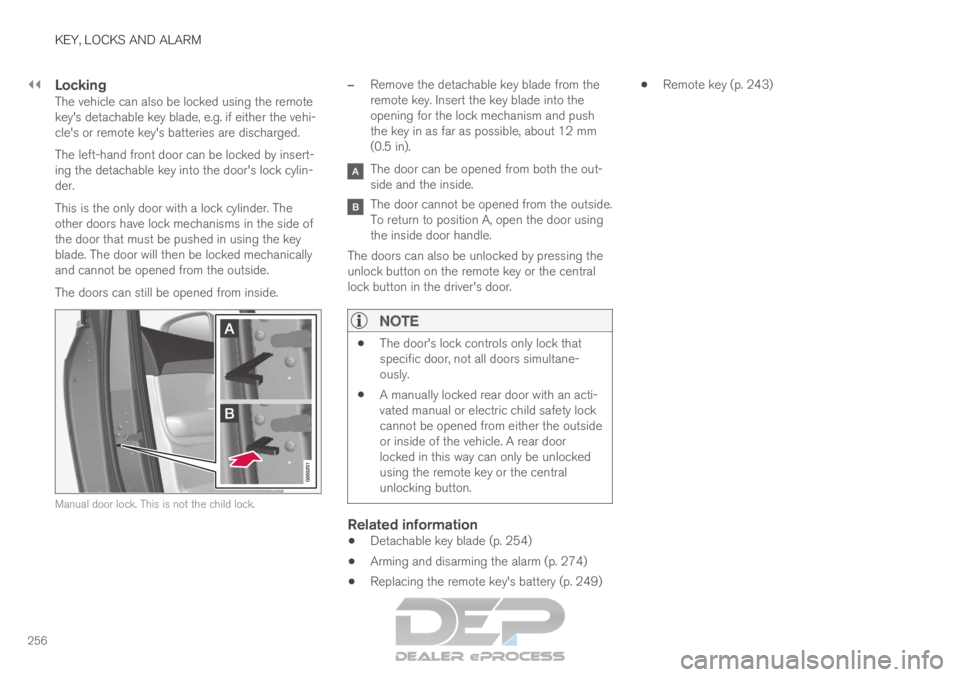
This is the only door with a lock cylinder. The
other doors have lock mechanisms in the side of
the door that must be pushed in using the key
blade. The door will then be locked mechanically
and cannot be opened from the outside.
The doors can still be opened from inside.
Manual door lock. This is not the child lock. –
Remove the detachable key blade from the
remote key. Insert the key blade into the
opening for the lock mechanism and push
the key in as far as possible, about 12 mm
(0.5 in). The door can be opened from both the out-
side and the inside.
The door cannot be opened from the outside.
To return to position A, open the door using
the inside door handle.
The doors can also be unlocked by pressing the
unlock button on the remote key or the central
lock button in the driver's door.
NOTE
The door's lock controls only lock that
specific door, not all doors simultane-
ously.
A manually locked rear door with an acti-
vated manual or electric child safety lock
cannot be opened from either the outside
or inside of the vehicle. A rear door
locked in this way can only be unlocked
using the remote key or the central
unlocking button.
Related information
Detachable key blade (p. 254)
Arming and disarming the alarm (p. 274)
Replacing the remote key's battery (p. 249)
Remote key (p. 243)
Page 275 of 697
KEY, LOCKS AND ALARM
}}
273
Related information
Private Locking (p. 271) Alarm
The alarm emits sound and light signals if any-
one without a valid remote key attempts to break
into the vehicle or interferes with the start battery
or alarm siren.
When armed, the alarm will be triggered if:
the hood, tailgate or any door is opened.
a battery cable is disconnected.
the alarm siren is disconnected.
Alarm signalsThe following occurs if the alarm is triggered:
A siren will sound for 30 seconds or until the
alarm is turned off.
All turn signals will flash for 5 minutes or
until the alarm is turned off.
If the reason the alarm was triggered is not recti-
fied, the alarm cycle will repeat up to 10 times 20
.
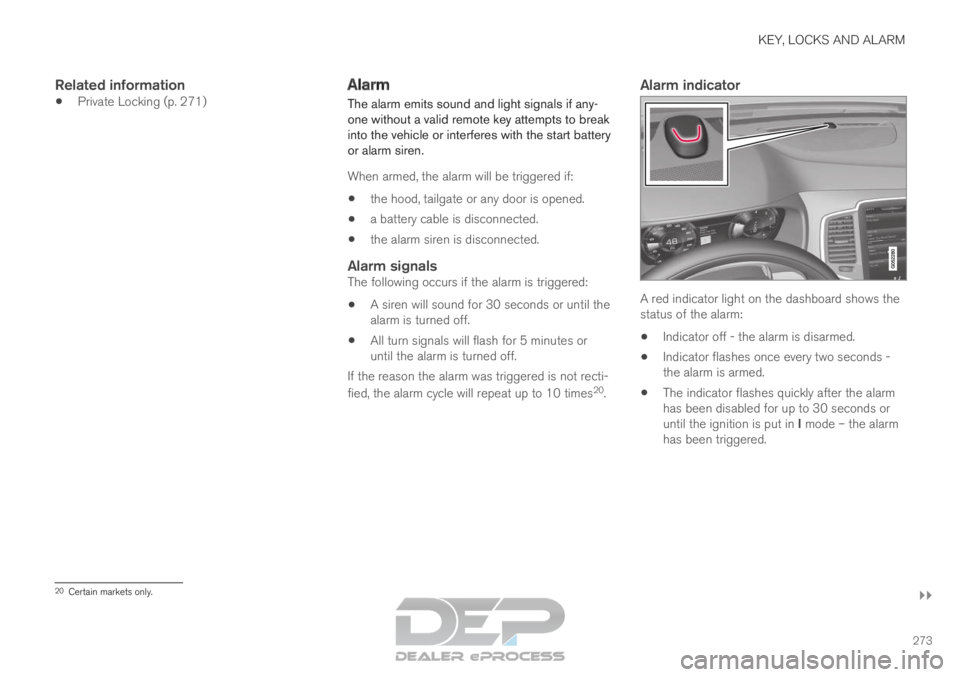
Alarm indicator A red indicator light on the dashboard shows the
status of the alarm:
Indicator off - the alarm is disarmed.
Indicator flashes once every two seconds -
the alarm is armed.
The indicator flashes quickly after the alarm
has been disabled for up to 30 seconds or
until the ignition is put in I mode – the alarm
has been triggered. 20
Certain markets only.
Page 277 of 697
KEY, LOCKS AND ALARM
275
Disarming the alarm without a functioning
remote key
The vehicle can be unlocked and disarmed even
if the remote key is not functioning, e.g. if the
battery is discharged.
1. Open the driver's door using the detachablekey blade.
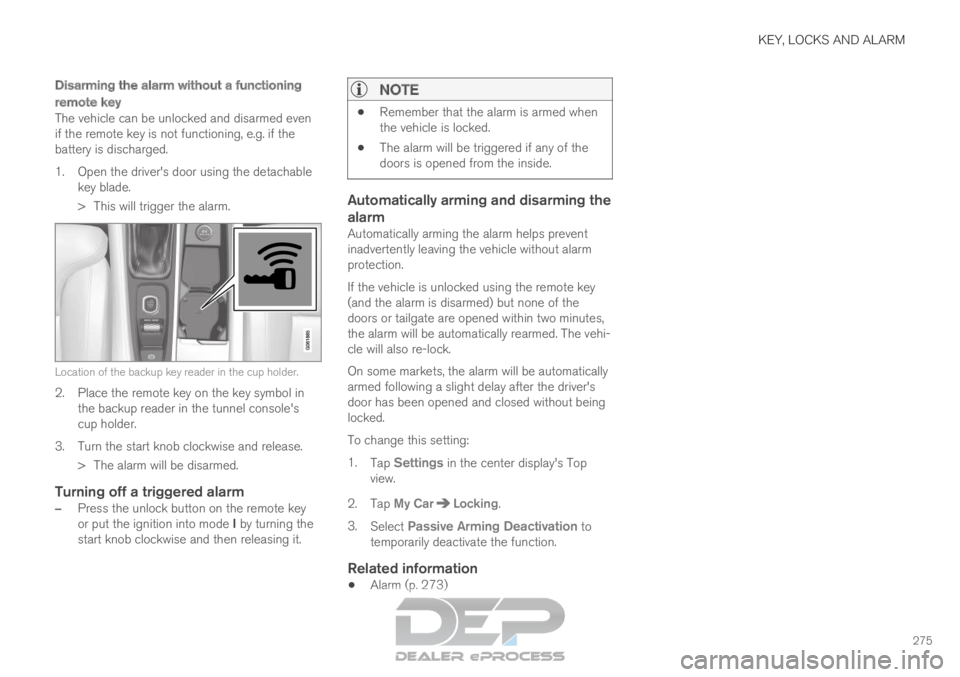
> This will trigger the alarm. Location of the backup key reader in the cup holder.
2. Place the remote key on the key symbol in
the backup reader in the tunnel console's
cup holder.
3.
Turn the start knob clockwise and release.
> The alarm will be disarmed.
Turning off a triggered alarm
– Press the unlock button on the remote key
or put the ignition into mode I by turning the
start knob clockwise and then releasing it.
NOTE
Remember that the alarm is armed when
the vehicle is locked.
The alarm will be triggered if any of the
doors is opened from the inside.
Automatically arming and disarming the
alarm
Automatically arming the alarm helps prevent
inadvertently leaving the vehicle without alarm
protection.
If the vehicle is unlocked using the remote key
(and the alarm is disarmed) but none of the
doors or tailgate are opened within two minutes,
the alarm will be automatically rearmed. The vehi-
cle will also re-lock.
On some markets, the alarm will be automatically
armed following a slight delay after the driver's
door has been opened and closed without being
locked.
To change this setting:
1.
Tap Settings in the center display's Top
view.
2.
Tap My Car Locking
.
3. Select Passive Arming Deactivation to
temporarily deactivate the function.
Related information
Alarm (p. 273)
Page 418 of 697
HYBRID INFORMATION
416General information about Twin
Engine
Twin Engine vehicles are driven just like any
other vehicle, but certain functions differ from a
vehicle powered exclusively by gasoline. The
electric motor powers the vehicle primarily at low
speeds; the gasoline engine is used at higher
speeds or during more active driving.
The instrument panel displays Twin Engine-spe-
cific information - charging information, selected
drive mode, distance to discharged battery and
hybrid battery charge level.
Different drive modes can be selected while driv-
ing, e.g. electric power only or, if more power is
needed, a combination of electric and gasoline
power. The vehicle calculates the optimal combi-
nation of driveability, driving experience, environ-
mental impact and fuel economy for the selected
drive mode.
In order to function optimally, the hybrid battery
(and its electrical drive systems) and the gasoline
engine (and its drive systems) must be at the
correct operating temperature. Battery capacity
can be considerably reduced if the battery is too
cold or too hot. Preconditioning prepares the
vehicle's drive systems and passenger compart-
ment before driving to help reduce both wear and
energy consumption. It also helps increase the
hybrid battery's range.
The hybrid battery which powers the electric
motor is recharged using the charging cable. It can also be recharged during light braking and
through engine braking in gear position B. The
combustion engine can also help recharge the
hybrid battery.
Important
No electrical current
Keep in mind that if there is no electrical current
to the vehicle, i.e. the ignition is switched off or
the start battery is discharged, certain functions
such as brakes, power steering, etc. will not work.
WARNING If the vehicle does not have electrical current
and both the electric motor and the gasoline
engine are switched off, the brakes cannot be
used to stop the vehicle.
Towing not permitted
Never tow a Twin Engine vehicle behind another
vehicle, as this could damage the electric motor.
Exterior engine noise
WARNING
Please be aware that there is no sound from
the engine when the vehicle is being powered
by the electric motor and it may be difficult to
detect by children, pedestrians, cyclists and
animals. This is especially true at low speeds.
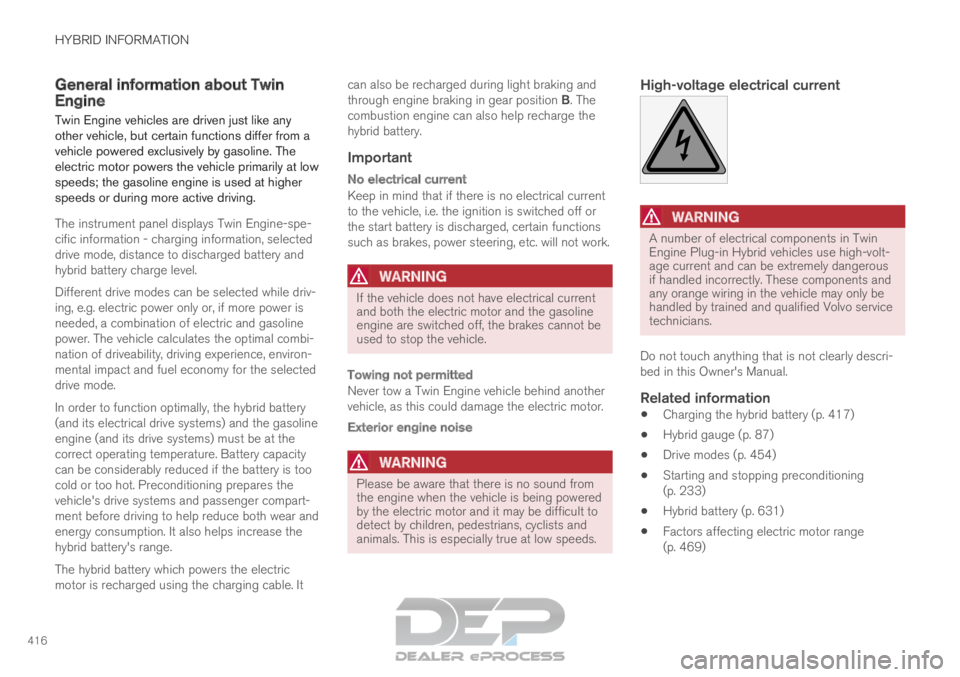
High-voltage electrical current
WARNING A number of electrical components in Twin
Engine Plug-in Hybrid vehicles use high-volt-
age current and can be extremely dangerous
if handled incorrectly. These components and
any orange wiring in the vehicle may only be
handled by trained and qualified Volvo service
technicians.
Do not touch anything that is not clearly descri-
bed in this Owner's Manual.
Related information
Charging the hybrid battery (p. 417)
Hybrid gauge (p. 87)
Drive modes (p. 454)
Starting and stopping preconditioning
(p. 233)
Hybrid battery (p. 631)
Factors affecting electric motor range
(p. 469)
Page 419 of 697
HYBRID INFORMATION
}}
417
Gear selector positions for automatic trans-
missions (p. 449)
Towing using a towline (p. 487) Charging the hybrid battery
In addition to the conventional fuel tank, your
vehicle is also equipped with a rechargeable
lithium-ion hybrid battery.
WARNING California Proposition 65
Operating, servicing and maintaining a pas-
senger vehicle can expose you to chemicals
including engine exhaust, carbon monoxide,
phthalates, and lead, which are known to the
State of California to cause cancer and birth
defects or other reproductive harm. To mini-
mize exposure, avoid breathing exhaust, do
not idle the engine except as necessary, serv-
ice your vehicle in a well ventilated area and
wear gloves or wash your hands frequently
when servicing your vehicle. For more infor-
mation go to www.P65Warnings.ca.gov/
passenger-vehicle.
The hybrid battery can be recharged using the
charging cable stored in a storage space in the
cargo compartment.
WARNING The hybrid electrical system in your vehicle
uses high voltage electrical current. Any dam-
age to this system or to the hybrid battery
may result in the danger of overheating, fire,
or serious injury. If the vehicle is involved in a
collision or subjected to flooding, fire, etc.,
have it inspected by a trained and qualified
Volvo service technician. Prior to this inspec-
tion, the vehicle should be parked outdoors at
a safe distance from any building or poten-
tially flammable materials.
The hybrid battery's charging time depends on
the charging current used.
NOTE The capacity of the hybrid battery diminishes
somewhat with age and use, which could
result in increased use of the gasoline engine
and consequently, slightly higher fuel con-
sumption.
WARNING
If the hybrid battery needs to be replaced, this
may only be done by a Volvo retailer or
authorized Volvo workshop.