battery VOLVO XC90 TWIN ENGINE 2019 User Guide
[x] Cancel search | Manufacturer: VOLVO, Model Year: 2019, Model line: XC90 TWIN ENGINE, Model: VOLVO XC90 TWIN ENGINE 2019Pages: 697, PDF Size: 10.33 MB
Page 91 of 697
DISPLAYS AND VOICE CONTROL
}}89
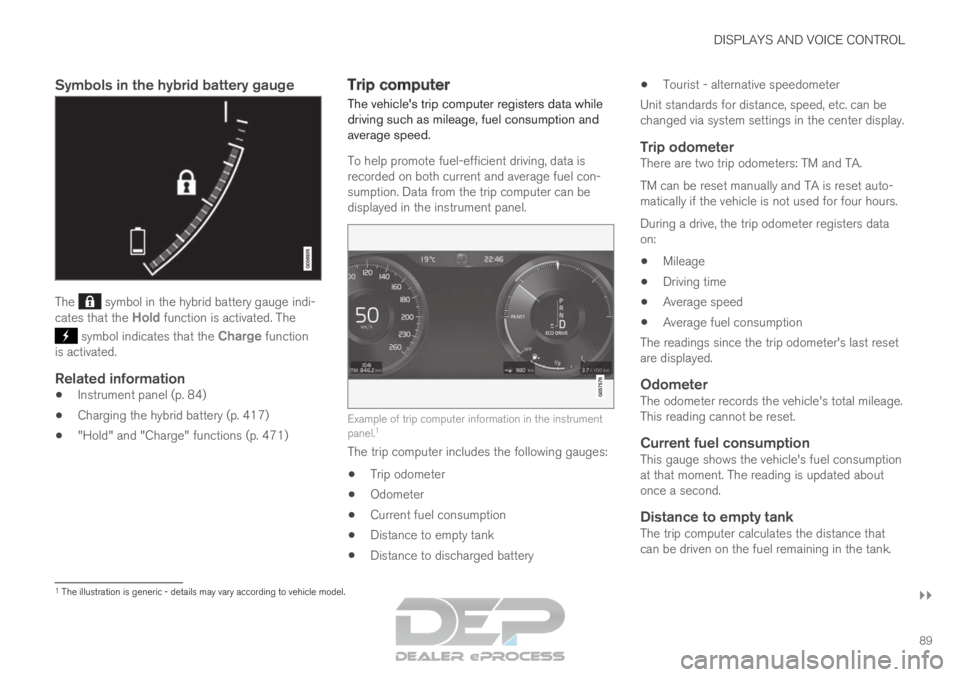
Symbols in the hybrid battery gauge The symbol in the hybrid battery gauge indi-
cates that the Hold function is activated. The symbol indicates that the Charge function
is activated.
Related information
Instrument panel (p. 84)
Charging the hybrid battery (p. 417)
"Hold" and "Charge" functions (p. 471) Trip computer
The vehicle's trip computer registers data while
driving such as mileage, fuel consumption and
average speed.
To help promote fuel-efficient driving, data is
recorded on both current and average fuel con-
sumption. Data from the trip computer can be
displayed in the instrument panel.
Example of trip computer information in the instrument
panel.
1
The trip computer includes the following gauges:
Trip odometer
Odometer
Current fuel consumption
Distance to empty tank
Distance to discharged battery
Tourist - alternative speedometer
Unit standards for distance, speed, etc. can be
changed via system settings in the center display.
Trip odometerThere are two trip odometers: TM and TA.
TM can be reset manually and TA is reset auto-
matically if the vehicle is not used for four hours.
During a drive, the trip odometer registers data
on:
Mileage
Driving time
Average speed
Average fuel consumption
The readings since the trip odometer's last reset
are displayed.
OdometerThe odometer records the vehicle's total mileage.
This reading cannot be reset.
Current fuel consumptionThis gauge shows the vehicle's fuel consumption
at that moment. The reading is updated about
once a second.
Distance to empty tankThe trip computer calculates the distance that
can be driven on the fuel remaining in the tank. 1
The illustration is generic - details may vary according to vehicle mode\
l.
Page 92 of 697
||DISPLAYS AND VOICE CONTROL
90
This calculation is based on average fuel con-
sumption during the last 30 km (20 miles) and
the amount of fuel remaining in the tank.
When the gauge displays "----", there is not
enough fuel remaining to calculate the remaining
mileage. Refuel as soon as possible.
NOTE
This may vary if your driving style changes.
An economical driving style will generally
increase how far you can drive on a certain
amount of fuel.
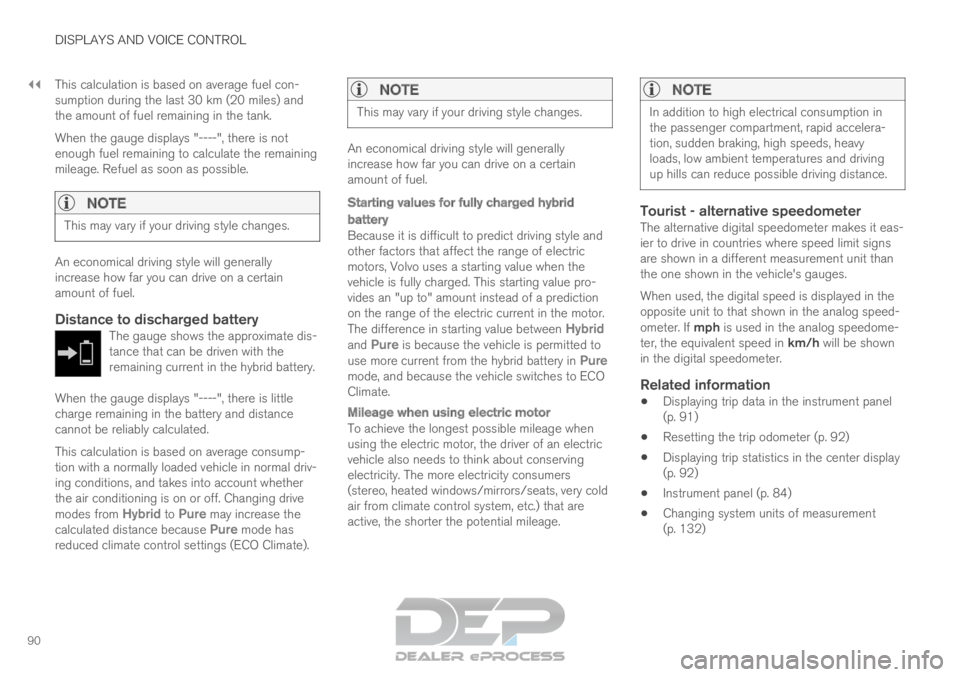
Distance to discharged batteryThe gauge shows the approximate dis-
tance that can be driven with the
remaining current in the hybrid battery.
When the gauge displays "----", there is little
charge remaining in the battery and distance
cannot be reliably calculated.
This calculation is based on average consump-
tion with a normally loaded vehicle in normal driv-
ing conditions, and takes into account whether
the air conditioning is on or off. Changing drive
modes from
Hybrid to Pure may increase the
calculated distance because Pure mode has
reduced climate control settings (ECO Climate).
NOTE This may vary if your driving style changes.
An economical driving style will generally
increase how far you can drive on a certain
amount of fuel.
Starting values for fully charged hybrid
battery
Because it is difficult to predict driving style and
other factors that affect the range of electric
motors, Volvo uses a starting value when the
vehicle is fully charged. This starting value pro-
vides an "up to" amount instead of a prediction
on the range of the electric current in the motor.
The difference in starting value between
Hybrid
and
Pure is because the vehicle is permitted to
use more current from the hybrid battery in Pure
mode, and because the vehicle switches to ECO
Climate.
Mileage when using electric motor
To achieve the longest possible mileage when
using the electric motor, the driver of an electric
vehicle also needs to think about conserving
electricity. The more electricity consumers
(stereo, heated windows/mirrors/seats, very cold
air from climate control system, etc.) that are
active, the shorter the potential mileage.
NOTE In addition to high electrical consumption in
the passenger compartment, rapid accelera-
tion, sudden braking, high speeds, heavy
loads, low ambient temperatures and driving
up hills can reduce possible driving distance.
Tourist - alternative speedometerThe alternative digital speedometer makes it eas-
ier to drive in countries where speed limit signs
are shown in a different measurement unit than
the one shown in the vehicle's gauges.
When used, the digital speed is displayed in the
opposite unit to that shown in the analog speed-
ometer. If mph is used in the analog speedome-
ter, the equivalent speed in km/h will be shown
in the digital speedometer.
Related information
Displaying trip data in the instrument panel
(p. 91)
Resetting the trip odometer (p. 92)
Displaying trip statistics in the center display
(p. 92)
Instrument panel (p. 84)
Changing system units of measurement
(p. 132)
Page 93 of 697
DISPLAYS AND VOICE CONTROL
91
Displaying trip data in the
instrument panel
Data recorded and calculated by the trip com-
puter can be displayed on the instrument panel.
This data is stored in a trip computer app. You
can choose which information the instrument
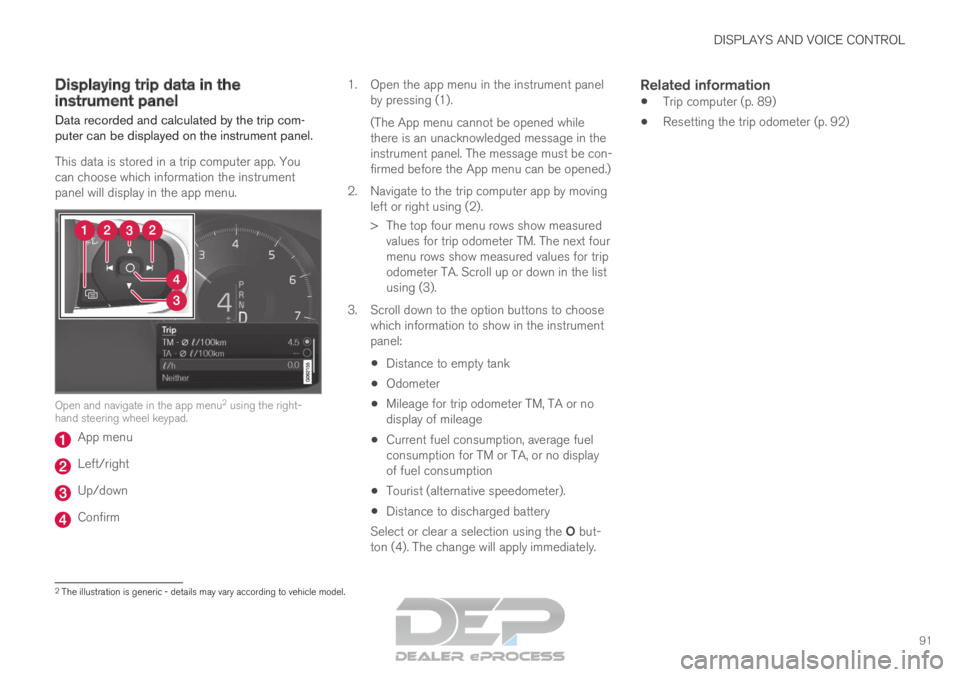
panel will display in the app menu. Open and navigate in the app menu
2
using the right-
hand steering wheel keypad. App menu
Left/right
Up/down
Confirm 1.
Open the app menu in the instrument panel
by pressing (1).
(The App menu cannot be opened while
there is an unacknowledged message in the
instrument panel. The message must be con-
firmed before the App menu can be opened.)
2. Navigate to the trip computer app by moving left or right using (2).
> The top four menu rows show measuredvalues for trip odometer TM. The next four
menu rows show measured values for trip
odometer TA. Scroll up or down in the list
using (3).
3. Scroll down to the option buttons to choose which information to show in the instrument
panel:
Distance to empty tank
Odometer
Mileage for trip odometer TM, TA or no
display of mileage
Current fuel consumption, average fuel
consumption for TM or TA, or no display
of fuel consumption
Tourist (alternative speedometer).
Distance to discharged battery
Select or clear a selection using the O but-
ton (4). The change will apply immediately.
Related information
Trip computer (p. 89)
Resetting the trip odometer (p. 92) 2
The illustration is generic - details may vary according to vehicle mode\
l.
Page 168 of 697
WINDOWS, GLASS AND MIRRORS
* Option/accessory.
166 Windows, glass and mirrors
The vehicle is equipped with controls for win-
dows, glass and mirrors. Some of the windows
in the car are laminated.
Laminated glassThe windshield has laminated glass. Laminated
glass is also available as on option for some
other glass surfaces. Laminated glass is rein-
forced, which provides better protection against
break-ins and improved soundproofing in the
passenger compartment.
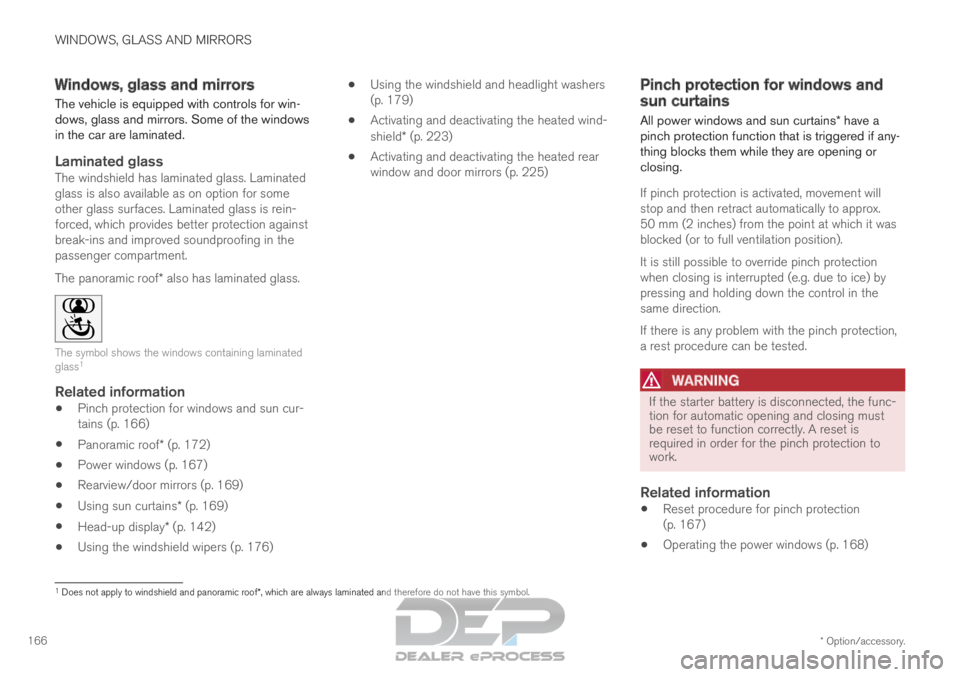
The panoramic roof* also has laminated glass. The symbol shows the windows containing laminated
glass
1
Related information
Pinch protection for windows and sun cur-
tains (p. 166)
Panoramic roof* (p. 172)
Power windows (p. 167)
Rearview/door mirrors (p. 169)
Using sun curtains* (p. 169)
Head-up display* (p. 142)
Using the windshield wipers (p. 176)
Using the windshield and headlight washers
(p. 179)
Activating and deactivating the heated wind-
shield* (p. 223)
Activating and deactivating the heated rear
window and door mirrors (p. 225) Pinch protection for windows and
sun curtains
All power windows and sun curtains* have a
pinch protection function that is triggered if any-
thing blocks them while they are opening or
closing.
If pinch protection is activated, movement will
stop and then retract automatically to approx.
50 mm (2 inches) from the point at which it was
blocked (or to full ventilation position).
It is still possible to override pinch protection
when closing is interrupted (e.g. due to ice) by
pressing and holding down the control in the
same direction.
If there is any problem with the pinch protection,
a rest procedure can be tested.
WARNING If the starter battery is disconnected, the func-
tion for automatic opening and closing must
be reset to function correctly. A reset is
required in order for the pinch protection to
work.
Related information
Reset procedure for pinch protection
(p. 167)
Operating the power windows (p. 168) 1
Does not apply to windshield and panoramic roof*, which are always laminated and therefore do not have this symbol.
Page 169 of 697

WINDOWS, GLASS AND MIRRORS
}}
* Option/accessory. 167
Using sun curtains* (p. 169)
Panoramic roof* (p. 172) Reset procedure for pinch
protection
If you experience any problems with the electri-
cal functions for the power windows, you can try
to perform a reset.
WARNING If the starter battery is disconnected, the func-
tion for automatic opening and closing must
be reset to function correctly. A reset is
required in order for the pinch protection to
work.
If the problem persists or if it affects the panor-
amic roof or sunroof, contact a workshop 2
.
Resetting a power window
1. Start with the window in the closed position.
2. Then operate the window in manual mode
three times upward toward the closed posi-
tion.
> The system will be automatically initiated.
Related information
Pinch protection for windows and sun cur-
tains (p. 166)
Operating the power windows (p. 168)
Using sun curtains* (p. 169) Power windows
The power windows are operated using the con-
trol panels found in the doors. The driver's door
has controls for operating all windows and for
activating the child safety locks. Driver's door control panel.
Electric child safety locks* that deactivate the
controls in the rear doors to prevent the
doors or windows from being opened from
the inside. Rear window controls.
Front window controls.
The power windows have pinch protection. If
there is any problem with the pinch protection, a
rest procedure can be tested. 2
An authorized Volvo workshop is recommended.
Page 240 of 697

CLIMATE CONTROL
* Option/accessory.
238 Parking climate symbols and
messages
A number of symbols and messages related to
parking climate may be displayed in the instru-
ment panel. Messages related to parking climate can also be
displayed in a device that has the Volvo On Call*
app.Symbol
Message MeaningParking climate
Service required
Parking climate is not functioning properly. Contact a workshop
A
to have the system checked as
soon as possible. Parking climate
Temporarily unavailable
Parking climate is temporarily not functioning properly. If the problem \
persists, contact a work-
shop
A
to have the system checked. Parking climate
Unavailable Charge level too low
The parking climate cannot be activated because the hybrid battery's \
charge level is too low to
start the parking heater. Start the vehicle.Parking climate
Unavailable, not connected to power
supply
The parking climate cannot be activated if the charging cable is not con\
nected. Connect the
charging cable.Parking climate
Limited Charge level too low
Parking climate will only run for a limited time when the hybrid battery\
's charge level is too low.
Start the vehicle.A
An authorized Volvo workshop is recommended.
Related information
Parking climate (p. 231)
Page 241 of 697
CLIMATE CONTROL
239
Heater
The heater helps the engine and passenger
compartment reach the correct temperature
before and while driving.
The heater has two sub-functions: Parking heater - heats the passenger com-
partment as needed when the parking cli-
mate's preconditioning is activated.
Auxiliary heater - heats the passenger com-
partment and engine while driving.
The heater is a high-voltage coolant heater and is
mounted in the front right-side wheel housing.
Battery and chargingThe heater is powered by the vehicle's hybrid bat-
tery. If the charge level in the hybrid battery is too
low, the heater will switch off automatically and a
message will be displayed in the instrument
panel.
NOTE Make sure that the battery has sufficient
charge if the heater must be used.
Related information
Climate (p. 204) Parking heater
The parking heater heats the passenger com-
partment as needed before driving if precondi-
tioning is activated.
The parking heater is one of two sub-functions of
the vehicle's heater. The heater is mounted in the
front right-side wheel housing.
The parking heater starts automatically if the
parking climate's preconditioning is activated and
the passenger compartment needs to be heated.
It switches off automatically when a set timer
time or the heater's maximum run time expires, or
if the car is restarted.
The heater's maximum running time is 40
minutes. Additional heater
The auxiliary heater helps heat the passenger
compartment and engine while driving.
The auxiliary heater is one of two sub-functions
of the vehicle's heater. The heater is mounted in
the front right-side wheel housing.
The auxiliary heater is started and controlled
automatically when extra heat is required while
the vehicle is being driven.
It switches off automatically when the ignition is
switched off.
Page 246 of 697
||KEY, LOCKS AND ALARM
* Option/accessory.
244 The keyless system for locking/unlocking the
doors and tailgate (Passive Entry*) is available as
an option. This system has a range in a semicircle
with a radius of approximately 1.5 meter (5 feet)
out from the driver's door and approx. 1 meter
(3 feet) out from the tailgate.
With keyless start in combination with keyless
locking and unlocking, the remote key can be
located anywhere in the passenger compartment
or cargo compartment in order to start the
engine.
Each remote key supplied with the vehicle can be
linked to a driver profile with unique settings for
the vehicle. When a key with a specific profile is
used, the vehicle settings are adjusted according
to that profile.
Buttonless key, Key TagFor vehicles equipped with keyless locking and
unlocking*, a smaller, lighter and button-less key
(Key Tag 4
) is also provided. It works the same
way as the regular remote key as regard keyless
start and keyless locking and unlocking. The key
is waterproof up to a depth of approx. 10 meters
(30 feet) for up to 60 minutes. It does not have a
detachable key blade and its battery cannot be
replaced.
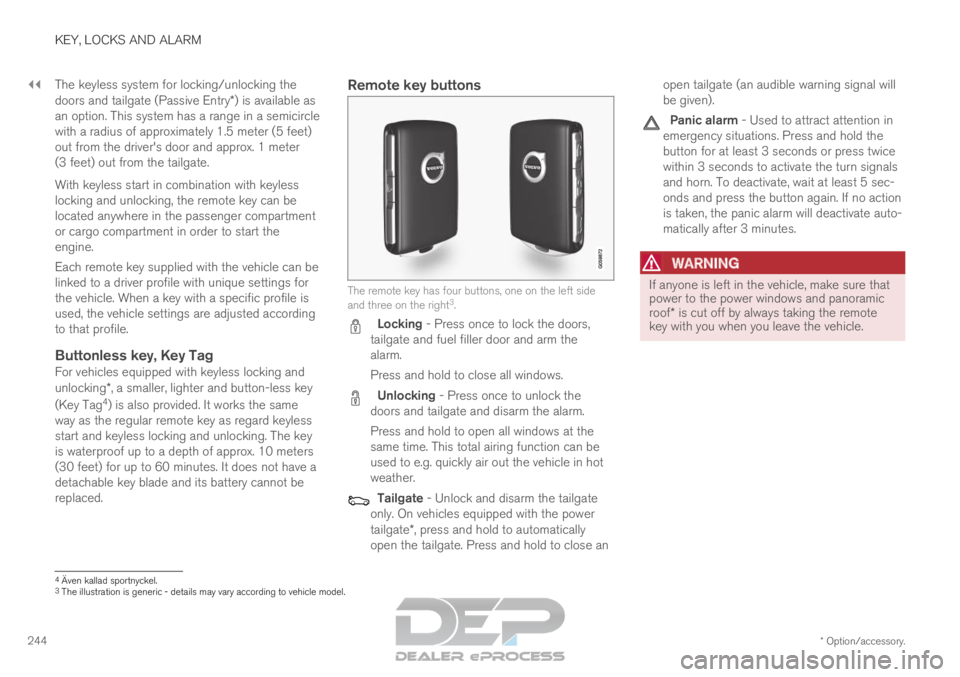
Remote key buttons The remote key has four buttons, one on the left side
and three on the right
3
. Locking - Press once to lock the doors,
tailgate and fuel filler door and arm the
alarm.
Press and hold to close all windows. Unlocking - Press once to unlock the
doors and tailgate and disarm the alarm.
Press and hold to open all windows at the
same time. This total airing function can be
used to e.g. quickly air out the vehicle in hot
weather. Tailgate - Unlock and disarm the tailgate
only. On vehicles equipped with the power
tailgate*, press and hold to automatically
open the tailgate. Press and hold to close an open tailgate (an audible warning signal will
be given). Panic alarm - Used to attract attention in
emergency situations. Press and hold the
button for at least 3 seconds or press twice
within 3 seconds to activate the turn signals
and horn. To deactivate, wait at least 5 sec-
onds and press the button again. If no action
is taken, the panic alarm will deactivate auto-
matically after 3 minutes.
WARNING If anyone is left in the vehicle, make sure that
power to the power windows and panoramic
roof* is cut off by always taking the remote
key with you when you leave the vehicle. 4
Även kallad sportnyckel.
3 The illustration is generic - details may vary according to vehicle mode\
l.
Page 247 of 697
KEY, LOCKS AND ALARM
* Option/accessory.245
NOTEBe aware of the risk of locking the remote
key in the vehicle.
If the remote key or Key Tag is left in the
vehicle, it will be deactivated when the
vehicle is locked and the alarm set using
another valid key. The deactivated key will
be reactivated when the vehicle is
unlocked.
If the remote key or Red Key is left in the
vehicle, it will be deactivated even if the
vehicle is locked using Volvo On Call, and
will be reactivated when the vehicle is
unlocked using Volvo On Call or by
pressing the unlock button on the key.
InterferenceElectromagnetic fields or obstructing objects may
interfere with the remote key's functions for key-
less start and keyless locking and unlocking*.
NOTE Avoid storing the remote control key near
metal objects or electronic devices, e.g. cell
phones, tablets, laptops or chargers – pref-
erably no closer than 10-15 cm (4-6 in.).
If you experience interference, use the remote
key's detachable blade to unlock the vehicle and place the remote key in the backup key reader in
the tunnel console cup holder to disarm the
alarm.
NOTE When the remote control key is placed in the
cup holder, make sure that no other vehicle
keys, metal objects or electronic devices (e.g.
cell phones, tablets, laptops or chargers) are
found in the cup holder. Multiple vehicle keys
close to each other in the cup holder can dis-
rupt their functionality.
WARNING
California Proposition 65
Operating, servicing and maintaining a pas-
senger vehicle can expose you to chemicals
including engine exhaust, carbon monoxide,
phthalates, and lead, which are known to the
State of California to cause cancer and birth
defects or other reproductive harm. To mini-
mize exposure, avoid breathing exhaust, do
not idle the engine except as necessary, serv-
ice your vehicle in a well ventilated area and
wear gloves or wash your hands frequently
when servicing your vehicle. For more infor-
mation go to www.P65Warnings.ca.gov/
passenger-vehicle.
Related information
Locking and unlocking using the remote key
(p. 246)
Remote key range (p. 248)
Replacing the remote key's battery (p. 249)
Detachable key blade (p. 254)
Electronic immobilizer (p. 257)
Linking a remote key to a driver profile
(p. 138)
Page 248 of 697
KEY, LOCKS AND ALARM
* Option/accessory.
246 Locking and unlocking using the
remote key
All doors and tailgate can be locked and
unlocked simultaneously using the buttons on
the remote key.
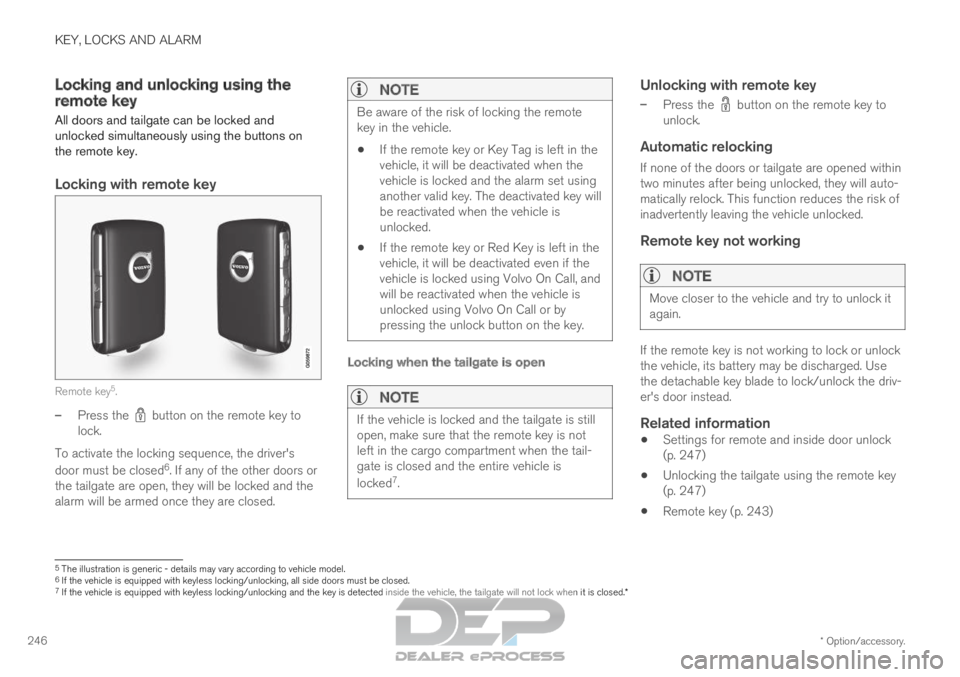
Locking with remote key Remote key
5
.
– Press the button on the remote key to
lock.
To activate the locking sequence, the driver's
door must be closed 6
. If any of the other doors or
the tailgate are open, they will be locked and the
alarm will be armed once they are closed.
NOTE Be aware of the risk of locking the remote
key in the vehicle.
If the remote key or Key Tag is left in the
vehicle, it will be deactivated when the
vehicle is locked and the alarm set using
another valid key. The deactivated key will
be reactivated when the vehicle is
unlocked.
If the remote key or Red Key is left in the
vehicle, it will be deactivated even if the
vehicle is locked using Volvo On Call, and
will be reactivated when the vehicle is
unlocked using Volvo On Call or by
pressing the unlock button on the key.
Locking when the tailgate is open
NOTE If the vehicle is locked and the tailgate is still
open, make sure that the remote key is not
left in the cargo compartment when the tail-
gate is closed and the entire vehicle is
locked
7
.
Unlocking with remote key
– Press the button on the remote key to
unlock.
Automatic relocking
If none of the doors or tailgate are opened within
two minutes after being unlocked, they will auto-
matically relock. This function reduces the risk of
inadvertently leaving the vehicle unlocked.
Remote key not working
NOTE Move closer to the vehicle and try to unlock it
again.
If the remote key is not working to lock or unlock
the vehicle, its battery may be discharged. Use
the detachable key blade to lock/unlock the driv-
er's door instead.
Related information
Settings for remote and inside door unlock
(p. 247)
Unlocking the tailgate using the remote key
(p. 247)
Remote key (p. 243) 5
The illustration is generic - details may vary according to vehicle mode\
l.
6 If the vehicle is equipped with keyless locking/unlocking, all side door\
s must be closed.
7 If the vehicle is equipped with keyless locking/unlocking and the key is\
detected inside the vehicle, the tailgate will not lock when it is clos\
ed.*