oil VOLVO XC90 TWIN ENGINE 2019 Owner's Manual
[x] Cancel search | Manufacturer: VOLVO, Model Year: 2019, Model line: XC90 TWIN ENGINE, Model: VOLVO XC90 TWIN ENGINE 2019Pages: 697, PDF Size: 10.33 MB
Page 652 of 697

MAINTENANCE AND SERVICE
650Cleaning interior plastic, metal and
wood surfaces
Only use cleaning agents and car care products
recommended by Volvo. Clean regularly and
treat stains immediately for best results.
Interior plastic, metal and wood
surfaces
A lightly dampened microfiber cloth is recom-
mended for cleaning interior details and surfaces.
These cloths are available for purchase at Volvo
retailers.
Never scrape or rub a stain. Never use strong
stain removers.
CAUTION
Do not use solvent containing alcohol to
clean the instrument panel glass.
CAUTION
Keep in mind that glossy surfaces can be
easily scratched. Wipe these surfaces with a
clean and dry microfiber cloth using small, cir-
cular motions. If necessary, moisten the cloth
lightly with clean water.
Related information
Cleaning the interior (p. 645)
Cleaning the center display (p. 645)
Cleaning fabric upholstery and ceiling liner
(p. 647)
Cleaning the seat belt (p. 647)
Cleaning floor mats and inlay mats (p. 647)
Cleaning leather upholstery (p. 648)
Cleaning the leather steering wheel (p. 649) Cleaning the exterior
The vehicle should be washed as soon as it
becomes dirty. This makes the vehicle easier to
clean because dirt does not attach as strongly. It
also reduces the risk of scratches and keeps the
vehicle looking new. Wash the vehicle in a car
wash or garage with an oil separator and use car
washing detergent.
Related information
Cleaning the exterior (p. 650)
Polishing and waxing (p. 651)
Hand washing (p. 651)
Automatic car washes (p. 653)
High-pressure washing (p. 654)
Cleaning the wiper blades (p. 654)
Cleaning exterior plastic, rubber and trim
components (p. 655)
Cleaning rims (p. 656)
Corrosion protection (p. 656)
Page 653 of 697

MAINTENANCE AND SERVICE
}}
651
Polishing and waxing
Polish and wax the vehicle when the paint is
matte or to provide extra protection. The vehicle
does not need to be polished until it is at least a
year old. However, it can be waxed during the
first year. Do not polish or wax the vehicle in
direct sunlight. The surface of the vehicle should
not be warmer than 45 °C (113 °F).
Wash and dry the vehicle very carefully
before polishing or waxing. Remove asphalt
and tar stains with asphalt remover or paint
thinner. More stubborn stains can be
removed with a grinding paste designed for
vehicle paint.
Use polish first and then liquid or paste wax.
Follow the instructions on the package care-
fully. Many products contain both polish and
wax.
A wide range of polymer-based waxes can
be purchased today. These waxes are easy to
use and produce a long-lasting, high-gloss
finish that protects the bodywork against oxi-
dation, road dirt and fading.
CAUTION Avoid waxing and polishing plastic and rubber.
If using degreaser on plastic and rubber, only
rub (if necessary) with slight pressure. Use a
soft sponge.
Polishing glossy trim moldings can wear away
or damage the glossy surface layer.
Polish containing abrasives must not be used.
CAUTION
Only use paintwork treatments recommended
by Volvo. Other treatments, such as preserva-
tion, sealing, protection, luster sealing or simi-
lar, could damage the paintwork. Paintwork
damage caused by such treatments are not
covered by Volvo's warranty.
Related information
Cleaning the exterior (p. 650)
Hand washing (p. 651)
Automatic car washes (p. 653)
High-pressure washing (p. 654)
Cleaning the wiper blades (p. 654)
Cleaning exterior plastic, rubber and trim
components (p. 655)
Cleaning rims (p. 656)
Corrosion protection (p. 656) Hand washing
The vehicle should be washed as soon as it
becomes dirty. This makes the vehicle easier to
clean because dirt does not attach as strongly. It
also reduces the risk of scratches and keeps the
vehicle looking new. Wash the vehicle in a car
wash or garage with an oil separator and use car
washing detergent.
Hand washingKeep the following points in mind when washing
the vehicle:
Avoid washing the vehicle in direct sunlight.
This could cause the detergent or wax to dry
out and become abrasive.
Remove bird droppings from paintwork as
soon as possible. It contains chemicals that
affect and discolor paintwork very quickly.
Use e.g. soft paper or a sponge soaked in
lots of water. Consult an authorized Volvo
workshop for assistance removing discolora-
tion.
Hose down the underbody, including the
wheel housings and bumper.
Hose down the entire vehicle and remove
any loose dirt, droppings etc. to reduce the
risk of scratches from washing. Do not spray
directly onto locks.
If necessary, use cold degreaser on heavily
soiled surfaces. Note that in such cases the
surfaces must not be hot from the sun.
Page 656 of 697

MAINTENANCE AND SERVICE
654High-pressure washing
The vehicle should be washed as soon as it
becomes dirty. This makes the vehicle easier to
clean because dirt does not attach as strongly. It
also reduces the risk of scratches and keeps the
vehicle looking new. Wash the vehicle in a car
wash or garage with an oil separator. Use a car
washing detergent.
High-pressure washingIf washing the vehicle with a high-pressure wash,
use sweeping movements and keep the nozzle at
least 30 cm (13 in.) from the vehicle. Do not
spray directly onto locks.
Related information
Cleaning the exterior (p. 650)
Polishing and waxing (p. 651)
Hand washing (p. 651)
Automatic car washes (p. 653)
Cleaning the wiper blades (p. 654)
Cleaning exterior plastic, rubber and trim
components (p. 655)
Cleaning rims (p. 656)
Corrosion protection (p. 656) Cleaning the wiper blades
The vehicle should be washed as soon as it
becomes dirty. This makes the vehicle easier to
clean because dirt does not attach as strongly. It
also reduces the risk of scratches and keeps the
vehicle looking new. Wash the vehicle in a car
wash or garage with an oil separator. Use a car
washing detergent.
Wiper bladesAsphalt, dust and salt residue on wiper blades, as
well as insects, ice etc. on the windshield, shorten
the service life of wiper blades.
When cleaning, put the wiper blades in the serv-
ice position.
NOTE
Wash the wiper blades and windshield regu-
larly with a lukewarm soap solution or vehicle
shampoo. Do not use strong solvents.
Related information
Cleaning the exterior (p. 650)
Polishing and waxing (p. 651)
Hand washing (p. 651)
Automatic car washes (p. 653)
High-pressure washing (p. 654)
Cleaning exterior plastic, rubber and trim
components (p. 655)
Cleaning rims (p. 656)
Corrosion protection (p. 656)
Page 657 of 697

MAINTENANCE AND SERVICE
* Option/accessory.655
Cleaning exterior plastic, rubber and
trim components
The vehicle should be washed as soon as it
becomes dirty. This makes the vehicle easier to
clean because dirt does not attach as strongly. It
also reduces the risk of scratches and keeps the
vehicle looking new. Wash the vehicle in a car
wash or garage with an oil separator and use car
washing detergent.
Exterior plastic, rubber and trim
components
A special cleaning agent available from Volvo
retailers is recommended for the cleaning and
care of colored plastic parts, rubber and trim
components, e.g. glossy trim. Follow the usage
instructions for the cleaning agent carefully.
Avoid using car washing detergents with a pH
value lower than 3.5 or higher than 11.5. Doing
so could result in the discoloring of anodized alu-
minum surfaces* (as shown in the illustrations
below). Abrasive polishing agents are not recom-
mended for these areas (as shown in the illustra-
tions below). Components that should be washed with a cleaning
product with a pH value between 3.5 and 11.5.
CAUTION
Avoid waxing and polishing plastic and rubber.
If using degreaser on plastic and rubber, only
rub (if necessary) with slight pressure. Use a
soft sponge.
Polishing glossy trim moldings can wear away
or damage the glossy surface layer.
Polish containing abrasives must not be used.
CAUTION Avoid washing the vehicle with cleaner with a
pH value below 3.5 or above 11.5. This could
cause discoloration of anodized aluminum
components like the roof rail and around the
side windows.
Never use metal polishing agent on anodized
aluminum components. This could cause dis-
coloration and destroy the surface treatment.
Related information
Cleaning the exterior (p. 650)
Polishing and waxing (p. 651)
Hand washing (p. 651)
Automatic car washes (p. 653)
High-pressure washing (p. 654)
Cleaning the wiper blades (p. 654)
Cleaning rims (p. 656)
Corrosion protection (p. 656)
Page 658 of 697

MAINTENANCE AND SERVICE
656Cleaning rims
The vehicle should be washed as soon as it
becomes dirty. This makes the vehicle easier to
clean because dirt does not attach as strongly. It
also reduces the risk of scratches and keeps the
vehicle looking new. Wash the vehicle in a car
wash or garage with an oil separator and use car
washing detergent.
RimsOnly use rim cleaning products recommended by
Volvo.
Strong rim cleaning agents could damage the
surface and stain the chromed aluminum rims.
Related information
Cleaning the exterior (p. 650)
Polishing and waxing (p. 651)
Hand washing (p. 651)
Automatic car washes (p. 653)
High-pressure washing (p. 654)
Cleaning exterior plastic, rubber and trim
components (p. 655)
Cleaning rims (p. 656)
Corrosion protection (p. 656) Corrosion protection
Your vehicle is constructed with effective protec-
tion against corrosion.
Corrosion protection for the body consists of
modern metallic protective coatings on the sheet
metal, a high-quality painting process, corrosion-
protected and minimized metal overlap, and
shielding plastic components, abrasion protection
and supplemental rust inhibitor in exposed areas.
In the chassis, exposed components of the wheel
suspension are made of corrosion-resistant cast
aluminum.
Inspection and maintenanceThe corrosion protection does not normally
require maintenance but keeping the vehicle
clean is always a good way to further reduce the
risk of corrosion. The use of strong alkaline or
acidic cleaning fluids should always be avoided
on shiny body components. Any stone chips in
the paint should be touched up as soon as they
are discovered.
Related information
Cleaning the exterior (p. 650)
Polishing and waxing (p. 651)
Hand washing (p. 651)
Automatic car washes (p. 653)
High-pressure washing (p. 654)
Cleaning the wiper blades (p. 654)
Cleaning exterior plastic, rubber and trim
components (p. 655)
Cleaning rims (p. 656)
Page 668 of 697

||SPECIFICATIONS
666
Engine oil. This label contains the recom-
mended engine oil specifications. Decal A/C. Refrigerant R134a.
NOTE
The decals shown in the Owner's Manual do
not claim to be exact reproductions of those
found in the vehicle. The purpose is to show
approximately how they look and about where
they are located on the vehicle. The informa-
tion that applies for your vehicle in particular
is found on the decal on the vehicle.
Related information
Air conditioning specifications (p. 674)
Page 673 of 697
SPECIFICATIONS
671
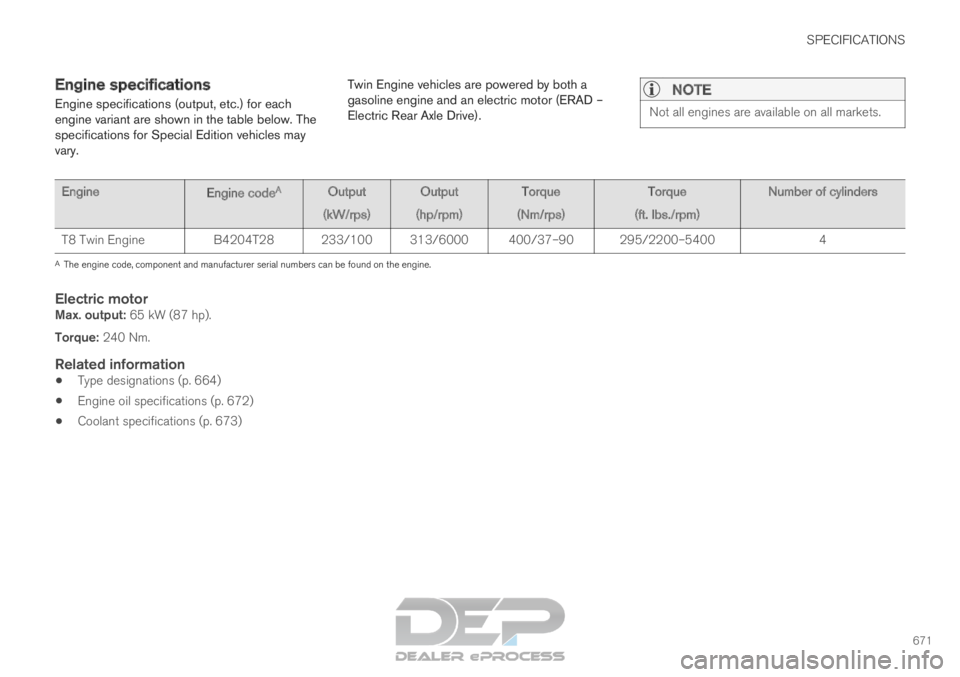
Engine specifications
Engine specifications (output, etc.) for each
engine variant are shown in the table below. The
specifications for Special Edition vehicles may
vary. Twin Engine vehicles are powered by both a
gasoline engine and an electric motor (ERAD –
Electric Rear Axle Drive).
NOTE Not all engines are available on all markets.
Engine
Engine codeA
Output
(kW/rps) Output
(hp/rpm) Torque
(Nm/rps) Torque
(ft. lbs./rpm) Number of cylinders
T8 Twin Engine
B4204T28 233/100 313/6000 400/37–90 295/2200–5400 4A
The engine code, component and manufacturer serial numbers can be found \
on the engine.
Electric motorMax. output: 65 kW (87 hp).
Torque: 240 Nm.
Related information
Type designations (p. 664)
Engine oil specifications (p. 672)
Coolant specifications (p. 673)
Page 674 of 697
SPECIFICATIONS
672Engine oil specifications
Fully synthetic engine oil of at least
ACEA A5/B5 must be used. Lower oil grades
may not offer the same fuel economy, engine
performance or engine protection.
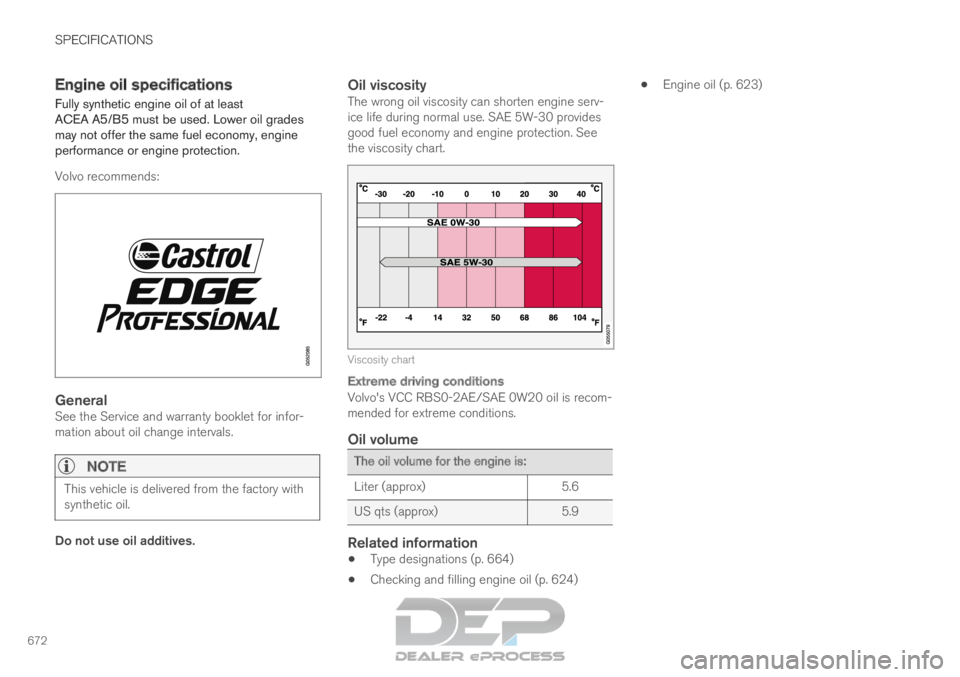
Volvo recommends:
GeneralSee the Service and warranty booklet for infor-
mation about oil change intervals.
NOTE This vehicle is delivered from the factory with
synthetic oil.
Do not use oil additives.
Oil viscosityThe wrong oil viscosity can shorten engine serv-
ice life during normal use. SAE 5W-30 provides
good fuel economy and engine protection. See
the viscosity chart. Viscosity chart
Extreme driving conditions
Volvo's VCC RBS0-2AE/SAE 0W20 oil is recom-
mended for extreme conditions.
Oil volume
The oil volume for the engine is:
Liter (approx)
5.6
US qts (approx) 5.9
Related information
Type designations (p. 664)
Checking and filling engine oil (p. 624)
Engine oil (p. 623)
Page 676 of 697

SPECIFICATIONS
674Fuel tank volume
The fuel tank's refillable volume is shown in the
table below. All models
Liter (approx)
70
US gallons (approx) 18,5
Related information
Refueling (p. 475)
Octane rating (p. 477) Air conditioning specifications
The climate system in the vehicle uses a freon-
free R134a refrigerant. For information regarding
the refrigerant, refer to the decal located on the
inside of the hood.
The prescribed grades and volumes for fluids and
lubricants in the air conditioning system are
shown in the tables below.A/C Decal Decal for R134a
Refrigerant
Vehicles with R134a refrigerant Weight
Prescribed grade
1050 g (2.31 lbs)
R134a
WARNING The air conditioning system contains the
refrigerant R134a under pressure. Service
and repairs to the system should only be done
by an authorized workshop.
Compressor oil
Volume
Prescribed grade
120 ml (4.06 fl. oz.)
PAG SP-A2
Evaporator
CAUTION The A/C system evaporator must never be
repaired or replaced with a previously used
evaporator. The new evaporator must be certi-
fied and labeled in accordance with SAE
J2842.
Related information
Climate control system service (p. 621)
Page 679 of 697
INDEX
677
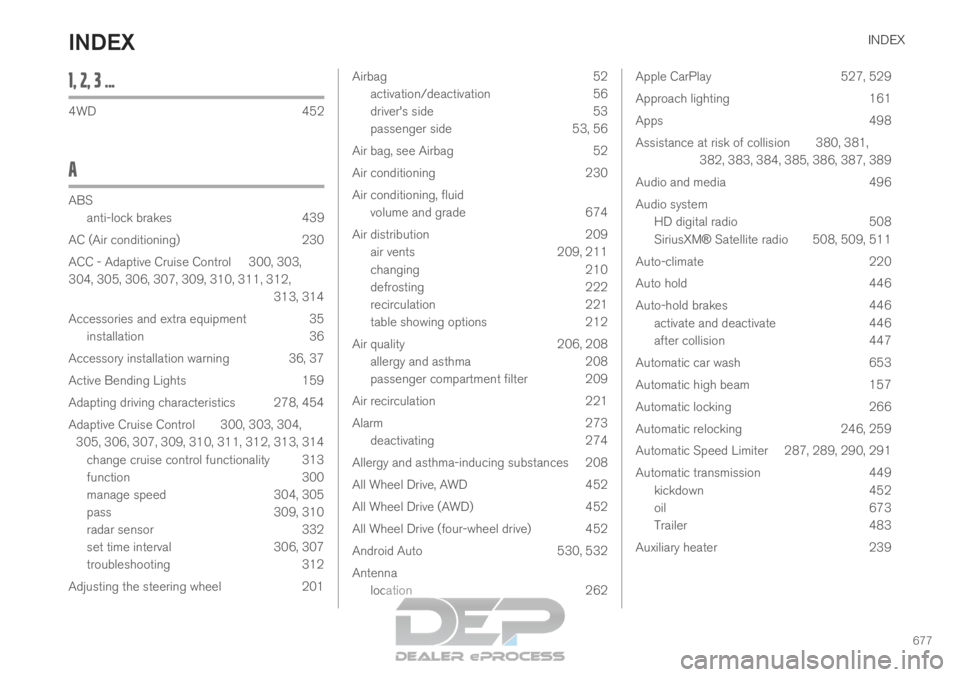
1, 2, 3 ... 4WD
452
A ABS
anti-lock brakes
439
AC (Air conditioning) 230
ACC - Adaptive Cruise Control 300, 303,
304, 305, 306, 307, 309, 310, 311, 312, 313, 314
Accessories and extra equipment 35 installation 36
Accessory installation warning 36, 37
Active Bending Lights 159
Adapting driving characteristics 278, 454
Adaptive Cruise Control 300, 303, 304, 305, 306, 307, 309, 310, 311, 312, 313, 314 change cruise control functionality 313
function 300
manage speed 304, 305
pass 309, 310
radar sensor 332
set time interval 306, 307
troubleshooting 312
Adjusting the steering wheel 201 Airbag
52
activation/deactivation
56
driver's side 53
passenger side 53, 56
Air bag, see Airbag 52
Air conditioning 230
Air conditioning, fluid volume and grade 674
Air distribution 209
air vents 209, 211
changing 210
defrosting 222
recirculation 221
table showing options 212
Air quality 206, 208
allergy and asthma 208
passenger compartment filter 209
Air recirculation 221
Alarm 273
deactivating 274
Allergy and asthma-inducing substances 208
All Wheel Drive, AWD 452
All Wheel Drive (AWD) 452
All Wheel Drive (four-wheel drive) 452
Android Auto 530, 532
Antenna location 262 Apple CarPlay
527, 529
Approach lighting 161
Apps 498
Assistance at risk of collision 380, 381, 382, 383, 384, 385, 386, 387, 389
Audio and media 496
Audio system HD digital radio 508
SiriusXM® Satellite radio 508, 509, 511
Auto-climate 220
Auto hold 446
Auto-hold brakes 446
activate and deactivate 446
after collision 447
Automatic car wash 653
Automatic high beam 157
Automatic locking 266
Automatic relocking 246, 259
Automatic Speed Limiter 287, 289, 290, 291
Automatic transmission 449
kickdown 452
oil 673
Trailer 483
Auxiliary heater 239
INDEX