change VOLVO XC90 TWIN ENGINE 2019 Workshop Manual
[x] Cancel search | Manufacturer: VOLVO, Model Year: 2019, Model line: XC90 TWIN ENGINE, Model: VOLVO XC90 TWIN ENGINE 2019Pages: 697, PDF Size: 10.33 MB
Page 228 of 697

CLIMATE CONTROL
226Setting the blower speed for the
front seats
The blower can be set to several different auto-
matically controlled speeds for the front seat.
Blower control buttons in Climate view.
1. Open Climate view in the center display.
2.
Tap the desired blower speed: Off,
1-5 or
Max.
>
The blower speed will be changed and the
buttons for the set speed will light up.
CAUTION The air conditioning will not engage if the
blower is turned off completely, which may
cause fogging on the inside of the windows.
NOTE The climate system automatically adapts air-
flow as needed within the set blower speed,
which means that airflow speed may vary
slightly within the same blower speed.
Related information
Climate system controls (p. 215) Setting the blower speed for the
rear seats
The blower can be set to several different auto-
matically controlled speeds for the rear seat.
Setting blower speed for the rear seats
from the front seats Blower control buttons in the Rear climate tab in Cli-
mate view.
1. Open Climate view in the center display and
select the Rear climate tab.
Page 229 of 697

CLIMATE CONTROL
* Option/accessory.227
2.
Tap the desired blower speed, 1-5.
The blower speed for the second and third
rows of seats* can be switched off by tap-
ping 2nd row climate.
The blower speed for the third row of seats is
linked to the setting for the second row, but
can be switched off separately by pressing
3rd row climate.
>
The blower speed will be changed and the
buttons for the set speed will light up.
Setting blower speed for the rear seats
from the rear seats
1. Tap the unlock button on the tunnel con- sole's climate panel to access the controls. Blower controls on the rear climate panel of the tunnel
console.
2.
Tap the desired blower speed, 1-5.
>
The blower speed will be changed and the
buttons for the set speed will light up.
NOTE The blower speed for the rear seat cannot be
set if the blower speed for the front seat is
Off.
The rear seat blower speed can only be
turned off from the climate view in the center
display.
NOTE The climate system automatically adapts air-
flow as needed within the set blower speed,
which means that airflow speed may vary
slightly within the same blower speed.
Related information
Climate system controls (p. 215)
Page 231 of 697

CLIMATE CONTROL
}}
229 Temperature control.
3. Set the temperature by:
dragging the control to the desired tem-
perature
tapping
+− to raise/lower the tempera-
ture.
>
The temperature will be set and the but-
ton will display the new temperature.
Setting the temperature for the rear
seats from the rear seats
1. Tap the unlock button on the tunnel con- sole's climate panel to access the controls. Temperature controls on the rear climate panel of the
tunnel console.
2.
Tap the left or right side's <> buttons to
lower/raise the temperature.
>
The temperature will be changed and the
climate panel screen will show the new
temperature.
NOTE Heating/cooling cannot be accelerated by
choosing a higher/lower temperature than
the desired temperature.
Related information
Climate system controls (p. 215) Synchronize temperature
The temperature in the different climate zones of
the vehicle can be synchronized with the tem-
perature set for the driver's side. Synchronization button on the driver's side temperature
control.
1. Tap the driver's side temperature button in
the center display's climate bar to open the
control.
2. Tap Synchronize temperature .
>
The temperature for all of the vehicle's cli-
mate zones will be synchronized with the
one set for the driver's side and the syn-
chronization symbol will be displayed next
to the temperature button.
Synchronization is stopped with another press on Synchronize temperature or by changing the
temperature setting for a climate zone other than
the driver's.
Page 237 of 697
CLIMATE CONTROL
}}
235
4.
Tap Date to set a time for a specific date.
Tap Days to set a time for one or more days
of the week.
With Days: Activate/deactivate the repeat
function by selecting/deselecting the
Repeat weekly checkbox.
5. With Date: Select a date for preconditioning
by scrolling in the date list using the arrows.
With Days: Select days of the week for pre-
conditioning by tapping the buttons for the
days.
6.
Set the time at which preconditioning should
be completed by scrolling using the arrows in
the clock.
7. Tap Confirm to add a timer setting.
>
The timer setting will be added to the list
and activated.
Editing a timer setting1. Open Climate view in the center display.
2. Select the Parking climate tab.
3.
Tap the timer setting you would like to
change.
> A pop-up window will appear.
4. To edit a timer setting, follow the procedures described under the heading "Adding a timer
setting" above.
Related information
Preconditioning (p. 232)
Preconditioning timer (p. 234)
Activating and deactivating preconditioning
timer (p. 235)
Deleting preconditioning timer settings
(p. 236) Activating and deactivating
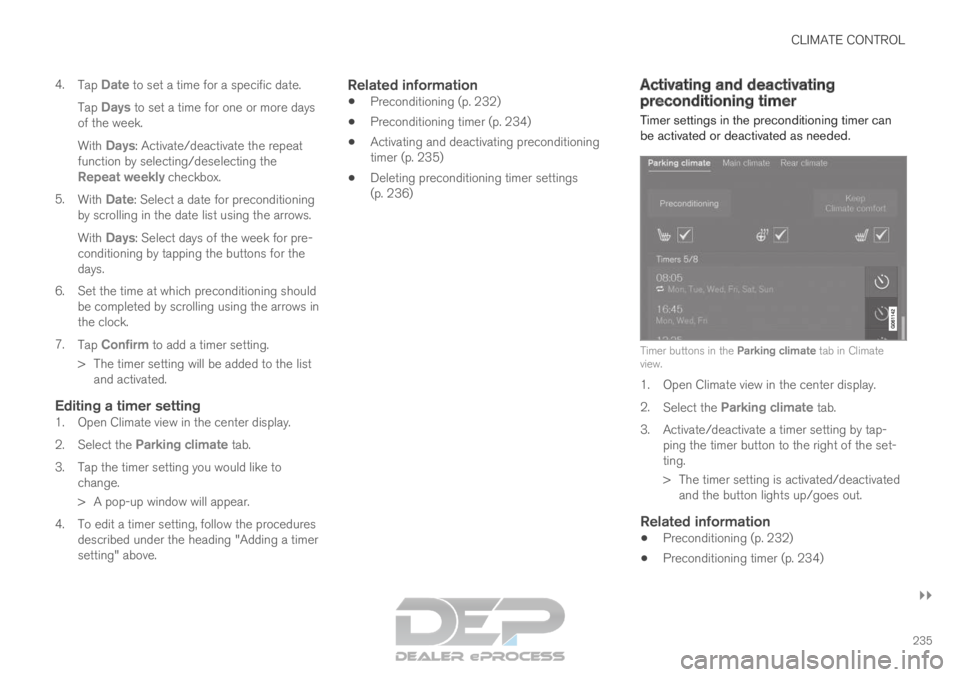
preconditioning timer
Timer settings in the preconditioning timer can
be activated or deactivated as needed. Timer buttons in the Parking climate tab in Climate
view.
1. Open Climate view in the center display.
2.
Select the Parking climate tab.
3.
Activate/deactivate a timer setting by tap-
ping the timer button to the right of the set-
ting.
> The timer setting is activated/deactivated and the button lights up/goes out.
Related information
Preconditioning (p. 232)
Preconditioning timer (p. 234)
Page 238 of 697

CLIMATE CONTROL
236
Adding and editing timer settings for precon-
ditioning (p. 234)
Deleting preconditioning timer settings
(p. 236) Deleting preconditioning timer
settings
A preconditioning timer setting that is no longer
needed can be deleted. The button for editing a list/deleting a timer setting in
the Parking climate tab in Climate view.
1. Open Climate view in the center display.
2.
Select the Parking climate tab.
3. Tap Edit list.
4.
Tap the editing icon to the right in the list.
> The icon will change to the text Delete.
5. Tap Delete to confirm.
>
The timer setting will be deleted from the
list.
Related information
Preconditioning (p. 232)
Preconditioning timer (p. 234)
Adding and editing timer settings for precon-
ditioning (p. 234)
Activating and deactivating preconditioning
timer (p. 235)
Page 255 of 697
KEY, LOCKS AND ALARM
}}
* Option/accessory. 253
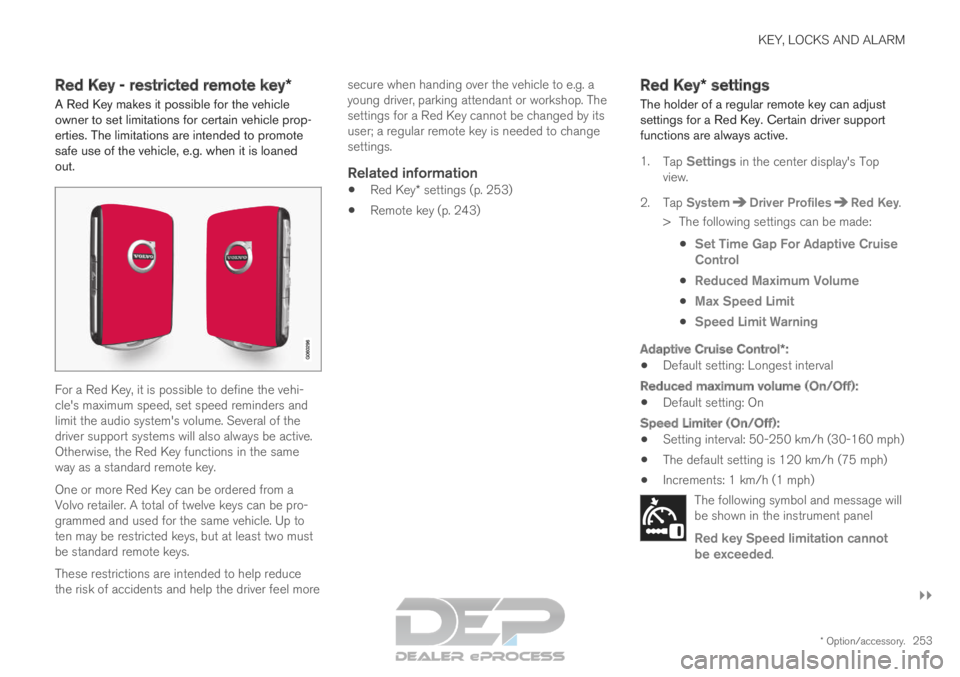
Red Key - restricted remote key*
A Red Key makes it possible for the vehicle
owner to set limitations for certain vehicle prop-
erties. The limitations are intended to promote
safe use of the vehicle, e.g. when it is loaned
out. For a Red Key, it is possible to define the vehi-
cle's maximum speed, set speed reminders and
limit the audio system's volume. Several of the
driver support systems will also always be active.
Otherwise, the Red Key functions in the same
way as a standard remote key.
One or more Red Key can be ordered from a
Volvo retailer. A total of twelve keys can be pro-
grammed and used for the same vehicle. Up to
ten may be restricted keys, but at least two must
be standard remote keys.
These restrictions are intended to help reduce
the risk of accidents and help the driver feel more secure when handing over the vehicle to e.g. a
young driver, parking attendant or workshop. The
settings for a Red Key cannot be changed by its
user; a regular remote key is needed to change
settings.
Related information
Red Key* settings (p. 253)
Remote key (p. 243) Red Key*
settings
The holder of a regular remote key can adjust
settings for a Red Key. Certain driver support
functions are always active.
1. Tap Settings in the center display's Top
view.
2.
Tap System Driver Profiles Red Key
.
> The following settings can be made:
Set Time Gap For Adaptive Cruise
Control
Reduced Maximum Volume
Max Speed Limit
Speed Limit Warning
Adaptive Cruise Control*:
Default setting: Longest interval
Reduced maximum volume (On/Off):
Default setting: On
Speed Limiter (On/Off):
Setting interval: 50-250 km/h (30-160 mph)
The default setting is 120 km/h (75 mph)
Increments: 1 km/h (1 mph)
The following symbol and message will
be shown in the instrument panel
Red key Speed limitation cannot
be exceeded.
Page 260 of 697
||KEY, LOCKS AND ALARM
* Option/accessory.
258 (1) This device may not cause harmful interfer-
ence, and
(2) this device must accept any interference
received, including interference that may cause
undesired operation.
Any changes or modification not expressly
approved by the party responsible for compliance
could void the user's authority to operate this
equipment.
Canada
Volvo Standard Key IC: 4008C-HUF8423
Volvo Tag ID IC: 4008C-HUF8432
This device complies with Industry Canada
license-exempt RSS standards. Operation is sub-
ject to the following two conditions:
(1) This device may not cause harmful interfer-
ence, and (2) this device must accept any inter-
ference received, including interference that may
cause undesired operation.
Immobilizer and Passive entry/Passive
start* systems
USA-FCC ID: LTQVO3134
This device complies with part 15 of the FCC
rules. Operation is subject to the following two
conditions:
(1) This device may not cause harmful interfer-
ence, and (2) this device must accept any interference
received, including interference that may cause
undesired operation.
Any changes or modification not expressly
approved by the party responsible for compliance
could void the user's authority to operate this
equipment.
Canada-IC:3659A-VO3134
This device complies with Industry Canada
license-exempt RSS standards. Operation is sub-
ject to the following two conditions:
(1) This device may not cause harmful interfer-
ence, and (2) this device must accept any inter-
ference received, including interference that may
cause undesired operation.
Related information
Remote key (p. 243) Keyless and touch-sensitive
surfaces*
If the vehicle is equipped with keyless locking
and unlocking, it is only necessary to have the
remote key within range, e.g. in a pocket or bag,
which makes it easier to open the vehicle if your
hands are full.
Page 265 of 697

KEY, LOCKS AND ALARM
* Option/accessory.263
Alternative unlocking methodAlternative unlocking method using side door opening
handle
15
.
– Pull either of the side door inside opening
handles and release.
>
Depending on the remote key settings,
either all doors will be unlocked or just the
selected door will be unlocked and
opened.
To change this setting, tap SettingsMy Car Locking Remote and
Interior Unlock in the Top view of the
center display.
Locking using the front door buttons
– Press the button (both front doors must
be closed).
>
All doors and the tailgate will lock.
Locking using the rear door button* Button with indicator light for locking/unlocking in rear
door.
The lock buttons in the rear doors only lock/
unlock that particular door.
Unlocking the rear door1. Pull the opening handle to unlock the rear door.
2. Pull the opening handle again to open the rear door 16
.
Related information
Settings for remote and inside door unlock
(p. 247)
Unlocking the tailgate from inside the vehicle
(p. 264)
Activating and deactivating child safety locks
(p. 264) 15
The illustration is generic - details may vary according to vehicle mode\
l.
16 Provided the child safety lock is not activated.
Page 277 of 697
KEY, LOCKS AND ALARM
275
Disarming the alarm without a functioning
remote key
The vehicle can be unlocked and disarmed even
if the remote key is not functioning, e.g. if the
battery is discharged.
1. Open the driver's door using the detachablekey blade.
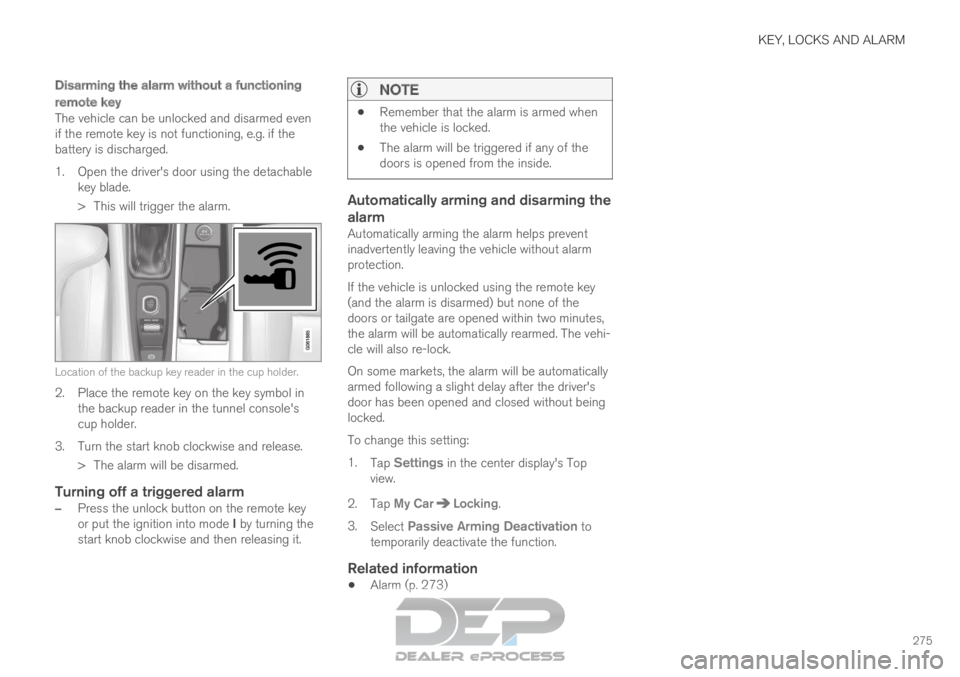
> This will trigger the alarm. Location of the backup key reader in the cup holder.
2. Place the remote key on the key symbol in
the backup reader in the tunnel console's
cup holder.
3.
Turn the start knob clockwise and release.
> The alarm will be disarmed.
Turning off a triggered alarm
– Press the unlock button on the remote key
or put the ignition into mode I by turning the
start knob clockwise and then releasing it.
NOTE
Remember that the alarm is armed when
the vehicle is locked.
The alarm will be triggered if any of the
doors is opened from the inside.
Automatically arming and disarming the
alarm
Automatically arming the alarm helps prevent
inadvertently leaving the vehicle without alarm
protection.
If the vehicle is unlocked using the remote key
(and the alarm is disarmed) but none of the
doors or tailgate are opened within two minutes,
the alarm will be automatically rearmed. The vehi-
cle will also re-lock.
On some markets, the alarm will be automatically
armed following a slight delay after the driver's
door has been opened and closed without being
locked.
To change this setting:
1.
Tap Settings in the center display's Top
view.
2.
Tap My Car Locking
.
3. Select Passive Arming Deactivation to
temporarily deactivate the function.
Related information
Alarm (p. 273)
Page 281 of 697
DRIVER SUPPORT
}}
* Option/accessory. 279
Changing the level of steering wheel
resistance*
To change the level of steering wheel resistance,
see the description of the INDIVIDUAL option
under "Available drive modes" in the "Drive
modes" section.
On models not equipped with drive mode con-
trols and the INDIVIDUAL option, steering wheel
resistance can instead be set in the center dis-
play's Top view under:
Settings My Car Drive Modes
Steering Force
Steering wheel resistance settings cannot be
accessed when turning at speeds above
10 km/h (6 mph).
Related information
Drive modes (p. 454)
Pilot Assist (p. 316)
Lane Keeping Aid (p. 372)
Steering assistance at risk of collision
(p. 380)
Park Assist Pilot* (p. 406) Stability system Roll Stability
Control
The Roll Stability Control (RSC 1
) system helps
minimize the risk of a rollover in the event of e.g.
a sudden evasive maneuver or if the vehicle
begins to skid.
The RSC system monitors the lateral angle at
which the vehicle is leaning and registers any
changes. Using this information, the system cal-
culates the likelihood of a rollover. If there is an
imminent risk of a rollover, Electronic Stability
Control is activated, engine torque is reduced and
brakes are applied to one or more of the wheels
until the vehicle has regained stability.
WARNING The vehicle