instrument panel VOLVO XC90 TWIN ENGINE 2019 Repair Manual
[x] Cancel search | Manufacturer: VOLVO, Model Year: 2019, Model line: XC90 TWIN ENGINE, Model: VOLVO XC90 TWIN ENGINE 2019Pages: 697, PDF Size: 10.33 MB
Page 291 of 697

DRIVER SUPPORT
289
Activating/deactivating Automatic
Speed Limiter
The Automatic Speed Limiter (ASL) is a supple-
ment to the Speed Limiter (SL) and can be acti-
vated/deactivated.
Activating ASLThe Speed Sign Assist but- ton is located in the center dis-
play's Function view. To activate the Automatic Speed Limiter:
1.
Tap the Speed Sign Assist button.
>
ASL will go into standby mode and a
green indicator light will illuminate. A road
sign symbol will be displayed in the center
of the speedometer in the instrument
panel.
2. Pressing the button on the steering
wheel keypad.
>
ASL will be activated and set to the vehi-
cle's current speed.
NOTE
If the Automatic Speed Limiter function is
activated, road sign information is shown
in the driver display even if RSI 19
is not
activated.
To remove road sign information from the
driver display, you must deactivate both
Automatic Speed Limiter and RSI.
When the Automatic Speed Limiter func-
tion is activated but RSI is deactivated, no
warnings are given from RSI. RSI must
also be activated for warnings to be pos-
sible.
Deactivating ASLTo deactivate the Automatic Speed Limiter:
–
Tap the
Speed Sign Assist button in Func-
tion view.
>
ASL will be deactivated, the indicator light
in the button will be GRAY and SL will be
activated instead.
WARNING The vehicle will no longer follow the posted
maximum speed after switching from ASL to
SL – it then only follows the maximum speed
stored in the memory.
Related information
Speed limiter (p. 283)
Automatic Speed Limiter (p. 287)
Activating/deactivating Road Sign Informa-
tion (p. 365) 19
Road Sign Information (RSI)
Page 297 of 697

DRIVER SUPPORT
295
Standby mode due to action by the driver
Cruise Control will be temporarily deactivated and
put in standby mode if: the brakes are applied
the gear selector is moved to N
the vehicle is driven faster than the set
speed for more than 1 minute
The driver must then control the vehicle's speed.
Temporarily increasing speed using the accelera-
tor pedal, e.g. when passing another vehicle, will
not affect the setting. The vehicle will return to
the set speed when the accelerator pedal is
released.
Automatic standby mode
Cruise Control will be temporarily deactivated and
put in standby mode if:
the wheels lose traction
the engine speed (rpm) is too low/high
the temperature in the brake system
becomes too high
the vehicle's speed goes below 30 km/h
(20 mph).
The driver must then control the vehicle's speed.
Related information
Cruise control (p. 291) Reactivating Cruise Control from
standby mode
Cruise Control (CC 28
) can be temporarily put
into standby mode and then reactivated.
Reactivating Cruise Control from
standby mode Note: This illustration is general and details may vary
depending on model.
To start Cruise Control from standby mode:
–
Press the button on the steering wheel
(1).
>
The Cruise Control marking in the instru-
ment panel will change from GRAY to
WHITE and the vehicle will then return to
the most recently set speed. or
To start Cruise Control from standby mode:
– Press the button on the steering wheel
(2).
>
The Cruise Control markings and symbols
in the instrument panel will change from
GRAY to WHITE and the vehicle's current
speed will be set.
WARNING A noticeable increase in speed may follow
when the speed is resumed with the
steering wheel button.
Related information
Cruise control (p. 291) 27
Cruise Control
28 Cruise Control
Page 298 of 697

DRIVER SUPPORT
* Option/accessory.
296 Switching off Cruise Control
Cruise control (Cruise Control - CC) can be
turned off. Function buttons and symbols
29
.
To turn off Cruise Control:
1. Press the button on the steering wheel
(2).
>
Cruise Control will go into standby mode.
2. Press the ◀ (1) or ▶ (3) buttons on the
steering wheel to select another function.
>
The Cruise Control symbol (4) in
the instrument panel will go out and the
set speed will be erased. 3.
Press the (2) button on the steering
wheel keypad again.
>
Another function will be activated.
NOTE In vehicles equipped with Adaptive Cruise
Control*, it is possible to switch between
cruise control and Adaptive Cruise Control –
see the heading "Switching between CC and
ACC".
Related information
Cruise control (p. 291)
Switching between Cruise Control and Adap-
tive Cruise Control (p. 313) Distance Alert*
30
The Distance Alert 31
function can help the driver
become aware if the time interval to the vehicle
in front is too short.
However, the vehicle must be equipped with a
head-up display in order to display the Distance
Alert, which will then be indicated by a symbol
on the windshield as long as the time interval to
the vehicle ahead is shorter than the set time
interval.
Distance Alert is active at speeds above 30 km/h
(20 mph) and only reacts for vehicles ahead mov-
ing in the same direction as your vehicle. No dis-
tance information is provided for oncoming, slow-
moving or stationary vehicles. 29
Note: This illustration is general and details may vary depending on mod\
el.
30 The Distance Alert function is only available in vehicles that can displ\
ay information on the windshield with a head-up display.
31 Distance Alert
Page 304 of 697

||DRIVER SUPPORT
* Option/accessory.
302
Overview
Controls Function buttons and symbols
39
. : Activates Adaptive Cruise Control from
standby mode and resumes the set speed : Increases the set speed
: From standby mode - activates the
Adaptive Cruise Control and stores the cur-
rent speed : From active mode - deactivates/
switches the Adaptive Cruise Control to
standby mode : Reduces the set speed
Increases the time interval to the vehicle
ahead Reduces the time interval to the vehicle
ahead
Target vehicle indicator: ACC has detected
and is following a target vehicle using the set
time interval
Symbol for time interval to the vehicle ahead
NOTE
In vehicles equipped with Adaptive Cruise
Control*, it is possible to switch between
cruise control and Adaptive Cruise Control –
see the heading "Switching between CC and
ACC".
Instrument panel Speed indicators
39
. Set speed
Speed of the vehicle ahead.
The current speed of your vehicle.
See "Adaptive Cruise Control symbols and mes-
sages" for examples of different combinations of
symbols depending on the traffic situation.
Related information
Adaptive Cruise Control and collision warning
(p. 303)
Head-up display for Adaptive Cruise Control
with collision warning (p. 304)
Activating and starting Adaptive Cruise Con-
trol (p. 304) 39
Note: This illustration is general and details may vary depending on mod\
el.
Page 308 of 697
||DRIVER SUPPORT
* Option/accessory.
306
Automatic transmission
Adaptive Cruise Control can follow another vehi-
cle at speeds from a standstill up to 200 km/h
(125 mph).
The lowest speed that can be set for Adaptive
Cruise Control is 30 km/h (20 mph). When fol-
lowing another vehicle, ACC can monitor that
vehicle's speed and slow your own vehicle down
to a standstill, but it is not possible to set speeds
lower than 30 km/h (20 mph).
The highest possible speed that can be set is
200 km/h (125 mph).
Related information
Adaptive Cruise Control* (p. 300) Setting Adaptive Cruise Control
time intervals
Adaptive Cruise Control (ACC
44
) can be set to
various time intervals to the vehicle ahead.
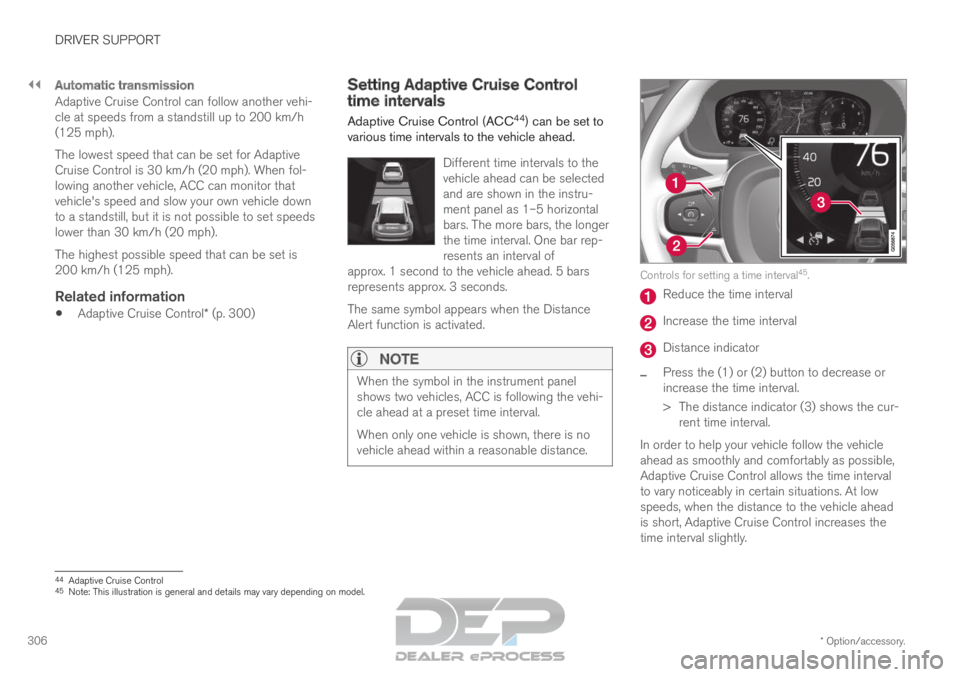
Different time intervals to the
vehicle ahead can be selected
and are shown in the instru-
ment panel as 1–5 horizontal
bars. The more bars, the longer
the time interval. One bar rep-
resents an interval of
approx. 1 second to the vehicle ahead. 5 bars
represents approx. 3 seconds.
The same symbol appears when the Distance
Alert function is activated.
NOTE When the symbol in the instrument panel
shows two vehicles, ACC is following the vehi-
cle ahead at a preset time interval.
When only one vehicle is shown, there is no
vehicle ahead within a reasonable distance. Controls for setting a time interval
45
. Reduce the time interval
Increase the time interval
Distance indicator
– Press the (1) or (2) button to decrease or
increase the time interval.
>
The distance indicator (3) shows the cur-
rent time interval.
In order to help your vehicle follow the vehicle
ahead as smoothly and comfortably as possible,
Adaptive Cruise Control allows the time interval
to vary noticeably in certain situations. At low
speeds, when the distance to the vehicle ahead
is short, Adaptive Cruise Control increases the
time interval slightly. 44
Adaptive Cruise Control
45 Note: This illustration is general and details may vary depending on mod\
el.
Page 310 of 697

||DRIVER SUPPORT
308
To temporarily deactivate Adaptive Cruise Control
and put it in standby mode:
– Press the button on the steering wheel
(2).
> The symbol in the instrument panel
changes color from WHITE to GRAY and
the set speed in the center of the speed-
ometer will change from BEIGE to GRAY.
WARNING
If Adaptive Cruise Control is in standby
mode, the driver must intervene and regu-
late both speed and distance to the vehicle
ahead.
If the vehicle comes too close to a vehicle
ahead when Adaptive Cruise Control is in
standby mode, the driver is instead warned
of the short distance by the Distance Alert
function.
Standby mode due to action by the driver
Adaptive Cruise Control will be temporarily deac-
tivated and put in standby mode if:
the brakes are applied
the gear selector is moved to N
the vehicle is driven faster than the set
speed for more than 1 minute Temporarily increasing speed using the accelera-
tor pedal, e.g. when passing another vehicle, will
not affect the setting. The vehicle will return to
the set speed when the accelerator pedal is
released.
Automatic standby mode
Adaptive Cruise Control is dependent on other
systems, such as Electronic Stability Control
(ESC
47
). If any of these other systems stops
working, Adaptive Cruise Control will automati-
cally switch off.
WARNING With automatic standby mode, the driver is
warned by an acoustic signal and a message
on the instrument panel.
The driver must then regulate vehicle
speed, apply the brakes if necessary, and
maintain a safe distance to other vehicles.
Adaptive Cruise Control may go into standby
mode if: your vehicle's speed goes below 5 km/h
(3 mph) and ACC cannot determine if the
vehicle ahead is stationary or if it is another
object, e.g. a speed bump.
your vehicle's speed goes under 5 km/h
(3 mph) and the vehicle ahead turns so that
ACC no longer has a vehicle to follow.
the driver opens the door.
the driver unbuckles the seat belt.
the engine speed (rpm) is too low/high.
one or more of the wheels lose traction.
the brake temperature is high.
the parking brake is applied.
the camera/radar sensor is covered by snow
or heavy rain (the camera lens/radar waves
are blocked)
Reactivating Adaptive Cruise Control
from standby mode Note: This illustration is general and details may vary
depending on model.
47
Electronic Stability Control
Page 315 of 697
DRIVER SUPPORT
* Option/accessory.313
Switching between Cruise Control
and Adaptive Cruise Control
In vehicles equipped with Adaptive Cruise Con-
trol (ACC), the driver can switch between Cruise
Control (CC) and ACC.
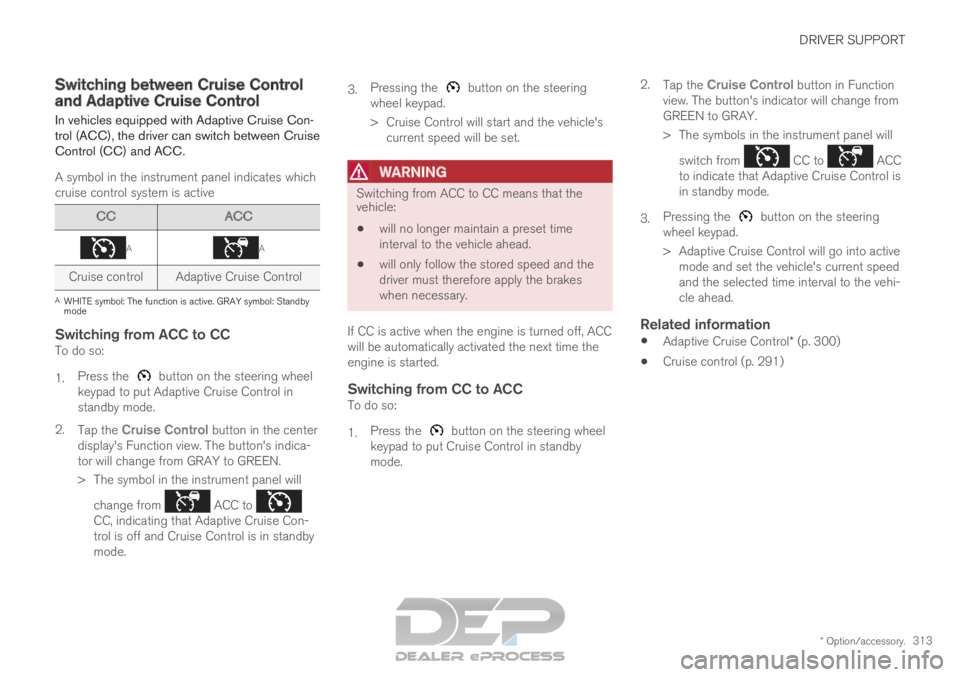
A symbol in the instrument panel indicates which
cruise control system is active CC
ACCA A
Cruise control
Adaptive Cruise Control A
WHITE symbol: The function is active. GRAY symbol: Standby
mode
Switching from ACC to CCTo do so:
1. Press the button on the steering wheel
keypad to put Adaptive Cruise Control in
standby mode.
2. Tap the Cruise Control button in the center
display's Function view. The button's indica-
tor will change from GRAY to GREEN.
>
The symbol in the instrument panel will
change from ACC to
CC, indicating that Adaptive Cruise Con-
trol is off and Cruise Control is in standby
mode. 3.
Pressing the button on the steering
wheel keypad.
>
Cruise Control will start and the vehicle's
current speed will be set.
WARNING Switching from ACC to CC means that the
vehicle:
will no longer maintain a preset time
interval to the vehicle ahead.
will only follow the stored speed and the
driver must therefore apply the brakes
when necessary.
If CC is active when the engine is turned off, ACC
will be automatically activated the next time the
engine is started.
Switching from CC to ACCTo do so:
1. Press the button on the steering wheel
keypad to put Cruise Control in standby
mode. 2.
Tap the Cruise Control button in Function
view. The button's indicator will change from
GREEN to GRAY.
>
The symbols in the instrument panel will
switch from CC to ACC
to indicate that Adaptive Cruise Control is
in standby mode.
3. Pressing the button on the steering
wheel keypad.
>
Adaptive Cruise Control will go into active
mode and set the vehicle's current speed
and the selected time interval to the vehi-
cle ahead.
Related information
Adaptive Cruise Control* (p. 300)
Cruise control (p. 291)
Page 316 of 697
DRIVER SUPPORT
* Option/accessory.
314 Symbols and messages for
Adaptive Cruise Control
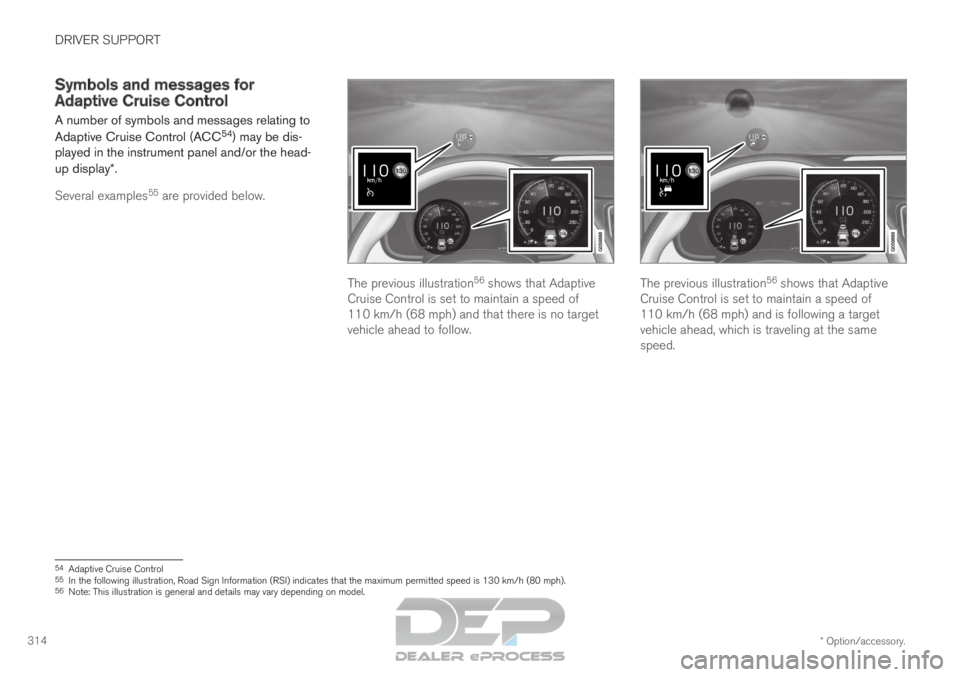
A number of symbols and messages relating to
Adaptive Cruise Control (ACC 54
) may be dis-
played in the instrument panel and/or the head-
up display*.
Several examples 55
are provided below. The previous illustration
56
shows that Adaptive
Cruise Control is set to maintain a speed of
110 km/h (68 mph) and that there is no target
vehicle ahead to follow. The previous illustration
56
shows that Adaptive
Cruise Control is set to maintain a speed of
110 km/h (68 mph) and is following a target
vehicle ahead, which is traveling at the same
speed. 54
Adaptive Cruise Control
55 In the following illustration, Road Sign Information (RSI) indicates t\
hat the maximum permitted speed is 130 km/h (80 mph).
56 Note: This illustration is general and details may vary depending on mod\
el.
Page 321 of 697
DRIVER SUPPORT
}}
* Option/accessory. 319
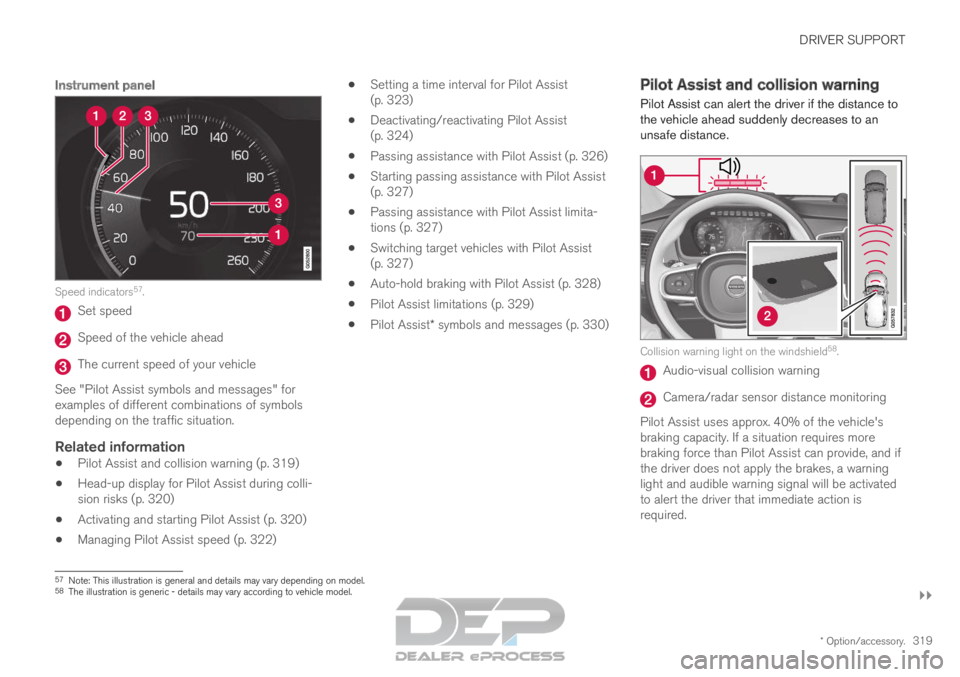
Instrument panelSpeed indicators
57
. Set speed
Speed of the vehicle ahead
The current speed of your vehicle
See "Pilot Assist symbols and messages" for
examples of different combinations of symbols
depending on the traffic situation.
Related information
Pilot Assist and collision warning (p. 319)
Head-up display for Pilot Assist during colli-
sion risks (p. 320)
Activating and starting Pilot Assist (p. 320)
Managing Pilot Assist speed (p. 322)
Setting a time interval for Pilot Assist
(p. 323)
Deactivating/reactivating Pilot Assist
(p. 324)
Passing assistance with Pilot Assist (p. 326)
Starting passing assistance with Pilot Assist
(p. 327)
Passing assistance with Pilot Assist limita-
tions (p. 327)
Switching target vehicles with Pilot Assist
(p. 327)
Auto-hold braking with Pilot Assist (p. 328)
Pilot Assist limitations (p. 329)
Pilot Assist* symbols and messages (p. 330) Pilot Assist and collision warning
Pilot Assist can alert the driver if the distance to
the vehicle ahead suddenly decreases to an
unsafe distance. Collision warning light on the windshield
58
. Audio-visual collision warning
Camera/radar sensor distance monitoring
Pilot Assist uses approx. 40% of the vehicle's
braking capacity. If a situation requires more
braking force than Pilot Assist can provide, and if
the driver does not apply the brakes, a warning
light and audible warning signal will be activated
to alert the driver that immediate action is
required. 57
Note: This illustration is general and details may vary depending on mod\
el.
58 The illustration is generic - details may vary according to vehicle mode\
l.
Page 325 of 697

DRIVER SUPPORT
}}
* Option/accessory. 323
Setting a time interval for Pilot
Assist
Pilot Assist
can be set to different time intervals.
Different time intervals to the
vehicle ahead can be selected
and are shown in the instru-
ment panel as 1–5 horizontal
bars. The more bars, the longer
the time interval. One bar rep-
resents an interval of
approx. 1 second to the vehicle ahead. 5 bars
represents approx. 3 seconds.
NOTE When the symbol in the instrument panel
shows a vehicle and a steering wheel, Pilot
Assist follows a vehicle ahead at a preset
time interval.
When only a steering wheel is shown, there is
no vehicle ahead within a reasonable dis-
tance. Controls for setting a time interval
60
. Reduce the time interval
Increase the time interval
Distance indicator
– Press the (1) or (2) button to decrease or
increase the time interval.
>
The distance indicator (3) shows the cur-
rent time interval.
In order to follow the vehicle ahead as smoothly
as possible, Pilot Assist allows the time interval to
vary considerably in certain situations. For exam-
ple, at low speeds and short distances to the
vehicle ahead, Pilot Assist increases the time
interval slightly.
NOTE
The greater the vehicles' speed, the
greater the distance between them for a
set time interval.
Only use the time intervals permitted by
local traffic regulations.
If Pilot Assist does not seem to respond
with a speed increase when activated, it
may be because the time interval to the
vehicle ahead is shorter than the set time
interval.
WARNING
Only use a time interval suitable for the
current traffic conditions.
The driver should be aware that short
time intervals give them limited time to
react and act to any unforeseen traffic
situation.
Setting how Pilot Assist should
maintain distance* to the vehicle ahead
The driver can choose different drive modes to
determine how Pilot Assist should maintain a
time interval to the vehicle ahead. Settings are
made using the DRIVE MODE controls. 60
Note: This illustration is general and details may vary depending on mod\
el.