brake VOLVO XC90 TWIN ENGINE 2020 Owners Manual
[x] Cancel search | Manufacturer: VOLVO, Model Year: 2020, Model line: XC90 TWIN ENGINE, Model: VOLVO XC90 TWIN ENGINE 2020Pages: 693, PDF Size: 13.34 MB
Page 632 of 693
||
MAINTENANCE AND SERVICE
* Option/accessory.
630
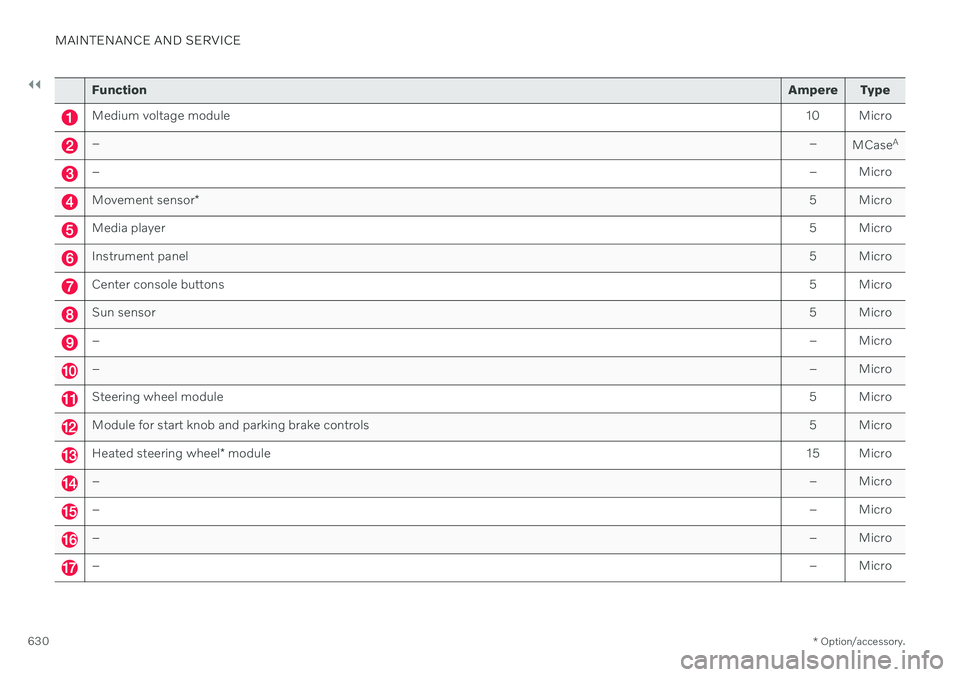
Function Ampere Type
Medium voltage module 10 Micro
– –
MCaseA
–
– Micro
Movement sensor* 5 Micro
Media player
5 Micro
Instrument panel5 Micro
Center console buttons5 Micro
Sun sensor5 Micro
–– Micro
–– Micro
Steering wheel module 5 Micro
Module for start knob and parking brake controls5 Micro
Heated steering wheel* module 15 Micro
–
– Micro
–– Micro
–– Micro
–– Micro
Page 644 of 693

||
MAINTENANCE AND SERVICE
* Option/accessory.
642
WARNING
Never use more than one inlay mat at a time on the driver's floor. If any othertype of floor mat is used, remove theoriginal mat from the driver's seat floorbefore driving. All types of mats mustbe securely anchored in the attach-ment points in the floor. Make sure thefloor mat does not impede the move-ment of the brake pedal or acceleratorpedal in any way, as this could be aserious safety hazard.
Volvo's floor mats are specially manu-factured for your vehicle. They must beproperly secured in the attachmentpoints in the floor to help ensure theycannot slide and become trappedunder the pedals.
Related information
Cleaning the interior (p. 639)
Cleaning the center display (p. 639)
Cleaning fabric upholstery and ceiling liner(p. 641)
Cleaning the seat belt (p. 641)
Cleaning leather upholstery
* (p. 642)
Cleaning the leather steering wheel(p. 643)
Cleaning interior plastic, metal and woodsurfaces (p. 643)
Cleaning leather upholstery
*
Only use cleaning agents and car care prod- ucts recommended by Volvo. Clean regularlyand treat stains immediately. It is importantto vacuum before using a cleaning agent.
Volvo's leather upholstery * is treated to pro-
tect its original appearance. Over time, sun- light, grease, dirt, etc. could break down theprotective layer. This could result in scratchesand cracking. Leather upholstery * is a natural product that
changes and acquires a beautiful patina over time. Regular cleaning and treatments arerequired to preserve the qualities and color ofthe leather. Volvo offers a comprehensiveproduct, Volvo Leather Care KitWipes, forcleaning and treating leather upholstery.When used as directed, it helps preserve theleather's protective coating. For optimal results, Volvo recommends clean- ing and applying protective cream one to fourtimes a year (or more often as needed). VolvoLeather Care Kit 951 0251 and Volvo LeatherSoftener 943 7429 are available for purchaseat Volvo retailers.
Cleaning the leather upholstery1. Apply the leather cleaner to a damp sponge and squeeze it until the cleanerfoams. 2. Move the sponge in circular motions to
apply the foam to the stain.
3. Dampen the stain thoroughly with the sponge. Let the sponge absorb the stainand do not rub.
4. Dry the stain using a soft towel and let the leather dry completely.
Protecting the leather upholstery1. Apply a small amount of leather protectorto a cloth and then apply the protector tothe leather using light circular movements.
2. Let it dry for approximately 20 minutes. > Protecting the leather upholsterymakes it better able to withstand sun-light's harmful UV rays.
Related information
Cleaning the interior (p. 639)
Cleaning the center display (p. 639)
Cleaning fabric upholstery and ceiling liner(p. 641)
Cleaning the seat belt (p. 641)
Cleaning floor mats and inlay mats(p. 641)
Cleaning the leather steering wheel(p. 643)
Cleaning interior plastic, metal and wood surfaces (p. 643)
Page 648 of 693
||
MAINTENANCE AND SERVICE
* Option/accessory.
646
Wash using a sponge, car washing deter- gent and plenty of lukewarm water.
Clean the wiper blades with lukewarmsoap solution or car washing detergent.
Dry the vehicle using a clean, soft chamoisor a squeegee. Try not to let drops ofwater dry in strong sunlight. This couldcause water drying stains that may needto be polished out.
In areas with heavy industrial emissions,more frequent washing of the vehicle'sexterior is recommended.
Tar spots from asphalt may remain evenafter washing. Use a tar remover toremove these spots.
WARNING
Always entrust engine washing to a work- shop. If the engine is hot, there is a risk offire.
CAUTION
Dirty headlights do not work as well. Clean them regularly, e.g. when refueling. Do not use corrosive cleaners. Use water and a non-abrasive sponge.
NOTE
Exterior lighting such as headlights and taillights may develop temporary conden-sation on the inside of the lens. This is nor-mal. All exterior lighting is designed toresist this. Condensation is normally ven-ted out of the lamp housing once the lighthas been lit for some period of time.
CAUTION
Make sure that the panoramic roof
*
and sun shade are closed before wash- ing the vehicle.
Never use abrasive polishing agents onthe panoramic roof.
Never use wax on the rubber sealsaround the panoramic roof.
CAUTION
Remember to remove dirt from the drain holes in the doors and sills after washingthe vehicle.
Related information
Cleaning the exterior (p. 644)
Polishing and waxing (p. 644)
Automatic car washes (p. 647)
High-pressure washing (p. 648)
Cleaning the wiper blades (p. 648)
Cleaning exterior plastic, rubber and trim components (p. 649)
Cleaning rims (p. 650)
Corrosion protection (p. 650)
Settings for automatically activating theparking brake (p. 423)
Page 649 of 693
MAINTENANCE AND SERVICE
}}
* Option/accessory.647
Automatic car washes
The vehicle should be washed as soon as it becomes dirty. The longer the dirt remains,the more difficult it will be to keep the vehicleclean. It could also lead to paint damage.
Washing your vehicle in an automatic car wash is a fast and easy way to keep your vehi-cle clean, but it does not reach all areas of thevehicle. Volvo recommends washing yourvehicle by hand or supplementing automaticcar washes with a hand wash.
NOTE
Volvo recommends not washing the vehi- cle in an automatic car wash during thefirst few months; the paintwork on newvehicles takes some time to fully harden.
CAUTION
Before driving the vehicle into a car wash, deactivate the Automatic Braking whenStationary and Automatic Parking BrakeApplication functions. If the functions arenot deactivated, the brake system willseize when the vehicle is stationary and thevehicle will not be able to roll.
CAUTION
For automatic car washes in which the vehicle is pulled forward on rolling wheels:
1. Before washing the vehicle, make sure that the automatic rain sensor is deac- tivated. If it is not deactivated andinadvertently starts, the wiper armscould be damaged.
2. To help prevent damage from the auto- matic car wash machinery, make surethat the door mirrors are folded in,antennas retracted or removed, andany auxiliary lights secured.
3. Drive into the automatic car wash.
4. Turn off the "Automatic Braking when Stationary" function using the
but-
ton in the tunnel console.
5. Turn off the "Automatic Parking Brake Application" function in the center dis- play's Top view.
6. Turn off the engine by turning the start knob in the tunnel console clockwise.Hold the knob in position for at least2 seconds.
The vehicle is now ready for the automaticcar wash.
CAUTION
The system will automatically change to P
mode if the above steps are not followed. In P mode, the wheels are locked, which
they should not be when the vehicle isbeing washed in a car wash.
NOTE
Keep in mind that if the vehicle is equipped with the keyless locking and unlocking function *, the doors and tailgate/trunk lid
may open when washing the vehicle if the remote key is within range.
Related information
Cleaning the exterior (p. 644)
Polishing and waxing (p. 644)
Hand washing (p. 645)
High-pressure washing (p. 648)
Cleaning the wiper blades (p. 648)
Cleaning exterior plastic, rubber and trim components (p. 649)
Cleaning rims (p. 650)
Corrosion protection (p. 650)
Auto-hold brakes (p. 424)
Page 650 of 693
MAINTENANCE AND SERVICE
* Option/accessory.
648
Settings for automatically activating the parking brake (p. 423)
Keyless and touch-sensitive surfaces
*
(p. 261)
High-pressure washing The vehicle should be washed as soon as it becomes dirty. The longer the dirt remains,the more difficult it will be to keep the vehicleclean. It could also lead to paint damage.Wash the vehicle in a car wash or garagewith an oil separator. Use a car washingdetergent.
If washing the vehicle with a high-pressure wash, use sweeping movements and keep thenozzle at least 30 cm (13 in.) from the vehicle.Do not spray directly onto locks.
Related information
Cleaning the exterior (p. 644)
Polishing and waxing (p. 644)
Hand washing (p. 645)
Automatic car washes (p. 647)
Cleaning the wiper blades (p. 648)
Cleaning exterior plastic, rubber and trimcomponents (p. 649)
Cleaning rims (p. 650)
Corrosion protection (p. 650)
Cleaning the wiper blades The vehicle should be washed as soon as it becomes dirty. The longer the dirt remains,the more difficult it will be to keep the vehicleclean. It could also lead to paint damage.Wash the vehicle in a car wash or garagewith an oil separator. Use a car washingdetergent.
Asphalt, dust and salt residue on wiper blades, as well as insects, ice etc. on the windshield,shorten the service life of wiper blades. When cleaning, put the wiper blades in the service position.
NOTE
Wash the wiper blades and windshield regularly with a lukewarm soap solution orvehicle shampoo. Do not use strong sol-vents.
Related information
Cleaning the exterior (p. 644)
Polishing and waxing (p. 644)
Hand washing (p. 645)
Automatic car washes (p. 647)
High-pressure washing (p. 648)
Cleaning exterior plastic, rubber and trim components (p. 649)
Page 669 of 693

SPECIFICATIONS
* Option/accessory.667
Towing capacity and tongue weight Towing capacity and tongue weight are shown in the tables below.
Category
USA
(lbs) Canada
(kg)
Max. trailer weights Without brakes: 1650 750 With brakes:
5000 2250
Max. tongue weight 500 225
CAUTION
The maximum trailer weights listed are only applicable for altitudes up to3280 ft (1,000 m) above sea level.With increasing altitude the enginepower and therefore the car's climbingability are impaired because of thereduced air density, so the maximumtrailer weight has to be reducedaccordingly. The weight of the car andtrailer must be reduced by 10% forevery further 3280 ft (1,000 m) (orpart thereof).
Related information
Type designations (p. 660)
Weights (p. 665)
Driving with a trailer (p. 465)
Trailer Stability Assist
* (p. 467)
Page 672 of 693
SPECIFICATIONS
670
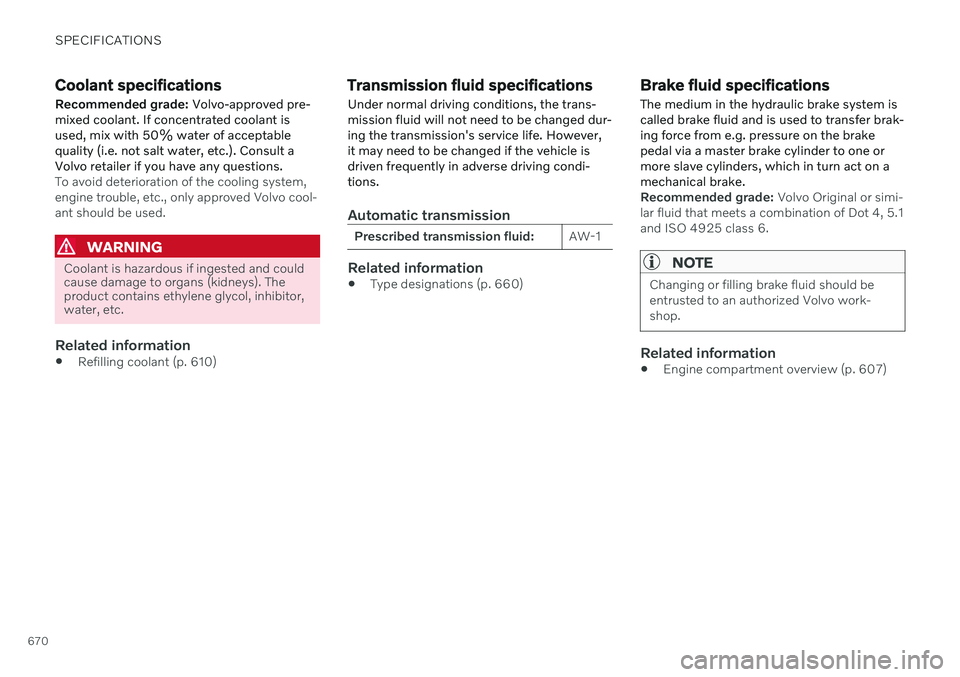
Coolant specifications
Recommended grade: Volvo-approved pre-
mixed coolant. If concentrated coolant is used, mix with 50% water of acceptablequality (i.e. not salt water, etc.). Consult aVolvo retailer if you have any questions.
To avoid deterioration of the cooling system, engine trouble, etc., only approved Volvo cool-ant should be used.
WARNING
Coolant is hazardous if ingested and could cause damage to organs (kidneys). Theproduct contains ethylene glycol, inhibitor,water, etc.
Related information
Refilling coolant (p. 610)
Transmission fluid specifications
Under normal driving conditions, the trans- mission fluid will not need to be changed dur-ing the transmission's service life. However,it may need to be changed if the vehicle isdriven frequently in adverse driving condi-tions.
Automatic transmission
Prescribed transmission fluid: AW-1
Related information
Type designations (p. 660)
Brake fluid specifications
The medium in the hydraulic brake system is called brake fluid and is used to transfer brak-ing force from e.g. pressure on the brakepedal via a master brake cylinder to one ormore slave cylinders, which in turn act on amechanical brake.
Recommended grade: Volvo Original or simi-
lar fluid that meets a combination of Dot 4, 5.1 and ISO 4925 class 6.
NOTE
Changing or filling brake fluid should be entrusted to an authorized Volvo work-shop.
Related information
Engine compartment overview (p. 607)
Page 675 of 693
INDEX
673
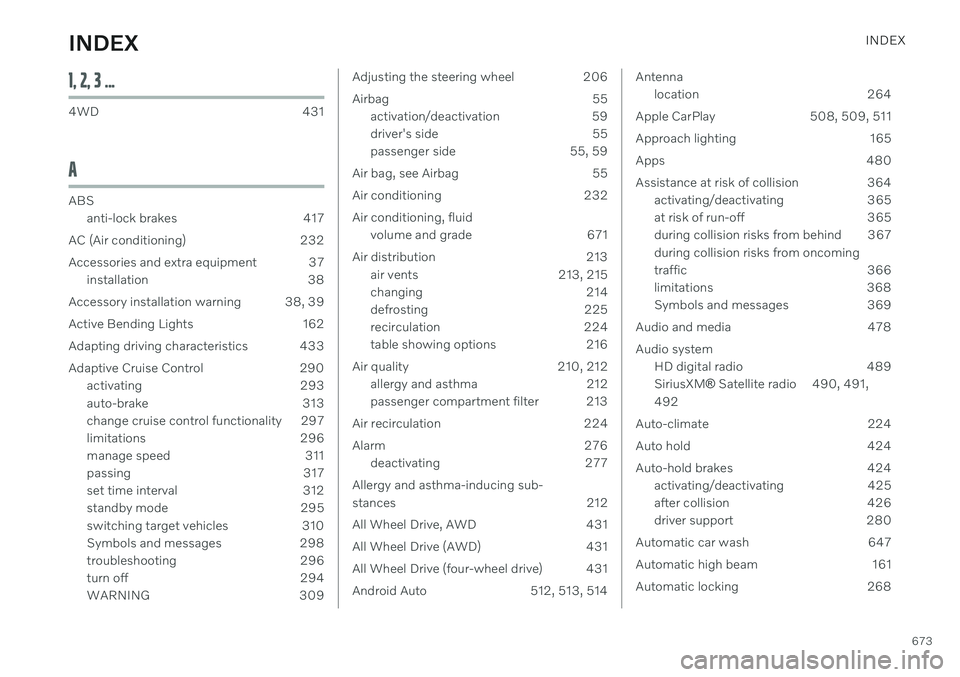
1, 2, 3 ...
4WD 431
A
ABSanti-lock brakes 417
AC (Air conditioning) 232
Accessories and extra equipment 37 installation 38
Accessory installation warning 38, 39
Active Bending Lights 162
Adapting driving characteristics 433
Adaptive Cruise Control 290 activating 293
auto-brake 313
change cruise control functionality 297
limitations 296
manage speed 311
passing 317
set time interval 312
standby mode 295
switching target vehicles 310
Symbols and messages 298
troubleshooting 296
turn off 294
WARNING 309
Adjusting the steering wheel 206
Airbag 55
activation/deactivation 59
driver's side 55
passenger side 55, 59
Air bag, see Airbag 55
Air conditioning 232Air conditioning, fluid volume and grade 671
Air distribution 213 air vents 213, 215
changing 214
defrosting 225
recirculation 224
table showing options 216
Air quality 210, 212 allergy and asthma 212
passenger compartment filter 213
Air recirculation 224
Alarm 276 deactivating 277
Allergy and asthma-inducing sub-
stances 212
All Wheel Drive, AWD 431
All Wheel Drive (AWD) 431
All Wheel Drive (four-wheel drive) 431
Android Auto 512, 513, 514Antenna location 264
Apple CarPlay 508, 509, 511
Approach lighting 165
Apps 480
Assistance at risk of collision 364 activating/deactivating 365
at risk of run-off 365
during collision risks from behind 367during collision risks from oncoming
traffic 366
limitations 368
Symbols and messages 369
Audio and media 478 Audio system HD digital radio 489 SiriusXM ®
Satellite radio 490, 491,
492
Auto-climate 224
Auto hold 424
Auto-hold brakes 424 activating/deactivating 425
after collision 426
driver support 280
Automatic car wash 647
Automatic high beam 161
Automatic locking 268
INDEX
Page 676 of 693
INDEX
674Automatic relocking 248, 262
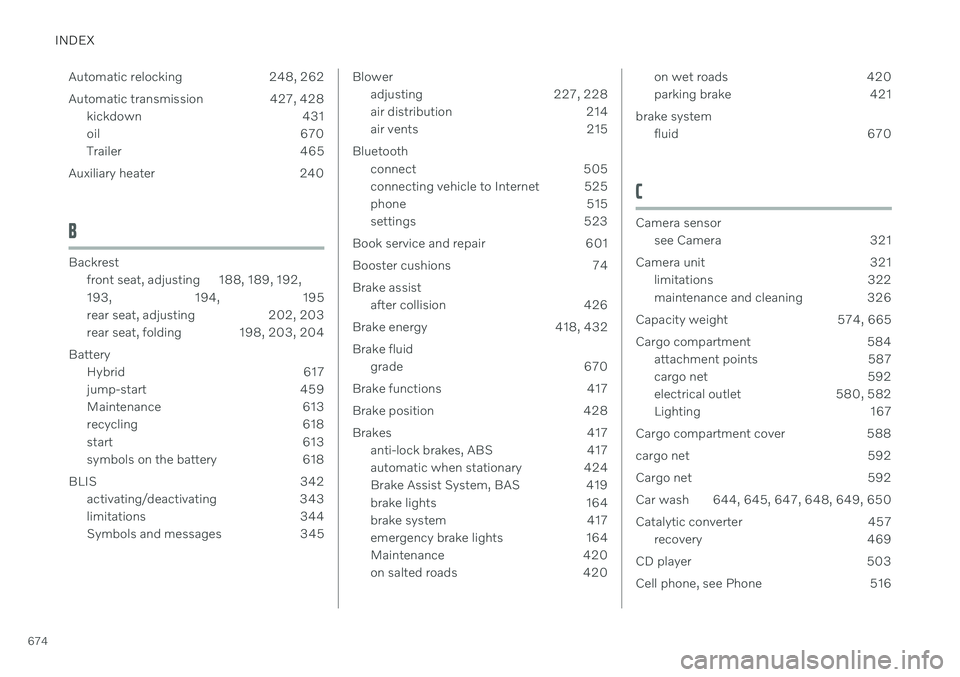
Automatic transmission 427, 428
kickdown 431
oil 670
Trailer 465
Auxiliary heater 240
B
Backrest front seat, adjusting 188, 189, 192, 193 , 194, 195
rear seat, adjusting 202, 203
rear seat, folding 198, 203, 204
Battery Hybrid 617
jump-start 459
Maintenance 613
recycling 618
start 613
symbols on the battery 618
BLIS 342 activating/deactivating 343
limitations 344
Symbols and messages 345
Bloweradjusting 227, 228
air distribution 214
air vents 215
Bluetooth connect 505
connecting vehicle to Internet 525
phone 515
settings 523
Book service and repair 601
Booster cushions 74 Brake assist after collision 426
Brake energy 418, 432Brake fluid grade 670
Brake functions 417
Brake position 428
Brakes 417 anti-lock brakes, ABS 417
automatic when stationary 424
Brake Assist System, BAS 419
brake lights 164
brake system 417
emergency brake lights 164
Maintenance 420
on salted roads 420on wet roads 420
parking brake 421
brake system fluid 670
C
Camera sensor
see Camera 321
Camera unit 321 limitations 322
maintenance and cleaning 326
Capacity weight 574, 665
Cargo compartment 584 attachment points 587
cargo net 592
electrical outlet 580, 582
Lighting 167
Cargo compartment cover 588
cargo net 592
Cargo net 592
Car wash 644, 645, 647, 648, 649, 650
Catalytic converter 457 recovery 469
CD player 503
Cell phone, see Phone 516
Page 679 of 693
INDEX
677
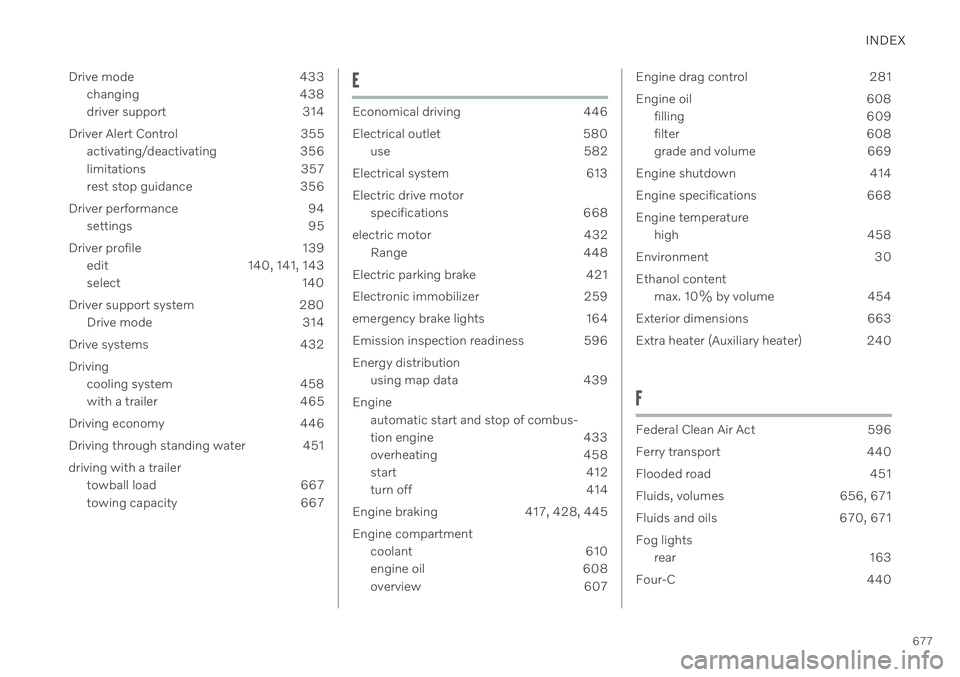
Drive mode 433
changing 438
driver support 314
Driver Alert Control 355 activating/deactivating 356
limitations 357
rest stop guidance 356
Driver performance 94 settings 95
Driver profile 139 edit 140, 141, 143
select 140
Driver support system 280 Drive mode 314
Drive systems 432 Driving cooling system 458
with a trailer 465
Driving economy 446
Driving through standing water 451 driving with a trailer towball load 667
towing capacity 667
E
Economical driving 446
Electrical outlet 580use 582
Electrical system 613Electric drive motor specifications 668
electric motor 432 Range 448
Electric parking brake 421
Electronic immobilizer 259
emergency brake lights 164
Emission inspection readiness 596Energy distribution using map data 439
Engine automatic start and stop of combus-
tion engine 433
overheating 458
start 412
turn off 414
Engine braking 417, 428, 445 Engine compartment coolant 610
engine oil 608
overview 607
Engine drag control 281
Engine oil 608 filling 609
filter 608
grade and volume 669
Engine shutdown 414
Engine specifications 668Engine temperature high 458
Environment 30Ethanol content max. 10% by volume 454
Exterior dimensions 663
Extra heater (Auxiliary heater) 240
F
Federal Clean Air Act 596
Ferry transport 440
Flooded road 451
Fluids, volumes 656, 671
Fluids and oils 670, 671 Fog lights rear 163
Four-C 440