ABS VOLVO XC90 TWIN ENGINE HYBRID 2017 User Guide
[x] Cancel search | Manufacturer: VOLVO, Model Year: 2017, Model line: XC90 TWIN ENGINE HYBRID, Model: VOLVO XC90 TWIN ENGINE HYBRID 2017Pages: 584, PDF Size: 14.2 MB
Page 381 of 584

STARTING AND DRIVING
379
Auto-hold brake function
With the Auto-hold brake function, the driver canrelease the brake pedal and the brakes willremain applied, for example, when the vehiclehas stopped at a traffic light or intersection.
When the vehicle is no longer moving forward,Auto-hold applies the brakes automatically, eitherusing the normal brakes or the parking brake.The brakes will be released when the acceleratorpedal is depressed.
If the driver's door is opened or the engine isturned off, the parking brake will be applied auto-matically.
Auto-hold control
Auto-hold control and indicator light
Turn Auto-hold on or off by pressing the controlin the tunnel console. The indicator light illumi-nates when the function is on.
When Auto-hold is off, Hill Start Assist (HSA) willbe activated to help prevent the vehicle from roll-ing backwards when starting up a hill.
Instrument panel symbol
SymbolExplanation
The symbol in the instrumentpanel illuminates when this func-tion is using the normal brakes tokeep the vehicle stationary.
A
B
This symbol in the instrumentpanel illuminates when Auto-holdis using the parking brake to keepthe vehicle stationary
AUS modelsBCanadian models
Related information
•Hill Start Assist (p. 381)
•Brake functions (p. 378)
Brake assist system
The Brake Assist System (BAS) increases brak-ing force, thereby helping reduce braking dis-tance.
The system monitors the driver's braking habitsand increases braking force when necessary.Brake force can be increased up to the point atwhich the ABS system is activated. The functionis deactivated when pressure on the brake pedaldecreases.
Related information
•Brakes (p. 376)
Page 382 of 584
STARTING AND DRIVING
380
Braking effect after a collision
In certain types of collisions, the vehicle's brakesare applied to help prevent or mitigate a secon-dary collision.
Maintaining control of the vehicle after a collisionmay be difficult. To help avoid or mitigate theeffect of a secondary collision, the brakes areapplied automatically to help bring the vehicle toa stop.
The brake lights and hazard warning flashers willbe activated and the flashers will remain on afterthe vehicle has come to a standstill. The parkingbrake will then be applied automatically.
In a situation where stopping the vehicle may notbe desirable, the driver can override this systemby pressing the accelerator pedal.
This feature can only function if the brake systemis intact after the collision.
Related information
•Brake functions (p. 378)
•Airbag system (p. 71)
•Rear Collision Warning (RCW) (p. 338)
Emergency brake lights
The emergency brake lights activate in the eventof hard braking/rapid deceleration at most nor-mal driving speeds or if the ABS system is acti-vated. This function causes an additional taillighton each side of the vehicle to illuminate to helpalert vehicles traveling behind.
Once the emergency brake lights have been acti-vated, if the driver releases the brake pedal, thebrake lights will return to their normal function.
Related information
•Brakes (p. 376)
•Hazard warning flashers (p. 151)
•Brake lights (p. 151)
Hill Descent Control (HDC)
HDC is a type of low-speed automatic enginebrake and makes it possible to increase ordecrease the vehicle's speed on steep downhillgradients using only the accelerator pedal, with-out applying the brakes.
HDC is integrated into the Off Road drivemode.
HDC is particularly useful when driving downsteep hills with rough surfaces, and where theroad may have slippery patches.
WARNING
HDC does not function in all situations, and isa supplementary braking aid. The driver hasfull responsibility for driving in a safe manner.
Function
HDC allows the vehicle to roll forward or inreverse at very low speed with enhanced enginebraking. However, speed can be adjusted withthe accelerator pedal. When the acceleratorpedal is released, the vehicle will return to verylow speed.
The driver can use the brakes to slow or stop thevehicle at any time.
HDC is activated along with Low Speed Control(LSC), which together make driving on slipperysurfaces at low speeds easier.
Page 399 of 584
STARTING AND DRIVING
}}
397
Driving with a trailer
When towing a trailer, always observe the legalrequirements of the state/province.
•All Volvo models are equipped with energy-absorbing shock-mounted bumpers. Trailerhitch installation should not interfere with theproper operation of this bumper system.
Trailer towing does not normally present any par-ticular problems, but take into consideration:
•Increase tire pressure to recommended fullpressure.
•When your vehicle is new, avoid towing heavytrailers during the first 620 miles (1,000 km).
•Maximum speed when towing a trailer:50 mph (80 km/h).
•Engine and transmission are subject toincreased loads. Therefore, engine coolanttemperature should be closely watched whendriving in hot climates or hilly terrain. Use alower gear and turn off the air conditioner ifthe temperature gauge needle enters the redrange.
•If the automatic transmission begins to over-heat, a message will be displayed in the textwindow.
•Avoid overload and other abusive operation.
•Hauling a trailer affects handling, durability,and economy.
•It is necessary to balance trailer brakes withthe towing vehicle brakes to provide a safestop (check and observe state/local regula-tions).
•Do not connect the trailer's brake systemdirectly to the vehicle's brake system.
•More frequent vehicle maintenance isrequired.
•Remove the ball holder when the hitch is notbeing used.
NOTE
•When parking the vehicle with a trailer ona hill, apply the parking brake before put-ting the gear selector in P. Always followthe trailer manufacturer's recommenda-tions for wheel chocking.
•When starting on a hill, put the gearselector in D before releasing the parkingbrake.
•If you use the manual (Geartronic) shiftpositions while towing a trailer, make surethe gear you select does not put toomuch strain on the engine (using toohigh a gear).
•The drawbar assembly/trailer hitch maybe rated for trailers heavier than the vehi-cle is designed to tow. Please adhere toVolvo's recommended trailer weights.
•Avoid driving with a trailer on inclines ofmore than 15%.
Page 421 of 584
STARTING AND DRIVING
419
Using the electric motor in citydriving
A number of factors affect the electric motor'sdriving range.
The driver can affect some of these factors whileothers depend on outside conditions such astemperature, road surface, etc.
Factors that determine the electric
motor's driving range
Factors outside of the driver's control
The following are examples of factors that thedriver cannot control:
•The current traffic situation
•Driving short distances
•Topography
•Ambient temperature and headwinds
•Road conditions/road surface
The following table shows the approximate rela-tionship between ambient temperature and driv-ing range using the electric motor (with reducedclimate system functionality). Warmer tempera-tures increase driving range.
77°F (25°C)105%
68°F (20°C)100%
50°F (10°C)90%
40°F (5 °C)85%
32°F (0°C)80%
23°F (-5°C)75%
14°F (-10°C)70%
Factors in the driver's control
The driver should be aware of the following fac-tors in order to utilize the vehicle's electric motormost efficiently:
•Charge the hybrid battery regularly
•Preconditioning
•The Pure drive mode
•Climate system settings
•Speed and acceleration
•Tires and inflation pressure
The following table shows the approximate rela-tionship between constant speed and drivingrange where driving at a lower constant speedhelps increase the electric motor's driving range.
62 mph (100 km/h)70%
55 mph (90 km/h)80%
50 mph(80 km/h)90%
43 mph (70 km/h)100%
37 mph (60 km/h)110%
30 mph(50 km/h)120%
NOTE
•The figures in the preceding tables per-tain to a new vehicle.
•None of the figures are absolute and areaffected by e.g., driving style, weather,traffic conditions, etc.
Driving with the electric motor
Use the Pure drive mode for the most energy-efficient driving to help maximize driving rangeusing the electric motor only.
Related information
•Driving economically (p. 385)
•Drive modes (p. 420)
Page 425 of 584

STARTING AND DRIVING
423
INDIVIDUAL
This setting allows you to adapt a driving mode toyour personal preferences.
Select one of the other driving modes as a basisand change the settings to provide the drivingcharacteristics that you prefer. This driving modeis only available if it has been activated in thecenter display.
INDIVIDUAL is only available if it has been acti-vated in the center display.
Settings view5 for INDIVIDUAL driving mode
1.Tap Settings in the center display's Topview.
2.Tap My CarIndividual Drive Mode andtap Individual Drive Mode.
3.Select: Eco, Comfort or Dynamic.
The following settings can be modified:
•Driver Display (instrument panel)
•Steering force
•Powertrain Characteristics
•Brake Characteristics
•Pneumatic suspension and shockabsorbers
•ECO Climate.
Related information
•Adjustable steering force (p. 262)
•Loading (p. 218)
•General information about the XC90 T8 TwinEngine Plug-in Hybrid (p. 16)
•All Wheel Drive (AWD) (p. 429)
•Hill Descent Control (HDC) (p. 380)
•Brakes (p. 376)
5Generic illustration.
Page 431 of 584
STARTING AND DRIVING
}}
* Option/accessory, for more information, see Introduction.429
Activating LSC
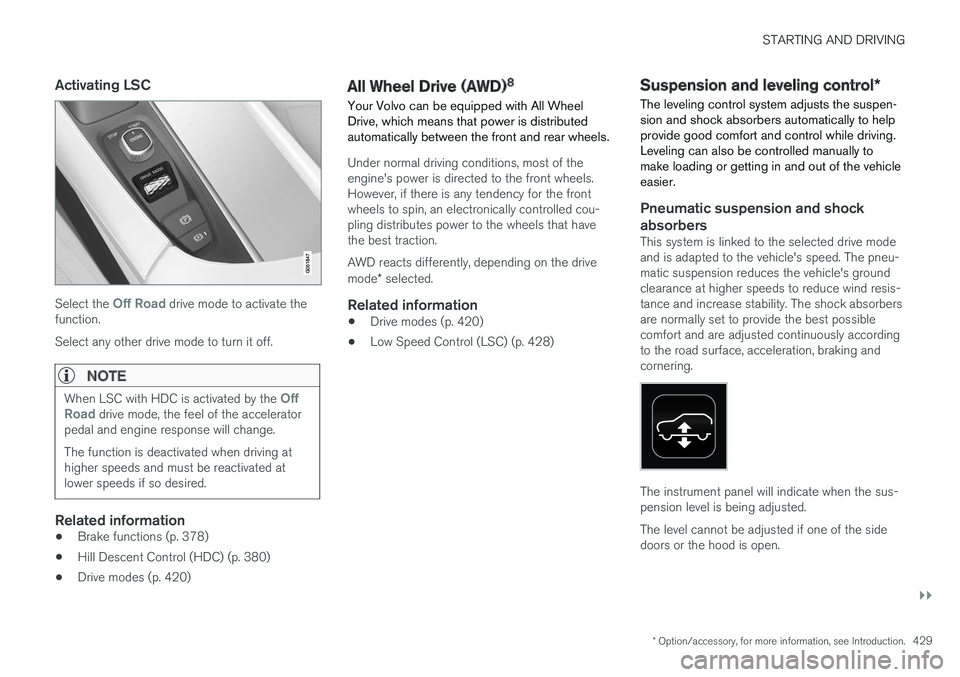
Select the Off Road drive mode to activate thefunction.
Select any other drive mode to turn it off.
NOTE
When LSC with HDC is activated by the OffRoad drive mode, the feel of the acceleratorpedal and engine response will change.
The function is deactivated when driving athigher speeds and must be reactivated atlower speeds if so desired.
Related information
•Brake functions (p. 378)
•Hill Descent Control (HDC) (p. 380)
•Drive modes (p. 420)
All Wheel Drive (AWD)8
Your Volvo can be equipped with All WheelDrive, which means that power is distributedautomatically between the front and rear wheels.
Under normal driving conditions, most of theengine's power is directed to the front wheels.However, if there is any tendency for the frontwheels to spin, an electronically controlled cou-pling distributes power to the wheels that havethe best traction.
AWD reacts differently, depending on the drivemode* selected.
Related information
•Drive modes (p. 420)
•Low Speed Control (LSC) (p. 428)
Suspension and leveling control*
The leveling control system adjusts the suspen-sion and shock absorbers automatically to helpprovide good comfort and control while driving.Leveling can also be controlled manually tomake loading or getting in and out of the vehicleeasier.
Pneumatic suspension and shock
absorbers
This system is linked to the selected drive modeand is adapted to the vehicle's speed. The pneu-matic suspension reduces the vehicle's groundclearance at higher speeds to reduce wind resis-tance and increase stability. The shock absorbersare normally set to provide the best possiblecomfort and are adjusted continuously accordingto the road surface, acceleration, braking andcornering.
The instrument panel will indicate when the sus-pension level is being adjusted.
The level cannot be adjusted if one of the sidedoors or the hood is open.
Page 493 of 584
WHEELS AND TIRES
}}
491
Installing a wheel
It is important to install wheels properly.
1. Clean the contact surfaces on the wheel andhub.
2.Lift the wheel and place it on the hub.
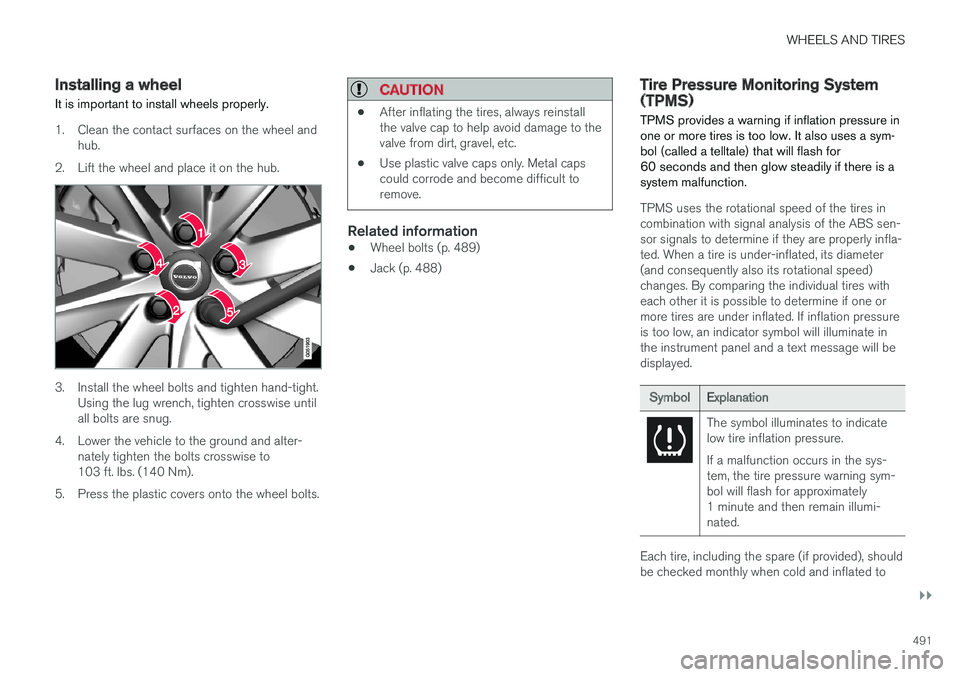
3. Install the wheel bolts and tighten hand-tight.Using the lug wrench, tighten crosswise untilall bolts are snug.
4.Lower the vehicle to the ground and alter-nately tighten the bolts crosswise to103 ft. lbs. (140 Nm).
5. Press the plastic covers onto the wheel bolts.
CAUTION
•After inflating the tires, always reinstallthe valve cap to help avoid damage to thevalve from dirt, gravel, etc.
•Use plastic valve caps only. Metal capscould corrode and become difficult toremove.
Related information
•Wheel bolts (p. 489)
•Jack (p. 488)
Tire Pressure Monitoring System(TPMS)
TPMS provides a warning if inflation pressure inone or more tires is too low. It also uses a sym-bol (called a telltale) that will flash for60 seconds and then glow steadily if there is asystem malfunction.
TPMS uses the rotational speed of the tires incombination with signal analysis of the ABS sen-sor signals to determine if they are properly infla-ted. When a tire is under-inflated, its diameter(and consequently also its rotational speed)changes. By comparing the individual tires witheach other it is possible to determine if one ormore tires are under inflated. If inflation pressureis too low, an indicator symbol will illuminate inthe instrument panel and a text message will bedisplayed.
SymbolExplanation
The symbol illuminates to indicatelow tire inflation pressure.
If a malfunction occurs in the sys-tem, the tire pressure warning sym-bol will flash for approximately1 minute and then remain illumi-nated.
Each tire, including the spare (if provided), shouldbe checked monthly when cold and inflated to
Page 509 of 584
MAINTENANCE AND SERVICING
507
Keep in mind that a download can be cancelledbut an installation that has already begun cannotbe interrupted.
Allowing background searches or
software updates
This function can be deactivated from the centerdisplay:
1. Go to the Settings in the center display's Topview and select Download Center.
2.Tap SystemDownload Center.
3.Tap to deselect Auto Software Update.
If an update is available, New software updatesavailable will appear in the center display's sta-tus bar. Tap the message to start a download appin Home view's lower sub-view. As soon as thedownload app has started, an icon in the Systemupdates button will indicate the number ofdownloads available.
Related information
•Center display overview (p. 33)
•Navigating in the center display's views(p. 43)
Remote updates
With the vehicle connected to the Internet,updates for a number of the vehicle's systemscan be downloaded from the center display.
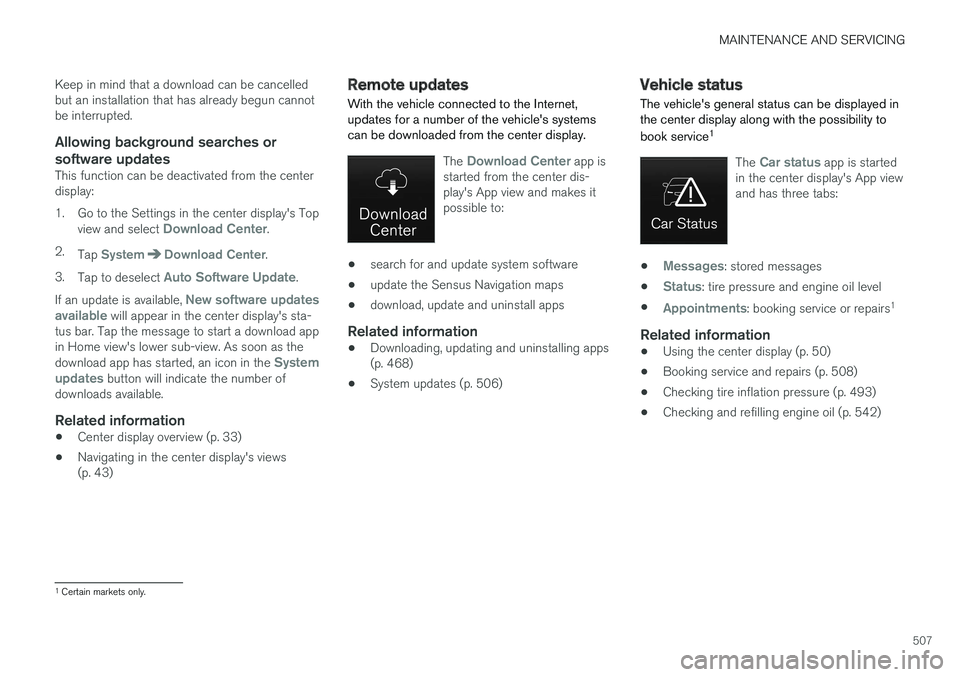
The Download Center app isstarted from the center dis-play's App view and makes itpossible to:
•search for and update system software
•update the Sensus Navigation maps
•download, update and uninstall apps
Related information
•Downloading, updating and uninstalling apps(p. 468)
•System updates (p. 506)
Vehicle status
The vehicle's general status can be displayed inthe center display along with the possibility to
book service1
The Car status app is startedin the center display's App viewand has three tabs:
•Messages: stored messages
•Status: tire pressure and engine oil level
•Appointments: booking service or repairs1
Related information
•Using the center display (p. 50)
•Booking service and repairs (p. 508)
•Checking tire inflation pressure (p. 493)
•Checking and refilling engine oil (p. 542)
1Certain markets only.
Page 514 of 584

MAINTENANCE AND SERVICING
512
Start battery
The vehicle's electrical system is single pole anduses the body and engine block as conductors.
The start (main) battery is used to power electri-cal components and systems. However, thehybrid battery is used to start the gasolineengine.
The start battery should only be replaced by atrained and qualified Volvo service technician.
The start battery is an Absorbed Glass Mat(AGM) 12-volt battery that is dimensioned foruse in vehicles to support electrical systems andfunctions.
The service life of a battery is affected by factorssuch as driving conditions/style, the number ofstarts, climate, etc. Extreme cold may also furtherdecrease the battery
Page 516 of 584
||
MAINTENANCE AND SERVICING
514
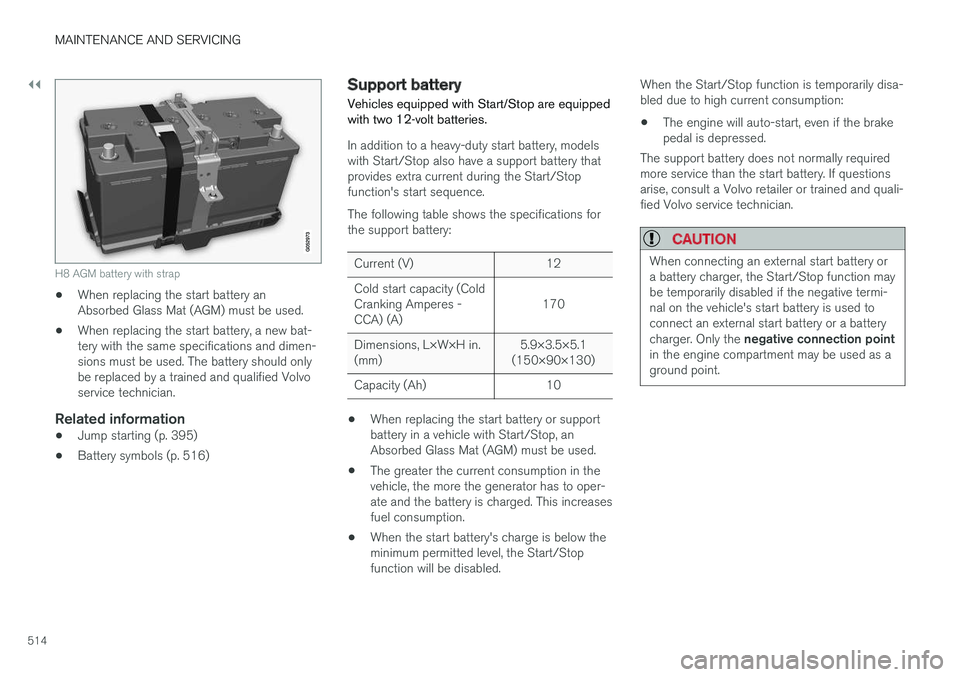
H8 AGM battery with strap
•When replacing the start battery anAbsorbed Glass Mat (AGM) must be used.
•When replacing the start battery, a new bat-tery with the same specifications and dimen-sions must be used. The battery should onlybe replaced by a trained and qualified Volvoservice technician.
Related information
•Jump starting (p. 395)
•Battery symbols (p. 516)
Support battery
Vehicles equipped with Start/Stop are equippedwith two 12-volt batteries.
In addition to a heavy-duty start battery, modelswith Start/Stop also have a support battery thatprovides extra current during the Start/Stopfunction's start sequence.
The following table shows the specifications forthe support battery:
Current (V)12
Cold start capacity (ColdCranking Amperes -CCA) (A)170
Dimensions, L×W×H in.(mm)5.9×3.5×5.1(150×90×130)
Capacity (Ah)10
•When replacing the start battery or supportbattery in a vehicle with Start/Stop, anAbsorbed Glass Mat (AGM) must be used.
•The greater the current consumption in thevehicle, the more the generator has to oper-ate and the battery is charged. This increasesfuel consumption.
•When the start battery's charge is below theminimum permitted level, the Start/Stopfunction will be disabled.
When the Start/Stop function is temporarily disa-bled due to high current consumption:
•The engine will auto-start, even if the brakepedal is depressed.
The support battery does not normally requiredmore service than the start battery. If questionsarise, consult a Volvo retailer or trained and quali-fied Volvo service technician.
CAUTION
When connecting an external start battery ora battery charger, the Start/Stop function maybe temporarily disabled if the negative termi-nal on the vehicle's start battery is used toconnect an external start battery or a batterycharger. Only the negative connection pointin the engine compartment may be used as aground point.