warning VOLVO XC90 TWIN ENGINE HYBRID 2017 User Guide
[x] Cancel search | Manufacturer: VOLVO, Model Year: 2017, Model line: XC90 TWIN ENGINE HYBRID, Model: VOLVO XC90 TWIN ENGINE HYBRID 2017Pages: 584, PDF Size: 14.2 MB
Page 57 of 584
INTRODUCTION
}}
55
Risk of damage to the vehicle
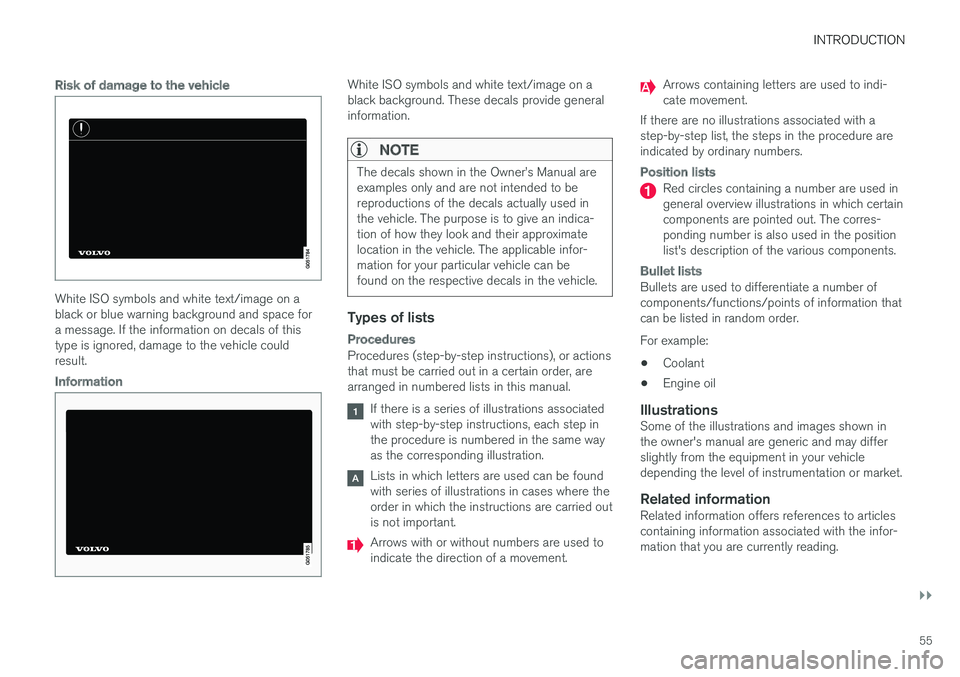
White ISO symbols and white text/image on ablack or blue warning background and space fora message. If the information on decals of thistype is ignored, damage to the vehicle couldresult.
Information
White ISO symbols and white text/image on ablack background. These decals provide generalinformation.
NOTE
The decals shown in the Owner
Page 61 of 584
INTRODUCTION
* Option/accessory, for more information, see Introduction.59
Using the search function
1.Tap the magnifying glass icon () in theowner's manual's upper menu. A keyboardwill appear at the bottom of the screen.
2.Enter a word, e.g., "seat belt."
> Suggested articles will be displayed asmore characters are entered.
3. Confirm by tapping the article. To leavesearch mode tap the up-arrow next to thesearch box.
Related information
•On-board digital owner's manual (p. 56)
•Using the center display keyboard (p. 36)
Glass
Laminated glass
The windshield and panoramic roof* are made oflaminated glass, which is reinforced to help pre-vent break-ins and to provide additional sound-proofing. Laminated glass is optional for theother side windows.
Laminated glass symbol5
Related information
•Laminated panoramic roof* (p. 110)
•Power windows (p. 113)
•Defrosting windows and mirrors (p. 206)
•Using sun shades (p. 115)
•Rearview mirror (p. 114)
•Power windows (p. 113)
•Head-up display (HUD)* (p. 122)
•Activating/deactivating the rain sensor(p. 162)
•Windshield and headlight washers (p. 163)
•Tailgate window wiper and washer (p. 164)
•Defrosting windows and mirrors (p. 206)
Technician certification
In addition to Volvo factory training, Volvo sup-ports certification by the National Institute forAutomotive Service Excellence (A.S.E.).
Certified technicians have demonstrated a highdegree of competence in specific areas. Besidespassing exams, each technician must also haveworked in the field for two or more years before acertificate is issued. These professional techni-cians are best able to analyze vehicle problemsand perform the necessary maintenance proce-dures to keep your Volvo at peak operating con-dition.
XC90 T8 Twin Engine Plug-in Hybrid
Technicians performing work on a vehicle withelectrification should also have the necessarytraining and specialized certification required forperforming repairs and/or maintenance on avehicle with electrification.
WARNING
A number of electrical components in theXC90 T8 Twin Engine Plug-in Hybrid usehigh-voltage current and can be extremelydangerous if handled incorrectly. These com-ponents and any orange wiring in the vehiclemay only be handled by trained and qualifiedVolvo service technicians.
5This symbol is not shown on the windshield or moon roof/panoramic roof.
Page 64 of 584
SAFETY
62
General safety information
The vehicle is equipped with a number of safetysystems for the driver and passengers.
In the event of an accident, there are a number ofsensors in the vehicle that react and triggersafety systems such as Roll Stability Control, air-bags, seat belt pretensioners, etc., depending onthe severity of the collision. There are alsomechanical systems such as the WhiplashProtection System.
Warning symbol in the instrument panel
The warning symbol in the instrumentpanel illuminates when the ignition is inmode II or higher. It will go out afterapprox. 6 seconds if no faults aredetected in the airbag system.
WARNING
•If the SRS warning light stays on after theengine has started or if it illuminateswhile you are driving, have the vehicleinspected by a trained and qualified Volvoservice technician as soon as possible.
•Never try to repair any component or partof the SRS yourself. Any interference inthe system could cause malfunction andserious injury. All work on these systemsshould be performed by a trained andqualified Volvo service technician.
If the dedicated warning symbol is notfunctioning, the general warning sym-bol will illuminate instead and the samemessage will be displayed in the instru-ment panel.
Related information
•Safety during pregnancy (p. 64)
•Seat belts (p. 66)
•Airbag system (p. 71)
•Safety mode (p. 79)
•Whiplash protection system (p. 65)
•Child safety (p. 81)
Occupant safety
Safety is Volvo's cornerstone.
Volvo's concern for safety
Our concern for safety dates back to 1927 whenthe first Volvo rolled off the production line.Three-point seat belts (a Volvo invention), safetycages, and energy-absorbing impact zones weredesigned into Volvo vehicles long before it wasfashionable or required by government regulation.
We will not compromise our commitment tosafety. We continue to seek out new safety fea-tures and to refine those already in our vehicles.You can help. We would appreciate hearing yoursuggestions about improving automobile safety.We also want to know if you ever have a safetyconcern with your vehicle. Call us in the U.S. at:1-800-458-1552 or in Canada at:1-800-663-8255.
Page 67 of 584
SAFETY
}}
* Option/accessory, for more information, see Introduction.65
Related information
•Buckling and unbuckling seat belts (p. 67)
•Adjusting power front seats* (p. 168)
•Manually operated front seats (p. 167)
Whiplash protection system
The Whiplash protection system (WHIPS) con-sists of specially designed hinges and bracketson the front seat backrests designed to helpabsorb some of the energy generated in a colli-sion from the rear (when the vehicle is rear-ended).
Function
In the event of certain rear-end collisions, thehinges and brackets of the front seat backrestsare designed to change position slightly to allowthe backrest/head restraint to help support theoccupant's head before moving slightly rearward.This movement helps absorb some of the forcesthat could result in whiplash.
WARNING
•The WHIPS system is designed to sup-plement the other safety systems in yourvehicle. For this system to function prop-erly, the three-point seat belt must beworn. Please be aware that no systemcan prevent all possible injuries that mayoccur in an accident.
•The WHIPS system is designed to func-tion in certain collisions from the rear,depending on the crash severity, angleand speed.
WARNING
•Occupants in the front seats must neversit out of position. The occupant's backmust be as upright as comfort allows andbe against the seat back with the seatbelt properly fastened.
•If your vehicle has been involved in a rear-end collision, the front seat backrestsmust be inspected by a trained and quali-fied Volvo service technician, even if theseats appear to be undamaged. Certaincomponents in the WHIPS system mayneed to be replaced.
•Do not attempt to service any componentin the WHIPS system yourself.
WARNING
•Boxes, suitcases, etc. wedged behind thefront seats could impede the function ofthe Whiplash Protection System.
•If the rear seat backrests are foldeddown, cargo must be secured to preventit from sliding forward against the frontseat backrests in the event of a collisionfrom the rear. This could interfere withthe action of the Whiplash ProtectionSystem.
Page 68 of 584
||
SAFETY
* Option/accessory, for more information, see Introduction.66
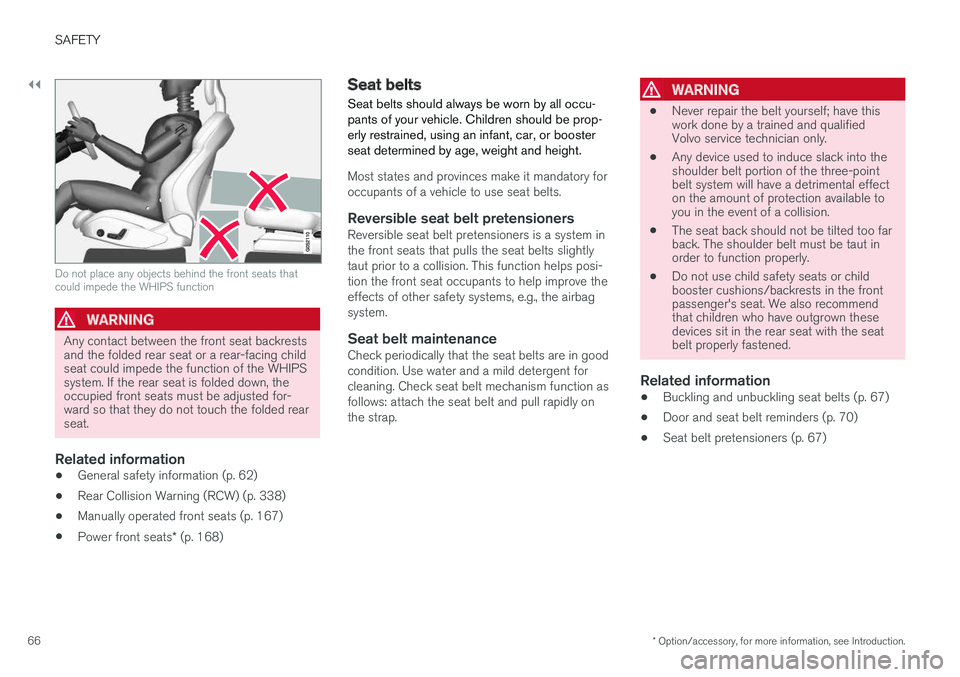
Do not place any objects behind the front seats thatcould impede the WHIPS function
WARNING
Any contact between the front seat backrestsand the folded rear seat or a rear-facing childseat could impede the function of the WHIPSsystem. If the rear seat is folded down, theoccupied front seats must be adjusted for-ward so that they do not touch the folded rearseat.
Related information
•General safety information (p. 62)
•Rear Collision Warning (RCW) (p. 338)
•Manually operated front seats (p. 167)
•Power front seats* (p. 168)
Seat belts
Seat belts should always be worn by all occu-pants of your vehicle. Children should be prop-erly restrained, using an infant, car, or boosterseat determined by age, weight and height.
Most states and provinces make it mandatory foroccupants of a vehicle to use seat belts.
Reversible seat belt pretensioners
Reversible seat belt pretensioners is a system inthe front seats that pulls the seat belts slightlytaut prior to a collision. This function helps posi-tion the front seat occupants to help improve theeffects of other safety systems, e.g., the airbagsystem.
Seat belt maintenance
Check periodically that the seat belts are in goodcondition. Use water and a mild detergent forcleaning. Check seat belt mechanism function asfollows: attach the seat belt and pull rapidly onthe strap.
WARNING
•Never repair the belt yourself; have thiswork done by a trained and qualifiedVolvo service technician only.
•Any device used to induce slack into theshoulder belt portion of the three-pointbelt system will have a detrimental effecton the amount of protection available toyou in the event of a collision.
•The seat back should not be tilted too farback. The shoulder belt must be taut inorder to function properly.
•Do not use child safety seats or childbooster cushions/backrests in the frontpassenger's seat. We also recommendthat children who have outgrown thesedevices sit in the rear seat with the seatbelt properly fastened.
Related information
•Buckling and unbuckling seat belts (p. 67)
•Door and seat belt reminders (p. 70)
•Seat belt pretensioners (p. 67)
Page 69 of 584
SAFETY
}}
67
Seat belt pretensioners
The vehicle's seat belts are equipped with stand-ard and electric pretensioners that can help pullthe seat belts taut in a critical situation or a colli-sion. Some or all of the pretensioners will betriggered in certain types of collisions, depend-ing on the direction and severity of the impact.
Reversible seat belt pretensioners
Reversible seat belt pretensioners is a system inthe front seats that pulls the seat belts slightlytaut prior to a collision. This function helps posi-tion the front seat occupants to help improve theeffects of other safety systems, e.g., the airbagsystem.
Seat belt pretensioners in collisions
The seat belts are equipped with standard pre-tensioners that are triggered according to theseverity of a collision.
Seat belt pretensioners in critical
situations
In addition to the standard pretensioners, theseat belts in the front seats are also equippedwith electric pretensioners.
The pretensioners interact and can be triggeredalong with the City Safety and Rear CollisionWarning systems. In critical situations such assudden braking, evasive maneuvers, etc., the seatbelt can be pulled taut by the pretensioner'selectric motor.
The electric pretensioner positions the occupantin the seat to help reduce the risk of striking theinterior of the passenger compartment andimproves the effect of other safety systems suchas the airbags.
Resetting the electric pretensioners
When a critical situation has passed, the seat beltand the electric pretensioner are reset automati-cally.
If the seat belt should remain taut:
1. Stop the vehicle safely.
2. Unbuckle the seat belt and rebuckle it.
> The seat belt and the electric preten-sioner will be reset.
Related information
•Seat belts (p. 66)
•Door and seat belt reminders (p. 70)
•Buckling and unbuckling seat belts (p. 67)
Buckling and unbuckling seat belts
Seat belts should be used by all occupants inthe vehicle when it is in motion.
Page 70 of 584
||
SAFETY
68
Buckling a seat belt
1. Pull the belt out slowly. It should not be twis-ted or turned.
Be sure that the seat belt in the center posi-tion of the second row of seats is correctlypositioned in the seat belt guide.
NOTE
Each seat belt is equipped with a seat beltretractor that will lock up in the following sit-uations:
•if the belt is pulled out rapidly
•during braking and acceleration
•if the vehicle is leaning excessively
•when driving in turns
•if the Automatic Locking Retractor/Emer-gency Locking Retractor (ALR/ELR) isactivated (each seat belt (except for thedriver's belt) is equipped with theALR/ELR function, which is designed tohelp keep the seat belt taut. ALR/ELRactivates if the seat belt is pulled out as faras possible. If this is done, a sound fromthe seat belt retractor will be audible,which is normal, and the seat belt will bepulled taut and locked in place. This func-tion is automatically disabled when theseat belt is unbuckled and fully retracted).
2. Insert the latch plate into the receptacle. Theseat belt retractor is normally "unlocked" andyou can move freely, provided that the shoul-der belt is not pulled out too far.
>A distinct click will be audible.
WARNING
The seat belt latch plate should only beinserted into its intended receptacle. Insertingit into one of the other receptacles may pre-vent it from functioning properly.
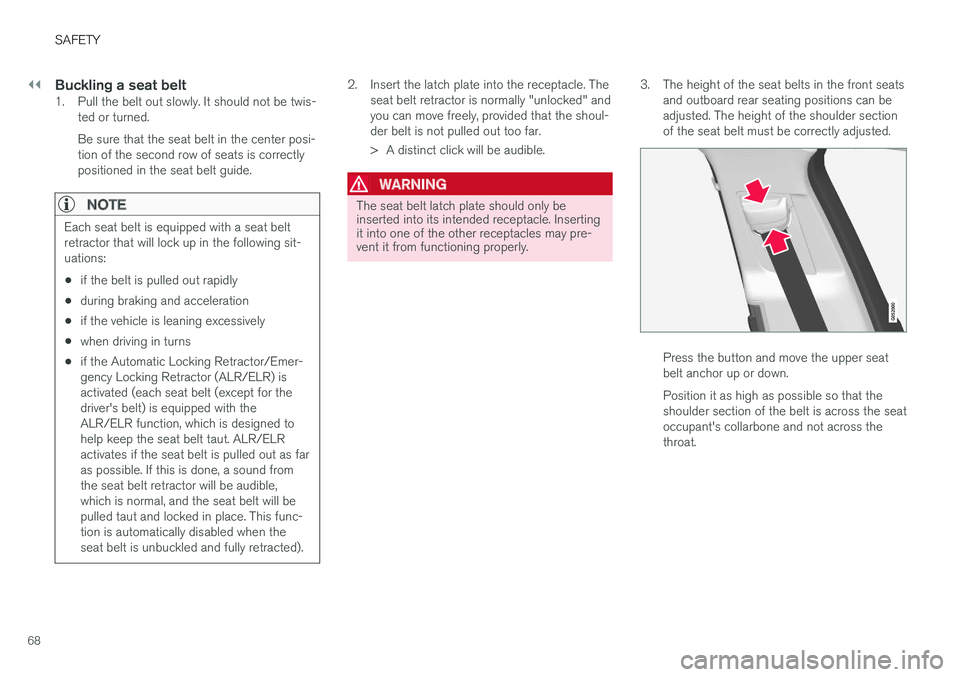
3.The height of the seat belts in the front seatsand outboard rear seating positions can beadjusted. The height of the shoulder sectionof the seat belt must be correctly adjusted.
Press the button and move the upper seatbelt anchor up or down.
Position it as high as possible so that theshoulder section of the belt is across the seatoccupant's collarbone and not across thethroat.
Page 71 of 584
SAFETY
69
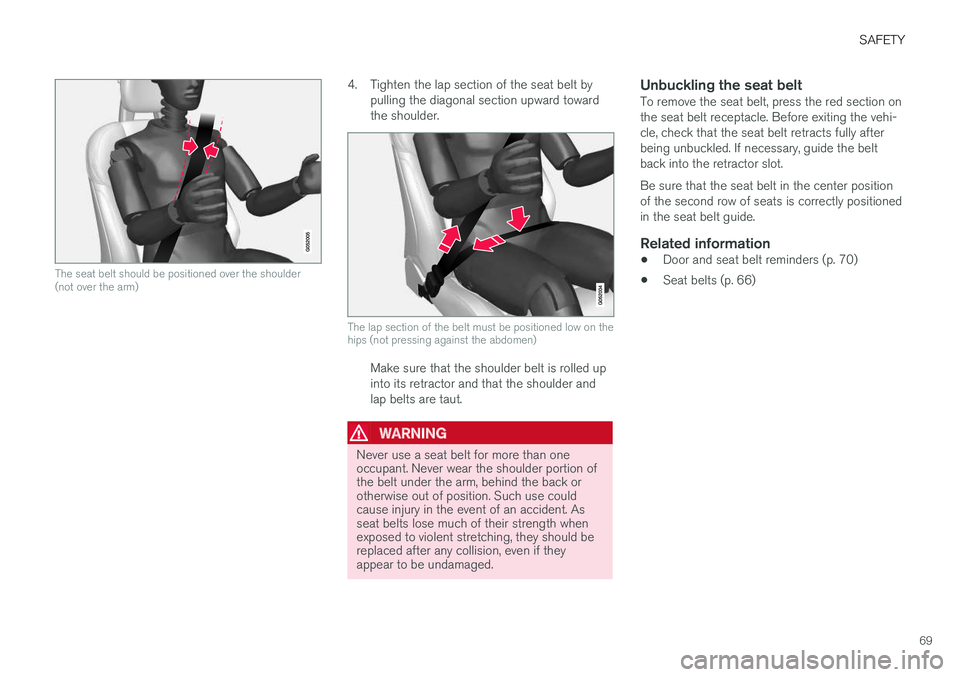
The seat belt should be positioned over the shoulder(not over the arm)
4. Tighten the lap section of the seat belt bypulling the diagonal section upward towardthe shoulder.
The lap section of the belt must be positioned low on thehips (not pressing against the abdomen)
Make sure that the shoulder belt is rolled upinto its retractor and that the shoulder andlap belts are taut.
WARNING
Never use a seat belt for more than oneoccupant. Never wear the shoulder portion ofthe belt under the arm, behind the back orotherwise out of position. Such use couldcause injury in the event of an accident. Asseat belts lose much of their strength whenexposed to violent stretching, they should bereplaced after any collision, even if theyappear to be undamaged.
Unbuckling the seat belt
To remove the seat belt, press the red section onthe seat belt receptacle. Before exiting the vehi-cle, check that the seat belt retracts fully afterbeing unbuckled. If necessary, guide the beltback into the retractor slot.
Be sure that the seat belt in the center positionof the second row of seats is correctly positionedin the seat belt guide.
Related information
•Door and seat belt reminders (p. 70)
•Seat belts (p. 66)
Page 72 of 584
SAFETY
70
Door and seat belt reminders
The door and seat belt reminders are intendedto alert all occupants of the vehicle that theirseat belts should be buckled before the vehiclebegins to move or if a door, the hood, tailgate orfuel filler door have not been closed properly.
Graphics in the instrument panel
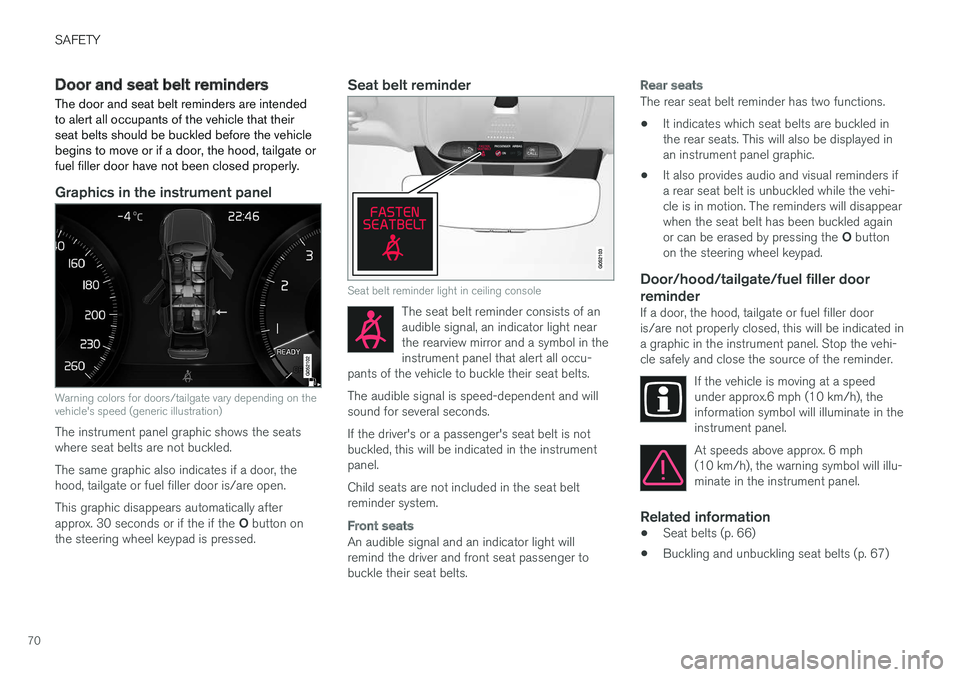
Warning colors for doors/tailgate vary depending on thevehicle's speed (generic illustration)
The instrument panel graphic shows the seatswhere seat belts are not buckled.
The same graphic also indicates if a door, thehood, tailgate or fuel filler door is/are open.
This graphic disappears automatically afterapprox. 30 seconds or if the if the O button onthe steering wheel keypad is pressed.
Seat belt reminder
Seat belt reminder light in ceiling console
The seat belt reminder consists of anaudible signal, an indicator light nearthe rearview mirror and a symbol in theinstrument panel that alert all occu-pants of the vehicle to buckle their seat belts.
The audible signal is speed-dependent and willsound for several seconds.
If the driver's or a passenger's seat belt is notbuckled, this will be indicated in the instrumentpanel.
Child seats are not included in the seat beltreminder system.
Front seats
An audible signal and an indicator light willremind the driver and front seat passenger tobuckle their seat belts.
Rear seats
The rear seat belt reminder has two functions.
•It indicates which seat belts are buckled inthe rear seats. This will also be displayed inan instrument panel graphic.
•It also provides audio and visual reminders ifa rear seat belt is unbuckled while the vehi-cle is in motion. The reminders will disappearwhen the seat belt has been buckled againor can be erased by pressing the O buttonon the steering wheel keypad.
Door/hood/tailgate/fuel filler door
reminder
If a door, the hood, tailgate or fuel filler dooris/are not properly closed, this will be indicated ina graphic in the instrument panel. Stop the vehi-cle safely and close the source of the reminder.
If the vehicle is moving at a speedunder approx.6 mph (10 km/h), theinformation symbol will illuminate in theinstrument panel.
At speeds above approx. 6 mph(10 km/h), the warning symbol will illu-minate in the instrument panel.
Related information
•Seat belts (p. 66)
•Buckling and unbuckling seat belts (p. 67)
Page 73 of 584
SAFETY
}}
71
Airbag system
As an enhancement to the three-point seat belts,your vehicle is equipped with an airbag system.
WARNING
•If the airbag warning light stays on afterthe engine has started or if it illuminateswhile you are driving, have the vehicleinspected by a trained and qualified Volvoservice technician as soon as possible.
•Never try to repair any component or partof the airbag systems yourself. Any inter-ference in the system could cause mal-function and serious injury. All work onthese systems should be performed by atrained and qualified Volvo service techni-cian.
WARNING
If your vehicle has become flood-damaged inany way (e.g., soaked carpeting/standingwater on the floor of the vehicle), do notattempt to start the vehicle. This may causeairbag deployment which could result in seri-ous injury. Have the vehicle towed to a trainedand qualified Volvo service technician forrepairs.
Before attempting to tow the vehicle:
1.Switch off the ignition for at least10 minutes and disconnect the battery.
2. Follow the instructions for manually over-riding the shiftlock system.
Deployed airbags
WARNING
If any of the airbags have deployed:
•Do not attempt to drive the vehicle. Haveit towed to a qualified repair facility.
•If necessary seek medical attentIon.
Driver/passenger side airbags
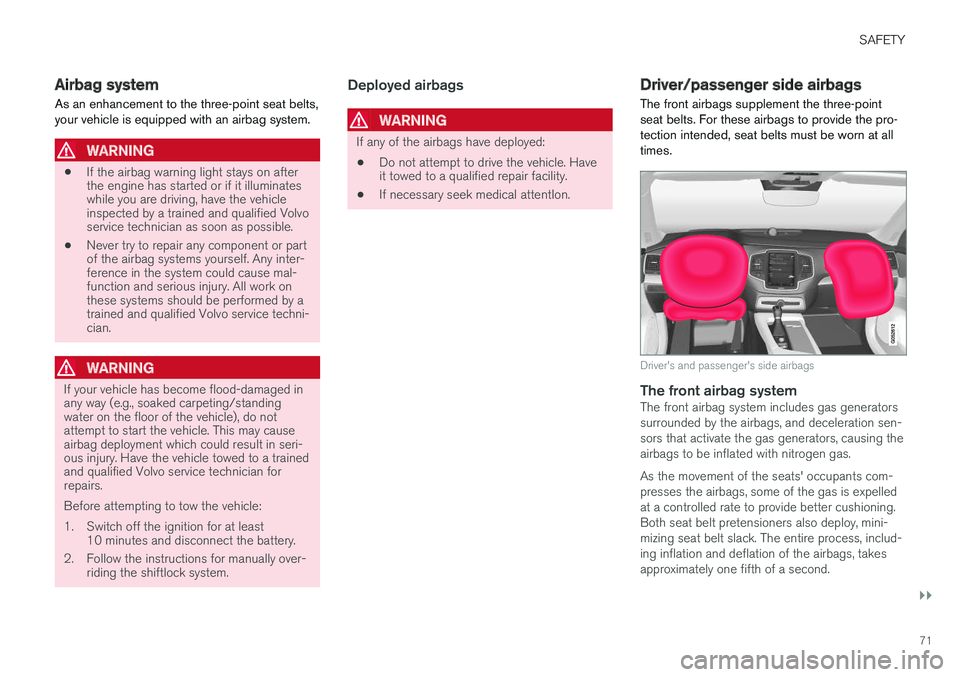
The front airbags supplement the three-pointseat belts. For these airbags to provide the pro-tection intended, seat belts must be worn at alltimes.
Driver's and passenger's side airbags
The front airbag system
The front airbag system includes gas generatorssurrounded by the airbags, and deceleration sen-sors that activate the gas generators, causing theairbags to be inflated with nitrogen gas.
As the movement of the seats' occupants com-presses the airbags, some of the gas is expelledat a controlled rate to provide better cushioning.Both seat belt pretensioners also deploy, mini-mizing seat belt slack. The entire process, includ-ing inflation and deflation of the airbags, takesapproximately one fifth of a second.