wheel YAMAHA BT1100 2002 User Guide
[x] Cancel search | Manufacturer: YAMAHA, Model Year: 2002, Model line: BT1100, Model: YAMAHA BT1100 2002Pages: 96, PDF Size: 3.32 MB
Page 80 of 96
MOTORCYCLE CARE AND STORAGE
Care
While the open design of a motorcycle re-
veals the attractiveness of the technology,
it also makes it more vulnerable. Rust and
corrosion can develop even if high-quality
components are used. A rusty exhaust
pipe may go unnoticed on a car, however,
it detracts from the overall appearance of a
motorcycle. Frequent and proper care
does not only comply with the terms of the
warranty, but it will also keep your motor-
cycle looking good, extend its life and opti-
mize its performance.Before cleaning
1. Cover the muffler outlets with plastic
bags after the engine has cooled
down.
2. Make sure that all caps and covers as
well as all electrical couplers and con-
nectors, including the spark plug
caps, are tightly installed.
3. Remove extremely stubborn dirt, like
oil burnt onto the crankcase, with a
degreasing agent and a brush, but
never apply such products onto
seals, gaskets and wheel axles. Al-
ways rinse the dirt and degreaser off
with water.CleaningECA00010
•Avoid using strong acidic wheel
cleaners, especially on spoked
wheels. If such products are used
on hard-to-remove dirt, do not
leave the cleaner on the affected
area any longer than instructed.
Also, thoroughly rinse the area off
with water, immediately dry it, and
then apply a corrosion protection
spray.
•Improper cleaning can damage
windshields, cowlings, panels and
other plastic parts. Use only a soft,
clean cloth or sponge with mild
detergent and water to clean plas-
tic.
CAUTION:
EAU03412
7-1
7
Page 81 of 96
MOTORCYCLE CARE AND STORAGE
•Do not use any harsh chemical
products on plastic parts. Be sure
to avoid using cloths or sponges
which have been in contact with
strong or abrasive cleaning prod-
ucts, solvent or thinner, fuel (gaso-
line), rust removers or inhibitors,
brake fluid, antifreeze or elec-
trolyte.
•Do not use high-pressure washers
or steam-jet cleaners since they
cause water seepage and deterio-
ration in the following areas: seals
(of wheel and swingarm bearings,
fork and brakes), electric compo-
nents (couplers, connectors,
instruments, switches and lights),
breather hoses and vents.
•For motorcycles equipped with a
windshield: Do not use strong
cleaners or hard sponges as they
will cause dulling or scratching.
Some cleaning compounds for
plastic may leave scratches on the
windshield. Test the product on asmall hidden part of the wind-
shield to make sure that it does
not leave any marks. If the wind-
shield is scratched, use a quality
plastic polishing compound after
washing.
After normal use
Remove dirt with warm water, a mild deter-
gent, and a soft, clean sponge, and then
rinse thoroughly with clean water. Use a
toothbrush or bottlebrush for hard-to-reach
areas. Stubborn dirt and insects will come
off more easily if the area is covered with a
wet cloth for a few minutes before clean-
ing.After riding in the rain, near the sea or on
salt-sprayed roads
Since sea salt or salt sprayed on roads
during winter are extremely corrosive in
combination with water, carry out the fol-
lowing steps after each ride in the rain,
near the sea or on salt-sprayed roads.
NOTE:
Salt sprayed on roads in the winter may
remain well into spring.
1. Clean the motorcycle with cold water
and a mild detergent, after the engine
has cooled down.
ECA00012
Do not use warm water since it increas-
es the corrosive action of the salt.
2. After drying the motorcycle, apply a
corrosion protection spray on all met-
al, including chrome- and nickel-plat-
ed, surfaces to prevent corrosion.
CAUTION:
EAU03412
7-2
7
Page 84 of 96
MOTORCYCLE CARE AND STORAGE
6. Lubricate all control cables and the
pivoting points of all levers and ped-
als as well as of the sidestand/center-
stand.
7. Check and, if necessary, correct the
tire air pressure, and then lift the mo-
torcycle so that both of its wheels are
off the ground. Alternatively, turn the
wheels a little every month in order to
prevent the tires from becoming de-
graded in one spot.
8. Cover the muffler outlets with plastic
bags to prevent moisture from enter-
ing them.9. Remove the battery and fully charge
it. Store it in a cool, dry place and
charge it once a month. Do not store
the battery in an excessively cold or
warm place (less than 0 °C or more
than 30 °C). For more information on
storing the battery, see page 6-27.
NOTE:
Make any necessary repairs before stor-
ing the motorcycle.
7-5
7
EAU03412
Page 86 of 96
SPECIFICATIONSEAU01038
8-1
8
Specifications
ModelBT1100
Dimensions
Overall length 2,200 mm
Overall width 800 mm
Overall height 1,140 mm
Seat height 812 mm
Wheelbase 1,530 mm
Ground clearance 168 mm
Minimum turning radius 2,980 mm
Basic weight
(with oil and full fuel tank)250.5 kg
Engine
Engine type Air-cooled 4-stroke,
SOHC
Cylinder arrangement V type 2-cylinder
Displacement 1,063 cm
3
Bore x stroke 95.0 x 75.0 mm
Compression ratio 8.3 : 1
Starting system Electric starter
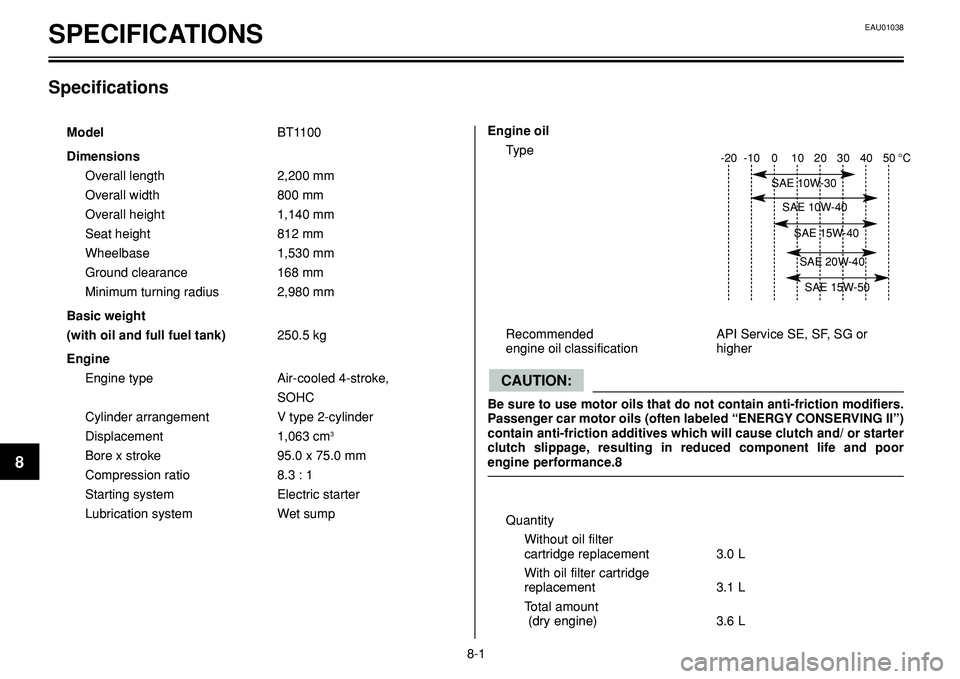
Lubrication system Wet sumpEngine oil
Ty p e
Recommended API Service SE, SF, SG or
engine oil classification higher
Be sure to use motor oils that do not contain anti-friction modifiers.
Passenger car motor oils (often labeled “ENERGY CONSERVING II”)
contain anti-friction additives which will cause clutch and/ or starter
clutch slippage, resulting in reduced component life and poor
engine performance.8
Quantity
Without oil filter
cartridge replacement 3.0 L
With oil filter cartridge
replacement 3.1 L
Total amount
(dry engine) 3.6 L
CAUTION:
-20-10 0 1020304050°C
SAE 10W-30
SAE 10W-40
SAE 20W-40
SAE 15W-50
SAE 15W-40
Page 88 of 96
SPECIFICATIONS
8-3
8
EAU01038
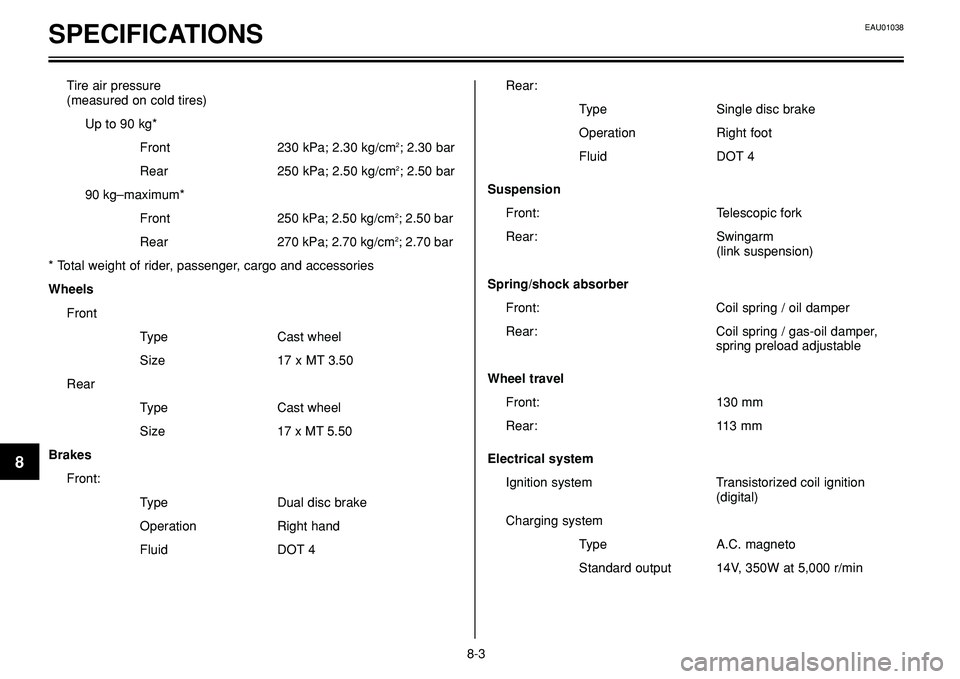
Tire air pressure
(measured on cold tires)
Up to 90 kg*
Front 230 kPa; 2.30 kg/cm
2; 2.30 bar
Rear 250 kPa; 2.50 kg/cm
2; 2.50 bar
90 kg–maximum*
Front 250 kPa; 2.50 kg/cm
2; 2.50 bar
Rear 270 kPa; 2.70 kg/cm
2; 2.70 bar
* Total weight of rider, passenger, cargo and accessories
Wheels
Front
Type Cast wheel
Size 17 x MT 3.50
Rear
Type Cast wheel
Size 17 x MT 5.50
Brakes
Front:
Type Dual disc brake
Operation Right hand
Fluid DOT 4Rear:
Type Single disc brake
Operation Right foot
Fluid DOT 4
Suspension
Front: Telescopic fork
Rear: Swingarm
(link suspension)
Spring/shock absorber
Front: Coil spring / oil damper
Rear: Coil spring / gas-oil damper,
spring preload adjustable
Wheel travel
Front: 130 mm
Rear: 113 mm
Electrical system
Ignition system Transistorized coil ignition
(digital)
Charging system
Type A.C. magneto
Standard output 14V, 350W at 5,000 r/min
Page 94 of 96
INDEX
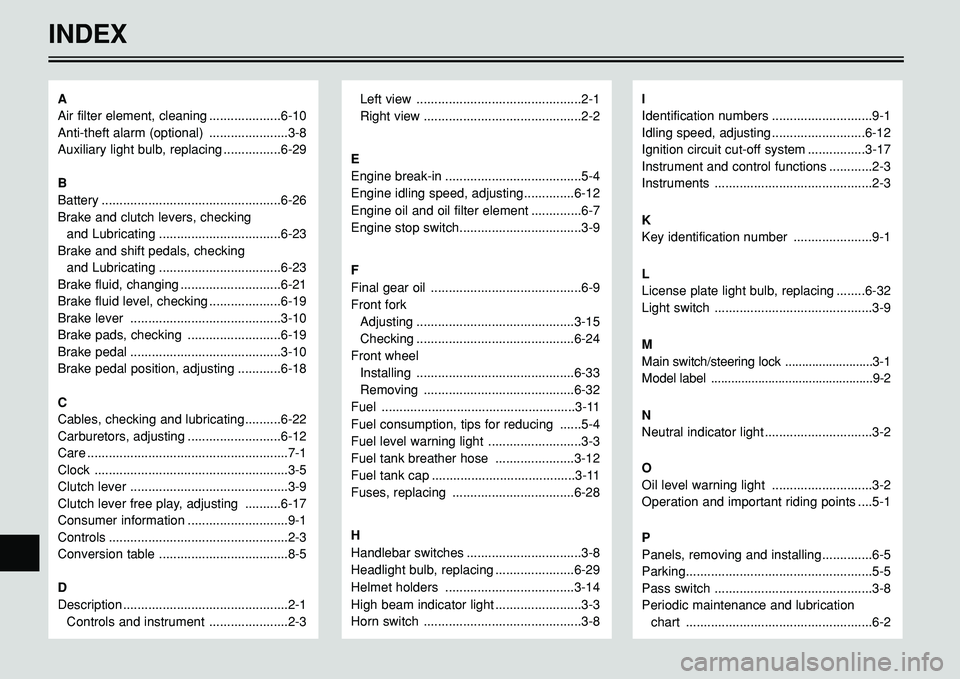
A
Air filter element, cleaning ....................6-10
Anti-theft alarm (optional) ......................3-8
Auxiliary light bulb, replacing ................6-29
B
Battery ..................................................6-26
Brake and clutch levers, checking
and Lubricating ..................................6-23
Brake and shift pedals, checking
and Lubricating ..................................6-23
Brake fluid, changing ............................6-21
Brake fluid level, checking ....................6-19
Brake lever ..........................................3-10
Brake pads, checking ..........................6-19
Brake pedal ..........................................3-10
Brake pedal position, adjusting ............6-18
C
Cables, checking and lubricating..........6-22
Carburetors, adjusting ..........................6-12
Care ........................................................7-1
Clock ......................................................3-5
Clutch lever ............................................3-9
Clutch lever free play, adjusting ..........6-17
Consumer information ............................9-1
Controls ..................................................2-3
Conversion table ....................................8-5
D
Description ..............................................2-1
Controls and instrument ......................2-3Left view ..............................................2-1
Right view ............................................2-2
E
Engine break-in ......................................5-4
Engine idling speed, adjusting..............6-12
Engine oil and oil filter element ..............6-7
Engine stop switch..................................3-9
F
Final gear oil ..........................................6-9
Front fork
Adjusting ............................................3-15
Checking ............................................6-24
Front wheel
Installing ............................................6-33
Removing ..........................................6-32
Fuel ......................................................3-11
Fuel consumption, tips for reducing ......5-4
Fuel level warning light ..........................3-3
Fuel tank breather hose ......................3-12
Fuel tank cap ........................................3-11
Fuses, replacing ..................................6-28
H
Handlebar switches ................................3-8
Headlight bulb, replacing ......................6-29
Helmet holders ....................................3-14
High beam indicator light ........................3-3
Horn switch ............................................3-8I
Identification numbers ............................9-1
Idling speed, adjusting ..........................6-12
Ignition circuit cut-off system ................3-17
Instrument and control functions ............2-3
Instruments ............................................2-3
K
Key identification number ......................9-1
L
License plate light bulb, replacing ........6-32
Light switch ............................................3-9
M
Main switch/steering lock ..........................3-1
Model label ................................................9-2
N
Neutral indicator light ..............................3-2
O
Oil level warning light ............................3-2
Operation and important riding points ....5-1
P
Panels, removing and installing..............6-5
Parking....................................................5-5
Pass switch ............................................3-8
Periodic maintenance and lubrication
chart ....................................................6-2
Page 95 of 96
INDEX
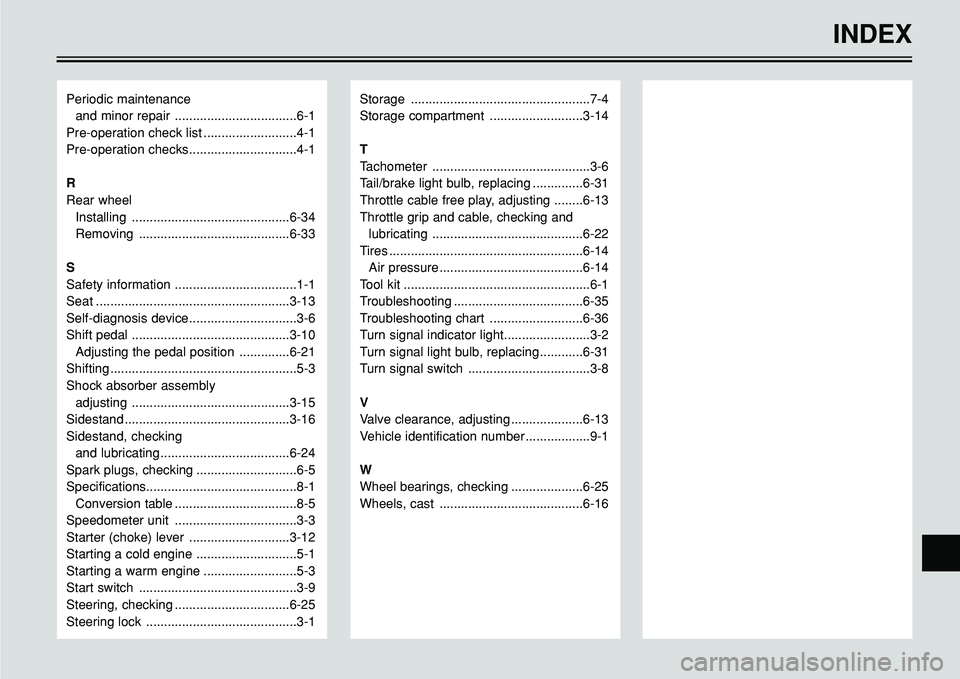
Periodic maintenance
and minor repair ..................................6-1
Pre-operation check list ..........................4-1
Pre-operation checks..............................4-1
R
Rear wheel
Installing ............................................6-34
Removing ..........................................6-33
S
Safety information ..................................1-1
Seat ......................................................3-13
Self-diagnosis device..............................3-6
Shift pedal ............................................3-10
Adjusting the pedal position ..............6-21
Shifting ....................................................5-3
Shock absorber assembly
adjusting ............................................3-15
Sidestand ..............................................3-16
Sidestand, checking
and lubricating ....................................6-24
Spark plugs, checking ............................6-5
Specifications..........................................8-1
Conversion table ..................................8-5
Speedometer unit ..................................3-3
Starter (choke) lever ............................3-12
Starting a cold engine ............................5-1
Starting a warm engine ..........................5-3
Start switch ............................................3-9
Steering, checking ................................6-25
Steering lock ..........................................3-1Storage ..................................................7-4
Storage compartment ..........................3-14
T
Tachometer ............................................3-6
Tail/brake light bulb, replacing ..............6-31
Throttle cable free play, adjusting ........6-13
Throttle grip and cable, checking and
lubricating ..........................................6-22
Tires ......................................................6-14
Air pressure ........................................6-14
Tool kit ....................................................6-1
Troubleshooting ....................................6-35
Troubleshooting chart ..........................6-36
Turn signal indicator light........................3-2
Turn signal light bulb, replacing............6-31
Turn signal switch ..................................3-8
V
Valve clearance, adjusting ....................6-13
Vehicle identification number ..................9-1
W
Wheel bearings, checking ....................6-25
Wheels, cast ........................................6-16