wheel YAMAHA EC-03 2012 Owners Manual
[x] Cancel search | Manufacturer: YAMAHA, Model Year: 2012, Model line: EC-03, Model: YAMAHA EC-03 2012Pages: 78, PDF Size: 2.19 MB
Page 6 of 78

TABLE OF CONTENTSSAFETY INFORMATION .................. 1-1
Further safe-riding points ................ 1-5
Charging the battery sa fely ............. 1-5
DESCRIPTION .................................. 2-1
Left view .......................................... 2-1
Right view ........................................ 2-2
Controls and instrument s................. 2-3
EC-03 FEATURES ............................. 3-1
Features ......................................... 3-1
Traveling distance .......................... 3-1
Effective use of the battery ............. 3-2
Battery level .................................... 3-3
INSTRUMENT AND CONTROL
FUNCTIONS ....................................... 4-1
Beeper ............................................ 4-1
Main switch/steering lock ................ 4-1
Multi-function display ...................... 4-2
Using the security lock .................... 4-7
Handlebar switches ...................... 4-11
Front brake lever .......................... 4-11
Rear brake lever ........................... 4-11
Seat .............................................. 4-12
Helmet holder ............................... 4-12
Luggage hook ............................... 4-13
Grab bar ....................................... 4-13
FOR YOUR SAFETY –
PRE-OPERATION CHECKS .............. 5-1CHARGING THE BATTERY
.............. 6-1
Battery charging locati on ................ 6-1
Charging procedure ....................... 6-3
Charging time ................................. 6-8
Display of charging progress status .......................................... 6-9
About the battery ............................ 6-9
OPERATION AND IMPORTANT
RIDING POINTS ................................. 7-1
Preparations for starting off ............ 7-1
Starting off ...................................... 7-3
Acceleration and deceleration ........ 7-4
Braking ........................................... 7-5
Parking ........................................... 7-5
PERIODIC MAINTENANCE AND
ADJUSTMENT ................................... 8-1
General maintenance and lubrication chart .......................... 8-2
Checking for irregular motor sounds ........................................ 8-4
Checking the accelerato r grip ........ 8-4
Tires ............................................... 8-5
Cast wheels .................................... 8-6
Adjusting the front and rear brake lever free play ............................. 8-6
Checking the front and rear brake
shoes .......................................... 8-8
Checking and lubricating the cables ......................................... 8-8 Lubricating the front and rear
brake levers ................................. 8-9
Checking and lubricating the centerstand .................................. 8-9
Checking the front fork .................. 8-10
Checking the steering ................... 8-10
Checking the wheel bearings ........ 8-11
Replacing the headlight bulb ........ 8-11
Replacing the tail/brake light bulb ............................................ 8-12
Replacing a turn signal light
bulb ............................................ 8-13
Checking the charging cord and charging plug ............................. 8-14
Troubleshooting .......... .................. 8-15
SCOOTER CARE AND STORAGE .... 9-1
Matte color caution ......................... 9-1
Care ................................................ 9-1
Storage ........................................... 9-3
SPECIFICATIONS ........................... 10-1
CONSUMER INFORMATION ........... 11-1
Identification numbers .. ................. 11-11CB-9-EA.book 1 ページ 2012年4月11日 水曜日 午前9時34分
Page 8 of 78

1-2
SAFETY INFORMATION
1tice riding your scooter where
there is no traffic until you have
become thoroughly familiar with
the scooter and all of its con-
trols.
Many accidents have been caused
by error of the scooter operator. A
typical error made by the operator
is veering wide on a turn due to ex-
cessive speed or undercornering
(insufficient lean angle for the
speed).
Always obey the speed limit and
never travel faster than warrant-
ed by road and traffic conditions.
Always signal before turning or changing lanes. Make sure that
other motorists can see you.
The posture of the operator is im-
portant for proper control. The op-
erator should keep both hands on
the handlebar and both feet on the
operator footrests during operation
to maintain control of the scooter.
Do not place magnets or objects
with a strong magnetic force near
the accelerator grip. In addition, do
not place objects susceptible to
magnetic forces (i.e., credit cards, watches, etc.) close to the acceler-
ator grip.
Never ride under the influence of
alcohol or other drugs.
This scooter is designed for
on-road use only. It is not suitable
for off-road use.
Avoid submerged roads
Do not ride on flooded roads. Water
could cause power unit failure, electric
leakage, and/or short-circuiting.
Protective Apparel
The majority of fatalities from scooter
accidents are the result of head inju-
ries. The use of a safety helmet is the
single most critical factor in the preven-
tion or reduction of head injuries.
Always wear an approved helmet.
Wear a face shield or goggles.
Wind in your unprotected eyes
could contribute to an impairment
of vision that could delay seeing a
hazard.
The use of a jacket, substantial
shoes, trousers, gloves, etc., is ef-
fective in preventing or reducing
abrasions or lacerations.
Never wear loose-fitting clothes,
otherwise they could catch on the
control levers or wheels and cause
injury or an accident.
Always wear protective clothing
that covers your legs, ankles, and
feet. The power unit become hot
during or after operation and can
cause burns.
Loading
Adding accessories or cargo to your
scooter can adversely affect stability
and handling if the weight distribution of
the scooter is changed. To avoid the
possibility of an accident, use extreme
caution when adding cargo or accesso-
ries to your scooter. Use extra care
when riding a scooter that has added
cargo or accessories. Here, along with
the information about accessories be-
low, are some general guidelines to fol-
low if loading cargo to your scooter:
The total weight of the operator, acces-
sories and cargo must not exceed the
maximum load limit. Operation of an
overloaded vehicle could cause an
accident.
1CB-9-EA.book 2 ページ 2012年4月11日 水曜日 午前9時34分
Page 10 of 78

1-4
SAFETY INFORMATION
1namic changes. If accessories
are added to the handlebar or
front fork area, they must be as
lightweight as possible and
should be kept to a minimum.
Bulky or large accessories may seriously affect the stability of
the scooter due to aerodynamic
effects. Wind may attempt to lift
the scooter, or the scooter may
become unstable in cross
winds. These accessories may
also cause instability when
passing or being passed by
large vehicles.
Certain accessories can dis- place the operator from his or
her normal riding position. This
improper position limits the free-
dom of movement of the opera-
tor and may limit control ability,
therefore, such accessories are
not recommended.
Use caution when adding electri-
cal accessories. If electrical acces-
sories exceed the capacity of the
scooter’s electrical system, an
electric failure could result, which
could cause a dangerous loss of lights or motor power.
Aftermarket Tires and Rims
The tires and rims that came with your
scooter were designed to match the
performance capabilities and to provide
the best combination of handling, brak-
ing, and comfort. Other tires, rims, siz-
es, and combinations may not be
appropriate. Refer to page 8-5 for tire
specifications and more information on
replacing your tires.
Transporting the Scooter
Be sure to observe following instruc-
tions before transporting the scooter in
another vehicle.
Remove all loose items from the
scooter.
Point the front wheel straight
ahead on the trailer or in the truck
bed, and choke it in a rail to pre-
vent movement.
Secure the scooter with tie-downs
or suitable straps that are attached
to solid parts of the scooter, such
as the frame or upper front fork tri-
ple clamp (and not, for example, to
rubber-mounted handlebars or turn signals, or parts that could
break). Choose the location for the
straps carefully so the straps will
not rub against painted surfaces
during transport.
The suspension should be com-
pressed somewhat by the
tie-downs, if possible, so that the
scooter will not bounce excessive-
ly during transport.
1CB-9-EA.book 4 ページ 2012年4月11日 水曜日 午前9時34分
Page 33 of 78
5-1
2
3
456
7
8
9
FOR YOUR SAFETY – PRE-OPERATION CHECKS
EAU15596
Inspect your vehicle each time you use it to make sure the vehicle is in safe operating condition. Always follow the inspection
and maintenance procedures and schedules described in the Owner’s Manual.
WARNING
EWA11151
Failure to inspect or maintain the vehicle properly increases the possibility of an accident or equipment damage.
Do not operate the vehicle if you find any problem. If a problem cannot be corrected by the procedures provided inthis manual, have the vehicle inspected by a Yamaha dealer.
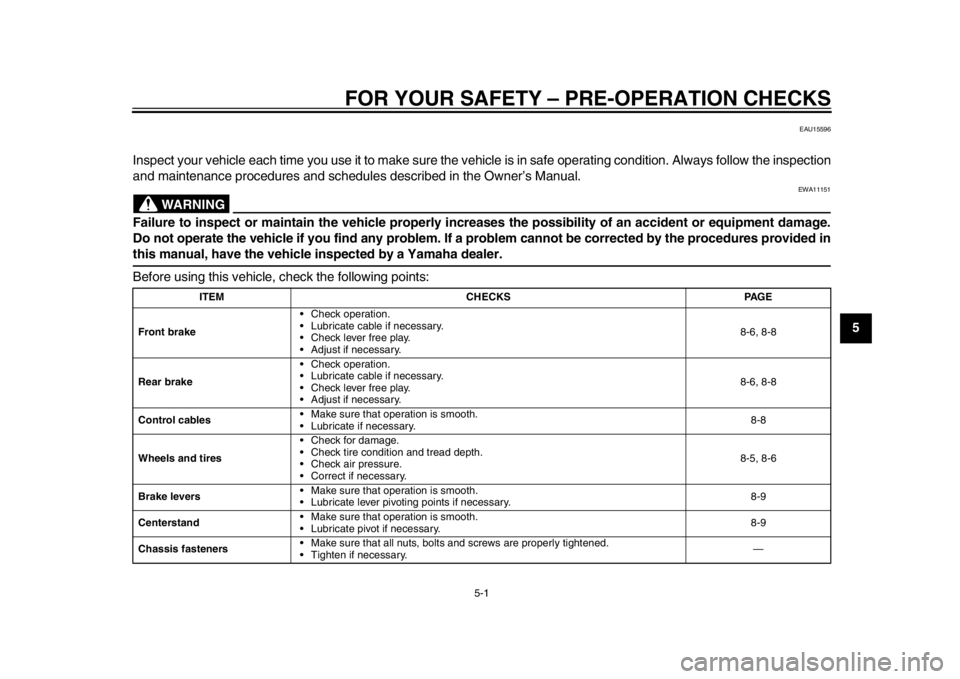
Before using this vehicle, check the following points:
ITEM CHECKS PAGE
Front brake Check operation.
Lubricate cable if necessary.
Check lever free play.
Adjust if necessary. 8-6, 8-8
Rear brake Check operation.
Lubricate cable if necessary.
Check lever free play.
Adjust if necessary. 8-6, 8-8
Control cables Make sure that operation is smooth.
Lubricate if necessary. 8-8
Wheels and tires Check for damage.
Check tire condition and tread depth.
Check air pressure.
Correct if necessary. 8-5, 8-6
Brake levers Make sure that operation is smooth.
Lubricate lever pivoting
points if necessary. 8-9
Centerstand Make sure that operation is smooth.
Lubricate pivot if necessary. 8-9
Chassis fasteners Make sure that all nuts, bolts
and screws are properly tightened.
Tighten if necessary. —
1CB-9-EA.book 1 ページ 2012年4月11日 水曜日 午前9時34分
Page 51 of 78
PERIODIC MAINTENANCE AND ADJUSTMENT
8-2
2
3
4
5
6
789
EAU50610
TIP
The annual checks must be performed every year, except if a kilometer-based maintenance is performed in-
stead.
From 30000 km, repeat the maintenance intervals starting from 6000 km.
Items marked with an asterisk should be performed by a Yamaha dealer as they require special tools, data and technicalskills.
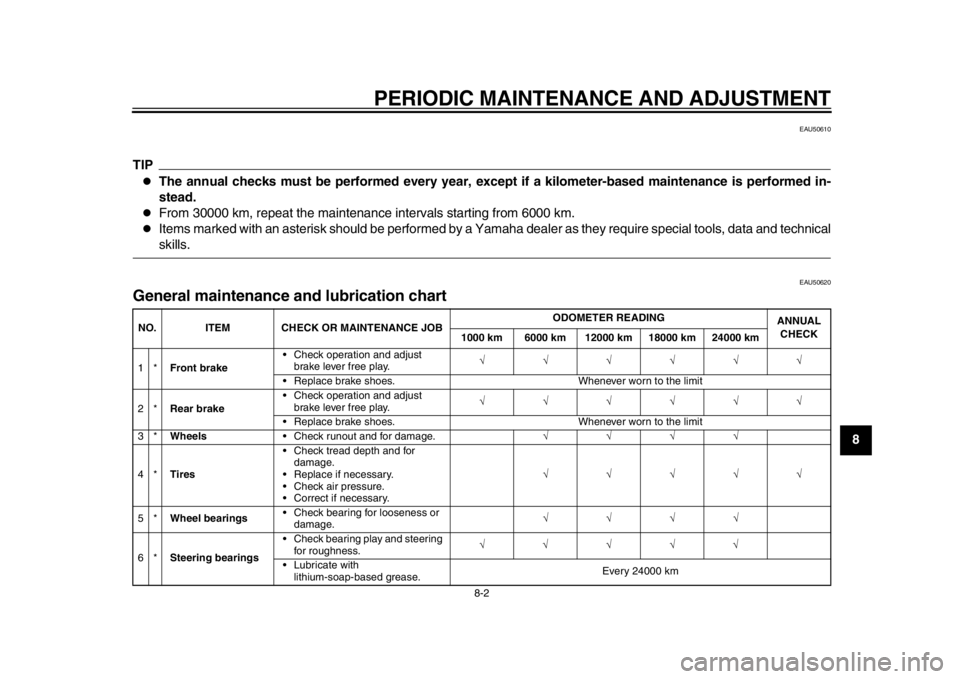
EAU50620
General maintenance and lubrication chart NO. ITEM CHECK OR MAINTENANCE JOB ODOMETER READING
ANNUAL
CHECK
1000 km 6000 km 12000 km 18000 km 24000 km
1* Front brake Check operation and adjust
brake lever free play.
Replace brake shoes. Whenever worn to the limit
2* Rear brake Check operation and adjust
brake lever free play.
Replace brake shoes. Whenever worn to the limit
3* Wheels Check runout and for damage.
4* Tires Check tread depth and for
damage.
Replace if necessary.
Check air pressure.
Correct if necessary.
5* Wheel bearings Check bearing for looseness or
damage.
6* Steering bearings Check bearing play and steering
for roughness.
Lubricate with lithium-soap-based grease. Every 24000 km
1CB-9-EA.book 2 ページ 2012年4月11日 水曜日 午前9時34分
Page 54 of 78
PERIODIC MAINTENANCE AND ADJUSTMENT
8-5
1
2
3
4
5
6
78
9
EAU50674
Tires Tires are the only contact between the
vehicle and the road. Safety in all con-
ditions of riding depends on a relatively
small area of road contact. Therefore, it
is essential to maintain the tires in good
condition at all times and replace them
at the appropriate time with the speci-
fied tires.
Tire air pressure
The tire air pressure should be checked
and, if necessary, adjusted before each
ride.
WARNING
EWA10511
Never overload your vehicle. Opera-
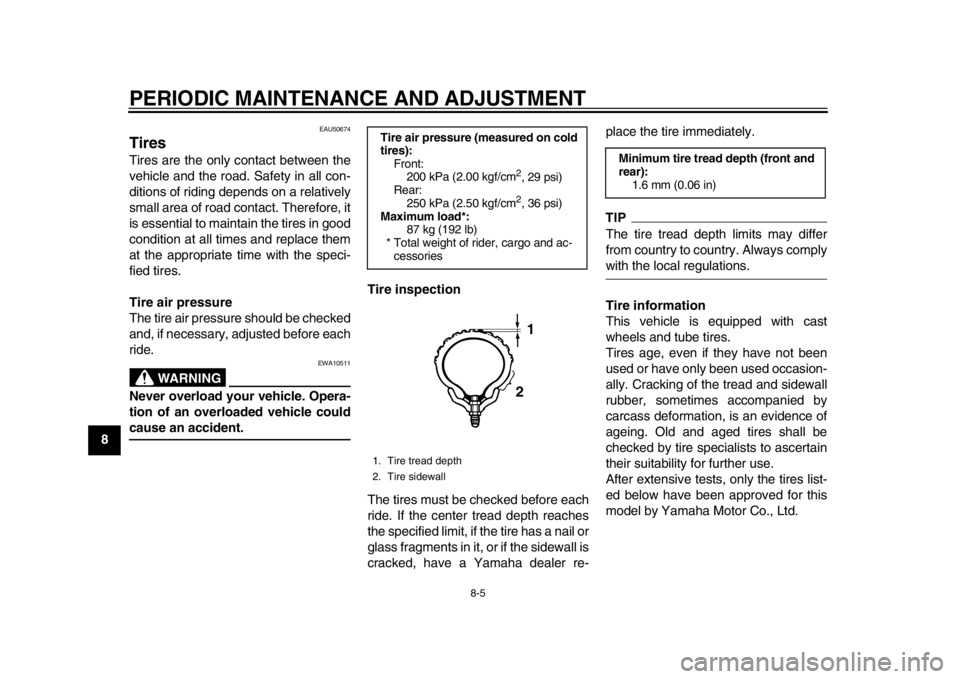
tion of an overloaded vehicle couldcause an accident.Tire inspection
The tires must be checked before each
ride. If the center tread depth reaches
the specified limit, if the tire has a nail or
glass fragments in it, or if the sidewall is
cracked, have a Yamaha dealer re-place the tire immediately.
TIPThe tire tread depth limits may differ
from country to country. Always complywith the local regulations.
Tire information
This vehicle is equipped with cast
wheels and tube tires.
Tires age, even if they have not been
used or have only been used occasion-
ally. Cracking of the tread and sidewall
rubber, sometimes accompanied by
carcass deformation, is an evidence of
ageing. Old and aged tires shall be
checked by tire specialists to ascertain
their suitability for further use.
After extensive tests, only the tires list-
ed below have been approved for this
model by Yamaha Motor Co., Ltd.
Tire air pressure (measured on cold
tires):
Front:200 kPa (2.00 kgf/cm
2, 29 psi)
Rear: 250 kPa (2.50 kgf/cm2, 36 psi)
Maximum load*:
87 kg (192 lb)
* Total weight of rider, cargo and ac- cessories
1. Tire tread depth
2. Tire sidewall
12
Minimum tire tread depth (front and
rear): 1.6 mm (0.06 in)
1CB-9-EA.book 5 ページ 2012年4月11日 水曜日 午前9時34分
Page 55 of 78
PERIODIC MAINTENANCE AND ADJUSTMENT
8-6
2
3
4
5
6
789
WARNING
EWA10471
Have a Yamaha dealer replace
excessively worn tires. Besides
being illegal, operating the vehi-
cle with excessively worn tires
decreases riding stability and
can lead to loss of control.
The replacement of all wheel
and brake-related parts, includ-
ing the tires, should be left to a
Yamaha dealer, who has the
necessary professional knowl-
edge and experience to do so.
Ride at moderate speeds after
changing a tire since the tire
surface must first be “broken
in” for it to develop its optimalcharacteristics.
EAU22003
Cast wheels
WARNING
EWA10610
The wheels on this model are not de-
signed for use with tubeless tires.
Do not attempt to use tubeless tireson this model.
To maximize the performance, durabil-
ity, and safe operation of your vehicle,
note the following points regarding the
specified wheels.
The wheel rims should be checked
for cracks, bends, warpage or oth-
er damage before each ride. If any
damage is found, have a Yamaha
dealer replace the wheel. Do not
attempt even the smallest repair to
the wheel. A deformed or cracked
wheel must be replaced.
The wheel should be balanced
whenever either the tire or wheel
has been changed or replaced. An
unbalanced wheel can result in
poor performance, adverse han-
dling characteristics, and a short-
ened tire life.
EAU22152
Adjusting the front and rear
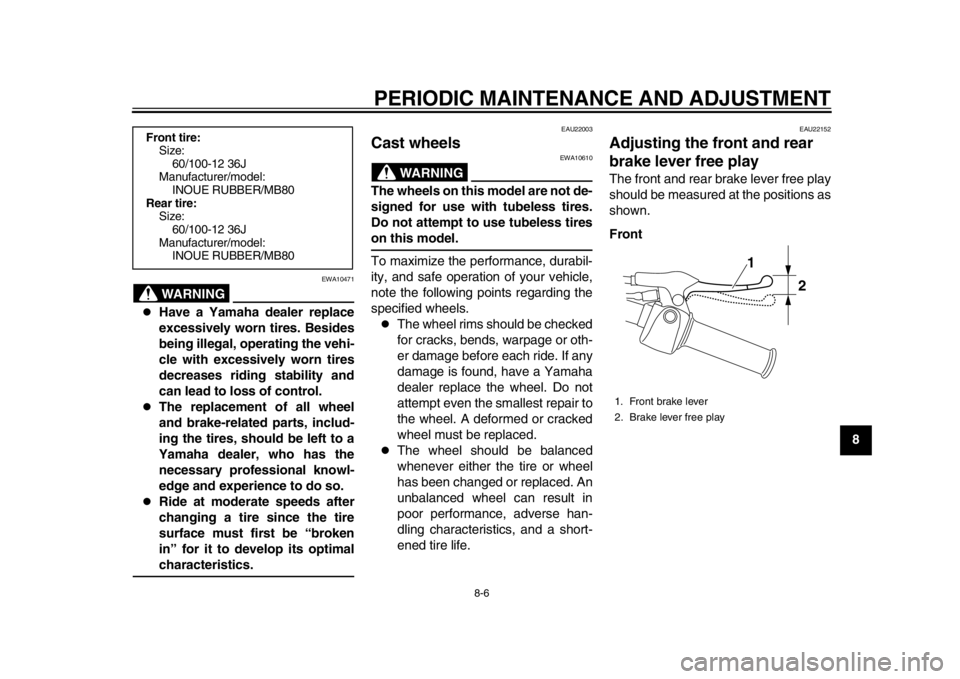
brake lever free play The front and rear brake lever free play
should be measured at the positions as
shown.
Front
Front tire:Size: 60/100-12 36J
Manufacturer/model:
INOUE RUBBER/MB80
Rear tire: Size:
60/100-12 36J
Manufacturer/model: INOUE RUBBER/MB80
1. Front brake lever
2. Brake lever free play
1
2
1CB-9-EA.book 6 ページ 2012年4月11日 水曜日 午前9時34分
Page 60 of 78
PERIODIC MAINTENANCE AND ADJUSTMENT
8-11
1
2
3
4
5
6
78
9
EAU23291
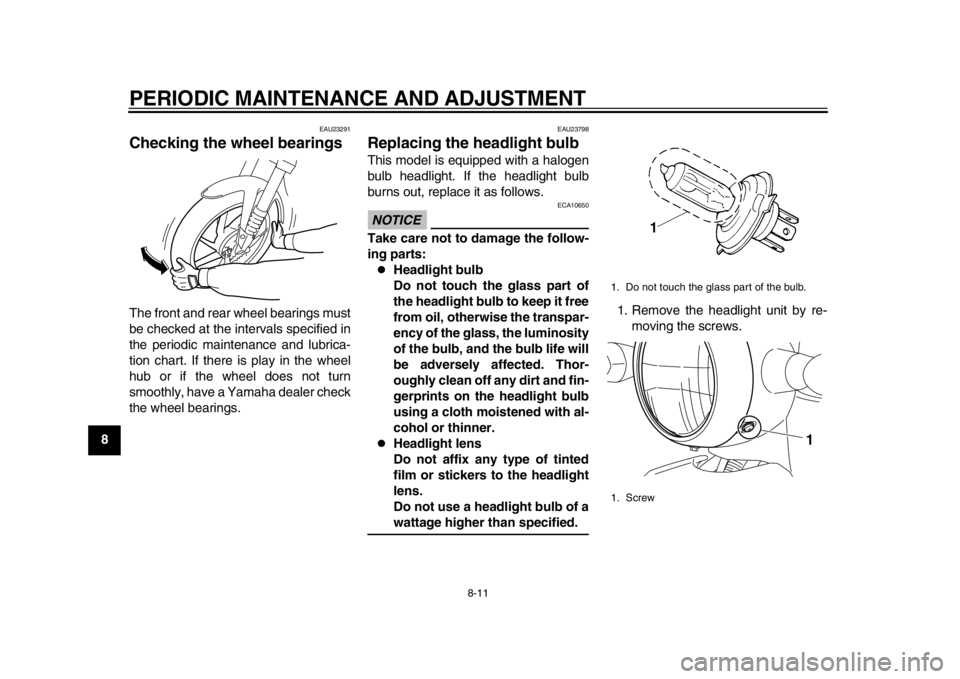
Checking the wheel bearings The front and rear wheel bearings must
be checked at the intervals specified in
the periodic maintenance and lubrica-
tion chart. If there is play in the wheel
hub or if the wheel does not turn
smoothly, have a Yamaha dealer check
the wheel bearings.
EAU23798
Replacing the headlight bulb This model is equipped with a halogen
bulb headlight. If the headlight bulb
burns out, replace it as follows.NOTICE
ECA10650
Take care not to damage the follow-
ing parts:
Headlight bulb
Do not touch the glass part of
the headlight bulb to keep it free
from oil, otherwise the transpar-
ency of the glass, the luminosity
of the bulb, and the bulb life will
be adversely affected. Thor-
oughly clean off any dirt and fin-
gerprints on the headlight bulb
using a cloth moistened with al-
cohol or thinner.
Headlight lens
Do not affix any type of tinted
film or stickers to the headlight
lens.
Do not use a headlight bulb of awattage higher than specified.1. Remove the headlight unit by re-
moving the screws.
1. Do not touch the glass part of the bulb.
1. Screw
1
1CB-9-EA.book 11 ページ 2012年4月11日 水曜日 午前9時34分
Page 70 of 78
9-1
1
2
3
4
5
6
7
89
SCOOTER CARE AND STORAGE
EAU37833
Matte color caution NOTICE
ECA15192
Some models are equipped with
matte colored finished parts. Be
sure to consult a Yamaha dealer for
advice on what products to use be-
fore cleaning the vehicle. Using a
brush, harsh chemical products or
cleaning compounds when cleaning
these parts will scratch or damage
their surface. Wax also should not
be applied to any matte colored fin-ished parts.
EAU50832
Care While the open design of a scooter re-
veals the attractiveness of the technol-
ogy, it also makes it more vulnerable.
Rust and corrosion can develop even if
high-quality components are used. Fre-
quent and proper care does not only
comply with the terms of the warranty,
but it will also keep your scooter looking
good, extend its life and optimize its
performance.
Before cleaning1. Make sure that the seat is properly closed before cleaning.
2. Make sure that all caps and covers as well as all electrical couplers
and connectors, are tightly in-
stalled.
3. Remove extremely stubborn dirt, with a degreasing agent and a
brush, but never apply such prod-
ucts onto seals, gaskets and wheel
axles. Always rinse the dirt and de-
greaser off with water. Cleaning
WARNING
EWA15810
Do not wash the vehicle while
charging the battery. This could
cause a fire or electric shock.
Make sure that the seat is prop-
erly closed before washing. If
the seat is not properly closed,
water could splash on the bat-
tery or built-in charger. This
could cause an electric shock or
short circuit.
Do not wash the charging cord
and charging plug. Wipe cleanwith a dry rag.
NOTICE
ECA17122
Avoid using strong acidic wheel
cleaners, especially on spoked
wheels. If such products are
used on hard-to-remove dirt, do
not leave the cleaner on the af-
fected area any longer than in-
structed. Also, thoroughly rinse
the area off with water, immedi-
ately dry it, and then apply a cor-
1CB-9-EA.book 1 ページ 2012年4月11日 水曜日 午前9時34分
Page 71 of 78
SCOOTER CARE AND STORAGE
9-2
2
3
4
5
6
7
89
rosion protection spray.
Improper cleaning can damage
plastic parts such as cowlings,
panels, windshields, headlight
lenses, meter lenses, etc. Use
only a soft, clean cloth or
sponge with water to clean plas-
tic. However, if the plastic parts
cannot be thoroughly cleaned
with water, diluted mild deter-
gent with water may be used. Be
sure to rinse off any detergent
residue using plenty of water, as
it is harmful to plastic parts.
Do not use any harsh chemical
products on plastic parts. Be
sure to avoid using cloths or
sponges which have been in
contact with strong or abrasive
cleaning products, solvent or
thinner, gasoline, rust removers
or inhibitors, brake fluid, anti-
freeze or electrolyte.
Do not use high-pressure wash-
ers or steam-jet cleaners since
they cause water seepage and
deterioration in the following ar-
eas: seals (of wheel and swing-
arm bearings, fork and brakes),electric components (couplers,
connectors, instruments, accel-
erator grip, switches and lights),
breather hoses and vents.
For scooters equipped with a
windshield: Do not use strong
cleaners or hard sponges as
they will cause dulling or
scratching. Some cleaning com-
pounds for plastic may leave
scratches on the windshield.
Test the product on a small hid-
den part of the windshield to
make sure that it does not leave
any marks. If the windshield is
scratched, use a quality plastic
polishing compound afterwashing.
After normal use
Remove dirt with warm water, a mild
detergent, and a soft, clean sponge,
and then rinse thoroughly with clean
water. Use a toothbrush or bottlebrush
for hard-to-reach areas. Stubborn dirt
and insects will come off more easily if
the area is covered with a wet cloth for
a few minutes before cleaning. After riding in the rain, near the sea or
on salt-sprayed roadsSince sea salt or salt sprayed on the
roads during winter are extremely cor-
rosive in combination with water, carry
out the following steps after each ride in
the rain, near the sea or on
salt-sprayed roads.TIPSalt sprayed on roads in the winter mayremain well into spring.
1. Clean the scooter with cold water and a mild detergent after the mo-
tor has cooled down. NOTICE: Do
not use warm water since it in-
creases the corrosive action of
the salt.
[ECA10791]
2. Apply a corrosion protection spray on all metal, including chrome- and
nickel-plated, surfaces to prevent
corrosion.
After cleaning 1. Dry the scooter with a chamois or an absorbing cloth.
2. Use a chrome polish to shine chrome, aluminum and stain-
less-steel parts.
1CB-9-EA.book 2 ページ 2012年4月11日 水曜日 午前9時34分