lights YAMAHA FJR1300A 2013 User Guide
[x] Cancel search | Manufacturer: YAMAHA, Model Year: 2013, Model line: FJR1300A, Model: YAMAHA FJR1300A 2013Pages: 118, PDF Size: 3.28 MB
Page 52 of 118
INSTRUMENT AND CONTROL FUNCTIONS
3-37
3
EAU39611
Adjusting the headlight
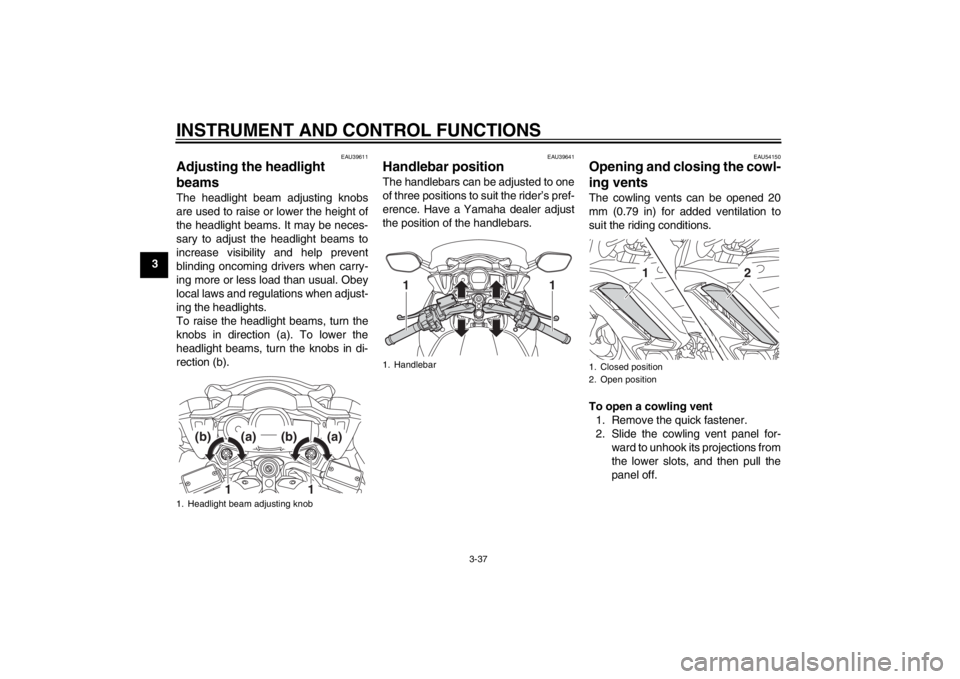
beams The headlight beam adjusting knobs
are used to raise or lower the height of
the headlight beams. It may be neces-
sary to adjust the headlight beams to
increase visibility and help prevent
blinding oncoming drivers when carry-
ing more or less load than usual. Obey
local laws and regulations when adjust-
ing the headlights.
To raise the headlight beams, turn the
knobs in direction (a). To lower the
headlight beams, turn the knobs in di-
rection (b).
EAU39641
Handlebar position The handlebars can be adjusted to one
of three positions to suit the rider’s pref-
erence. Have a Yamaha dealer adjust
the position of the handlebars.
EAU54150
Opening and closing the cowl-
ing vents The cowling vents can be opened 20
mm (0.79 in) for added ventilation to
suit the riding conditions.
To open a cowling vent1. Remove the quick fastener.
2. Slide the cowling vent panel for- ward to unhook its projections from
the lower slots, and then pull the
panel off.
1. Headlight beam adjusting knob
1
1
(b)
(a)
(b)
(a)
1. Handlebar
11
1. Closed position
2. Open position
1
2
U1MCE0E0.book Page 37 Thursday, July 19, 2012 6:59 PM
Page 63 of 118

FOR YOUR SAFETY – PRE-OPERATION CHECKS
4-3
4
Instruments, lights, signals
and switches Check operation.
Correct if necessary.
—
Sidestand switch Check operation of ignition circuit cut-off system.
If system is not working correctly, have Yamaha dealer check vehicle.
3-42
ITEM CHECKS PAGE
U1MCE0E0.book Page 3 Thursday, July 19, 2012 6:59 PM
Page 64 of 118
OPERATION AND IMPORTANT RIDING POINTS
5-1
5
EAU15951
Read the Owner’s Manual carefully to
become familiar with all controls. If
there is a control or function you do not
understand, ask your Yamaha dealer.
WARNING
EWA10271
Failure to familiarize yourself with
the controls can lead to loss of con-
trol, which could cause an accident
or injury.
EAU47150
TIPThis model is equipped with:●
a lean angle sensor to stop the en-
gine in case of a turnover. In this
case, the multi-function meter unit
indicates error code 30, but this is
not a malfunction. Turn the key to
“OFF” and then to “ON” to clear the
error code. Failing to do so will pre-
vent the engine from starting even
though the engine will crank when
pushing the start switch.
●
an engine auto-stop system. The
engine stops automatically if left
idling for 20 minutes. In this case,
the multi-function meter unit indi-
cates error code 70, but this is not
a malfunction. Push the start
switch to clear the error code and
to restart the engine.
EAU54170
Starting the engine In order for the ignition circuit cut-off
system to enable starting, one of the
following conditions must be met:●
The transmission is in the neutral
position.
●
The transmission is in gear with
the clutch lever pulled and the
sidestand up.
See page 3-43 for more informa-
tion.
1. Turn the key to “ON” and make sure that the start/engine stop
switch is set to “ ”.
The following warning lights and
indicator lights should come on for
a few seconds, then go off.●
Oil level warning light
●
Engine trouble warning light
●
Traction control system indi-
cator/warning light
●
Cruise control indicator lights
●
Immobilizer system indicator
light
U1MCE0E0.book Page 1 Thursday, July 19, 2012 6:59 PM
Page 66 of 118
OPERATION AND IMPORTANT RIDING POINTS
5-3
5
NOTICE
ECA10260
●
Even with the transmission in
the neutral position, do not
coast for long periods of time
with the engine off, and do not
tow the motorcycle for long dis-
tances. The transmission is
properly lubricated only when
the engine is running. Inade-
quate lubrication may damage
the transmission.
●
Always use the clutch while
changing gears to avoid damag-
ing the engine, transmission,
and drive train, which are not
designed to withstand the
shock of forced shifting.
EAU16810
Tips for reducing fuel con-
sumption Fuel consumption depends largely on
your riding style. Consider the following
tips to reduce fuel consumption:●
Shift up swiftly, and avoid high en-
gine speeds during acceleration.
●
Do not rev the engine while shifting
down, and avoid high engine
speeds with no load on the engine.
●
Turn the engine off instead of let-
ting it idle for an extended length of
time (e.g., in traffic jams, at traffic
lights or at railroad crossings).
EAU16841
Engine break-in There is never a more important period
in the life of your engine than the period
between 0 and 1600 km (1000 mi). For
this reason, you should read the follow-
ing material carefully.
Since the engine is brand new, do not
put an excessive load on it for the first
1600 km (1000 mi). The various parts in
the engine wear and polish themselves
to the correct operating clearances.
During this period, prolonged full-throt-
tle operation or any condition that might
result in engine overheating must be
avoided.
EAU17123
0–1000 km (0–600 mi)
Avoid prolonged operation above 4500
r/min. NOTICE: After 1000 km (600
mi) of operation, the engine oil and
final gear oil must be changed, and
the oil filter cartridge or element re-
placed.
[ECA10332]
U1MCE0E0.book Page 3 Thursday, July 19, 2012 6:59 PM
Page 73 of 118

PERIODIC MAINTENANCE AND ADJUSTMENT
6-6
6
21*Rear suspension re-
lay arm and con-
necting arm
pivoting points Check operation.
√√√√
Lubricate with lithium-soap-based grease. √√
22 Engine oil Change.
Check oil level and vehicle for oil
leakage. √√√√√√
23 Engine oil filter car-
tridge Replace.
√√√
24 *Cooling system Check coolant level and vehicle
for coolant leakage. √√√√√
Change coolant. Every 3 years
25 Final gear oil Check oil level and vehicle for oil
leakage.
Change. √√√√√
26 *Front and rear brake
switches Check operation.
√√√√√√
27 Moving parts and
cables
Lubricate.
√√√√√
28 *Throttle grip Check operation.
Check throttle grip free play, and
adjust if necessary.
Lubricate cable and grip housing. √√√√√
29 *Lights, signals and
switches Check operation.
Adjust headlight beam.
√√√√√√
NO. ITEM CHECK OR MAINTENANCE JOB
ODOMETER READING
ANNUAL
CHECK
1000 km
(600 mi) 10000 km
(6000 mi) 20000 km
(12000 mi) 30000 km
(18000 mi) 40000 km
(24000 mi)
U1MCE0E0.book Page 6 Thursday, July 19, 2012 6:59 PM
Page 101 of 118
PERIODIC MAINTENANCE AND ADJUSTMENT
6-34
6
EAU40361
Headlight bulb If a headlight does not come on, have a
Yamaha dealer check its electrical cir- cuit or replace the bulb.NOTICE
ECA16580
Do not affix any type of tinted film or
stickers to the headlight lens.
EAU54240
Front turn signal light This model is equipped with LED-type
front turn signal lights.
If a front turn signal light does not come
on, have a Yamaha dealer check it.
EAU27004
Replacing a rear turn signal
light bulb or a tail/brake light
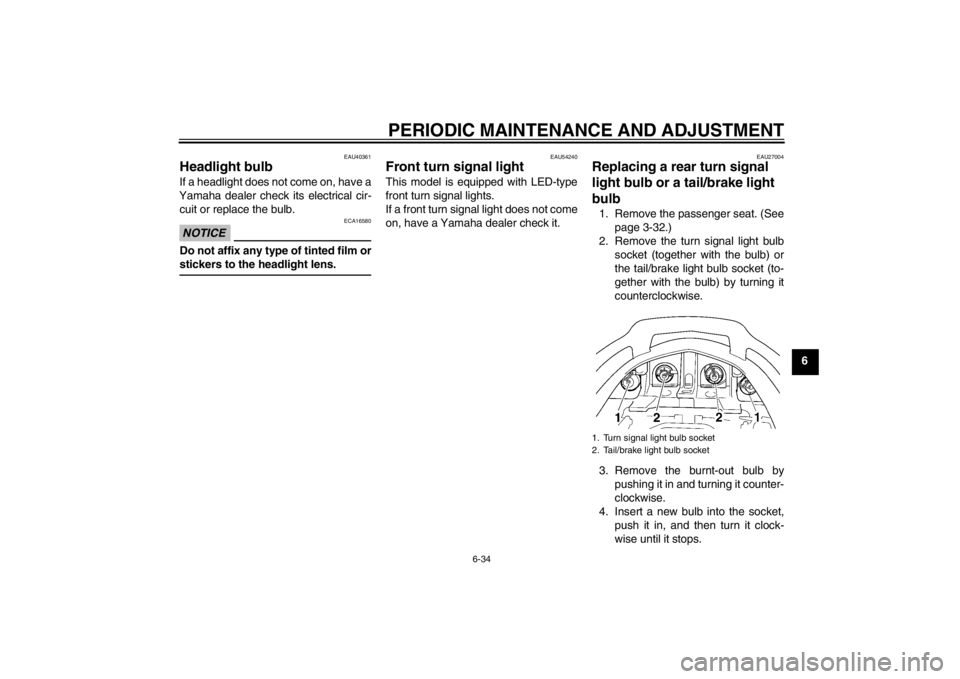
bulb 1. Remove the passenger seat. (See
page 3-32.)
2. Remove the turn signal light bulb socket (together with the bulb) or
the tail/brake light bulb socket (to-
gether with the bulb) by turning it
counterclockwise.
3. Remove the burnt-out bulb by pushing it in and turning it counter-
clockwise.
4. Insert a new bulb into the socket, push it in, and then turn it clock-
wise until it stops.1. Turn signal light bulb socket
2. Tail/brake light bulb socket
U1MCE0E0.book Page 34 Thursday, July 19, 2012 6:59 PM
Page 103 of 118
PERIODIC MAINTENANCE AND ADJUSTMENT
6-36
6
EAU54500
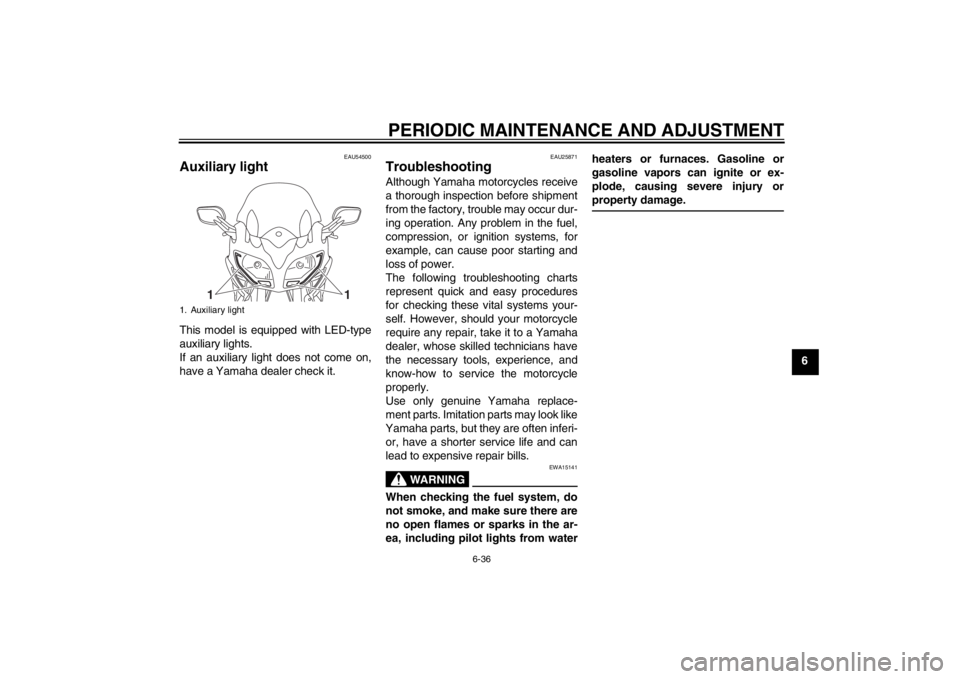
Auxiliary light This model is equipped with LED-type
auxiliary lights.
If an auxiliary light does not come on,
have a Yamaha dealer check it.
EAU25871
Troubleshooting Although Yamaha motorcycles receive
a thorough inspection before shipment
from the factory, trouble may occur dur-
ing operation. Any problem in the fuel,
compression, or ignition systems, for
example, can cause poor starting and
loss of power.
The following troubleshooting charts
represent quick and easy procedures
for checking these vital systems your-
self. However, should your motorcycle
require any repair, take it to a Yamaha
dealer, whose skilled technicians have
the necessary tools, experience, and
know-how to service the motorcycle
properly.
Use only genuine Yamaha replace-
ment parts. Imitation parts may look like
Yamaha parts, but they are often inferi-
or, have a shorter service life and can
lead to expensive repair bills.
WARNING
EWA15141
When checking the fuel system, do
not smoke, and make sure there are
no open flames or sparks in the ar-
ea, including pilot lights from waterheaters or furnaces. Gasoline or
gasoline vapors can ignite or ex-
plode, causing severe injury or
property damage.
1. Auxiliary light
1
1
U1MCE0E0.book Page 36 Thursday, July 19, 2012 6:59 PM
Page 107 of 118
MOTORCYCLE CARE AND STORAGE
7-2
7
off any detergent residue using
plenty of water, as it is harmful
to plastic parts.
●
Do not use any harsh chemical
products on plastic parts. Be
sure to avoid using cloths or
sponges which have been in
contact with strong or abrasive
cleaning products, solvent or
thinner, fuel (gasoline), rust re-
movers or inhibitors, brake flu-
id, antifreeze or electrolyte.
●
Do not use high-pressure wash-
ers or steam-jet cleaners since
they cause water seepage and
deterioration in the following ar-
eas: seals (of wheel and swing-
arm bearings, fork and brakes),
electric components (couplers,
connectors, instruments,
switches and lights), breather
hoses and vents.
●
For motorcycles equipped with
a windshield: Do not use strong
cleaners or hard sponges as
they will cause dulling or
scratching. Some cleaning com-
pounds for plastic may leave
scratches on the windshield. Test the product on a small hid-
den part of the windshield to
make sure that it does not leave
any marks. If the windshield is
scratched, use a quality plastic
polishing compound after
washing.
After normal useRemove dirt with warm water, a mild
detergent, and a soft, clean sponge,
and then rinse thoroughly with clean
water. Use a toothbrush or bottlebrush
for hard-to-reach areas. Stubborn dirt
and insects will come off more easily if
the area is covered with a wet cloth for
a few minutes before cleaning.
After riding in the rain, near the sea oron salt-sprayed roadsSince sea salt or salt sprayed on roads
during winter are extremely corrosive in
combination with water, carry out the
following steps after each ride in the
rain, near the sea or on salt-sprayed
roads.
TIPSalt sprayed on roads in the winter may
remain well into spring.1. Clean the motorcycle with cold wa-
ter and a mild detergent, after the
engine has cooled down.
NOTICE: Do not use warm water
since it increases the corrosive
action of the salt.
[ECA10791]
2. After drying the motorcycle, apply a corrosion protection spray on all
metal, including chrome- and nick-
el-plated, surfaces to prevent cor-
rosion.
Windshield cleaningAvoid using any alkaline or strong acid
cleaner, gasoline, brake fluid, or any
other solvent. Clean the windshield with
a cloth or sponge dampened with a
neutral detergent, and after cleaning,
thoroughly wash it off with water. For
additional cleaning, use Yamaha Wind-
shield Cleaner or other quality cleaner.
Some cleaning compounds for plastics
may leave scratches on surfaces of the
U1MCE0E0.book Page 2 Thursday, July 19, 2012 6:59 PM
Page 115 of 118

INDEX
AABS ...................................................... 3-26
ABS warning light ................................... 3-5
Accessory box ...................................... 3-36
Air filter element, cleaning .................... 6-17
Auxiliary DC jack .................................. 3-45
Auxiliary light ........................................ 6-36BBattery .................................................. 6-31
Brake and clutch fluid levels, checking ............................................. 6-24
Brake and clutch fluids, changing ......... 6-26
Brake and clutch levers, checking and lubricating ........................................... 6-27
Brake and shift pedals, checking and
lubricating ........................................... 6-27
Brake lever ........................................... 3-26
Brake lever free play, checking ............ 6-23
Brake light switches .............................. 6-23
Brake pedal .......................................... 3-26CCables, checking and lubricating .......... 6-26
Care ........................................................ 7-1
Catalytic converters .............................. 3-31
Centerstand and sidestand, checking and lubricating .................................... 6-28
Clutch lever.................................. 3-25, 6-22
Coolant ................................................. 6-16
Cowling vents, opening and closing ..... 3-37
Cruise control indicator lights ................. 3-4
Cruise control switches ......................... 3-24
Cruise control system ............................. 3-6DDimmer/Pass switch ............................. 3-23 D-mode (drive mode) ............................ 3-22
EEngine break-in .......................................5-3
Engine idling speed, checking............... 6-18
Engine oil and oil filter cartridge ............ 6-12
Engine trouble warning light .................... 3-4FFinal gear oil.......................................... 6-14
Front and rear brake pads, checking .... 6-24
Front fork, adjusting .............................. 3-39
Front fork, checking...............................6-29
Front turn signal light............................. 6-34
Fuel ....................................................... 3-30
Fuel consumption, tips for reducing ........ 5-3
Fuel tank breather/overflow hose .......... 3-31
Fuel tank cap......................................... 3-29
Fuses, replacing .................................... 6-32HHandlebar position, adjusting ................ 3-37
Handlebar switches ............................... 3-23
Hazard switch........................................ 3-24
Headlight beams, adjusting ................... 3-37
Headlight bulb ....................................... 6-34
High beam indicator light......................... 3-4
Horn switch ........................................... 3-24IIdentification numbers ............................. 9-1
Ignition circuit cut-off system ................. 3-43
Immobilizer system .................................3-1
Immobilizer system indicator light ........... 3-6
Indicator lights and warning lights ........... 3-4LLicense plate light bulb, replacing ......... 6-35
MMain switch/steering lock ........................ 3-2
Maintenance and lubrication, periodic .... 6-4
Maintenance, emission control system ... 6-3
Matte color, caution ................................ 7-1
Menu switch .......................................... 3-24
Model label ............................................. 9-1
Multi-function meter unit ......................... 3-9NNeutral indicator light .............................. 3-4OOil level warning light .............................. 3-4PPanels, removing and installing .............. 6-8
Parking.................................................... 5-4
Part locations .......................................... 2-1RRear suspension, lubricating ................ 6-29
Rear view mirrors.................................. 3-39
Rider seat height, adjusting .................. 3-33SSafety information ................................... 1-1
Seats..................................................... 3-32
Select switch ......................................... 3-24
Shifting .................................................... 5-2
Shift pedal ............................................. 3-25
Shock absorber assembly, adjusting .... 3-41
Sidestand .............................................. 3-42
Spark plugs, checking........................... 6-11
Specifications.......................................... 8-1
Start/Engine stop switch ....................... 3-24
Starting the engine.................................. 5-1
Steering, checking ................................ 6-30
Storage ................................................... 7-4
U1MCE0E0.book Page 1 Thursday, July 19, 2012 6:59 PM
Page 116 of 118

INDEXStorage compartments.......................... 3-35
Swingarm pivots, lubricating ................. 6-29TThrottle grip and cable, checking and lubricating ........................................... 6-26
Throttle grip free play, checking ............ 6-19
Tires ...................................................... 6-19
Tool kit .................................................... 6-2
Traction control system ......................... 3-27
Traction control system indicator/
warning light ......................................... 3-5
Troubleshooting .................................... 6-36
Troubleshooting charts ......................... 6-37
Turn signal indicator lights ...................... 3-4
Turn signal light or tail/brake light bulb, replacing ............................................. 6-34
Turn signal switch ................................. 3-23VValve clearance .................................... 6-19
Vehicle identification number .................. 9-1WWheel bearings, checking ..................... 6-30
Wheels .................................................. 6-22
U1MCE0E0.book Page 2 Thursday, July 19, 2012 6:59 PM