ABS YAMAHA FJR1300A 2013 Owners Manual
[x] Cancel search | Manufacturer: YAMAHA, Model Year: 2013, Model line: FJR1300A, Model: YAMAHA FJR1300A 2013Pages: 118, PDF Size: 3.28 MB
Page 6 of 118

TABLE OF CONTENTSSAFETY INFORMATION ..................1-1
DESCRIPTION ..................................2-1
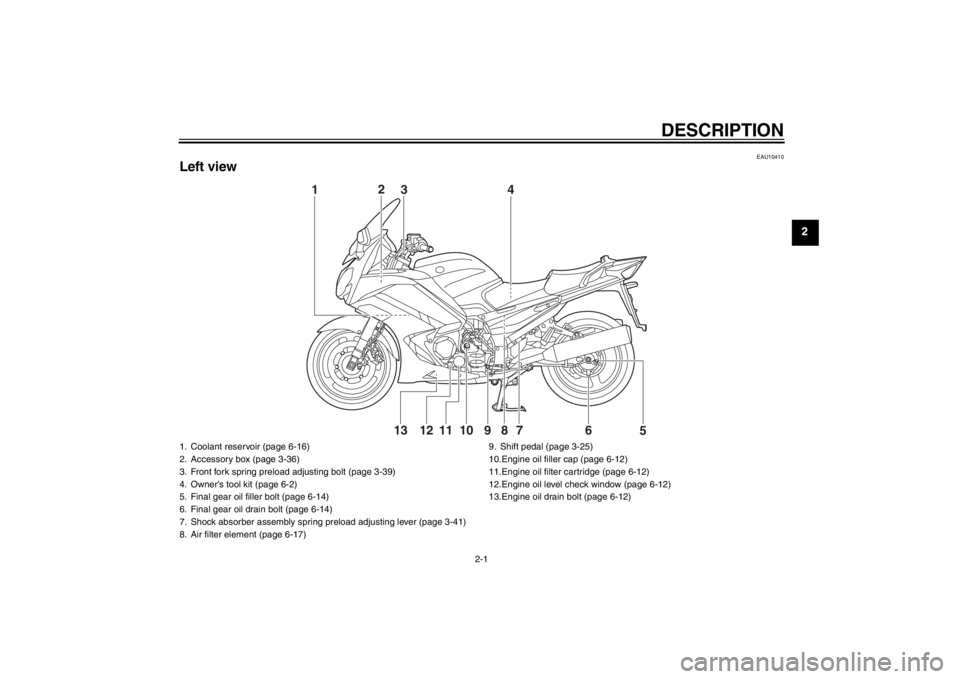
Left view ..........................................2-1
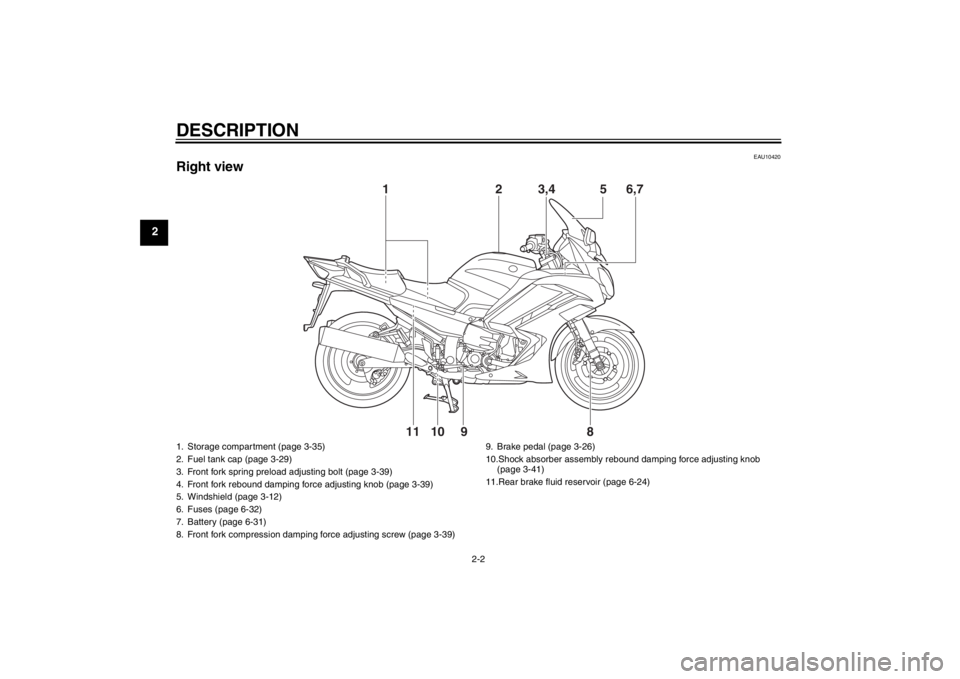
Right view ........................................2-2
Controls and instruments.................2-3
INSTRUMENT AND CONTROL
FUNCTIONS .......................................3-1
Immobilizer system .........................3-1
Main switch/steering lock ................3-2
Indicator lights and warning lights ............................................3-4
Cruise control system .....................3-6
Multi-function meter unit .................3-9
D-mode (drive mode) ....................3-22
Handlebar switches ......................3-23
Clutch lever ...................................3-25
Shift pedal .....................................3-25
Brake lever ...................................3-26
Brake pedal ..................................3-26
ABS ..............................................3-26
Traction control system ................3-27
Fuel tank cap ................................3-29
Fuel ...............................................3-30
Fuel tank breather/overflow
hose ..........................................3-31
Catalytic converters ......................3-31
Seats ............................................3-32
Adjusting the rider seat height ......3-33
Storage compartments .................3-35 Accessory box .............................. 3-36
Adjusting the headlight beams ..... 3-37
Handlebar position ....................... 3-37
Opening and closing the cowling
vents ......................................... 3-37
Rear view mirrors ......................... 3-39
Adjusting the front fork ................. 3-39
Adjusting the shock absorber assembly ................................... 3-41
Sidestand ..................................... 3-42
Ignition circuit cut-off system ........ 3-43
Auxiliary DC jack .......................... 3-45
FOR YOUR SAFETY –
PRE-OPERATION CHECKS ............. 4-1
OPERATION AND IMPORTANT
RIDING POINTS ................................. 5-1
Starting the engine ......................... 5-1
Shifting ........................................... 5-2
Tips for reducing fuel consumption ............................... 5-3
Engine break-in .............................. 5-3
Parking ........................................... 5-4
PERIODIC MAINTENANCE AND
ADJUSTMENT ................................... 6-1
Owner’s tool kit ............................... 6-2
Periodic maintenance chart for the emission control system ............. 6-3 General maintenance and
lubrication chart .......................... 6-4
Removing and installing panels ..... 6-8
Checking the spark plugs ............ 6-11
Engine oil and oil filter cartridge ... 6-12
Final gear oil ................................ 6-14
Coolant ........................................ 6-16
Cleaning the air filter element ...... 6-17
Checking the engine idling speed ........................................ 6-18
Checking the throttle grip free
play ........................................... 6-19
Valve clearance ........................... 6-19
Tires ............................................. 6-19
Cast wheels ................................. 6-22
Clutch lever .................................. 6-22
Checking the brake lever free play ........................................... 6-23
Brake light switches ..................... 6-23
Checking the front and rear brake pads .......................................... 6-24
Checking the brake and clutch fluid levels ................................. 6-24
Changing the brake and clutch fluids ......................................... 6-26
Checking and lubricating the
cables ....................................... 6-26
Checking and lubricating the throttle grip and cable ............... 6-26
Checking and lubricating the brake and shift pedals .............. 6-27U1MCE0E0.book Page 1 Thursday, July 19, 2012 6:59 PM
Page 13 of 118
DESCRIPTION
2-1
2
EAU10410
Left view
12
34
5
76
8910111213
1. Coolant reservoir (page 6-16)
2. Accessory box (page 3-36)
3. Front fork spring preload adjusting bolt (page 3-39)
4. Owner’s tool kit (page 6-2)
5. Final gear oil filler bolt (page 6-14)
6. Final gear oil drain bolt (page 6-14)
7. Shock absorber assembly spring preload adjusting lever (page 3-41)
8. Air filter element (page 6-17) 9. Shift pedal (page 3-25)
10.Engine oil filler cap (page 6-12)
11.Engine oil filter cartridge (page 6-12)
12.Engine oil level check window (page 6-12)
13.Engine oil drain bolt (page 6-12)
U1MCE0E0.book Page 1 Thursday, July 19, 2012 6:59 PM
Page 14 of 118
DESCRIPTION
2-2
2
EAU10420
Right view
8
910116,7
5
3,42
1
1. Storage compartment (page 3-35)
2. Fuel tank cap (page 3-29)
3. Front fork spring preload adjusting bolt (page 3-39)
4. Front fork rebound damping fo rce adjusting knob (page 3-39)
5. Windshield (page 3-12)
6. Fuses (page 6-32)
7. Battery (page 6-31)
8. Front fork compression damping force adjusting screw (page 3-39) 9. Brake pedal (page 3-26)
10.Shock absorber assembly
rebound damping force adjusting knob
(page 3-41)
11.Rear brake fluid reservoir (page 6-24)U1MCE0E0.book Page 2 Thursday, July 19, 2012 6:59 PM
Page 19 of 118
INSTRUMENT AND CONTROL FUNCTIONS
3-4
3
EAU49392
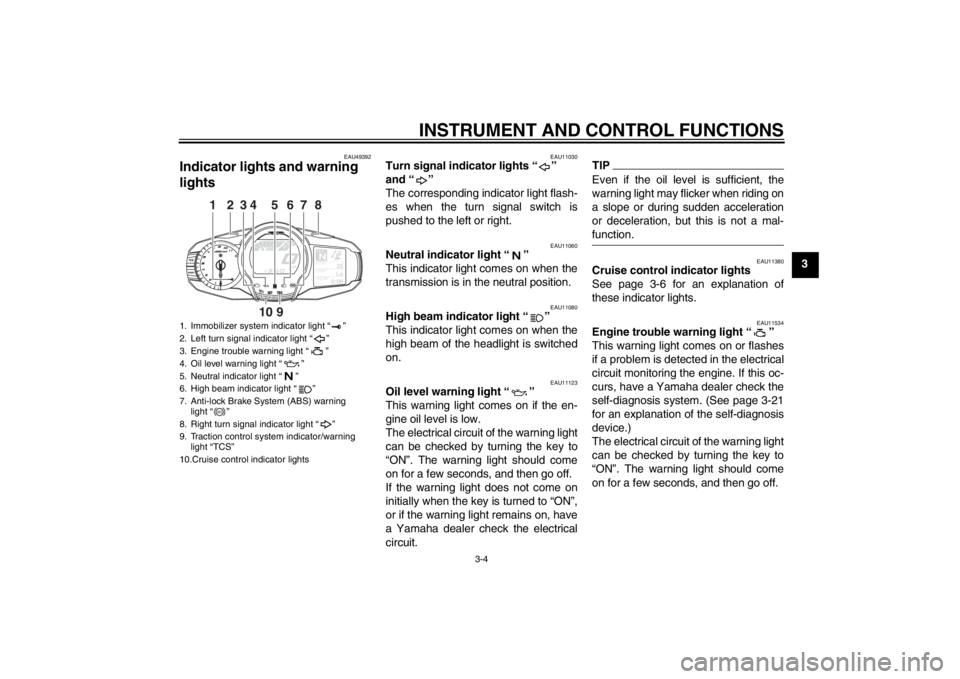
Indicator lights and warning
lights
EAU11030
Turn signal indicator lights “ ”
and “ ”
The corresponding indicator light flash-
es when the turn signal switch is
pushed to the left or right.
EAU11060
Neutral indicator light “ ”
This indicator light comes on when the
transmission is in the neutral position.
EAU11080
High beam indicator light “ ”
This indicator light comes on when the
high beam of the headlight is switched
on.
EAU11123
Oil level warning light “ ”
This warning light comes on if the en-
gine oil level is low.
The electrical circuit of the warning light
can be checked by turning the key to
“ON”. The warning light should come
on for a few seconds, and then go off.
If the warning light does not come on
initially when the key is turned to “ON”,
or if the warning light remains on, have
a Yamaha dealer check the electrical
circuit.
TIPEven if the oil level is sufficient, the
warning light may flicker when riding on
a slope or during sudden acceleration
or deceleration, but this is not a mal-
function.
EAU11380
Cruise control indicator lights
See page 3-6 for an explanation of
these indicator lights.
EAU11534
Engine trouble warning light “ ”
This warning light comes on or flashes
if a problem is detected in the electrical
circuit monitoring the engine. If this oc-
curs, have a Yamaha dealer check the
self-diagnosis system. (See page 3-21
for an explanation of the self-diagnosis
device.)
The electrical circuit of the warning light
can be checked by turning the key to
“ON”. The warning light should come
on for a few seconds, and then go off.
1. Immobilizer system indicator light “ ”
2. Left turn signal indicator light “ ”
3. Engine trouble warning light “ ”
4. Oil level warning light “ ”
5. Neutral indicator light “ ”
6. High beam indicator light “ ”
7. Anti-lock Brake System (ABS) warning light “ ”
8. Right turn signal indicator light “ ”
9. Traction control system indicator/warning light “TCS”
10.Cruise control indicator lights
GEARN
25
A.TEMP ˚C
Lo
C.TEMP˚C
0:06
TIME TRIP
1
2
8
3
7
4
9
10
6
5
ABS
U1MCE0E0.book Page 4 Thursday, July 19, 2012 6:59 PM
Page 20 of 118
INSTRUMENT AND CONTROL FUNCTIONS
3-5
3If the warning light does not come on
initially when the key is turned to “ON”,
or if the warning light remains on, have
a Yamaha dealer check the electrical
circuit.
EAU51661
ABS warning light “ ”
In normal operation, the ABS warning
light comes on when the key is turned
to “ON”, and goes off after traveling at a
speed of 10 km/h (6 mi/h) or higher.
If the ABS warning light:●
does not come on when the key is
turned to “ON”
●
comes on or flashes while riding
●
does not go off after traveling at a
speed of 10 km/h (6 mi/h) or higher
The ABS may not work correctly. If any
of the above occurs, have a Yamaha
dealer check the system as soon as
possible. (See page 3-26 for an expla-
nation of the ABS.)WARNING
EWA16040
If the ABS warning light does not go
off after traveling at a speed of 10
km/h (6 mi/h) or higher, or if the
warning light comes on or flashes while riding, the brake system re-
verts to conventional braking. If ei-
ther of the above occurs, or if the
warning light does not come on at
all, use extra caution to avoid possi-
ble wheel lock during emergency
braking. Have a Yamaha dealer
check the brake system and electri-
cal circuits as soon as possible.
TIPIf the start switch is pushed while the
engine is running, the ABS warning
light will come on, but this is not a mal-
function.
EAU54260
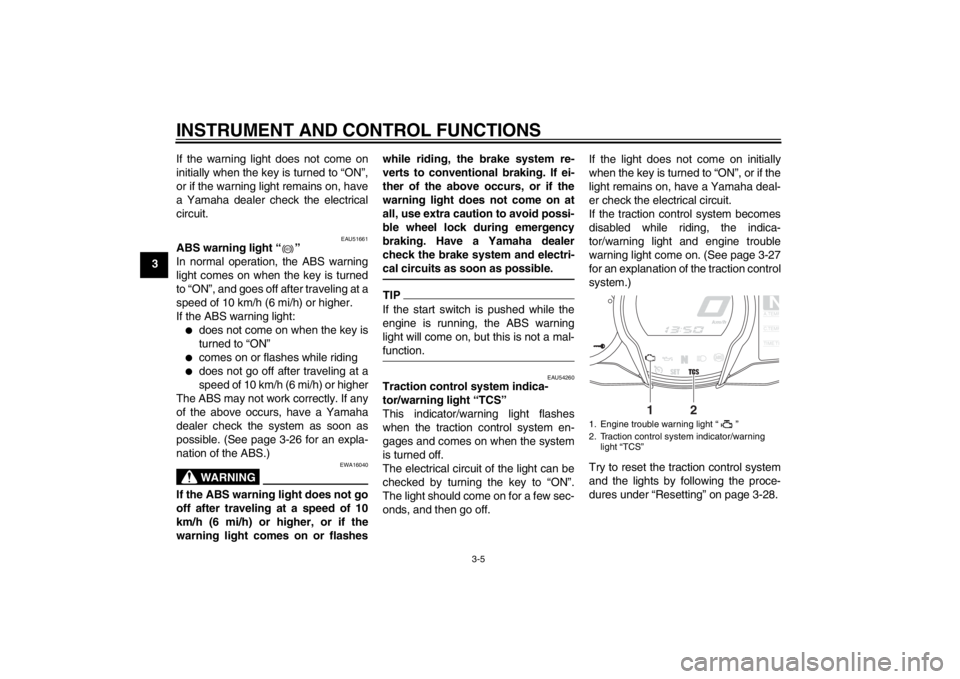
Traction control system indica-
tor/warning light “TCS”
This indicator/warning light flashes
when the traction control system en-
gages and comes on when the system
is turned off.
The electrical circuit of the light can be
checked by turning the key to “ON”.
The light should come on for a few sec-
onds, and then go off.
If the light does not come on initially
when the key is turned to “ON”, or if the
light remains on, have a Yamaha deal-
er check the electrical circuit.
If the traction control system becomes
disabled while riding, the indica-
tor/warning light and engine trouble
warning light come on. (See page 3-27
for an explanation of the traction control
system.)
Try to reset the traction control system
and the lights by following the proce-
dures under “Resetting” on page 3-28.
ABS
1. Engine trouble warning light “ ”
2. Traction control system indicator/warning
light “TCS”
NA.TEM
P
C.TEM
P
TIME T
R
2
1
U1MCE0E0.book Page 5 Thursday, July 19, 2012 6:59 PM
Page 39 of 118
INSTRUMENT AND CONTROL FUNCTIONS
3-24
3
position. To cancel the turn signal
lights, push the switch in after it has re-
turned to the center position.
EAU12500
Horn switch “ ”
Press this switch to sound the horn.
EAU54210
Start/Engine stop switch “ / / ”
To crank the engine with the starter, set
this switch to “ ”, and then push
the “ ” side of the switch. See page
5-1 for starting instructions prior to
starting the engine.
Set this switch to “ ” to stop the en-
gine in case of an emergency, such as
when the vehicle overturns or when the
throttle cable is stuck.
EAU42341
The engine trouble warning light and
ABS warning light may come on when
the key is turned to “ON” and the start
switch is pushed, but this does not indi-
cate a malfunction.
EAU12733
Hazard switch “ ”
With the key in the “ON” or “ ” posi-
tion, use this switch to turn on the haz-
ard lights (simultaneous flashing of all
turn signal lights).
The hazard lights are used in case of
an emergency or to warn other drivers
when your vehicle is stopped where it
might be a traffic hazard.NOTICE
ECA10061
Do not use the hazard lights for an
extended length of time with the en-
gine not running, otherwise the bat-
tery may discharge.
EAU12780
Cruise control switches
See page 3-6 for an explanation of the
cruise control system.
EAU54230
Menu switch “MENU”
This switch is used to perform selec-
tions in the function display and setting
mode display of the multi-function
meter unit.
See “Multi-function meter unit” on page
3-9 for detailed information.
EAU54220
Select switch “ / ”
This switch is used to perform selec-
tions in the function display and setting
mode display of the multi-function
meter unit.
See “Multi-function meter unit” on page
3-9 for detailed information.
EAU54690
Drive mode switch “MODE”
WARNING
EWA15340
Do not change the D-mode while the
vehicle is moving.Using this switch changes the drive
mode to touring mode “T” or sports
mode “S”.
The throttle grip must be completely
closed in order to change the drive
mode.
The selected mode is shown on the
drive mode display. (See page 3-12.)
The drive mode cannot be changed
while the cruise control system is oper-
ating.
U1MCE0E0.book Page 24 Thursday, July 19, 2012 6:59 PM
Page 41 of 118
INSTRUMENT AND CONTROL FUNCTIONS
3-26
3
EAU26824
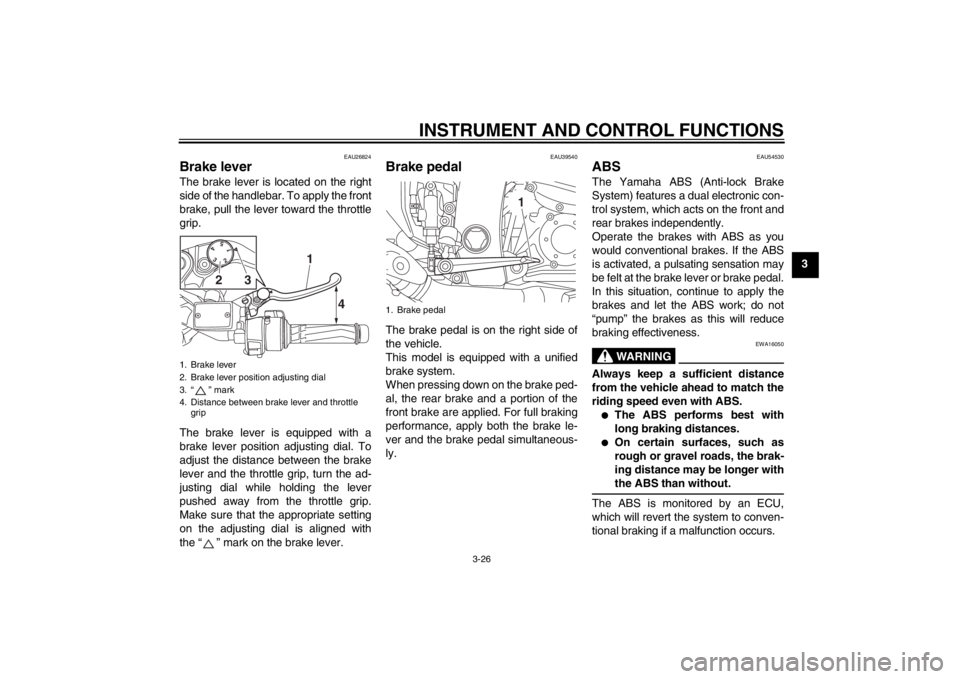
Brake lever The brake lever is located on the right
side of the handlebar. To apply the front
brake, pull the lever toward the throttle
grip.
The brake lever is equipped with a
brake lever position adjusting dial. To
adjust the distance between the brake
lever and the throttle grip, turn the ad-
justing dial while holding the lever
pushed away from the throttle grip.
Make sure that the appropriate setting
on the adjusting dial is aligned with
the “ ” mark on the brake lever.
EAU39540
Brake pedal The brake pedal is on the right side of
the vehicle.
This model is equipped with a unified
brake system.
When pressing down on the brake ped-
al, the rear brake and a portion of the
front brake are applied. For full braking
performance, apply both the brake le-
ver and the brake pedal simultaneous-
ly.
EAU54530
ABS The Yamaha ABS (Anti-lock Brake
System) features a dual electronic con-
trol system, which acts on the front and
rear brakes independently.
Operate the brakes with ABS as you
would conventional brakes. If the ABS
is activated, a pulsating sensation may
be felt at the brake lever or brake pedal.
In this situation, continue to apply the
brakes and let the ABS work; do not
“pump” the brakes as this will reduce
braking effectiveness.
WARNING
EWA16050
Always keep a sufficient distance
from the vehicle ahead to match the
riding speed even with ABS.●
The ABS performs best with
long braking distances.
●
On certain surfaces, such as
rough or gravel roads, the brak-
ing distance may be longer with
the ABS than without.
The ABS is monitored by an ECU,
which will revert the system to conven-
tional braking if a malfunction occurs.
1. Brake lever
2. Brake lever position adjusting dial
3. “ ” mark
4. Distance between brake lever and throttle grip
15
43
2
4
1
3
2
1. Brake pedal
1
U1MCE0E0.book Page 26 Thursday, July 19, 2012 6:59 PM
Page 42 of 118
INSTRUMENT AND CONTROL FUNCTIONS
3-27
3
TIP●
The ABS performs a self-diagno-
sis test each time the vehicle first
starts off after the key is turned to
“ON” and the vehicle has traveled
at a speed of 10 km/h (6 mi/h) or
higher. During this test, a “clicking”
noise can be heard from under the
seat, and if the brake lever or
brake pedal is even slightly ap-
plied, a vibration can be felt at the
lever and pedal, but these do not
indicate a malfunction.
●
This ABS has a test mode which
allows the owner to experience the
pulsation at the brake lever or
brake pedal when the ABS is oper-
ating. However, special tools are
required, so please consult your
Yamaha dealer when performing
this test.
NOTICE
ECA16830
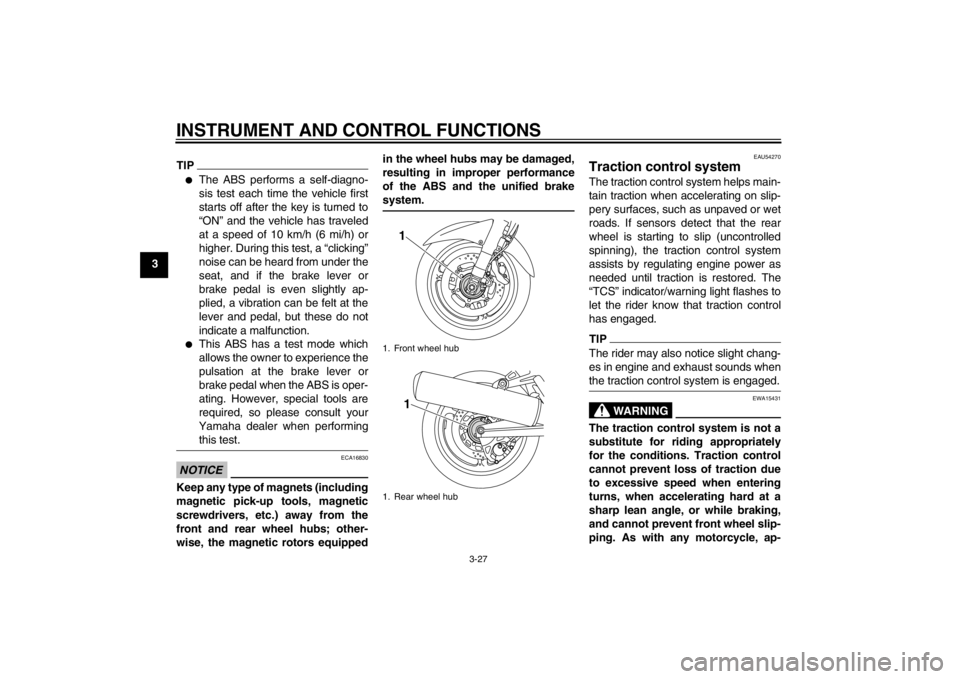
Keep any type of magnets (including
magnetic pick-up tools, magnetic
screwdrivers, etc.) away from the
front and rear wheel hubs; other-
wise, the magnetic rotors equippedin the wheel hubs may be damaged,
resulting in improper performance
of the ABS and the unified brake
system.
EAU54270
Traction control system The traction control system helps main-
tain traction when accelerating on slip-
pery surfaces, such as unpaved or wet
roads. If sensors detect that the rear
wheel is starting to slip (uncontrolled
spinning), the traction control system
assists by regulating engine power as
needed until traction is restored. The
“TCS” indicator/warning light flashes to
let the rider know that traction control
has engaged.TIPThe rider may also notice slight chang-
es in engine and exhaust sounds when
the traction control system is engaged.
WARNING
EWA15431
The traction control system is not a
substitute for riding appropriately
for the conditions. Traction control
cannot prevent loss of traction due
to excessive speed when entering
turns, when accelerating hard at a
sharp lean angle, or while braking,
and cannot prevent front wheel slip-
ping. As with any motorcycle, ap-
1. Front wheel hub
1. Rear wheel hub
11
U1MCE0E0.book Page 27 Thursday, July 19, 2012 6:59 PM
Page 56 of 118
INSTRUMENT AND CONTROL FUNCTIONS
3-41
3ber of clicks of each damping force ad-
justing mechanism and to modify the
specifications as necessary.
EAU14916
Adjusting the shock absorber
assembly This shock absorber assembly is
equipped with a spring preload adjust-
ing lever and a rebound damping force
adjusting knob.NOTICE
ECA16570
To avoid damaging the mechanism,
do not attempt to move beyond the
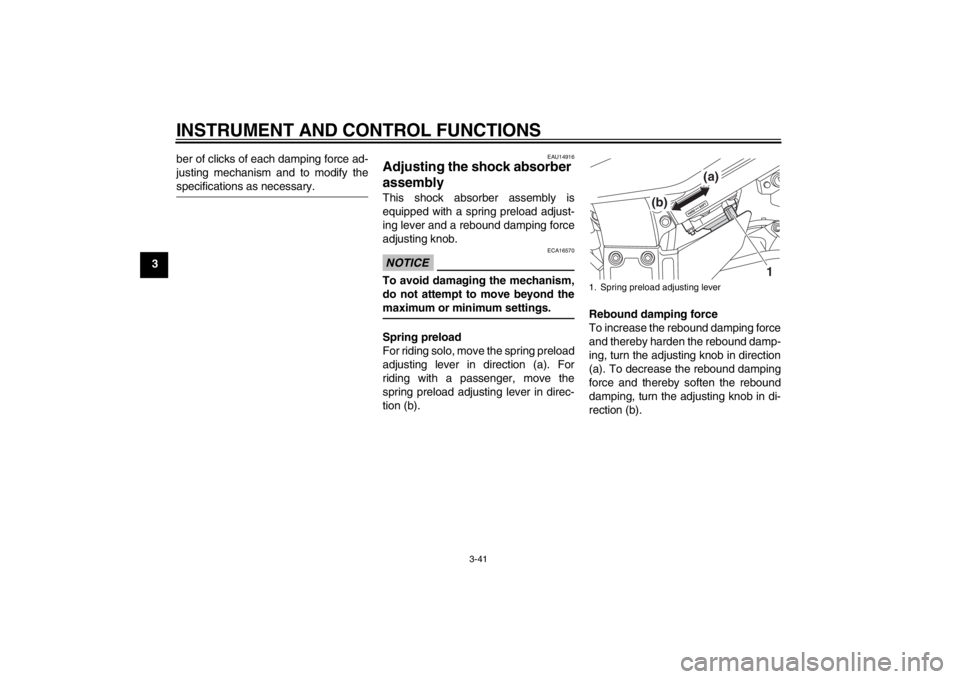
maximum or minimum settings.Spring preload
For riding solo, move the spring preload
adjusting lever in direction (a). For
riding with a passenger, move the
spring preload adjusting lever in direc-
tion (b).
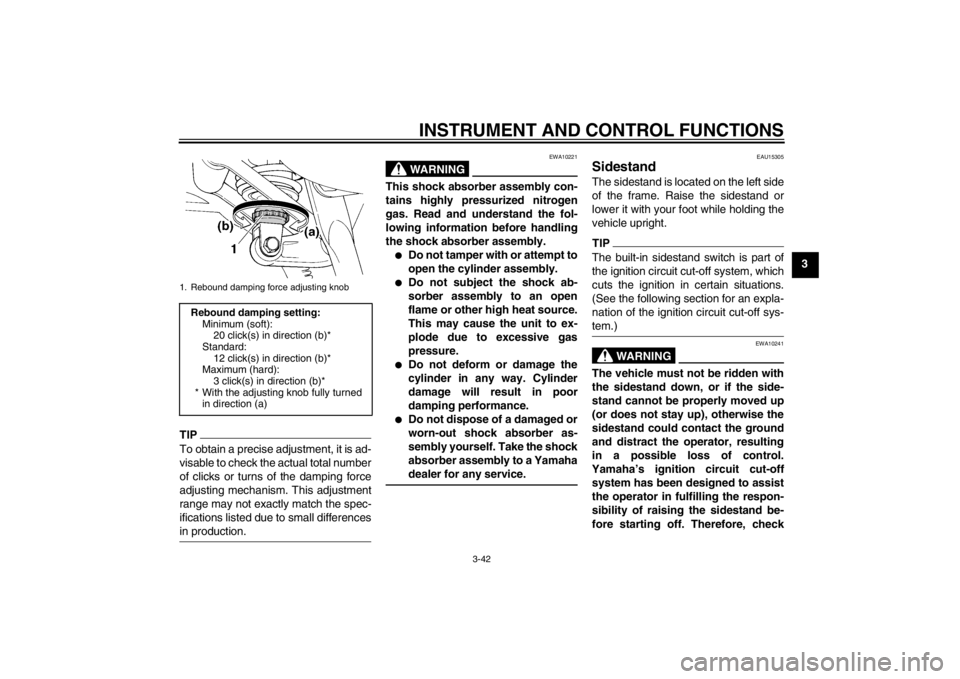
Rebound damping force
To increase the rebound damping force
and thereby harden the rebound damp-
ing, turn the adjusting knob in direction
(a). To decrease the rebound damping
force and thereby soften the rebound
damping, turn the adjusting knob in di-
rection (b).
1. Spring preload adjusting lever
1
(b)
(a)
U1MCE0E0.book Page 41 Thursday, July 19, 2012 6:59 PM
Page 57 of 118
INSTRUMENT AND CONTROL FUNCTIONS
3-42
3
TIPTo obtain a precise adjustment, it is ad-
visable to check the actual total number
of clicks or turns of the damping force
adjusting mechanism. This adjustment
range may not exactly match the spec-
ifications listed due to small differences
in production.
WARNING
EWA10221
This shock absorber assembly con-
tains highly pressurized nitrogen
gas. Read and understand the fol-
lowing information before handling
the shock absorber assembly.●
Do not tamper with or attempt to
open the cylinder assembly.
●
Do not subject the shock ab-
sorber assembly to an open
flame or other high heat source.
This may cause the unit to ex-
plode due to excessive gas
pressure.
●
Do not deform or damage the
cylinder in any way. Cylinder
damage will result in poor
damping performance.
●
Do not dispose of a damaged or
worn-out shock absorber as-
sembly yourself. Take the shock
absorber assembly to a Yamaha
dealer for any service.
EAU15305
Sidestand The sidestand is located on the left side
of the frame. Raise the sidestand or
lower it with your foot while holding the
vehicle upright.TIPThe built-in sidestand switch is part of
the ignition circuit cut-off system, which
cuts the ignition in certain situations.
(See the following section for an expla-
nation of the ignition circuit cut-off sys-
tem.)
WARNING
EWA10241
The vehicle must not be ridden with
the sidestand down, or if the side-
stand cannot be properly moved up
(or does not stay up), otherwise the
sidestand could contact the ground
and distract the operator, resulting
in a possible loss of control.
Yamaha’s ignition circuit cut-off
system has been designed to assist
the operator in fulfilling the respon-
sibility of raising the sidestand be-
fore starting off. Therefore, check
1. Rebound damping force adjusting knobRebound damping setting:Minimum (soft):20 click(s) in direction (b)*
Standard: 12 click(s) in direction (b)*
Maximum (hard):
3 click(s) in direction (b)*
* With the adjusting knob fully turned in direction (a)
U1MCE0E0.book Page 42 Thursday, July 19, 2012 6:59 PM