Engine idle YAMAHA FX SVHO 2014 Owners Manual
[x] Cancel search | Manufacturer: YAMAHA, Model Year: 2014, Model line: FX SVHO, Model: YAMAHA FX SVHO 2014Pages: 118, PDF Size: 5.89 MB
Page 35 of 118
![YAMAHA FX SVHO 2014 Owners Manual Control function operation
29
will not start. Also, the starter motor could
be damaged.
[ECJ01041]
The engine will not start under any of the fol-
lowing conditions:
Lock mode of the Yamaha Securi](/img/51/49923/w960_49923-34.png "YAMAHA FX SVHO 2014 Owners Manual Control function operation
29
will not start. Also, the starter motor could
be damaged.
[ECJ01041]
The engine will not start under any of the fol-
lowing conditions:
Lock mode of the Yamaha Securi")
Control function operation
29
will not start. Also, the starter motor could
be damaged.
[ECJ01041]
The engine will not start under any of the fol-
lowing conditions:
Lock mode of the Yamaha Security System
has been selected. (See page 27 for
Yamaha Security System setting proce- dures.)
Clip is removed from the engine shut-off
switch.
Throttle lever is squeezed.
Throttle lever is malfunctioning.EJU31212Throttle lever
The throttle lever increases the engine speed
when the lever is squeezed.
The throttle lever returns automatically to its
fully closed (idle) position when released.
EJU31262Steering system
By turning the handlebars in the direction you
wish to travel, the angle of the jet thrust noz-
zle is changed, and the direction of the water-
craft is changed accordingly.
Since the strength of the jet thrust determines
the speed and degree of a turn, throttle must
always be applied when attempting a turn,
except at trolling speed.
This model is equipped with the Yamaha En-
gine Management System (YEMS) that in-
cludes an off-throttle steering (OTS) system.
It will activate at planing speeds should you
attempt to steer the watercraft after releasing
the throttle lever. The OTS system assists in
turning by continuing to supply some thrust
while the watercraft is decelerating, but you
can turn more sharply if you apply throttle
while turning the handlebars. The OTS sys-
tem does not function below planing speeds
or when the engine is off. Once the engine
slows down, the watercraft will no longer turn
1 Start switch
1 Throttle lever
1
1
1Handlebar
2 Jet thrust nozzle
1
2
UF3J70E0.book Page 29 Wednesd ay, October 9, 2013 2:07 PM
Page 38 of 118
Watercraft operation
32
EJU40012
Watercraft operation functions
EJU42493Shift system
WARNING
EWJ01231
Do not use the reverse function to slow
down or stop the watercraft as it could
cause you to lose control, be ejected, or
impact the handlebars.
Make sure that there are no obstacles or
people behind you before shifting into
reverse.
Do not touch the reverse gate while the
shift lever is being operated, otherwise
you could be pinched.
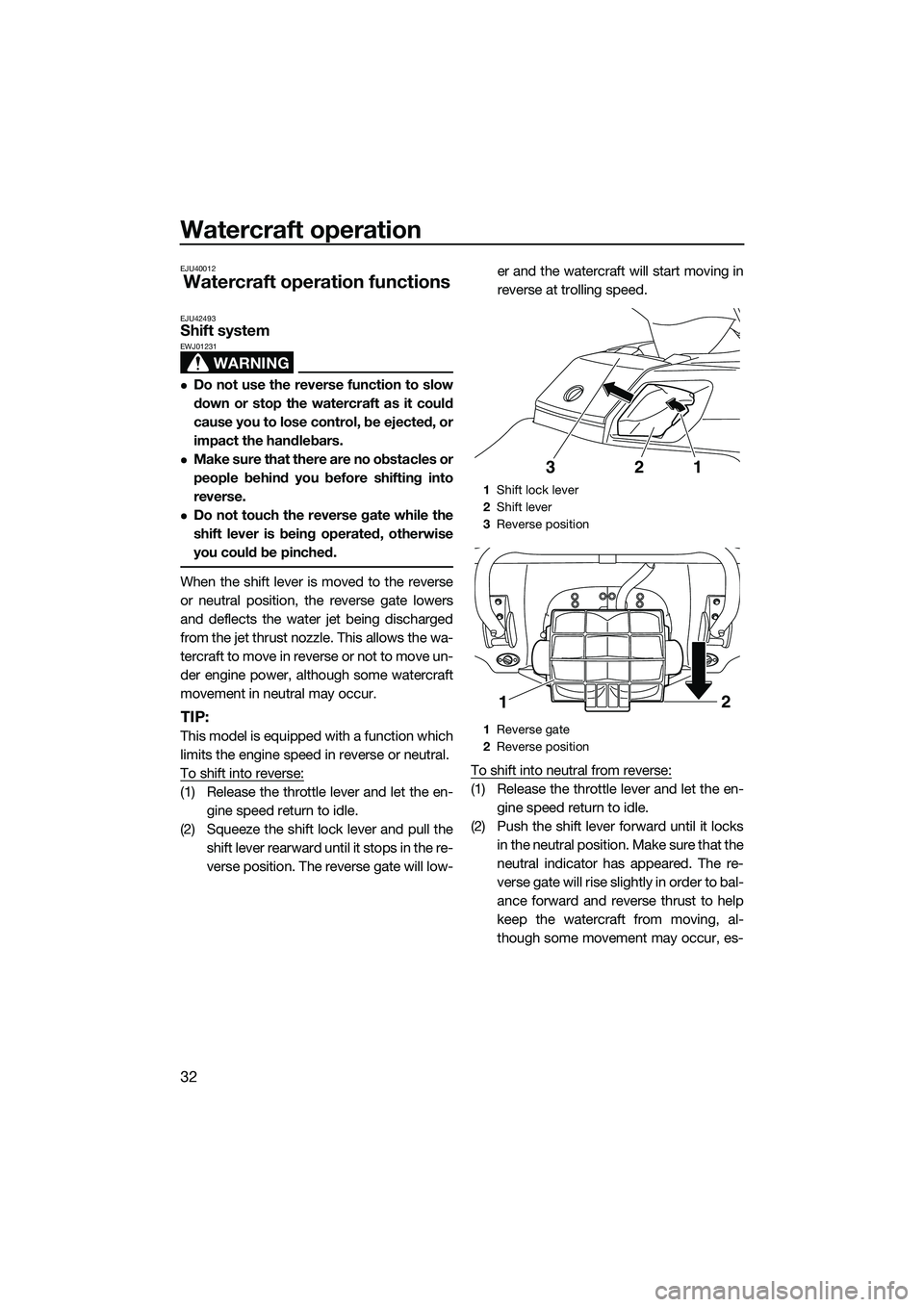
When the shift lever is moved to the reverse
or neutral position, the reverse gate lowers
and deflects the water jet being discharged
from the jet thrust nozzle. This allows the wa-
tercraft to move in reverse or not to move un-
der engine power, although some watercraft
movement in neutral may occur.
TIP:
This model is equipped with a function which
limits the engine speed in reverse or neutral.
To shift into reverse:
(1) Release the throttle lever and let the en-gine speed return to idle.
(2) Squeeze the shift lock lever and pull the shift lever rearward until it stops in the re-
verse position. The reverse gate will low- er and the watercraft will start moving in
reverse at trolling speed.
To shift into neutral from reverse:(1) Release the throttle lever and let the en- gine speed return to idle.
(2) Push the shift lever forward until it locks in the neutral position. Make sure that the
neutral indicator has appeared. The re-
verse gate will rise slightly in order to bal-
ance forward and reverse thrust to help
keep the watercraft from moving, al-
though some movement may occur, es-
1Shift lock lever
2 Shift lever
3 Reverse position
1 Reverse gate
2 Reverse position
2
31
1 2
UF3J70E0.book Page 32 Wednesd
ay, October 9, 2013 2:07 PM
Page 43 of 118
Watercraft operation
37
TIP:
The beeps and the blinking digital speedom-
eter display also indicate the activation of the
cruise assist. (See page 37 for information on
the cruise assist.)
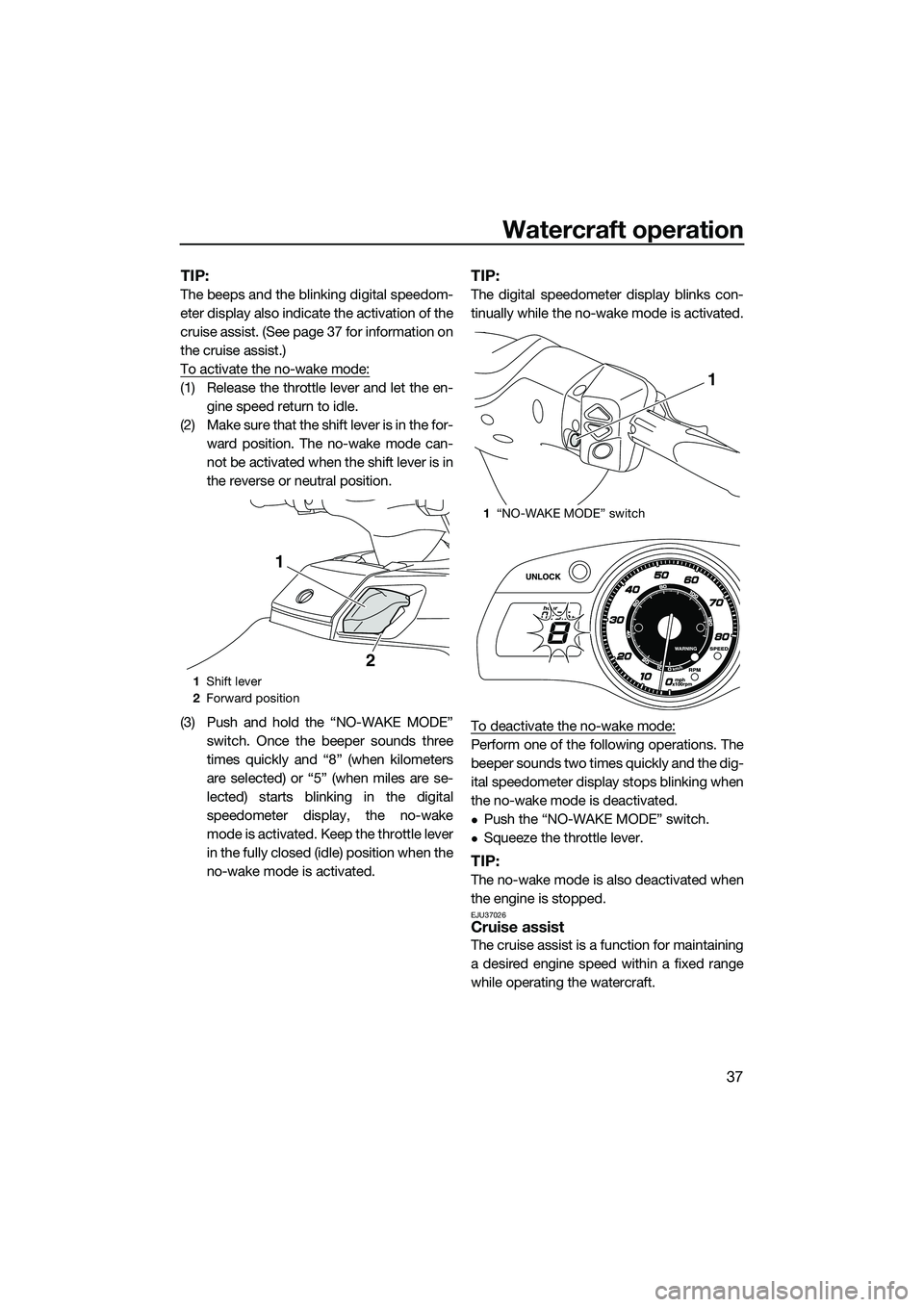
To activate the no-wake mode:
(1) Release the throttle lever and let the en-gine speed return to idle.
(2) Make sure that the shift lever is in the for- ward position. The no-wake mode can-
not be activated when the shift lever is in
the reverse or neutral position.
(3) Push and hold the “NO-WAKE MODE” switch. Once the beeper sounds three
times quickly and “8” (when kilometers
are selected) or “5” (when miles are se-
lected) starts blinking in the digital
speedometer display, the no-wake
mode is activated. Keep the throttle lever
in the fully closed (idle) position when the
no-wake mode is activated.
TIP:
The digital speedometer display blinks con-
tinually while the no-wake mode is activated.
To deactivate the no-wake mode:
Perform one of the following operations. The
beeper sounds two times quickly and the dig-
ital speedometer display stops blinking when
the no-wake mode is deactivated.
Push the “NO-WAKE MODE” switch.
Squeeze the throttle lever.
TIP:
The no-wake mode is also deactivated when
the engine is stopped.
EJU37026Cruise assist
The cruise assist is a function for maintaining
a desired engine speed within a fixed range
while operating the watercraft.
1Shift lever
2 Forward position
1
2
1“NO-WAKE MODE” switch
1
UF3J70E0.book Page 37 Wednesd ay, October 9, 2013 2:07 PM
Page 83 of 118
Operation
77
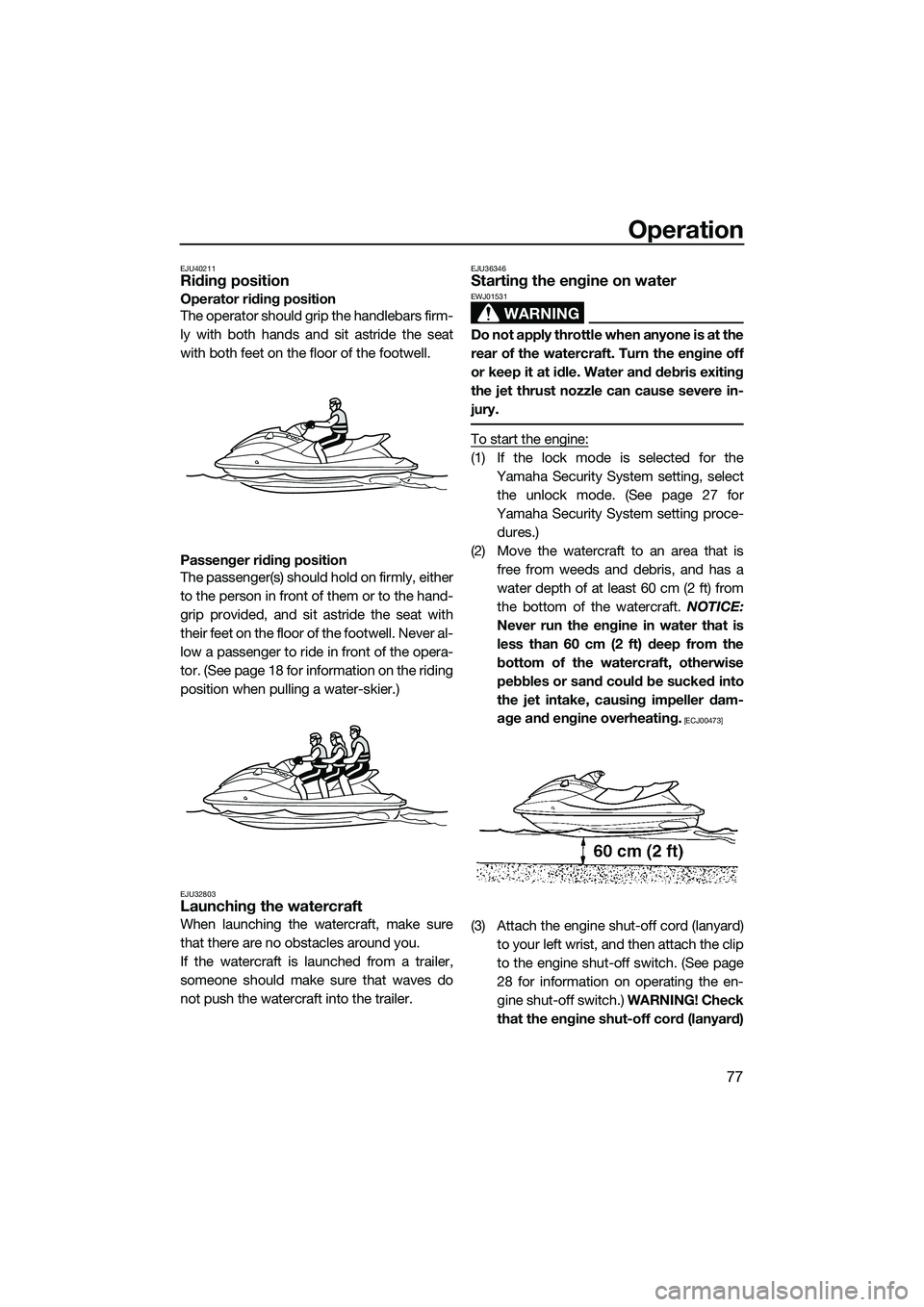
EJU40211Riding position
Operator riding position
The operator should grip the handlebars firm-
ly with both hands and sit astride the seat
with both feet on the floor of the footwell.
Passenger riding position
The passenger(s) should hold on firmly, either
to the person in front of them or to the hand-
grip provided, and sit astride the seat with
their feet on the floor of the footwell. Never al-
low a passenger to ride in front of the opera-
tor. (See page 18 for information on the riding
position when pulling a water-skier.)
EJU32803Launching the watercraft
When launching the watercraft, make sure
that there are no obstacles around you.
If the watercraft is launched from a trailer,
someone should make sure that waves do
not push the watercraft into the trailer.
EJU36346Starting the engine on water
WARNING
EWJ01531
Do not apply throttle when anyone is at the
rear of the watercraft. Turn the engine off
or keep it at idle. Water and debris exiting
the jet thrust nozzle can cause severe in-
jury.
To start the engine:
(1) If the lock mode is selected for theYamaha Security System setting, selectthe unlock mode. (See page 27 for
Yamaha Security System setting proce- dures.)
(2) Move the watercraft to an area that is free from weeds and debris, and has a
water depth of at least 60 cm (2 ft) from
the bottom of the watercraft. NOTICE:
Never run the engine in water that is
less than 60 cm (2 ft) deep from the
bottom of the watercraft, otherwise
pebbles or sand could be sucked into
the jet intake, causing impeller dam-
age and engine overheating.
[ECJ00473]
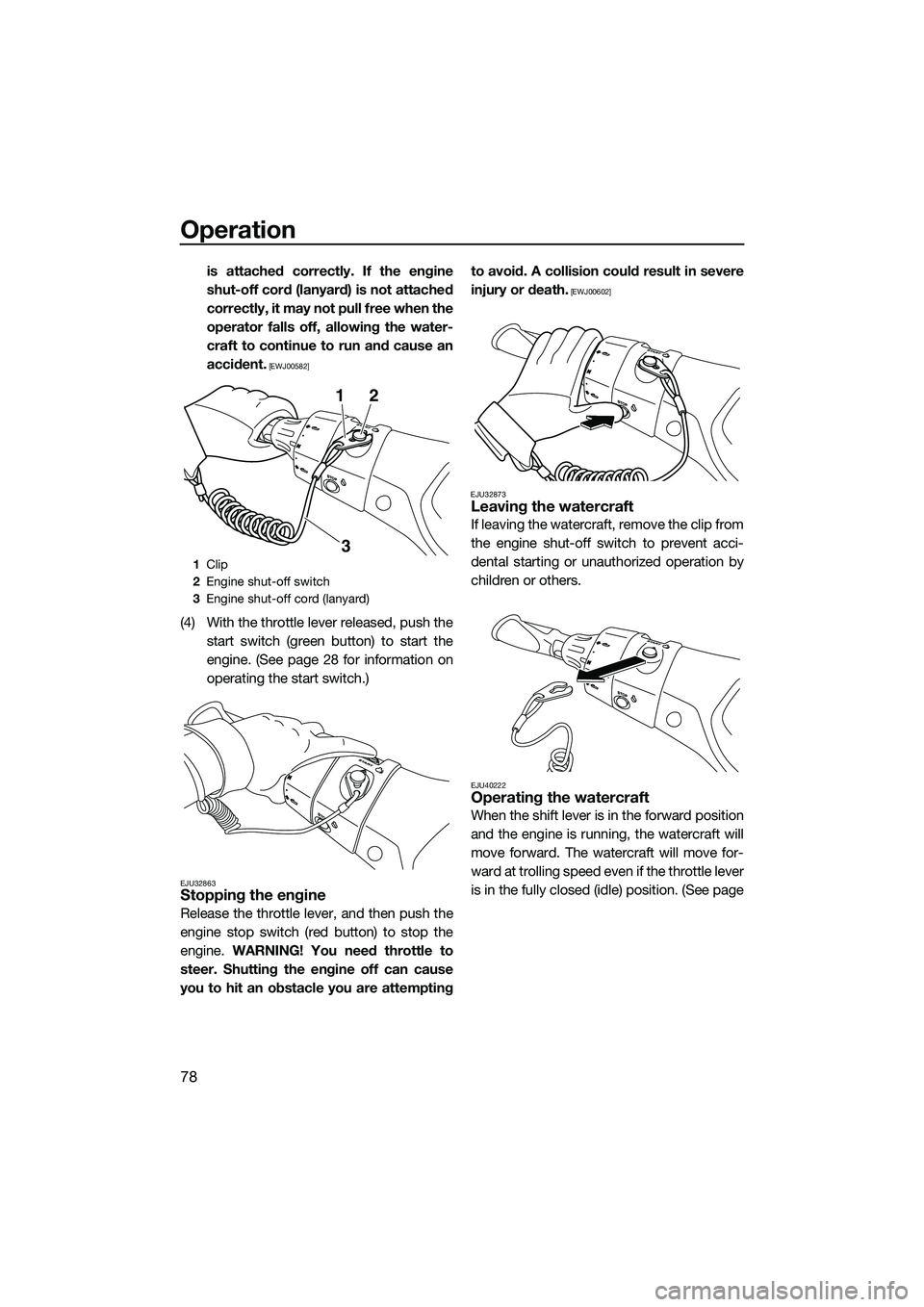
(3) Attach the engine shut-off cord (lanyard) to your left wrist, and then attach the clip
to the engine shut-off switch. (See page
28 for information on operating the en-
gine shut-off switch.) WARNING! Check
that the engine shut-off cord (lanyard)
UF3J70E0.book Page 77 Wednesd ay, October 9, 2013 2:07 PM
Page 84 of 118
Operation
78
is attached correctly. If the engine
shut-off cord (lanyard) is not attached
correctly, it may not pull free when the
operator falls off, allowing the water-
craft to continue to run and cause an
accident.
[EWJ00582]
(4) With the throttle lever released, push thestart switch (green button) to start the
engine. (See page 28 for information on
operating the start switch.)
EJU32863Stopping the engine
Release the throttle lever, and then push the
engine stop switch (red button) to stop the
engine. WARNING! You need throttle to
steer. Shutting the engine off can cause
you to hit an obstacle you are attempting to avoid. A collision could result in severe
injury or death.
[EWJ00602]
EJU32873
Leaving the watercraft
If leaving the watercraft, remove the clip from
the engine shut-off switch to prevent acci-
dental starting or unauthorized operation by
children or others.
EJU40222Operating the watercraft
When the shift lever is in the forward position
and the engine is running, the watercraft will
move forward. The watercraft will move for-
ward at trolling speed even if the throttle lever
is in the fully closed (idle) position. (See page
1 Clip
2 Engine shut-off switch
3 Engine shut-off cord (lanyard)
12
3
UF3J70E0.book Page 78 Wednesd ay, October 9, 2013 2:07 PM
Page 86 of 118
Operation
80
engine slows down, the watercraft will no
longer respond to handlebar input until
you apply throttle again or you reach
trolling speed.
At trolling speed, the watercraft can be
turned gradually by handlebar position
alone using just the amount of thrust
available at idle.
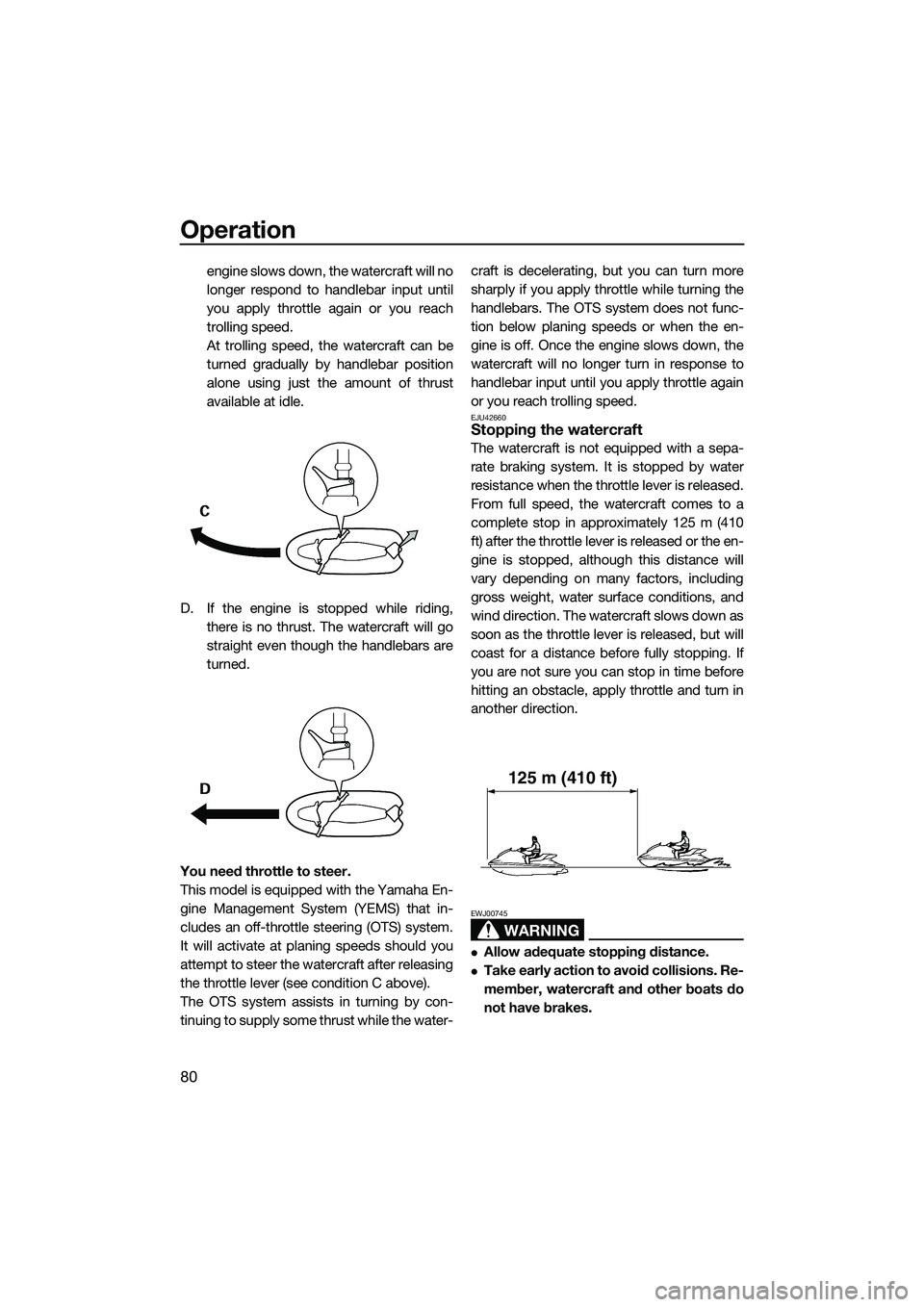
D. If the engine is stopped while riding, there is no thrust. The watercraft will go
straight even though the handlebars are
turned.
You need throttle to steer.
This model is equipped with the Yamaha En-
gine Management System (YEMS) that in-
cludes an off-throttle steering (OTS) system.
It will activate at planing speeds should you
attempt to steer the watercraft after releasing
the throttle lever (see condition C above).
The OTS system assists in turning by con-
tinuing to supply some thrust while the water- craft is decelerating, but you can turn more
sharply if you apply throttle while turning the
handlebars. The OTS system does not func-
tion below planing speeds or when the en-
gine is off. Once the engine slows down, the
watercraft will no longer turn in response to
handlebar input until you apply throttle again
or you reach trolling speed.
EJU42660Stopping the watercraft
The watercraft is not equipped with a sepa-
rate braking system. It is stopped by water
resistance when the throttle lever is released.
From full speed, the watercraft comes to a
complete stop in approximately 125 m (410
ft) after the throttle lever is released or the en-
gine is stopped, although this distance will
vary depending on many factors, including
gross weight, water surface conditions, and
wind direction. The watercraft slows down as
soon as the throttle lever is released, but will
coast for a distance before fully stopping. If
you are not sure you can stop in time before
hitting an obstacle, apply throttle and turn in
another direction.
WARNING
EWJ00745
Allow adequate stopping distance.
Take early action to avoid collisions. Re-
member, watercraft and other boats do
not have brakes.
125 m (410 ft)
UF3J70E0.book Page 80 Wednesd
ay, October 9, 2013 2:07 PM