ABS YAMAHA FZ1 S 2012 User Guide
[x] Cancel search | Manufacturer: YAMAHA, Model Year: 2012, Model line: FZ1 S, Model: YAMAHA FZ1 S 2012Pages: 106, PDF Size: 2.28 MB
Page 40 of 106
INSTRUMENT AND CONTROL FUNCTIONS
3-25
3
TIPTo obtain a precise adjustment, it is ad-
visable to check the actual total number
of clicks or turns of the damping force
adjusting mechanism. This adjustment
range may not exactly match the spec-
ifications listed due to small differences
in production.
WARNING
EWA10221
This shock absorber assembly con-
tains highly pressurized nitrogen
gas. Read and understand the fol-
lowing information before handling
the shock absorber assembly.●
Do not tamper with or attempt to
open the cylinder assembly.
●
Do not subject the shock ab-
sorber assembly to an open
flame or other high heat source.
This may cause the unit to ex-
plode due to excessive gas
pressure.
●
Do not deform or damage the
cylinder in any way. Cylinder
damage will result in poor
damping performance.
●
Do not dispose of a damaged or
worn-out shock absorber as-
sembly yourself. Take the shock
absorber assembly to a Yamaha
dealer for any service.
EAU15151
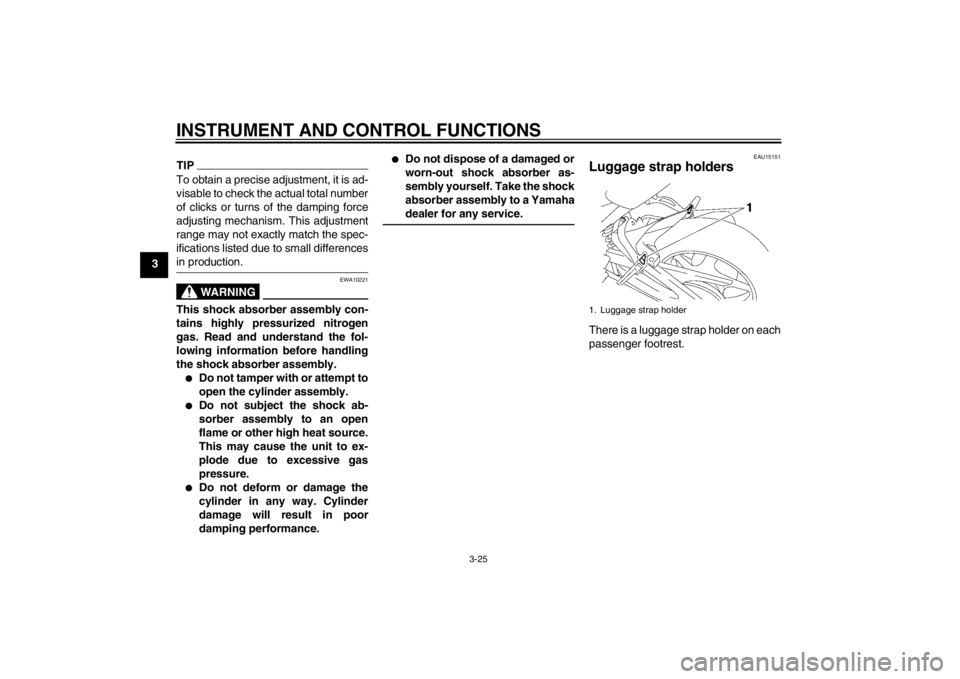
Luggage strap holders There is a luggage strap holder on each
passenger footrest.1. Luggage strap holder
U1CAE1E0.book Page 25 Tuesday, September 13, 2011 5:02 PM
Page 47 of 106
OPERATION AND IMPORTANT RIDING POINTS
5-1
5
EAU15951
Read the Owner’s Manual carefully to
become familiar with all controls. If
there is a control or function you do not
understand, ask your Yamaha dealer.
WARNING
EWA10271
Failure to familiarize yourself with
the controls can lead to loss of con-
trol, which could cause an accident
or injury.
EAU47150
TIPThis model is equipped with:●
a lean angle sensor to stop the en-
gine in case of a turnover. In this
case, the multi-function meter unit
indicates error code 30, but this is
not a malfunction. Turn the key to
“OFF” and then to “ON” to clear the
error code. Failing to do so will pre-
vent the engine from starting even
though the engine will crank when
pushing the start switch.
●
an engine auto-stop system. The
engine stops automatically if left
idling for 20 minutes. In this case,
the multi-function meter unit indi-
cates error code 70, but this is not
a malfunction. Push the start
switch to clear the error code and
to restart the engine.
EAU44728
Starting the engine In order for the ignition circuit cut-off
system to enable starting, one of the
following conditions must be met.●
The transmission is in the neutral
position.
●
The transmission is in gear with
the clutch lever pulled and the
sidestand up.
See page 3-27 for more informa-
tion.
1. Turn the key to “ON” and make sure that the engine stop switch is
set to “ ”.
The following warning lights and
indicator light should come on for a
few seconds, then go off.●
Oil level warning light
●
Coolant temperature warning
light
●
Engine trouble warning light
●
ABS warning light (for ABS
models)
●
Immobilizer system indicator
light
U1CAE1E0.book Page 1 Tuesday, September 13, 2011 5:02 PM
Page 55 of 106

PERIODIC MAINTENANCE AND ADJUSTMENT
6-5
6
10 Drive chain Check chain slack, alignment and
condition.
Adjust and lubricate chain with a special O-ring chain lubricant
thoroughly. Every 1000 km (600 mi) and after washing the motorcycle, riding in the rain or
riding in wet areas
11 *Steering bearings Check bearing play and steering
for roughness. √√√√√
Lubricate with lithium-soap-based grease. Every 20000 km (12000 mi)
12 *Chassis fasteners Make sure that all nuts, bolts and
screws are properly tightened. √√√√√
13 Brake lever pivot
shaft
Lubricate with silicone grease.
√√√√√
14 Brake pedal pivot
shaft Lubricate with lithium-soap-based
grease. √√√√√
15 Clutch lever pivot
shaft Lubricate with lithium-soap-based
grease. √√√√√
16 Shift pedal pivot
shaft Lubricate with lithium-soap-based
grease. √√√√√
17 Sidestand, center-
stand Check operation.
Lubricate with lithium-soap-based
grease. √√√√√
18 *Sidestand switch Check operation. √√√√√√
19 *Front fork Check operation and for oil leak-
age. √√√√
20 *Shock absorber as-
sembly Check operation and shock ab-
sorber for oil leakage. √√√√
NO. ITEM CHECK OR MAINTENANCE JOB
ODOMETER READING
ANNUAL
CHECK
1000 km
(600 mi) 10000 km
(6000 mi) 20000 km
(12000 mi) 30000 km
(18000 mi) 40000 km
(24000 mi)
U1CAE1E0.book Page 5 Tuesday, September 13, 2011 5:02 PM
Page 72 of 106
PERIODIC MAINTENANCE AND ADJUSTMENT
6-22
6braking performance, which may re-
sult in loss of control and an acci-
dent.
EAU50750
Brake light switches (for ABS
models) The brake light, which is activated by
the brake pedal and brake lever, should
come on just before braking takes ef-
fect. If necessary, have a Yamaha deal-
er adjust the brake light switches.
EAU50760
Brake light switches (for non-
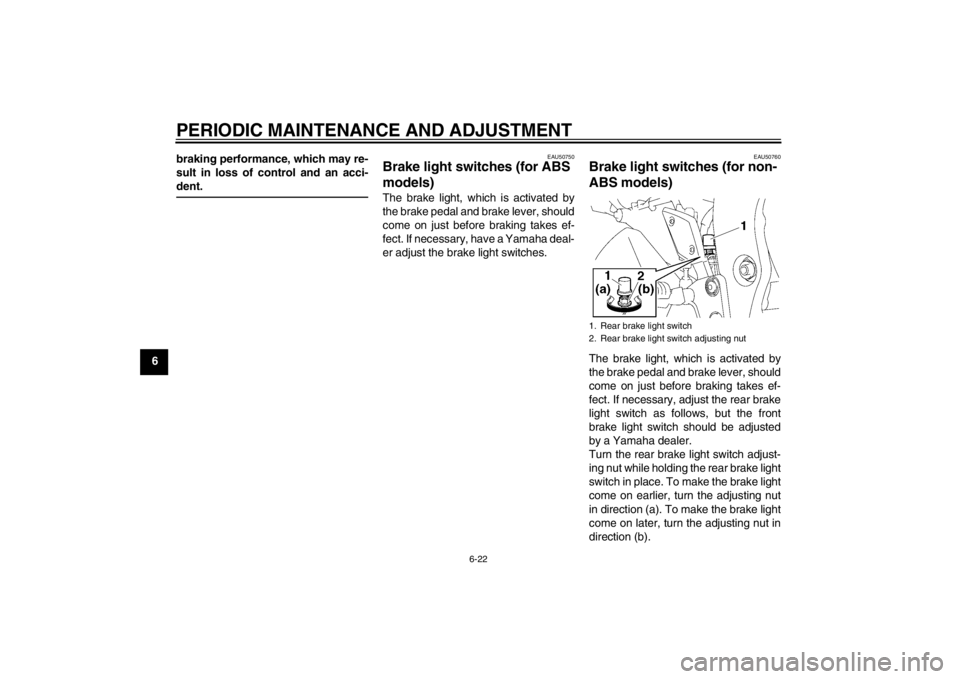
ABS models) The brake light, which is activated by
the brake pedal and brake lever, should
come on just before braking takes ef-
fect. If necessary, adjust the rear brake
light switch as follows, but the front
brake light switch should be adjusted
by a Yamaha dealer.
Turn the rear brake light switch adjust-
ing nut while holding the rear brake light
switch in place. To make the brake light
come on earlier, turn the adjusting nut
in direction (a). To make the brake light
come on later, turn the adjusting nut in
direction (b).1. Rear brake light switch
2. Rear brake light switch adjusting nut
U1CAE1E0.book Page 22 Tuesday, September 13, 2011 5:02 PM
Page 74 of 106
PERIODIC MAINTENANCE AND ADJUSTMENT
6-24
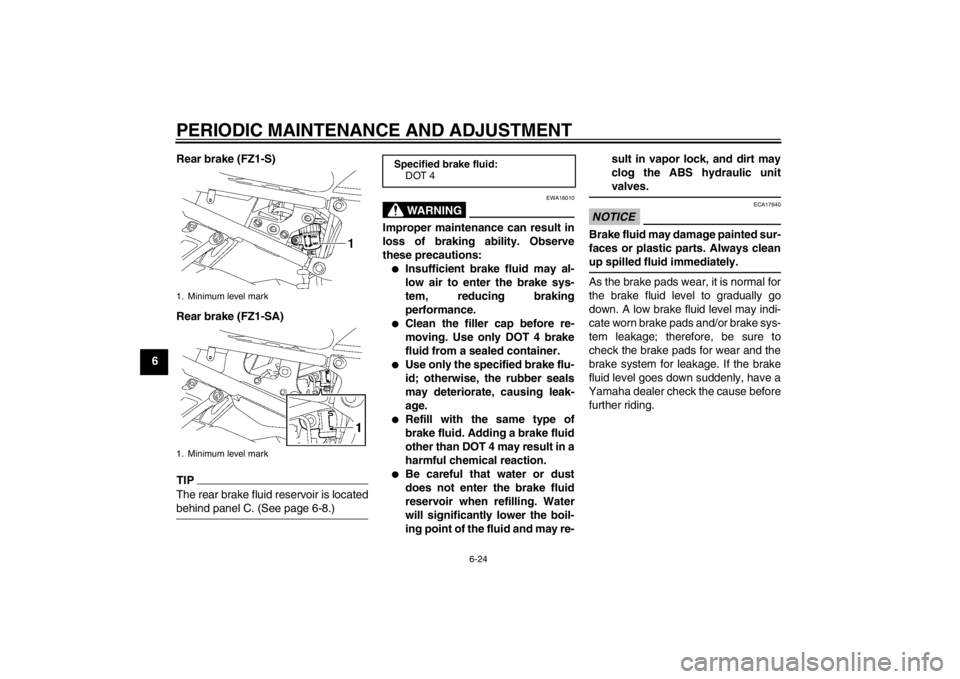
6Rear brake (FZ1-S)
Rear brake (FZ1-SA)
TIPThe rear brake fluid reservoir is located
behind panel C. (See page 6-8.)
WARNING
EWA16010
Improper maintenance can result in
loss of braking ability. Observe
these precautions:●
Insufficient brake fluid may al-
low air to enter the brake sys-
tem, reducing braking
performance.
●
Clean the filler cap before re-
moving. Use only DOT 4 brake
fluid from a sealed container.
●
Use only the specified brake flu-
id; otherwise, the rubber seals
may deteriorate, causing leak-
age.
●
Refill with the same type of
brake fluid. Adding a brake fluid
other than DOT 4 may result in a
harmful chemical reaction.
●
Be careful that water or dust
does not enter the brake fluid
reservoir when refilling. Water
will significantly lower the boil-
ing point of the fluid and may re- sult in vapor lock, and dirt may
clog the ABS hydraulic unit
valves.
NOTICE
ECA17640
Brake fluid may damage painted sur-
faces or plastic parts. Always clean
up spilled fluid immediately.As the brake pads wear, it is normal for
the brake fluid level to gradually go
down. A low brake fluid level may indi-
cate worn brake pads and/or brake sys-
tem leakage; therefore, be sure to
check the brake pads for wear and the
brake system for leakage. If the brake
fluid level goes down suddenly, have a
Yamaha dealer check the cause before further riding.
1. Minimum level mark
1. Minimum level mark
Specified brake fluid: DOT 4
U1CAE1E0.book Page 24 Tuesday, September 13, 2011 5:02 PM
Page 83 of 106
PERIODIC MAINTENANCE AND ADJUSTMENT
6-33
6
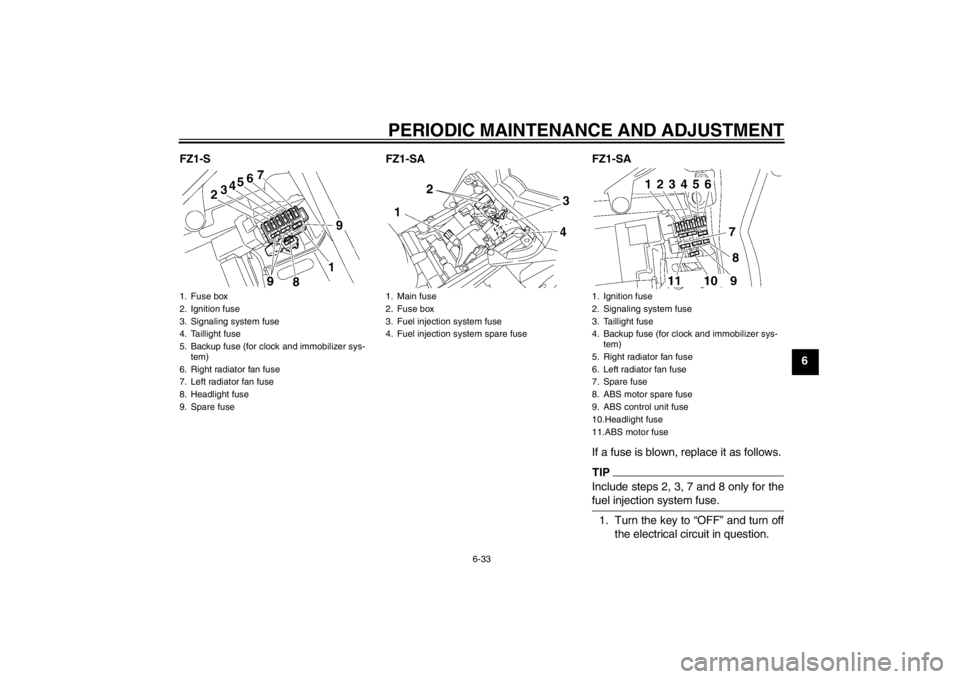
FZ1-S FZ1-SA FZ1-SA
If a fuse is blown, replace it as follows.
TIPInclude steps 2, 3, 7 and 8 only for the
fuel injection system fuse.1. Turn the key to “OFF” and turn offthe electrical circuit in question.
1. Fuse box
2. Ignition fuse
3. Signaling system fuse
4. Taillight fuse
5. Backup fuse (for clock and immobilizer sys-tem)
6. Right radiator fan fuse
7. Left radiator fan fuse
8. Headlight fuse
9. Spare fuse
1. Main fuse
2. Fuse box
3. Fuel injection system fuse
4. Fuel injection system spare fuse
1. Ignition fuse
2. Signaling system fuse
3. Taillight fuse
4. Backup fuse (for clock and immobilizer sys- tem)
5. Right radiator fan fuse
6. Left radiator fan fuse
7. Spare fuse
8. ABS motor spare fuse
9. ABS control unit fuse
10.Headlight fuse
11.ABS motor fuse
U1CAE1E0.book Page 33 Tuesday, September 13, 2011 5:02 PM
Page 84 of 106
PERIODIC MAINTENANCE AND ADJUSTMENT
6-34
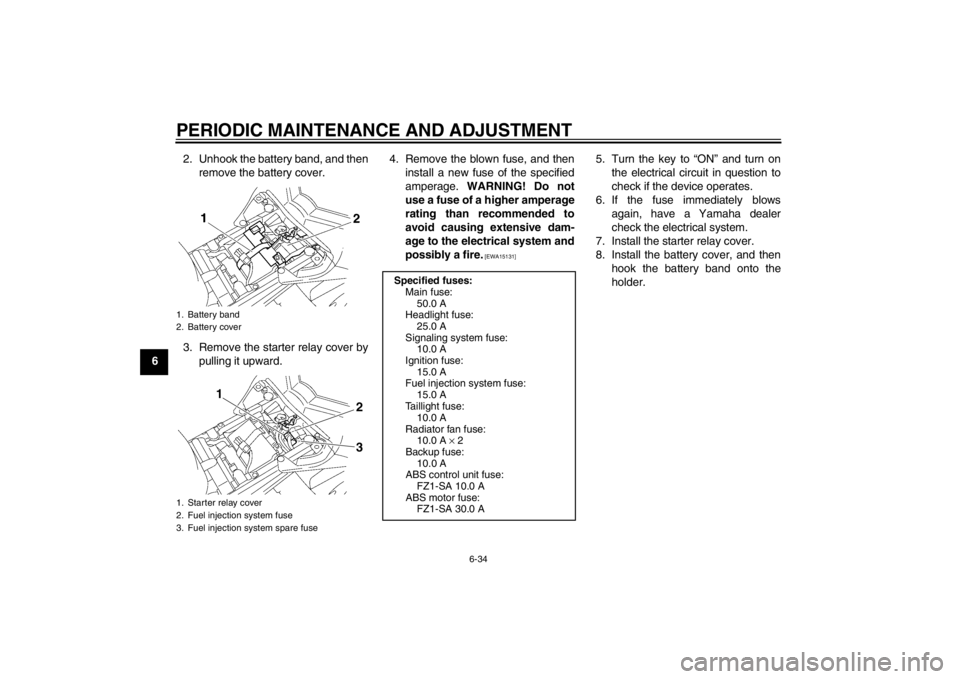
62. Unhook the battery band, and then
remove the battery cover.
3. Remove the starter relay cover by pulling it upward. 4. Remove the blown fuse, and then
install a new fuse of the specified
amperage. WARNING! Do not
use a fuse of a higher amperage
rating than recommended to
avoid causing extensive dam-
age to the electrical system and
possibly a fire.
[EWA15131]
5. Turn the key to “ON” and turn on the electrical circuit in question to
check if the device operates.
6. If the fuse immediately blows again, have a Yamaha dealer
check the electrical system.
7. Install the starter relay cover.
8. Install the battery cover, and then hook the battery band onto the
holder.
1. Battery band
2. Battery cover
1. Starter relay cover
2. Fuel injection system fuse
3. Fuel injection system spare fuse
2
1
3
Specified fuses:Main fuse:50.0 A
Headlight fuse:
25.0 A
Signaling system fuse: 10.0 A
Ignition fuse: 15.0 A
Fuel injection system fuse:
15.0 A
Taillight fuse: 10.0 A
Radiator fan fuse: 10.0 A × 2
Backup fuse:
10.0 A
ABS control unit fuse: FZ1-SA 10.0 A
ABS motor fuse: FZ1-SA 30.0 A
U1CAE1E0.book Page 34 Tuesday, September 13, 2011 5:02 PM
Page 88 of 106
PERIODIC MAINTENANCE AND ADJUSTMENT
6-38
6
EAU44791
Front wheel (for non-ABS
models)
WARNING
EWA14840
For the ABS model, have a Yamaha
dealer remove and install the wheel.
EAU40062
To remove the front wheel
WARNING
EWA10821
To avoid injury, securely support the
vehicle so there is no danger of it
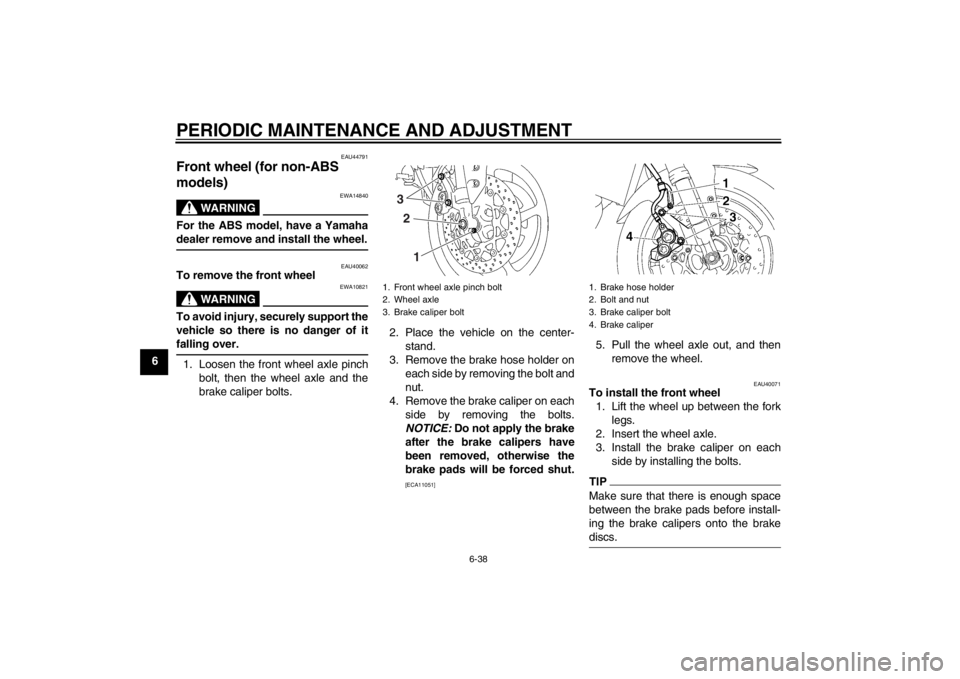
falling over.1. Loosen the front wheel axle pinchbolt, then the wheel axle and the
brake caliper bolts. 2. Place the vehicle on the center-
stand.
3. Remove the brake hose holder on each side by removing the bolt and
nut.
4. Remove the brake caliper on each side by removing the bolts.
NOTICE: Do not apply the brake
after the brake calipers have
been removed, otherwise the
brake pads will be forced shut.
[ECA11051]
5. Pull the wheel axle out, and then remove the wheel.
EAU40071
To install the front wheel1. Lift the wheel up between the fork legs.
2. Insert the wheel axle.
3. Install the brake caliper on each side by installing the bolts.TIPMake sure that there is enough space
between the brake pads before install-
ing the brake calipers onto the brake
discs.
1. Front wheel axle pinch bolt
2. Wheel axle
3. Brake caliper bolt
3
2
1
1. Brake hose holder
2. Bolt and nut
3. Brake caliper bolt
4. Brake caliper
U1CAE1E0.book Page 38 Tuesday, September 13, 2011 5:02 PM
Page 89 of 106
PERIODIC MAINTENANCE AND ADJUSTMENT
6-39
6
4. Install the brake hose holder on
each side by installing the bolt and
nut.
5. Take the vehicle off the center- stand so that the front wheel is on
the ground, and then put the side-
stand down.
6. Tighten the wheel axle, the front wheel axle pinch bolt, and the
brake caliper bolts to the specified
torques.
7. Push down hard on the handlebar several times to check for proper
fork operation.
EAU44801
Rear wheel (for non-ABS mod-
els)
WARNING
EWA14840
For the ABS model, have a Yamaha
dealer remove and install the wheel.
EAU40022
To remove the rear wheel
WARNING
EWA10821
To avoid injury, securely support the
vehicle so there is no danger of it
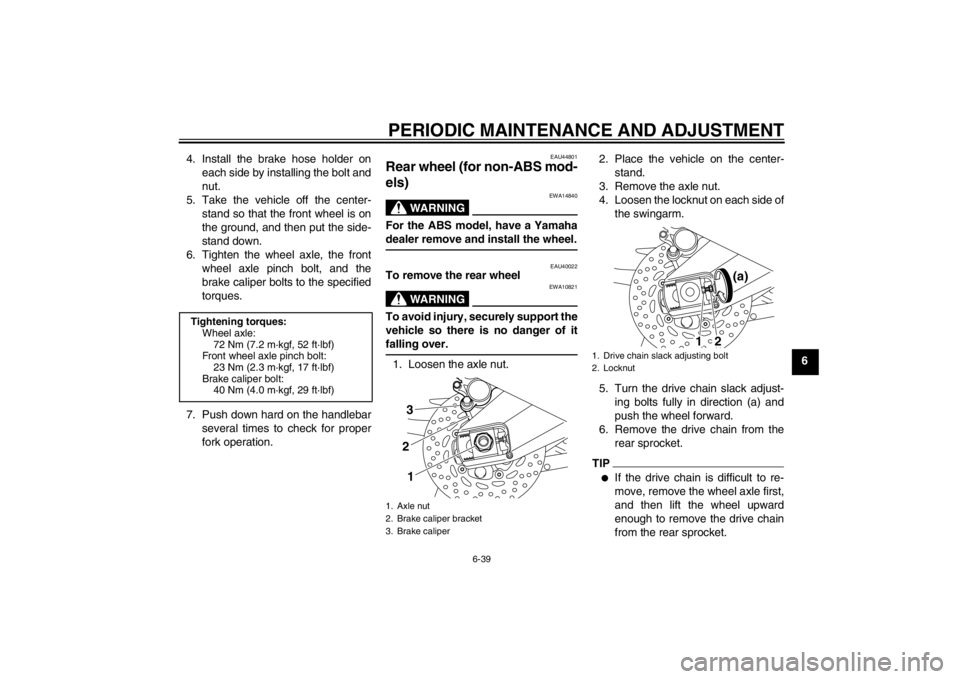
falling over.1. Loosen the axle nut. 2. Place the vehicle on the center-
stand.
3. Remove the axle nut.
4. Loosen the locknut on each side of the swingarm.
5. Turn the drive chain slack adjust- ing bolts fully in direction (a) and
push the wheel forward.
6. Remove the drive chain from the rear sprocket.
TIP●
If the drive chain is difficult to re-
move, remove the wheel axle first,
and then lift the wheel upward
enough to remove the drive chain
from the rear sprocket.
Tightening torques:Wheel axle:72 Nm (7.2 m·kgf, 52 ft·lbf)
Front wheel axle pinch bolt:
23 Nm (2.3 m·kgf, 17 ft·lbf)
Brake caliper bolt: 40 Nm (4.0 m·kgf, 29 ft·lbf)
1. Axle nut
2. Brake caliper bracket
3. Brake caliper
321
1. Drive chain slack adjusting bolt
2. Locknut
(a)
1
2
U1CAE1E0.book Page 39 Tuesday, September 13, 2011 5:02 PM
Page 95 of 106
MOTORCYCLE CARE AND STORAGE
7-2
7
off any detergent residue using
plenty of water, as it is harmful
to plastic parts.
●
Do not use any harsh chemical
products on plastic parts. Be
sure to avoid using cloths or
sponges which have been in
contact with strong or abrasive
cleaning products, solvent or
thinner, fuel (gasoline), rust re-
movers or inhibitors, brake flu-
id, antifreeze or electrolyte.
●
Do not use high-pressure wash-
ers or steam-jet cleaners since
they cause water seepage and
deterioration in the following ar-
eas: seals (of wheel and swing-
arm bearings, fork and brakes),
electric components (couplers,
connectors, instruments,
switches and lights), breather
hoses and vents.
●
For motorcycles equipped with
a windshield: Do not use strong
cleaners or hard sponges as
they will cause dulling or
scratching. Some cleaning com-
pounds for plastic may leave
scratches on the windshield. Test the product on a small hid-
den part of the windshield to
make sure that it does not leave
any marks. If the windshield is
scratched, use a quality plastic
polishing compound after
washing.
After normal useRemove dirt with warm water, a mild
detergent, and a soft, clean sponge,
and then rinse thoroughly with clean
water. Use a toothbrush or bottlebrush
for hard-to-reach areas. Stubborn dirt
and insects will come off more easily if
the area is covered with a wet cloth for
a few minutes before cleaning.
After riding in the rain, near the sea oron salt-sprayed roadsSince sea salt or salt sprayed on roads
during winter are extremely corrosive in
combination with water, carry out the
following steps after each ride in the
rain, near the sea or on salt-sprayed
roads.
TIPSalt sprayed on roads in the winter may
remain well into spring.1. Clean the motorcycle with cold wa-
ter and a mild detergent, after the
engine has cooled down.
NOTICE: Do not use warm water
since it increases the corrosive
action of the salt.
[ECA10791]
2. Apply a corrosion protection spray on all metal, including chrome- and
nickel-plated, surfaces to prevent
corrosion.
After cleaning 1. Dry the motorcycle with a chamois or an absorbing cloth.
2. Immediately dry the drive chain and lubricate it to prevent it from
rusting.
3. Use a chrome polish to shine chrome, aluminum and stainless-
steel parts, including the exhaust
system. (Even the thermally in-
duced discoloring of stainless-
steel exhaust systems can be re-
moved through polishing.)
U1CAE1E0.book Page 2 Tuesday, September 13, 2011 5:02 PM