ECU YAMAHA FZR 2013 Owner's Manual
[x] Cancel search | Manufacturer: YAMAHA, Model Year: 2013, Model line: FZR, Model: YAMAHA FZR 2013Pages: 104, PDF Size: 5.07 MB
Page 62 of 104
Pre-operation checks
56
EJU32281
Pre-operation check points EJU41311Pre-launch checks
Perform the pre-launch checks in the pre-op-
eration checklist while the watercraft is on
land.
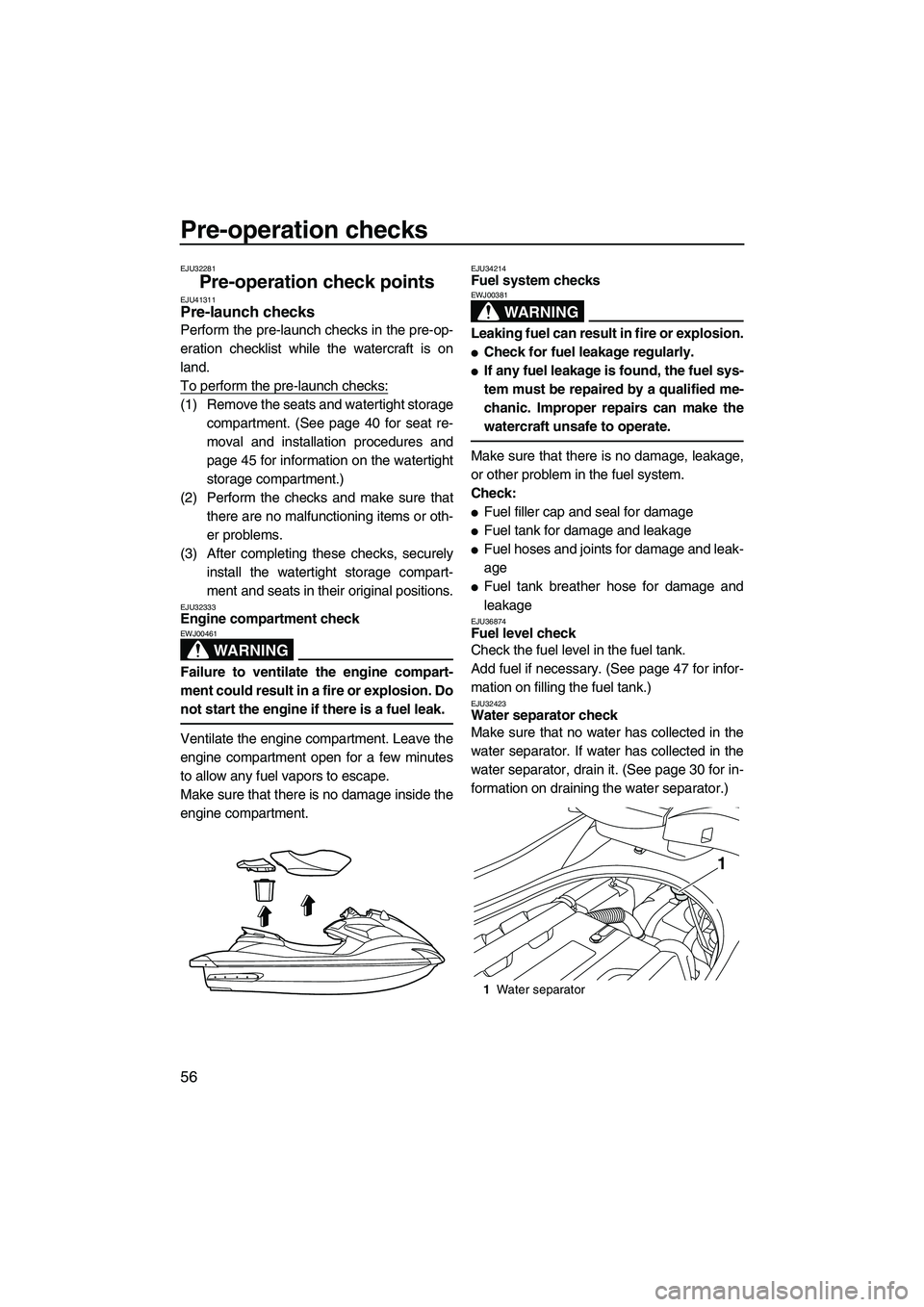
To perform the pre-launch checks:
(1) Remove the seats and watertight storagecompartment. (See page 40 for seat re-
moval and installation procedures and
page 45 for information on the watertight
storage compartment.)
(2) Perform the checks and make sure that there are no malfunctioning items or oth-
er problems.
(3) After completing these checks, securely install the watertight storage compart-
ment and seats in their original positions.
EJU32333Engine compartment check
WARNING
EWJ00461
Failure to ventilate the engine compart-
ment could result in a fire or explosion. Do
not start the engine if there is a fuel leak.
Ventilate the engine compartment. Leave the
engine compartment open for a few minutes
to allow any fuel vapors to escape.
Make sure that there is no damage inside the
engine compartment.
EJU34214Fuel system checks
WARNING
EWJ00381
Leaking fuel can result in fire or explosion.
●Check for fuel leakage regularly.
●If any fuel leakage is found, the fuel sys-
tem must be repaired by a qualified me-
chanic. Improper repairs can make the
watercraft unsafe to operate.
Make sure that there is no damage, leakage,
or other problem in the fuel system.
Check:
●Fuel filler cap and seal for damage
●Fuel tank for damage and leakage
●Fuel hoses and joints for damage and leak-
age
●Fuel tank breather hose for damage and
leakage
EJU36874Fuel level check
Check the fuel level in the fuel tank.
Add fuel if necessary. (See page 47 for infor-
mation on filling the fuel tank.)
EJU32423Water separator check
Make sure that no water has collected in the
water separator. If water has collected in the
water separator, drain it. (See page 30 for in-
formation on draining the water separator.)
1Water separator
1
UF2R74E0.book Page 56 Wednesday, August 22, 2012 2:26 PM
Page 63 of 104
Pre-operation checks
57
EJU40181Engine unit check
Check the exterior of the engine unit for dam-
age or other problem.
EJU36885Engine oil level check
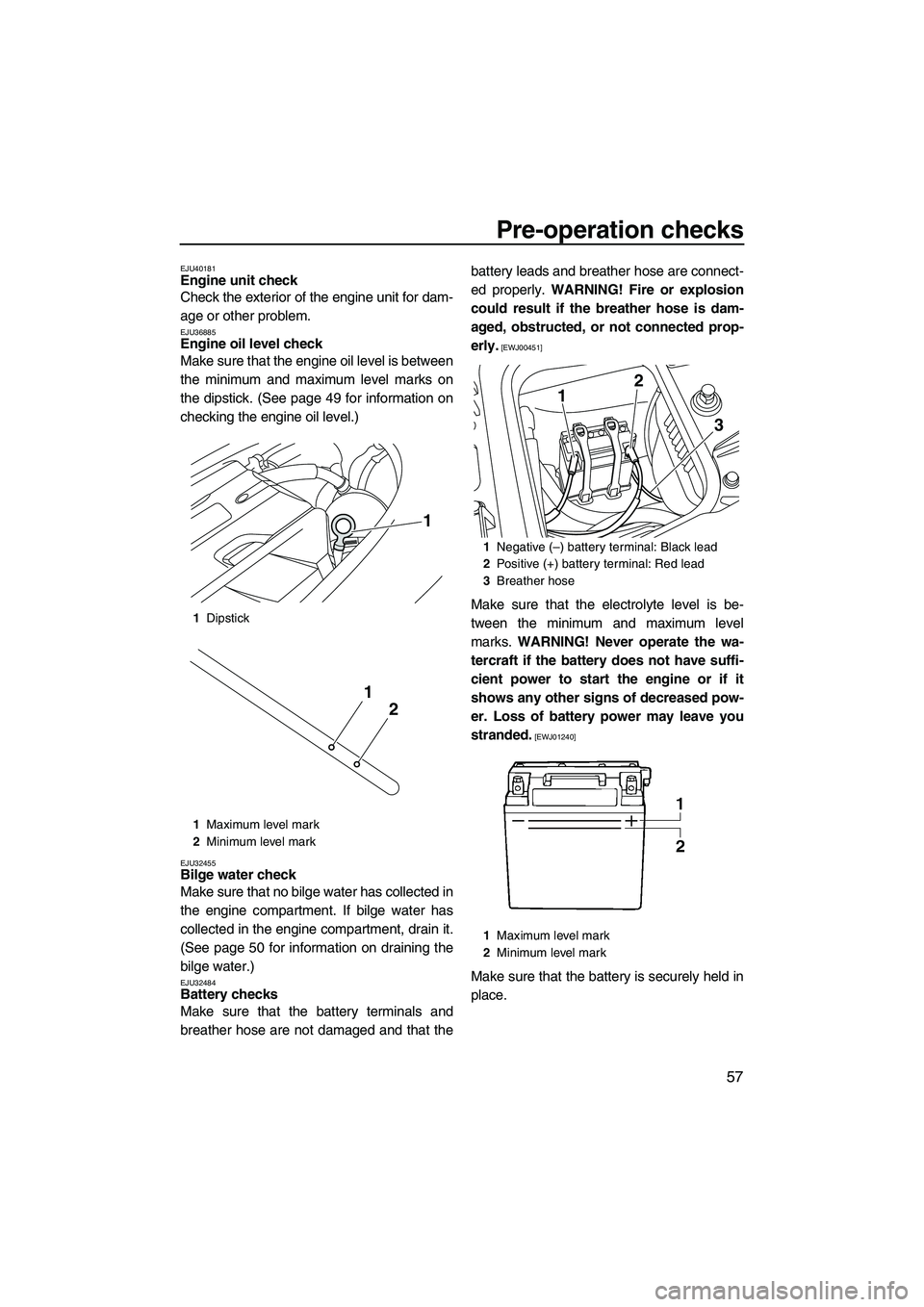
Make sure that the engine oil level is between
the minimum and maximum level marks on
the dipstick. (See page 49 for information on
checking the engine oil level.)
EJU32455Bilge water check
Make sure that no bilge water has collected in
the engine compartment. If bilge water has
collected in the engine compartment, drain it.
(See page 50 for information on draining the
bilge water.)
EJU32484Battery checks
Make sure that the battery terminals and
breather hose are not damaged and that thebattery leads and breather hose are connect-
ed properly.
WARNING! Fire or explosion
could result if the breather hose is dam-
aged, obstructed, or not connected prop-
erly.
[EWJ00451]
Make sure that the electrolyte level is be-
tween the minimum and maximum level
marks. WARNING! Never operate the wa-
tercraft if the battery does not have suffi-
cient power to start the engine or if it
shows any other signs of decreased pow-
er. Loss of battery power may leave you
stranded.
[EWJ01240]
Make sure that the battery is securely held in
place.
1 Dipstick
1 Maximum level mark
2 Minimum level mark
1
2
1
1Negative (–) battery terminal: Black lead
2 Positive (+) battery terminal: Red lead
3 Breather hose
1 Maximum level mark
2 Minimum level mark
12
3
UF2R74E0.book Page 57 Wednesday, August 22, 2012 2:26 PM
Page 64 of 104
Pre-operation checks
58
EJU32613Steering system checks
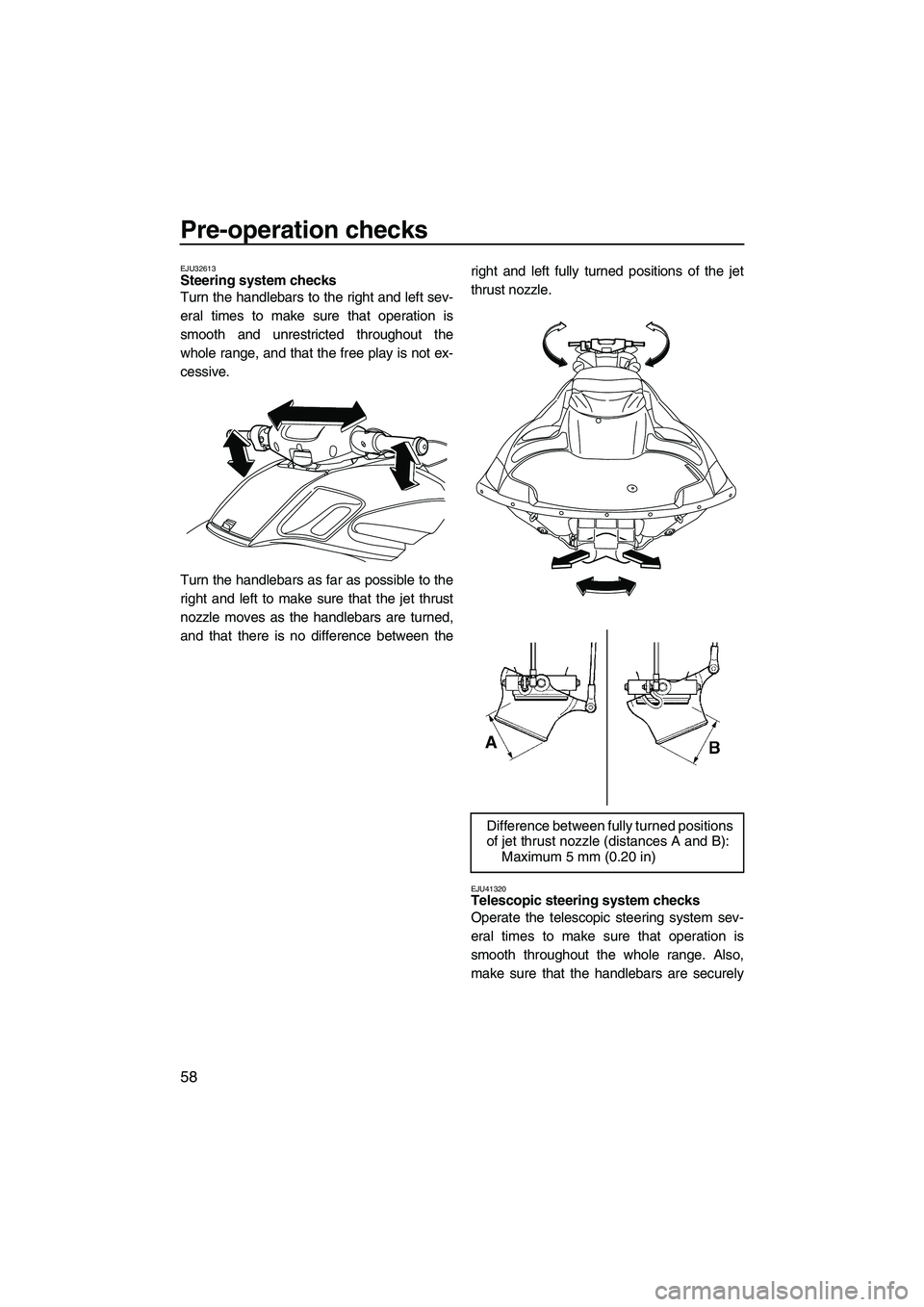
Turn the handlebars to the right and left sev-
eral times to make sure that operation is
smooth and unrestricted throughout the
whole range, and that the free play is not ex-
cessive.
Turn the handlebars as far as possible to the
right and left to make sure that the jet thrust
nozzle moves as the handlebars are turned,
and that there is no difference between theright and left fully turned positions of the jet
thrust nozzle.
EJU41320Telescopic steering system checks
Operate the telescopic steering system sev-
eral times to make sure that operation is
smooth throughout the whole range. Also,
make sure that the handlebars are securely
Difference between fully turned positions
of jet thrust nozzle (distances A and B):
Maximum 5 mm (0.20 in)
UF2R74E0.book Page 58 Wednesday, August 22, 2012 2:26 PM
Page 66 of 104
Pre-operation checks
60
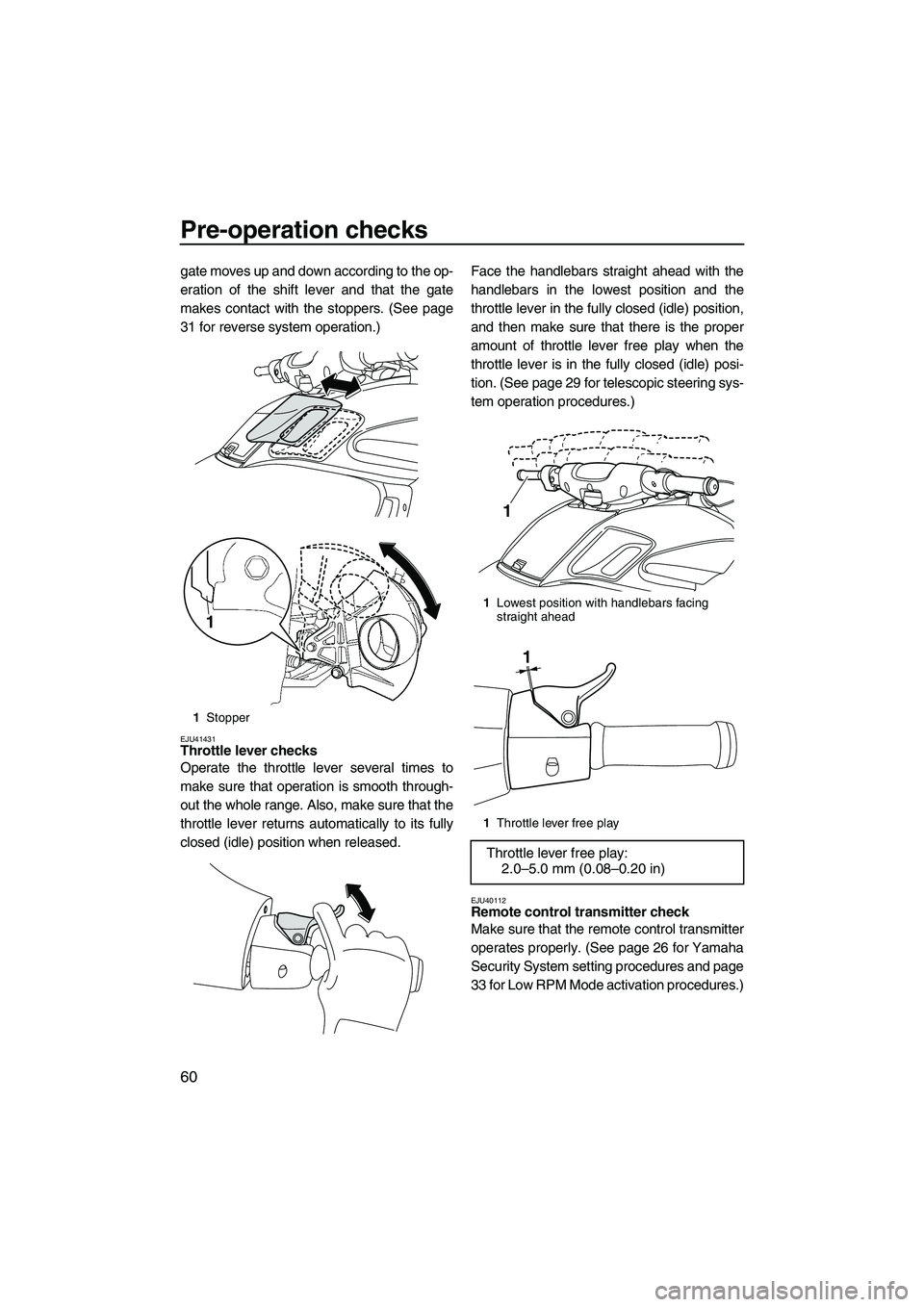
gate moves up and down according to the op-
eration of the shift lever and that the gate
makes contact with the stoppers. (See page
31 for reverse system operation.)
EJU41431Throttle lever checks
Operate the throttle lever several times to
make sure that operation is smooth through-
out the whole range. Also, make sure that the
throttle lever returns automatically to its fully
closed (idle) position when released.Face the handlebars straight ahead with the
handlebars in the lowest position and the
throttle lever in the fully closed (idle) position,
and then make sure that there is the proper
amount of throttle lever free play when the
throttle lever is in the fully closed (idle) posi-
tion. (See page 29 for telescopic steering sys-
tem operation procedures.)
EJU40112Remote control transmitter check
Make sure that the remote control transmitter
operates properly. (See page 26 for Yamaha
Security System setting procedures and page
33 for Low RPM Mode activation procedures.)
1
Stopper
1
1Lowest position with handlebars facing
straight ahead
1 Throttle lever free play
Throttle lever free play:
2.0–5.0 mm (0.08–0.20 in)
1
1
UF2R74E0.book Page 60 Wednesday, August 22, 2012 2:26 PM
Page 67 of 104
Pre-operation checks
61
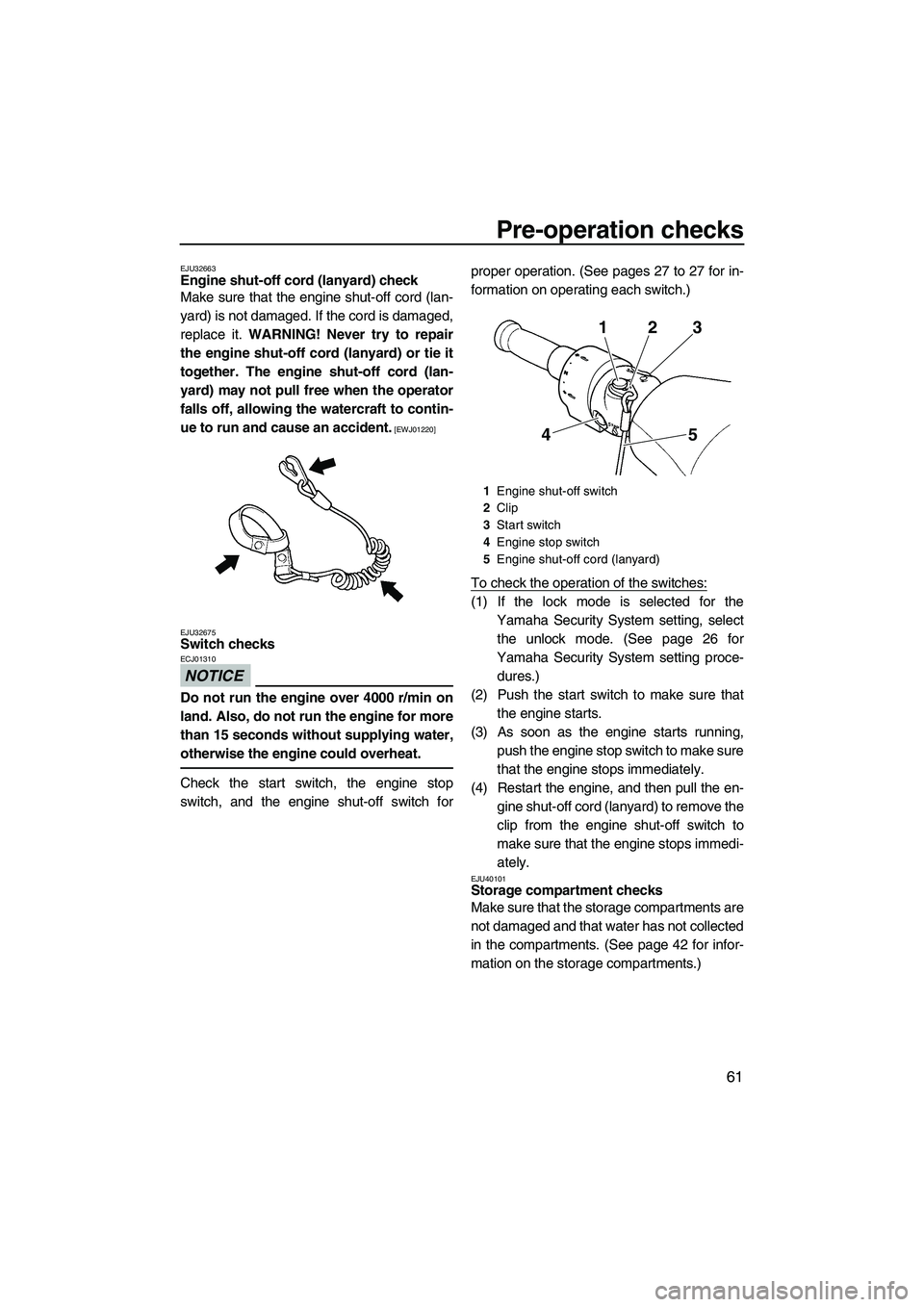
EJU32663Engine shut-off cord (lanyard) check
Make sure that the engine shut-off cord (lan-
yard) is not damaged. If the cord is damaged,
replace it. WARNING! Never try to repair
the engine shut-off cord (lanyard) or tie it
together. The engine shut-off cord (lan-
yard) may not pull free when the operator
falls off, allowing the watercraft to contin-
ue to run and cause an accident.
[EWJ01220]
EJU32675
Switch checks
NOTICE
ECJ01310
Do not run the engine over 4000 r/min on
land. Also, do not run the engine for more
than 15 seconds without supplying water,
otherwise the engine could overheat.
Check the start switch, the engine stop
switch, and the engine shut-off switch for proper operation. (See pages 27 to 27 for in-
formation on operating each switch.)
To check the operation of the switches:
(1) If the lock mode is selected for the
Yamaha Security System setting, selectthe unlock mode. (See page 26 for
Yamaha Security System setting proce- dures.)
(2) Push the start switch to make sure that the engine starts.
(3) As soon as the engine starts running, push the engine stop switch to make sure
that the engine stops immediately.
(4) Restart the engine, and then pull the en- gine shut-off cord (lanyard) to remove the
clip from the engine shut-off switch to
make sure that the engine stops immedi-
ately.
EJU40101Storage compartment checks
Make sure that the storage compartments are
not damaged and that water has not collected
in the compartments. (See page 42 for infor-
mation on the storage compartments.)
1Engine shut-off switch
2 Clip
3 Start switch
4 Engine stop switch
5 Engine shut-off cord (lanyard)
23
1
5
4
UF2R74E0.book Page 61 Wednesday, August 22, 2012 2:26 PM
Page 68 of 104
Pre-operation checks
62
EJU41081Fire extinguisher holder, cover, and band
checks
Make sure that the fire extinguisher holder,
cover, and band are not damaged and that
the cover is securely held in place using the
band. (See page 45 for information on the fire
extinguisher holder, cover, and band.)
EJU32543Fire extinguisher check
Check that there is a full fire extinguisher on
board.
To check the fire extinguisher, see the instruc-
tions supplied by the fire extinguisher manu-
facturer. Always keep the fire extinguisher
secured in the holder with its cover in place.
Always carry a fire extinguisher on board. A
fire extinguisher is not standard equipment
with this watercraft. If you do not have one,
contact a Yamaha dealer or a fire extinguisher
dealer to obtain one meeting the proper spec-
ifications.
EJU40121Safety equipment check
Check that safety equipment meeting the ap-
plicable regulations is on board.
EJU32352Hull and deck check
Check the hull and deck for damage or other
problem.
EJU32656Jet intake checks
Make sure that the jet intake is not damaged
or clogged with weeds or debris. If the jet in-take is clogged, clean it. (See page 90 for in-
formation on the jet intake.)
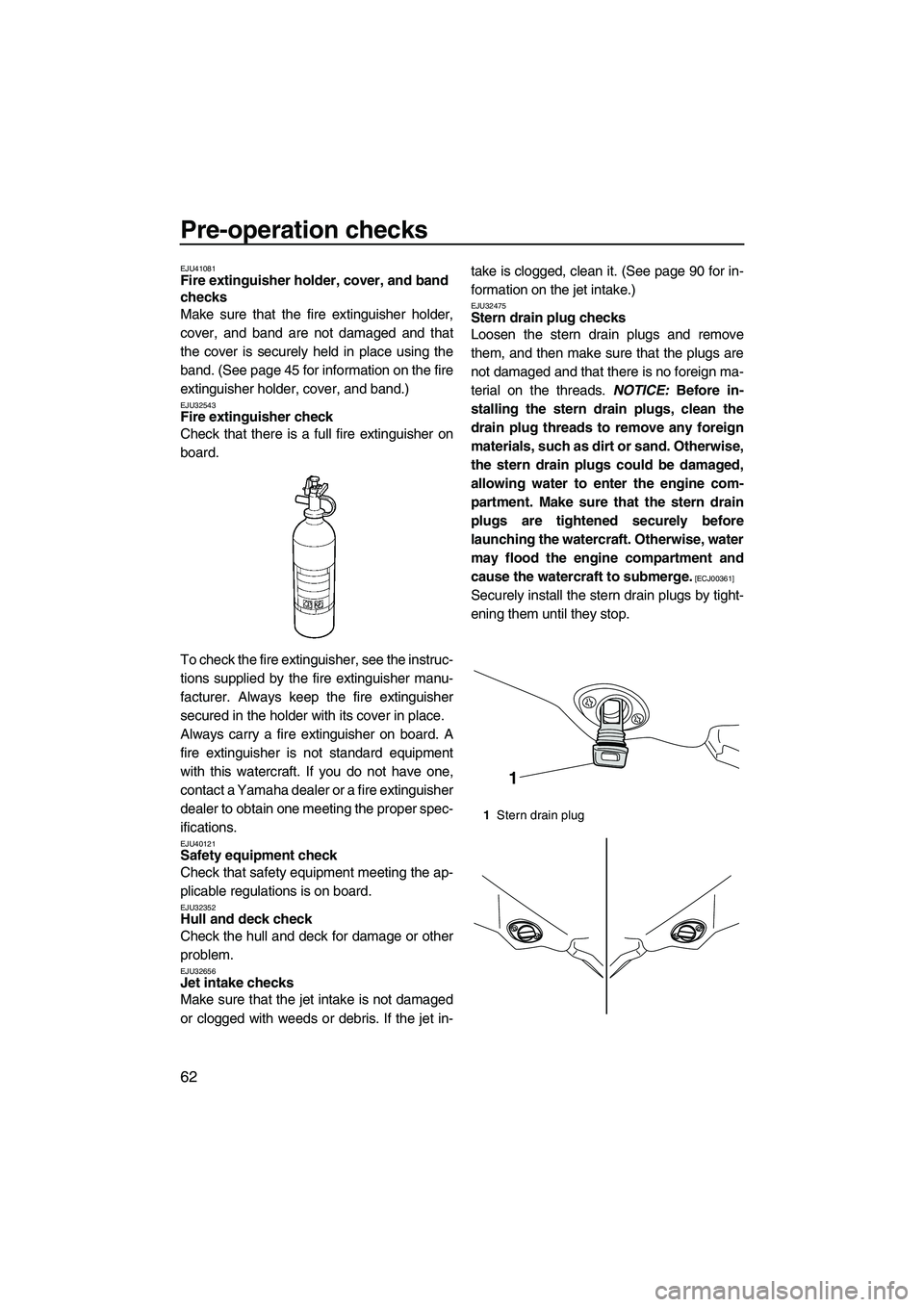
EJU32475Stern drain plug checks
Loosen the stern drain plugs and remove
them, and then make sure that the plugs are
not damaged and that there is no foreign ma-
terial on the threads.
NOTICE: Before in-
stalling the stern drain plugs, clean the
drain plug threads to remove any foreign
materials, such as dirt or sand. Otherwise,
the stern drain plugs could be damaged,
allowing water to enter the engine com-
partment. Make sure that the stern drain
plugs are tightened securely before
launching the watercraft. Otherwise, water
may flood the engine compartment and
cause the watercraft to submerge.
[ECJ00361]
Securely install the stern drain plugs by tight-
ening them until they stop.
1 Stern drain plug
1
UF2R74E0.book Page 62 Wednesday, August 22, 2012 2:26 PM
Page 69 of 104
Pre-operation checks
63
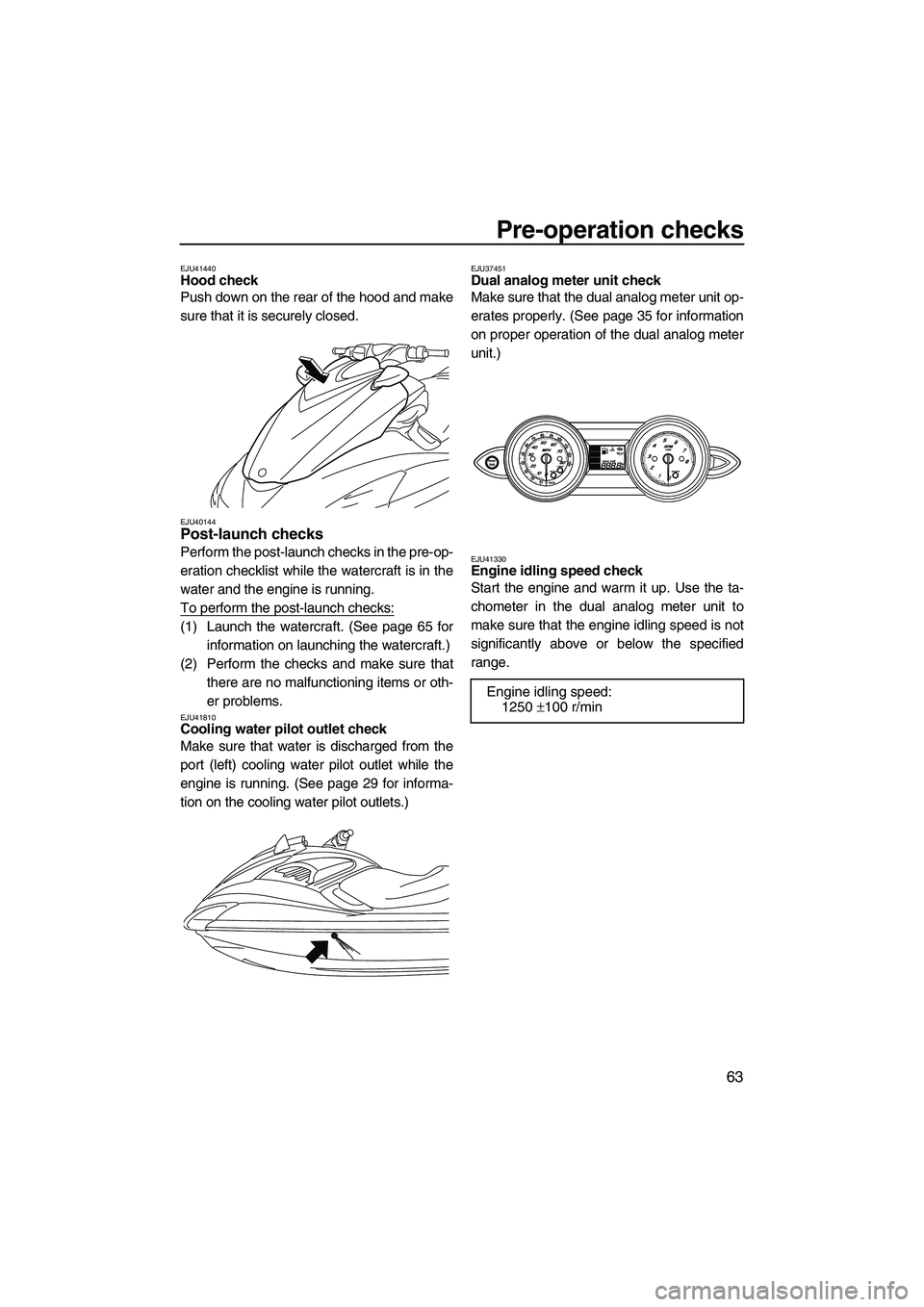
EJU41440Hood check
Push down on the rear of the hood and make
sure that it is securely closed.
EJU40144Post-launch checks
Perform the post-launch checks in the pre-op-
eration checklist while the watercraft is in the
water and the engine is running.
To perform the post-launch checks:
(1) Launch the watercraft. (See page 65 forinformation on launching the watercraft.)
(2) Perform the checks and make sure that there are no malfunctioning items or oth-
er problems.
EJU41810Cooling water pilot outlet check
Make sure that water is discharged from the
port (left) cooling water pilot outlet while the
engine is running. (See page 29 for informa-
tion on the cooling water pilot outlets.)
EJU37451Dual analog meter unit check
Make sure that the dual analog meter unit op-
erates properly. (See page 35 for information
on proper operation of the dual analog meter
unit.)
EJU41330Engine idling speed check
Start the engine and warm it up. Use the ta-
chometer in the dual analog meter unit to
make sure that the engine idling speed is not
significantly above or below the specified
range.
Engine idling speed:1250 ±100 r/min
UF2R74E0.book Page 63 Wednesday, August 22, 2012 2:26 PM
Page 71 of 104
Operation
65
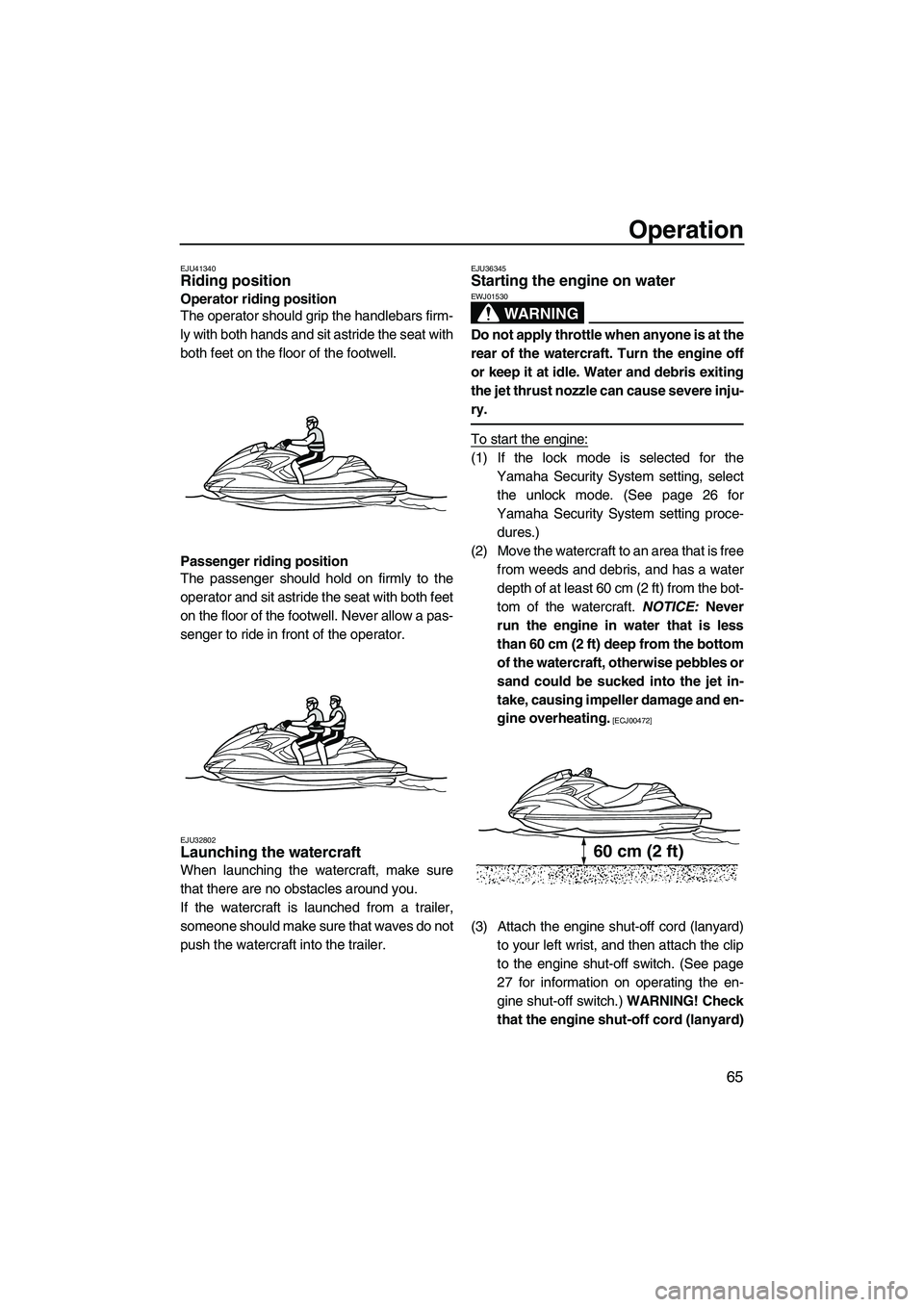
EJU41340Riding position
Operator riding position
The operator should grip the handlebars firm-
ly with both hands and sit astride the seat with
both feet on the floor of the footwell.
Passenger riding position
The passenger should hold on firmly to the
operator and sit astride the seat with both feet
on the floor of the footwell. Never allow a pas-
senger to ride in front of the operator.
EJU32802Launching the watercraft
When launching the watercraft, make sure
that there are no obstacles around you.
If the watercraft is launched from a trailer,
someone should make sure that waves do not
push the watercraft into the trailer.
EJU36345Starting the engine on water
WARNING
EWJ01530
Do not apply throttle when anyone is at the
rear of the watercraft. Turn the engine off
or keep it at idle. Water and debris exiting
the jet thrust nozzle can cause severe inju-
ry.
To start the engine:
(1) If the lock mode is selected for theYamaha Security System setting, selectthe unlock mode. (See page 26 for
Yamaha Security System setting proce- dures.)
(2) Move the watercraft to an area that is free from weeds and debris, and has a water
depth of at least 60 cm (2 ft) from the bot-
tom of the watercraft. NOTICE: Never
run the engine in water that is less
than 60 cm (2 ft) deep from the bottom
of the watercraft, otherwise pebbles or
sand could be sucked into the jet in-
take, causing impeller damage and en-
gine overheating.
[ECJ00472]
(3) Attach the engine shut-off cord (lanyard) to your left wrist, and then attach the clip
to the engine shut-off switch. (See page
27 for information on operating the en-
gine shut-off switch.) WARNING! Check
that the engine shut-off cord (lanyard)
60 cm (2 ft)
UF2R74E0.book Page 65 Wednesday, August 22, 2012 2:26 PM
Page 76 of 104
Operation
70
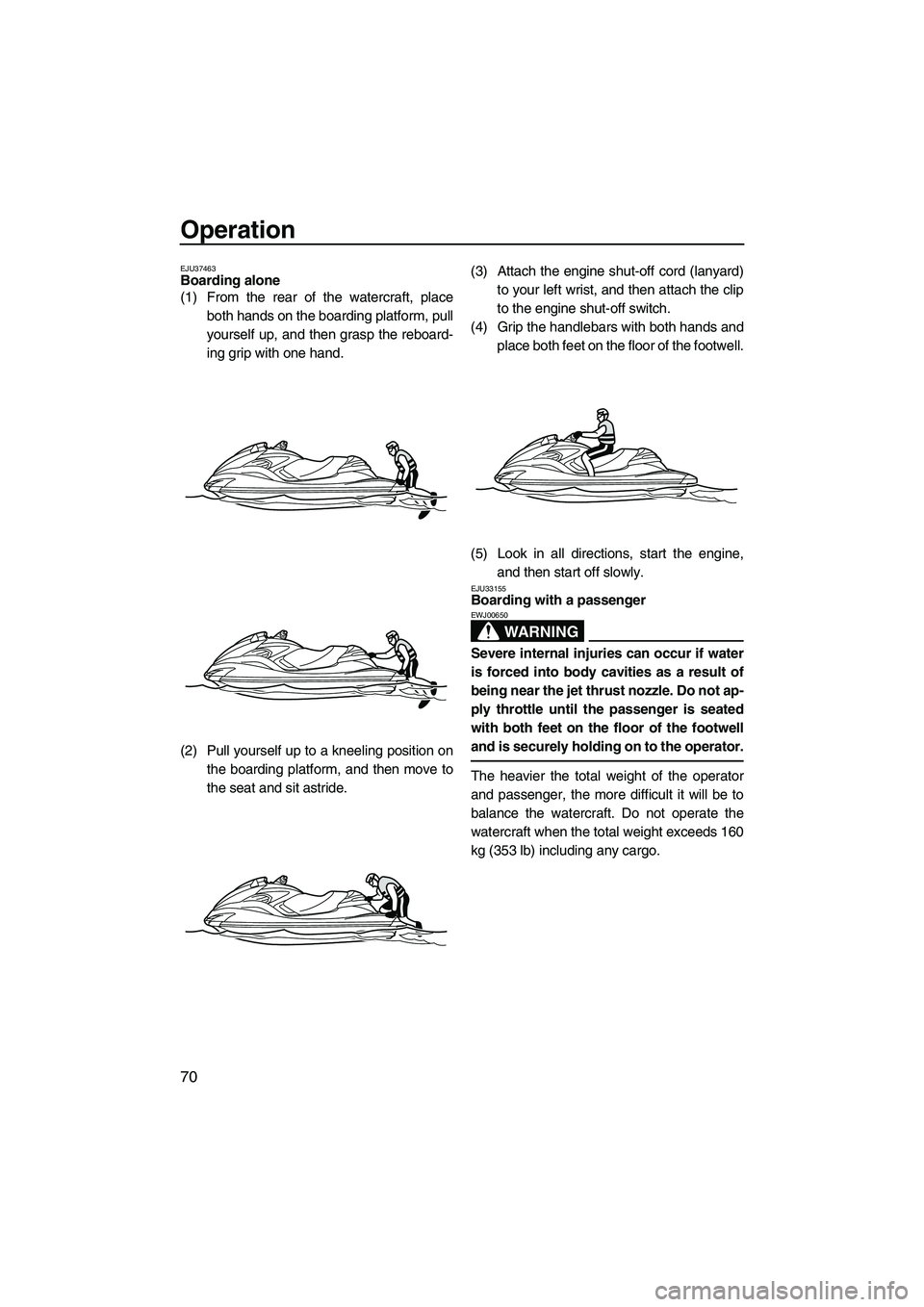
EJU37463Boarding alone
(1) From the rear of the watercraft, placeboth hands on the boarding platform, pull
yourself up, and then grasp the reboard-
ing grip with one hand.
(2) Pull yourself up to a kneeling position on the boarding platform, and then move to
the seat and sit astride. (3) Attach the engine shut-off cord (lanyard)
to your left wrist, and then attach the clip
to the engine shut-off switch.
(4) Grip the handlebars with both hands and place both feet on the floor of the footwell.
(5) Look in all directions, start the engine, and then start off slowly.
EJU33155Boarding with a passenger
WARNING
EWJ00650
Severe internal injuries can occur if water
is forced into body cavities as a result of
being near the jet thrust nozzle. Do not ap-
ply throttle until the passenger is seated
with both feet on the floor of the footwell
and is securely holding on to the operator.
The heavier the total weight of the operator
and passenger, the more difficult it will be to
balance the watercraft. Do not operate the
watercraft when the total weight exceeds 160
kg (353 lb) including any cargo.
UF2R74E0.book Page 70 Wednesday, August 22, 2012 2:26 PM
Page 77 of 104
Operation
71
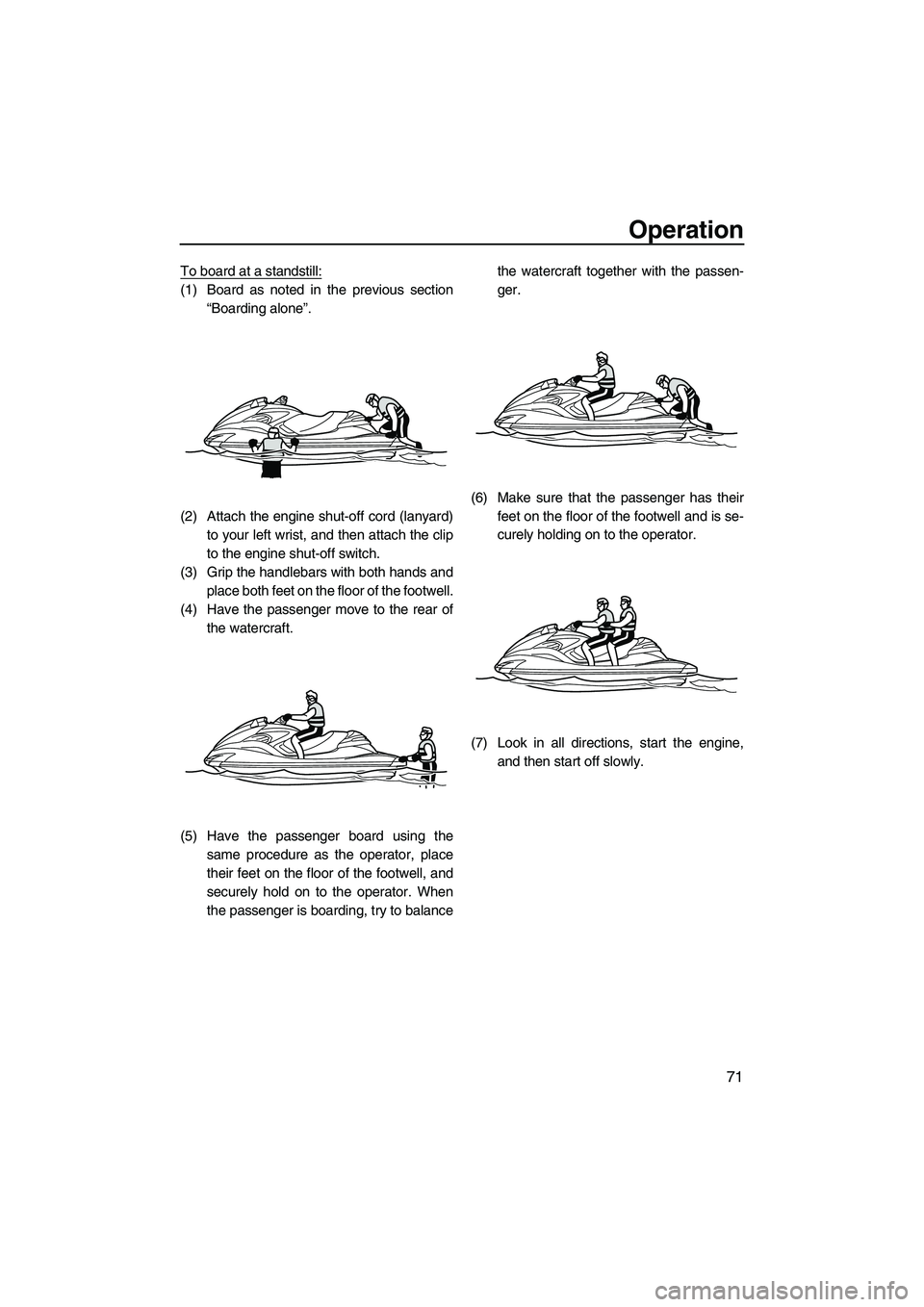
To board at a standstill:
(1) Board as noted in the previous section“Boarding alone”.
(2) Attach the engine shut-off cord (lanyard) to your left wrist, and then attach the clip
to the engine shut-off switch.
(3) Grip the handlebars with both hands and place both feet on the floor of the footwell.
(4) Have the passenger move to the rear of the watercraft.
(5) Have the passenger board using the same procedure as the operator, place
their feet on the floor of the footwell, and
securely hold on to the operator. When
the passenger is boarding, try to balance the watercraft together with the passen-
ger.
(6) Make sure that the passenger has their feet on the floor of the footwell and is se-
curely holding on to the operator.
(7) Look in all directions, start the engine, and then start off slowly.
UF2R74E0.book Page 71 Wednesday, August 22, 2012 2:26 PM