check engine YAMAHA FZS SVHO 2016 User Guide
[x] Cancel search | Manufacturer: YAMAHA, Model Year: 2016, Model line: FZS SVHO, Model: YAMAHA FZS SVHO 2016Pages: 106, PDF Size: 4 MB
Page 59 of 106

Operation and handling requirements
53
EJU40022
Draining the bilge water
NOTICE
ECJ01302
Do not run the engine at full throttle when
bilge water remains in the engine com-
partment. The bilge water can splash into
the engine, which can result in severe
damage.
EJU40036Draining the bilge water on land
To drain the bilge water on land:
(1) Loosen the stern drain plugs and remove
them.
(2) Raise the bow of the watercraft, such as
by placing the watercraft on a slope, to
drain the bilge water from the engine
compartment.
(3) After the bilge water has drained from the
stern drain plug holes, wipe up any re-
maining moisture in the engine compart-
ment with a dry cloth.
(4) Securely install the stern drain plugs by
tightening them until they stop. NOTICE:
Before installing the stern drain plugs,
clean the drain plug threads and the
O-rings on the plugs to remove any
foreign materials, such as dirt or sand.
Otherwise, the stern drain plugs could
be damaged, allowing water to enter
the engine compartment. Check theO-rings on the stern drain plugs and
make sure that the plugs are tightened
securely before launching the water-
craft. Otherwise, water may flood the
engine compartment and cause the
watercraft to submerge.
[ECJ00363]
EJU40044
Draining the bilge water on water
A small quantity of bilge water will remain in
the engine compartment even after the bilge
water is drained on water. To completely
drain the bilge water, remove the watercraft
from the water and drain the bilge water on
land.
Jet vacuum bilge draining system
While the watercraft is operating, bilge water
in the engine compartment is drawn in by the
vacuum that is generated in the jet pump and
discharged from the watercraft through the
jet thrust nozzle.
To drain the bilge water on water:
Operate the watercraft as straight as possible
and above planing speed for at least 2 minu-
tes. NOTICE: Do not run the engine at full
throttle for at least 1 minute after the en-
gine has been restarted. Bilge water in the
engine compartment can splash into the
1Stern drain plug
1
1O-ring
1
UF3K72E0.book Page 53 Thursday, July 16, 2015 2:31 PM
Page 60 of 106
![YAMAHA FZS SVHO 2016 User Guide Operation and handling requirements
54
engine, which can result in severe dam-
age.
[ECJ00554]
Electric bilge draining system
Bilge water in the engine compartment is
drawn in by the operation of the](/img/51/50230/w960_50230-59.png "YAMAHA FZS SVHO 2016 User Guide Operation and handling requirements
54
engine, which can result in severe dam-
age.
[ECJ00554]
Electric bilge draining system
Bilge water in the engine compartment is
drawn in by the operation of the")
Operation and handling requirements
54
engine, which can result in severe dam-
age.
[ECJ00554]
Electric bilge draining system
Bilge water in the engine compartment is
drawn in by the operation of the electric bilge
pump and discharged from the watercraft.
To check for proper operation of the electric
bilge draining system, make sure that bilge
water is being discharged from the electric
bilge pilot outlet.
To drain the bilge water:
Start the engine to operate the electric bilge
pump.
TIP:
The electric bilge pump continues to operate
for a short time after the engine stops.
EJU33465
Transporting on a trailer
When transporting the watercraft on a trailer,
secure the tie downs to the trailer through the
bow eye and stern eyes. NOTICE: Do not at-
tach ropes or tie downs to any part of the
watercraft other than the bow eye and
stern eyes to secure the watercraft to the
trailer. Otherwise, the watercraft may be
damaged. Wrap the ropes or tie downs
with towels or rags where they touch the
body of the watercraft to avoid scratches
or damage. Do not transport the water-
craft with the shift lever in the reverse po-
sition. Otherwise, the reverse gate may hit
an obstacle, which could cause damage.
[ECJ00645]
1Electric bilge pilot outlet
1
UF3K72E0.book Page 54 Thursday, July 16, 2015 2:31 PM
Page 61 of 106

First-time operation
55
EJU42690
Engine break-in
NOTICE
ECJ00432
Failure to perform the engine break-in
could result in reduced engine life or even
severe engine damage.
The engine break-in is essential to allow the
various components of the engine to wear
and polish themselves to the correct operat-
ing clearances. This ensures proper perfor-
mance and promotes longer component life.
To perform the engine break-in:
(1) Check the engine oil level. (See page 51
for information on checking the engine
oil level.)
(2) Launch the watercraft and start the en-
gine. (See page 68 for information on
starting the engine.)
(3) For the first 5 minutes, operate with the
engine speed at 2000 r/min.
(4) For the next 90 minutes, operate with the
engine speed below 5000 r/min.
After the engine break-in is complete, the wa-
tercraft can be operated normally.
UF3K72E0.book Page 55 Thursday, July 16, 2015 2:31 PM
Page 62 of 106

Pre-operation checks
56
EJU31982
WARNING
EWJ00412
Failure to inspect or maintain the watercraft properly increases the possibility of an ac-
cident or damage to the watercraft. Do not operate the watercraft if you find any prob-
lem. If a problem cannot be corrected by the procedures provided in this manual, have
the watercraft inspected by a Yamaha dealer.
EJU41234Pre-operation checklist
Before using this watercraft, be sure to perform the checks in the following checklist.
ITEM ROUTINE PAGE
PRE-LAUNCH CHECKS
Engine compartmentVentilate the engine compartment.
Check inside the engine compartment for damage.58
Fuel systemCheck the fuel system for leakage.
Check the fuel level in the fuel tank.58
Water separatorCheck the water separator for water. 58
Engine unitCheck the exterior of the engine unit for damage. 59
Engine oil levelCheck the engine oil level. 59
Bilge waterCheck the engine compartment for bilge water. 59
BatteryCheck the battery connections and electrolyte level. 59
Steering systemCheck the steering system for proper operation. 60
Telescopic steering systemCheck the telescopic steering system for proper op-
eration and check that the handlebars are securely
locked in place.61
Q.S.T.S.Check the Q.S.T.S. for proper operation and check
that the Q.S.T.S. selector is securely locked in pla-
ce.61
Reverse systemCheck the reverse system for proper operation. 62
Throttle leverCheck the throttle lever for proper operation.
Check the throttle lever free play.62
Remote control transmitterCheck the remote control transmitter for proper op-
eration.63
Engine shut-off cord (lan-
yard)Check the engine shut-off cord (lanyard) for dam-
age.63
SwitchesCheck the start switch, engine stop switch, and en-
gine shut-off switch for proper operation.63
Storage compartmentsCheck the storage compartments for damage and
water.64
Fire extinguisher holder,
cover, and bandCheck the fire extinguisher holder, cover, and band
for damage.64
Fire extinguisherCheck the condition of the fire extinguisher. 64
UF3K72E0.book Page 56 Thursday, July 16, 2015 2:31 PM
Page 63 of 106

Pre-operation checks
57
TIP:
To ensure safety and reliability, pre-operation checks should be made each time the water-
craft is used.
Safety equipmentCheck that safety equipment meeting the applica-
ble regulations is on board.64
Hull and deckCheck the hull and deck for damage. 64
Jet intakeCheck the jet intake for damage and clogging. 65
Jet thrust nozzle and re-
verse gateCheck the jet thrust nozzle and reverse gate for
damage.65
Stern drain plugsCheck the stern drain plugs for damage and foreign
material and check that they are securely installed.65
HoodCheck that the hood is securely closed. 65
Front and rear seatsCheck that the seats are securely installed. 41
POST-LAUNCH CHECKS
Cooling water pilot outletCheck that water is discharged from the port (left)
cooling water pilot outlet while the engine is run-
ning.66
Dual analog meter unitCheck the dual analog meter unit for proper opera-
tion.66
Engine idling speedCheck the engine idling speed. 66 ITEM ROUTINE PAGE
UF3K72E0.book Page 57 Thursday, July 16, 2015 2:31 PM
Page 64 of 106
Pre-operation checks
58
EJU32282
Pre-operation check pointsEJU42383Pre-launch checks
Perform the pre-launch checks in the pre-op-
eration checklist while the watercraft is on
land.
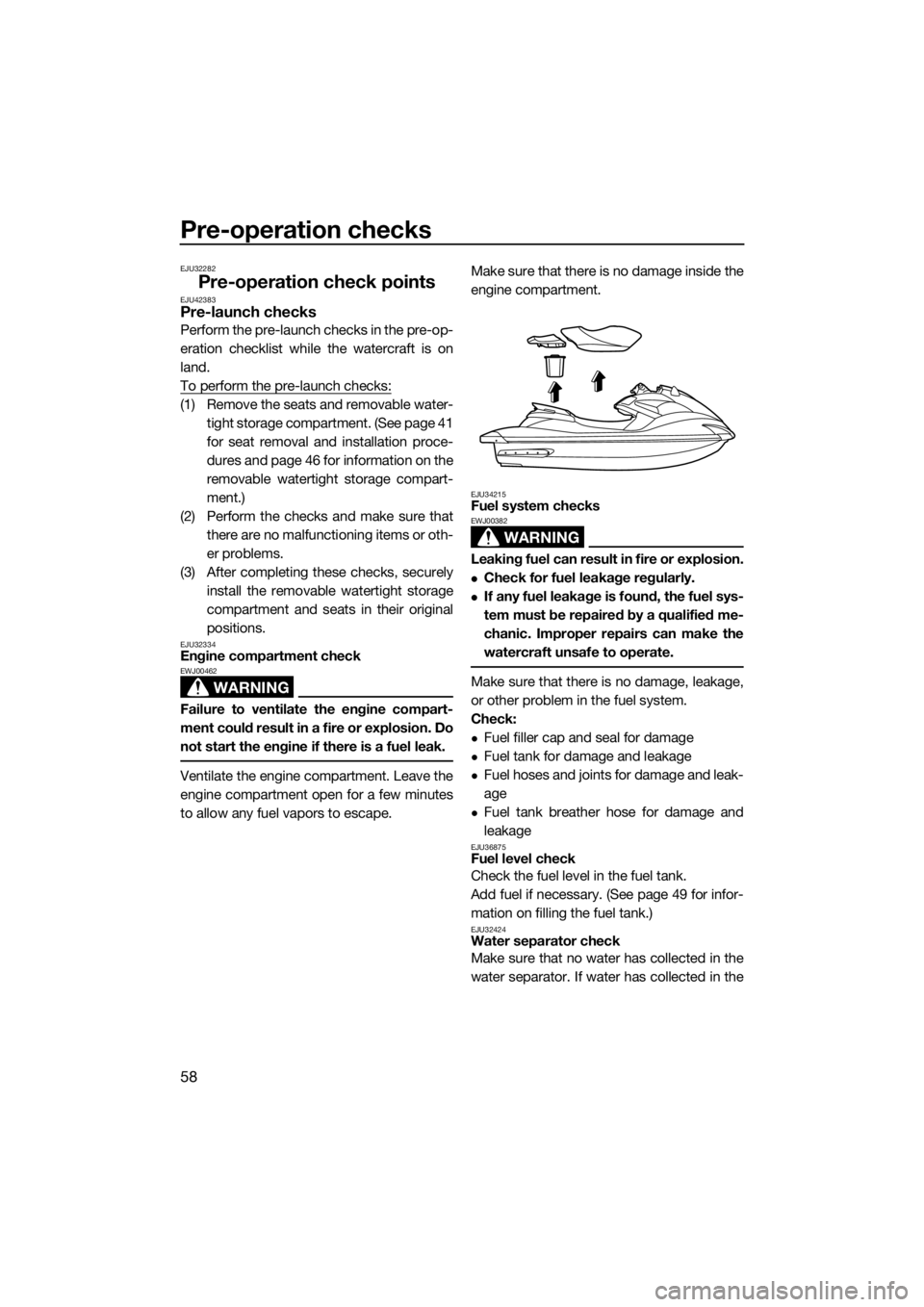
To perform the pre-launch checks:
(1) Remove the seats and removable water-
tight storage compartment. (See page 41
for seat removal and installation proce-
dures and page 46 for information on the
removable watertight storage compart-
ment.)
(2) Perform the checks and make sure that
there are no malfunctioning items or oth-
er problems.
(3) After completing these checks, securely
install the removable watertight storage
compartment and seats in their original
positions.
EJU32334Engine compartment check
WARNING
EWJ00462
Failure to ventilate the engine compart-
ment could result in a fire or explosion. Do
not start the engine if there is a fuel leak.
Ventilate the engine compartment. Leave the
engine compartment open for a few minutes
to allow any fuel vapors to escape.Make sure that there is no damage inside the
engine compartment.
EJU34215Fuel system checks
WARNING
EWJ00382
Leaking fuel can result in fire or explosion.
Check for fuel leakage regularly.
If any fuel leakage is found, the fuel sys-
tem must be repaired by a qualified me-
chanic. Improper repairs can make the
watercraft unsafe to operate.
Make sure that there is no damage, leakage,
or other problem in the fuel system.
Check:
Fuel filler cap and seal for damage
Fuel tank for damage and leakage
Fuel hoses and joints for damage and leak-
age
Fuel tank breather hose for damage and
leakage
EJU36875Fuel level check
Check the fuel level in the fuel tank.
Add fuel if necessary. (See page 49 for infor-
mation on filling the fuel tank.)
EJU32424Water separator check
Make sure that no water has collected in the
water separator. If water has collected in the
UF3K72E0.book Page 58 Thursday, July 16, 2015 2:31 PM
Page 65 of 106
Pre-operation checks
59
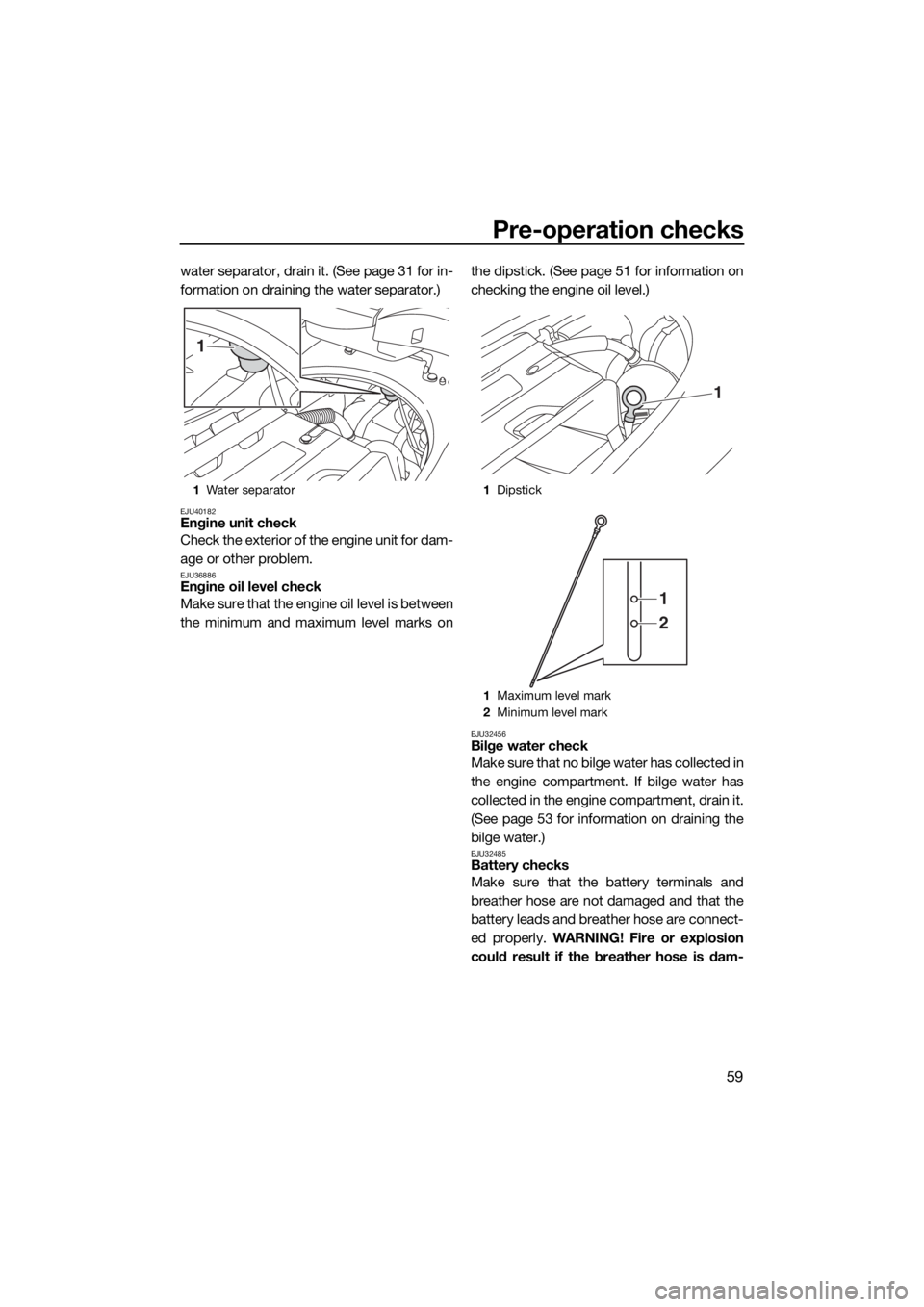
water separator, drain it. (See page 31 for in-
formation on draining the water separator.)
EJU40182Engine unit check
Check the exterior of the engine unit for dam-
age or other problem.
EJU36886Engine oil level check
Make sure that the engine oil level is between
the minimum and maximum level marks onthe dipstick. (See page 51 for information on
checking the engine oil level.)
EJU32456Bilge water check
Make sure that no bilge water has collected in
the engine compartment. If bilge water has
collected in the engine compartment, drain it.
(See page 53 for information on draining the
bilge water.)
EJU32485Battery checks
Make sure that the battery terminals and
breather hose are not damaged and that the
battery leads and breather hose are connect-
ed properly. WARNING! Fire or explosion
could result if the breather hose is dam-
1Water separator
1
1Dipstick
1Maximum level mark
2Minimum level mark
1
1
2
UF3K72E0.book Page 59 Thursday, July 16, 2015 2:31 PM
Page 66 of 106
![YAMAHA FZS SVHO 2016 User Guide Pre-operation checks
60
aged, obstructed, or not connected prop-
erly.
[EWJ00452]
Make sure that the electrolyte level is be-
tween the minimum and maximum level
marks. WARNING! Never operate the wa-](/img/51/50230/w960_50230-65.png "YAMAHA FZS SVHO 2016 User Guide Pre-operation checks
60
aged, obstructed, or not connected prop-
erly.
[EWJ00452]
Make sure that the electrolyte level is be-
tween the minimum and maximum level
marks. WARNING! Never operate the wa-")
Pre-operation checks
60
aged, obstructed, or not connected prop-
erly.
[EWJ00452]
Make sure that the electrolyte level is be-
tween the minimum and maximum level
marks. WARNING! Never operate the wa-
tercraft if the battery does not have suffi-
cient power to start the engine or if it
shows any other signs of decreased pow-
er. Loss of battery power may leave you
stranded.
[EWJ01241]
Make sure that the battery is securely held in
place.
EJU32614Steering system checks
Turn the handlebars to the right and left sev-
eral times to make sure that operation is
smooth and unrestricted throughout thewhole range, and that the free play is not ex-
cessive.
Turn the handlebars as far as possible to the
right and left to make sure that the jet thrust
nozzle moves as the handlebars are turned,
and that there is no difference between the
1Negative (–) battery terminal: Black lead
2Positive (+) battery terminal: Red lead
3Breather hose
1Maximum level mark
2Minimum level mark
12
3
UF3K72E0.book Page 60 Thursday, July 16, 2015 2:31 PM
Page 69 of 106
Pre-operation checks
63
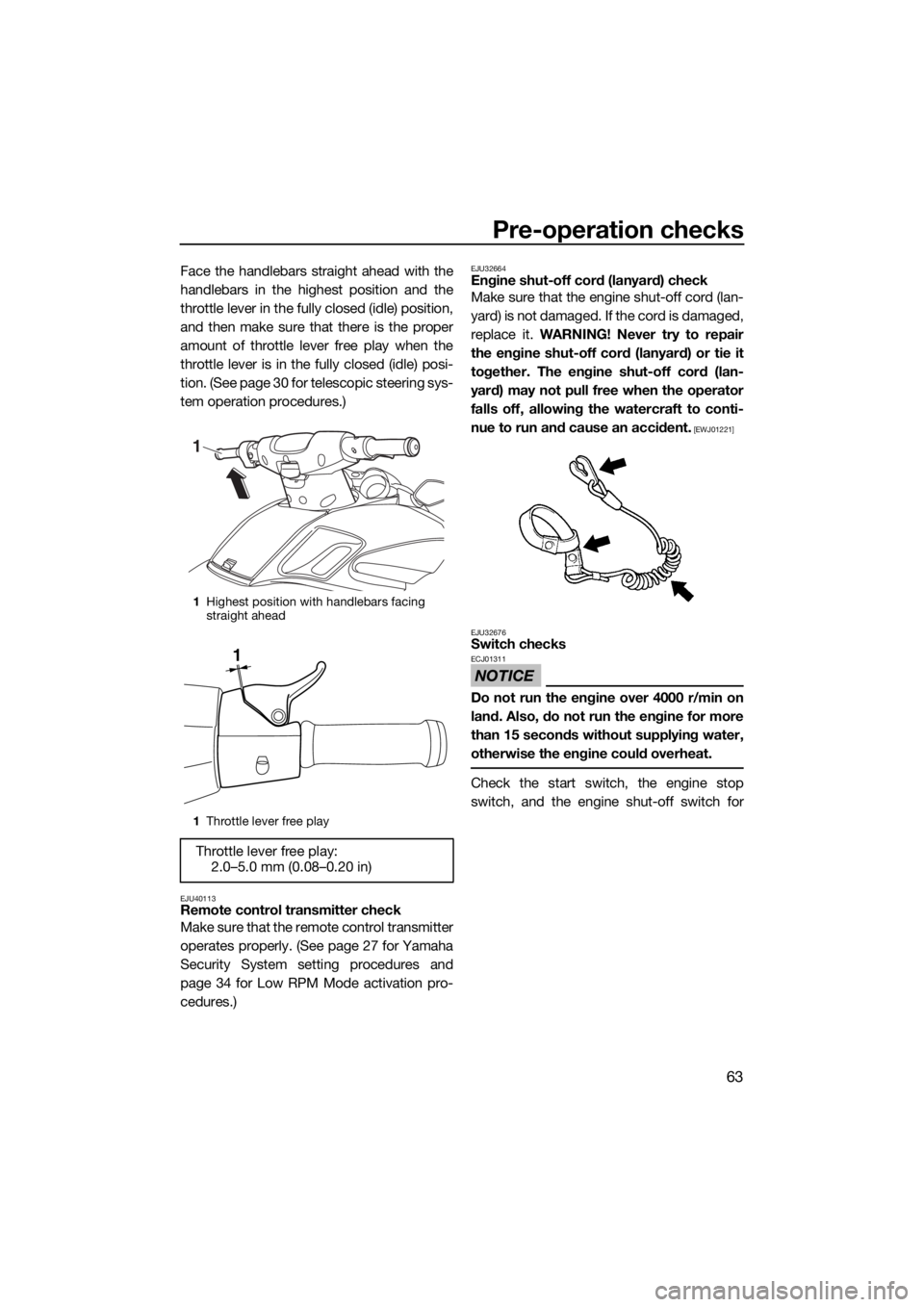
Face the handlebars straight ahead with the
handlebars in the highest position and the
throttle lever in the fully closed (idle) position,
and then make sure that there is the proper
amount of throttle lever free play when the
throttle lever is in the fully closed (idle) posi-
tion. (See page 30 for telescopic steering sys-
tem operation procedures.)
EJU40113Remote control transmitter check
Make sure that the remote control transmitter
operates properly. (See page 27 for Yamaha
Security System setting procedures and
page 34 for Low RPM Mode activation pro-
cedures.)
EJU32664Engine shut-off cord (lanyard) check
Make sure that the engine shut-off cord (lan-
yard) is not damaged. If the cord is damaged,
replace it. WARNING! Never try to repair
the engine shut-off cord (lanyard) or tie it
together. The engine shut-off cord (lan-
yard) may not pull free when the operator
falls off, allowing the watercraft to conti-
nue to run and cause an accident.
[EWJ01221]
EJU32676
Switch checks
NOTICE
ECJ01311
Do not run the engine over 4000 r/min on
land. Also, do not run the engine for more
than 15 seconds without supplying water,
otherwise the engine could overheat.
Check the start switch, the engine stop
switch, and the engine shut-off switch for
1Highest position with handlebars facing
straight ahead
1Throttle lever free play
Throttle lever free play:
2.0–5.0 mm (0.08–0.20 in)
1
1
UF3K72E0.book Page 63 Thursday, July 16, 2015 2:31 PM
Page 70 of 106
Pre-operation checks
64
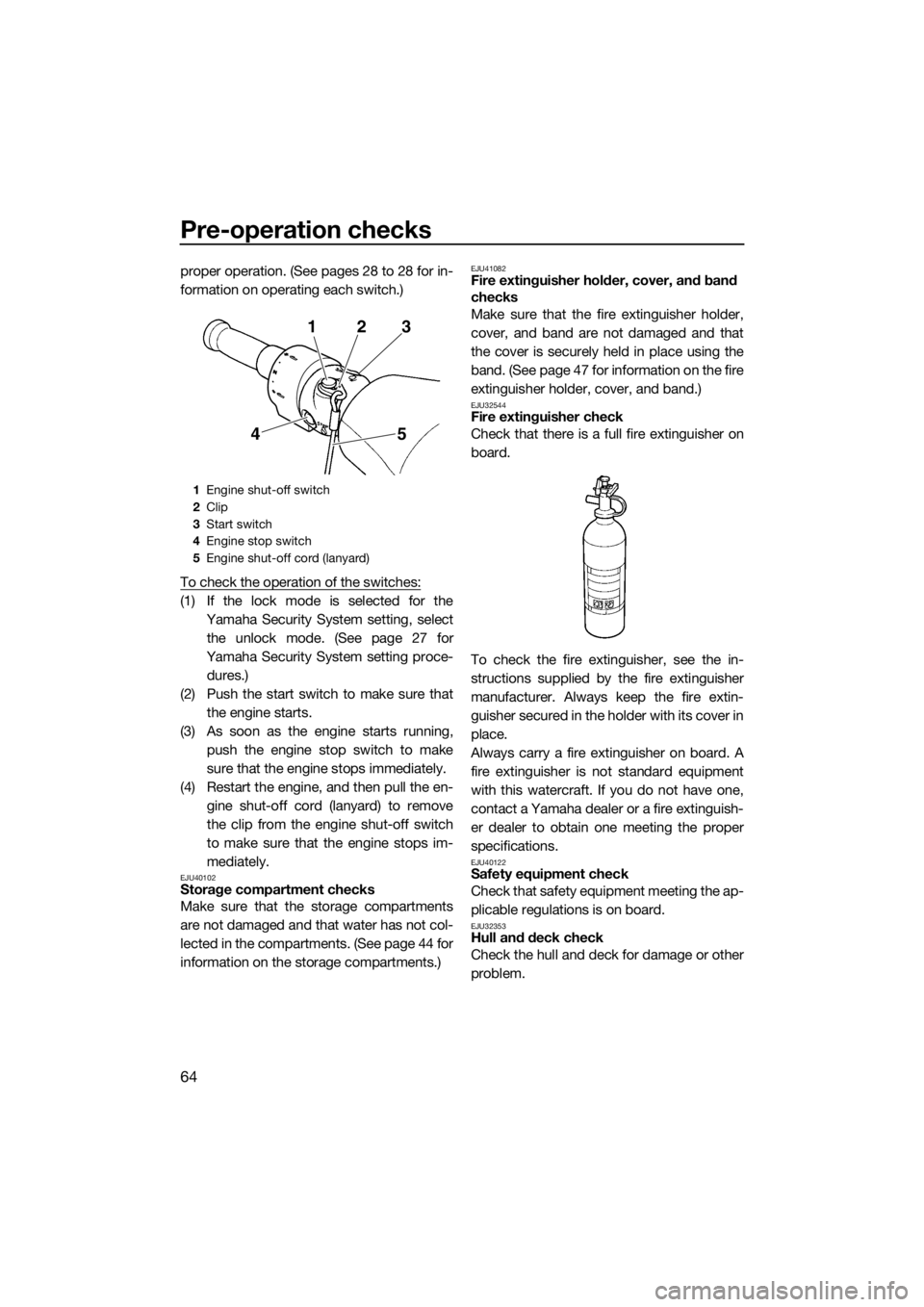
proper operation. (See pages 28 to 28 for in-
formation on operating each switch.)
To check the operation of the switches:
(1) If the lock mode is selected for the
Yamaha Security System setting, select
the unlock mode. (See page 27 for
Yamaha Security System setting proce-
dures.)
(2) Push the start switch to make sure that
the engine starts.
(3) As soon as the engine starts running,
push the engine stop switch to make
sure that the engine stops immediately.
(4) Restart the engine, and then pull the en-
gine shut-off cord (lanyard) to remove
the clip from the engine shut-off switch
to make sure that the engine stops im-
mediately.
EJU40102Storage compartment checks
Make sure that the storage compartments
are not damaged and that water has not col-
lected in the compartments. (See page 44 for
information on the storage compartments.)
EJU41082Fire extinguisher holder, cover, and band
checks
Make sure that the fire extinguisher holder,
cover, and band are not damaged and that
the cover is securely held in place using the
band. (See page 47 for information on the fire
extinguisher holder, cover, and band.)
EJU32544Fire extinguisher check
Check that there is a full fire extinguisher on
board.
To check the fire extinguisher, see the in-
structions supplied by the fire extinguisher
manufacturer. Always keep the fire extin-
guisher secured in the holder with its cover in
place.
Always carry a fire extinguisher on board. A
fire extinguisher is not standard equipment
with this watercraft. If you do not have one,
contact a Yamaha dealer or a fire extinguish-
er dealer to obtain one meeting the proper
specifications.
EJU40122Safety equipment check
Check that safety equipment meeting the ap-
plicable regulations is on board.
EJU32353Hull and deck check
Check the hull and deck for damage or other
problem.
1Engine shut-off switch
2Clip
3Start switch
4Engine stop switch
5Engine shut-off cord (lanyard)
23 1
5 4
UF3K72E0.book Page 64 Thursday, July 16, 2015 2:31 PM