engine YAMAHA GRIZZLY 450 2016 Owner's Manual
[x] Cancel search | Manufacturer: YAMAHA, Model Year: 2016, Model line: GRIZZLY 450, Model: YAMAHA GRIZZLY 450 2016Pages: 170, PDF Size: 3.97 MB
Page 49 of 170
4-19
4
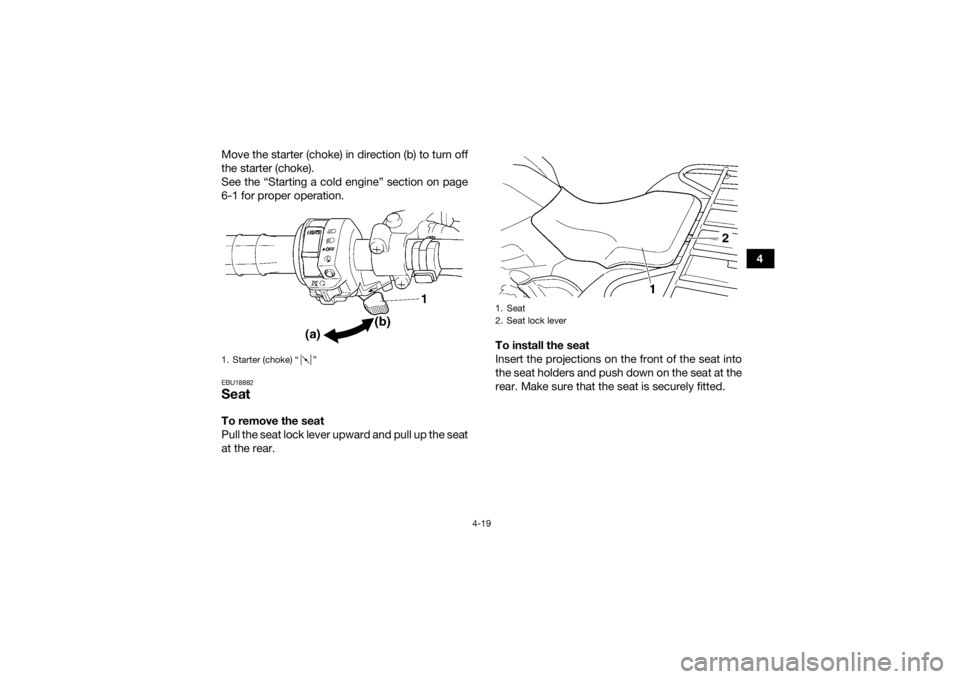
Move the starter (choke) in direction (b) to turn off
the starter (choke).
See the “Starting a cold engine” section on page
6-1 for proper operation.
EBU18882SeatTo remove the seat
Pull the seat lock lever upward and pull up the seat
at the rear.
To install the seat
Insert the projections on the front of the seat into
the seat holders and push down on the seat at the
rear. Make sure that the seat is securely fitted.1. Starter (choke) “ ”
1. Seat
2. Seat lock lever
U2LC62E0.book Page 19 Monday, May 11, 2015 2:28 PM
Page 54 of 170
4-24
4
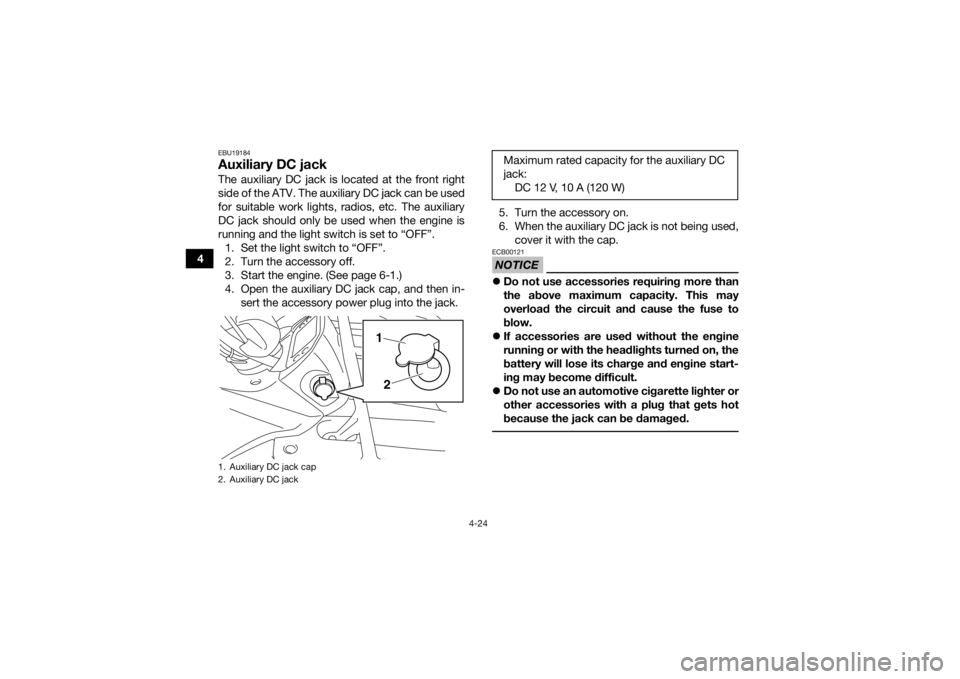
EBU19184Auxiliary DC jackThe auxiliary DC jack is located at the front right
side of the ATV. The auxiliary DC jack can be used
for suitable work lights, radios, etc. The auxiliary
DC jack should only be used when the engine is
running and the light switch is set to “OFF”.1. Set the light switch to “OFF”.
2. Turn the accessory off.
3. Start the engine. (See page 6-1.)
4. Open the auxiliary DC jack cap, and then in- sert the accessory power plug into the jack. 5. Turn the accessory on.
6. When the auxiliary DC jack is not being used,
cover it with the cap.
NOTICEECB00121Do not use accessories requiring more than
the above maximum capacity. This may
overload the circuit and cause the fuse to
blow.
If accessories are used without the engine
running or with the headlights turned on, the
battery will lose its charge and engine start-
ing may become difficult.
Do not use an automotive cigarette lighter or
other accessories with a plug that gets hot
because the jack can be damaged.
1. Auxiliary DC jack cap
2. Auxiliary DC jack
1
2
Maximum rated capacity for the auxiliary DC
jack: DC 12 V, 10 A (120 W)
U2LC62E0.book Page 24 Monday, May 11, 2015 2:28 PM
Page 55 of 170
5-1
5
EBU19203
PRE-OPERATION CHECKS
EBU19226Inspect your vehicle each time you use it to make sure the vehicle is in safe operating condition. Always
follow the inspection and maintenance procedures and schedules described in the Owner’s Manual.
WARNING
EWB00482Failure to inspect or maintain the vehicle properly increases the possibility of an accident or equip-
ment damage. Do not operate the vehicle if you find any problem. If a problem cannot be corrected
by the procedures provided in this manual, have the vehicle inspected by a Yamaha dealer. Before using this vehicle, check the following points:
ITEMROUTINE PAGE
Fuel • Check fuel level in fuel tank,
and add recommended fuel if neces-
sary.
• Check fuel line for leakage. Correct if necessary. 4-15, 5-3
Engine oil • Check oil level in engine, and add recommended oil to specified
level if necessary.
• Check ATV for oil leakage. Correct if necessary. 5-3, 8-16
Final gear oil • Check ATV for oil leakage. Correct if necessary. 5-3, 8-21
Differential gear oil • Check ATV for oil leakage. Correct if necessary. 5-3, 8-24
Coolant • Check coolant level in reservoir, and add recommended coolant to
specified level if necessary.
• Check cooling system for leakage. Correct if necessary. 5-3, 8-26
U2LC62E0.book Page 1 Monday, May 11, 2015 2:28 PM
Page 57 of 170
5-3
5
EBU19542FuelMake sure that there is sufficient fuel in the tank.
(See page 4-15.)EBU19561Engine oilMake sure that the engine oil is at the specified
level. Add oil as necessary. (See page 8-16.)EBU19591Final gear oilMake sure that the final gear oil is at the specified
level. Add oil as necessary. (See page 8-21.)EBU19601Differential gear oilMake sure that the differential gear oil is at the
specified level. Add oil as necessary. (See page
8-24.)EBU19632CoolantMake sure that the coolant is at the specified level.
Add coolant as necessary. (See page 8-26.)
TIPThe coolant level must be checked on a cold en-
gine since the level varies with engine tempera-
ture. EBU28533Front and rear brakesBrake levers and brake pedal
Check that there is no free play in the front
brake lever. If there is free play, have a Yamaha
dealer check the brake system.
Check for correct free play in the rear brake le-
ver and brake pedal. If the free play is incorrect,
adjust it. (See page 8-41.)
Check operation of the levers and pedal. They
should move smoothly and there should be a
firm feeling when the brake is applied. If not,
have a Yamaha dealer check them.
Brake fluid level (front brake)
Check the brake fluid level. Add fluid if necessary.
(See page 8-39.)
Specified brake fluid:DOT 4
U2LC62E0.book Page 3 Monday, May 11, 2015 2:28 PM
Page 62 of 170
6-1
6
EBU19882
OPERATION
EBU19902Read the Owner’s Manual carefully before riding
the ATV. If there is a control or function you do not
understand, ask your Yamaha dealer.
WARNING
EWB00632Read the Owner’s Manual carefully to become
familiar with all controls in order to help pre-
vent any loss of control, which could cause an
accident or injury. EBU26546Starting a cold engineNOTICEECB00151See the “Engine break-in” section on page 6-5
prior to operating the engine for the first time. 1. Turn the fuel cock to “ON”.
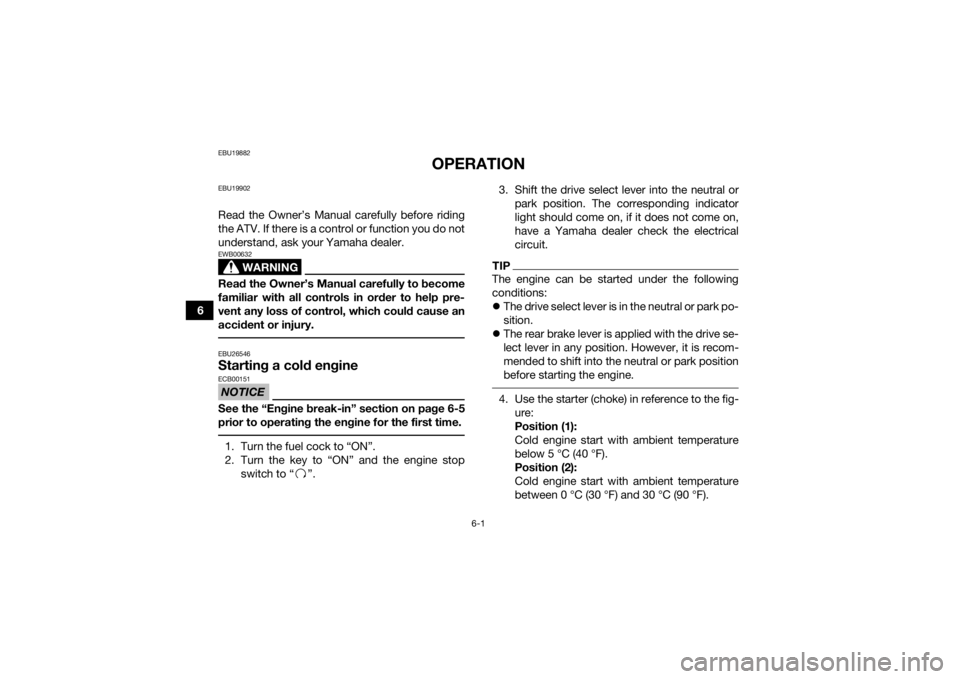
2. Turn the key to “ON” and the engine stopswitch to “ ”. 3. Shift the drive select lever into the neutral or
park position. The corresponding indicator
light should come on, if it does not come on,
have a Yamaha dealer check the electrical
circuit.
TIPThe engine can be started under the following
conditions:
The drive select lever is in the neutral or park po-
sition.
The rear brake lever is applied with the drive se-
lect lever in any position. However, it is recom-
mended to shift into the neutral or park position
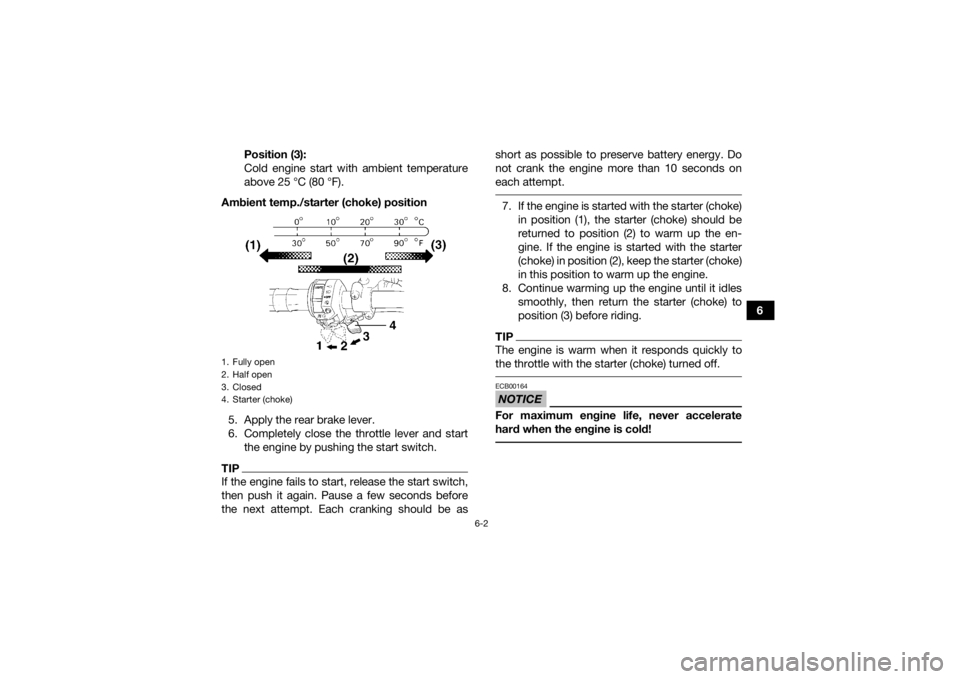
before starting the engine. 4. Use the starter (choke) in reference to the fig-
ure:
Position (1):
Cold engine start with ambient temperature
below 5 °C (40 °F).
Position (2):
Cold engine start with ambient temperature
between 0 °C (30 °F) and 30 °C (90 °F).
U2LC62E0.book Page 1 Monday, May 11, 2015 2:28 PM
Page 63 of 170
6-2
6
Position (3):
Cold engine start with ambient temperature
above 25 °C (80 °F).
Ambient temp./starter (choke) position
5. Apply the rear brake lever.
6. Completely close the throttle lever and start the engine by pushing the start switch.
TIPIf the engine fails to start, release the start switch,
then push it again. Pause a few seconds before
the next attempt. Each cranking should be as short as possible to preserve battery energy. Do
not crank the engine more than 10 seconds on
each attempt.
7. If the engine is started with the starter (choke)
in position (1), the starter (choke) should be
returned to position (2) to warm up the en-
gine. If the engine is started with the starter
(choke) in position (2), keep the starter (choke)
in this position to warm up the engine.
8. Continue warming up the engine until it idles smoothly, then return the starter (choke) to
position (3) before riding.TIPThe engine is warm when it responds quickly to
the throttle with the starter (choke) turned off. NOTICEECB00164For maximum engine life, never accelerate
hard when the engine is cold!
1. Fully open
2. Half open
3. Closed
4. Starter (choke)U2LC62E0.book Page 2 Monday, May 11, 2015 2:28 PM
Page 64 of 170
6-3
6
EBU20292Starting a warm engineFollow the same procedure as for starting a cold
engine, with the exception that the starter (choke)
is not required when the engine is warm. Instead,
start the engine with the throttle slightly open.EBU20442Operating the drive select lever and
driving in reverseNOTICEECB00171Before shifting, stop the ATV, otherwise the
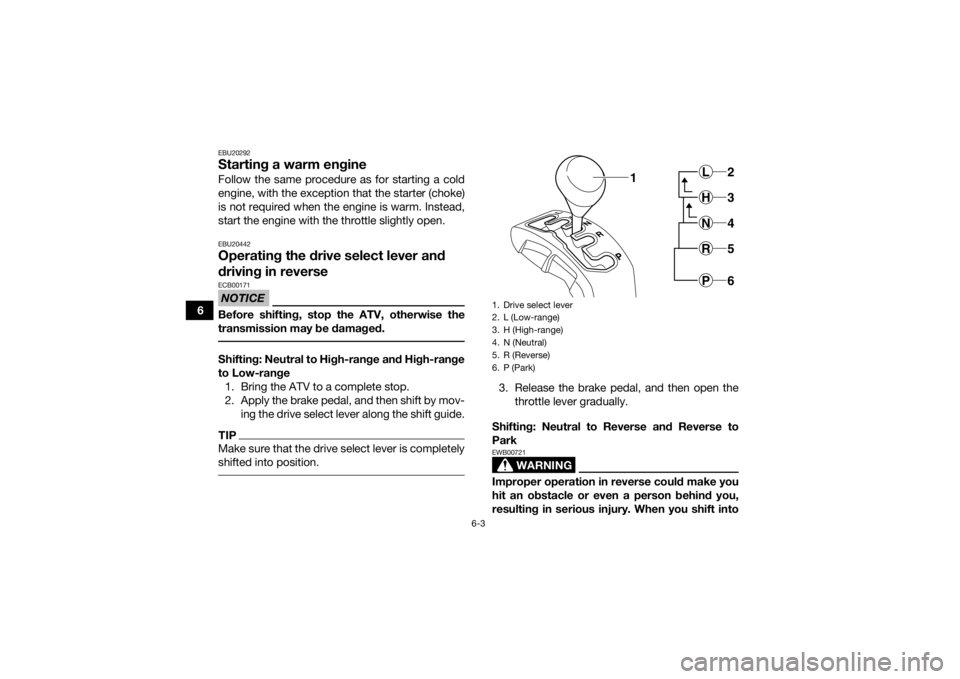
transmission may be damaged. Shifting: Neutral to High-range and High-range
to Low-range1. Bring the ATV to a complete stop.
2. Apply the brake pedal, and then shift by mov- ing the drive select lever along the shift guide.TIPMake sure that the drive select lever is completely
shifted into position.
3. Release the brake pedal, and then open thethrottle lever gradually.
Shifting: Neutral to Reverse and Reverse to
Park
WARNING
EWB00721Improper operation in reverse could make you
hit an obstacle or even a person behind you,
resulting in serious injury. When you shift into1. Drive select lever
2. L (Low-range)
3. H (High-range)
4. N (Neutral)
5. R (Reverse)
6. P (Park)
1
2L3H4N5R6P
U2LC62E0.book Page 3 Monday, May 11, 2015 2:28 PM
Page 66 of 170
6-5
64. Check behind for people or obstacles, and
then release the brake pedal.
5. Open the throttle lever gradually and continue to watch to the rear while backing.
EBU20683Engine break-inTIPFor ATVs equipped with an odometer or an hour
meter, follow the figures given in km (mi) or the
figures given in hours.
For ATVs not equipped with an odometer or
hour meter, follow the figures given in hours. There is never a more important period in the life
of your engine than the first 320 km (200 mi) or 20
hours of riding. For this reason, you should read
the following material carefully.
Since the engine is brand new, do not put an ex-
cessive load on it for the first 320 km (200 mi) or
20 hours. The various parts in the engine wear and
polish themselves to the correct operating clear-
ances. During this period, prolonged full-throttle
operation or any condition that might result in en-
gine overheating must be avoided. 0–160 km (0–100 mi) or 0–10 hours
Avoid prolonged operation above 1/2 throttle.
Vary the speed of the ATV regularly. Do not oper-
ate it at one set throttle position.
160–320 km (100–200 mi) or 10–20 hours
Avoid prolonged operation above 3/4 throttle. Rev
the engine freely, but do not use full throttle at any
time.
320 km (200 mi) or 20 hours and beyond
The ATV can now be operated normally.
NOTICEECB00221If any engine trouble should occur during the
engine break-in period, immediately have a
Yamaha dealer check the ATV. EBU20692ParkingWhen parking the ATV, stop the engine, apply the
brake pedal, shift the drive select lever into the
park position, and then turn the fuel cock to the
“OFF” position.
U2LC62E0.book Page 5 Monday, May 11, 2015 2:28 PM
Page 67 of 170
6-6
6
EBU20822Parking on a slope
WARNING
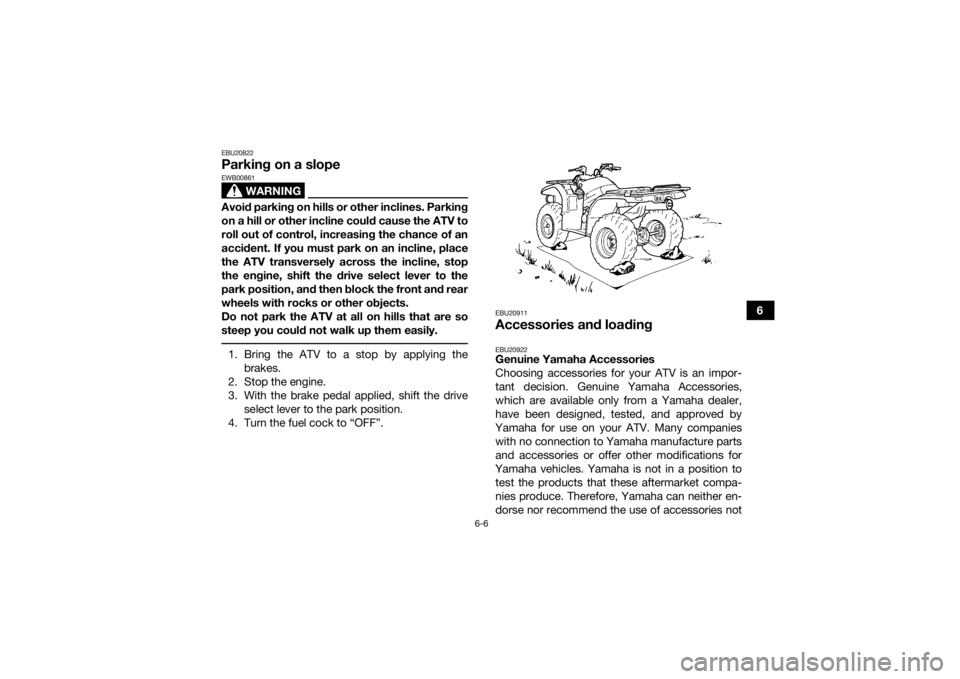
EWB00861Avoid parking on hills or other inclines. Parking
on a hill or other incline could cause the ATV to
roll out of control, increasing the chance of an
accident. If you must park on an incline, place
the ATV transversely across the incline, stop
the engine, shift the drive select lever to the
park position, and then block the front and rear
wheels with rocks or other objects.
Do not park the ATV at all on hills that are so
steep you could not walk up them easily. 1. Bring the ATV to a stop by applying thebrakes.
2. Stop the engine.
3. With the brake pedal applied, shift the drive select lever to the park position.
4. Turn the fuel cock to “OFF”.
EBU20911Accessories and loadingEBU20922Genuine Yamaha Accessories
Choosing accessories for your ATV is an impor-
tant decision. Genuine Yamaha Accessories,
which are available only from a Yamaha dealer,
have been designed, tested, and approved by
Yamaha for use on your ATV. Many companies with no connection to Yamaha manufacture parts
and accessories or offer other modifications for
Yamaha vehicles. Yamaha is not in a position to test the products that these aftermarket compa-
nies produce. Therefore, Yamaha can neither en-
dorse nor recommend the use of accessories not
U2LC62E0.book Page 6 Monday, May 11, 2015 2:28 PM
Page 72 of 170
7-3
7the time to learn the basic techniques well before
attempting more difficult maneuvers. Become fa-
miliar with this ATV at slow speeds first, even if you
are an experienced operator.
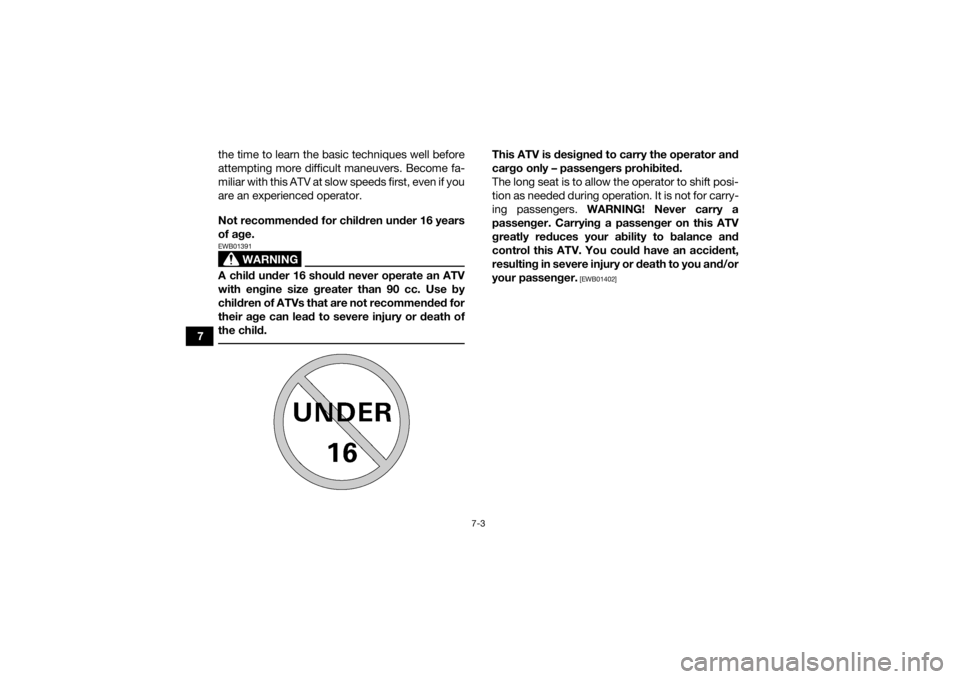
Not recommended for children under 16 years
of age.
WARNING
EWB01391A child under 16 should never operate an ATV
with engine size greater than 90 cc. Use by
children of ATVs that are not recommended for
their age can lead to severe injury or death of
the child.
This ATV is designed to carry the operator and
cargo only – passengers prohibited.
The long seat is to allow the operator to shift posi-
tion as needed during operation. It is not for carry-
ing passengers.
WARNING! Never carry a
passenger. Carrying a passenger on this ATV
greatly reduces your ability to balance and
control this ATV. You could have an accident,
resulting in severe injury or death to you and/or
your passenger.
[EWB01402]
U2LC62E0.book Page 3 Monday, May 11, 2015 2:28 PM