lock YAMAHA GRIZZLY 700 2014 Owner's Manual
[x] Cancel search | Manufacturer: YAMAHA, Model Year: 2014, Model line: GRIZZLY 700, Model: YAMAHA GRIZZLY 700 2014Pages: 174, PDF Size: 4.2 MB
Page 84 of 174

7-15
7Do not attempt to climb hills until you have mas-
tered basic maneuvers on flat ground. Always
check the terrain carefully before attempting any
hill. In all cases avoid inclines with slippery or loose
surfaces, or obstacles that might cause you to lose
control.
To climb a hill, you need traction, momentum, and
steady throttle. For more traction and control for
climbing steeper and/or rougher slopes, select
“4WD” or 4WD-LOCK (“DIFF. LOCK”). Travel fast
enough to maintain momentum, but not so fast that
you cannot react to changes in the terrain as you
climb.
It is important when climbing a hill to make sure
that your weight is transferred forward on the ATV.
This can be accomplished by leaning forward and,
on steeper inclines, standing on the footboards
and leaning forward over the handlebars. Whenev-
er possible, ride straight up hills.
Slow down when you reach the crest of the hill if
you cannot see clearly what is on the other side –
there could be another person, an obstacle, or a
sharp drop-off. Use common sense and remember
that some hills are too steep for you to climb or de-
scend. If you are climbing a hill and you find that you have
not properly judged your ability to make it to the
top, you should turn the ATV around while you still
have forward motion (provided you have the room
to do so) and go down the hill.
If your ATV has stalled or stopped and you believe
you can continue up the hill, restart carefully to
make sure you do not lift the front wheels which
could cause you to lose control. If you are unable
to continue up the hill, dismount the ATV on the up-
hill side. Physically turn the ATV around and then
descend the hill.
If you start to roll backwards, DO NOT apply either
brake abruptly. If you are in “2WD”, apply only the
front brake. When fully stopped, apply the rear
brake as well, and then shift to the park position. If
you are in “4WD”, because all wheels are intercon-
nected by the drive train, applying either brake will
brake all wheels, therefore, avoid sudden applica-
tion of either the front or rear brake as the wheels
on the uphill side could come off the ground. The
ATV could easily tip over backwards. Apply both
the front and rear brakes gradually. When fully
stopped, lock shift to the park position and dis-
mount the ATV immediately on the uphill side. Dis-
mount on uphill side or to a side if pointed straight
U2BG60E0.book Page 15 Monday, May 20, 2013 3:04 PM
Page 114 of 174
8-22
8
TIPIf a torque wrench is not available when installing
the spark plug, a good estimate of the correct
torque is 1/4–1/2 turn past finger tight. However,
the spark plug should be tightened to the specified
torque as soon as possible.3. Install the spark plug cap.EBU27467Engine oil and oil filter cartridge The engine oil level should be checked before
each ride. In addition, the oil must be changed and
the oil filter cartridge replaced at the intervals spec-
ified in the periodic maintenance and lubrication
chart.
To check the engine oil level
1. Place the ATV on a level surface.
2. Check the engine oil level on a cold engine.
TIPIf the engine was started before checking the oil
level, be sure to warm up the engine sufficiently,
and then wait at least 10 minutes until the oil settles
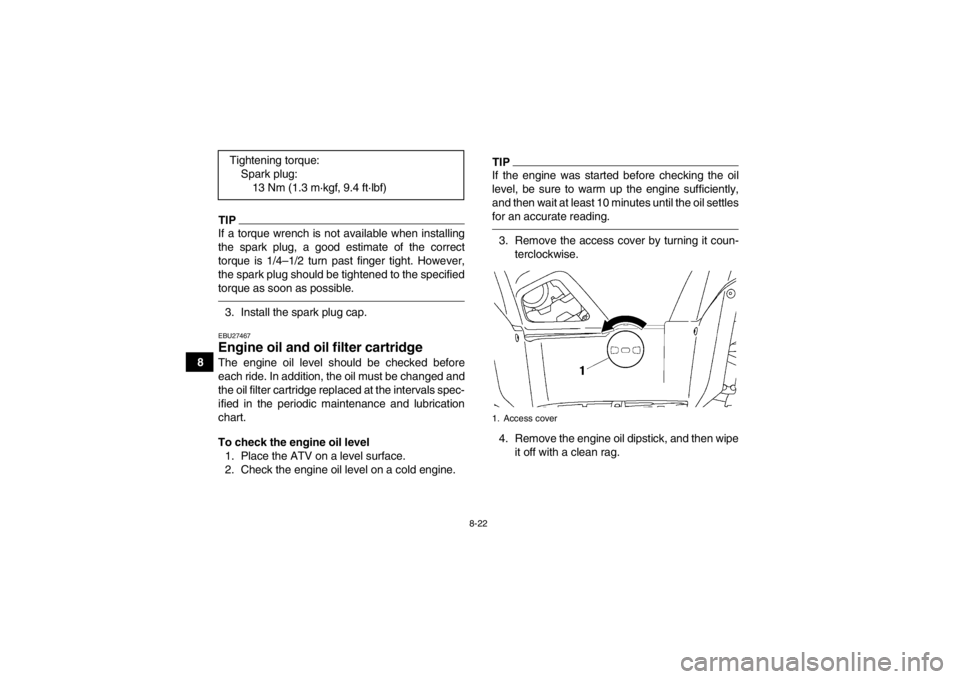
for an accurate reading.3. Remove the access cover by turning it coun- terclockwise.
4. Remove the engine oil dipstick, and then wipe it off with a clean rag.
Tightening torque:
Spark plug:13 Nm (1.3 m·kgf, 9.4 ft·lbf)1. Access cover
U2BG60E0.book Page 22 Monday, May 20, 2013 3:04 PM
Page 115 of 174
8-23
8
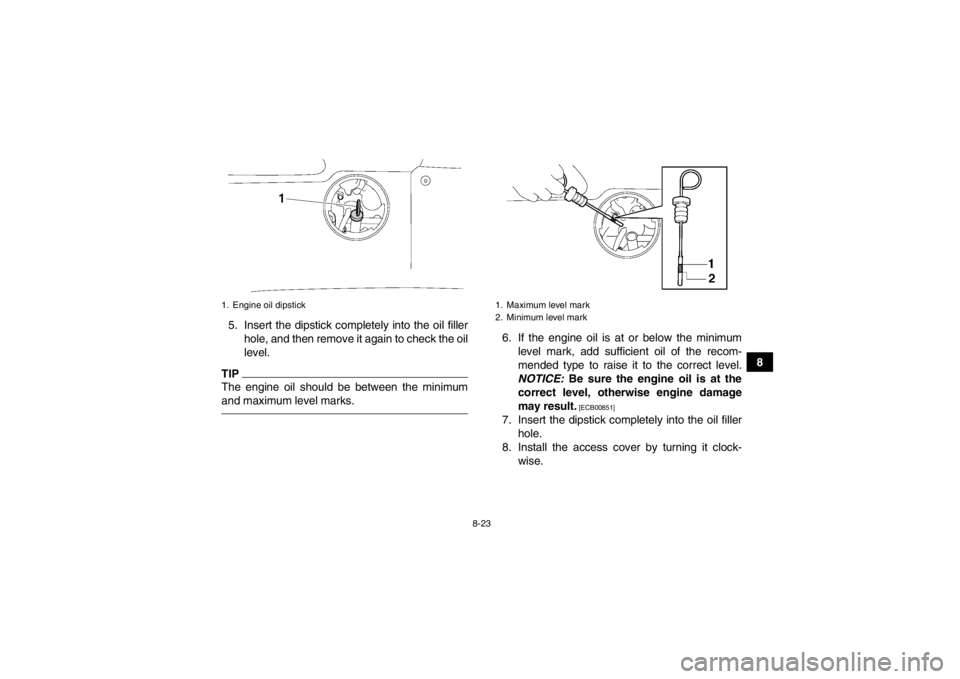
5. Insert the dipstick completely into the oil filler
hole, and then remove it again to check the oil
level.
TIPThe engine oil should be between the minimum
and maximum level marks.
6. If the engine oil is at or below the minimumlevel mark, add sufficient oil of the recom-
mended type to raise it to the correct level.
NOTICE: Be sure the engine oil is at the
correct level, otherwise engine damage
may result.
[ECB00851]
7. Insert the dipstick completely into the oil filler hole.
8. Install the access cover by turning it clock- wise.
1. Engine oil dipstick
1. Maximum level mark
2. Minimum level mark
U2BG60E0.book Page 23 Monday, May 20, 2013 3:04 PM
Page 116 of 174
8-24
8To change the engine oil (with or without oil fil-
ter cartridge replacement)
1. Place the ATV on a level surface.
2. Remove the access cover by turning it coun- terclockwise.
3. Place an oil pan under the engine to collect the used oil.
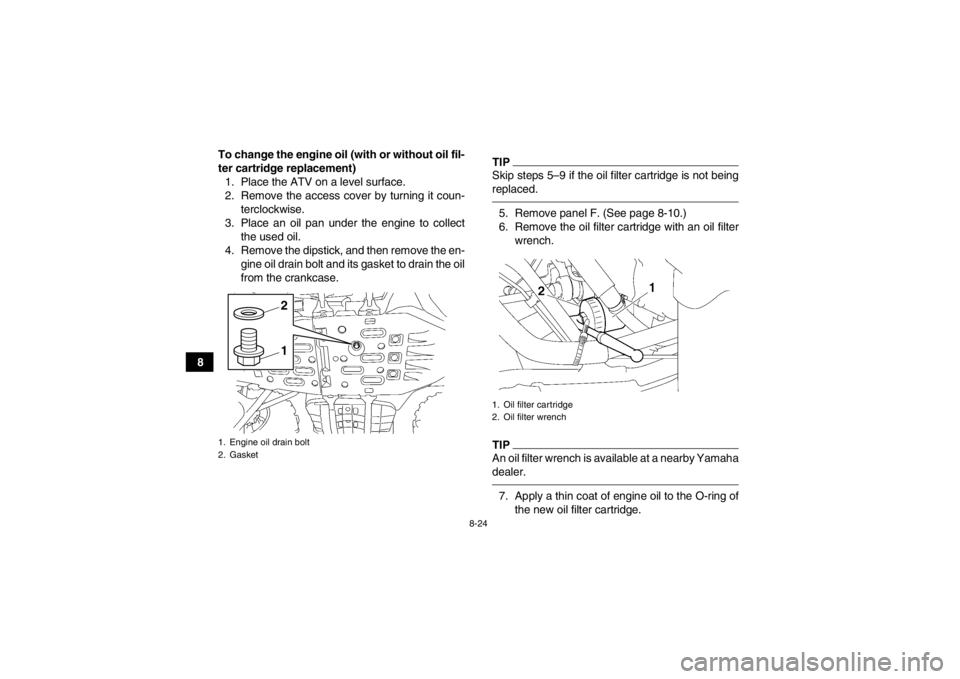
4. Remove the dipstick, and then remove the en- gine oil drain bolt and its gasket to drain the oil
from the crankcase.
TIPSkip steps 5–9 if the oil filter cartridge is not being
replaced.5. Remove panel F. (See page 8-10.)
6. Remove the oil filter cartridge with an oil filterwrench.TIPAn oil filter wrench is available at a nearby Yamaha
dealer.7. Apply a thin coat of engine oil to the O-ring ofthe new oil filter cartridge.
1. Engine oil drain bolt
2. Gasket
12
1. Oil filter cartridge
2. Oil filter wrench
U2BG60E0.book Page 24 Monday, May 20, 2013 3:04 PM
Page 118 of 174
8-26
811. Refill with the specified amount of the recom-
mended engine oil, and then insert the dip-
stick completely into the oil filler hole.
TIPBe sure to wipe off spilled oil on any parts after the
engine and exhaust system have cooled down.NOTICEECB00300●In order to prevent clutch slippage (since the
engine oil also lubricates the clutch), do not
mix any chemical additives. Do not use oils
with a diesel specification of “CD” or oils of
a higher quality than specified. In addition,
do not use oils labeled “ENERGY CONSERV-
ING II” or higher.
●Make sure that no foreign material enters the
crankcase.12. Start the engine, and then let it idle for severalminutes while checking it for oil leakage. If oil
is leaking, immediately turn the engine off and
check for the cause.
13. Turn the engine off, wait at least ten minutes, and then check the oil level and correct it if
necessary.
14. Install the access cover by turning it clock- wise.EBU27306Final gear oil The final gear case must be checked for oil leak-
age before each ride. If any leakage is found, have
a Yamaha dealer check and repair the ATV. In ad-
dition, the final gear oil level must be checked and
the oil changed as follows at the intervals specified
in the periodic maintenance and lubrication chart.
To check the final gear oil level1. Place the ATV on a level surface.
Recommended oil:
See page 10-1.
Oil quantity: Without oil filter cartridge replacement:2.00 L (2.11 US qt, 1.76 Imp.qt)
With oil filter cartridge replacement: 2.10 L (2.22 US qt, 1.85 Imp.qt)
U2BG60E0.book Page 26 Monday, May 20, 2013 3:04 PM
Page 136 of 174
8-44
8
WARNING
EWB02340Do not start the engine when cleaning the
spark arrester, otherwise it could cause injury
to the eyes, burns, carbon monoxide poison-
ing, possibly leading to death, and start a fire.
Always let the exhaust system cool prior to
touching exhaust components.EBU23931V-belt case drain plug After riding in water deep enough to allow it to en-
ter the V-belt case, remove the V-belt case drain
plug to drain the water from the case.TIPIf water drains from the V-belt case after removing
the plug, have a Yamaha dealer check the ATV as
the water may affect other engine parts.
EBU29702Adjusting the throttle lever free play The throttle lever free play should be checked and,
if necessary, adjusted at the intervals specified in
the periodic maintenance and lubrication chart.
The throttle lever free play should measure 3.0–
5.0 mm (0.12–0.20 in) as shown. Periodically
check the throttle lever free play and, if necessary,
adjust it as follows.1. Slide the rubber cover back.
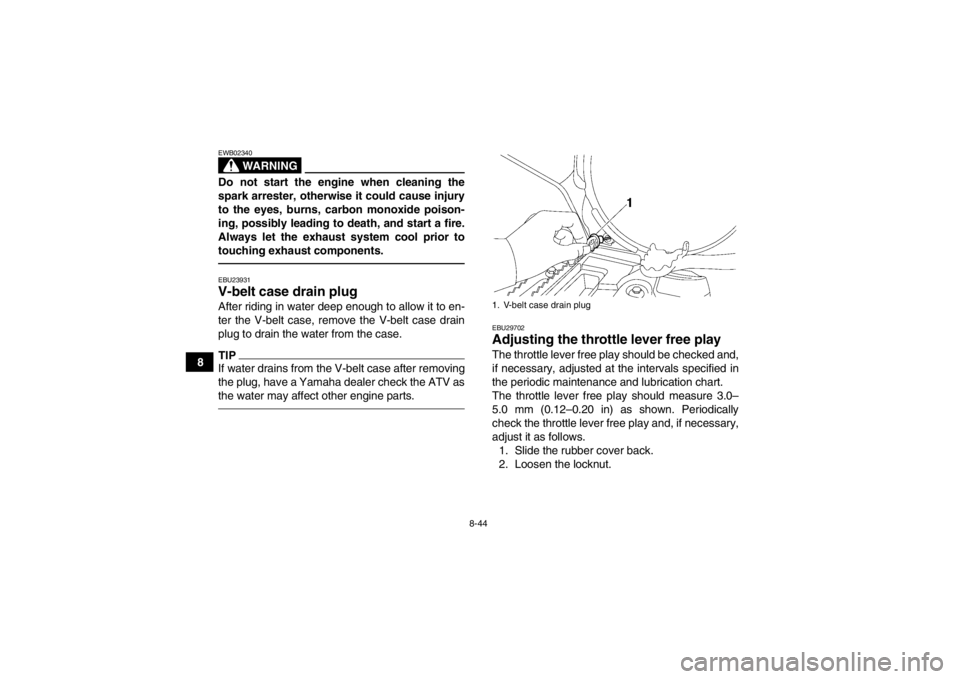
2. Loosen the locknut.1. V-belt case drain plug
U2BG60E0.book Page 44 Monday, May 20, 2013 3:04 PM
Page 137 of 174
8-45
8
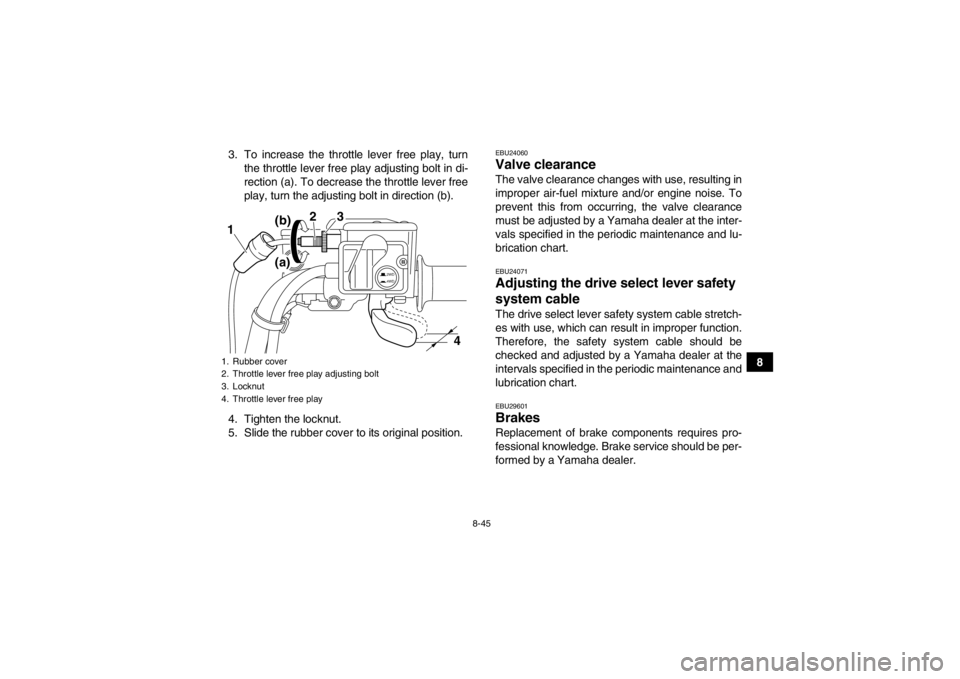
3. To increase the throttle lever free play, turn
the throttle lever free play adjusting bolt in di-
rection (a). To decrease the throttle lever free
play, turn the adjusting bolt in direction (b).
4. Tighten the locknut.
5. Slide the rubber cover to its original position.
EBU24060Valve clearance The valve clearance changes with use, resulting in
improper air-fuel mixture and/or engine noise. To
prevent this from occurring, the valve clearance
must be adjusted by a Yamaha dealer at the inter-
vals specified in the periodic maintenance and lu-
brication chart.EBU24071Adjusting the drive select lever safety
system cable The drive select lever safety system cable stretch-
es with use, which can result in improper function.
Therefore, the safety system cable should be
checked and adjusted by a Yamaha dealer at the
intervals specified in the periodic maintenance and
lubrication chart.EBU29601Brakes Replacement of brake components requires pro-
fessional knowledge. Brake service should be per-
formed by a Yamaha dealer.
1. Rubber cover
2. Throttle lever free play adjusting bolt
3. Locknut
4. Throttle lever free play
2WD
4WD
3
2
1
4
(b)
(a)
U2BG60E0.book Page 45 Monday, May 20, 2013 3:04 PM
Page 140 of 174
8-48
8
●Use only the specified brake fluid; otherwise,
the rubber seals may deteriorate, causing
leakage.●Refill with the same type of brake fluid. Add-
ing a brake fluid other than DOT 4 may result
in a harmful chemical reaction.●Be careful that water does not enter the
brake fluid reservoir when refilling. Water
will significantly lower the boiling point of
the fluid and may result in vapor lock.NOTICEECB01160Brake fluid may damage painted surfaces or
plastic parts. Always clean up spilled fluid im-
mediately.As the brake pads wear, it is normal for the brake
fluid level to gradually go down. A low brake fluid
level may indicate worn brake pads and/or brake
system leakage; therefore, be sure to check the
brake pads for wear and the brake system for leak-
age. If the brake fluid level goes down suddenly,
have a Yamaha dealer check the cause before fur-
ther riding.
EBU24292Changing the brake fluid Have a Yamaha dealer change the brake fluid at
the intervals specified in the periodic maintenance
and lubrication chart. In addition, have the oil seals
of the master cylinders and calipers as well as the
brake hoses replaced at the intervals listed below
or whenever they are damaged or leaking.●Oil seals: Replace every two years.●Brake hoses: Replace every four years.EBU27772Checking the front and rear brake lever
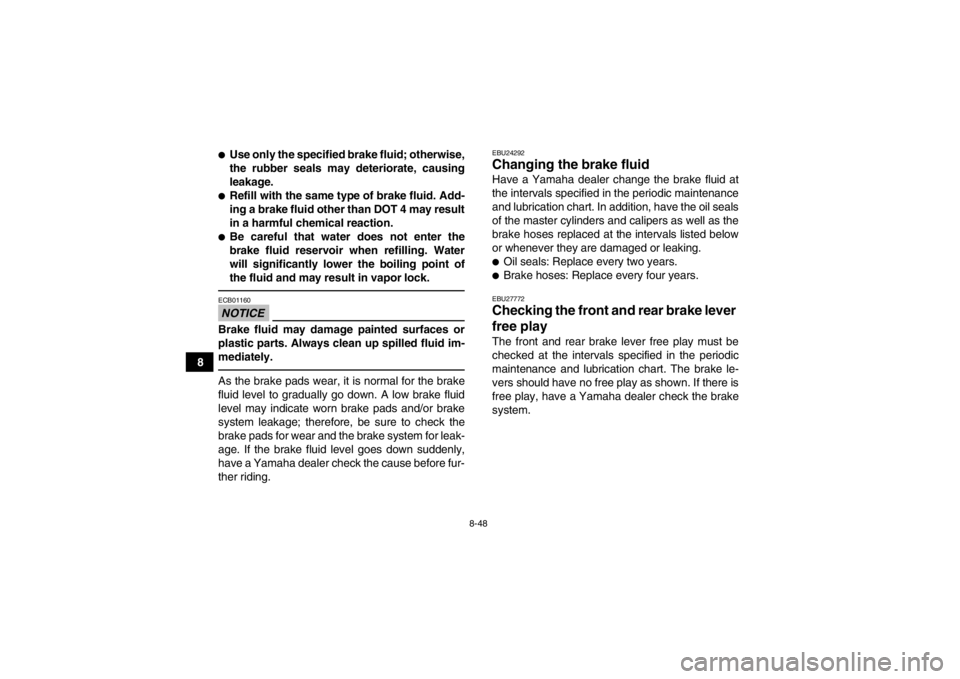
free play The front and rear brake lever free play must be
checked at the intervals specified in the periodic
maintenance and lubrication chart. The brake le-
vers should have no free play as shown. If there is
free play, have a Yamaha dealer check the brake
system.
U2BG60E0.book Page 48 Monday, May 20, 2013 3:04 PM
Page 142 of 174
8-50
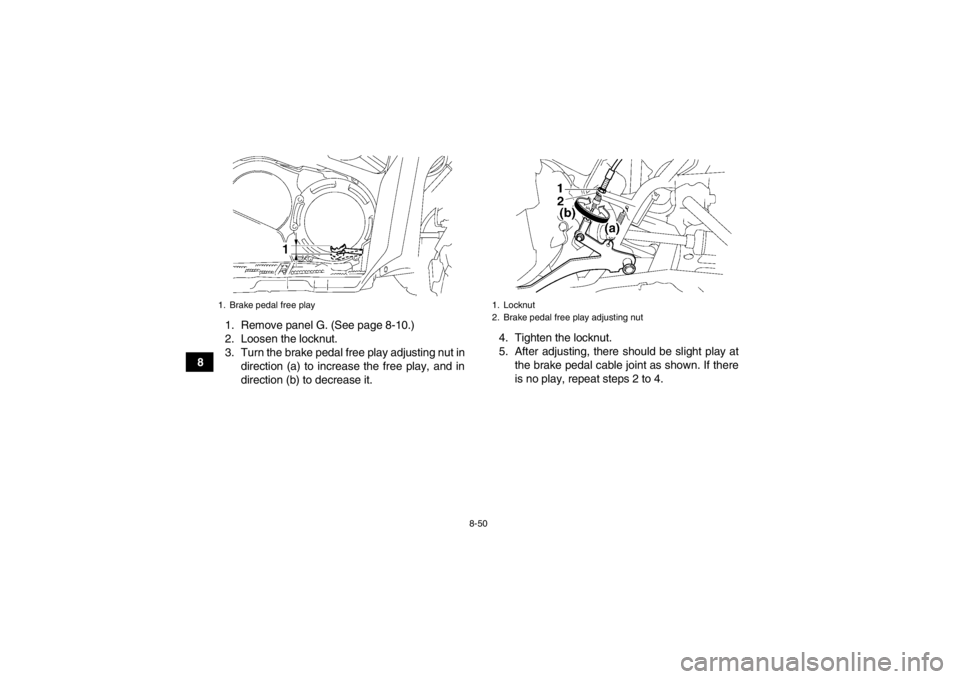
81. Remove panel G. (See page 8-10.)
2. Loosen the locknut.
3. Turn the brake pedal free play adjusting nut in
direction (a) to increase the free play, and in
direction (b) to decrease it. 4. Tighten the locknut.
5. After adjusting, there should be slight play at
the brake pedal cable joint as shown. If there
is no play, repeat steps 2 to 4.
1. Brake pedal free play
1. Locknut
2. Brake pedal free play adjusting nut
U2BG60E0.book Page 50 Monday, May 20, 2013 3:04 PM
Page 155 of 174
8-63
8
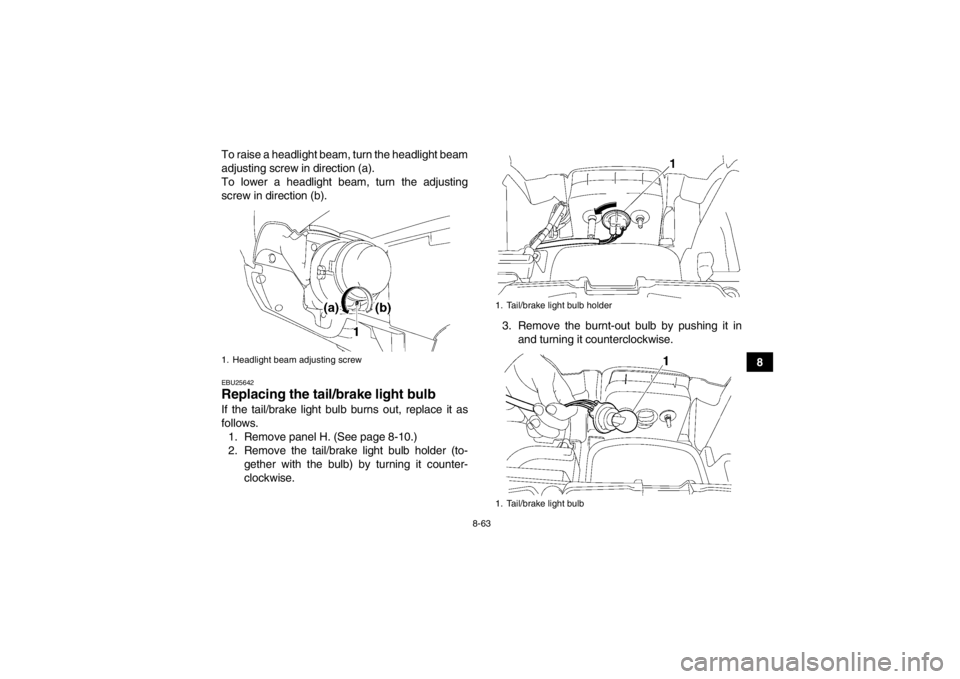
To raise a headlight beam, turn the headlight beam
adjusting screw in direction (a).
To lower a headlight beam, turn the adjusting
screw in direction (b).
EBU25642Replacing the tai
l/brake light bulb If the tail/brake light bulb burns out, replace it as
follows.
1. Remove panel H. (See page 8-10.)
2. Remove the tail/brake light bulb holder (to- gether with the bulb) by turning it counter-
clockwise. 3. Remove the burnt-out bulb by pushing it in
and turning it counterclockwise.1. Headlight beam adjusting screw
1. Tail/brake light bulb holder
1. Tail/brake light bulb
U2BG60E0.book Page 63 Monday, May 20, 2013 3:04 PM