light YAMAHA JETBLASTER 2022 Owners Manual
[x] Cancel search | Manufacturer: YAMAHA, Model Year: 2022, Model line: JETBLASTER, Model: YAMAHA JETBLASTER 2022Pages: 98, PDF Size: 4.83 MB
Page 18 of 98

Safety information
11
tercraft, otherwise you increase your chan-
ce of hitting a submerged object, which
could result in injury.
This watercraft is not equipped with light-
ing required for night operation. Do not op-
erate the watercraft after sunset or before
dawn, otherwise you increase the risk of
colliding with another boat, which could re-
sult in severe injury or death.
Follow navigation rules, and state/provin-
cial and local laws that apply to watercraft.
EJU43131
Operation requirements
All riders must wear a personal flotation de-
vice (PFD) that is approved by the appro-
priate authorities and is suitable for
personal watercraft use.
Wear protective clothing. Severe internal
injuries can occur if water is forced into
body cavities as a result of falling into the
water or being near the jet thrust nozzle.
You must wear shorts with neoprene (wet-
suit material) to keep water from being
forcefully injected into the rectum or vagina
during a fall backward. Riders not wearing
neoprene shorts have received severe rec-
tal, vaginal, and internal injuries resulting in
permanent damage. Normal swimwear
does not offer adequate protection.
Eye protection is recommended to keep
wind, water, and glare from the sun out of
your eyes while you operate your water-
craft. Restraining straps for eyewear are
made which are designed to float should
your eyewear fall in the water.
Footwear and gloves are recommended.
You must decide whether to wear a helmet
while you ride for recreation. You should
know that a helmet could help protect you
60 cm (2 ft)
1Authority-approved PFD
2 Wetsuit bottom
1
2
UF6C70E0.book Page 11 Wednesday, November 10, 2021 11:33 AM
Page 26 of 98

Description
19
EJU43332
Watercraft glossary
Trolling speed
“Trolling” is the lowest maneuvering speed. You are applying little or no throttle. The water-
craft is down in the water, and there is no wake.
Sub-planing speed
“Sub-planing” is a medium speed. The bow of the watercraft is slightly up from the water sur-
face, but you are still traveling through the water. There is a wake.
Planing speed
“Planing” is a faster speed. The watercraft is more level and is skimming on top of the water.
There is a wake.
Bow
The front end of the watercraft.
Stern
The rear end of the watercraft.
Starboard
The right side of the watercraft when facing forward.
Port
The left side of the watercraft when facing forward.
Bilge water
Water that has collected in the engine compartment.
Yamaha Engine Management System (YEMS) YEMS is an integrated, computerized management system that controls and adjusts ignition
timing, fuel injection, engine diagnostics, and the off-throttle steering (OTS) system.
Reverse with Intuitive Deceleration Electronics (RiDE)
RiDE is an electronic system that controls the reverse, neutral, and deceleration operations of
the watercraft.
UF6C70E0.book Page 19 Wednesday, November 10, 2021 11:33 AM
Page 36 of 98

Watercraft operation
29
TIP
If the RiDE lever is squeezed while the throttle
lever is squeezed, the watercraft will slow
down, and once stopped, move in reverse.
To shift into neutral from forward:
(1) Release the throttle lever.
(2) Lightly squeeze and release the RiDE le-ver. The “N” (neutral) shift indicator will
be displayed.
TIP
If the RiDE lever is squeezed continuously,
the reverse gate will move to the reverse po-
sition.
EJU47170Electric trim system
The electric trim system is a function for
changing the vertical angle of the jet thrust
nozzle to change the trim angle and perfor-
mance characteristics of the watercraft.
This function can be used only for forward
operation of the watercraft.
TIP
When the watercraft is moving in reverse or
is in neutral, the jet thrust nozzle will auto-
matically change to the neutral trim setting.
When the watercraft is shifted into forward,
the jet thrust nozzle will automatically
change to the selected trim setting.
The watercraft perfor mance characteristics
according to the trim angle change de-
pending on the operating conditions.
Confirming the trim setting
The trim setting can be confirmed by the trim
setting indicator on the multifunction infor-
mation center.
1 “F” (Forward position)
1
1“N” (Neutral position)
1
UF6C70E0.book Page 29 Wednesday, November 10, 2021 11:33 AM
Page 38 of 98
Instrument operation
31
EJU47200
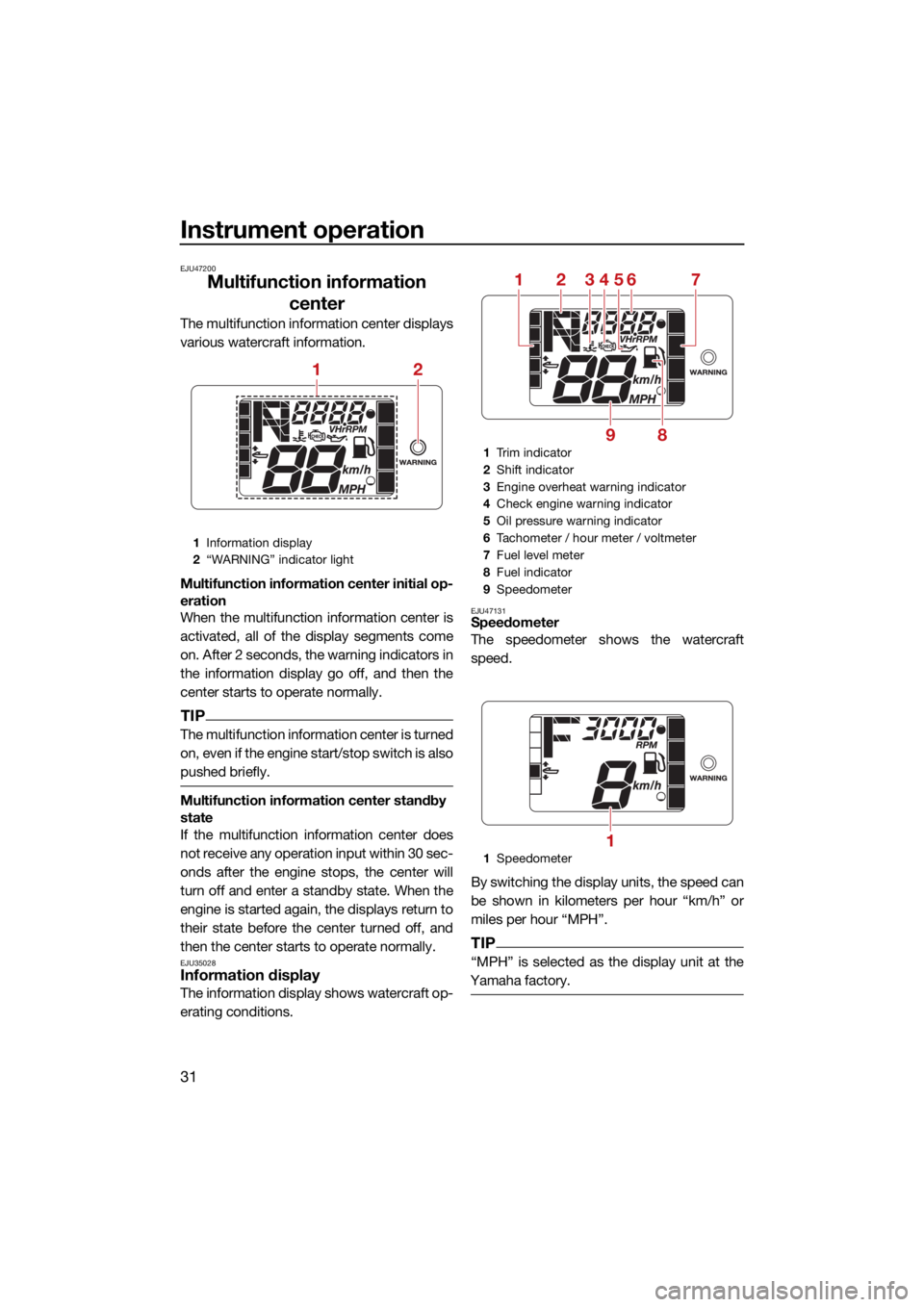
Multifunction information center
The multifunction information center displays
various watercraft information.
Multifunction information center initial op-
eration
When the multifunction information center is
activated, all of the display segments come
on. After 2 seconds, the warning indicators in
the information display go off, and then the
center starts to operate normally.
TIP
The multifunction information center is turned
on, even if the engine start/stop switch is also
pushed briefly.
Multifunction information center standby
state
If the multifunction information center does
not receive any operation input within 30 sec-
onds after the engine stops, the center will
turn off and enter a standby state. When the
engine is started again, the displays return to
their state before the center turned off, and
then the center starts to operate normally.
EJU35028Information display
The information display shows watercraft op-
erating conditions.
EJU47131Speedometer
The speedometer shows the watercraft
speed.
By switching the display units, the speed can
be shown in kilometers per hour “km/h” or
miles per hour “MPH”.
TIP
“MPH” is selected as the display unit at the
Yamaha factory.
1 Information display
2 “WARNING” indicator light
21
1Trim indicator
2 Shift indicator
3 Engine overheat warning indicator
4 Check engine warning indicator
5 Oil pressure warning indicator
6 Tachometer / hour meter / voltmeter
7 Fuel level meter
8 Fuel indicator
9 Speedometer
1 Speedometer
2345716
98
1
UF6C70E0.book Page 31 Wednesday, November 10, 2021 11:33 AM
Page 41 of 98

Instrument operation
34
EJU37272Fuel level meter
The fuel level meter shows the amount of fuel
remaining in the fuel tank. The amount of re-
maining fuel is shown using four display seg-
ments, which disappear one at a time as the
fuel level decreases.
TIP
The accuracy of the fuel level meter varies
depending on the operating conditions. Use
this function as a reference only.
EJU44711Fuel level warning
If the fuel remaining in the fuel tank drops to
about 8 L (2.1 US gal, 1.8 Imp.gal), the lowest
fuel level segment, the fuel level warning indi-
cator, and the “WARNING” indicator light
blink, and the buzzer sounds intermittently for
30 seconds.If the fuel level warning is activated, refill the
fuel tank as soon as possible. (See page 41
for information on filling the fuel tank.)
After the fuel tank is refilled, the warning sig-
nals will be cleared when the engine is re-
started.
EJU43721Oil pressure warning
If the oil pressure drops significantly, the oil
pressure warning indicator, the check engine
warning indicator, and the “WARNING” indi-
cator light blink, and the buzzer sounds inter-
mittently for 30 seconds. At the same time,
the maximum engine speed is limited.
If the oil pressure warning is activated, imme-
diately reduce the engine speed, return to
shore, and then check the engine oil level.
(See page 43 for information on checking the
engine oil level.) If the oil level is sufficient,
have a Yamaha dealer check the watercraft.
EJU43902Engine overheat warning
If the engine temperature rises significantly,
the engine overheat warning indicator, the
check engine warning indicator, and the
“WARNING” indicator light blink, and the
buzzer sounds intermittently. After 5 sec-
onds, the engine overheat warning indicator
and the “WARNING” indicator light stop
blinking and remain on, and the buzzer
sounds continuously. After 30 seconds, the
buzzer stops. While the engine overheat
1
Fuel level meter
1
UF6C70E0.book Page 34 Wednesday, November 10, 2021 11:33 AM
Page 42 of 98

Instrument operation
35
warning is activated, the maximum engine
speed is limited.
If the engine overheat warning is activated,
immediately reduce the engine speed, return
to shore, and then make sure that water is
being discharged from the cooling water pilot
outlet while the engine is running. If there is
no discharge of water, stop the engine, and
then check the jet intake for clogging. (See
page 84 for information on the jet intake.)
NOTICE: If you cannot locate and correct
the cause of the overheating, consult a
Yamaha dealer. Continuing to operate at higher speeds could result in severe en-
gine damage.
[ECJ00042]
EJU44691
Check engine warning
If a sensor malfunction or a short circuit is de-
tected, the check engine warning indicator
and the “WARNING” indicator light blink, and
the buzzer sounds intermittently for 30 sec-
onds. If the engine is stopped after the check en-
gine warning is activated, the tachometer
portion of the information display will show
the hour meter and error code alternately at
3-second intervals.
If the check engine warning is activated, im-
mediately reduce the engine speed, return to
shore, and have a Yamaha dealer check the
engine.
1
Error code
1
UF6C70E0.book Page 35 Wednesday, November 10, 2021 11:33 AM
Page 49 of 98

Operation and handling requirements
42
(See page 36 for seat removal and instal-
lation procedures and page 40 for infor-
mation on the fire extinguisher holder.)
(4) Loosen the fuel filler cap and remove it.
(5) Slowly add fuel to the fuel tank. (6) Stop filling when the fuel level reaches
approximately 50 mm (2 in) from the top
of the fuel tank. Do not overfill the fuel
tank. Because fuel expands when it
heats up, heat from the engine or the sun
can cause fuel to spill out of the fuel tank.
Do not leave the watercraft with a full
tank in direct sunlight.
(7) Wipe up any spilled fuel immediately with a dry cloth.
(8) Securely install the fuel filler cap by tight- ening it until it clicks.
(9) Securely install the fire extinguisher hold- er and seat in their original positions.
1Fuel tank
1 Fuel filler cap
Fuel tank capacity:
50 L (13.2 US gal, 11.0 Imp.gal)
1
1
1Top of the fuel tank
2 Approximately 50 mm (2 in) from top of the
fuel tank
1 Top of the fuel tank
2 Approximately 50 mm (2 in) from top of the
fuel tank
21
1
2
UF6C70E0.book Page 42 Wednesday, November 10, 2021 11:33 AM
Page 64 of 98

Operation
57
EJU32905
Operating your watercraftEWJ00512
Before operating your watercraft, become
familiar with all of the controls. Consult a
Yamaha dealer about any control or func- tion that you do not fully understand. Fail-
ure to understand how the controls work
could cause an accident or prevent you
from avoiding an accident.
EJU32965Getting to know your watercraft
Operating your watercraft requires skills ac-
quired through practice over a period of time.
Take the time to learn the basic techniques
well before attempting more difficult maneu-
vers.
Operating your new watercraft can be a very
enjoyable activity, providing you with hours of
pleasure. However, it is essential to familiar-
ize yourself with the operation of the water-
craft to achieve the skill level necessary to
enjoy riding safely.
Before operating this watercraft, read this
owner’s/operator’s manual, the Riding Prac-
tice Guide, the Riding Instruction card, and all
labels on the watercraft. Pay particular atten-
tion to the safety information beginning on
page 9. These materials should give you an
understanding of the watercraft and its oper-
ation.
Remember: This watercraft is designed to
carry the operator and up to 2 passengers.
Never exceed the maximum load limit or al-
low more than 3 persons (or 2 persons if a
wakeboarder or water-skier is being pulled)
to ride the watercraft at any time.
EJU33006Learning to operate your watercraft
Before operating the watercraft, always per-
form the pre-operation checks listed on page
48. The short time spent checking the water-
craft will reward you with added safety and
reliability.
Check local laws before operating your wa-
tercraft.
Operate defensively at safe speeds and keep
a safe distance away from people, objects,
and other watercraft. Select a wide area to
learn in, where there is good visibility and
light boat traffic.
Use the buddy system—operate with some-
one nearby. Scan constantly for people, ob-
jects, and other watercraft. Be alert for
conditions that limit your visibility or block
your vision of others.
You should grip the handlebars firmly and
keep both feet on the floor of the footwell. Do
not attempt to ride with passengers until your
operating skills are fully developed. Maximum load:
225 kg (496 lb)
Load is the total weight of cargo, op-
erator, and passengers.
UF6C70E0.book Page 57 Wednesday, November 10, 2021 11:33 AM
Page 69 of 98

Operation
62
proximately 100 m (330 ft) after the throttle le-
ver is released or the engine is stopped,
although this distance will vary depending on
many factors, including gross weight, water
surface conditions, and wind direction.
If the RiDE lever is squeezed to slow down,
the stopping distance is approximately 30%
shorter than when the RiDE lever is not used.
However, this distance will vary depending
on many factors, including gross weight, wa-
ter surface conditions, and wind direction.
EWJ01794
Allow adequate stopping distance. Stay
far enough away from others so you can
always safely coast to a stop.
Take early action to avoid collisions. Re-
member, watercraft and other boats do
not have brakes.
Operate defensively at safe speeds and
keep a safe distance away from people,
objects, and other watercraft to give you
time to stop.
Do not shut the engine off when slowing
down in case you need engine power to
steer away from a boat or other obstacle
that comes into your path.
To avoid rear-end collisions while oper-
ating the watercraft, check behind you
before using the RiDE lever to slow
down or stop the watercraft.
EJU43447Operating the watercraft in reverse or
neutral
Operating in reverse
When the RiDE lever is squeezed, the “R” (re-
verse) shift indicator will be displayed and the
watercraft will move in reverse. (See page 27
for shift system operation procedures.)
Make sure that there are no obstacles or peo-
ple behind you before shifting into reverse.
TIP
This model is equipped with a function which
limits the engine speed in reverse.
Operating in neutral
When the RiDE lever is squeezed lightly and
released, the “N” (neutral) shift indicator will
be displayed and the watercraft will stop in its
current location. (See page 27 for shift sys-
tem operation procedures.)
1“R” (Reverse position)
1
UF6C70E0.book Page 62 Wednesday, November 10, 2021 11:33 AM
Page 89 of 98

Trouble recovery
82
Engine runs irregu-
larly or stallsFuel Fuel tank empty Refill as soon as pos-
sible41
Stale or contaminat-
ed Have serviced by
Yamaha dealer
—
Fuel tank Water or dirt present Have serviced by Yamaha dealer—
Spark plug Fouled or defective Have serviced by Yamaha dealer—
Incorrect heat range Have serviced by Yamaha dealer —
Gap incorrect Have serviced by Yamaha dealer —
Electrical wir-
ing Loose connection Have serviced by
Yamaha dealer —
Fuel injec-
tion system Faulty or clogged in-
jectors Have serviced by
Yamaha dealer
—
Warning light or in-
dicator blinks or
comes on Fuel level
warning
Fuel tank empty Refill as soon as pos-
sible 41
Oil pressure
warning Oil pressure dropped Have serviced by
Yamaha dealer 34
Engine over-
heat warning Jet intake clogged Clean
84
Check en-
gine warning Faulty sensors Have serviced by
Yamaha dealer 35
TROUBLE POSSIBLE CAUSE REMEDY PAGE
UF6C70E0.book Page 82 Wednesday, November 10, 2021 11:33 AM