warning YAMAHA JOG50R 2014 User Guide
[x] Cancel search | Manufacturer: YAMAHA, Model Year: 2014, Model line: JOG50R, Model: YAMAHA JOG50R 2014Pages: 76, PDF Size: 1.51 MB
Page 28 of 76
EAU14160
Rider seat
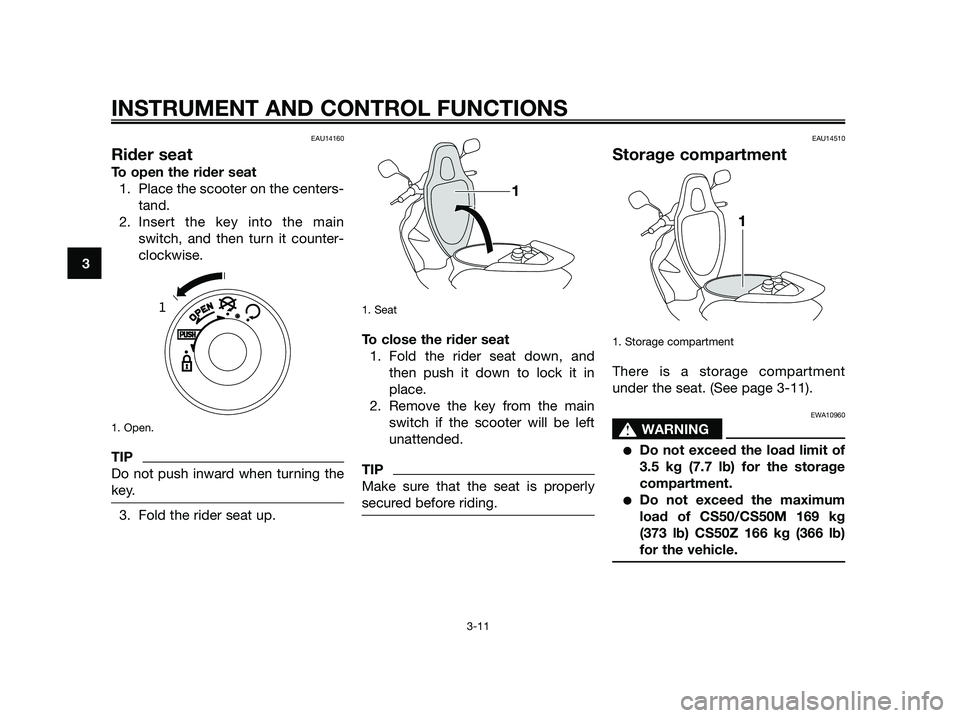
To open the rider seat
1. Place the scooter on the centers-
tand.
2. Insert the key into the main
switch, and then turn it counter-
clockwise.
1. Open.
TIP
Do not push inward when turning the
key.
3. Fold the rider seat up.
1. Seat
To close the rider seat
1. Fold the rider seat down, and
then push it down to lock it in
place.
2. Remove the key from the main
switch if the scooter will be left
unattended.
TIP
Make sure that the seat is properly
secured before riding.
EAU14510
Storage compartment
1. Storage compartment
There is a storage compartment
under the seat. (See page 3-11).
EWA10960
sWARNING
●Do not exceed the load limit of
3.5 kg (7.7 lb) for the storage
compartment.
●Do not exceed the maximum
load of CS50/CS50M 169 kg
(373 lb) CS50Z 166 kg (366 lb)
for the vehicle.
1
1
1
INSTRUMENT AND CONTROL FUNCTIONS
3-11
3
Page 30 of 76
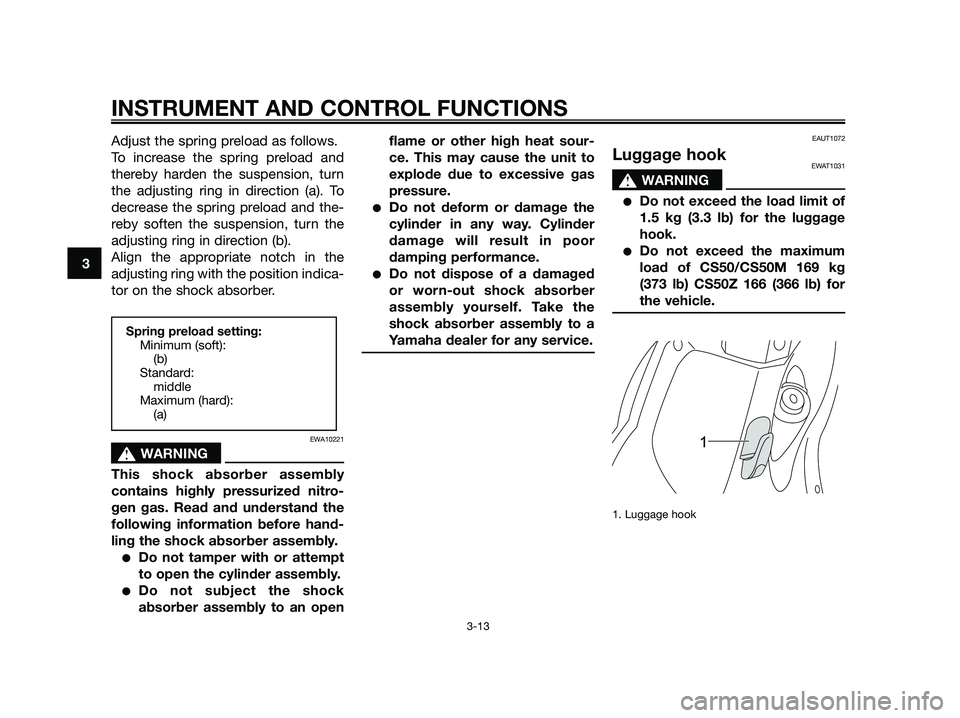
Adjust the spring preload as follows.
To increase the spring preload and
thereby harden the suspension, turn
the adjusting ring in direction (a). To
decrease the spring preload and the-
reby soften the suspension, turn the
adjusting ring in direction (b).
Align the appropriate notch in the
adjusting ring with the position indica-
tor on the shock absorber.
EWA10221
sWARNING
This shock absorber assembly
contains highly pressurized nitro-
gen gas. Read and understand the
following information before hand-
ling the shock absorber assembly.
●Do not tamper with or attempt
to open the cylinder assembly.
●Do not subject the shock
absorber assembly to an openflame or other high heat sour-
ce. This may cause the unit to
explode due to excessive gas
pressure.
●Do not deform or damage the
cylinder in any way. Cylinder
damage will result in poor
damping performance.
●Do not dispose of a damaged
or worn-out shock absorber
assembly yourself. Take the
shock absorber assembly to a
Yamaha dealer for any service.
EAUT1072
Luggage hookEWAT1031
sWARNING
●Do not exceed the load limit of
1.5 kg (3.3 lb) for the luggage
hook.
●Do not exceed the maximum
load of CS50/CS50M 169 kg
(373 lb) CS50Z 166 (366 lb) for
the vehicle.
1. Luggage hook
Spring preload setting:
Minimum (soft):
(b)
Standard:
middle
Maximum (hard):
(a)
INSTRUMENT AND CONTROL FUNCTIONS
3-13
3
Page 31 of 76
EAU15595
Inspect your vehicle each time you use it to make sure the vehicle is in safe operating condition. Always follow the ins-
pection and maintenance procedures and schedules described in the Owner’s Manual.
EWA11151
sWARNING
Failure to inspect or maintain the vehicle properly increases the possibility of an accident or equipment dama-
ge. Do not operate the vehicle if you find any problem. If a problem cannot be corrected by the procedures pro-
vided in this manual, have the vehicle inspected by a Yamaha dealer.
Before using this vehicle, check the following points:
FOR YOUR SAFETY – PRE-OPERATION CHECKS
4-1
4
Page 34 of 76
EAU15951
Read the Owner’s Manual carefully to
become familiar with all controls. If
there is a control or function you do
not understand, ask your Yamaha
dealer.
EWA10271
sWARNING
Failure to familiarize yourself with
the controls can lead to loss of
control, which could cause an acci-
dent or injury.
EAU16562
Starting a cold engineECA10250
NOTICE
See page 5-4 for engine break-in
instructions prior to operating the
vehicle for the first time.
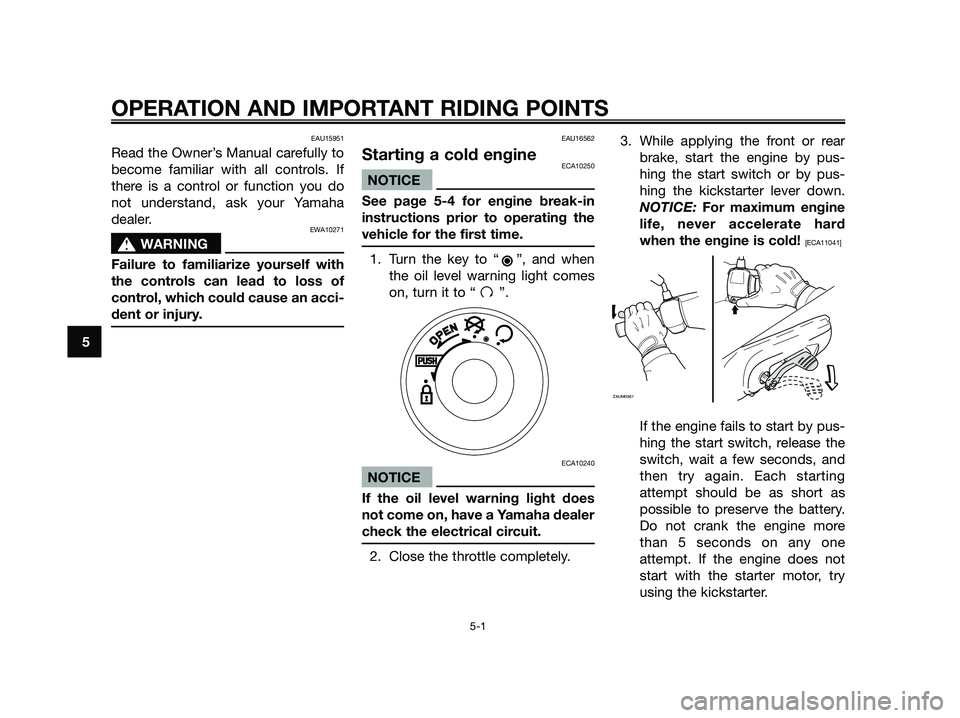
1. Turn the key to “ ”, and when
the oil level warning light comes
on, turn it to “ ”.
ECA10240
NOTICE
If the oil level warning light does
not come on, have a Yamaha dealer
check the electrical circuit.
2. Close the throttle completely.3. While applying the front or rear
brake, start the engine by pus-
hing the start switch or by pus-
hing the kickstarter lever down.
NOTICE: For maximum engine
life, never accelerate hard
when the engine is cold!
[ECA11041]
If the engine fails to start by pus-
hing the start switch, release the
switch, wait a few seconds, and
then try again. Each starting
attempt should be as short as
possible to preserve the battery.
Do not crank the engine more
than 5 seconds on any one
attempt. If the engine does not
start with the starter motor, try
using the kickstarter.
ZAUM0367
OPERATION AND IMPORTANT RIDING POINTS
5-1
5
Page 36 of 76
EAU16793
BrakingEWA10300
sWARNING
●Avoid braking hard or suddenly
(especially when leaning over
to one side), otherwise the sco-
oter may skid or overturn.
●Railroad crossings, streetcar
rails, iron plates on road cons-
truction sites, and manhole
covers become extremely slip-
pery when wet. Therefore, slow
down when approaching such
areas and cross them with cau-
tion.
●Keep in mind that braking on a
wet road is much more difficult.
●Ride slowly down a hill, as bra-
king downhill can be very diffi-
cult.
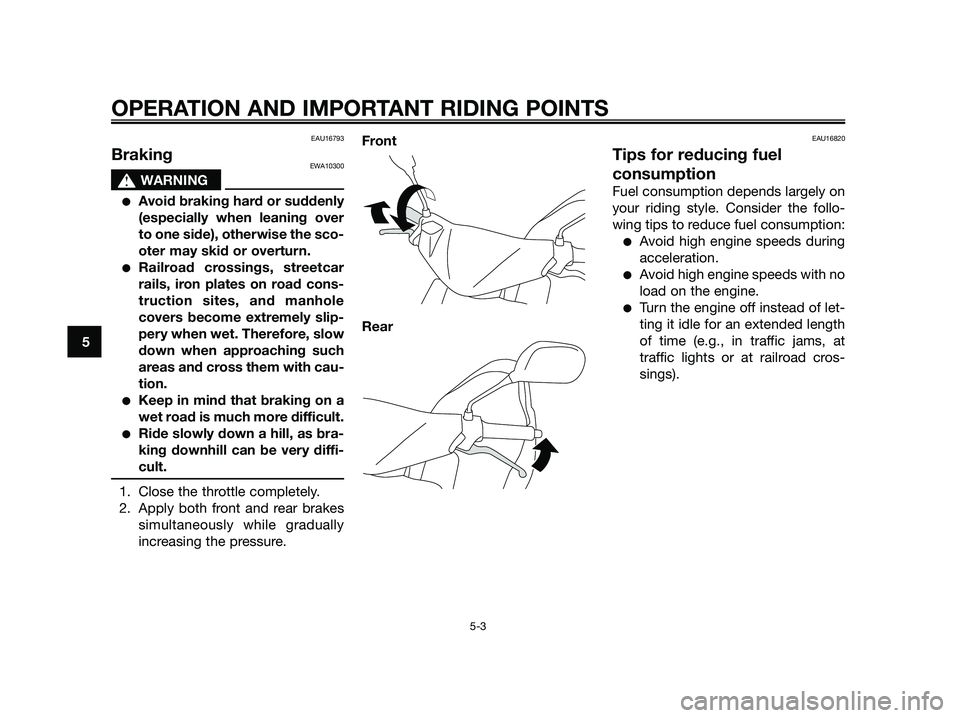
1. Close the throttle completely.
2. Apply both front and rear brakes
simultaneously while gradually
increasing the pressure.Front
Rear
EAU16820
Tips for reducing fuel
consumption
Fuel consumption depends largely on
your riding style. Consider the follo-
wing tips to reduce fuel consumption:
●Avoid high engine speeds during
acceleration.
●Avoid high engine speeds with no
load on the engine.
●Turn the engine off instead of let-
ting it idle for an extended length
of time (e.g., in traffic jams, at
traffic lights or at railroad cros-
sings).
OPERATION AND IMPORTANT RIDING POINTS
5-3
5
Page 37 of 76
EAU16830
Engine break-in
There is never a more important
period in the life of your engine than
the period between 0 and 1000 km
(600 mi). For this reason, you should
read the following material carefully.
Since the engine is brand new, do not
put an excessive load on it for the first
1000 km (600 mi). The various parts in
the engine wear and polish themsel-
ves to the correct operating clearan-
ces. During this period, prolonged
full-throttle operation or any condition
that might result in engine overhea-
ting must be avoided.
EAU17213
Parking
When parking, stop the engine, and
then remove the key from the main
switch.
EWA10311
sWARNING
●Since the engine and exhaust
system can become very hot,
park in a place where pedes-
trians or children are not likely
to touch them and be burned.
●Do not park on a slope or on
soft ground, otherwise the
vehicle may overturn, increa-
sing the risk of a fuel leak and
fire.
●Do not park near grass or other
flammable materials which
might catch fire.
OPERATION AND IMPORTANT RIDING POINTS
5-4
5
Page 38 of 76
EAU17281
Periodic inspection, adjustment, and
lubrication will keep your vehicle in
the safest and most efficient condi-
tion possible. Safety is an obligation
of the vehicle owner/operator. The
most important points of vehicle ins-
pection, adjustment, and lubrication
are explained on the following pages.
The intervals given in the periodic
maintenance and lubrication chart
should be simply considered as a
general guide under normal riding
conditions. However, depending on
the weather, terrain, geographical
location, and individual use, the main-
tenance intervals may need to be
shortened.
EWA10321
sWARNING
Failure to properly maintain the
vehicle or performing maintenance
activities incorrectly may increase
your risk of injury or death during
service or while using the vehicle. If
you are not familiar with vehicle
service, have a Yamaha dealer per-
form service.
EWA15121
sWARNING
Turn off the engine when perfor-
ming maintenance unless otherwi-
se specified.
●A running engine has moving
parts that can catch on body
parts or clothing and electrical
parts that can cause shocks or
fires.
●Running the engine while servi-
cing can lead to eye injury,
burns, fire, or carbon monoxide
poisoning – possibly leading to
death. See page 1-1 for more
information about carbon
monoxide.
EWA10330
sWARNING
This scooter is designed for use on
paved roads only. If this scooter is
operated in abnormally dusty,
muddy or wet conditions, the air fil-
ter element should be cleaned or
replaced more frequently, otherwi-
se rapid engine wear may result.
Consult a Yamaha dealer for proper
maintenance intervals.
PERIODIC MAINTENANCE AND ADJUSTMENT
6-1
6
Page 45 of 76
6. Refill with the specified amount
of the recommended final trans-
mission oil, and then install and
tighten the oil filler cap. WAR-
NING! Make sure that no
foreign material enters the final
transmission case. Make sure
that no oil gets on the tire or
wheel.
[EWA11311]
7. Check the final transmission case
for oil leakage. If oil is leaking,
check for the cause.
EAUS1200
Coolant (CS50Z)
The coolant level should be checked
before each ride. In addition, the coo-
lant must be changed at the intervals
specified in the periodic maintenance
and lubrication chart.
EAUM2102
To check the coolant level
1. Place the vehicle on a level surfa-
ce and hold it in an upright posi-
tion.
TIP
●The coolant level must be chec-
ked on a cold engine since the
level varies with engine tempera-
ture.
●Make sure that the vehicle is
positioned straight up when
checking the coolant level. A
slight tilt to the side can result in
a false reading.
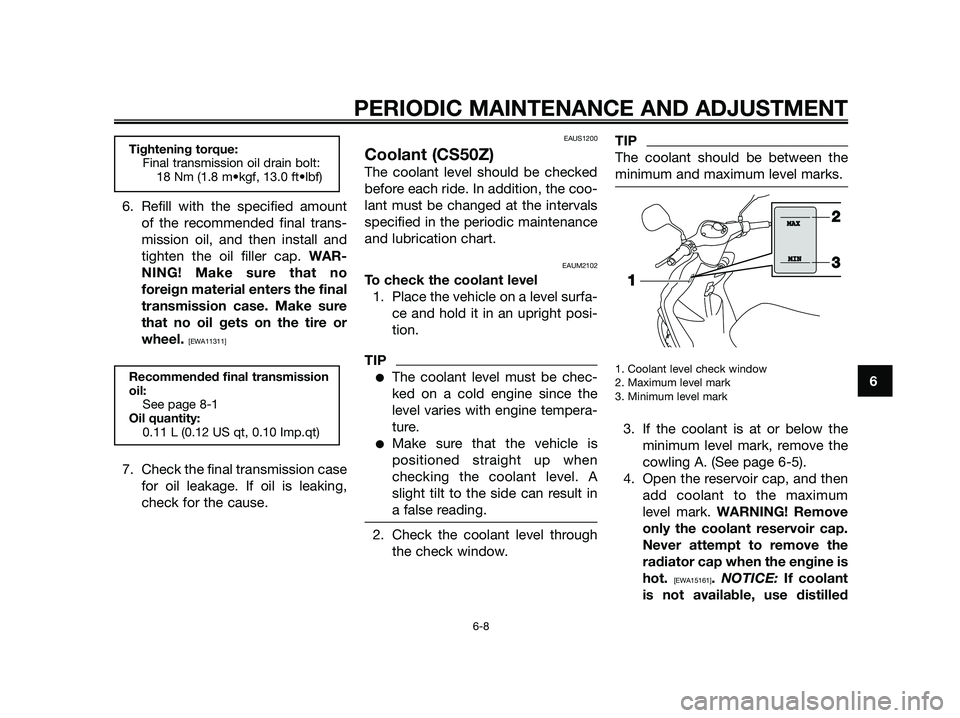
2. Check the coolant level through
the check window.
TIP
The coolant should be between the
minimum and maximum level marks.
1. Coolant level check window
2. Maximum level mark
3. Minimum level mark
3. If the coolant is at or below the
minimum level mark, remove the
cowling A. (See page 6-5).
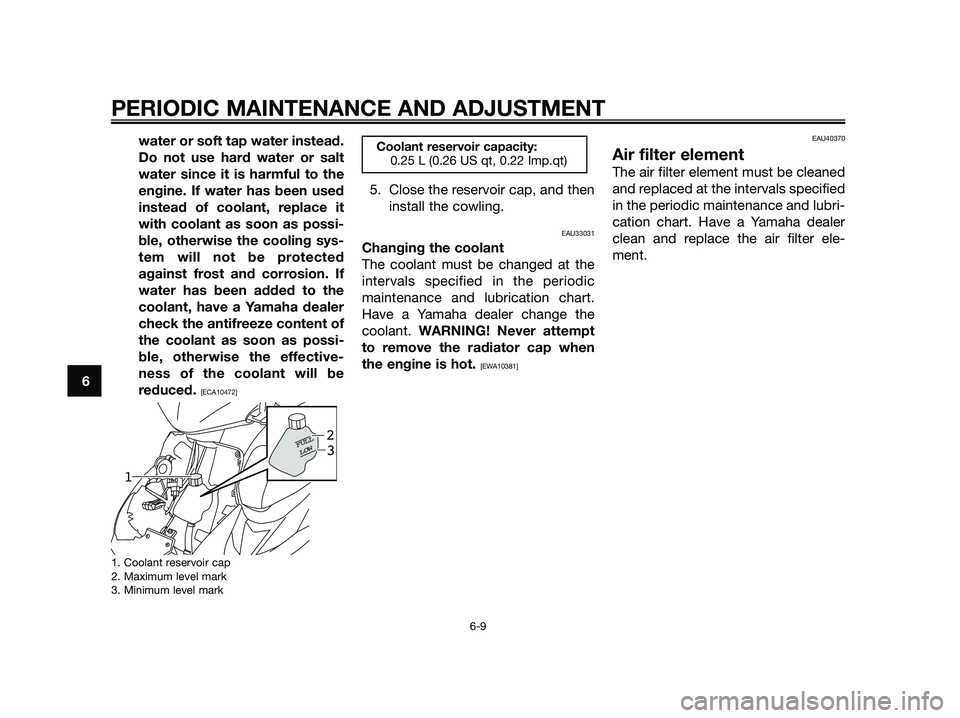
4. Open the reservoir cap, and then
add coolant to the maximum
level mark. WARNING! Remove
only the coolant reservoir cap.
Never attempt to remove the
radiator cap when the engine is
hot.
[EWA15161]. NOTICE: If coolant
is not available, use distilled
MAX
MIN2
3
1
Recommended final transmission
oil:
See page 8-1
Oil quantity:
0.11 L (0.12 US qt, 0.10 Imp.qt)
Tightening torque:
Final transmission oil drain bolt:
18 Nm (1.8 m•kgf, 13.0 ft•lbf)
PERIODIC MAINTENANCE AND ADJUSTMENT
6-8
6
Page 46 of 76
water or soft tap water instead.
Do not use hard water or salt
water since it is harmful to the
engine. If water has been used
instead of coolant, replace it
with coolant as soon as possi-
ble, otherwise the cooling sys-
tem will not be protected
against frost and corrosion. If
water has been added to the
coolant, have a Yamaha dealer
check the antifreeze content of
the coolant as soon as possi-
ble, otherwise the effective-
ness of the coolant will be
reduced.
[ECA10472]
1. Coolant reservoir cap
2. Maximum level mark
3. Minimum level mark
5. Close the reservoir cap, and then
install the cowling.
EAU33031
Changing the coolant
The coolant must be changed at the
intervals specified in the periodic
maintenance and lubrication chart.
Have a Yamaha dealer change the
coolant. WARNING! Never attempt
to remove the radiator cap when
the engine is hot.
[EWA10381]EAU40370
Air filter element
The air filter element must be cleaned
and replaced at the intervals specified
in the periodic maintenance and lubri-
cation chart. Have a Yamaha dealer
clean and replace the air filter ele-
ment.
Coolant reservoir capacity:
0.25 L (0.26 US qt, 0.22 Imp.qt)
1
2
3FULL
LOW
PERIODIC MAINTENANCE AND ADJUSTMENT
6-9
6
Page 48 of 76
EAU33601
Tires
To maximize the performance, durabi-
lity, and safe operation of your vehi-
cle, note the following points regar-
ding the specified tires.
Tire air pressure
The tire air pressure should be chec-
ked and, if necessary, adjusted befo-
re each ride.
EWA10501
sWARNING
Operation of this vehicle with
improper tire pressure may cause
severe injury or death from loss of
control.
●The tire air pressure must be
checked and adjusted on cold
tires (i.e., when the temperatu-re of the tires equals the
ambient temperature).
●The tire air pressure must be
adjusted in accordance with
the riding speed and with the
total weight of rider, passenger,
cargo, and accessories appro-
ved for this model.
EWA10511
sWARNING
Never overload your vehicle. Ope-
ration of an overloaded vehicle
could cause an accident.
Tire inspection
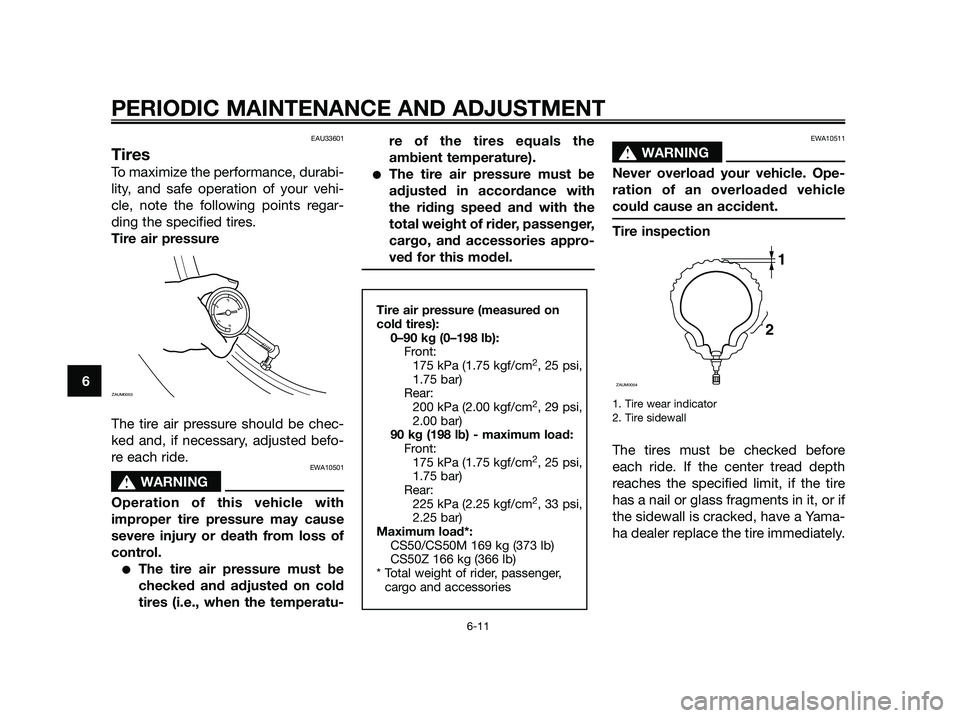
1. Tire wear indicator
2. Tire sidewall
The tires must be checked before
each ride. If the center tread depth
reaches the specified limit, if the tire
has a nail or glass fragments in it, or if
the sidewall is cracked, have a Yama-
ha dealer replace the tire immediately.
1
2
ZAUM0054
Tire air pressure (measured on
cold tires):
0–90 kg (0–198 lb):
Front:
175 kPa (1.75 kgf/cm
2, 25 psi,
1.75 bar)
Rear:
200 kPa (2.00 kgf/cm
2, 29 psi,
2.00 bar)
90 kg (198 lb) - maximum load:
Front:
175 kPa (1.75 kgf/cm
2, 25 psi,
1.75 bar)
Rear:
225 kPa (2.25 kgf/cm
2, 33 psi,
2.25 bar)
Maximum load*:
CS50/CS50M 169 kg (373 lb)
CS50Z 166 kg (366 lb)
* Total weight of rider, passenger,
cargo and accessories
ZAUM0053
PERIODIC MAINTENANCE AND ADJUSTMENT
6-11
6