lights YAMAHA KODIAK 700 2017 Owners Manual
[x] Cancel search | Manufacturer: YAMAHA, Model Year: 2017, Model line: KODIAK 700, Model: YAMAHA KODIAK 700 2017Pages: 178, PDF Size: 4.61 MB
Page 9 of 178

EBU17421
TABLE OF CONTENTS
LOCATION OF THE WARNING AND
SPECIFICATION LABELS .............................. 1-1
SAFETY INFORMATION ................................ 2-1
DESCRIPTION................................................ 3-1Left view ...................................................... 3-1
Right view.................................................... 3-1
Controls and instruments............................ 3-2
INSTRUMENT AND CONTROL
FUNCTIONS ................................................... 4-1 Main switch ................................................. 4-1
Indicator lights and warning lights .............. 4-2
Multi-function display (YFM70KPXH / YFM70KPHH / YFM70KPSH /
YFM70KPAH) ............................................ 4-6
Handlebar switches .................................... 4-9
Drive lever “2WD”/“4WD” (YFM70KDXH / YFM70KPXH / YFM70KPHH /
YFM70KPAH) .......................................... 4-15
Throttle lever ............................................. 4-16
Speed limiter ............................................. 4-17
Front brake lever ....................................... 4-18 Brake pedal and rear brake lever ............. 4-18
Drive select lever ...................................... 4-19
Fuel tank cap ............................................ 4-19
Fuel ........................................................... 4-19
Seat .......................................................... 4-21
Storage compartment............................... 4-22
Front carrier .............................................. 4-23
Rear carrier ............................................... 4-23
Adjusting the front and rear shock
absorber assemblies (YFM70KPXH /
YFM70KPHH / YFM70KPSH /
YFM70KPAH).......................................... 4-24
Trailer hitch (YFM70KPXH / YFM70KPHH / YFM70KPSH /
YFM70KPAH).......................................... 4-25
Auxiliary DC jack....................................... 4-26
PRE-OPERATION CHECKS .......................... 5-1 Fuel ............................................................. 5-3
Engine oil .................................................... 5-3
Final gear oil ............................................... 5-3
Differential gear oil ...................................... 5-3
Coolant ....................................................... 5-3
Front and rear brakes ................................. 5-3UB1661E0.book Page 1 Thursday, May 12, 2016 2:47 PM
Page 10 of 178

Throttle lever ............................................... 5-4
Tires ............................................................ 5-4
Chassis fasteners ........................................ 5-7
Instruments, lights and switches ................ 5-7
OPERATION ................................................... 6-1 Starting the engine ...................................... 6-1
Operating the drive select lever and driving in reverse ....................................... 6-2
Engine break-in ........................................... 6-4
Parking ........................................................ 6-5
Parking on a slope ...................................... 6-5
Accessories and loading ............................. 6-5
RIDING YOUR ATV ........................................ 7-1 GETTING TO KNOW YOUR ATV ................ 7-2
RIDE WITH CARE AND GOOD JUDGMENT .............................................. 7-2
BE CAREFUL WHERE YOU RIDE ............... 7-9
TURNING YOUR ATV................................ 7-12
CLIMBING UPHILL ................................... 7-13
RIDING DOWNHILL .................................. 7-16
CROSSING A SLOPE................................ 7-17
CROSSING THROUGH SHALLOW WATER .................................................... 7-18
RIDING OVER ROUGH TERRAIN ............. 7-20
SLIDING AND SKIDDING .......................... 7-21 WHAT TO DO IF... .................................... 7-22
WHAT TO DO... ........................................ 7-22
PERIODIC MAINTENANCE AND
ADJUSTMENT ............................................... 8-1 Owner’s manual and tool kit ....................... 8-2
Periodic maintenance chart for the emission control system ........................... 8-3
General maintenance and lubrication chart.......................................................... 8-5
Removing and installing panels .................. 8-9
Checking the spark plug........................... 8-17
Engine oil and oil filter cartridge ............... 8-20
Final gear oil ............................................. 8-24
Differential gear oil .................................... 8-27
Coolant ..................................................... 8-29
Cleaning the air filter element ................... 8-37
Cleaning the spark arrester ...................... 8-39
V-belt case drain plug............................... 8-41
Adjusting the throttle lever free play ......... 8-41
Valve clearance......................................... 8-42
Brakes....................................................... 8-42
Checking the front brake pads and rear brake friction plates ................................ 8-42
Checking the brake fluid level .................. 8-44
Changing the brake fluid .......................... 8-45
Checking the front brake lever free play... 8-45
UB1661E0.book Page 2 Thursday, May 12, 2016 2:47 PM
Page 26 of 178

2-3
2technique described in this manual on level
ground. Avoid crossing the side of a steep hill if
possible.
Always use proper procedures if you stall or roll
backwards when climbing a hill. To avoid stall-
ing, use the proper gear range and maintain a
steady speed when climbing a hill. If you stall or
roll backwards, follow the special procedure for
braking described in this manual. Dismount on
the uphill side or to a side if pointed straight up-
hill. Turn the ATV around and remount, following
the procedure described in this manual.
Always check for obstacles before operating in
a new area.
Never attempt to operate over large obstacles,
such as large rocks or fallen trees. Always follow
proper procedures when operating over obsta-
cles as described in this manual.
Always be careful when skidding or sliding.
Learn to safely control skidding or sliding by
practicing at low speeds and on level, smooth
terrain. On extremely slippery surfaces, such as
ice, go slowly and be very cautious in order to
reduce the chance of skidding or sliding out of
control.
Never operate an ATV in fast flowing water or in
water deeper than that recommended in this
manual. Remember that wet brakes may have
reduced stopping ability. Test your brakes after
leaving water. If necessary, apply them several
times to let friction dry out the linings.
Always be sure there are no obstacles or people
behind you when you operate in reverse. When
it is safe to proceed in reverse, go slowly.
Always use the size and type of tires specified in
this manual.
Always maintain proper tire pressure as de-
scribed in this manual.
Never exceed the stated load capacity for an
ATV. Cargo should be properly distributed and
securely attached. Reduce speed and follow in-
structions in this manual for carrying cargo or
pulling a trailer. Allow greater distance for brak-
ing.
Do not operate your ATV during darkness un-
less it is equipped with a properly functioning
headlight. Off-road riding is inherently danger-
ous and additionally, off-road trails do not have
streetlights to guide you.
UB1661E0.book Page 3 Thursday, May 12, 2016 2:47 PM
Page 27 of 178

2-4
2
Never maintain an ATV without proper knowl-
edge. Contact an authorized ATV dealer to in-
form you on basic ATV maintenance. Certain
maintenance can only be carried out by certified
staff.
In the event of an accident 1. If serious injuries are incurred, you may be safer staying next to your vehicle; it may
shield you from oncoming riders. Depending
on your injuries and position in the trail; you
must make a judgment call as to whether you
should move to a position off the trail. If you
have sustained head, neck, or back injuries,
or cannot feel your limbs, you should not
move. Keep your helmet on and remain mo-
tionless. Lie down next to your vehicle and
wait for help.
2. If less serious injuries are incurred and you can walk, then move to a position off the trail.
Check yourself for injuries and apply first aid
as needed.
3. If your injuries are light, when safe to do so, move your vehicle off the trail to avoid colli-
sions with oncoming riders. Check for injuries
and apply first aid as necessary. If you can
physically operate your vehicle, inspect your vehicle. If the vehicle is in safe operating con-
dition and you can safely operate it, restart it
and ride gently back to camp or other known
location where you can receive medical at-
tention. If necessary, contact your riding party
or local authorities to let them know where
you are and what has happened.
In the event of a breakdown 1. If your vehicle will not restart or is not in safe operating condition, turn off the main switch
and engine stop switch. If the breakdown oc-
curs at twilight or night, leave the main switch
on so that your lights may warn other riders of
your stopped vehicle.
2. Get out of danger. Check for oncoming vehi- cles and when safe, push your vehicle to the
side of the trail or even off the main trail to
avoid any possible collisions with oncoming
riders. If you cannot move your vehicle by
yourself, when safe, walk to the nearest van-
tage point and signal an oncoming rider to
help you push your vehicle to a safe place off
the trail.
3. Inspect your vehicle for any immediate haz- ardous conditions. The most obvious hazard-
ous conditions are leaking fuel and
UB1661E0.book Page 4 Thursday, May 12, 2016 2:47 PM
Page 28 of 178

2-5
2ungrounded or broken wiring. Visually check
for broken wiring and leaking fuel. Leaking
fuel can be confirmed by the odor of gasoline.
4. Once immediate safety hazards are con- firmed not to exist, you may remove your hel-
met to more closely inspect your vehicle.
Check for external signs of wear, broken
parts, fluid leaks, cracks in the frame, sus-
pension damage, wheel damage, and so on.
Fuel, oil, and coolant usually give off a notice-
able odor.
5. If your vehicle will not restart or if it is unsafe to ride, then turn off all vehicle systems (en-
gine stop switch, main switch, and fuel cock),
and then signal or go for help.
Aftermarket Parts, Accessories, and Modifica-
tions
While you may find aftermarket products similar in
design and quality to genuine Yamaha accesso-
ries, recognize that some aftermarket accessories
or modifications are not suitable because of po-
tential safety hazards to you or others. Installing
aftermarket products or having other modifica-
tions performed to your vehicle that change any of
the vehicle’s design or operation characteristics
can put you and others at greater risk of serious injury or death. You are responsible for injuries re-
lated to changes in the vehicle. Keep the following
guidelines in mind, as well as those provided un-
der “Loading” when mounting accessories.
Never install accessories that would impair the
performance of your ATV. Carefully inspect the
accessory before using it to make sure that it
does not in any way reduce ground clearance,
limit suspension travel, steering travel or control
operation.
Accessories fitted to the ATV can create insta-
bility due to improper weight distribution.
Bulky or large accessories may seriously affect
the stability of the ATV.
Certain accessories can displace the operator
from his or her normal riding position. This im-
proper position limits the freedom of movement
of the operator and may limit control ability,
therefore, such accessories are not recom-
mended.
Use caution when adding electrical accesso-
ries. If electrical accessories exceed the capac-
ity of the ATV’s electrical system, an electric
failure could result, which could cause a dan-
gerous loss of lights or engine power.
UB1661E0.book Page 5 Thursday, May 12, 2016 2:47 PM
Page 31 of 178
3-2
3
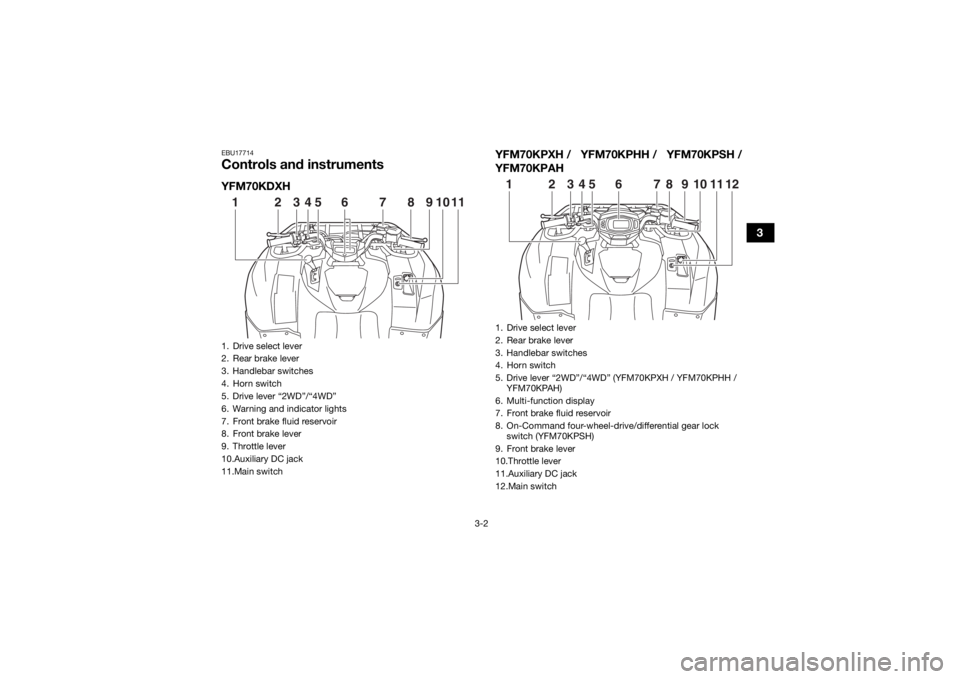
EBU17714Controls and instrumentsYFM70KDXHYFM70KPXH / YFM70KPHH / YFM70KPSH /
YFM70KPAH1. Drive select lever
2. Rear brake lever
3. Handlebar switches
4. Horn switch
5. Drive lever “2WD”/“4WD”
6. Warning and indicator lights
7. Front brake fluid reservoir
8. Front brake lever
9. Throttle lever
10.Auxiliary DC jack
11.Main switch123
4 5 6 7 8 9 10 11
1. Drive select lever
2. Rear brake lever
3. Handlebar switches
4. Horn switch
5. Drive lever “2WD”/“4WD” (YFM70KPXH / YFM70KPHH /
YFM70KPAH)
6. Multi-function display
7. Front brake fluid reservoir
8. On-Command four-wheel-drive/differential gear lock switch (YFM70KPSH)
9. Front brake lever
10.Throttle lever
11.Auxiliary DC jack
12.Main switch123 67
8 9 10 11 12
45
UB1661E0.book Page 2 Thursday, May 12, 2016 2:47 PM
Page 33 of 178
4-1
4
EBU17738
INSTRUMENT AND CONTROL FUNCTIONS
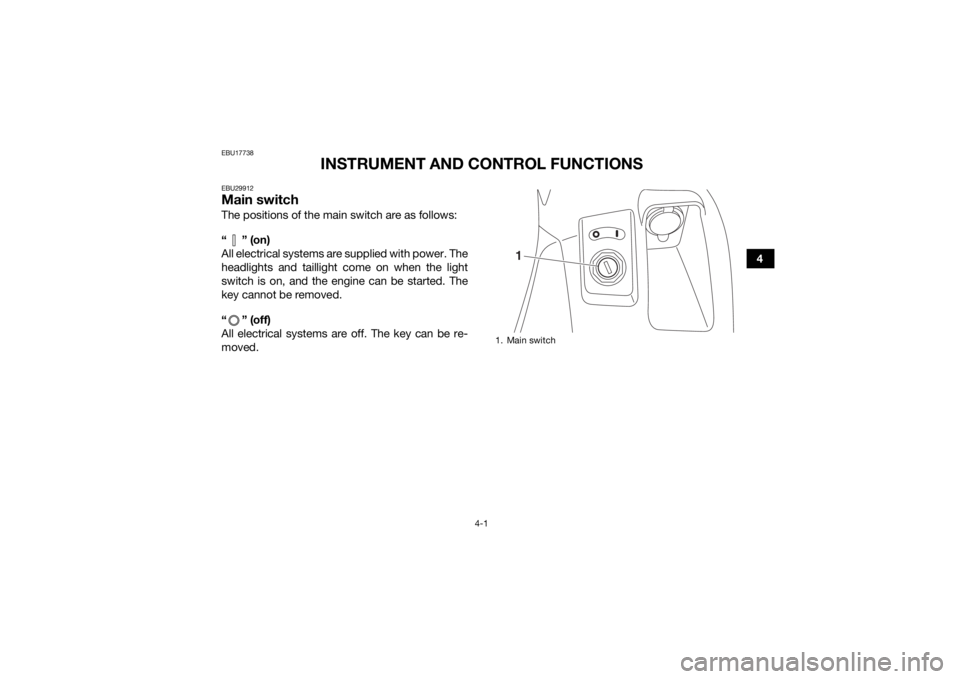
EBU29912Main switchThe positions of the main switch are as follows:
“” (on)
All electrical systems are supplied with power. The
headlights and taillight come on when the light
switch is on, and the engine can be started. The
key cannot be removed.
“ ” (off)
All electrical systems are off. The key can be re-
moved.
1. Main switch
1
UB1661E0.book Page 1 Thursday, May 12, 2016 2:47 PM
Page 34 of 178
4-2
4
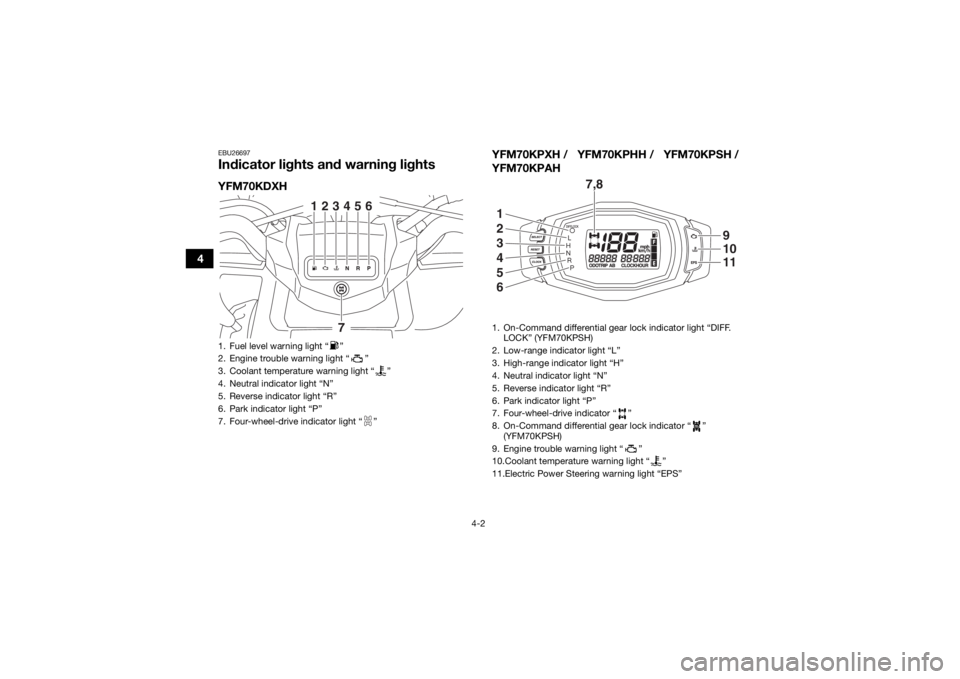
EBU26697Indicator lights and warning lightsYFM70KDXHYFM70KPXH / YFM70KPHH / YFM70KPSH /
YFM70KPAH1. Fuel level warning light “ ”
2. Engine trouble warning light “ ”
3. Coolant temperature warning light “ ”
4. Neutral indicator light “N”
5. Reverse indicator light “R”
6. Park indicator light “P”
7. Four-wheel-drive indicator light “ ”
123456
7
1. On-Command differential gear lock indicator light “DIFF.
LOCK” (YFM70KPSH)
2. Low-range indicator light “L”
3. High-range indicator light “H”
4. Neutral indicator light “N”
5. Reverse indicator light “R”
6. Park indicator light “P”
7. Four-wheel-drive indicator “ ”
8. On-Command differential gear lock indicator “ ” (YFM70KPSH)
9. Engine trouble warning light “ ”
10.Coolant temperature warning light “ ”
11.Electric Power Steering warning light “EPS”
7,8
1
2
3
4
5
6
91011
UB1661E0.book Page 2 Thursday, May 12, 2016 2:47 PM
Page 42 of 178
4-10
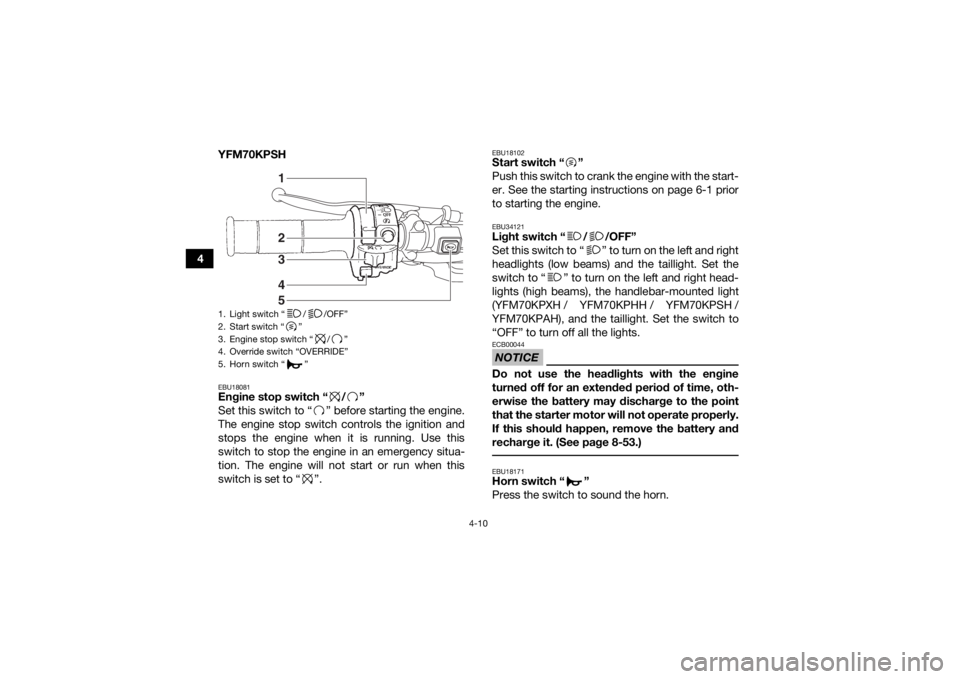
4YFM70KPSH
EBU18081Engine stop switch “ / ”
Set this switch to “ ” before starting the engine.
The engine stop switch controls the ignition and
stops the engine when it is running. Use this
switch to stop the engine in an emergency situa-
tion. The engine will not start or run when this
switch is set to “ ”.
EBU18102Start switch “ ”
Push this switch to crank the engine with the start-
er. See the starting instructions on page 6-1 prior
to starting the engine.EBU34121Light switch “ / /OFF”
Set this switch to “ ” to turn on the left and right
headlights (low beams) and the taillight. Set the
switch to “ ” to turn on the left and right head-
lights (high beams), the handlebar-mounted light
(YFM70KPXH / YFM70KPHH / YFM70KPSH /
YFM70KPAH), and the taillight. Set the switch to
“OFF” to turn off all the lights.NOTICEECB00044Do not use the headlights with the engine
turned off for an extended period of time, oth-
erwise the battery may discharge to the point
that the starter motor will not operate properly.
If this should happen, remove the battery and
recharge it. (See page 8-53.) EBU18171Horn switch “ ”
Press the switch to sound the horn.
1. Light switch “ / /OFF”
2. Start switch “ ”
3. Engine stop switch “ / ”
4. Override switch “OVERRIDE”
5. Horn switch “ ”
41325
UB1661E0.book Page 10 Thursday, May 12, 2016 2:47 PM
Page 52 of 178
4-20
4of sparks, open flames, or other sources of
ignition such as the pilot lights of water heat-
ers and clothes dryers.
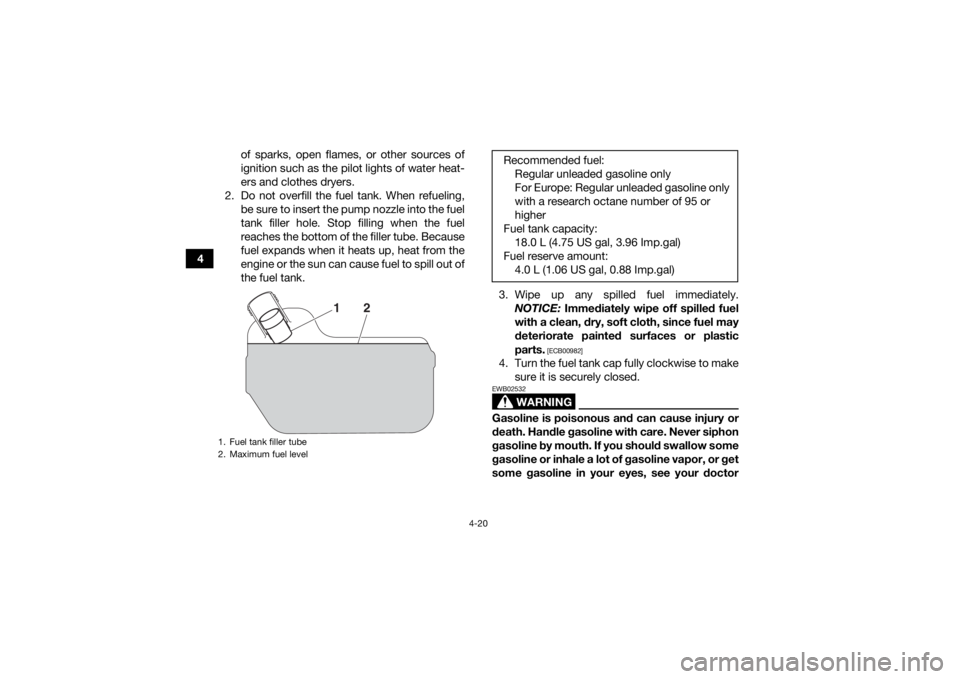
2. Do not overfill the fuel tank. When refueling, be sure to insert the pump nozzle into the fuel
tank filler hole. Stop filling when the fuel
reaches the bottom of the filler tube. Because
fuel expands when it heats up, heat from the
engine or the sun can cause fuel to spill out of
the fuel tank.
3. Wipe up any spilled fuel immediately.NOTICE: Immediately wipe off spilled fuel
with a clean, dry, soft cloth, since fuel may
deteriorate painted surfaces or plastic
parts.
[ECB00982]
4. Turn the fuel tank cap fully clockwise to make sure it is securely closed.
WARNING
EWB02532Gasoline is poisonous and can cause injury or
death. Handle gasoline with care. Never siphon
gasoline by mouth. If you should swallow some
gasoline or inhale a lot of gasoline vapor, or get
some gasoline in your eyes, see your doctor
1. Fuel tank filler tube
2. Maximum fuel level
2
1
Recommended fuel:Regular unleaded gasoline only
For Europe: Regular unleaded gasoline only
with a research octane number of 95 or
higher
Fuel tank capacity: 18.0 L (4.75 US gal, 3.96 Imp.gal)
Fuel reserve amount: 4.0 L (1.06 US gal, 0.88 Imp.gal)
UB1661E0.book Page 20 Thursday, May 12, 2016 2:47 PM