tires YAMAHA KODIAK 700 2019 Owners Manual
[x] Cancel search | Manufacturer: YAMAHA, Model Year: 2019, Model line: KODIAK 700, Model: YAMAHA KODIAK 700 2019Pages: 180, PDF Size: 6.41 MB
Page 9 of 180

EBU17421
TABLE OF CONTENTS
LOCATION OF THE WARNING AND
SPECIFICATION LABELS .............................. 1-1
SAFETY INFORMATION ................................ 2-1
DESCRIPTION................................................ 3-1Left view ...................................................... 3-1
Right view.................................................... 3-1
Controls and instruments............................ 3-2
INSTRUMENT AND CONTROL
FUNCTIONS ................................................... 4-1 Main switch ................................................. 4-1
Indicator lights and warning lights .............. 4-1
Multi-function display (YFM70KPXK / YFM70KPAK / YFM70KPHK /
YFM70KPSK / YFM70KPLK) .................... 4-6
Handlebar switches .................................. 4-12
Drive lever “2WD/4WD” (YFM70KDXK / YFM70KDHK) .......................................... 4-17
Throttle lever ............................................. 4-18
Speed limiter ............................................. 4-19
Front brake lever ....................................... 4-19
Brake pedal and rear brake lever .............. 4-20 Drive select lever ...................................... 4-21
Fuel tank cap ............................................ 4-21
Fuel ........................................................... 4-22
Seat .......................................................... 4-24
Storage compartment............................... 4-25
Front carrier .............................................. 4-26
Rear carrier ............................................... 4-26
Front and rear shock absorbers
(YFM70KPXK / YFM70KPAK /
YFM70KPHK / YFM70KPSK /
YFM70KPLK) .......................................... 4-26
Trailer hitch .............................................. 4-28
Auxiliary DC jack....................................... 4-29
PRE-OPERATION CHECKS .......................... 5-1 Fuel ............................................................. 5-3
Engine oil .................................................... 5-3
Final gear oil ............................................... 5-3
Differential gear oil ...................................... 5-3
Coolant ....................................................... 5-3
Front and rear brakes ................................. 5-3
Throttle lever ............................................... 5-4
Tires ............................................................ 5-4
Chassis fasteners ....................................... 5-7UB5K60E0.book Page 1 Monday, May 28, 2018 11:35 AM
Page 18 of 180
1-7
1
E10E5
**.* kPa
*.** kgf/cm²
*.* psi **.* kPa
*.** kgf/cm²
*.* psi
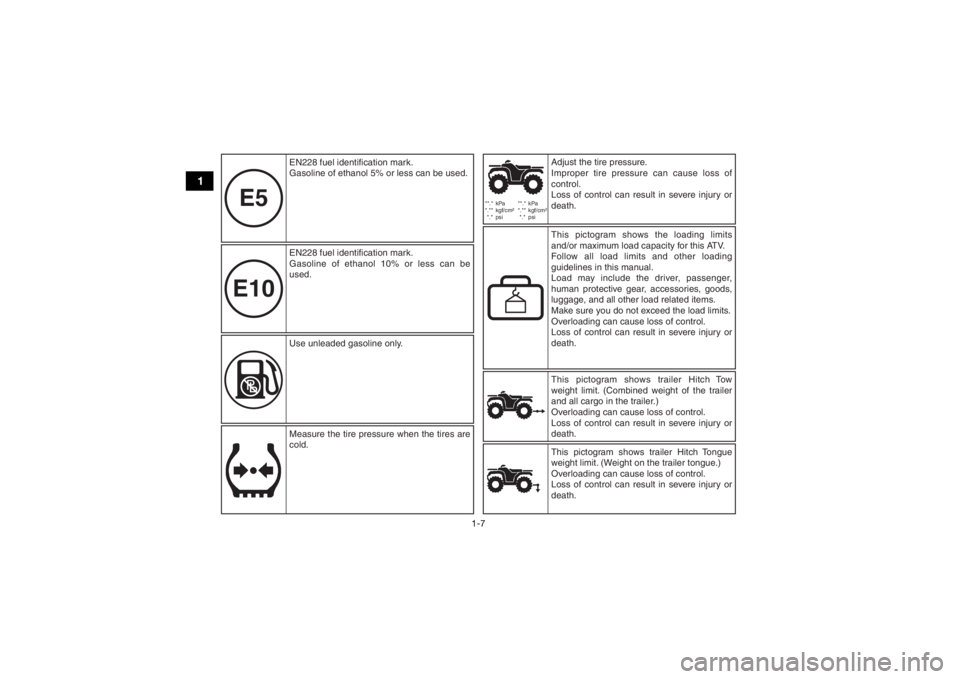
This pictogram shows trailer Hitch Tow
weight limit. (Combined weight of the trailer
and all cargo in the trailer.)
Overloading can cause loss of control.
Loss of control can result in severe injury or
death.
EN228 fuel identification mark.
Gasoline of ethanol 10% or less can be
used. EN228 fuel identification mark.
Gasoline of ethanol 5% or less can be used.
Use unleaded gasoline only.
Measure the tire pressure when the tires are
cold. Adjust the tire pressure.
Improper tire pressure can cause loss of
control.
Loss of control can result in severe injury or
death.
This pictogram shows the loading limits
and/or maximum load capacity for this ATV.
Follow all load limits and other loading
guidelines in this manual.
Load may include the driver, passenger,
human protective gear, accessories, goods,
luggage, and all other load related items.
Make sure you do not exceed the load limits.
Overloading can cause loss of control.
Loss of control can result in severe injury or
death.
This pictogram shows trailer Hitch Tongue
weight limit. (Weight on the trailer tongue.)
Overloading can cause loss of control.
Loss of control can result in severe injury or
death.
UB5K60E0.book Page 7 Monday, May 28, 2018 11:35 AM
Page 22 of 180
1-11
1
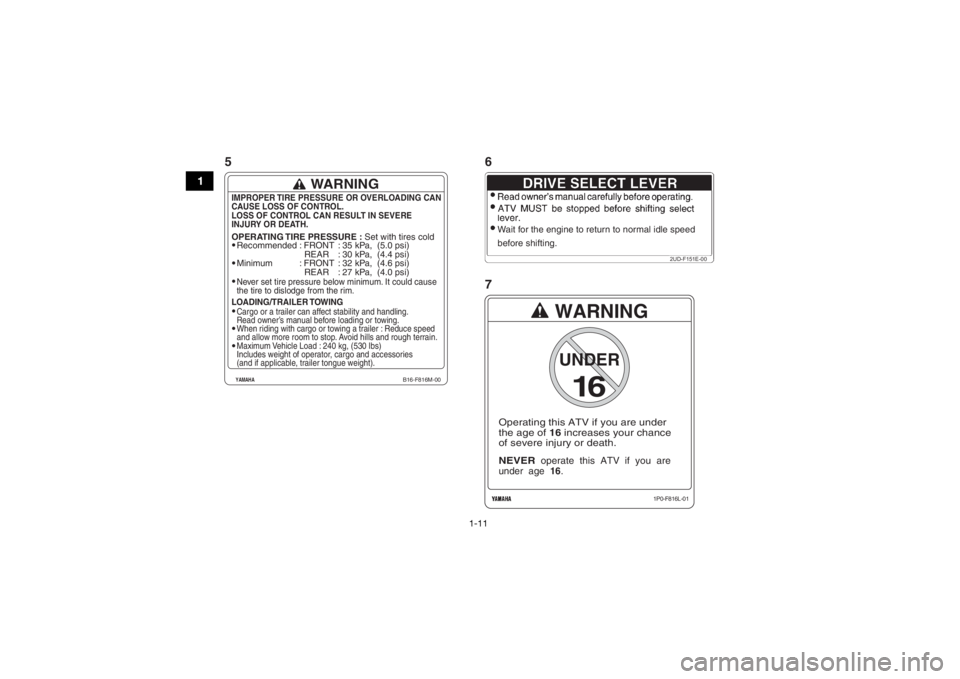
Recommended
Minimum: FRONT
REAR
: FRONT
REAR: 35 kPa, (5.0 psi)
: 30 kPa, (4.4 psi)
: 32 kPa, (4.6 psi)
: 27 kPa, (4.0 psi)Never set tire pressure below minimum. It could cause
the tire to dislodge from the rim.Cargo or a trailer can affect stability and handling.
Read owner’s manual before loading or towing.
When riding with cargo or towing a trailer : Reduce speed
and allow more room to stop. Avoid hills and rough terrain.
Maximum Vehicle Load : 240 kg, (530 lbs)
Includes weight of operator, cargo and accessories
(and if applicable, trailer tongue weight).
WARNING
B16-F816M-00
YAMAHAIMPROPER TIRE PRESSURE OR OVERLOADING CAN
CAUSE LOSS OF CONTROL.
LOSS OF CONTROL CAN RESULT IN SEVERE
INJURY OR DEATH.OPERATING TIRE PRESSURE : Set with tires coldLOADING/TRAILER TOWING
WARNING
NEVER
operate this ATV if you are
under age 16.Operating this ATV if you are under
the age of 16 increases your chance
of severe injury or death.
16
UNDER
1P0-F816L-01
Wait for the engine to return to normal idle speed
before shifting.
2UD-F151E-00
56
7UB5K60E0.book Page 11 Monday, May 28, 2018 11:35 AM
Page 26 of 180

2-3
2technique described in this manual on level
ground. Avoid crossing the side of a steep hill if
possible.
Always use proper procedures if you stall or roll
backwards when climbing a hill. To avoid stall-
ing, use the proper gear range and maintain a
steady speed when climbing a hill. If you stall or
roll backwards, follow the special procedure for
braking described in this manual. Dismount on
the uphill side or to a side if pointed straight up-
hill. Turn the ATV around and remount, following
the procedure described in this manual.
Always check for obstacles before operating in
a new area.
Never attempt to operate over large obstacles,
such as large rocks or fallen trees. Always follow
proper procedures when operating over obsta-
cles as described in this manual.
Always be careful when skidding or sliding.
Learn to safely control skidding or sliding by
practicing at low speeds and on level, smooth
terrain. On extremely slippery surfaces, such as
ice, go slowly and be very cautious in order to
reduce the chance of skidding or sliding out of
control.
Never operate an ATV in fast flowing water or in
water deeper than that recommended in this
manual. Remember that wet brakes may have
reduced stopping ability. Test your brakes after
leaving water. If necessary, apply them several
times to let friction dry out the linings.
Always be sure there are no obstacles or people
behind you when you operate in reverse. When
it is safe to proceed in reverse, go slowly.
Always use the size and type of tires specified in
this manual.
Always maintain proper tire pressure as de-
scribed in this manual.
Never exceed the stated load capacity for an
ATV. Cargo should be properly distributed and
securely attached. Reduce speed and follow in-
structions in this manual for carrying cargo or
pulling a trailer. Allow greater distance for brak-
ing.
Do not operate your ATV during darkness un-
less it is equipped with a properly functioning
headlight. Off-road riding is inherently danger-
ous and additionally, off-road trails do not have
streetlights to guide you.
UB5K60E0.book Page 3 Monday, May 28, 2018 11:35 AM
Page 63 of 180

5-2
5
Front brake• Check operation. If soft or spongy, have Yamaha dealer bleed hy-
draulic system.
• Check brake pads for wear, and replace if necessary.
• Check brake fluid level in reservoir, and add specified brake fluid to specified level if necessary.
• Check hydraulic system for leakage. Correct if necessary. 5-3, 8-42, 8-43, 8-44
Rear brake • Check operation, and correct if necessary.
• Lubricate cables if necessary.
• Check lever and pedal free play, and adjust if necessary. 5-3, 8-42, 8-44
Throttle lever • Make sure that operation is smooth. Lubricate cable and lever
housing if necessary.
• Check lever free play, and adjust if necessary. 5-4, 8-41
Control cables • Make sure that operation is smooth. Lubricate if necessary. 8-48
Wheels and tires • Check wheel condition, and replace if damaged.
• Check tire condition and tread depth. Replace if necessary.
• Check air pressure. Correct if necessary. 5-4
Brake pedal • Make sure that operation is smooth. Lubricate pedal pivoting point
if necessary. 8-50
Brake levers • Make sure that operation is smooth. Lubricate lever pivoting points
if necessary. 8-49
Axle boots • Check for cracks or damage, and replace if necessary. 8-47
Chassis fasteners • Make sure that all nuts, bolts and screws are properly tightened. 5-7
Instruments, lights and
switches • Check operation, and correct if necessary. 5-7
ITEM ROUTINE PAGE
UB5K60E0.book Page 2 Monday, May 28, 2018 11:35 AM
Page 65 of 180
5-4
5
Brake fluid leakage (front brake)
Check to see if any brake fluid is leaking out of the
hose, joint or brake fluid reservoir of the front
brake. Apply the brake firmly for one minute. If the
lever moves slowly inward, there may be a leak in
the brake system. If there is any leakage, the brake
system should be checked by a Yamaha dealer.
Brake operation
Test the brakes at slow speed after starting out to
make sure they are working properly. If the brakes
do not provide proper braking performance,
check the brake pads and friction plates for wear.
(See page 8-42.)
EBU19762Throttle leverCheck the operation of the throttle lever. It must
open smoothly and spring back to the idle position
when released. Have a Yamaha dealer correct if
necessary.EBU38062TiresCheck and adjust the tire pressure before each
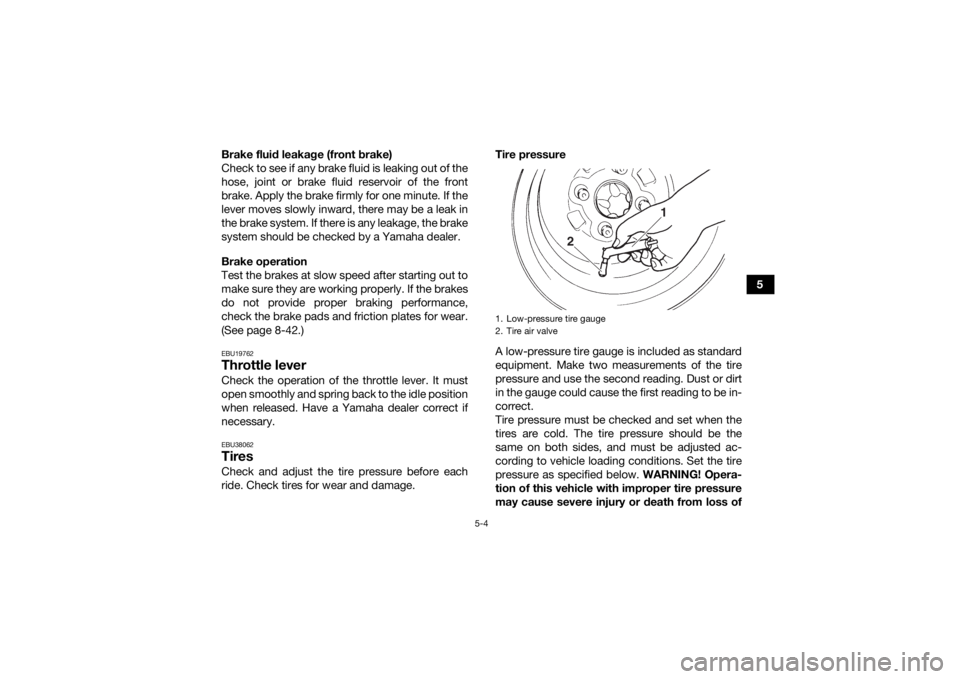
ride. Check tires for wear and damage. Tire pressure
A low-pressure tire gauge is included as standard
equipment. Make two measurements of the tire
pressure and use the second reading. Dust or dirt
in the gauge could cause the first reading to be in-
correct.
Tire pressure must be checked and set when the
tires are cold. The tire pressure should be the
same on both sides, and must be adjusted ac-
cording to vehicle loading conditions. Set the tire
pressure as specified below.
WARNING! Opera-
tion of this vehicle with improper tire pressure
may cause severe injury or death from loss of
1. Low-pressure tire gauge
2. Tire air valve
2
1
UB5K60E0.book Page 4 Monday, May 28, 2018 11:35 AM
Page 67 of 180
5-6
5
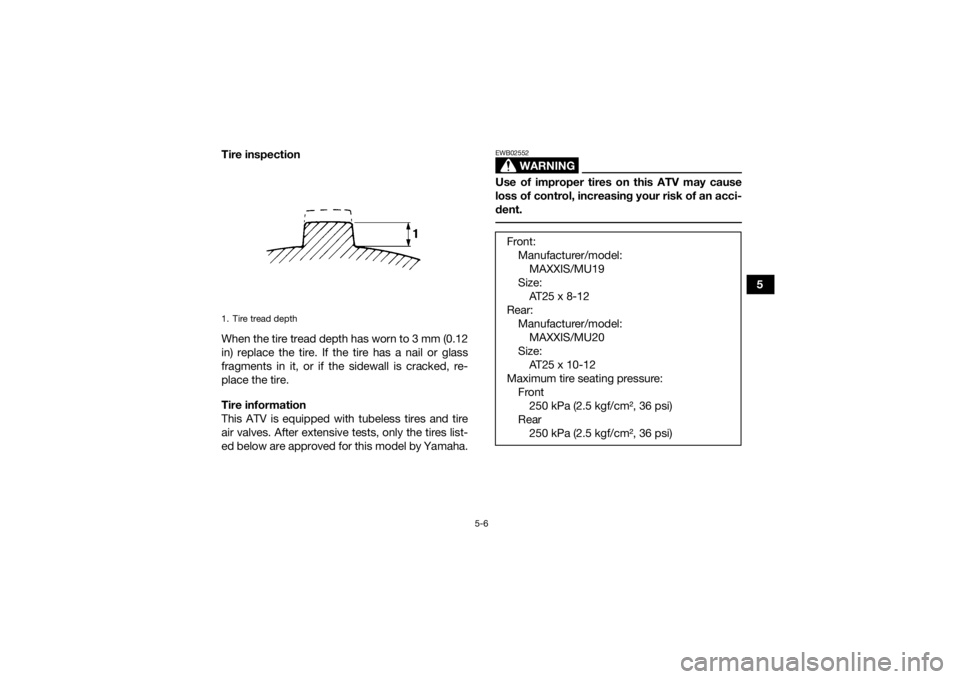
Tire inspection
When the tire tread depth has worn to 3 mm (0.12
in) replace the tire. If the tire has a nail or glass
fragments in it, or if the sidewall is cracked, re-
place the tire.
Tire information
This ATV is equipped with tubeless tires and tire
air valves. After extensive tests, only the tires list-
ed below are approved for this model by Yamaha.
WARNING
EWB02552Use of improper tires on this ATV may cause
loss of control, increasing your risk of an acci-
dent.
1. Tire tread depth
Front:
Manufacturer/model:MAXXIS/MU19
Size: AT25 x 8-12
Rear: Manufacturer/model:MAXXIS/MU20
Size: AT25 x 10-12
Maximum tire seating pressure: Front250 kPa (2.5 kgf/cm², 36 psi)
Rear 250 kPa (2.5 kgf/cm², 36 psi)
UB5K60E0.book Page 6 Monday, May 28, 2018 11:35 AM
Page 68 of 180

5-7
5Aftermarket tires and rims
The tires and rims that came with your ATV were
designed to match the performance capabilities
and to provide the best combination of handling,
braking, and comfort. Other tires, rims, sizes, and
combinations may not be appropriate.
EBU19841Chassis fastenersMake sure that all nuts, bolts and screws are
properly tightened.EBU19851Instruments, lights and switchesCheck that all instruments, lights and switches are
working properly. Correct if necessary.UB5K60E0.book Page 7 Monday, May 28, 2018 11:35 AM
Page 87 of 180
7-12
7
Select a large, flat, unpaved area to become famil-
iar with your ATV. Make sure that this area is free
of obstacles and other riders. You should practice
control of the throttle, brakes, shifting procedures,
and turning techniques in this area before trying
more difficult terrain.
Shift to the park position and follow the instruction
on page 6-1 to start the engine. Once it has
warmed up you are ready to begin riding your
ATV. With the engine idling, shift the drive select
lever into the low-range position or the high-range
position. Apply the throttle slowly and smoothly.
The centrifugal clutch will engage and you will
start to accelerate. If the throttle is applied too
abruptly, the front wheels may lift off the ground,
resulting in a loss of directional control. Avoid
higher speeds until you are thoroughly familiar
with the operation of your ATV.
When slowing down or stopping, release the
throttle and apply the brakes smoothly and evenly.
Improper use of the brakes can cause the tires to
lose traction, reducing control and increasing the
possibility of an accident.
NOTICEECB00252Do not shift from low-range to high-range or
vice versa without coming to a complete stop.
Damage to the engine or drive train may occur. TURNING YOUR ATV
WARNING
EWB01772Always follow proper procedures for turning as
described in this Owner’s Manual. Practice
turning at low speeds before attempting to turn
at faster speeds. Do not turn at speeds too fast
for your skills or the conditions. ATV could go
out of control, causing a collision or overturn. To achieve maximum traction on unpaved surfac-
es, the two rear wheels turn together at the same
speed. Therefore, unless the wheel on the inside
of the turn is allowed to slip or lose some traction,
the ATV will resist turning. A special turning tech-
nique must be used to allow the ATV to make
turns quickly and easily. It is essential that this skill
be learned first at low speed.
UB5K60E0.book Page 12 Monday, May 28, 2018 11:35 AM
Page 94 of 180
7-19
7than the depth specified in your Owner’s Man-
ual, as tires may float, increasing the risk of an
overturn.
The ATV can be used to cross slow moving, shal-
low water of up to a maximum of 35 cm (14 in) in
depth. Before entering the water, choose your
path carefully. Enter where there is no sharp drop
off, and avoid rocks or other obstacles which may
be slippery or upset the ATV. Drive slowly and
carefully.
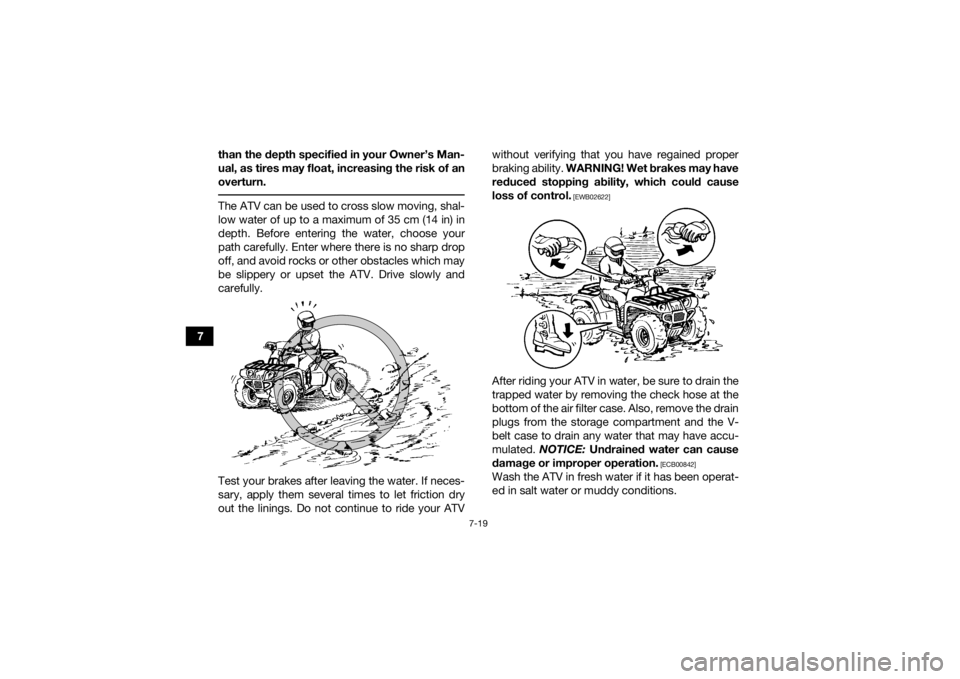
Test your brakes after leaving the water. If neces-
sary, apply them several times to let friction dry
out the linings. Do not continue to ride your ATV without verifying that you have regained proper
braking ability. WARNING! Wet brakes may have
reduced stopping ability, which could cause
loss of control.
[EWB02622]
After riding your ATV in water, be sure to drain the
trapped water by removing the check hose at the
bottom of the air filter case. Also, remove the drain
plugs from the storage compartment and the V-
belt case to drain any water that may have accu-
mulated.
NOTICE: Undrained water can cause
damage or improper operation.
[ECB00842]
Wash the ATV in fresh water if it has been operat-
ed in salt water or muddy conditions.
UB5K60E0.book Page 19 Monday, May 28, 2018 11:35 AM