light YAMAHA KODIAK 700 2022 Owner's Manual
[x] Cancel search | Manufacturer: YAMAHA, Model Year: 2022, Model line: KODIAK 700, Model: YAMAHA KODIAK 700 2022Pages: 174, PDF Size: 4.74 MB
Page 58 of 174

5-31
5
NOTICEECB00122If accessories are used with the engine off or
with the headlights on, the battery may dis-
charge to the point that the engine will not
start.
Do not use an automotive cigarette lighter or
other accessory with a plug that gets hot.
The DC jack may be damaged. UB5K64E0.book Page 31 Thursday, September 16, 2021 9:00 AM
Page 60 of 174

6-2
6
Front brake• Check operation. If soft or spongy, have Yamaha dealer bleed hy-
draulic system.
• Check brake pads for wear, and replace if necessary.
• Check brake fluid level in reservoir, and add specified brake fluid to specified level if necessary.
• Check hydraulic system for leakage. Correct if necessary. 6-3, 9-42, 9-43, 9-44
Rear brake • Check operation, and correct if necessary.
• Lubricate cables if necessary.
• Check lever and pedal free play, and adjust if necessary. 6-3, 9-42, 9-44
Throttle lever • Make sure that operation is smooth. Lubricate cable and lever
housing if necessary.
• Check lever free play, and adjust if necessary. 6-4, 9-41
Control cables • Make sure that operation is smooth. Lubricate if necessary. 9-48
Wheels and tires • Check wheel condition, and replace if damaged.
• Check tire condition and tread depth. Replace if necessary.
• Check air pressure. Correct if necessary. 6-4
Brake pedal • Make sure that operation is smooth. Lubricate pedal pivoting point
if necessary. 9-50
Brake levers • Make sure that operation is smooth. Lubricate lever pivoting points
if necessary. 9-49
Axle boots • Check for cracks or damage, and replace if necessary. 9-47
Chassis fasteners • Make sure that all nuts, bolts and screws are properly tightened. 6-7
Instruments, lights and
switches • Check operation, and correct if necessary. 6-7
Winch • Confirm winch hook and rope are not dangling loose.
• Confirm winch clutch is locked (positively engaged).
5-28
ITEM ROUTINE PAGEUB5K64E0.book Page 2 Thursday, September 16, 2021 9:00 AM
Page 65 of 174

6-7
6
Aftermarket tires and rims
The tires and rims that came with your ATV were
designed to match the performance capabilities
and to provide the best combination of handling,
braking, and comfort. Other tires, rims, sizes, and
combinations may not be appropriate.
EBU19841Chassis fastenersMake sure that all nuts, bolts and screws are
properly tightened.EBU19851Instruments, lights and switchesCheck that all instruments, lights and switches are
working properly. Correct if necessary.UB5K64E0.book Page 7 Thursday, September 16, 2021 9:00 AM
Page 66 of 174

7-1
7
EBU19882
OPERATION
EBU19902Read the Owner’s Manual carefully before riding
the ATV. If there is a control or function you do not
understand, ask your Yamaha dealer.
WARNING
EWB00632Read the Owner’s Manual carefully to become
familiar with all controls in order to help pre-
vent any loss of control, which could cause an
accident or injury. EBU38301Starting the engineThis model is equipped with an ignition circuit cut-
off system. To enable starting one of the following
conditions must be met:
The drive select lever is in the neutral or park po-
sition.
The rear brake lever or brake pedal is applied.TIPIt is recommended to shift into neutral or park and
apply the rear brake when starting the engine.
NOTICEECB00151See the “Engine break-in” section on page 7-4
prior to operating the engine for the first time. To start the engine
1. Turn the key to “ ” (on) and the engine stop switch to “ ” (run).
YFM700FWB
The coolant temperature warning light, the
engine trouble warning light, and the fuel level
warning light should come on for a few sec-
onds, then go off.
YFM700FWBD
The battery voltage warning light, the cool-
ant temperature warning light, and the en-
gine trouble warning light should come on
for a few seconds, then go off.
The electric power steering warning light
should come on and stay on until the en-
gine is started.
UB5K64E0.book Page 1 Thursday, September 16, 2021 9:00 AM
Page 67 of 174

7-2
7
NOTICEECB00826To avoid possible damage, do not operate the
ATV if a warning light does not work as de-
scribed above. 2. Apply the brake pedal, then shift the drive se-lect lever into the neutral or park position. The
corresponding indicator light should come
on. If the indicator light does not come on,
have a Yamaha dealer check the electrical
circuit.
3. Apply the rear brake lever or brake pedal.
4. Release the throttle lever, then push the start switch to crank the engine with the starter.
Release the start switch when the engine has
started.TIPIf the engine fails to start, release the start switch.
Wait a few seconds before the next cranking at-
tempt to allow battery voltage to restore. Do not
crank the engine more than 10 seconds on any
single attempt.
NOTICEECB00164For maximum engine life, never accelerate
hard when the engine is cold! EBU36230Operating the drive select lever and
driving in reverseNOTICEECB03330Do not shift without coming to a complete stop
and waiting for the engine to return to normal
idle speed. Damage to the engine or drivetrain
may occur. Shifting: Neutral to High-range and High-range
to Low-range1. Bring the ATV to a complete stop.
2. Apply the brake pedal, and then shift by mov- ing the drive select lever along the shift guide.TIPMake sure that the drive select lever is completely
shifted into position.
UB5K64E0.book Page 2 Thursday, September 16, 2021 9:00 AM
Page 69 of 174

7-4
7
TIPWhen in reverse, the reverse indicator light
should come on. If the indicator light does not
come on, have a Yamaha dealer check the elec-
trical circuit.
Due to the synchronizing mechanism in the en-
gine, the indicator light may not come on until
the ATV starts moving. 4. Check behind for people or obstacles, and
then release the brake pedal.
5. Open the throttle lever gradually and continue to watch to the rear while backing.EBU36862Engine break-inThere is never a more important period in the life
of your engine than the first 240 km (150 mi) or 15
hours of operation. For this reason, you should fol-
low the engine break-in instructions carefully.
Since the engine is brand new, do not put an ex-
cessive load on it for the first 240 km (150 mi) or
15 hours. During this period the various parts in
the engine wear and polish themselves to the cor-
rect operating clearances. Avoid prolonged full-
throttle operation or any condition that might re-
sult in engine overheating. 0–120 km (0–75 mi) or 0–8 hours
Avoid prolonged operation above 1/2 throttle.
Vary the speed of the ATV regularly. Do not oper-
ate it at one set throttle position.
120–240 km (75–150 mi) or 8–15 hours
Avoid prolonged operation above 3/4 throttle. Rev
the engine freely, but do not use full throttle at any
time.
240 km (150 mi) or 15 hours and beyond
The ATV can now be operated normally.
NOTICEECB00221If any engine trouble should occur during the
engine break-in period, immediately have a
Yamaha dealer check the ATV. EBU27322ParkingWhen parking the ATV, stop the engine, and shift
the drive select lever into the park position.
UB5K64E0.book Page 4 Thursday, September 16, 2021 9:00 AM
Page 85 of 174

8-13
8
As you approach a curve, slow down and begin to
turn the handlebars in the desired direction. As
you do so, put your weight on the footboard to the
outside of the turn (opposite your desired direc-
tion) and lean your upper body into the turn. Use
the throttle to maintain an even speed through the
turn. This maneuver will let the wheel on the inside
of the turn slip slightly, allowing the ATV to make
the turn properly.
This procedure should be practiced at slow speed
many times in a large unpaved area with no obsta-
cles. If an incorrect technique is used, your ATV may continue to go straight. If the ATV doesn’t
turn, come to a stop and then practice the proce-
dure again. If the riding surface is slippery or
loose, it may help to position more of your weight
over the front wheels by moving forward on the
seat.
Once you have learned this technique, you should
be able to perform it at higher speeds or in tighter
curves.
Improper riding procedures such as abrupt throt-
tle changes, excessive braking, incorrect body
movements, or too much speed for the sharpness
of the turn may cause the ATV to tip. If the ATV be-
gins to tip over to the outside while negotiating a
turn, lean more to the inside. It may also be nec-
essary to gradually let off on the throttle and steer
to the outside of the turn to avoid tipping over.
Remember: Avoid higher speeds until you are
thoroughly familiar with the operation of your ATV.
CLIMBING UPHILL
WARNING
EWB01672Climbing hills improperly can cause overturns
or loss of control. Use proper riding techniques
described in this Owner’s Manual.
1. Lean towards inside of turn.
2. Support your weight on the outer footboard.UB5K64E0.book Page 13 Thursday, September 16, 2021 9:00 AM
Page 90 of 174
8-18
8
Shift your weight to the uphill side of the ATV.
Never attempt to turn the ATV around on any
hill until you have mastered the turning tech-
nique as described in the Owner’s Manual on
level ground. Be very careful when turning
on any hill.
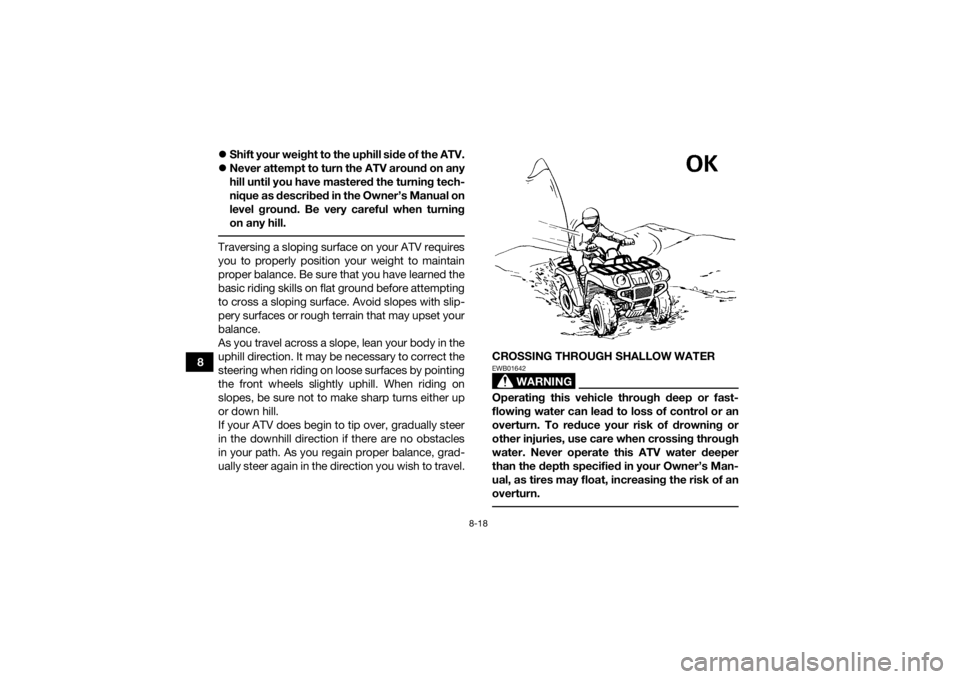
Traversing a sloping surface on your ATV requires
you to properly position your weight to maintain
proper balance. Be sure that you have learned the
basic riding skills on flat ground before attempting
to cross a sloping surface. Avoid slopes with slip-
pery surfaces or rough terrain that may upset your
balance.
As you travel across a slope, lean your body in the
uphill direction. It may be necessary to correct the
steering when riding on loose surfaces by pointing
the front wheels slightly uphill. When riding on
slopes, be sure not to make sharp turns either up
or down hill.
If your ATV does begin to tip over, gradually steer
in the downhill direction if there are no obstacles
in your path. As you regain proper balance, grad-
ually steer again in the direction you wish to travel. CROSSING THROUGH SHALLOW WATER
WARNING
EWB01642Operating this vehicle through deep or fast-
flowing water can lead to loss of control or an
overturn. To reduce your risk of drowning or
other injuries, use care when crossing through
water. Never operate this ATV water deeper
than the depth specified in your Owner’s Man-
ual, as tires may float, increasing the risk of an
overturn.
UB5K64E0.book Page 18 Thursday, September 16, 2021 9:00 AM
Page 103 of 174
9-8
9
EBU28392TIPSome maintenance items need more frequent service if you are riding in unusually wet, dusty, sandy or
muddy areas, or at full-throttle.
Hydraulic brake service
• Regularly check and, if necessary, correct the brake fluid level.
• Every two years replace the internal components of the brake master cylinder and calipers, and chan-
ge the brake fluid.
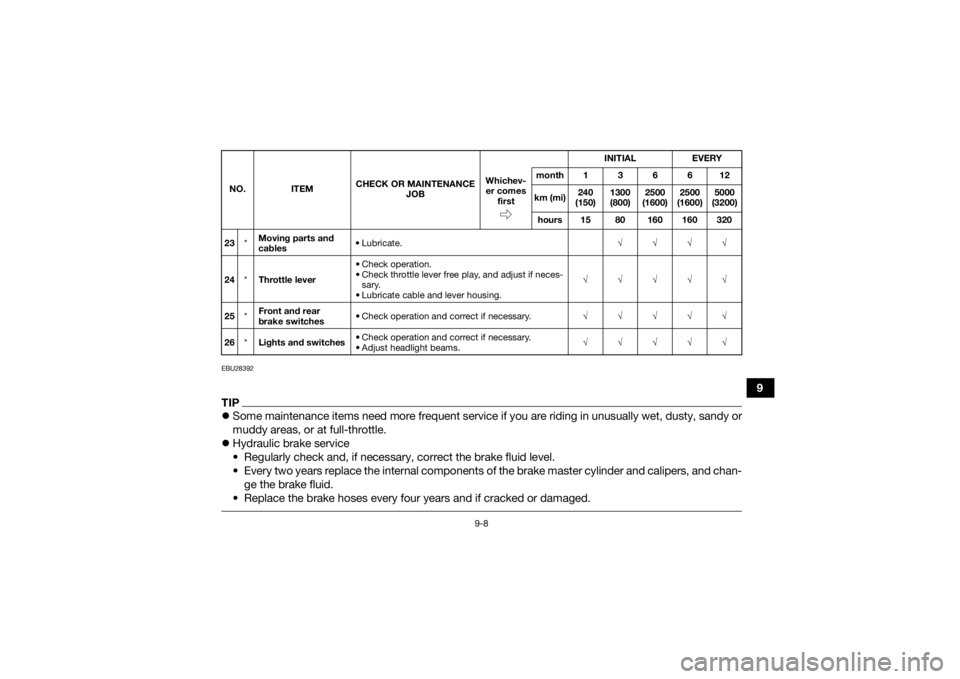
• Replace the brake hoses every four years and if cracked or damaged. 23 *Moving parts and
cables •Lubricate.
√√√√
24 *Throttle lever • Check operation.
• Check throttle lever free play, and adjust if neces-
sary.
• Lubricate cable and lever housing. √√√√√
25 *Front and rear
brake switches • Check operation and correct if necessary.
√√√√√
26 *Lights and switches • Check operation and correct if necessary.
• Adjust headlight beams. √√√√√
NO. ITEM
CHECK OR MAINTENANCE
JOB INITIAL EVERY
Whichev- er comes first month136612
km (mi) 240
(150) 1300
(800) 2500
(1600) 2500
(1600) 5000
(3200)
hours 15 80 160 160 320UB5K64E0.book Page 8 Thursday, September 16, 2021 9:00 AM
Page 113 of 174

9-18
9
To check the spark plug
1. Check that the porcelain insulator around the center electrode of the spark plug is a medi-
um-to-light tan (the ideal color when the vehi-
cle is ridden normally).
TIPIf the spark plug shows a distinctly different color,
the engine could be operating improperly. Do not
attempt to diagnose such problems yourself. In-
stead, have a Yamaha dealer check the vehicle. 2. Check the spark plug for electrode erosionand excessive carbon or other deposits, and
replace it if necessary.
3. Measure the spark plug gap with a wire thick- ness gauge and, if necessary, adjust the gap
to specification. To install the spark plug
1. Clean the surface of the spark plug gasket and its mating surface, and then wipe off any
grime from the spark plug threads.
2. Install the spark plug with the spark plug wrench, and then tighten it to the specified
torque.
Specified spark plug:
NGK/CPR7EA-9
1. Spark plug gapSpark plug gap:0.8–0.9 mm (0.031–0.035 in)
UB5K64E0.book Page 18 Thursday, September 16, 2021 9:00 AM