fuel YAMAHA MAJESTY 250 2000 User Guide
[x] Cancel search | Manufacturer: YAMAHA, Model Year: 2000, Model line: MAJESTY 250, Model: YAMAHA MAJESTY 250 2000Pages: 106, PDF Size: 1.65 MB
Page 47 of 106

6-3
PERIODIC MAINTENANCE AND MINOR REPAIR
1
2
3
4
56
7
8
9
EAU03685
Periodic maintenance and lubrication chart
NOTE:
8The annual checks must be performed every year, except if a kilometer-based maintenance is performed instead.
8From 50,000 km, repeat the maintenance intervals starting from 10,000 km.
8Items marked with an asterisk should be performed by a Yamaha dealer as they require special tools, data and
technical skills.NO.ITEMCHECK OR MAINTENANCE JOBODOMETER READING (´1,000 km)
ANNUAL
CHECK
110203040
1
*Fuel line¥Check fuel hoses and vacuum hose for cracks or damage.ÖÖÖÖÖ
2Spark plug¥Check condition.
¥Clean and regap.ÖÖ
¥Replace.ÖÖ
3*Valves¥Check valve clearance.
¥Adjust.ÖÖ
4Air filter element¥Clean.ÖÖ
¥Replace.ÖÖ
5V-belt case air filter
element¥Clean.ÖÖÖÖ
6*Front brake¥Check operation, fluid level and vehicle for fluid leakage.
(See NOTE on page 6-5.)ÖÖÖÖÖÖ
¥Replace brake pads.Whenever worn to the limit
7*Rear brake¥Check operation, fluid level and vehicle for fluid leakage.
(See NOTE on page 6-5.)ÖÖÖÖÖÖ
¥Replace brake pads.Whenever worn to the limit
8*Brake hoses¥Check for cracks or damage.ÖÖÖÖÖ
¥Replace. (See NOTE on page 6-5.)Every 4 years
5GM-9-E1(No ABS) 9/27/00 2:18 PM Page 46
Page 82 of 106
6-38
PERIODIC MAINTENANCE AND MINOR REPAIR
1
2
3
4
56
7
8
9
12
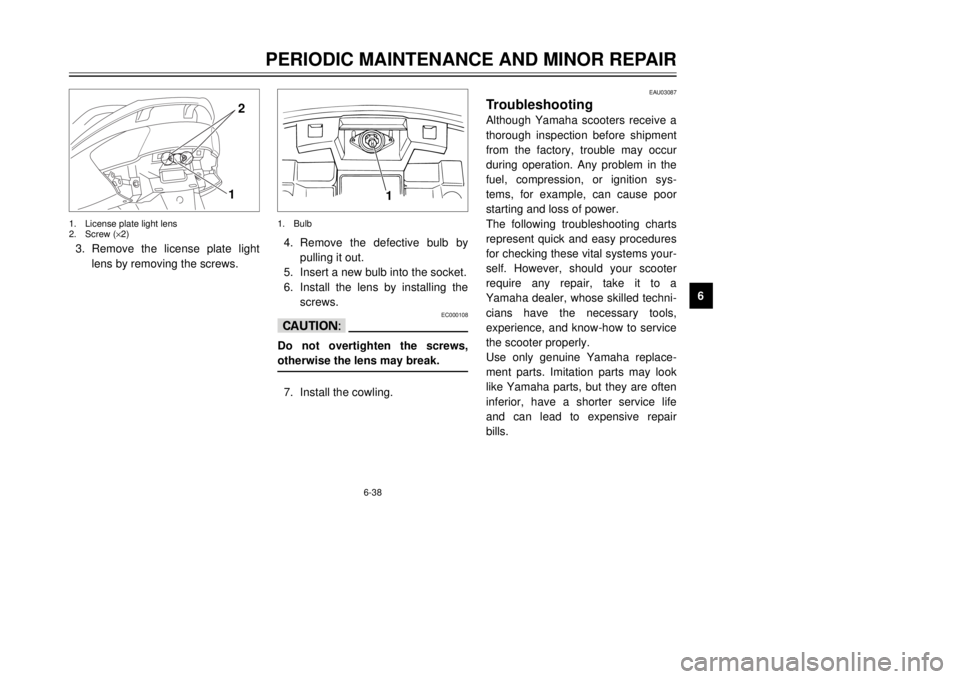
3.Remove the license plate light
lens by removing the screws.1.License plate light lens
2.Screw (´2)
1
4.Remove the defective bulb by
pulling it out.
5.Insert a new bulb into the socket.
6.Install the lens by installing the
screws.
EC000108
cCDo not overtighten the screws,
otherwise the lens may break.7.Install the cowling.1.Bulb
EAU03087
TroubleshootingAlthough Yamaha scooters receive a
thorough inspection before shipment
from the factory, trouble may occur
during operation. Any problem in the
fuel, compression, or ignition sys-
tems, for example, can cause poor
starting and loss of power.
The following troubleshooting charts
represent quick and easy procedures
for checking these vital systems your-
self. However, should your scooter
require any repair, take it to a
Yamaha dealer, whose skilled techni-
cians have the necessary tools,
experience, and know-how to service
the scooter properly.
Use only genuine Yamaha replace-
ment parts. Imitation parts may look
like Yamaha parts, but they are often
inferior, have a shorter service life
and can lead to expensive repair
bills.
5GM-9-E1(No ABS) 9/27/00 2:18 PM Page 81
Page 83 of 106
6-39
PERIODIC MAINTENANCE AND MINOR REPAIR
1
2
3
4
56
7
8
9
EAU01581
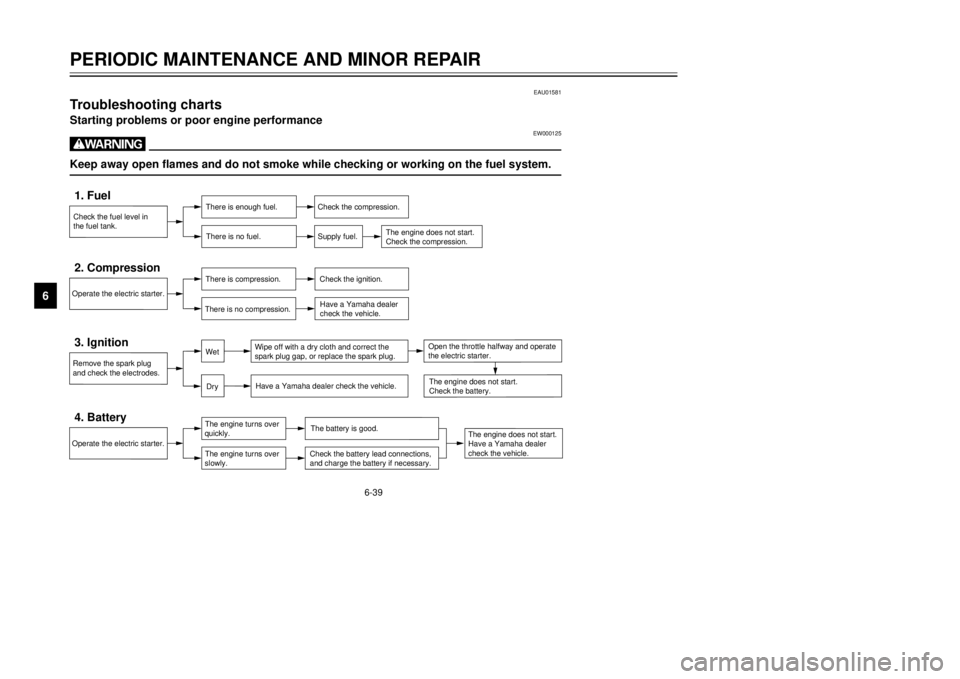
Troubleshooting chartsStarting problems or poor engine performance
EW000125
wKeep away open flames and do not smoke while checking or working on the fuel system.Check the fuel level in
the fuel tank.1. Fuel
There is enough fuel.
There is no fuel.
Check the compression.
Supply fuel.
The engine does not start.
Check the compression.
Operate the electric starter.2. Compression
There is compression.
There is no compression.
Check the ignition.
Have a Yamaha dealer
check the vehicle.
Remove the spark plug
and check the electrodes.3. Ignition
Wipe off with a dry cloth and correct the
spark plug gap, or replace the spark plug.
Have a Yamaha dealer check the vehicle.
The engine does not start.
Have a Yamaha dealer
check the vehicle.
The engine does not start.
Check the battery.
Operate the electric starter.4. Battery
The engine turns over
The engine turns over
The battery is good.Check the battery lead connections,
and charge the battery if necessary.
DryWet
Open the throttle halfway and operate
the electric starter.
quickly.
slowly.
5GM-9-E1(No ABS) 9/27/00 2:18 PM Page 82
Page 88 of 106
7-2
SCOOTER CARE AND STORAGE
1
2
3
4
5
67
8
9 8Do not use any harsh chemical
products on plastic parts. Be
sure to avoid using cloths or
sponges which have been in
contact with strong or abra-
sive cleaning products, sol-
vent or thinner, fuel (gasoline),
rust removers or inhibitors,
brake fluid, antifreeze or elec-
trolyte.
8Do not use high-pressure
washers or steam-jet cleaners
since they cause water seep-
age and deterioration in the
following areas: seals (of
wheel and swingarm bearings,
fork and brakes), electric com-
ponents (couplers, connec-
tors, instruments, switches
and lights), breather hoses
and vents.8For scooters equipped with a
windshield: Do not use strong
cleaners or hard sponges as
they will cause dulling or
scratching. Some cleaning
compounds for plastic may
leave scratches on the wind-
shield. Test the product on a
small hidden part of the wind-
shield to make sure that it
does not leave any marks. If
the windshield is scratched,
use a quality plastic polishing
compound after washing.
After normal useRemove dirt with warm water, a mild
detergent, and a soft, clean sponge,
and then rinse thoroughly with clean
water. Use a toothbrush or bottle-
brush for hard-to-reach areas.
Stubborn dirt and insects will come
off more easily if the area is covered
with a wet cloth for a few minutes
before cleaning.After riding in the rain, near the sea
or on salt-sprayed roadsSince sea salt or salt sprayed on the
roads during winter are extremely
corrosive in combination with water,
carry out the following steps after
each ride in the rain, near the sea or
on salt-sprayed roads.NOTE:
Salt sprayed on roads in the winter
may remain well into spring.1.Clean the scooter with cold water
and a mild detergent after the
engine has cooled down.
ECA00012
cCDo not use warm water since it
increases the corrosive action of
the salt.2.Apply a corrosion protection
spray on all metal, including
chrome- and nickel-plated, sur-
faces to prevent corrosion.
5GM-9-E1(No ABS) 9/27/00 2:18 PM Page 87
Page 90 of 106

7
SCOOTER CARE AND STORAGE
7-4
StorageShort-term
Always store your scooter in a cool,
dry place and, if necessary, protect it
against dust with a porous cover.
ECA00015
cC8Storing the scooter in a poorly
ventilated room or covering it
with a tarp, while it is still wet,
will allow water and humidity
to seep in and cause rust.
8To prevent corrosion, avoid
damp cellars, stables (because
of the presence of ammonia)
and areas where strong chemi-
cals are stored.
Long-term
Before storing your scooter for sever-
al months:
1.Follow all the instructions in the
ÒCareÓ section of this chapter.
2.Drain the carburetor float cham-
ber by loosening the drain bolt;
this will prevent fuel deposits
from building up. Pour the
drained fuel into the fuel tank.
3.Fill up the fuel tank and add fuel
stabilizer (if available) to prevent
the fuel tank from rusting and the
fuel from deteriorating.
4.Perform the following steps to
protect the cylinder, piston rings,
etc. from corrosion.a.Remove the spark plug cap and
spark plug.
b.Pour a teaspoonful of engine oil
into the spark plug bore.
c.Install the spark plug cap onto
the spark plug, and then place
the spark plug on the cylinder
head so that the electrodes are
grounded. (This will limit spark-
ing during the next step.)
d.Turn the engine over several
times with the starter. (This will
coat the cylinder wall with oil.)
e.Remove the spark plug cap from
the spark plug, and then install
the spark plug and the spark
plug cap.
EWA00003
wTo prevent damage or injury from
sparking, make sure to ground the
spark plug electrodes while turn-
ing the engine over.
5GM-9-E1(No ABS) 9/27/00 2:18 PM Page 89
Page 93 of 106
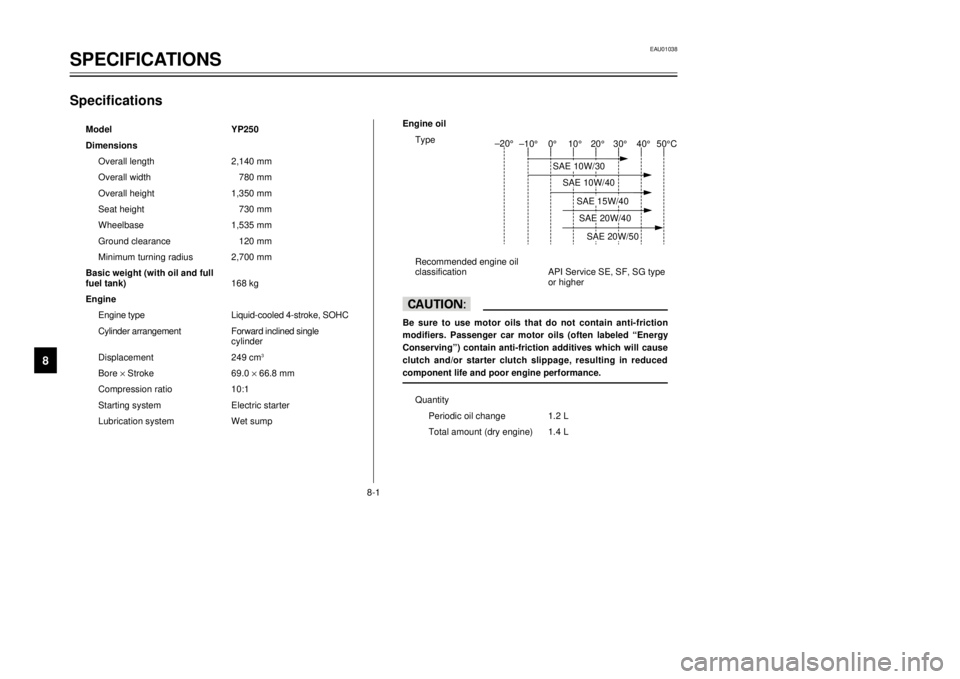
Specifications
ModelYP250
Dimensions
Overall length2,140 mm
Overall width780 mm
Overall height1,350 mm
Seat height730 mm
Wheelbase1,535 mm
Ground clearance120 mm
Minimum turning radius2,700 mm
Basic weight (with oil and full
fuel tank)168 kg
Engine
Engine typeLiquid-cooled 4-stroke, SOHC
Cylinder arrangementForward inclined single
cylinder
Displacement249 cm
3
Bore ´Stroke69.0 ´66.8 mm
Compression ratio10:1
Starting systemElectric starter
Lubrication systemWet sump
EAU01038
SPECIFICATIONS
1
2
3
4
5
6
78
9
8-1
Engine oil
Type
Recommended engine oil
classificationAPI Service SE, SF, SG type
or highercCBe sure to use motor oils that do not contain anti-friction
modifiers. Passenger car motor oils (often labeled ÒEnergy
ConservingÓ) contain anti-friction additives which will cause
clutch and/or starter clutch slippage, resulting in reduced
component life and poor engine performance.
Quantity
Periodic oil change1.2 L
Total amount (dry engine)1.4 L
–10° 0° 10° 20° 30°
40°
SAE 10W/30
SAE 10W/40
SAE 20W/40
SAE 20W/50
–20°
SAE 15W/40 50°C
5GM-9-E1(No ABS) 9/27/00 2:18 PM Page 92
Page 94 of 106

8-2
SPECIFICATIONS
1
2
3
4
5
6
78
9
Final gear case oil
TypeEngine oil SAE 10W-30
(API SE)
Total amount0.25 L
Radiator capacity
(including all routes)1.4 L
Air filterWet type element
Fuel
TypeRegular unleaded gasoline
Fuel tank capacity12 L
Carburetor
ManufacturerTEIKEI
Model ´ quantityY28V-1E ´ 1
Spark plug
Manufacturer/modelNGK / DR8EA
Spark plug gap0.6Ð0.7 mm
Clutch typeDry, centrifugal automatic
Transmission
Primary reduction systemHelical gear
Primary reduction ratio40/15 (2.666)
Secondary reduction systemHelical gear
Secondary reduction ratio38/15 (2.533)
Transmission typeV-belt automatic
OperationCentrifugal automatic typeChassis
Frame typeSteel tube underbone
Caster angle28¡
Trail103 mm
Tires
Front
TypeTubeless
Size110/90-12 64L
Manufacturer/INOUE / MB67
modelMICHELIN / BOPPER
Rear
TypeTubeless
Size130/70-12 62L
Manufacturer/INOUE / MB67
modelMICHELIN / BOPPER
Maximum load*187 kg
Air pressure (cold tire)
up to 90 kg load*
Front175 kPa (1.75 kg/cm
2, 1.75 bar)
Rear200 kPa (2.00 kg/cm2, 2.00 bar)
90 kg loadÐmaximum load*
Front200 kPa (2.00 kg/cm2, 2.00 bar)
Rear225 kPa (2.25 kg/cm2, 2.25 bar)
* Total weight of rider, passenger, cargo and accessories
5GM-9-E1(No ABS) 9/27/00 2:18 PM Page 93
Page 101 of 106
INDEX
F
Final gear oil..........................................6-17
Front and rear brake lever free play,
adjusting.............................................6-25
Front and rear brake pads, checking.....6-26
Front fork, checking...............................6-29
Fuel.......................................................3-10
Fuel consumption, tips for reducing........5-4
Fuel gauge..............................................3-4
Fuel tank cap...........................................3-9
Fuses, replacing....................................6-33
H
Handlebar switches.................................3-5
Pass switch.........................................3-5
Dimmer switch....................................3-5
Turn signal switch...............................3-6
Horn switch.........................................3-6
Light switch.........................................3-6
Headlight variations............................3-7
Engine stop switch..............................3-8
Start switch.........................................3-8
Headlight bulb, replacing.......................6-34
I
Identification numbers.............................9-1
Ignition circuit cut-off system.................3-15
Indicator lights.........................................3-2
Oil change indicator light....................3-2
High beam indicator light....................3-2
Turn signal indicator lights..................3-2
K
Key identification number........................9-1
L
License plate light bulb, replacing.........6-37
M
Main switch/steering lock........................3-1
Model label..............................................9-2
P
Parking....................................................5-5
Part locations...........................................2-1
Periodic maintenance and lubrication
chart......................................................6-3
Pre-operation check list...........................4-1
R
Rider seat..............................................3-11
Rider seat, adjusting..............................3-12
S
Safe-riding points....................................1-2
Self-diagnosis device..............................3-3
Shock absorber assemblies, adjusting..3-14
Sidestand..............................................3-15
Spark plug, checking.............................6-12
Specifications..........................................8-1
Speedometer unit....................................3-3
Starting off...............................................5-2
Starting the engine..................................5-1
Steering, checking.................................6-30
Storage....................................................7-4
A
Acceleration and deceleration.................5-3
Air filter and V-belt case air filter
elements, cleaning..............................6-20
Air flow louver........................................6-22
Anti-theft alarm (optional)........................3-4
B
Battery...................................................6-31
Battery cover, removing........................6-31
Brake fluid level, checking.....................6-27
Brake fluid, changing.............................6-28
Brake lever (front)....................................3-8
Brake lever (rear)....................................3-8
Brake levers, lubricating........................6-28
Braking....................................................5-3
C
Cables, checking and lubricating...........6-28
Care.........................................................7-1
Catalytic converter.................................3-10
Centerstand and sidestand, checking
and lubricating....................................6-29
Clock.......................................................3-5
Conversion table.....................................8-5
Coolant..................................................6-18
Coolant temperature gauge.....................3-4
Cowlings and panel, removing and
installing................................................6-6
E
Engine break-in.......................................5-4
Engine oil...............................................6-14
5GM-9-E1(No ABS) 9/27/00 2:18 PM Page 100