ABS YAMAHA MT-03 2020 Owners Manual
[x] Cancel search | Manufacturer: YAMAHA, Model Year: 2020, Model line: MT-03, Model: YAMAHA MT-03 2020Pages: 94, PDF Size: 6.88 MB
Page 5 of 94
Table of contents
Safety information............................1-1
Description........................................2-1
Left view ..........................................2-1
Right view........................................2-2
Controls and instruments ................2-3
Instrument and control functions....3-1
Main switch/steering lock ...............3-1
Indicator lights and warning
lights ............................................3-2
Multi-function meter unit .................3-4
Handlebar switches.......................3-10
Clutch lever ...................................3-11
Shift pedal .....................................3-12
Brake lever ....................................3-12
Brake pedal ...................................3-13
ABS ...............................................3-13
Fuel tank cap.................................3-14
Fuel................................................3-15
Fuel tank overflow hose ................3-16
Catalytic converter ........................3-17
Seats .............................................3-17
Helmet holders ..............................3-19
Storage compartment ...................3-20
Adjusting the shock absorber
assembly....................................3-20
Luggage strap holders ..................3-21
Sidestand ......................................3-22
Ignition circuit cut-off system........3-22
For your safety – pre-operation
checks...............................................4-1
Operation and important riding
points.................................................5-1
Engine break-in ...............................5-1
Starting the engine ..........................5-2
Shifting ............................................5-3
Tips for reducing fuel
consumption ................................5-4
Parking ............................................5-5
Periodic maintenance and
adjustment........................................6-1
Tool kit.............................................6-2Periodic maintenance charts .......... 6-3
Periodic maintenance chart for
the emission control system........ 6-3
General maintenance and
lubrication chart........................... 6-4
Checking the spark plugs ............... 6-7
Canister........................................... 6-8
Engine oil and oil filter cartridge ..... 6-8
Why Yamalube .............................. 6-11
Coolant ......................................... 6-12
Replacing the air filter element
and cleaning the check hose..... 6-13
Checking the throttle grip
free play ..................................... 6-15
Valve clearance ............................. 6-15
Tires .............................................. 6-16
Cast wheels .................................. 6-18
Adjusting the clutch lever
free play ..................................... 6-18
Checking the brake lever
free play ..................................... 6-19
Brake light switches ...................... 6-20
Checking the front and rear
brake pads................................. 6-20
Checking the brake fluid level....... 6-21
Changing the brake fluid............... 6-22
Drive chain slack ........................... 6-23
Cleaning and lubricating the
drive chain ................................. 6-24
Checking and lubricating the
cables ........................................ 6-25
Checking and lubricating the
throttle grip and cable ............... 6-25
Checking and lubricating the
brake and shift pedals ............... 6-26
Checking and lubricating the
brake and clutch levers ............. 6-26
Checking and lubricating the
sidestand ................................... 6-27
Lubricating the swingarm pivots... 6-27
Checking the front fork ................. 6-28
Checking the steering ................... 6-28
Checking the wheel bearings ....... 6-29
Battery .......................................... 6-29
Replacing the fuses ...................... 6-31
Vehicle lights ................................. 6-33
UB6WE0E0.book Page 1 Friday, March 27, 2020 11:37 AM
Page 12 of 94

Description
2-1
2
EAU63371
Left view
12345
9
10876
1. Coolant reservoir (page 6-12)
2. Main fuse (page 6-31)
3. Tool kit (page 6-2)
4. Passenger seat lock (page 3-17)
5. Storage compartment (page 3-20)
6. Shock absorber assembly spring preload adjusting ring (page 3-20)
7. Shift pedal (page 3-12)
8. Engine oil drain bolt (page 6-8)
9. Engine oil filter cartridge (page 6-8)
10.Canister (page 6-8)
UB6WE0E0.book Page 1 Friday, March 27, 2020 11:37 AM
Page 16 of 94

Instrument and control functions
3-2
3From the “LOCK” position, push the
key in and turn it to “OFF”.
EAU4939H
Indicator lights and warning
lights
EAU11032Turn signal indicator lights “ ”
and“”
Each indicator light will flash when its
corresponding turn signal lights are
flashing.
EAU11061Neutral indicator light “ ”
This indicator light comes on when the
transmission is in the neutral position.
EAU11081High beam indicator light “ ”
This indicator light comes on when the
high beam of the headlight is switched
on.
EAU85091Oil pressure warning light “ ”
This warning light comes on when the
engine oil pressure is low.
1. Engine trouble warning light “ ”
2. Oil pressure warning light “ ”
3. Left turn signal indicator light “ ”
4. Neutral indicator light “ ”
5. Shift indicator light “ ”
6. Right turn signal indicator light “ ”
7. High beam indicator light “ ”
8. Anti-lock Brake System (ABS) warning
light “ ”
8
MPH
MPG mile
123 4 5 67
ABS
UB6WE0E0.book Page 2 Friday, March 27, 2020 11:37 AM
Page 17 of 94

Instrument and control functions
3-3
3
TIP
When the vehicle is turned on, the light
should come on and remain on until
the engine is started. Otherwise, have
a Yamaha dealer check the vehicle.
NOTICE
ECA21211
If the warning light comes on when
the engine is running, stop the en-
gine and check the oil level. If the oil
level is low, add sufficient oil of the
recommended type. If the warning
light remains on after adding oil,
stop the engine and have a Yamaha
dealer check the vehicle.
EAU79311Engine trouble warning light “ ”
This warning light comes on if a prob-
lem is detected in the engine. If this oc-
curs, have a Yamaha dealer check the
on-board diagnostic system.
TIP
When the vehicle is turned on, this light
should come on for a few seconds and
then go off. Otherwise, have a Yamaha
dealer check the vehicle.
EAU69895ABS warning light “ ”
This warning light comes on when the
vehicle is first turned on, and goes off
after starting riding. If the warning light
comes on while riding, the anti-lock
brake system may not work correctly.
WARNING
EWA16043
If the ABS warning light does not
turn off after reaching 10 km/h (6
mi/h), or if the warning light comes
on while riding: Use extra caution to avoid pos-
sible wheel lock during emer-
gency braking.
Have a Yamaha dealer check
the vehicle as soon as possible.
EAU67433Shift indicator light “ ”
This indicator light comes on when it is
time to shift to the next higher gear.
The engine speeds at which it comes
on or goes off can be adjusted.
TIP
When the vehicle is turned on, this light
should come on for a few seconds and
then go off. If the light does not come
on, or if the light remains on, have a
Yamaha dealer check the vehicle.
ABS
UB6WE0E0.book Page 3 Friday, March 27, 2020 11:37 AM
Page 27 of 94

Instrument and control functions
3-13
3
EAU12944
Brake pedal
The brake pedal is located on the right
side of the motorcycle. To apply the
rear brake, press down on the brake
pedal.
EAU63040
ABS
The Yamaha ABS (Anti-lock Brake
System) features a dual electronic con-
trol system, which acts on the front and
rear brakes independently.
Operate the brakes with ABS as you
would conventional brakes. If the ABS
is activated, a pulsating sensation may
be felt at the brake lever or brake ped-
al. In this situation, continue to apply
the brakes and let the ABS work; do
not “pump” the brakes as this will re-
duce braking effectiveness.
WARNING
EWA16051
Always keep a sufficient distance
from the vehicle ahead to match the
riding speed even with ABS.
The ABS performs best with
long braking distances.
On certain surfaces, such as
rough or gravel roads, the brak-
ing distance may be longer with
the ABS than without.
The ABS is monitored by an ECU,
which will revert the system to conven-
tional braking if a malfunction occurs.
TIP
The ABS performs a self-diagno-
sis test each time the vehicle first
starts off after the key is turned to
“ON” and the vehicle has traveled
at a speed of 10 km/h (6 mi/h) or
higher. During this test, a “click-
ing” noise can be heard from the
hydraulic control unit, and if the
brake lever or brake pedal is even
slightly applied, a vibration can be
felt at the lever and pedal, but
these do not indicate a malfunc-
tion.
1. Brake pedal
1
UB6WE0E0.book Page 13 Friday, March 27, 2020 11:37 AM
Page 28 of 94
Instrument and control functions
3-14
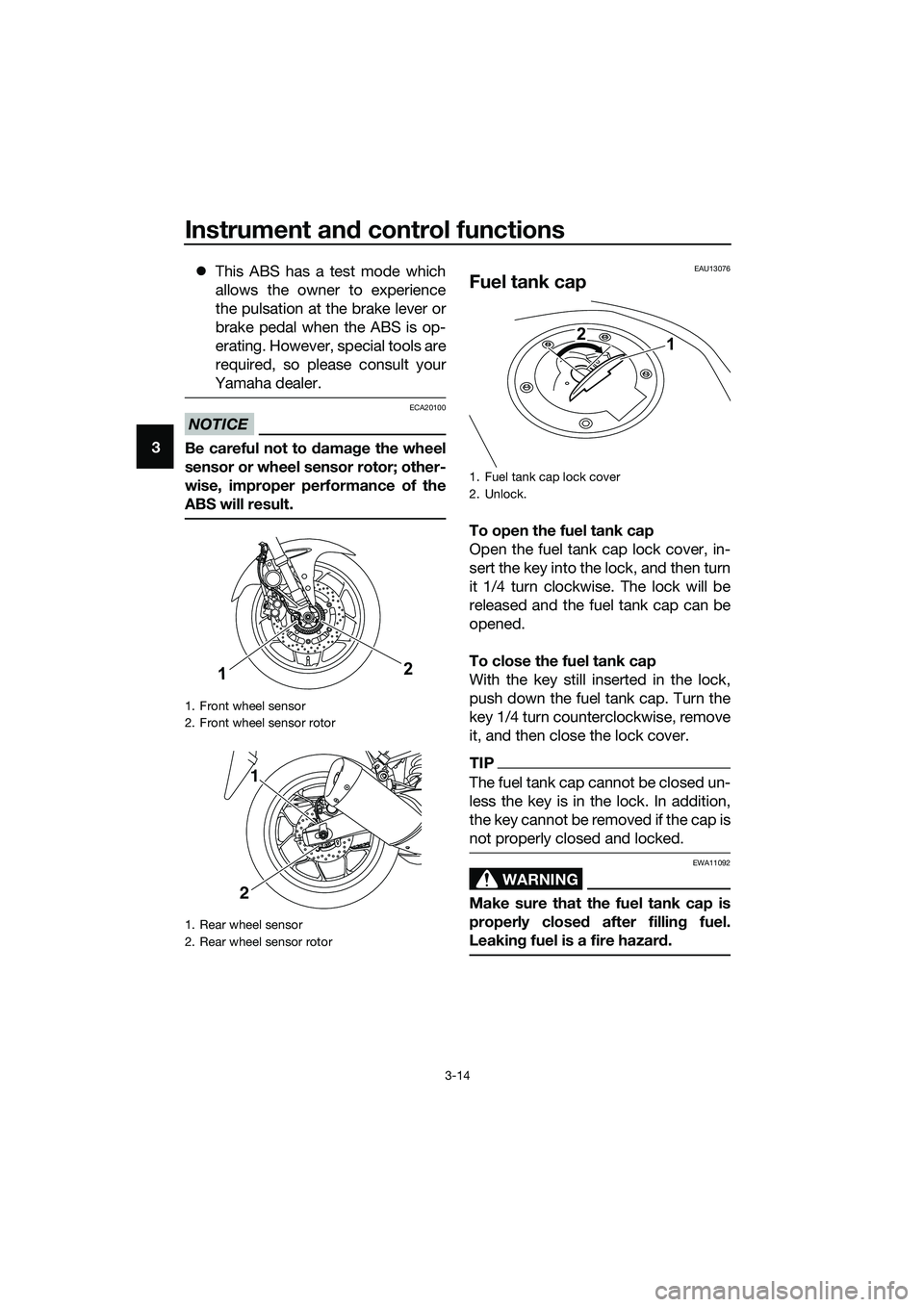
3This ABS has a test mode which
allows the owner to experience
the pulsation at the brake lever or
brake pedal when the ABS is op-
erating. However, special tools are
required, so please consult your
Yamaha dealer.
NOTICE
ECA20100
Be careful not to damage the wheel
sensor or wheel sensor rotor; other-
wise, improper performance of the
ABS will result.
EAU13076
Fuel tank cap
To open the fuel tank cap
Open the fuel tank cap lock cover, in-
sert the key into the lock, and then turn
it 1/4 turn clockwise. The lock will be
released and the fuel tank cap can be
opened.
To close the fuel tank cap
With the key still inserted in the lock,
push down the fuel tank cap. Turn the
key 1/4 turn counterclockwise, remove
it, and then close the lock cover.
TIP
The fuel tank cap cannot be closed un-
less the key is in the lock. In addition,
the key cannot be removed if the cap is
not properly closed and locked.
WARNING
EWA11092
Make sure that the fuel tank cap is
properly closed after filling fuel.
Leaking fuel is a fire hazard.
1. Front wheel sensor
2. Front wheel sensor rotor
1. Rear wheel sensor
2. Rear wheel sensor rotor
12
1
2
1. Fuel tank cap lock cover
2. Unlock.
1 2
UB6WE0E0.book Page 14 Friday, March 27, 2020 11:37 AM
Page 34 of 94

Instrument and control functions
3-20
3
EAU62550
Storage compartment
The storage compartment is located
under the passenger seat. (See page
3-17.)
When storing documents or other
items in the storage compartment, be
sure to wrap them in a plastic bag so
that they will not get wet. When wash-
ing the vehicle, be careful not to let any
water enter the storage compartment.
WARNING
EWA15401
Do not exceed the maximum load of
160 kg (353 lb) for the vehicle.
EAU68143
Adjusting the shock absorber
assembly
This shock absorber assembly is
equipped with a spring preload adjust-
ing ring.
NOTICE
ECA10102
To avoid damaging the mechanism,
do not attempt to turn beyond the
maximum or minimum settings.
Adjust the spring preload as follows.
TIP
For ABS models, remove the drive
chain guard by removing the bolts and
collars.
Turn the adjusting ring in direction (a)
to increase the spring preload.
Turn the adjusting ring in direction (b)
to decrease the spring preload.
Align the appropriate notch in the
adjusting ring with the position in-
dicator on the shock absorber.
Use the special wrench and the
extension bar included in the tool
kit to make the adjustment.
1. Storage compartment
1
1. Drive chain guard
2. Bolt and collar
2
1
UB6WE0E0.book Page 20 Friday, March 27, 2020 11:37 AM
Page 35 of 94

Instrument and control functions
3-21
3
TIP
For ABS models, be sure to install the
drive chain guard by installing the col-
lars and bolts, and then tighten the
bolts to the specified torque.
EAU84680
Luggage strap holders
Use the indicated strap points to se-
cure luggage ties to the vehicle.
1. Extension bar
2. Special wrench
3. Spring preload adjusting ring
4. Position indicator
Spring preload setting:
Minimum (soft):
1
Standard:
4
Maximum (hard):
7
Tightening torque:
Drive chain guard bolt:
10 N·m (1.0 kgf·m, 7.4 lb·ft)
7654321
4
(b)
(a)
32
1
1. Luggage strap holder
1
UB6WE0E0.book Page 21 Friday, March 27, 2020 11:37 AM
Page 41 of 94

Operation and important riding points
5-2
5
EAU86620
Starting the engine
The ignition circuit cut-off system will
enable starting when:
the transmission is in the neutral
position or
the transmission is in gear, the
sidestand is up, and the clutch le-
ver is pulled.
To start the engine
1. Turn the main switch on and set
the engine stop switch to the run
position.
2. Confirm the indicator and warning
light(s) come on for a few sec-
onds, and the go off. (See page
3-2.)
TIP
Do not start the engine if the en-
gine trouble warning light remains
on.
The oil pressure warning light
should come on and stay on until
the engine is started.
The ABS warning light should
come on and stay on until the ve-
hicle reaches a speed of 10 km/h
(6 mi/h).
NOTICE
ECA24110
If a warning or indicator light does
not work as described above, have a
Yamaha dealer check the vehicle.
3. Shift the transmission into the
neutral position.
4. Start the engine by pushing the
start switch.5. Release the start switch when the
engine starts, or after 5 seconds.
Wait 10 seconds before pressing
the switch again to allow battery
voltage to restore.
NOTICE
ECA11043
For maximum engine life, never ac-
celerate hard when the engine is
cold!
UB6WE0E0.book Page 2 Friday, March 27, 2020 11:37 AM
Page 49 of 94

Periodic maintenance and adjustment
6-5
6
14*Steering bearings• Check bearing assemblies for
looseness.√√ √
• Moderately repack with lithium-
soap-based grease.√√
15*Chassis fasteners• Make sure that all nuts, bolts
and screws are properly tight-
ened.√√√√√
16Brake lever pivot
shaft• Lubricate with silicone grease.√√√√√
17Brake pedal pivot
shaft• Lubricate with lithium-soap-
based grease.√√√√√
18Clutch lever pivot
shaft• Lubricate with lithium-soap-
based grease.√√√√√
19Shift pedal pivot
shaft• Lubricate with lithium-soap-
based grease.√√√√√
20 Sidestand• Check operation.
• Lubricate with lithium-soap-
based grease.√√√√√
21*Sidestand switch• Check operation and replace if
necessary.√√√√√√
22*Front fork• Check operation and for oil
leakage.
• Replace if necessary.√√√√
23*Shock absorber
assembly• Check operation and for oil
leakage.
• Replace if necessary.√√√√
24 Engine oil• Change (warm engine before
draining).
• Check oil level and vehicle for
oil leakage.At the initial interval and
when the oil change indi-
cator flashes or comes
on.√
25En
gine oil filter
cartridge• Replace.√√√
26*Cooling system• Check coolant level and vehicle
for coolant leakage.√√√√√
• Change. Every 3 years
27*Front and rear
brake switches• Check operation.√√√√√√ NO. ITEM
X 1000 km CHECK OR
MAINTENANCE JOB
X 1000 mi
ODOMETER
READINGS
ANNUAL CHECK
110203040
0.66121824
UB6WE0E0.book Page 5 Friday, March 27, 2020 11:37 AM