warning YAMAHA MT-125 2016 Owner's Guide
[x] Cancel search | Manufacturer: YAMAHA, Model Year: 2016, Model line: MT-125, Model: YAMAHA MT-125 2016Pages: 98, PDF Size: 7.38 MB
Page 63 of 98
Periodic maintenance and adjustment
6-21
6
EAUM1355
Adjusting the brake pedal free
play
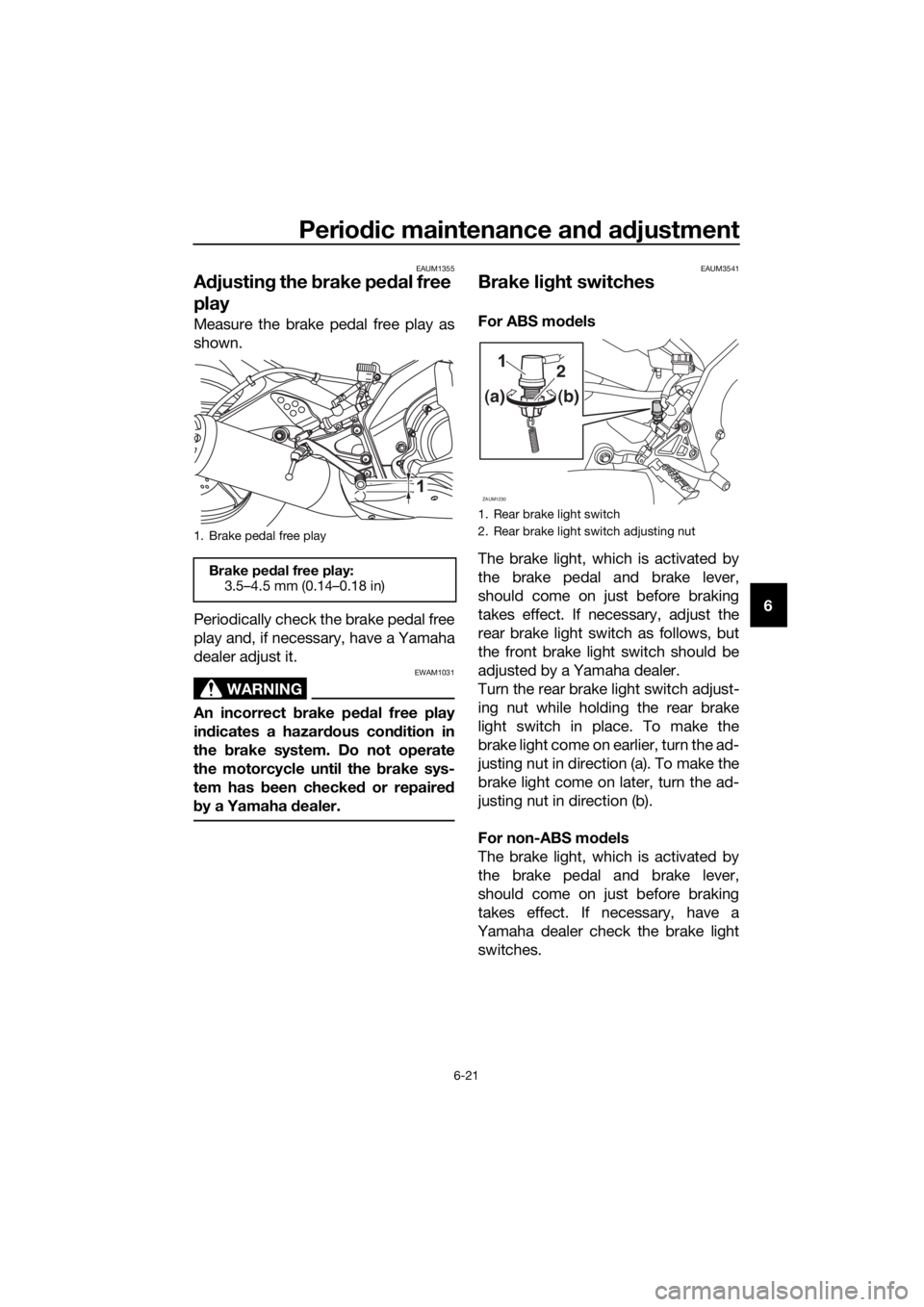
Measure the brake pedal free play as
shown.
Periodically check the brake pedal free
play and, if necessary, have a Yamaha
dealer adjust it.
WARNING
EWAM1031
An incorrect brake pedal free play
indicates a hazardous condition in
the brake system. Do not operate
the motorcycle until the brake sys-
tem has been checked or repaired
by a Yamaha dealer.
EAUM3541
Brake light switches
For ABS models
The brake light, which is activated by
the brake pedal and brake lever,
should come on just before braking
takes effect. If necessary, adjust the
rear brake light switch as follows, but
the front brake light switch should be
adjusted by a Yamaha dealer.
Turn the rear brake light switch adjust-
ing nut while holding the rear brake
light switch in place. To make the
brake light come on earlier, turn the ad-
justing nut in direction (a). To make the
brake light come on later, turn the ad-
justing nut in direction (b).
For non-ABS models
The brake light, which is activated by
the brake pedal and brake lever,
should come on just before braking
takes effect. If necessary, have a
Yamaha dealer check the brake light
switches.
1. Brake pedal free play
Brake pedal free play:
3.5–4.5 mm (0.14–0.18 in)
1. Rear brake light switch
2. Rear brake light switch adjusting nut
ZAUM1230
2
(a)(b)
UBR3E0E0.book Page 21 Friday, June 19, 2015 1:19 PM
Page 65 of 98
Periodic maintenance and adjustment
6-23
6
EAU40262
Checking the brake fluid level
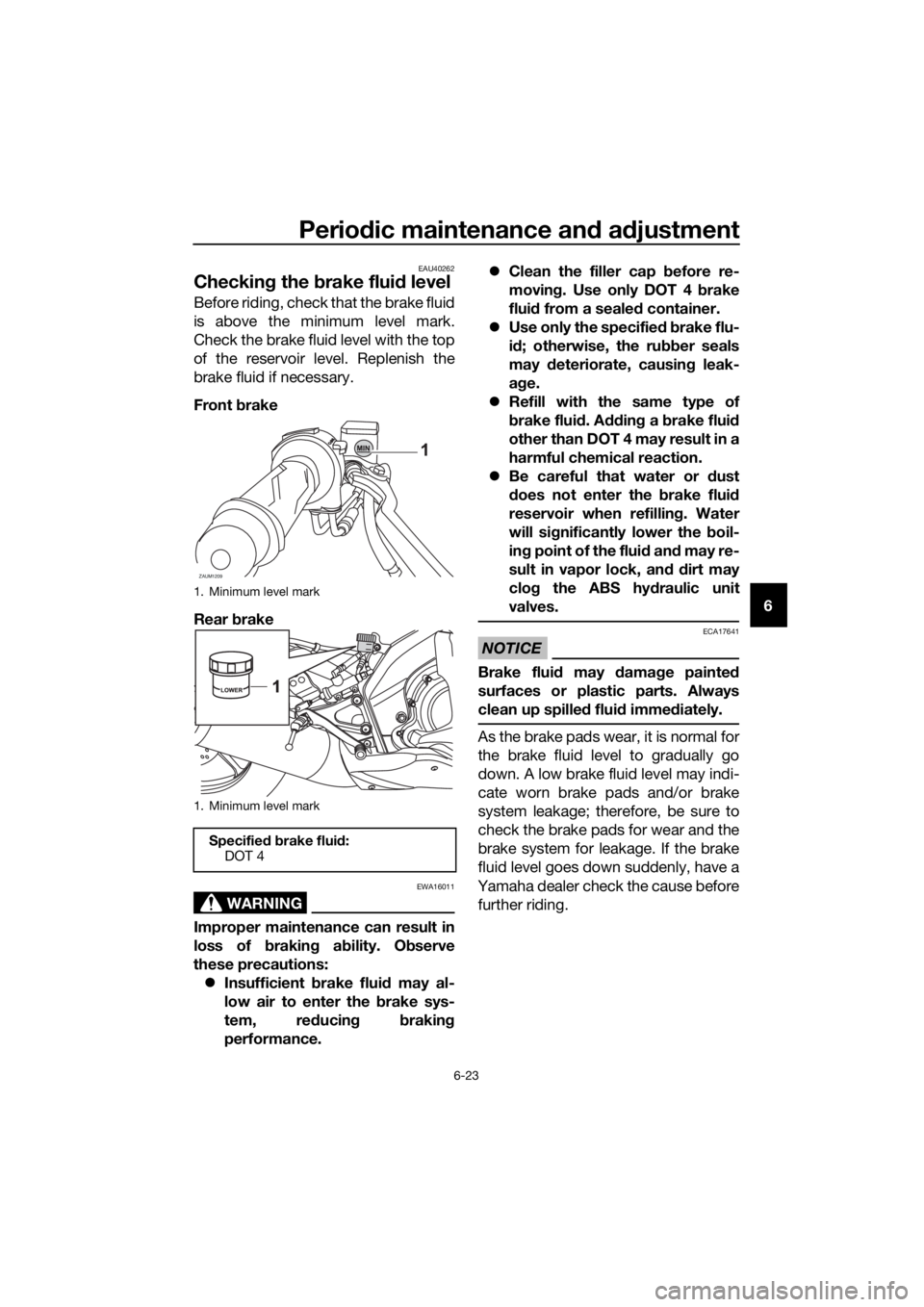
Before riding, check that the brake fluid
is above the minimum level mark.
Check the brake fluid level with the top
of the reservoir level. Replenish the
brake fluid if necessary.
Front brake
Rear brake
WARNING
EWA16011
Improper maintenance can result in
loss of braking ability. Observe
these precautions:
Insufficient brake fluid may al-
low air to enter the brake sys-
tem, reducing braking
performance.Clean the filler cap before re-
moving. Use only DOT 4 brake
fluid from a sealed container.
Use only the specified brake flu-
id; otherwise, the rubber seals
may deteriorate, causing leak-
age.
Refill with the same type of
brake fluid. Adding a brake fluid
other than DOT 4 may result in a
harmful chemical reaction.
Be careful that water or dust
does not enter the brake fluid
reservoir when refilling. Water
will significantly lower the boil-
ing point of the fluid and may re-
sult in vapor lock, an
d dirt may
clog the ABS hydraulic unit
valves.
NOTICE
ECA17641
Brake fluid may damage painted
surfaces or plastic parts. Always
clean up spilled fluid immediately.
As the brake pads wear, it is normal for
the brake fluid level to gradually go
down. A low brake fluid level may indi-
cate worn brake pads and/or brake
system leakage; therefore, be sure to
check the brake pads for wear and the
brake system for leakage. If the brake
fluid level goes down suddenly, have a
Yamaha dealer check the cause before
further riding.
1. Minimum level mark
1. Minimum level mark
Specified brake fluid:
DOT 4
ZAUM1209
I
NFOI
NFO
UBR3E0E0.book Page 23 Friday, June 19, 2015 1:19 PM
Page 68 of 98
Periodic maintenance and adjustment
6-26
6
EAU23026
Cleaning and lubricating the
drive chain
The drive chain must be cleaned and
lubricated at the intervals specified in
the periodic maintenance and lubrica-
tion chart, otherwise it will quickly wear
out, especially when riding in dusty or
wet areas. Service the drive chain as
follows.
NOTICE
ECA10584
The drive chain must be lubricated
after washing the motorcycle, riding
in the rain or riding in wet areas.
1. Clean the drive chain with kero-
sene and a small soft brush.
NOTICE: To prevent damaging
the O-rings, do not clean the
drive chain with steam cleaners,
high-pressure washers or inap-
propriate solvents.
[ECA11122]
2. Wipe the drive chain dry.
3. Thoroughly lubricate the drive
chain with a special O-ring chain
lubricant. NOTICE: Do not use
engine oil or any other lubri-
cants for the drive chain, as they
may contain substances that
could damage the O-rings.
[ECA11112]EAU23098
Checking and lubricating the
cables
The operation of all control cables and
the condition of the cables should be
checked before each ride, and the ca-
bles and cable ends should be lubri-
cated if necessary. If a cable is
damaged or does not move smoothly,
have a Yamaha dealer check or re-
place it. WARNING! Damage to the
outer housing of cables may result
in internal rusting and cause inter-
ference with cable movement. Re-
place damaged cables as soon as
possible to prevent unsafe condi-
tions.
[EWA10712]
Recommended lubricant:
Yamaha cable lubricant or other
suitable cable lubricant
UBR3E0E0.book Page 26 Friday, June 19, 2015 1:19 PM
Page 70 of 98
Periodic maintenance and adjustment
6-28
6
EAU23185
Checking and lubricating the
brake pedal
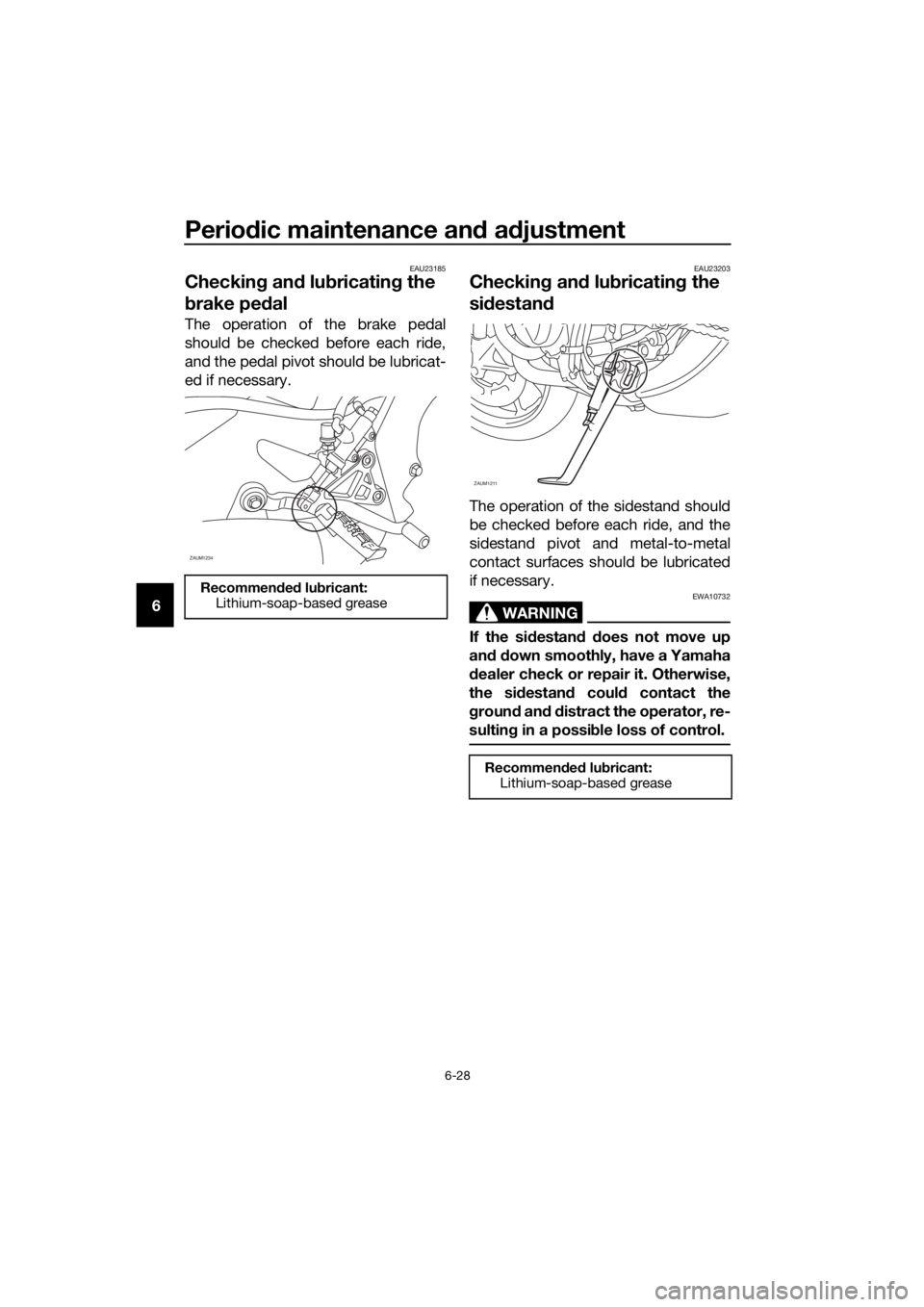
The operation of the brake pedal
should be checked before each ride,
and the pedal pivot should be lubricat-
ed if necessary.
EAU23203
Checking and lubricating the
sidestand
The operation of the sidestand should
be checked before each ride, and the
sidestand pivot and metal-to-metal
contact surfaces should be lubricated
if necessary.
WARNING
EWA10732
If the sidestand does not move up
and down smoothly, have a Yamaha
dealer check or repair it. Otherwise,
the sidestand could contact the
ground and distract the operator, re-
sulting in a possible loss of control.
Recommended lubricant:
Lithium-soap-based grease
ZAUM1234
Recommended lubricant:
Lithium-soap-based grease
ZAUM1211
UBR3E0E0.book Page 28 Friday, June 19, 2015 1:19 PM
Page 71 of 98

Periodic maintenance and adjustment
6-29
6
EAUM1653
Lubricating the swingarm piv-
ots
The swingarm pivots must be lubricat-
ed by a Yamaha dealer at the intervals
specified in the periodic maintenance
and lubrication chart.
EAU23273
Checking the front fork
The condition and operation of the
front fork must be checked as follows
at the intervals specified in the periodic
maintenance and lubrication chart.
To check the condition
Check the inner tubes for scratches,
damage and excessive oil leakage.
To check the operation
1. Place the vehicle on a level sur-
face and hold it in an upright posi-
tion. WARNING! To avoid injury,
securely support the vehicle so
there is no danger of it falling
over.
[EWA10752]
2. While applying the front brake,
push down hard on the handle-
bars several times to check if the
front fork compresses and re-
bounds smoothly.
NOTICE
ECA10591
If any damage is found or the front
fork does not operate smoothly,
have a Yamaha dealer check or re-
pair it.
Recommended lubricant:
Lithium-soap-based grease
ZAUM1212
YA M A H A
UBR3E0E0.book Page 29 Friday, June 19, 2015 1:19 PM
Page 72 of 98

Periodic maintenance and adjustment
6-30
6
EAU23285
Checking the steering
Worn or loose steering bearings may
cause danger. Therefore, the operation
of the steering must be checked as fol-
lows at the intervals specified in the
periodic maintenance and lubrication
chart.
1. Raise the front wheel off the
ground. (See page 6-37.)
WARNING! To avoid injury, se-
curely support the vehicle so
there is no danger of it falling
over.
[EWA10752]
2. Hold the lower ends of the front
fork legs and try to move them for-
ward and backward. If any free
play can be felt, have a Yamaha
dealer check or repair the steer-
ing.
EAU23292
Checking the wheel bearings
The front and rear wheel bearings must
be checked at the intervals specified in
the periodic maintenance and lubrica-
tion chart. If there is play in the wheel
hub or if the wheel does not turn
smoothly, have a Yamaha dealer
check the wheel bearings.
ZAUM1213
UBR3E0E0.book Page 30 Friday, June 19, 2015 1:19 PM
Page 73 of 98

Periodic maintenance and adjustment
6-31
6
EAU23315
Battery
A poorly maintained battery will cor-
rode and discharge quickly. The elec-
trolyte level, battery lead connections
and breather hose routing should be
checked before each ride and at the in-
tervals specified in the periodic mainte-
nance and lubrication chart.
WARNING
EWA10771
Electrolyte is poisonous and
dangerous since it contains sul-
furic acid, which causes severe
burns. Avoid any contact with
skin, eyes or clothing and al-
ways shield your eyes when
working near batteries. In case
of contact, administer the fol-
lowing FIRST AID.
EXTERNAL: Flush with plenty
of water.
INTERNAL: Drink large quan-
tities of water or milk and im-
mediately call a physician.
EYES: Flush with water for 15
minutes and seek prompt
medical attention.
Batteries produce explosive hy-
drogen gas. Therefore, keep
sparks, flames, cigarettes, etc.,
away from the battery and pro-
vide sufficient ventilation when
charging it in an enclosed
space.
Take care not to spill electrolyte
on the drive chain, as this may
weaken it, shorten chain life and
possibly result in an accident.
KEEP THIS AND ALL BATTER-
IES OUT OF THE REACH OF
CHILDREN.
To check the electrolyte level
1. Place the vehicle on a level sur-
face and hold it in an upright posi-
tion.
TIP
Make sure that the vehicle is posi-
tioned straight up when checking the
electrolyte level.
2. Check the electrolyte level in the
battery.
TIP
The electrolyte should be between the
minimum and maximum level marks.
3. If the electrolyte is at or below the
minimum level mark, add distilled
water to raise it to the maximum
level mark. NOTICE: Use only
distilled water, as tap water
contains minerals that are
harmful to the battery.
[ECA10612]
4. Check and, if necessary, tighten
the battery lead connections and
correct the breather hose routing.
To store the battery
1. If the motorcycle will not be used
for more than one month, remove
the battery, fully charge it, and
1. Maximum level mark
2. Minimum level mark
1
2+UPPER
LOWER
ZAUM0106
UBR3E0E0.book Page 31 Friday, June 19, 2015 1:19 PM
Page 74 of 98
Periodic maintenance and adjustment
6-32
6then place it in a cool, dry place.
NOTICE: When removing the
battery, be sure the key is
turned to “OFF”, then discon-
nect the negative lead before
disconnecting the positive lead.
[ECA16303]
2. If the battery will be stored for
more than two months, check the
specific gravity of the electrolyte
at least once a month and fully
charge the battery whenever nec-
essary.
3. Fully charge the battery before in-
stallation. NOTICE: When install-
ing the battery, be sure the key
is turned to “OFF”, then connect
the positive lead before con-
necting the negative lead.
[ECA16841]
4. After installation, make sure that
the battery leads are properly con-
nected to the battery terminals
and that the breather hose is prop-
erly routed, in good condition, and
not obstructed. NOTICE: If the
breather hose is positioned in
such a way that the frame is ex-
posed to electrolyte or gas ex-
pelled from the battery, the
frame could suffer structural
and external damages.
[ECA10602]EAUM3461
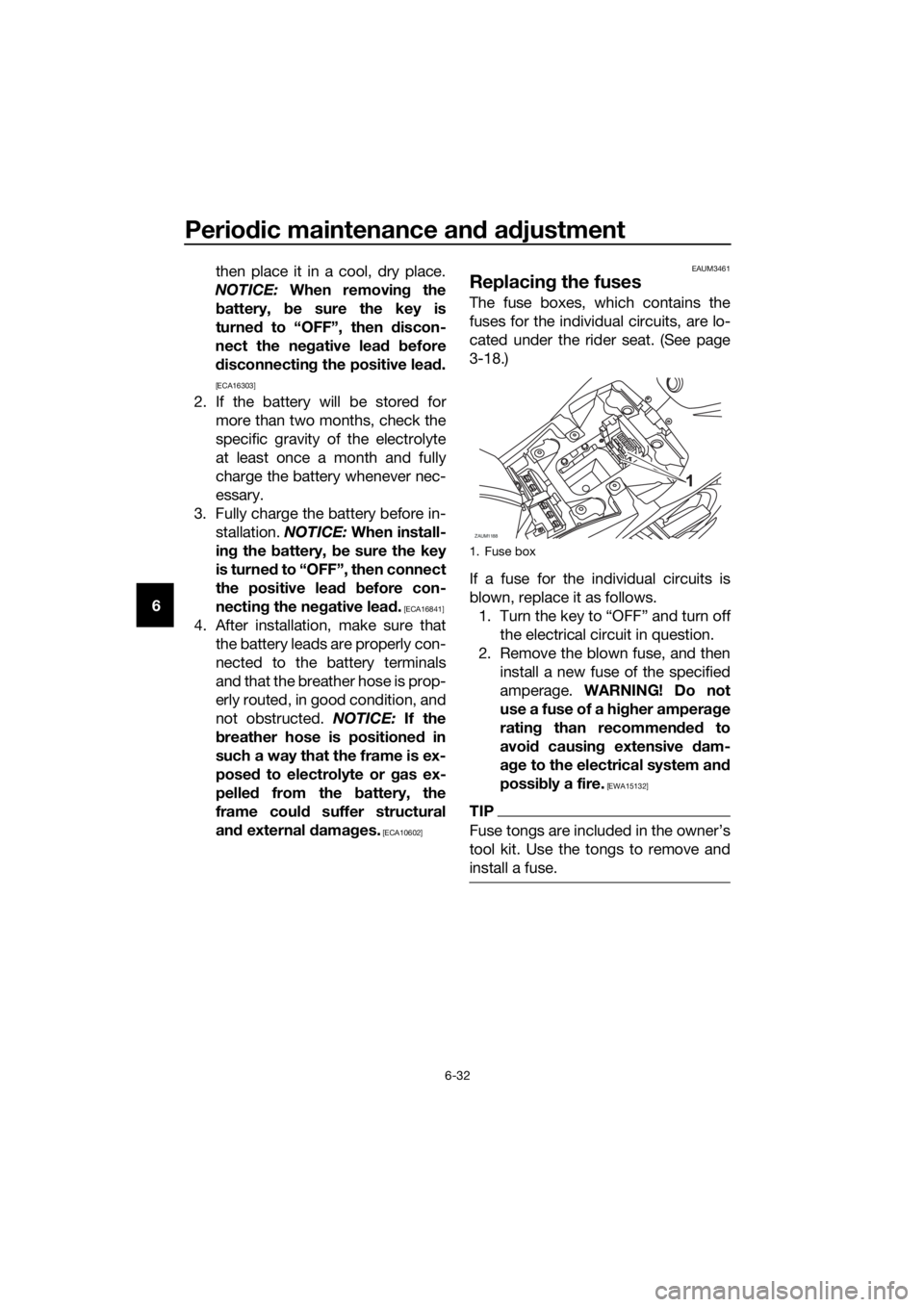
Replacing the fuses
The fuse boxes, which contains the
fuses for the individual circuits, are lo-
cated under the rider seat. (See page
3-18.)
If a fuse for the individual circuits is
blown, replace it as follows.
1. Turn the key to “OFF” and turn off
the electrical circuit in question.
2. Remove the blown fuse, and then
install a new fuse of the specified
amperage. WARNING! Do not
use a fuse of a higher amperage
rating than recommended to
avoid causing extensive dam-
age to the electrical system and
possibly a fire.
[EWA15132]
TIP
tool kit. Use the tongs to remove and
install a fuse.
1. Fuse box
ZAUM1188
UBR3E0E0.book Page 32 Friday, June 19, 2015 1:19 PM
Page 80 of 98

Periodic maintenance and adjustment
6-38
6
EAU44792
Front wheel (for non-ABS
models)
WARNING
EWA14841
For the ABS model, have a Yamaha
dealer remove and install the wheel.
EAU56531
To remove the front wheel
WARNING
EWA10822
To avoid injury, securely support the
vehicle so there is no danger of it
falling over.
1. Loosen the front wheel axle pinch
bolts, then the wheel axle and the
brake caliper bolts.2. Lift the front wheel off the ground
according to the procedure in the
previous section “Supporting the
motorcycle”.
3. Remove the brake caliper by re-
moving the bolts. NOTICE: Do
not apply the brake after the
wheel and brake disc have been
removed, otherwise the brake
pads will be forced shut.
[ECA11073]
4. Pull the wheel axle out, and then
remove the wheel.
To install the front wheel
1. Lift the wheel up between the fork
legs.
2. Insert the wheel axle.
3. Lower the front wheel so that it is
on the ground.
4. Install the brake caliper by install-
ing the bolts.
TIP
Make sure that there is enough space
between the brake pads before install-
ing the brake caliper onto the brake
disc.
5. Tighten the wheel axle to the
specified torque.
1. Axle bolt
2. Front wheel axle pinch bolt A
3. Front wheel axle pinch bolt B
ZAUM12153
1. Brake caliper bolt
2. Brake caliper
ZAUM1192
UBR3E0E0.book Page 38 Friday, June 19, 2015 1:19 PM
Page 81 of 98
Periodic maintenance and adjustment
6-39
6 6. Tighten the wheel axle pinch bolt
A and pinch bolt B to the specified
torques.
7. Retighten the wheel axle pinch
bolt A to the specified torque.
8. Tighten the brake caliper bolts to
the specified torques.
9. Push down hard on the handlebar
several times to check for proper
fork operation.
EAU44802
Rear wheel (for non-ABS
models)
WARNING
EWA14841
For the ABS model, have a Yamaha
dealer remove and install the wheel.
EAU56701
To remove the rear wheel
WARNING
EWA10822
To avoid injury, securely support the
vehicle so there is no danger of it
falling over.
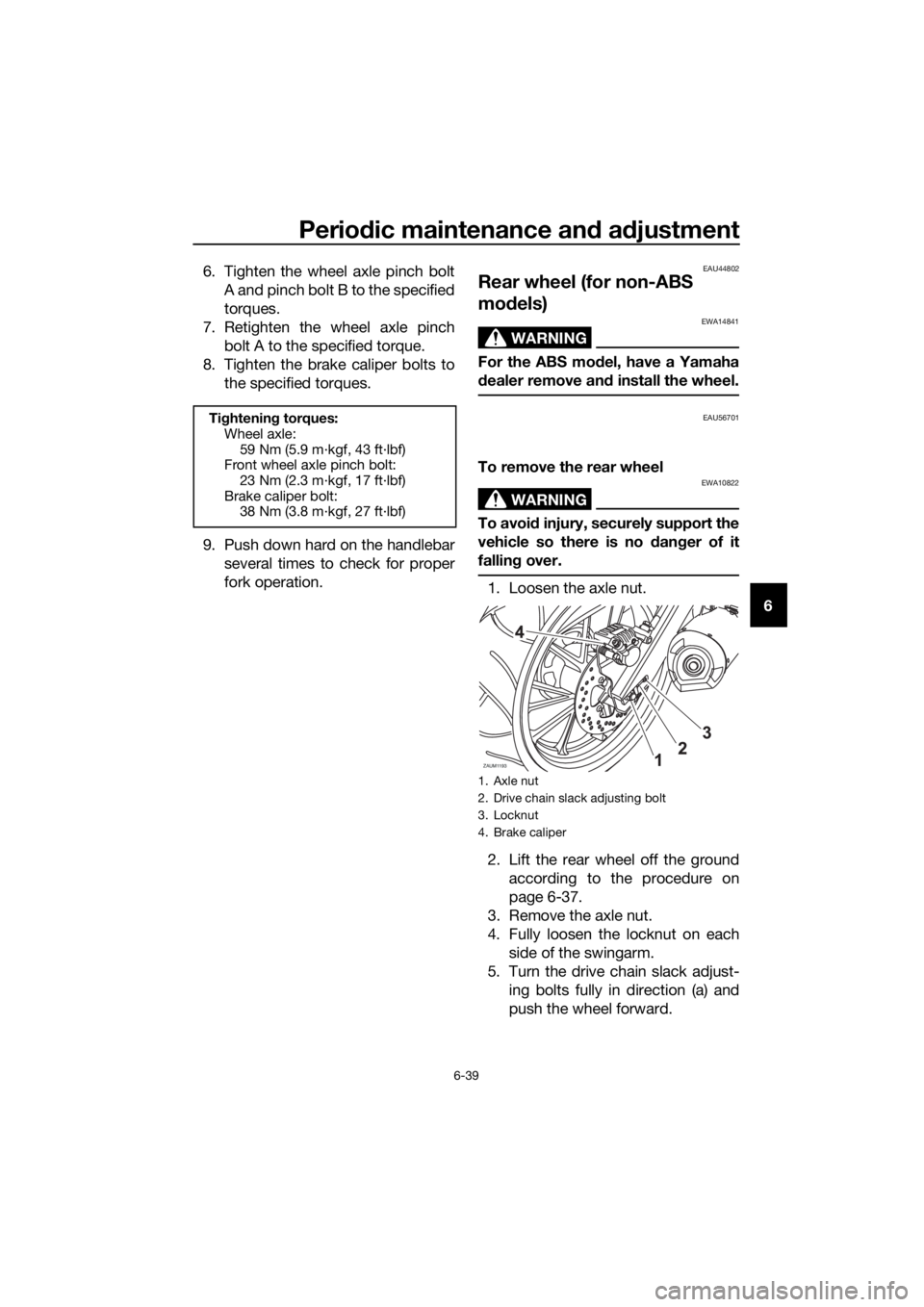
1. Loosen the axle nut.
2. Lift the rear wheel off the ground
according to the procedure on
page 6-37.
3. Remove the axle nut.
4. Fully loosen the locknut on each
side of the swingarm.
5. Turn the drive chain slack adjust-
ing bolts fully in direction (a) and
push the wheel forward.
Tightening torques:
Wheel axle:
59 Nm (5.9 m·kgf, 43 ft·lbf)
Front wheel axle pinch bolt:
23 Nm (2.3 m·kgf, 17 ft·lbf)
Brake caliper bolt:
38 Nm (3.8 m·kgf, 27 ft·lbf)
1. Axle nut
2. Drive chain slack adjusting bolt
3. Locknut
4. Brake caliper
ZAUM1193
UBR3E0E0.book Page 39 Friday, June 19, 2015 1:19 PM