cruise control YAMAHA NIKEN 2018 Owners Manual
[x] Cancel search | Manufacturer: YAMAHA, Model Year: 2018, Model line: NIKEN, Model: YAMAHA NIKEN 2018Pages: 106, PDF Size: 9.44 MB
Page 6 of 106

Table of contentsSafety information ............................ 1-1
Description ....................................... 2-1
Left view ......................................... 2-1
Right view ....................................... 2-2
Controls and instruments ............... 2-3
Instrument an d control functions ... 3-1
Immobilizer system......................... 3-1
Main switch/steering lock............... 3-2
Handlebar switches ........................ 3-3
Indicator lights and warning lights............................................ 3-5
Cruise control system..................... 3-8
Multi-function meter unit .............. 3-11
D-mode (drive mode).................... 3-18
Clutch lever .................................. 3-18
Shift pedal .................................... 3-19
Quick shift system ........................ 3-19
Brake lever.................................... 3-20
Brake pedal .................................. 3-20
ABS .............................................. 3-20
Traction control system ................ 3-21
Fuel tank cap ................................ 3-23
Fuel ............................................... 3-24
Fuel tank overflow hose ............... 3-26
Catalytic converter ....................... 3-26
Seats ............................................ 3-27
Helmet holding cable.................... 3-28
Storage compartment .................. 3-29
Rear view mirrors.......................... 3-30 Adjusting the front fork ................. 3-30
Adjusting the shock absorber
assembly.................................... 3-31
Auxiliary DC jack ........................... 3-33
Auxiliary DC connector ................. 3-34
Sidestand ...................................... 3-34
Ignition circuit cut-off system ....... 3-35
For your safety – pre-operation
checks ............................................... 4-1
Operation an d important ri din g
points ................................................. 5-1
Starting the engine .......................... 5-1
Shifting ............................................ 5-2
Tips for reducing fuel consumption ................................ 5-3
Engine break-in ............................... 5-3
Parking ............................................ 5-4
Perio dic maintenance an d
a d justment ........................................ 6-1
Tool kit ............................................ 6-2
Periodic maintenance charts .......... 6-3
Periodic maintenance chart for the emission control system .............. 6-3
General maintenance and lubrication chart ........................... 6-5
Removing and installing the
panel ............................................ 6-9
Checking the spark plugs ............. 6-10 Canister ........................................ 6-11
Engine oil ...................................... 6-11
Coolant ......................................... 6-13
Air filter element ............................ 6-15
Checking the engine idling
speed ........................................ 6-15
Checking the throttle grip free play ............................................ 6-15
Valve clearance............................. 6-16
Tires .............................................. 6-16
Cast wheels .................................. 6-18
Adjusting the clutch lever free play ............................................ 6-19
Checking the brake lever free
play ............................................ 6-19
Brake light switches ..................... 6-20
Checking the front and rear brake pads ................................ 6-20
Checking the brake fluid level ...... 6-21
Changing the brake fluid .............. 6-23
Drive chain slack........................... 6-23
Cleaning and lubricating the drive chain ................................. 6-24
Checking and lubricating the cables ........................................ 6-25
Checking and lubricating the
throttle grip and cable ............... 6-25
Checking and lubricating the brake and shift pedals............... 6-26
Checking and lubricating the brake and clutch levers ............. 6-26UBD5E0E0.book Page 1 Wednesday, April 25, 2018 2:23 PM
Page 18 of 106
Instrument and control functions
3-3
3
TIPIf the steering will not lock, try turning
the handlebars back to the right slight-
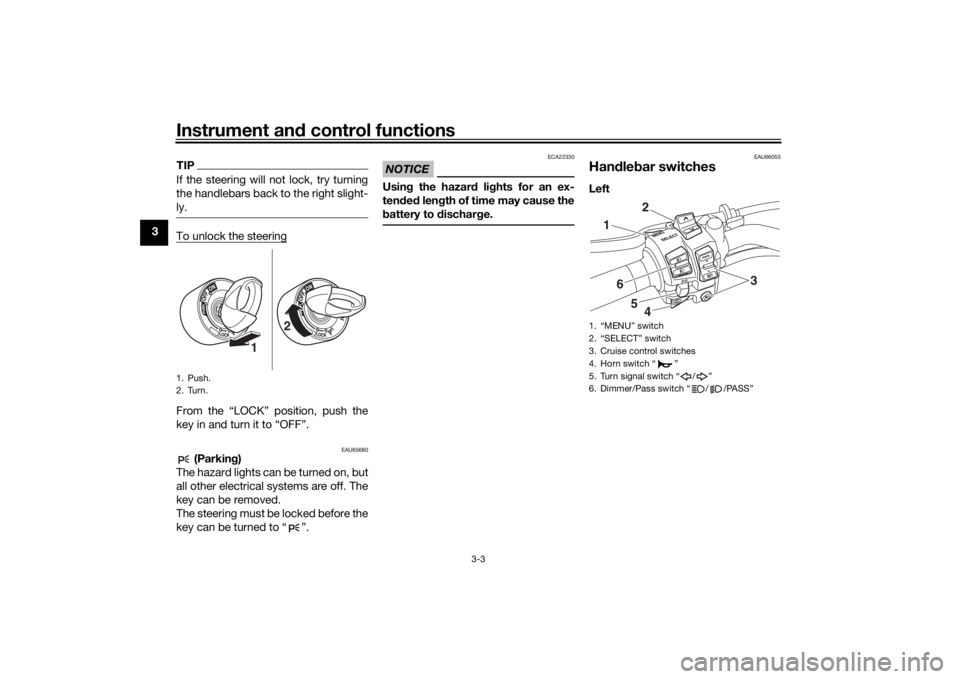
ly.To unlock the steeringFrom the “LOCK” position, push the
key in and turn it to “OFF”.
EAU65680
(Parkin g)
The hazard lights can be turned on, but
all other electrical systems are off. The
key can be removed.
The steering must be locked before the
key can be turned to “ ”.
NOTICE
ECA22330
Usin g the hazar d li ghts for an ex-
ten ded len gth of time may cause the
b attery to d ischarge.
EAU66055
Han dle bar switchesLeft
1. Push.
2. Turn.
1 2
1. “MENU” switch
2. “SELECT” switch
3. Cruise control switches
4. Horn switch “ ”
5. Turn signal switch “ / ”
6. Dimmer/Pass switch “ / /PASS”
1
2
34
5
6
UBD5E0E0.book Page 3 Wednesday, April 25, 2018 2:23 PM
Page 19 of 106
Instrument and control functions
3-4
3
Ri
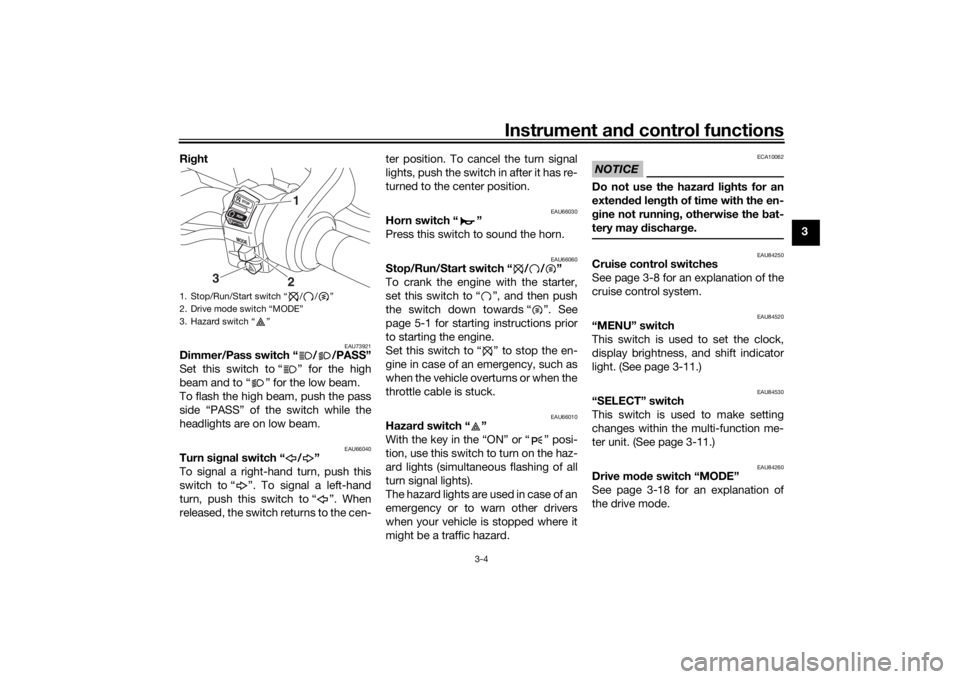
ght
EAU73921
Dimmer/Pass switch “ / /PASS”
Set this switch to “ ” for the high
beam and to “ ” for the low beam.
To flash the high beam, push the pass
side “PASS” of the switch while the
headlights are on low beam.
EAU66040
Turn si gnal switch “ / ”
To signal a right-hand turn, push this
switch to “ ”. To signal a left-hand
turn, push this switch to “ ”. When
released, the switch returns to the cen- ter position. To cancel the turn signal
lights, push the switch in after it has re-
turned to the center position.
EAU66030
Horn switch “ ”
Press this switch to sound the horn.
EAU66060
Stop/Run/Start switch “ / / ”
To crank the engine with the starter,
set this switch to “ ”, and then push
the switch down towards “ ”. See
page 5-1 for starting instructions prior
to starting the engine.
Set this switch to “ ” to stop the en-
gine in case of an emergency, such as
when the vehicle overturns or when the
throttle cable is stuck.
EAU66010
Hazar
d switch “ ”
With the key in the “ON” or “ ” posi-
tion, use this switch to turn on the haz-
ard lights (simultaneous flashing of all
turn signal lights).
The hazard lights are used in case of an
emergency or to warn other drivers
when your vehicle is stopped where it
might be a traffic hazard.
NOTICE
ECA10062
Do not use the hazar d lig hts for an
exten ded len gth of time with the en-
g ine not runnin g, otherwise the bat-
tery may d ischarge.
EAU84250
Cruise control switches
See page 3-8 for an explanation of the
cruise control system.
EAU84520
“MENU” switch
This switch is used to set the clock,
display brightness, and shift indicator
light. (See page 3-11.)
EAU84530
“SELECT” switch
This switch is used to make setting
changes within the multi-function me-
ter unit. (See page 3-11.)
EAU84260
Drive mo de switch “MODE”
See page 3-18 for an explanation of
the drive mode.
1. Stop/Run/Start switch “ / / ”
2. Drive mode switch “MODE”
3. Hazard switch “ ”
1
3
2
UBD5E0E0.book Page 4 Wednesday, April 25, 2018 2:23 PM
Page 20 of 106
Instrument and control functions
3-5
3
EAU4939F
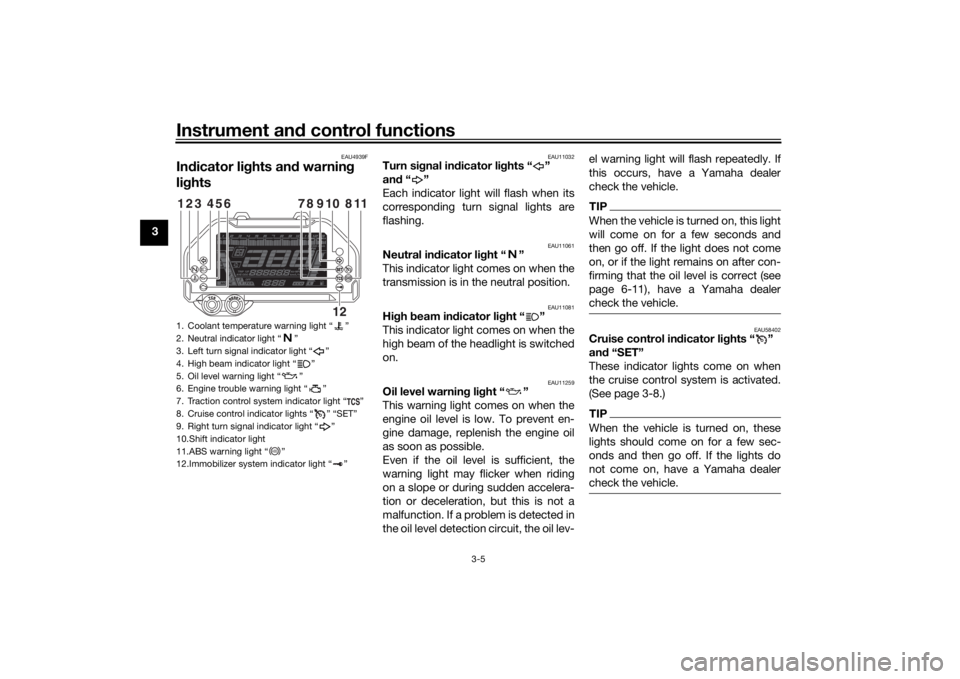
In dicator li ghts an d warnin g
li g hts
EAU11032
Turn si gnal in dicator li ghts “ ”
an d“”
Each indicator light will flash when its
corresponding turn signal lights are
flashing.
EAU11061
Neutral in dicator li ght “ ”
This indicator light comes on when the
transmission is in the neutral position.
EAU11081
Hi gh beam in dicator li ght “ ”
This indicator light comes on when the
high beam of the headlight is switched
on.
EAU11259
Oil level warnin g li ght “ ”
This warning light comes on when the
engine oil level is low. To prevent en-
gine damage, replenish the engine oil
as soon as possible.
Even if the oil level is sufficient, the
warning light may flicker when riding
on a slope or during sudden accelera-
tion or deceleration, but this is not a
malfunction. If a problem is detected in
the oil level detection circuit, the oil lev- el warning light will flash repeatedly. If
this occurs, have a Yamaha dealer
check the vehicle.
TIPWhen the vehicle is turned on, this light
will come on for a few seconds and
then go off. If the light does not come
on, or if the light remains on after con-
firming that the oil level is correct (see
page 6-11), have a Yamaha dealer
check the vehicle.
EAU58402
Cruise control in
dicator li ghts “ ”
an d “SET”
These indicator lights come on when
the cruise control system is activated.
(See page 3-8.)TIPWhen the vehicle is turned on, these
lights should come on for a few sec-
onds and then go off. If the lights do
not come on, have a Yamaha dealer
check the vehicle.
1. Coolant temperature warning light “ ”
2. Neutral indicator light “ ”
3. Left turn signal indicator light “ ”
4. High beam indicator light “ ”
5. Oil level warning light “ ”
6. Engine trouble warning light “ ”
7. Traction control system indicator light “ ”
8. Cruise control indicator lights “ ” “SET”
9. Right turn signal indicator light “ ”
10.Shift indicator light
11.ABS warning light “ ”
12.Immobilizer system indicator light “ ”123
654
118
910
78
12
ABS
UBD5E0E0.book Page 5 Wednesday, April 25, 2018 2:23 PM
Page 23 of 106
Instrument and control functions
3-8
3
EAU84291
Cruise control systemThis model is equipped with a cruise
control system designed to maintain a
set cruising speed.
The cruise control system operates
only when riding in 4th, 5th or 6th gear
at speeds between about 50 km/h (31
mi/h) and 160 km/h (100 mi/h).
WARNING
EWA16341
Improper use of the cruise con-
trol system may result in loss of
control, which coul d lea d to an
acci dent. Do not activate the
cruise control system in heavy
traffic, poor weather con ditions,
or amon g win din g, slippery,
hilly, roug h or gravel roa ds.
When travelin g uphill or d own-
hill, the cruise control system
may not b e able to maintain the
set cruisin g spee d.
To prevent acci dentally activat-
in g the cruise control system,
turn it off when not in use. Make
sure that the cruise control sys-
tem ind icator light “ ” is off.
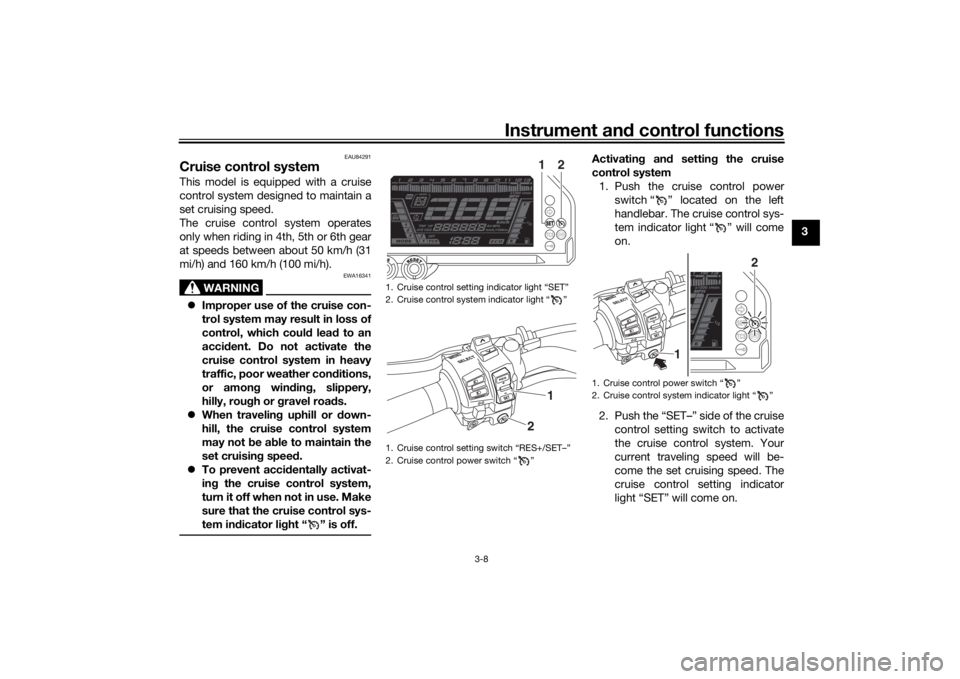
Activatin g an d settin g the cruise
control system 1. Push the cruise control power switch “ ” located on the left
handlebar. The cruise control sys-
tem indicator light “ ” will come
on.
2. Push the “SET–” side of the cruise control setting switch to activate
the cruise control system. Your
current traveling speed will be-
come the set cruising speed. The
cruise control setting indicator
light “SET” will come on.
1. Cruise control setting indicator light “SET”
2. Cruise control system indicator light “ ”
1. Cruise control setting switch “RES+/SET–”
2. Cruise control power switch “ ”
2
11
2
1. Cruise control power switch “ ”
2. Cruise control system indicator light “ ”
1 2
UBD5E0E0.book Page 8 Wednesday, April 25, 2018 2:23 PM
Page 24 of 106
Instrument and control functions
3-9
3
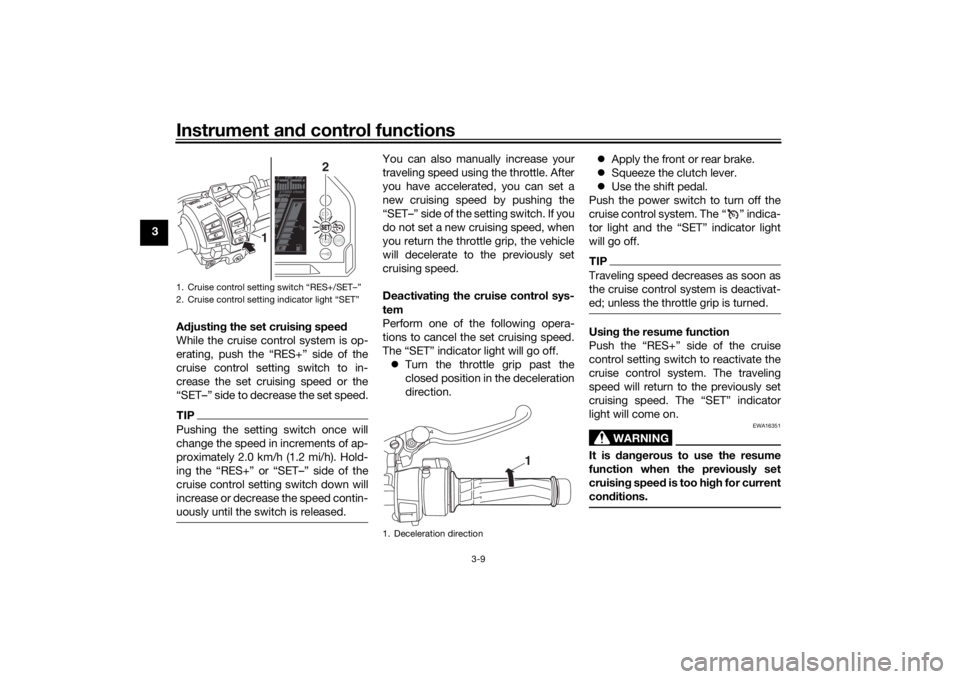
Adjustin g the set cruisin g speed
While the cruise control system is op-
erating, push the “RES+” side of the
cruise control setting switch to in-
crease the set cruising speed or the
“SET–” side to decrease the set speed.
TIPPushing the setting switch once will
change the speed in increments of ap-
proximately 2.0 km/h (1.2 mi/h). Hold-
ing the “RES+” or “SET–” side of the
cruise control setting switch down will
increase or decrease the speed contin-
uously until the switch is released.
You can also manually increase your
traveling speed using the throttle. After
you have accelerated, you can set a
new cruising speed by pushing the
“SET–” side of the setting switch. If you
do not set a new cruising speed, when
you return the throttle grip, the vehicle
will decelerate to the previously set
cruising speed.
Deactivatin g the cruise control sys-
tem
Perform one of the following opera-
tions to cancel the set cruising speed.
The “SET” indicator light will go off. Turn the throttle grip past the
closed position in the deceleration
direction.
Apply the front or rear brake.
Squeeze the clutch lever.
Use the shift pedal.
Push the power switch to turn off the
cruise control system. The “ ” indica-
tor light and the “SET” indicator light
will go off.
TIPTraveling speed decreases as soon as
the cruise control system is deactivat-
ed; unless the throttle grip is turned.Usin g the resume function
Push the “RES+” side of the cruise
control setting switch to reactivate the
cruise control system. The traveling
speed will return to the previously set
cruising speed. The “SET” indicator
light will come on.
WARNING
EWA16351
It is d angerous to use the resume
function when the previously set
cruisin g speed is too hi gh for current
con ditions.
1. Cruise control setting switch “RES+/SET–”
2. Cruise control setting indicator light “SET”
1 2
1. Deceleration direction
1
UBD5E0E0.book Page 9 Wednesday, April 25, 2018 2:23 PM
Page 25 of 106
Instrument and control functions
3-10
3
TIPPushing the power switch while the
system is operating will turn the sys-
tem off completely and erase the previ-
ously set cruising speed. You will not
be able to use the resume function until
a new cruising speed has been set.Automatic deactivation of the cruisecontrol systemThe cruise control system for this mod-
el is electronically controlled and is
linked with the other control systems.
The cruise control system will auto-
matically become deactivated under
the following conditions:
The cruise control system is not
able to maintain the set cruising
speed.
Wheel slip or wheel spin is detect-
ed. (If the traction control system
has not been turned off, the trac-
tion control system will work.)
The start/engine stop switch is set
to the “ ” position.
The engine stalls.
The sidestand is lowered. When traveling with a set cruising
speed, if the cruise control system is
deactivated under the above condi-
tions, the “ ” indicator light will go off
and the “SET” indicator light will flash
for 4 seconds, and then go off.
When not traveling with a set cruising
speed, if the start/engine stop switch is
set to the “ ” position, the engine
stalls, or the sidestand is lowered, then
the “ ” indicator light will go off (the
“SET” indicator light will not flash).
If the cruise control system is automat-
ically deactivated, please stop and
confirm that your vehicle is in good op-
erating condition.
Before using the cruise control system
again, activate it using the power
switch.
TIPIn some cases, the cruise control sys-
tem may not be able to maintain the set
cruising speed when the vehicle is
traveling uphill or downhill.
When the vehicle is traveling up-
hill, the actual traveling speed may
become lower than the set cruis- ing speed. If this occurs, acceler-
ate to the desired traveling speed
using the throttle.
When the vehicle is traveling
downhill, the actual traveling
speed may become higher than
the set cruising speed. If this oc-
curs, the setting switch cannot be
used to adjust the set cruising
speed. To reduce the traveling
speed, apply the brakes. When
the brakes are applied, the cruise
control system will become deac-
tivated.
UBD5E0E0.book Page 10 Wednesday, April 25, 2018 2:23 PM
Page 55 of 106
Operation and important ri din g points
5-1
5
EAU15952
Read the Owner’s Manual carefully to
become familiar with all controls. If
there is a control or function you do not
understand, ask your Yamaha dealer.
WARNING
EWA10272
Failure to familiarize yourself with
the controls can lead to loss of con-
trol, which coul d cause an acci dent
or injury.
EAUM3632
TIPThis model is equipped with: a lean angle sensor. This sensor
stops the engine in case of a vehi-
cle turnover. If this happens, the
engine trouble warning light will
come on, but this is not a malfunc-
tion. Turn the vehicle power off
and then back on again to cancel
the warning light. Failing to do so
will prevent the engine from start-
ing even though the engine will
crank when pushing the start
switch.
an engine auto-stop system. The
engine stops automatically if left
idling for 20 minutes. If the engine
stops, simply push the start
switch to restart the engine.
EAU84620
Startin g the en gineUnder normal conditions, shift the
transmission into neutral before start-
ing the engine. To start the engine with
the transmission in gear, the sidestand
must be up and the clutch lever pulled.
To start the engine1. Set the engine stop switch to “ ”.
2. Turn the main switch to “ ”.
3. Confirm the following lights per-
form a circuit check. Coolant temperature warning
light
Oil level warning light
Engine trouble warning light
ABS warning light
Traction control system indi-
cator light
Cruise control indicator lights
Shift indicator light
Immobilizer system indicator
lightTIP The ABS warning light should go
off after reaching a speed of 10
km/h (6 mi/h) or higher.
UBD5E0E0.book Page 1 Wednesday, April 25, 2018 2:23 PM
Page 89 of 106
Periodic maintenance an d a djustment
6-31
6
EAU84650
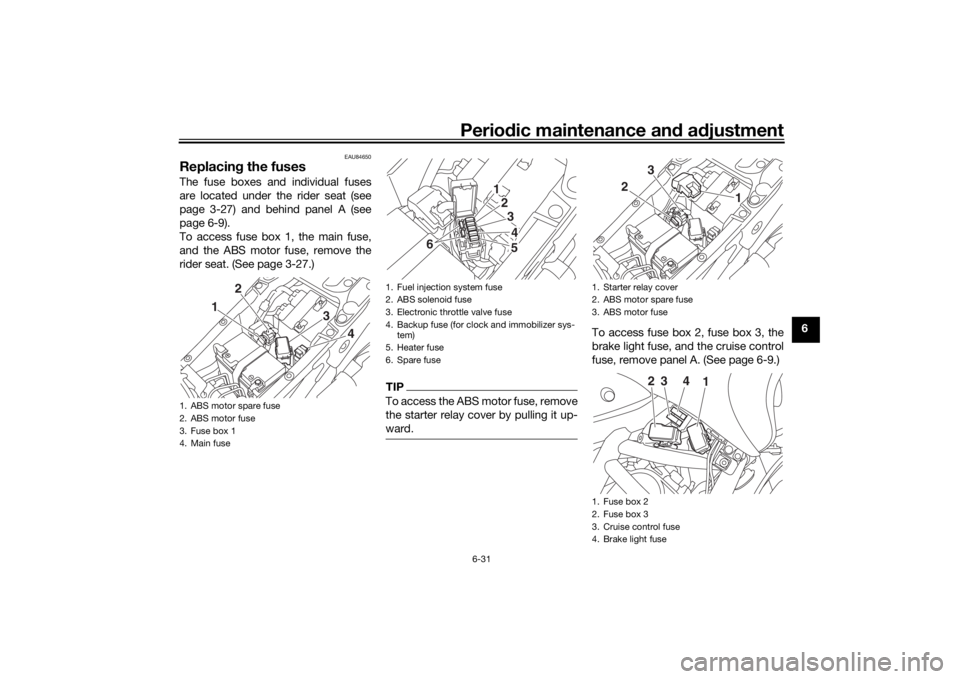
Replacin g the fusesThe fuse boxes and individual fuses
are located under the rider seat (see
page 3-27) and behind panel A (see
page 6-9).
To access fuse box 1, the main fuse,
and the ABS motor fuse, remove the
rider seat. (See page 3-27.)
TIPTo access the ABS motor fuse, remove
the starter relay cover by pulling it up-
ward.
To access fuse box 2, fuse box 3, the
brake light fuse, and the cruise control
fuse, remove panel A. (See page 6-9.)
1. ABS motor spare fuse
2. ABS motor fuse
3. Fuse box 1
4. Main fuse
1 2
34
1. Fuel injection system fuse
2. ABS solenoid fuse
3. Electronic throttle valve fuse
4. Backup fuse (for clock and immobilizer sys-tem)
5. Heater fuse
6. Spare fuse
1234
65
1. Starter relay cover
2. ABS motor spare fuse
3. ABS motor fuse
1. Fuse box 2
2. Fuse box 3
3. Cruise control fuse
4. Brake light fuse
2 3
1
2
3
41
UBD5E0E0.book Page 31 Wednesday, April 25, 2018 2:23 PM
Page 90 of 106
Periodic maintenance an d a djustment
6-32
6
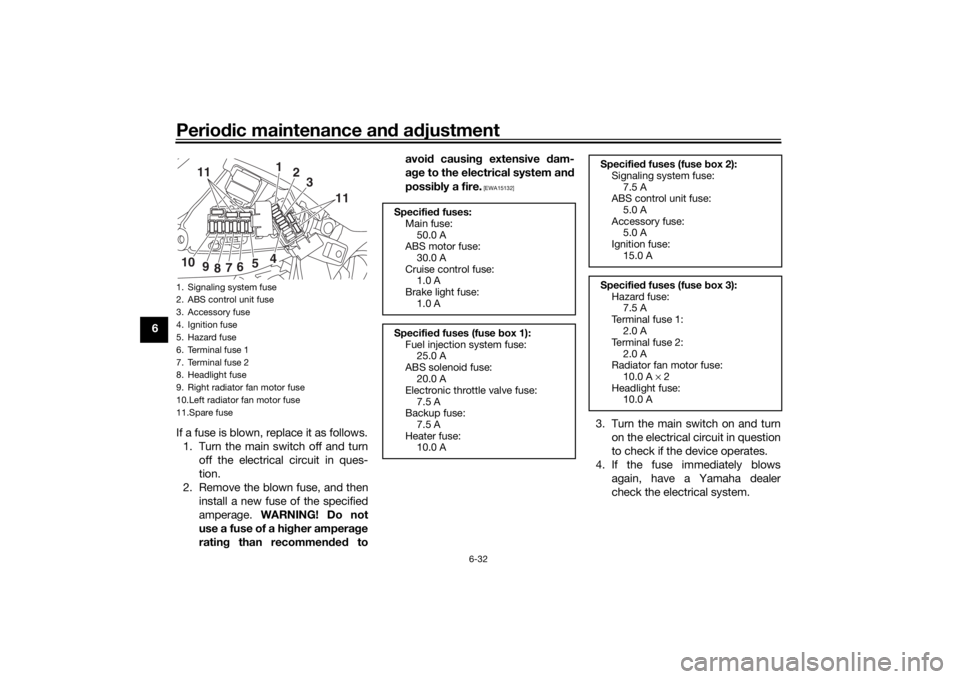
If a fuse is blown, replace it as follows.1. Turn the main switch off and turn off the electrical circuit in ques-
tion.
2. Remove the blown fuse, and then install a new fuse of the specified
amperage. WARNING! Do not
use a fuse of a hi gher ampera ge
ratin g than recommen ded to avoi
d causin g extensive d am-
a g e to the electrical system an d
possi bly a fire.
[EWA15132]
3. Turn the main switch on and turn
on the electrical circuit in question
to check if the device operates.
4. If the fuse immediately blows again, have a Yamaha dealer
check the electrical system.
1. Signaling system fuse
2. ABS control unit fuse
3. Accessory fuse
4. Ignition fuse
5. Hazard fuse
6. Terminal fuse 1
7. Terminal fuse 2
8. Headlight fuse
9. Right radiator fan motor fuse
10.Left radiator fan motor fuse
11.Spare fuse
11 1
2
3
11
10 9876 5 4
Specifie
d fuses:
Main fuse: 50.0 A
ABS motor fuse:
30.0 A
Cruise control fuse: 1.0 A
Brake light fuse: 1.0 A
Specifie d fuses (fuse box 1):
Fuel injection system fuse: 25.0 A
ABS solenoid fuse: 20.0 A
Electronic throttle valve fuse:
7.5 A
Backup fuse: 7.5 A
Heater fuse: 10.0 A
Specifie d fuses (fuse box 2):
Signaling system fuse:
7.5 A
ABS control unit fuse:
5.0 A
Accessory fuse: 5.0 A
Ignition fuse: 15.0 A
Specifie d fuses (fuse box 3):
Hazard fuse: 7.5 A
Te r m i n a l f u s e 1 : 2.0 A
Te r m i n a l f u s e 2 :
2.0 A
Radiator fan motor fuse: 10.0 A × 2
Headlight fuse: 10.0 A
UBD5E0E0.book Page 32 Wednesday, April 25, 2018 2:23 PM