tow YAMAHA NIKEN GT 2020 Owners Manual
[x] Cancel search | Manufacturer: YAMAHA, Model Year: 2020, Model line: NIKEN GT, Model: YAMAHA NIKEN GT 2020Pages: 108, PDF Size: 9.92 MB
Page 19 of 108
Instrument and control functions
3-4
3
Ri
ght
EAU85481
Dimmer/Pass switch “ / /PASS”
Set this switch to “ ” for the high
beam and to “ ” for the low beam.
To flash the high beam, press the
switch down to “PASS” while the
headlights are on low beam.TIPWhen the switch is set to low beam,
only the two outer headlights come on.
When the switch is set to high beam,
the two inner headlights also come on.
EAU66040
Turn si gnal switch “ / ”
To signal a right-hand turn, push this
switch to “ ”. To signal a left-hand
turn, push this switch to “ ”. When
released, the switch returns to the cen-
ter position. To cancel the turn signal
lights, push the switch in after it has re-
turned to the center position.
EAU66030
Horn switch “ ”
Press this switch to sound the horn.
EAU66061
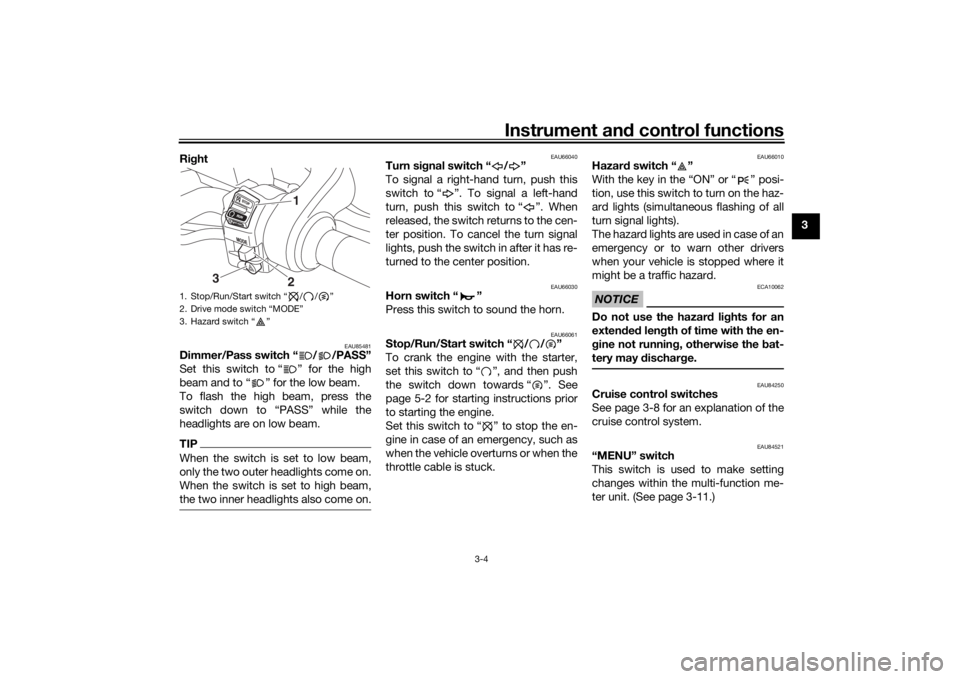
Stop/Run/Start switch “ / / ”
To crank the engine with the starter,
set this switch to “ ”, and then push
the switch down towards “ ”. See
page 5-2 for starting instructions prior
to starting the engine.
Set this switch to “ ” to stop the en-
gine in case of an emergency, such as
when the vehicle overturns or when the
throttle cable is stuck.
EAU66010
Hazar d switch “ ”
With the key in the “ON” or “ ” posi-
tion, use this switch to turn on the haz-
ard lights (simultaneous flashing of all
turn signal lights).
The hazard lights are used in case of an
emergency or to warn other drivers
when your vehicle is stopped where it
might be a traffic hazard.NOTICE
ECA10062
Do not use the hazar d lig hts for an
exten ded len gth of time with the en-
g ine not runnin g, otherwise the bat-
tery may d ischarge.
EAU84250
Cruise control switches
See page 3-8 for an explanation of the
cruise control system.
EAU84521
“MENU” switch
This switch is used to make setting
changes within the multi-function me-
ter unit. (See page 3-11.)
1. Stop/Run/Start switch “ / / ”
2. Drive mode switch “MODE”
3. Hazard switch “ ”
1
3
2
UB5BE1E0.book Page 4 Wednesday, October 30, 2019 9:59 AM
Page 27 of 108
Instrument and control functions
3-12
3
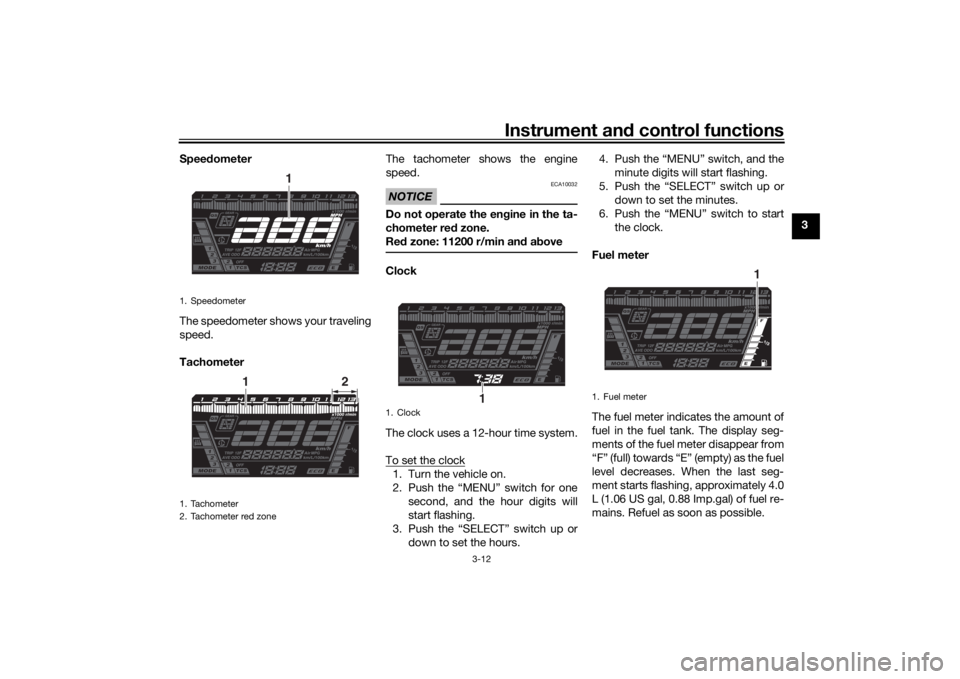
Spee
dometer
The speedometer shows your traveling
speed.
Tachometer The tachometer shows the engine
speed.
NOTICE
ECA10032
Do not operate the en
gine in the ta-
chometer red zone.
Re d zone: 11200 r/min an d a boveClock
The clock uses a 12-hour time system.
To set the clock1. Turn the vehicle on.
2. Push the “MENU” switch for one
second, and the hour digits will
start flashing.
3. Push the “SELECT” switch up or down to set the hours. 4. Push the “MENU” switch, and the
minute digits will start flashing.
5. Push the “SELECT” switch up or down to set the minutes.
6. Push the “MENU” switch to start the clock.
Fuel meter
The fuel meter indicates the amount of
fuel in the fuel tank. The display seg-
ments of the fuel meter disappear from
“F” (full) towards “E” (empty) as the fuel
level decreases. When the last seg-
ment starts flashing, approximately 4.0
L (1.06 US gal, 0.88 Imp.gal) of fuel re-
mains. Refuel as soon as possible.
1. Speedometer
1. Tachometer
2. Tachometer red zone
1
1
2
1. Clock
1
1. Fuel meter
1
UB5BE1E0.book Page 12 Wednesday, October 30, 2019 9:59 AM
Page 34 of 108
Instrument and control functions
3-19
3 MODE 3
This mode offers response that is
somewhat less sharp compared to
MODE 2 for riding situations that re-
quire especially sensitive throttle oper-
ation.
MODE 2
This mode is suitable for various riding
conditions.
This mode allows the rider to enjoy
smooth and sporty drivability from the
low-speed range to the high-speed
range.
MODE 1
This mode offers a sportier engine re-
sponse in the low- to mid-speed range
compared to MODE 2.
TIPThe current drive mode is saved when
the vehicle is turned off.
EAU12823
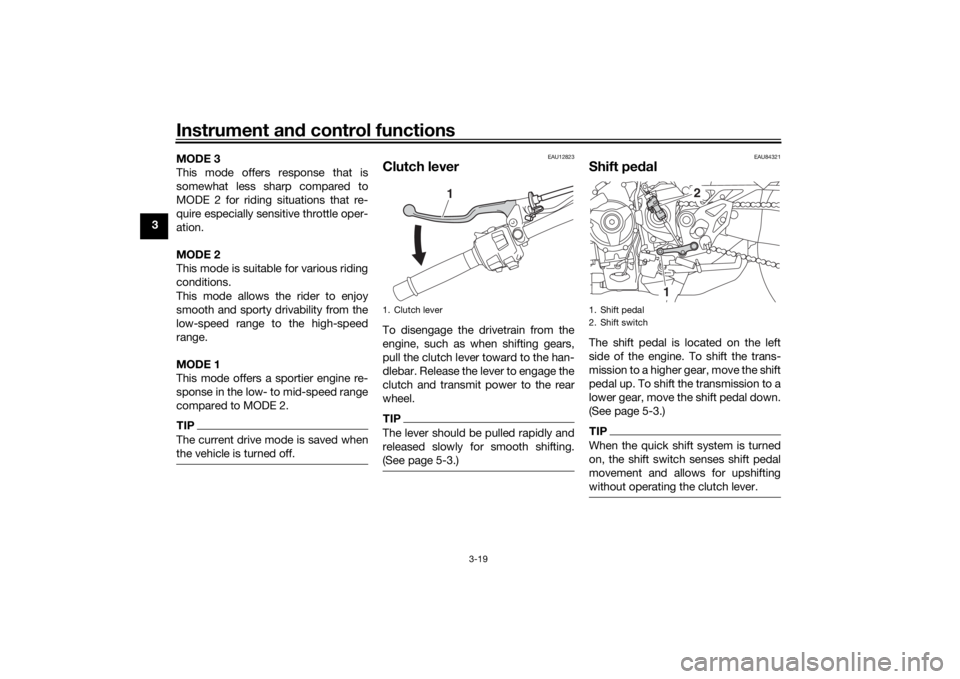
Clutch leverTo disengage the drivetrain from the
engine, such as when shifting gears,
pull the clutch lever toward to the han-
dlebar. Release the lever to engage the
clutch and transmit power to the rear
wheel.TIPThe lever should be pulled rapidly and
released slowly for smooth shifting.
(See page 5-3.)
EAU84321
Shift pe
dalThe shift pedal is located on the left
side of the engine. To shift the trans-
mission to a higher gear, move the shift
pedal up. To shift the transmission to a
lower gear, move the shift pedal down.
(See page 5-3.)TIPWhen the quick shift system is turned
on, the shift switch senses shift pedal
movement and allows for upshifting
without operating the clutch lever.
1. Clutch lever
1
1. Shift pedal
2. Shift switch
2
1
UB5BE1E0.book Page 19 Wednesday, October 30, 2019 9:59 AM
Page 35 of 108
Instrument and control functions
3-20
3
EAU84560
Quick shift systemThe quick shift system (QS) allows for
full-throttle, clutch lever-less, electron-
ically-assisted upshifts. When the shift
switch detects motion in the shift ped-
al, engine power and drive torque are
momentarily adjusted to allow the up-
shift to occur.TIP QS operates when traveling at
least 20 km/h (12 mi/h) with an en-
gine speed of 4000 r/min or high-
er, and only when accelerating.
QS does not operate when the
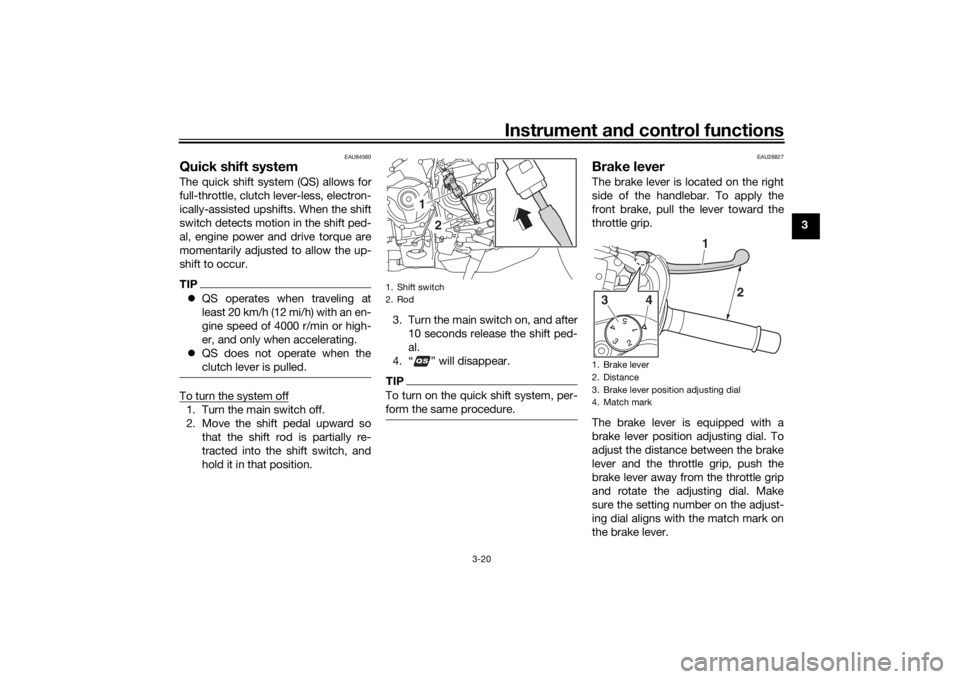
clutch lever is pulled.To turn the system off1. Turn the main switch off.
2. Move the shift pedal upward so
that the shift rod is partially re-
tracted into the shift switch, and
hold it in that position. 3. Turn the main switch on, and after
10 seconds release the shift ped-
al.
4. “ ” will disappear.
TIPTo turn on the quick shift system, per-
form the same procedure.
EAU26827
Brake leverThe brake lever is located on the right
side of the handlebar. To apply the
front brake, pull the lever toward the
throttle grip.
The brake lever is equipped with a
brake lever position adjusting dial. To
adjust the distance between the brake
lever and the throttle grip, push the
brake lever away from the throttle grip
and rotate the adjusting dial. Make
sure the setting number on the adjust-
ing dial aligns with the match mark on
the brake lever.
1. Shift switch
2. Rod
1
2
1. Brake lever
2. Distance
3. Brake lever position adjusting dial
4. Match mark3
4
1
2
UB5BE1E0.book Page 20 Wednesday, October 30, 2019 9:59 AM
Page 57 of 108
Operation and important ri din g points
5-3
5
EAU84370
Shiftin gShifting gears lets you control the
amount of engine power available for
starting off, accelerating, climbing hills,
etc.
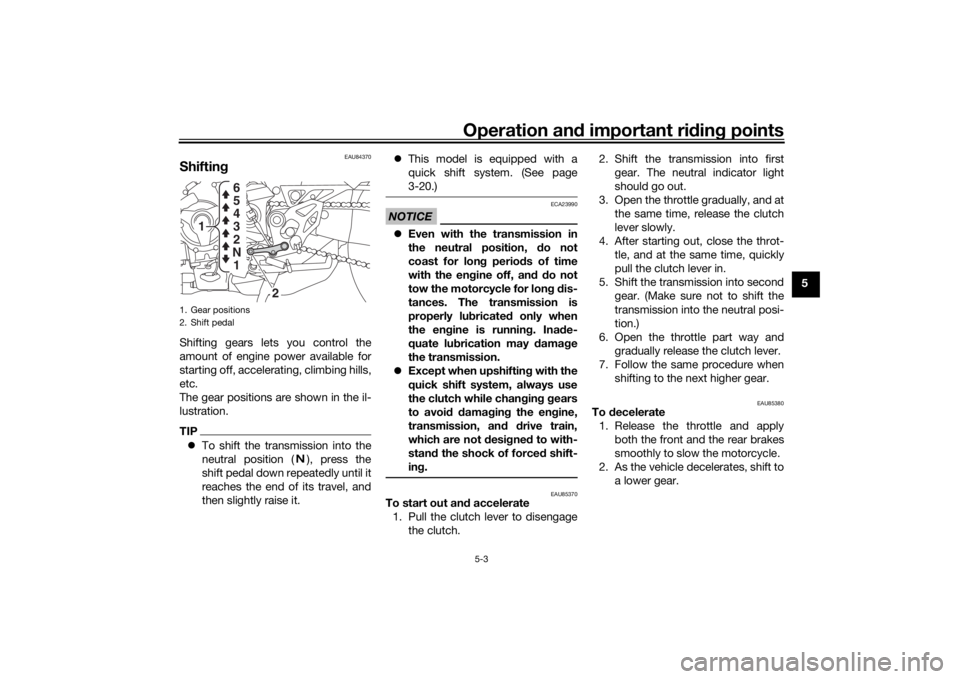
The gear positions are shown in the il-
lustration.TIPTo shift the transmission into the
neutral position ( ), press the
shift pedal down repeatedly until it
reaches the end of its travel, and
then slightly raise it.
This model is equipped with a
quick shift system. (See page
3-20.)
NOTICE
ECA23990
Even with the transmission in
the neutral position, do not
coast for lon g period s of time
with the eng ine off, and d o not
tow the motorcycle for lon g d is-
tances. The transmission is
properly lu bricated only when
the en gine is runnin g. Ina de-
quate lu brication may damag e
the transmission.
Except when upshiftin g with the
quick shift system, always use
the clutch while chan gin g g ears
to avoi d d amag ing the en gine,
transmission, an d drive train,
which are not desi gne d to with-
stan d the shock of forced shift-
in g.
EAU85370
To start out an d accelerate
1. Pull the clutch lever to disengage the clutch. 2. Shift the transmission into first
gear. The neutral indicator light
should go out.
3. Open the throttle gradually, and at the same time, release the clutch
lever slowly.
4. After starting out, close the throt- tle, and at the same time, quickly
pull the clutch lever in.
5. Shift the transmission into second gear. (Make sure not to shift the
transmission into the neutral posi-
tion.)
6. Open the throttle part way and gradually release the clutch lever.
7. Follow the same procedure when shifting to the next higher gear.
EAU85380
To decelerate
1. Release the throttle and apply both the front and the rear brakes
smoothly to slow the motorcycle.
2. As the vehicle decelerates, shift to a lower gear.
1. Gear positions
2. Shift pedal
2
1
1
N 2 3 4
5
6
UB5BE1E0.book Page 3 Wednesday, October 30, 2019 9:59 AM
Page 95 of 108
Periodic maintenance an d a djustment
6-36
6
EAU86420
En gine overheatin g
WARNING
EWAT1041
Do not remove the ra diator cap when the en gine an d ra diator are hot. Scal din g hot flui d an d steam may be
b lown out un der pressure, which coul d cause serious injury. Be sure to wait until the en gine has coole d.
Place a thick ra g, like a towel, over the ra diator cap, an d then slowly rotate the cap counterclockwise to the
d etent to allow any resi dual pressure to escape. When the hissin g soun d has stoppe d, press down on the cap
while turnin g it counterclockwise, an d then remove the cap.TIPIf coolant is not available, tap water can be temporarily used instead, provided that it is changed to the recommended cool-
ant as soon as possible.
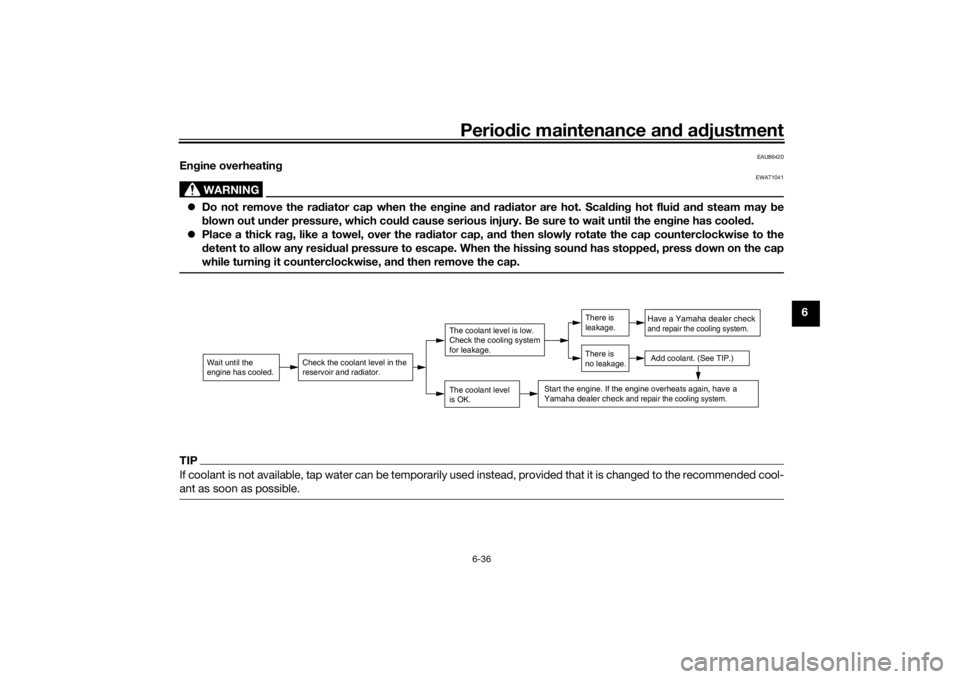
Wait until the
engine has cooled.
Check the coolant level in the
reservoir and radiator.
The coolant level
is OK.The coolant level is low.
Check the cooling system
for leakage.
Have a Yamaha dealer checkand repair the cooling system.Add coolant. (See TIP.)
Start the engine. If the engine overheats again,
have a
Yamaha dealer check
and repair the cooling system.
There is
leakage.
There is
no leakage.
UB5BE1E0.book Page 36 Wednesday, October 30, 2019 9:59 AM
Page 96 of 108
Motorcycle care and stora ge
7-1
7
EAU37834
Matte color cautionNOTICE
ECA15193
Some mo dels are equipped with
matte colore d finishe d parts. Be
sure to consult a Yamaha d ealer for
a d vice on what prod ucts to use be-
fore cleanin g the vehicle. Usin g a
b rush, harsh chemical prod ucts or
cleanin g compoun ds when cleanin g
these parts will scratch or damag e
their surface. Wax also shoul d not
b e applied to any matte colore d fin-
ishe d parts.
EAU83443
CareFrequent, thorough cleaning of the ve-
hicle will not only enhance its appear-
ance but also will improve its general
performance and extend the useful life
of many components. Washing, clean-
ing, and polishing will also give you a
chance to inspect the condition of the
vehicle more frequently. Be sure to
wash the vehicle after riding in the rain
or near the sea, because salt is corro-
sive to metals.TIP The roads of heavy snowfall areas
may be sprayed with salt as a de-
icing method. This salt can stay on
the roads well into spring, so be
sure to wash the underside and
chassis parts after riding in such
areas.
Genuine Yamaha care and main-
tenance products are sold under
the YAMALUBE brand in many
markets worldwide.
See your Yamaha dealer for addi-
tional cleaning tips.
NOTICE
ECA26280
Improper cleanin g can cause cos-
metic an d mechanical damag e. Do
not use: high-pressure washers or
steam-jet cleaners. Excessive
water pressure may cause wa-
ter seepa ge an d d eterioration of
wheel bearin gs, brakes, trans-
mission seals an d electrical d e-
vices. Avoi d hi gh-pressure
d eter gent applications such as
those availa ble in coin-operate d
car washers.
harsh chemicals, inclu din g
stron g aci dic wheel cleaners,
especially on spoke or ma gne-
sium wheels.
harsh chemicals, ab rasive
cleanin g compoun ds, or wax on
matte-finishe d parts. Brushes
can scratch an d damag e the
matte-finish, use soft spon ge or
towel only.
towels, spon ges, or brushes
contaminated with abrasive
cleanin g prod ucts or stron g
UB5BE1E0.book Page 1 Wednesday, October 30, 2019 9:59 AM
Page 97 of 108

Motorcycle care and stora ge
7-2
7
chemicals such as, solvents,
g
asoline, rust removers, b rake
flui d, or antifreeze, etc.
Before washin g
1. Park the vehicle out of direct sun- light and allow it to cool. This will
help avoid water spots.
2. Make sure all caps, covers, elec- trical couplers and connectors are
tightly installed.
3. Cover the muffler end with a plas- tic bag and a strong rubber band.
4. Pre-soak stubborn stains like in- sects or bird droppings with a wet
towel for a few minutes.
5. Remove road grime and oil stains with a quality degreasing agent
and a plastic-bristle brush or
sponge. NOTICE: Do not use
d eg reasin g a gent on areas re-
quirin g lu brication such as
seals, gaskets, an d wheel axles.
Follow pro duct instructions.
[ECA26290]
Washin g
1. Rinse off any degreaser and spray down the vehicle with a garden
hose. Use only enough pressure
to do the job. Avoid spraying wa-
ter directly into the muffler, instru-
ment panel, air inlet, or other inner
areas such as underseat storage
compartments.
2. Wash the vehicle with a quality au- tomotive-type detergent mixed
with cool water and a soft, clean
towel or sponge. Use an old tooth-
brush or plastic-bristle brush for
hard-to-reach places. NOTICE:
Use col d water if the vehicle has
b een exposed to salt. Warm wa-
ter will increase salt’s corrosive
properties.
[ECA26301]
3. For windshield-equipped vehicles: Clean the windshield with a soft
towel or sponge dampened with
water and a pH neutral detergent.
If necessary, use a high-quality
windshield cleaner or polish for
motorcycles. NOTICE: Never use
any stron g chemicals to clean
the wind shield. Additionally,
some cleanin g compoun ds for plastic may scratch the win
d-
shiel d, so b e sure to test all
cleanin g pro ducts before gen-
eral application.
[ECA26310]
4. Rinse off thoroughly with clean water. Be sure to remove all deter-
gent residues, as they can be
harmful to plastic parts.
After washin g
1. Dry the vehicle with a chamois or absorbent towel, preferably mi-
crofiber terrycloth.
2. For drive chain-equipped models: Dry and then lubricate the drive
chain to prevent rust.
3. Use a chrome polish to shine chrome, aluminum, and stainless
steel parts. Often the thermally in-
duced discoloring of stainless
steel exhaust systems can be re-
moved through polishing.
4. Apply a corrosion protection spray on all metal parts including
chrome or nickel-plated surfaces.
WARNING! Do not apply sili- cone or oil spray to seats, han d
g rips, ru bber foot pe gs or tire
trea ds. Otherwise these parts
UB5BE1E0.book Page 2 Wednesday, October 30, 2019 9:59 AM