brake YAMAHA PW50 2013 User Guide
[x] Cancel search | Manufacturer: YAMAHA, Model Year: 2013, Model line: PW50, Model: YAMAHA PW50 2013Pages: 76, PDF Size: 1.67 MB
Page 46 of 76
PERIODIC MAINTENANCE AND ADJUSTMENT
7-5
7
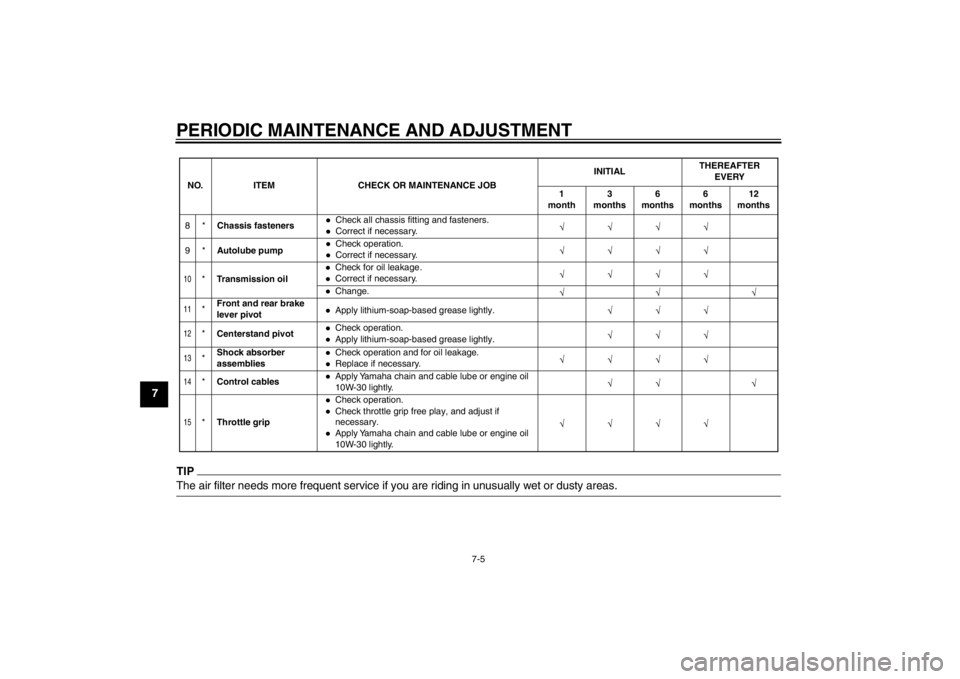
TIPThe air filter needs more frequent service if you are riding in unusually wet or dusty areas.10
*Transmission oil
Check for oil leakage .Correct if necessary.Change.
11
*Front and rear brake
lever pivot
Apply lithium-soap-based grease lightly.
12
*
Centerstand pivot
Check operation.Apply lithium-soap-based grease lightly.
13
*Shock absorber
assemblies
Check operation and for oil leakage.Replace if necessary.
14
*
Control cables
Apply Yamaha chain and cable lube or engine oil
10W-30 lightly.
15
*Throttle grip
Check operation.Check throttle grip free play, and adjust if
necessary.Apply Yamaha chain and cable lube or engine oil
10W-30 lightly.
NO. ITEM CHECK OR MAINTENANCE JOB
INITIAL
THEREAFTER
EVERY
1
month 3
months 6
months 6
months 12
months
8* Chassis fastenersCorrect if necessary.
A
9* utolube pumpCheck operation.Correct if necessary. Check all chassis fitting and fasteners.
U5PG8BE0.book Page 5 Wednesday, June 27, 2012 2:53 PM
Page 54 of 76
PERIODIC MAINTENANCE AND ADJUSTMENT
7-13
7Tire information
This motorcycle is equipped with panel
wheels and tube tires.
Tires age, even if they have not been
used or have only been used occasion-
ally. Cracking of the tread and sidewall
rubber, sometimes accompanied by
carcass deformation, is an evidence of
ageing. Old and aged tires shall be
checked by tire specialists to ascertain
their suitability for further use.
WARNING
EWA10461
The front and rear tires should be of
the same make and design, other-
wise the handling characteristics of
the vehicle may be different, which
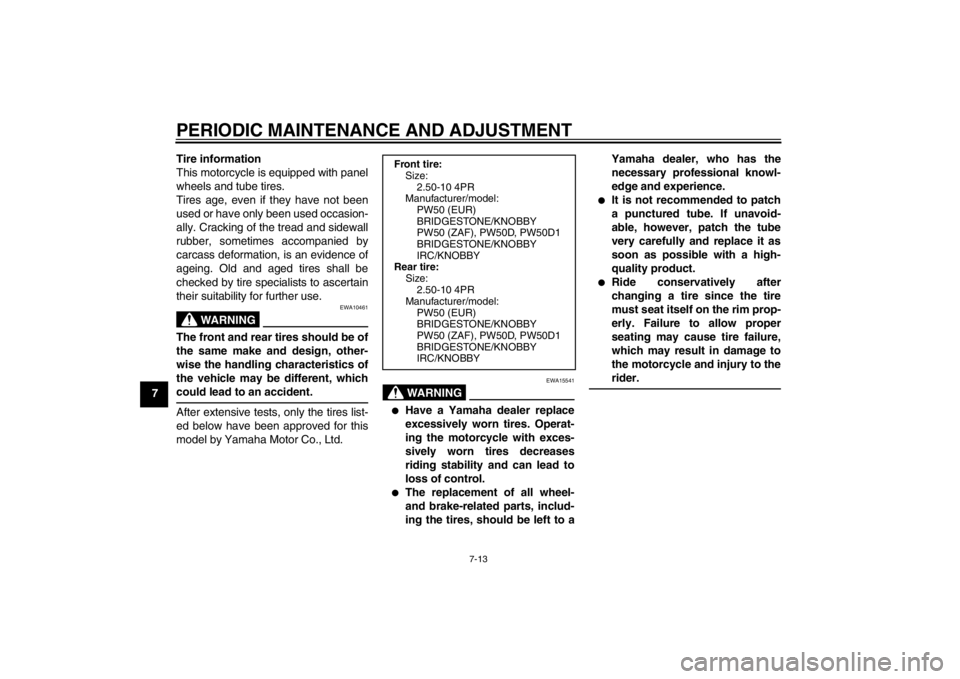
could lead to an accident.After extensive tests, only the tires list-
ed below have been approved for this
model by Yamaha Motor Co., Ltd.
WARNING
EWA15541
●
Have a Yamaha dealer replace
excessively worn tires. Operat-
ing the motorcycle with exces-
sively worn tires decreases
riding stability and can lead to
loss of control.
●
The replacement of all wheel-
and brake-related parts, includ-
ing the tires, should be left to a Yamaha dealer, who has the
necessary professional knowl-
edge and experience.
●
It is not recommended to patch
a punctured tube. If unavoid-
able, however, patch the tube
very carefully and replace it as
soon as possible with a high-
quality product.
●
Ride conservatively after
changing a tire since the tire
must seat itself on the rim prop-
erly. Failure to allow proper
seating may cause tire failure,
which may result in damage to
the motorcycle and injury to the
rider.
Front tire:
Size:
2.50-10 4PR
Manufacturer/model:
PW50 (EUR)
BRIDGESTONE/KNOBBY
PW50 (ZAF), PW50D, PW50D1
BRIDGESTONE/KNOBBY
IRC/KNOBBY
Rear tire:
Size:2.50-10 4PR
Manufacturer/model:
PW50 (EUR)
BRIDGESTONE/KNOBBY
PW50 (ZAF), PW50D, PW50D1
BRIDGESTONE/KNOBBY
IRC/KNOBBY
U5PG8BE0.book Page 13 Wednesday, June 27, 2012 2:53 PM
Page 55 of 76
PERIODIC MAINTENANCE AND ADJUSTMENT
7-14
7
EAU40781
Panel wheels
WARNING
EWA10610
The wheels on this model are not de-
signed for use with tubeless tires.
Do not attempt to use tubeless tires
on this model.To maximize the performance, durabil-
ity, and safe operation of your motorcy-
cle, note the following points regarding
the specified wheels.●
The wheel rims should be checked
for cracks, bends, warpage or
damage before each ride. If any
damage is found, have a Yamaha
dealer replace the wheel. Do not
attempt even the smallest repair to
the wheel. A deformed or cracked
wheel must be replaced.
●
The wheel should be balanced
whenever either the tire or wheel
has been changed or replaced. An
unbalanced wheel can result in
poor performance, adverse han-
dling characteristics, and a short-
ened tire life.
EAU22152
Adjusting the front and rear
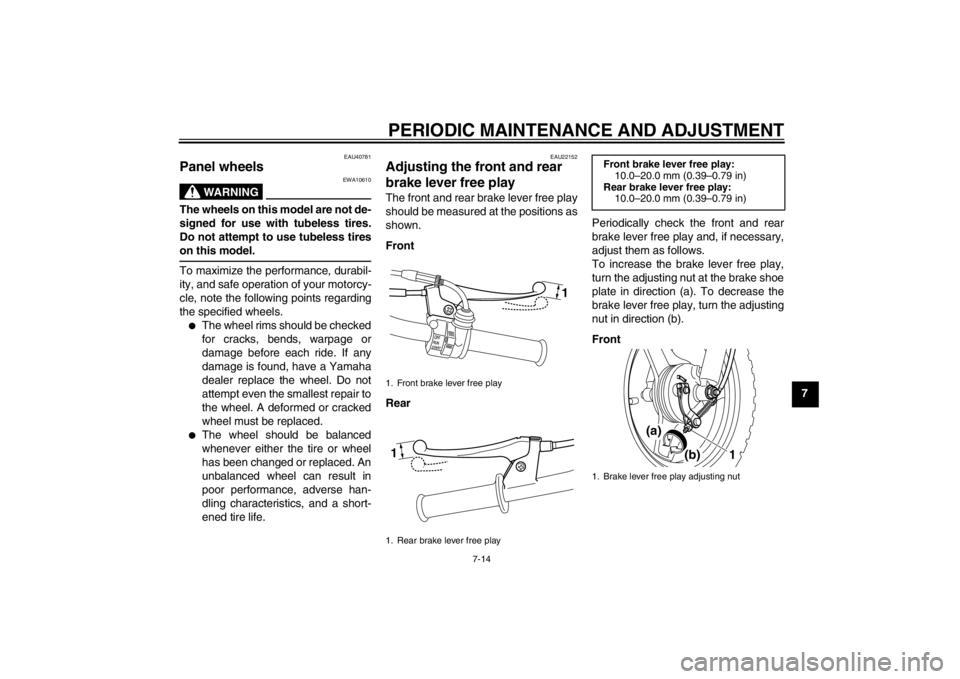
brake lever free play The front and rear brake lever free play
should be measured at the positions as
shown.
Front
RearPeriodically check the front and rear
brake lever free play and, if necessary,
adjust them as follows.
To increase the brake lever free play,
turn the adjusting nut at the brake shoe
plate in direction (a). To decrease the
brake lever free play, turn the adjusting
nut in direction (b).
Front1. Front brake lever free play
1. Rear brake lever free play
1
1
Front brake lever free play:
10.0–20.0 mm (0.39–0.79 in)
Rear brake lever free play: 10.0–20.0 mm (0.39–0.79 in)
1. Brake lever free play adjusting nut
1
(a)
(b)
U5PG8BE0.book Page 14 Wednesday, June 27, 2012 2:53 PM
Page 56 of 76
PERIODIC MAINTENANCE AND ADJUSTMENT
7-15
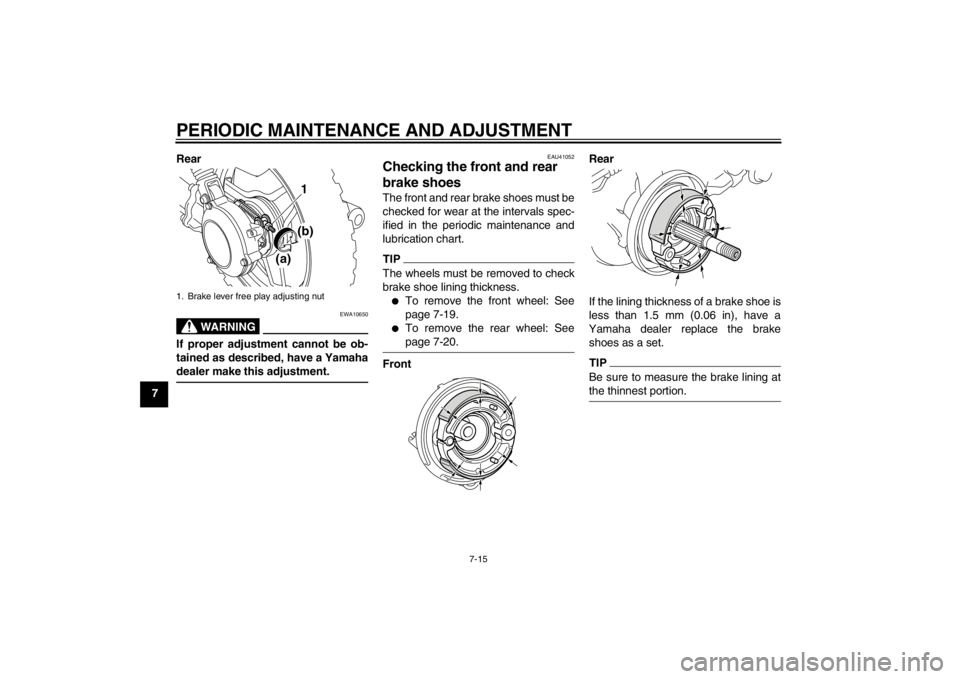
7Rear
WARNING
EWA10650
If proper adjustment cannot be ob-
tained as described, have a Yamaha
dealer make this adjustment.
EAU41052
Checking the front and rear
brake shoes The front and rear brake shoes must be
checked for wear at the intervals spec-
ified in the periodic maintenance and
lubrication chart.TIPThe wheels must be removed to check
brake shoe lining thickness.●
To remove the front wheel: See
page 7-19.
●
To remove the rear wheel: See
page 7-20.
Front
Rear
If the lining thickness of a brake shoe is
less than 1.5 mm (0.06 in), have a
Yamaha dealer replace the brake shoes as a set.
TIPBe sure to measure the brake lining at
the thinnest portion.
1. Brake lever free play adjusting nut
1
(a) (b)
U5PG8BE0.book Page 15 Wednesday, June 27, 2012 2:53 PM
Page 58 of 76
PERIODIC MAINTENANCE AND ADJUSTMENT
7-17
7
EAU43631
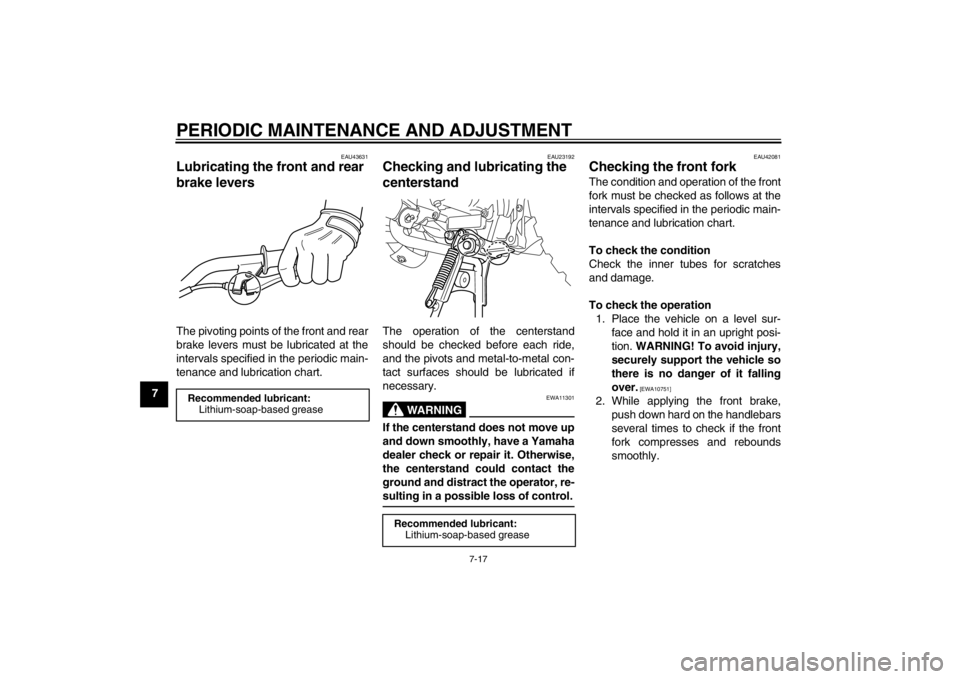
Lubricating the front and rear
brake levers The pivoting points of the front and rear
brake levers must be lubricated at the
intervals specified in the periodic main-
tenance and lubrication chart.
EAU23192
Checking and lubricating the
centerstand The operation of the centerstand
should be checked before each ride,
and the pivots and metal-to-metal con-
tact surfaces should be lubricated if
necessary.
WARNING
EWA11301
If the centerstand does not move up
and down smoothly, have a Yamaha
dealer check or repair it. Otherwise,
the centerstand could contact the
ground and distract the operator, re-
sulting in a possible loss of control.
EAU42081
Checking the front fork The condition and operation of the front
fork must be checked as follows at the
intervals specified in the periodic main-
tenance and lubrication chart.
To check the condition
Check the inner tubes for scratches
and damage.
To check the operation1. Place the vehicle on a level sur- face and hold it in an upright posi-
tion. WARNING! To avoid injury,
securely support the vehicle so
there is no danger of it falling
over.
[EWA10751]
2. While applying the front brake, push down hard on the handlebars
several times to check if the front
fork compresses and rebounds
smoothly.
Recommended lubricant:Lithium-soap-based grease
Recommended lubricant:Lithium-soap-based grease
U5PG8BE0.book Page 17 Wednesday, June 27, 2012 2:53 PM
Page 60 of 76
PERIODIC MAINTENANCE AND ADJUSTMENT
7-19
7
EAU24360
Front wheel
EAU41024
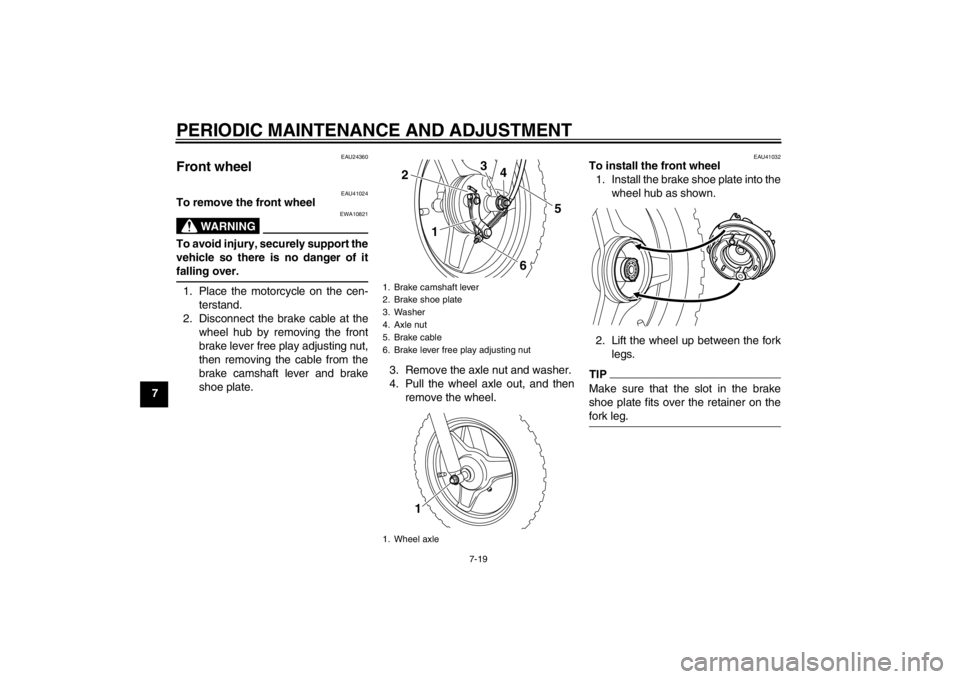
To remove the front wheel
WARNING
EWA10821
To avoid injury, securely support the
vehicle so there is no danger of it
falling over.1. Place the motorcycle on the cen-terstand.
2. Disconnect the brake cable at the wheel hub by removing the front
brake lever free play adjusting nut,
then removing the cable from the
brake camshaft lever and brake
shoe plate. 3. Remove the axle nut and washer.
4. Pull the wheel axle out, and then
remove the wheel.
EAU41032
To install the front wheel1. Install the brake shoe plate into the wheel hub as shown.
2. Lift the wheel up between the fork legs.TIPMake sure that the slot in the brake
shoe plate fits over the retainer on the
fork leg.
1. Brake camshaft lever
2. Brake shoe plate
3. Washer
4. Axle nut
5. Brake cable
6. Brake lever free play adjusting nut
1. Wheel axle
5
6
1 3
4
2
1
U5PG8BE0.book Page 19 Wednesday, June 27, 2012 2:53 PM
Page 61 of 76
PERIODIC MAINTENANCE AND ADJUSTMENT
7-20
7
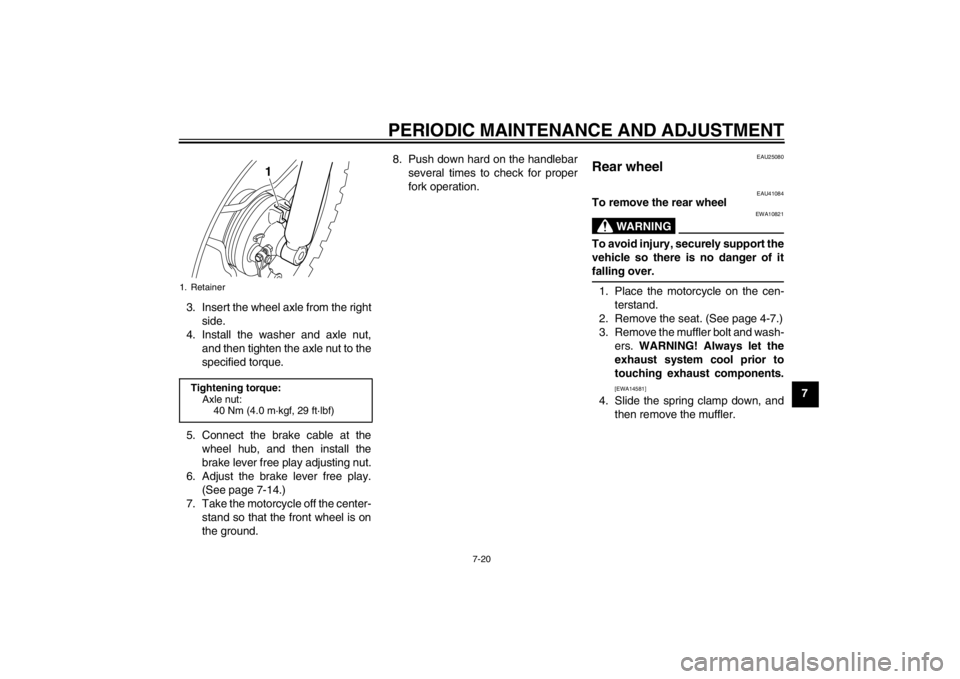
3. Insert the wheel axle from the right
side.
4. Install the washer and axle nut, and then tighten the axle nut to the
specified torque.
5. Connect the brake cable at the wheel hub, and then install the
brake lever free play adjusting nut.
6. Adjust the brake lever free play. (See page 7-14.)
7. Take the motorcycle off the center- stand so that the front wheel is on
the ground. 8. Push down hard on the handlebar
several times to check for proper
fork operation.
EAU25080
Rear wheel
EAU41084
To remove the rear wheel
WARNING
EWA10821
To avoid injury, securely support the
vehicle so there is no danger of it
falling over.1. Place the motorcycle on the cen-terstand.
2. Remove the seat. (See page 4-7.)
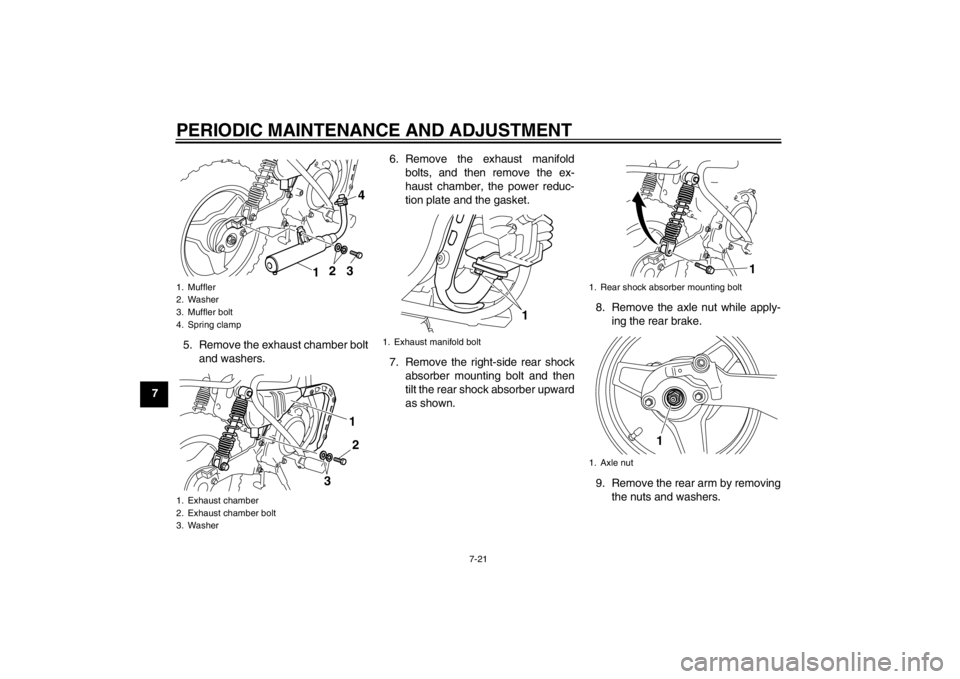
3. Remove the muffler bolt and wash- ers. WARNING! Always let the
exhaust system cool prior to
touching exhaust components.
[EWA14581]
4. Slide the spring clamp down, and then remove the muffler.
1. RetainerTightening torque:Axle nut:40 Nm (4.0 m·kgf, 29 ft·lbf)
1
U5PG8BE0.book Page 20 Wednesday, June 27, 2012 2:53 PM
Page 62 of 76
PERIODIC MAINTENANCE AND ADJUSTMENT
7-21
75. Remove the exhaust chamber bolt
and washers. 6. Remove the exhaust manifold
bolts, and then remove the ex-
haust chamber, the power reduc-
tion plate and the gasket.
7. Remove the right-side rear shock absorber mounting bolt and then
tilt the rear shock absorber upward
as shown. 8. Remove the axle nut while apply-
ing the rear brake.
9. Remove the rear arm by removing the nuts and washers.
1. Muffler
2. Washer
3. Muffler bolt
4. Spring clamp
1. Exhaust chamber
2. Exhaust chamber bolt
3. Washer
3
1
2 4
2
1
3
1. Exhaust manifold bolt
1
1. Rear shock absorber mounting bolt
1. Axle nut
1
1
U5PG8BE0.book Page 21 Wednesday, June 27, 2012 2:53 PM
Page 63 of 76
PERIODIC MAINTENANCE AND ADJUSTMENT
7-22
7
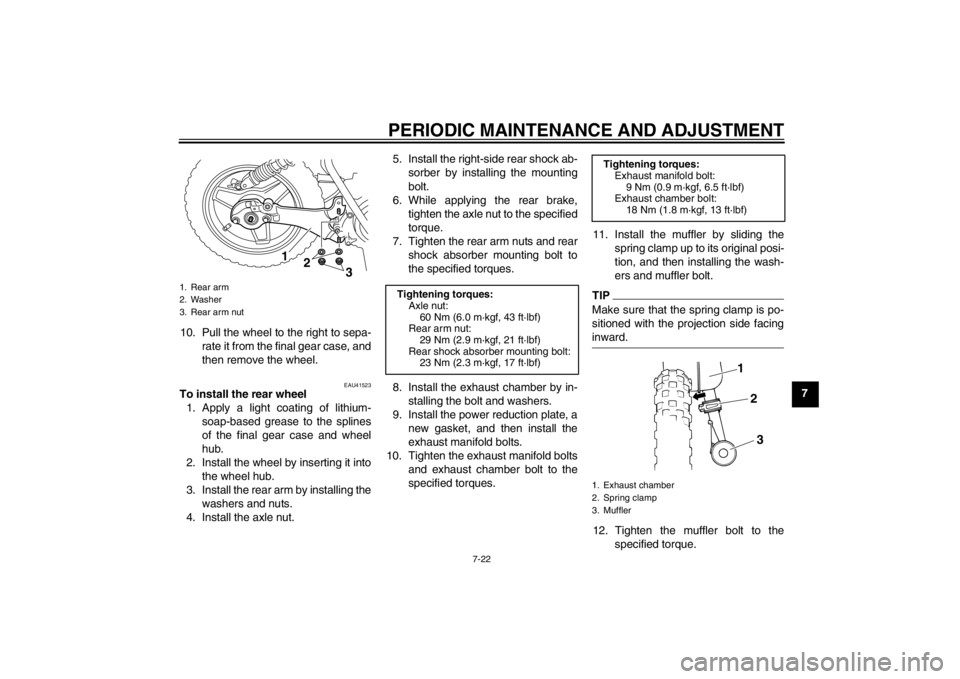
10. Pull the wheel to the right to sepa-
rate it from the final gear case, and
then remove the wheel.
EAU41523
To install the rear wheel1. Apply a light coating of lithium- soap-based grease to the splines
of the final gear case and wheel
hub.
2. Install the wheel by inserting it into the wheel hub.
3. Install the rear arm by installing the washers and nuts.
4. Install the axle nut. 5. Install the right-side rear shock ab-
sorber by installing the mounting
bolt.
6. While applying the rear brake, tighten the axle nut to the specified
torque.
7. Tighten the rear arm nuts and rear shock absorber mounting bolt to
the specified torques.
8. Install the exhaust chamber by in- stalling the bolt and washers.
9. Install the power reduction plate, a new gasket, and then install the
exhaust manifold bolts.
10. Tighten the exhaust manifold bolts and exhaust chamber bolt to the
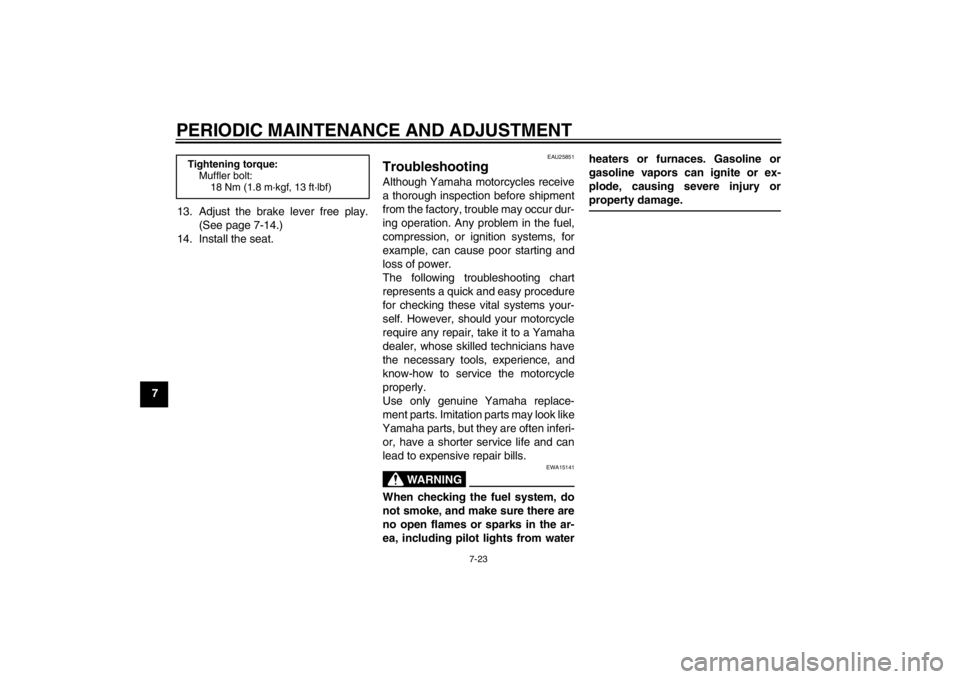
specified torques. 11. Install the muffler by sliding the
spring clamp up to its original posi-
tion, and then installing the wash-
ers and muffler bolt.
TIPMake sure that the spring clamp is po-
sitioned with the projection side facing
inward.12. Tighten the muffler bolt to thespecified torque.
1. Rear arm
2. Washer
3. Rear arm nut
12
3
Tightening torques:
Axle nut:60 Nm (6.0 m·kgf, 43 ft·lbf)
Rear arm nut:
29 Nm (2.9 m·kgf, 21 ft·lbf)
Rear shock absorber mounting bolt: 23 Nm (2.3 m·kgf, 17 ft·lbf)
Tightening torques:Exhaust manifold bolt:
9 Nm (0.9 m·kgf, 6.5 ft·lbf)
Exhaust chamber bolt:
18 Nm (1.8 m·kgf, 13 ft·lbf)
1. Exhaust chamber
2. Spring clamp
3. Muffler
1
2
3
U5PG8BE0.book Page 22 Wednesday, June 27, 2012 2:53 PM
Page 64 of 76
PERIODIC MAINTENANCE AND ADJUSTMENT
7-23
713. Adjust the brake lever free play.
(See page 7-14.)
14. Install the seat.
EAU25851
Troubleshooting Although Yamaha motorcycles receive
a thorough inspection before shipment
from the factory, trouble may occur dur-
ing operation. Any problem in the fuel,
compression, or ignition systems, for
example, can cause poor starting and
loss of power.
The following troubleshooting chart
represents a quick and easy procedure
for checking these vital systems your-
self. However, should your motorcycle
require any repair, take it to a Yamaha
dealer, whose skilled technicians have
the necessary tools, experience, and
know-how to service the motorcycle
properly.
Use only genuine Yamaha replace-
ment parts. Imitation parts may look like
Yamaha parts, but they are often inferi- or, have a shorter service life and can
lead to expensive repair bills.
WARNING
EWA15141
When checking the fuel system, do
not smoke, and make sure there are
no open flames or sparks in the ar-
ea, including pilot lights from water heaters or furnaces. Gasoline or
gasoline vapors can ignite or ex-
plode, causing severe injury or
property damage.
Tightening torque:
Muffler bolt:
18 Nm (1.8 m·kgf, 13 ft·lbf)
U5PG8BE0.book Page 23 Wednesday, June 27, 2012 2:53 PM