tires YAMAHA PW50 2013 Owners Manual
[x] Cancel search | Manufacturer: YAMAHA, Model Year: 2013, Model line: PW50, Model: YAMAHA PW50 2013Pages: 76, PDF Size: 1.67 MB
Page 9 of 76

TABLE OF CONTENTS
LOCATION OF IMPORTANT
LABELS ............................................1-1
SAFETY INFORMATION .................. 2-1
DESCRIPTION .................................. 3-1
Left view .......................................... 3-1
Right view ........................................ 3-2
Controls and instruments ................3-3
INSTRUMENT AND CONTROL
FUNCTIONS ....................................... 4-1
Handlebar switch ............................ 4-1
Speed limiter and power reduction plate ............................................4-1
Front brake lever ............................ 4-2
Rear brake lever ............................. 4-3
Fuel tank cap .................................. 4-3
Fuel ................................................ 4-3
Fuel tank breather hose ................. 4-5
2-stroke engine oil ..........................4-6
Fuel cock ........................................ 4-6
Starter (choke) lever ....................... 4-7
Kickstarter ......................................4-7
Seat ................................................ 4-7
Cable lock (for Europe) .................. 4-8 FOR YOUR SAFETY –
PRE-OPERATION CHECKS
............. 5-1
OPERATION AND IMPORTANT
RIDING POINTS ................................ 6-1
Starting and warming up a cold engine .............................. 6-1
Starting a warm engine .................. 6-1
Starting off ..................................... 6-2
Acceleration and deceleration ....... 6-2
Braking ........................................... 6-2
Engine break-in .............................. 6-3
Parking ........................................... 6-4
PERIODIC MAINTENANCE AND
ADJUSTMENT ................................... 7-1
Owner’s tool kit .............................. 7-2
Periodic maintenance chart for
the emission control system ....... 7-3
General maintenance and
lubrication chart .......................... 7-4
Checking the spark plug ................ 7-6
Removing the power reduction plate ............................................ 7-7
Transmission oil ............................. 7-8
Middle and final gear cases ........... 7-9
Cleaning the air filter element ........ 7-9
Cleaning the spark arrester ......... 7-10
Adjusting the carburetor ............... 7-11
Adjusting the engine idling speed ........................................ 7-11 Checking the throttle grip free
play ........................................... 7-12
Tires ............................................. 7-12
Panel wheels ................................ 7-14
Adjusting the front and rear brake lever free play .......... 7-14
Checking the front and rear brake shoes ....................... 7-15
Checking and lubricating the cables ................................. 7-16
Checking and lubricating
the throttle grip and cable ......... 7-16
Adjusting the Autolube pump ....... 7-16
Lubricating the front and rear brake levers ....................... 7-17
Checking and lubricating the centerstand ......................... 7-17
Checking the front fork ................. 7-17
Checking the steering .................. 7-18
Checking the wheel bearings ....... 7-18
Front wheel .................................. 7-19
Rear wheel ................................... 7-20
Troubleshooting ........................... 7-23
Troubleshooting chart .................. 7-24
MOTORCYCLE CARE AND
STORAGE .......................................... 8-1
Matte color caution ......................... 8-1
Care ............................................... 8-1
Storage ........................................... 8-3
U5PG8BE0.book Page 1 Wednesday, June 27, 2012 2:53 PM
Page 17 of 76
LOCATION OF IMPORTANT LABELS1-7
1
**.* kPa
*.** kgf/cm²*.* psi **.* kPa
*.** kgf/cm²
*.* psi
******
*** kW *** kg1
23
YAMAHA MOTOR CO., LTD.
2500 SHINGAI, IWATA, JAPAN
****1
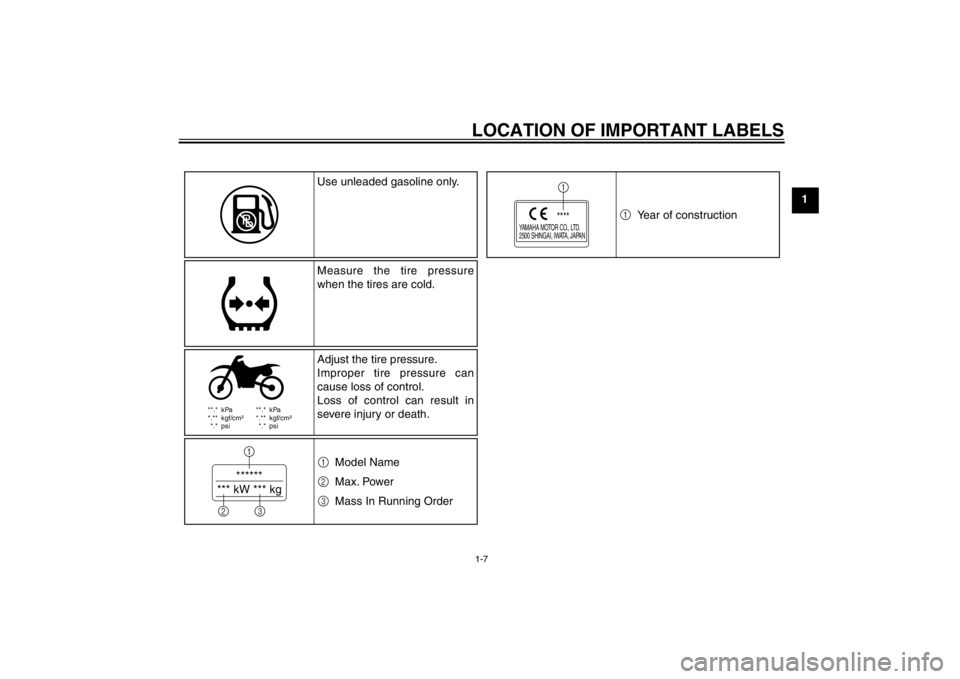
Use unleaded gasoline only.
Measure the tire pressure
when the tires are cold.
Adjust the tire pressure.
Improper tire pressure can
cause loss of control.
Loss of control can result in
severe injury or death.
1
2
3 Model Name
Max. Power
Mass In Running Order 1
Year of construction
U5PG8BE0.book Page 7 Wednesday, June 27, 2012 2:53 PM
Page 22 of 76

SAFETY INFORMATION
2-3
2
●
Do not run engine indoors. Even if
you try to ventilate engine exhaust
with fans or open windows and
doors, carbon monoxide can rap-
idly reach dangerous levels.
●
Do not run engine in poorly venti-
lated or partially enclosed areas
such as barns, garages, or car-
ports.
●
Do not run engine outdoors where
engine exhaust can be drawn into
a building through openings such
as windows and doors.
Loading
Adding accessories to your motorcycle
can adversely affect stability and han-
dling if the weight distribution of the mo-
torcycle is changed. To avoid the
possibility of an accident, use extreme
caution when adding accessories to
your motorcycle. Use extra care when
riding a motorcycle that has added ac-
cessories. Here are some general
guidelines to follow if adding accesso-
ries to your motorcycle:
Operation of an overloaded vehicle
could cause an accident.
●
The weight of the operator must
not exceed 25 kg (55 lb).
●
Accessory weight should be kept
as low and close to the motorcycle
as possible. Securely pack your
heaviest items as close to the cen-
ter of the vehicle as possible and
make sure to distribute the weight
as evenly as possible on both
sides of the motorcycle to mini-
mize imbalance or instability.
●
Shifting weights can create a sud-
den imbalance. Make sure that ac-
cessories are securely attached to
the motorcycle before riding.
Check accessory mounts fre-
quently. Properly adjust the suspension for your load (suspension-ad-
justable models only), and
check the condition and pres-
sure of your tires.
Never attach any large or heavy items to the handlebar, front
fork, or front fender. Genuine Yamaha Accessories
Choosing accessories for your vehicle
is an important decision. Genuine
Yamaha accessories, which are avail- able only from a Yamaha dealer, have
been designed, tested, and approved
by Yamaha for use on your vehicle.
Many companies with no connection to
Yamaha manufacture parts and acces- sories or offer other modifications for
Yamaha vehicles. Yamaha is not in a position to test the products that these
aftermarket companies produce.
Therefore, Yamaha can neither en-
dorse nor recommend the use of ac-
cessories not sold by Yamaha or
modifications not specifically recom-
mended by Yamaha, even if sold and
installed by a Yamaha dealer.
Aftermarket Parts, Accessories, and
Modifications
While you may find aftermarket prod-
ucts similar in design and quality to
genuine Yamaha accessories, recog-
nize that some aftermarket accessories
or modifications are not suitable be-
cause of potential safety hazards to you
or others. Installing aftermarket prod-
U5PG8BE0.book Page 3 Wednesday, June 27, 2012 2:53 PM
Page 23 of 76

SAFETY INFORMATION
2-4
2
ucts or having other modifications per-
formed to your vehicle that change any
of the vehicle’s design or operation
characteristics can put you and others
at greater risk of serious injury or death.
You are responsible for injuries related
to changes in the vehicle.
Keep the following guidelines in mind,
as well as those provided under “Load-
ing” when mounting accessories.
●
Never install accessories that
would impair the performance of
your motorcycle. Carefully inspect
the accessory before using it to
make sure that it does not in any
way reduce ground clearance or
cornering clearance, limit suspen-
sion travel, steering travel or con-
trol operation.
Accessories fitted to the handle- bar or the front fork area can
create instability due to improper
weight distribution. If accesso-
ries are added to the handlebar
or front fork area, they must be
as lightweight as possible and
should be kept to a minimum. Bulky or large accessories may
seriously affect the stability of
the motorcycle. Wind may at-
tempt to lift the motorcycle, or
the motorcycle may become un-
stable in cross winds.
Certain accessories can dis- place the operator from his or
her normal riding position. This
improper position limits the free-
dom of movement of the opera-
tor and may limit control ability,
therefore, such accessories are
not recommended.
●
Use caution when adding electri-
cal accessories. If electrical acces-
sories exceed the capacity of the
motorcycle’s electrical system, an
electric failure could result, which
could cause a dangerous loss of
lights or engine power.
Aftermarket Tires and Rims
The tires and rims that came with your
motorcycle were designed to match the
performance capabilities and to provide
the best combination of handling, brak-
ing, and comfort. Other tires, rims, siz-
es, and combinations may not be appropriate. Refer to page 7-12 for tire
specifications and more information on
replacing your tires.
Transporting the Motorcycle
Be sure to observe following instruc-
tions before transporting the motorcy-
cle in another vehicle.
●
Remove all loose items from the
motorcycle.
●
Check that the fuel cock is in the
“S” (stop) position and that there
are no fuel leaks.
●
Point the front wheel straight
ahead on the trailer or in the truck
bed, and choke it in a rail to pre-
vent movement.
●
Shift the transmission in gear (for
models with a manual transmis-
sion).
●
Secure the motorcycle with tie-
downs or suitable straps that are
attached to solid parts of the mo-
torcycle, such as the frame or up-
per front fork triple clamp (and not,
for example, to rubber-mounted
handlebars or turn signals, or parts
that could break). Choose the lo-
U5PG8BE0.book Page 4 Wednesday, June 27, 2012 2:53 PM
Page 37 of 76

FOR YOUR SAFETY – PRE-OPERATION CHECKS
5-2
5
Throttle grip Make sure that operation is smooth.
Check throttle grip free play.
If necessary, have Yamaha dealer adjust throttle grip free play and lubricate cable
and grip housing. 7-12, 7-16
Control cables Make sure that operation is smooth.
Lubricate if necessary.
7-16
Wheels and tires Check for damage.
Check tire condition and tread depth.
Check air pressure.
Correct if necessary. 7-12, 7-14
Brake levers Make sure that operation is smooth.
Lubricate lever pivoting points if necessary. 7-17
Centerstand Make sure that operation is smooth.
Lubricate pivot if necessary.
7-17
Chassis fasteners Make sure that all nuts, bolts and screws are properly tightened.
Tighten if necessary. —
Engine stop switch Check operation. 4-1
ITEM CHECKS PAGE
U5PG8BE0.book Page 2 Wednesday, June 27, 2012 2:53 PM
Page 45 of 76
PERIODIC MAINTENANCE AND ADJUSTMENT
7-4
7
EAU41757
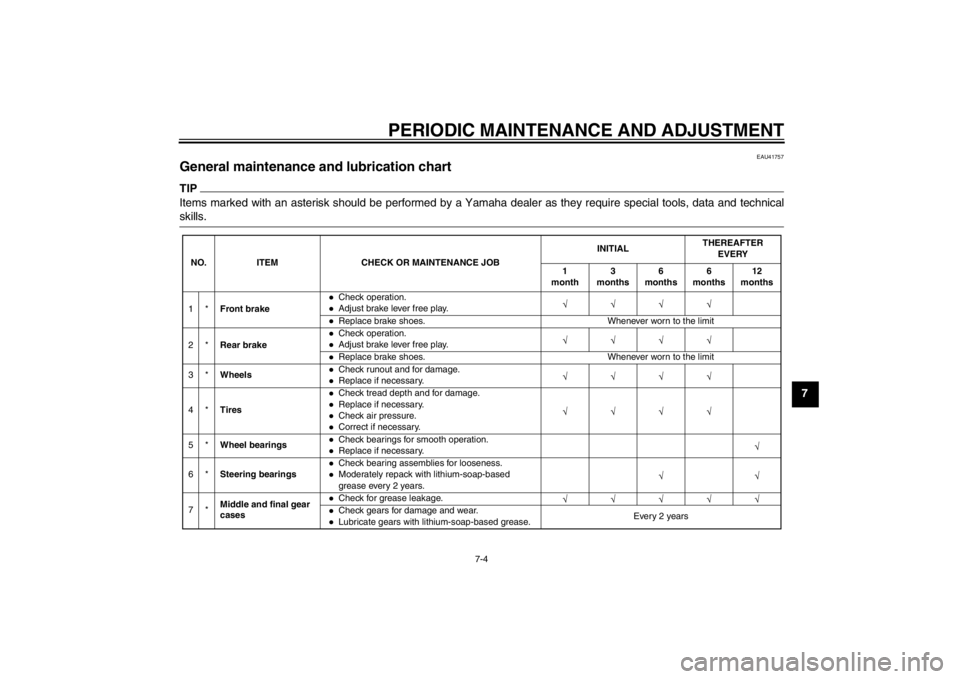
General maintenance and lubrication chart TIPItems marked with an asterisk should be performed by a Yamaha dealer as they require special tools, data and technical
skills.NO. ITEM CHECK OR MAINTENANCE JOB INITIAL
THEREAFTER
EVERY
1
month 3
months 6
months 6
months 12
months
1* Front brake
Check operation.Adjust brake lever free play.Replace brake shoes. Whenever worn to the limit
2* Rear brakeCheck operation.Adjust brake lever free play.Replace brake shoes. Whenever worn to the limit
3* WheelsCheck runout and for damage.Replace if necessary.
4* TiresCheck tread depth and for damage.Replace if necessary.Check air pressure.Correct if necessary.
5* Wheel bearingsCheck bearings for smooth operation.Replace if necessary.
6* Steering bearingsCheck bearing assemblies for looseness.Moderately repack with lithium-soap-based
grease every 2 years.
7*Check for grease leakage.Check gears for damage and wear.Lubricate gears with lithium-soap-based grease. Every 2 years
Middle and final gear
cases
U5PG8BE0.book Page 4 Wednesday, June 27, 2012 2:53 PM
Page 53 of 76
PERIODIC MAINTENANCE AND ADJUSTMENT
7-12
7
EAU21384
Checking the throttle grip free
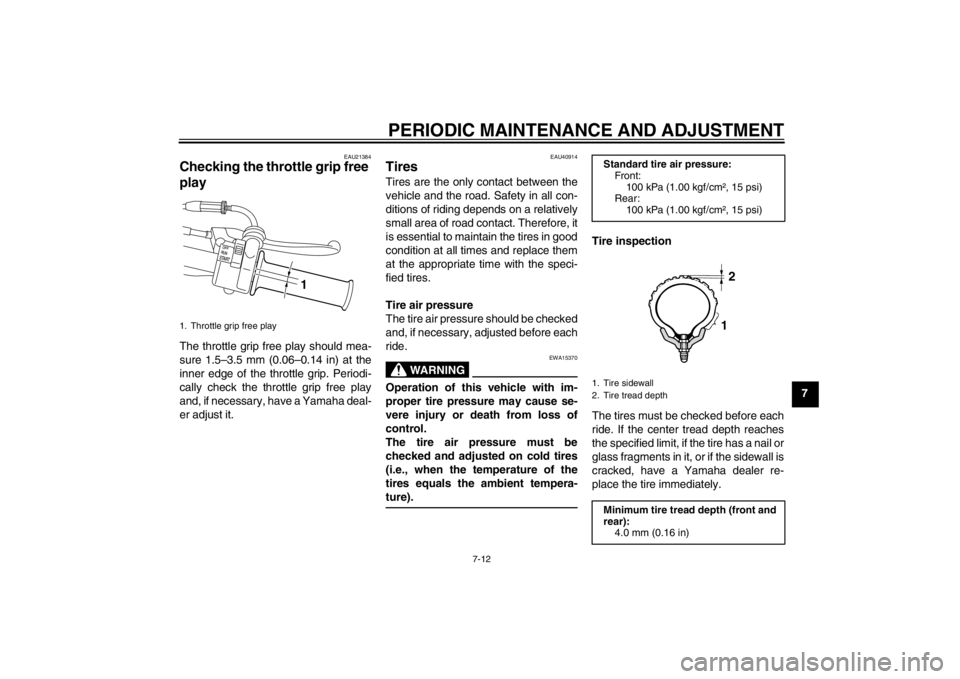
play The throttle grip free play should mea-
sure 1.5–3.5 mm (0.06–0.14 in) at the
inner edge of the throttle grip. Periodi-
cally check the throttle grip free play
and, if necessary, have a Yamaha deal-
er adjust it.
EAU40914
Tires Tires are the only contact between the
vehicle and the road. Safety in all con-
ditions of riding depends on a relatively
small area of road contact. Therefore, it
is essential to maintain the tires in good
condition at all times and replace them
at the appropriate time with the speci-
fied tires.
Tire air pressure
The tire air pressure should be checked
and, if necessary, adjusted before each
ride.
WARNING
EWA15370
Operation of this vehicle with im-
proper tire pressure may cause se-
vere injury or death from loss of
control.
The tire air pressure must be
checked and adjusted on cold tires
(i.e., when the temperature of the
tires equals the ambient tempera-
ture).
Tire inspection
The tires must be checked before each
ride. If the center tread depth reaches
the specified limit, if the tire has a nail or
glass fragments in it, or if the sidewall is
cracked, have a Yamaha dealer re-
place the tire immediately.
1. Throttle grip free play
1
Standard tire air pressure:Front:
100 kPa (1.00 kgf/cm², 15 psi)
Rear:
100 kPa (1.00 kgf/cm², 15 psi)
1. Tire sidewall
2. Tire tread depth
Minimum tire tread depth (front and
rear):4.0 mm (0.16 in)
12
U5PG8BE0.book Page 12 Wednesday, June 27, 2012 2:53 PM
Page 54 of 76
PERIODIC MAINTENANCE AND ADJUSTMENT
7-13
7Tire information
This motorcycle is equipped with panel
wheels and tube tires.
Tires age, even if they have not been
used or have only been used occasion-
ally. Cracking of the tread and sidewall
rubber, sometimes accompanied by
carcass deformation, is an evidence of
ageing. Old and aged tires shall be
checked by tire specialists to ascertain
their suitability for further use.
WARNING
EWA10461
The front and rear tires should be of
the same make and design, other-
wise the handling characteristics of
the vehicle may be different, which
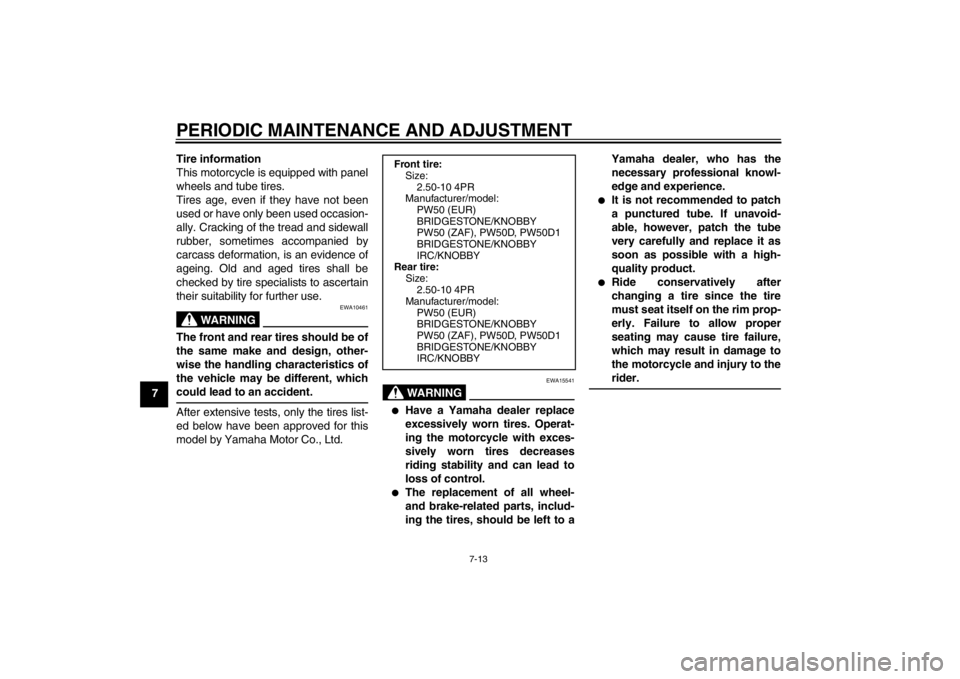
could lead to an accident.After extensive tests, only the tires list-
ed below have been approved for this
model by Yamaha Motor Co., Ltd.
WARNING
EWA15541
●
Have a Yamaha dealer replace
excessively worn tires. Operat-
ing the motorcycle with exces-
sively worn tires decreases
riding stability and can lead to
loss of control.
●
The replacement of all wheel-
and brake-related parts, includ-
ing the tires, should be left to a Yamaha dealer, who has the
necessary professional knowl-
edge and experience.
●
It is not recommended to patch
a punctured tube. If unavoid-
able, however, patch the tube
very carefully and replace it as
soon as possible with a high-
quality product.
●
Ride conservatively after
changing a tire since the tire
must seat itself on the rim prop-
erly. Failure to allow proper
seating may cause tire failure,
which may result in damage to
the motorcycle and injury to the
rider.
Front tire:
Size:
2.50-10 4PR
Manufacturer/model:
PW50 (EUR)
BRIDGESTONE/KNOBBY
PW50 (ZAF), PW50D, PW50D1
BRIDGESTONE/KNOBBY
IRC/KNOBBY
Rear tire:
Size:2.50-10 4PR
Manufacturer/model:
PW50 (EUR)
BRIDGESTONE/KNOBBY
PW50 (ZAF), PW50D, PW50D1
BRIDGESTONE/KNOBBY
IRC/KNOBBY
U5PG8BE0.book Page 13 Wednesday, June 27, 2012 2:53 PM
Page 55 of 76
PERIODIC MAINTENANCE AND ADJUSTMENT
7-14
7
EAU40781
Panel wheels
WARNING
EWA10610
The wheels on this model are not de-
signed for use with tubeless tires.
Do not attempt to use tubeless tires
on this model.To maximize the performance, durabil-
ity, and safe operation of your motorcy-
cle, note the following points regarding
the specified wheels.●
The wheel rims should be checked
for cracks, bends, warpage or
damage before each ride. If any
damage is found, have a Yamaha
dealer replace the wheel. Do not
attempt even the smallest repair to
the wheel. A deformed or cracked
wheel must be replaced.
●
The wheel should be balanced
whenever either the tire or wheel
has been changed or replaced. An
unbalanced wheel can result in
poor performance, adverse han-
dling characteristics, and a short-
ened tire life.
EAU22152
Adjusting the front and rear
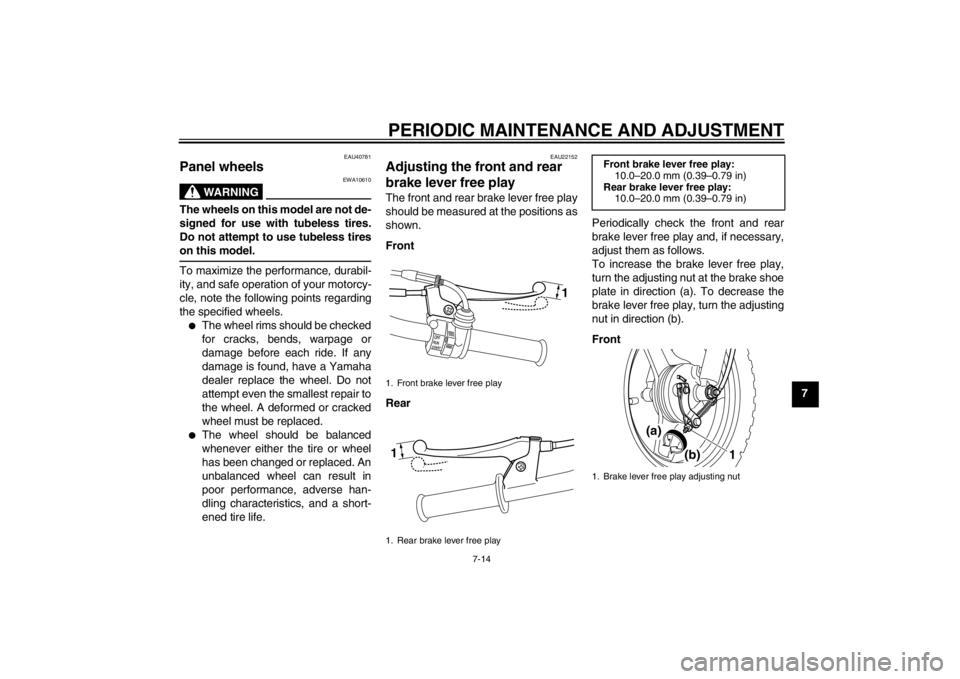
brake lever free play The front and rear brake lever free play
should be measured at the positions as
shown.
Front
RearPeriodically check the front and rear
brake lever free play and, if necessary,
adjust them as follows.
To increase the brake lever free play,
turn the adjusting nut at the brake shoe
plate in direction (a). To decrease the
brake lever free play, turn the adjusting
nut in direction (b).
Front1. Front brake lever free play
1. Rear brake lever free play
1
1
Front brake lever free play:
10.0–20.0 mm (0.39–0.79 in)
Rear brake lever free play: 10.0–20.0 mm (0.39–0.79 in)
1. Brake lever free play adjusting nut
1
(a)
(b)
U5PG8BE0.book Page 14 Wednesday, June 27, 2012 2:53 PM
Page 67 of 76
MOTORCYCLE CARE AND STORAGE
8-2
8
●
Do not use any harsh chemical
products on plastic parts. Be
sure to avoid using cloths or
sponges which have been in
contact with strong or abrasive
cleaning products, solvent or
thinner, fuel (gasoline), rust re-
movers or inhibitors, brake flu-
id, antifreeze or electrolyte.
●
Do not use high-pressure wash-
ers or steam-jet cleaners since
they cause water seepage and
deterioration in the following ar-
eas: seals (of wheel and swing-
arm bearings, fork and brakes),
electric components (couplers,
connectors, and switches),
breather hoses and vents.
After normal useRemove dirt with warm water, a mild
detergent, and a soft, clean sponge,
and then rinse thoroughly with clean
water. Use a toothbrush or bottlebrush
for hard-to-reach areas. Stubborn dirt
and insects will come off more easily if
the area is covered with a wet cloth for
a few minutes before cleaning.After riding in the rain or near the sea
Since sea salt is extremely corrosive,
carry out the following steps after each
ride in the rain or near the sea.
1. Clean the motorcycle with cold wa- ter and a mild detergent, after the
engine has cooled down.
NOTICE: Do not use warm water
since it increases the corrosive
action of the salt.
[ECA10791]
2. Apply a corrosion protection spray on all metal, including chrome- and
nickel-plated, surfaces to prevent
corrosion.
After cleaning 1. Dry the motorcycle with a chamois or an absorbing cloth.
2. Use a chrome polish to shine chrome, aluminum and stainless-
steel parts.
3. To prevent corrosion, it is recom- mended to apply a corrosion pro-
tection spray on all metal,
including chrome- and nickel-plat-
ed, surfaces.
4. Use spray oil as a universal clean- er to remove any remaining dirt. 5. Touch up minor paint damage
caused by stones, etc.
6. Wax all painted surfaces.
7. Let the motorcycle dry completely before storing or covering it.
WARNING
EWA14501
Contaminants on the brakes or tires
can cause loss of control.●
Make sure that there is no oil or
wax on the tires.
●
If necessary, wash the tires with
warm water and a mild deter-
gent. Before riding at higher
speeds, test the motorcycle’s
braking performance and cor-
nering behavior.
NOTICE
ECA10800
●
Apply spray oil and wax spar-
ingly and make sure to wipe off
any excess.
●
Never apply oil or wax to any
rubber and plastic parts, but
treat them with a suitable care
product.
U5PG8BE0.book Page 2 Wednesday, June 27, 2012 2:53 PM