brake YAMAHA PW50 2014 User Guide
[x] Cancel search | Manufacturer: YAMAHA, Model Year: 2014, Model line: PW50, Model: YAMAHA PW50 2014Pages: 76, PDF Size: 1.74 MB
Page 46 of 76
PERIODIC MAINTENANCE AND ADJUSTMENT
7-5
7
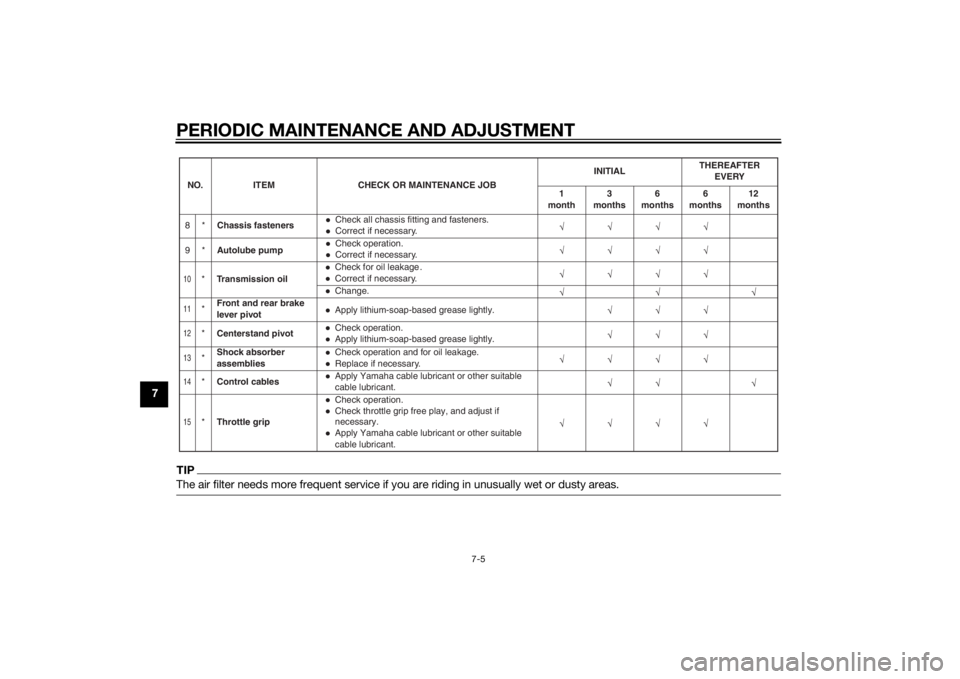
TIPThe air filter needs more frequent service if you are riding in unusually wet or dusty areas.10
*Transmission oil
Check for oil leakage .Correct if necessary.Change.
11
*Front and rear brake
lever pivot
Apply lithium-soap-based grease lightly.
12
*
Centerstand pivot
Check operation.Apply lithium-soap-based grease lightly.
13
*Shock absorber
assemblies
Check operation and for oil leakage.Replace if necessary.
14
*
Control cables
Apply Yamaha cable lubricant or other suitable
cable lubricant.
15
*Throttle grip
Check operation.Check throttle grip free play, and adjust if
necessary.Apply Yamaha cable lubricant or other suitable
cable lubricant.
NO. ITEM CHECK OR MAINTENANCE JOB
INITIAL
THEREAFTER
EVERY
1
month 3
months 6
months 6
months 12
months
8* Chassis fastenersCorrect if necessary.
A
9* utolube pumpCheck operation.Correct if necessary. Check all chassis fitting and fasteners.
U2SA80E0.book Page 5 Monday, June 3, 2013 5:25 PM
Page 55 of 76
PERIODIC MAINTENANCE AND ADJUSTMENT
7-14
7
EAU40782
Panel wheels
WARNING
EWA10611
The wheels on this model are not
d esi gne d for use with tu beless tires.
Do not attempt to use tub eless tires
on this mo del.To maximize the performance, durabil-
ity, and safe operation of your motor-
cycle, note the following points
regarding the specified wheels.
The wheel rims should be
checked for cracks, bends, warp-
age or damage before each ride. If
any damage is found, have a
Yamaha dealer replace the wheel. Do not attempt even the smallest
repair to the wheel. A deformed or
cracked wheel must be replaced.
The wheel should be balanced
whenever either the tire or wheel
has been changed or replaced. An
unbalanced wheel can result in
poor performance, adverse han-
dling characteristics, and a short-
ened tire life.
EAU22153
Adjustin g the front an d rear
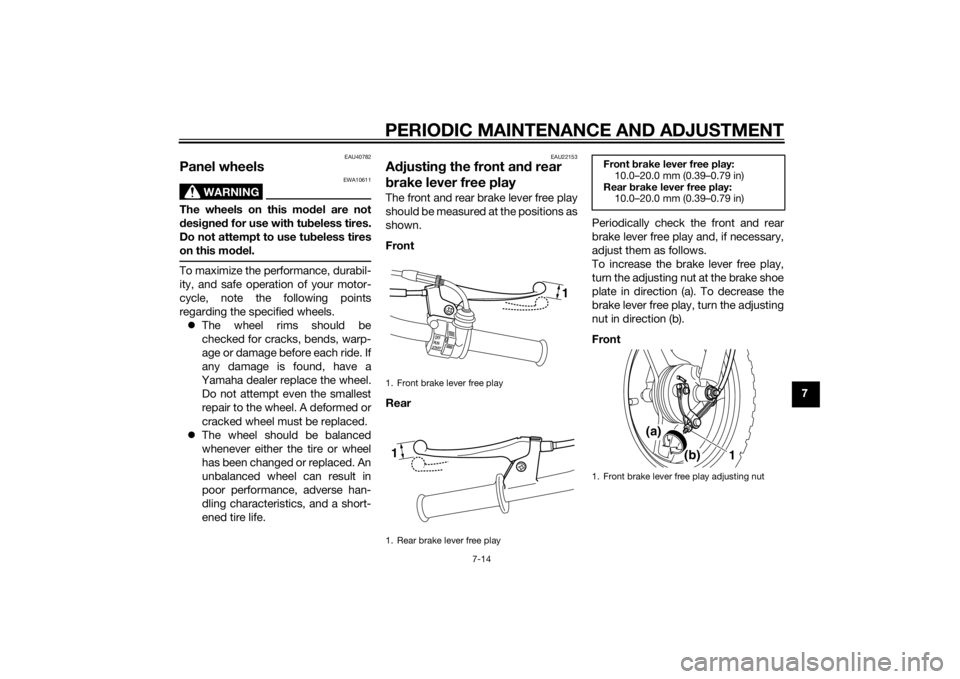
b rake lever free playThe front and rear brake lever free play
should be measured at the positions as
shown.
Front
Rear Periodically check the front and rear
brake lever free play and, if necessary,
adjust them as follows.
To increase the brake lever free play,
turn the adjusting nut at the brake shoe
plate in direction (a). To decrease the
brake lever free play, turn the adjusting
nut in direction (b).
Front1. Front brake lever free play
1. Rear brake lever free play
1
1
Front
brake lever free play:
10.0–20.0 mm (0.39–0.79 in)
Rear brake lever free play:
10.0–20.0 mm (0.39–0.79 in)
1. Front brake lever free play adjusting nut
1
(a)
(b)
U2SA80E0.book Page 14 Monday, June 3, 2013 5:25 PM
Page 56 of 76
PERIODIC MAINTENANCE AND ADJUSTMENT
7-15
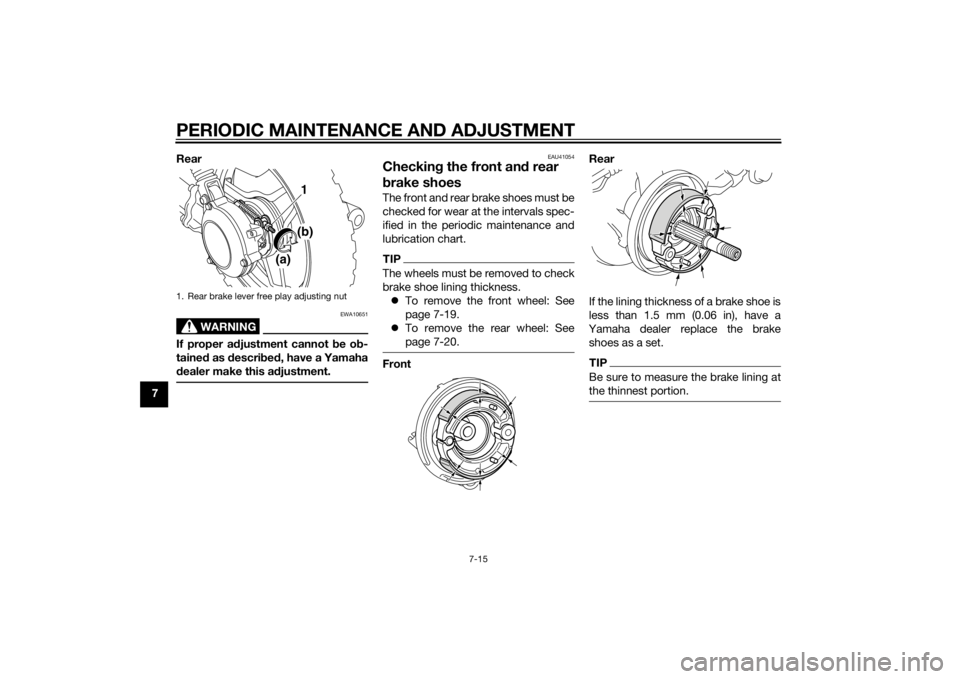
7Rear
WARNING
EWA10651
If proper ad
justment cannot be o b-
taine d as d escri bed , have a Yamaha
d ealer make this ad justment.
EAU41054
Checking the front an d rear
b rake shoesThe front and rear brake shoes must be
checked for wear at the intervals spec-
ified in the periodic maintenance and
lubrication chart.TIPThe wheels must be removed to check
brake shoe lining thickness.
To remove the front wheel: See
page 7-19.
To remove the rear wheel: See
page 7-20.Front Rear
If the lining thickness of a brake shoe is
less than 1.5 mm (0.06 in), have a
Yamaha dealer replace the brake shoes as a set.
TIPBe sure to measure the brake lining at
the thinnest portion.
1. Rear brake lever free play adjusting nut
1
(a) (b)
U2SA80E0.book Page 15 Monday, June 3, 2013 5:25 PM
Page 58 of 76
PERIODIC MAINTENANCE AND ADJUSTMENT
7-17
7
EAU43634
Lubricatin g the front an d rear
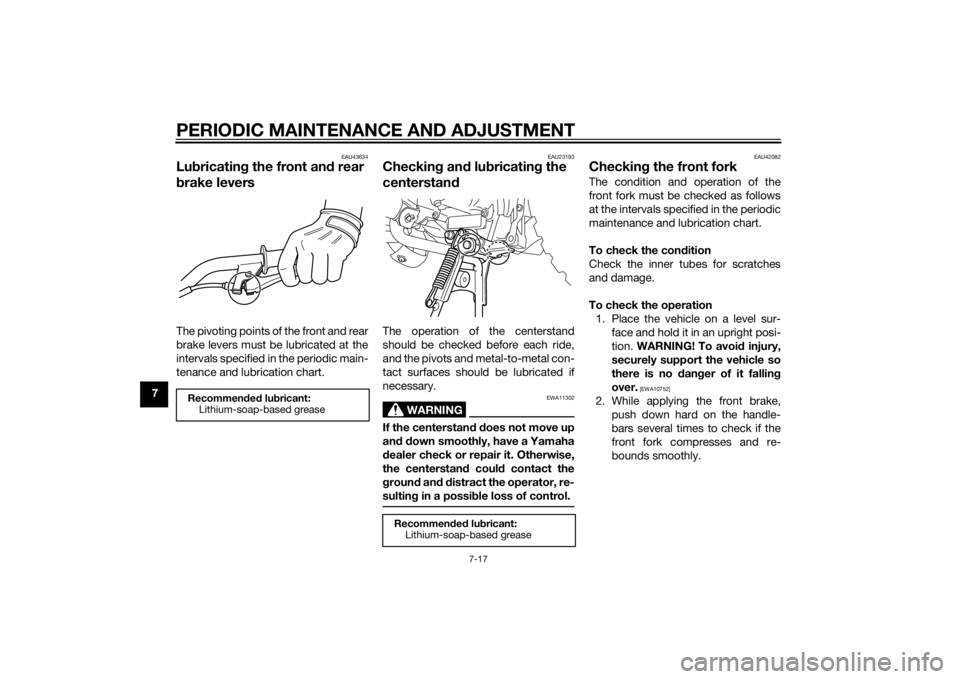
b rake leversThe pivoting points of the front and rear
brake levers must be lubricated at the
intervals specified in the periodic main-
tenance and lubrication chart.
EAU23193
Checkin g an d lu bricatin g the
centerstan dThe operation of the centerstand
should be checked before each ride,
and the pivots and metal-to-metal con-
tact surfaces should be lubricated if
necessary.
WARNING
EWA11302
If the centerstan d d oes not move up
an d d own smoothly, have a Yamaha
d ealer check or repair it. Otherwise,
the centerstan d coul d contact the
g roun d an d d istract the operator, re-
sultin g in a possi ble loss of control.
EAU42082
Checkin g the front forkThe condition and operation of the
front fork must be checked as follows
at the intervals specified in the periodic
maintenance and lubrication chart.
To check the con dition
Check the inner tubes for scratches
and damage.
To check the operation 1. Place the vehicle on a level sur- face and hold it in an upright posi-
tion. WARNING! To avoi d injury,
securely support the vehicle so
there is no dan ger of it fallin g
over.
[EWA10752]
2. While applying the front brake, push down hard on the handle-
bars several times to check if the
front fork compresses and re-
bounds smoothly.
Recommen ded lu bricant:
Lithium-soap-based grease
Recommen ded lu bricant:
Lithium-soap-based grease
U2SA80E0.book Page 17 Monday, June 3, 2013 5:25 PM
Page 60 of 76
PERIODIC MAINTENANCE AND ADJUSTMENT
7-19
7
EAU24361
Front wheel
EAU56510
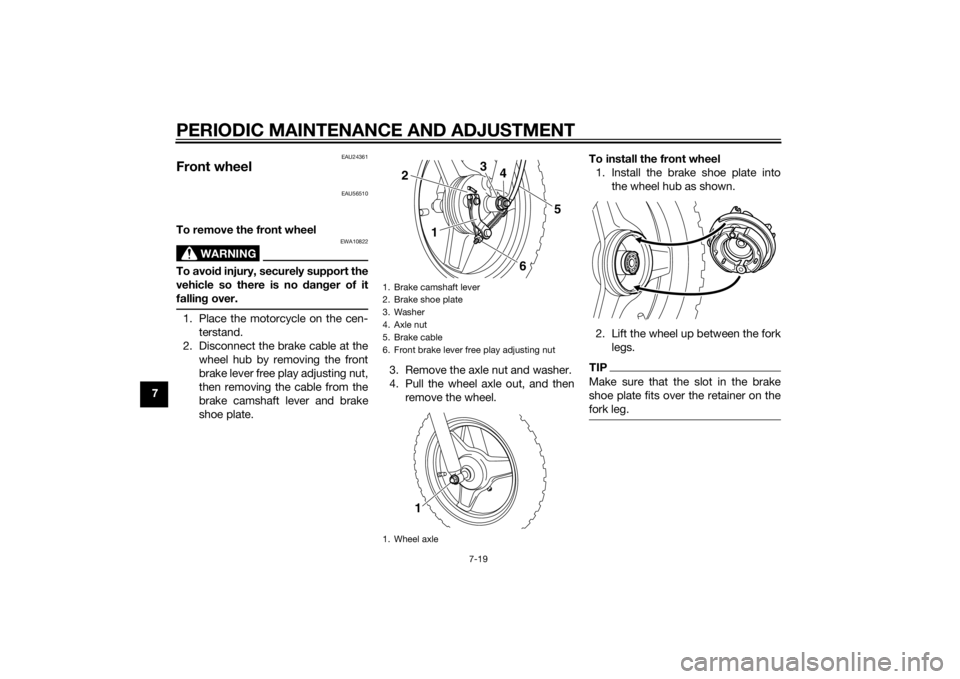
To remove the front wheel
WARNING
EWA10822
To avoid injury, securely support the
vehicle so there is no dan ger of it
fallin g over.1. Place the motorcycle on the cen-
terstand.
2. Disconnect the brake cable at the wheel hub by removing the front
brake lever free play adjusting nut,
then removing the cable from the
brake camshaft lever and brake
shoe plate. 3. Remove the axle nut and washer.
4. Pull the wheel axle out, and then
remove the wheel. To install the front wheel
1. Install the brake shoe plate into the wheel hub as shown.
2. Lift the wheel up between the fork legs.
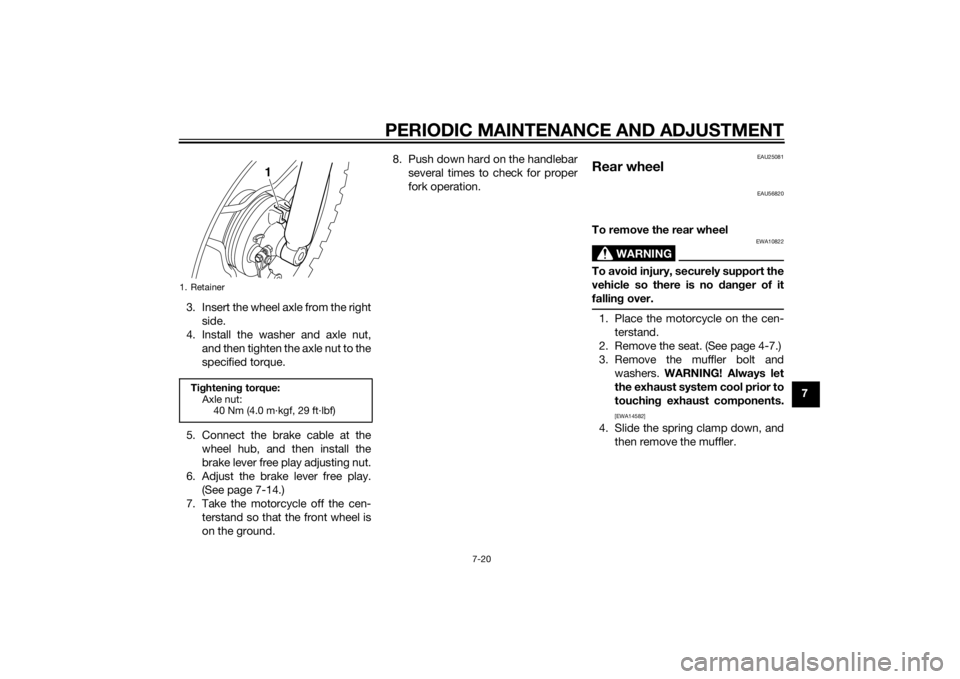
TIPMake sure that the slot in the brake
shoe plate fits over the retainer on the
fork leg.
1. Brake camshaft lever
2. Brake shoe plate
3. Washer
4. Axle nut
5. Brake cable
6. Front brake lever free play adjusting nut
1. Wheel axle
5
6
1 3
4
2
1
U2SA80E0.book Page 19 Monday, June 3, 2013 5:25 PM
Page 61 of 76
PERIODIC MAINTENANCE AND ADJUSTMENT
7-20
7
3. Insert the wheel axle from the right
side.
4. Install the washer and axle nut, and then tighten the axle nut to the
specified torque.
5. Connect the brake cable at the wheel hub, and then install the
brake lever free play adjusting nut.
6. Adjust the brake lever free play. (See page 7-14.)
7. Take the motorcycle off the cen- terstand so that the front wheel is
on the ground. 8. Push down hard on the handlebar
several times to check for proper
fork operation.
EAU25081
Rear wheel
EAU56820
To remove the rear wheel
WARNING
EWA10822
To avoi d injury, securely support the
vehicle so there is no dan ger of it
fallin g over.1. Place the motorcycle on the cen-
terstand.
2. Remove the seat. (See page 4-7.)
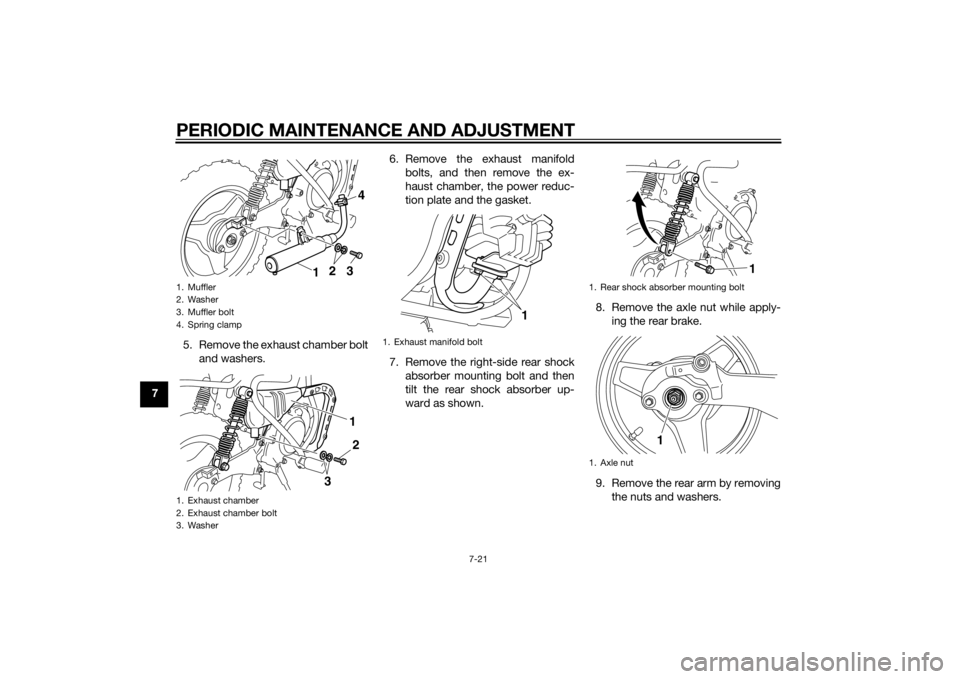
3. Remove the muffler bolt and washers. WARNING! Always let
the exhaust system cool prior to
touchin g exhaust components.
[EWA14582]
4. Slide the spring clamp down, and
then remove the muffler.
1. RetainerTightenin g torque:
Axle nut: 40 Nm (4.0 m·kgf, 29 ft·lbf)
1
U2SA80E0.book Page 20 Monday, June 3, 2013 5:25 PM
Page 62 of 76
PERIODIC MAINTENANCE AND ADJUSTMENT
7-21
75. Remove the exhaust chamber bolt
and washers. 6. Remove the exhaust manifold
bolts, and then remove the ex-
haust chamber, the power reduc-
tion plate and the gasket.
7. Remove the right-side rear shock absorber mounting bolt and then
tilt the rear shock absorber up-
ward as shown. 8. Remove the axle nut while apply-
ing the rear brake.
9. Remove the rear arm by removing the nuts and washers.
1. Muffler
2. Washer
3. Muffler bolt
4. Spring clamp
1. Exhaust chamber
2. Exhaust chamber bolt
3. Washer
3
1
2 4
2
1
3
1. Exhaust manifold bolt
1
1. Rear shock absorber mounting bolt
1. Axle nut
1
1
U2SA80E0.book Page 21 Monday, June 3, 2013 5:25 PM
Page 63 of 76
PERIODIC MAINTENANCE AND ADJUSTMENT
7-22
7
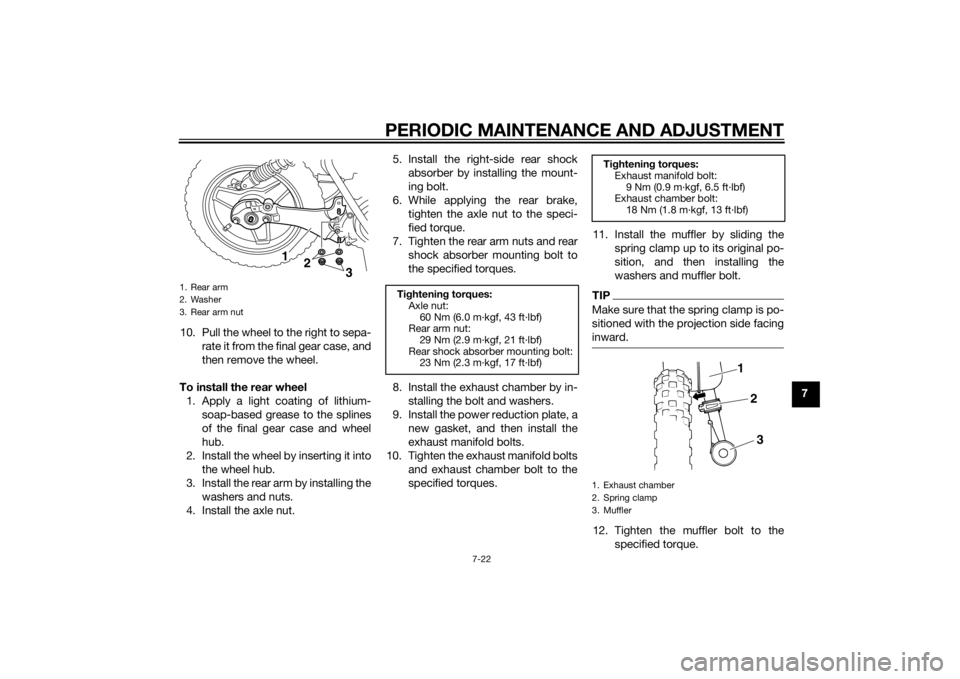
10. Pull the wheel to the right to sepa-
rate it from the final gear case, and
then remove the wheel.
To install the rear wheel 1. Apply a light coating of lithium- soap-based grease to the splines
of the final gear case and wheel
hub.
2. Install the wheel by inserting it into the wheel hub.
3. Install the rear arm by installing the washers and nuts.
4. Install the axle nut. 5. Install the right-side rear shock
absorber by installing the mount-
ing bolt.
6. While applying the rear brake, tighten the axle nut to the speci-
fied torque.
7. Tighten the rear arm nuts and rear shock absorber mounting bolt to
the specified torques.
8. Install the exhaust chamber by in- stalling the bolt and washers.
9. Install the power reduction plate, a new gasket, and then install the
exhaust manifold bolts.
10. Tighten the exhaust manifold bolts and exhaust chamber bolt to the
specified torques. 11. Install the muffler by sliding the
spring clamp up to its original po-
sition, and then installing the
washers and muffler bolt.
TIPMake sure that the spring clamp is po-
sitioned with the projection side facing
inward.12. Tighten the muffler bolt to thespecified torque.
1. Rear arm
2. Washer
3. Rear arm nut
12
3
Tightenin g torques:
Axle nut: 60 Nm (6.0 m·kgf, 43 ft·lbf)
Rear arm nut:
29 Nm (2.9 m·kgf, 21 ft·lbf)
Rear shock absorber mounting bolt: 23 Nm (2.3 m·kgf, 17 ft·lbf)
Tightenin g torques:
Exhaust manifold bolt:
9 Nm (0.9 m·kgf, 6.5 ft·lbf)
Exhaust chamber bolt:
18 Nm (1.8 m·kgf, 13 ft·lbf)
1. Exhaust chamber
2. Spring clamp
3. Muffler
1
2
3
U2SA80E0.book Page 22 Monday, June 3, 2013 5:25 PM
Page 64 of 76
PERIODIC MAINTENANCE AND ADJUSTMENT
7-23
713. Adjust the brake lever free play.
(See page 7-14.)
14. Install the seat.
EAU25852
Trou bleshootin gAlthough Yamaha motorcycles receive
a thorough inspection before shipment
from the factory, trouble may occur
during operation. Any problem in the
fuel, compression, or ignition systems,
for example, can cause poor starting
and loss of power.
The following troubleshooting chart
represents a quick and easy procedure
for checking these vital systems your-
self. However, should your motorcycle
require any repair, take it to a Yamaha
dealer, whose skilled technicians have
the necessary tools, experience, and
know-how to service the motorcycle
properly.
Use only genuine Yamaha replace-
ment parts. Imitation parts may look
like Yamaha parts, but they are often
inferior, have a shorter service life and
can lead to expensive repair bills.
WARNING
EWA15142
When checkin g the fuel system, do
not smoke, an d make sure there are
no open flames or sparks in the ar-
ea, inclu din g pilot lig hts from water heaters or furnaces. Gasoline or
g
asoline vapors can i gnite or ex-
plod e, causin g severe injury or prop-
erty damag e.
Tightenin g torque:
Muffler bolt:
18 Nm (1.8 m·kgf, 13 ft·lbf)
U2SA80E0.book Page 23 Monday, June 3, 2013 5:25 PM
Page 67 of 76
MOTORCYCLE CARE AND STORAGE8-2
8
d
eter gent resi due usin g plenty
of water, as it is harmful to plas-
tic parts.
Do not use any harsh chemical
prod ucts on plastic parts. Be
sure to avoi d usin g cloths or
spon ges which have b een in
contact with stron g or a brasive
cleanin g prod ucts, solvent or
thinner, fuel ( gasoline), rust re-
movers or inhi bitors, brake flui d,
antifreeze or electrolyte.
Do not use hi gh-pressure wash-
ers or steam-jet cleaners since
they cause water seepag e and
d eterioration in the followin g ar-
eas: seals (of wheel an d swin g-
arm bearin gs, fork an d b rakes),
electric components (couplers,
connectors, an d switches),
b reather hoses an d vents.
After normal useRemove dirt with warm water, a mild
detergent, and a soft, clean sponge,
and then rinse thoroughly with clean
water. Use a toothbrush or bottlebrush
for hard-to-reach areas. Stubborn dirt and insects will come off more easily if
the area is covered with a wet cloth for
a few minutes before cleaning.
After riding in the rain or near the sea
Since sea salt is extremely corrosive,
carry out the following steps after each
ride in the rain or near the sea.
1. Clean the motorcycle with cold water and a mild detergent, after
the engine has cooled down.
NOTICE: Do not use warm wa-
ter since it increases the corro-
sive action of the salt.
[ECA10792]
2. Apply a corrosion protection spray on all metal, including chrome-
and nickel-plated, surfaces to pre-
vent corrosion.
After cleanin g
1. Dry the motorcycle with a chamois or an absorbing cloth.
2. Use a chrome polish to shine chrome, aluminum and stainless-
steel parts. 3. To prevent corrosion, it is recom-
mended to apply a corrosion pro-
tection spray on all metal,
including chrome- and nickel-plat-
ed, surfaces.
4. Use spray oil as a universal clean- er to remove any remaining dirt.
5. Touch up minor paint damage caused by stones, etc.
6. Wax all painted surfaces.
7. Let the motorcycle dry completely before storing or covering it.
WARNING
EWA14502
Contaminants on the brakes or tires
can cause loss of control. Make sure that there is no oil or
wax on the tires.
If necessary, wash the tires with
warm water an d a mil d d eter-
g ent. Before ri din g at hi gher
speed s, test the motorcycle’s
b rakin g performance an d cor-
nering b ehavior.
U2SA80E0.book Page 2 Monday, June 3, 2013 5:25 PM