warning YAMAHA PW50 2014 User Guide
[x] Cancel search | Manufacturer: YAMAHA, Model Year: 2014, Model line: PW50, Model: YAMAHA PW50 2014Pages: 76, PDF Size: 1.74 MB
Page 36 of 76
FOR YOUR SAFETY – PRE-OPERATION CHECKS
5-1
5
EAU15598
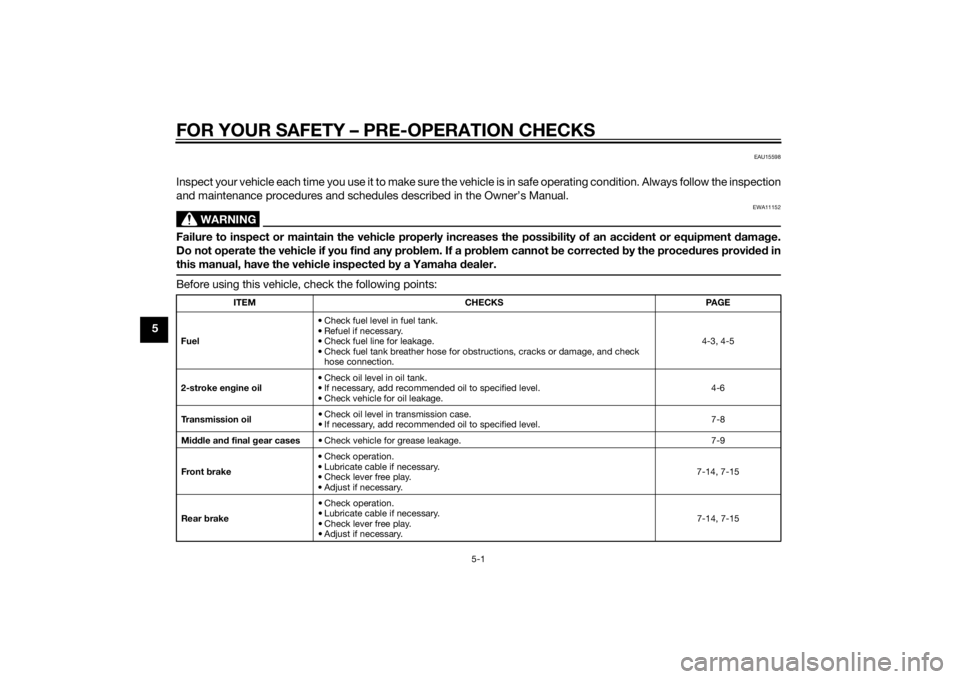
Inspect your vehicle each time you use it to make sure the vehicle is in safe operating condition. Always follow the inspection
and maintenance procedures and schedules described in the Owner’s Manual.
WARNING
EWA11152
Failure to inspect or maintain the vehicle properly increases the possibility of an acci dent or equipment damag e.
Do not operate the vehicle if you fin d any pro blem. If a pro blem cannot be corrected b y the proce dures provi ded in
this manual, have the vehicle inspecte d b y a Yamaha dealer.Before using this vehicle, check the following points:
ITEM CHECKS PAGE
Fuel • Check fuel level in fuel tank.
• Refuel if necessary.
• Check fuel line for leakage.
• Check fuel tank breather hose for obstructions, cracks or damage, and check
hose connection. 4-3, 4-5
2-stroke en gine oil • Check oil level in oil tank.
• If necessary, add recommended oil to specified level.
• Check vehicle for oil leakage. 4-6
Tr a n s m i s s i o n o i l • Check oil level in transmission case.
• If necessary, add recommended oil to specified level.
7-8
Mi dd le an d final g ear cases • Check vehicle for grease leakage. 7-9
Front brake • Check operation.
• Lubricate cable if necessary.
• Check lever free play.
• Adjust if necessary. 7-14, 7-15
Rear brake • Check operation.
• Lubricate cable if necessary.
• Check lever free play.
• Adjust if necessary.
7-14, 7-15
U2SA80E0.book Page 1 Monday, June 3, 2013 5:25 PM
Page 38 of 76
OPERATION AND IMPORTANT RIDING POINTS
6-1
6
EAU15952
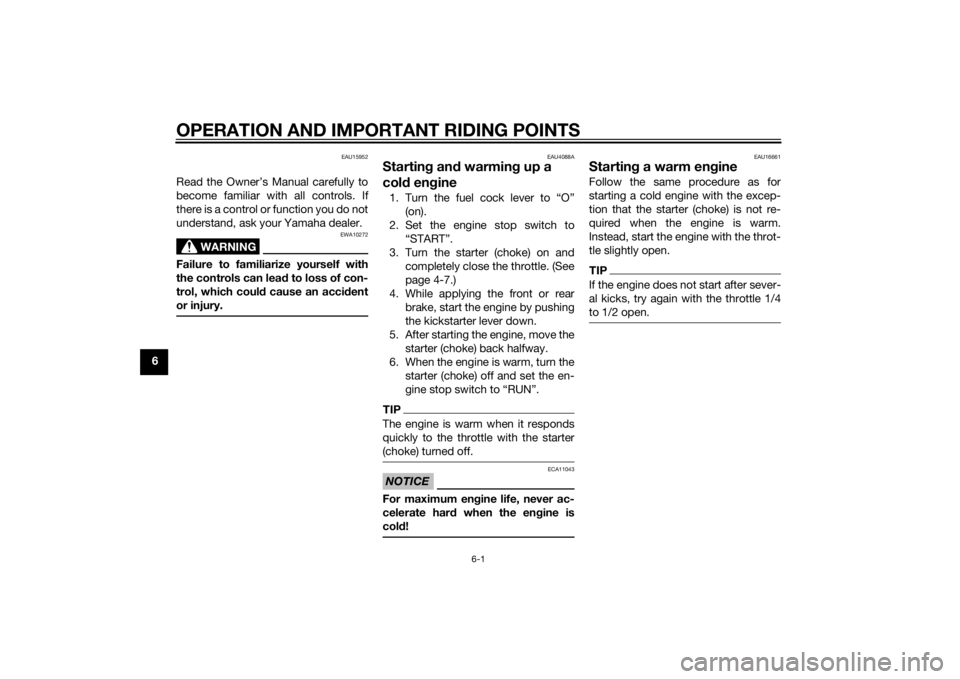
Read the Owner’s Manual carefully to
become familiar with all controls. If
there is a control or function you do not
understand, ask your Yamaha dealer.
WARNING
EWA10272
Failure to familiarize yourself with
the controls can lead to loss of con-
trol, which coul d cause an acci dent
or injury.
EAU4088A
Startin g an d warmin g up a
col d en gine1. Turn the fuel cock lever to “O”
(on).
2. Set the engine stop switch to “START”.
3. Turn the starter (choke) on and completely close the throttle. (See
page 4-7.)
4. While applying the front or rear brake, start the engine by pushing
the kickstarter lever down.
5. After starting the engine, move the starter (choke) back halfway.
6. When the engine is warm, turn the starter (choke) off and set the en-
gine stop switch to “RUN”.TIPThe engine is warm when it responds
quickly to the throttle with the starter
(choke) turned off.NOTICE
ECA11043
For maximum en gine life, never ac-
celerate har d when the en gine is
col d!
EAU16661
Startin g a warm en gineFollow the same procedure as for
starting a cold engine with the excep-
tion that the starter (choke) is not re-
quired when the engine is warm.
Instead, start the engine with the throt-
tle slightly open.TIPIf the engine does not start after sever-
al kicks, try again with the throttle 1/4
to 1/2 open.
U2SA80E0.book Page 1 Monday, June 3, 2013 5:25 PM
Page 39 of 76
OPERATION AND IMPORTANT RIDING POINTS
6-2
6
EAU41003
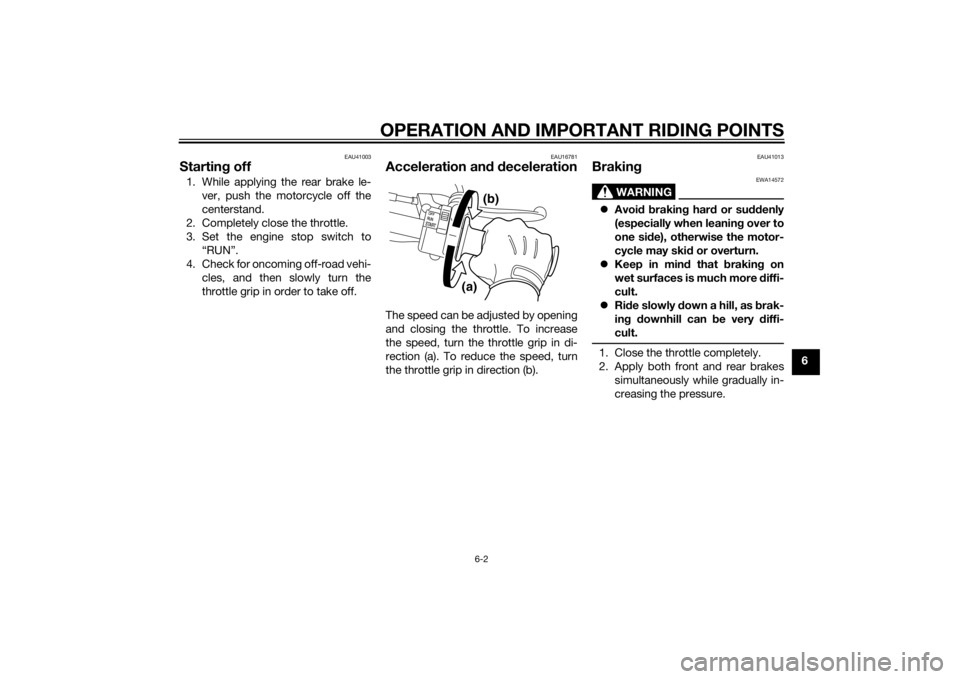
Starting off1. While applying the rear brake le-
ver, push the motorcycle off the
centerstand.
2. Completely close the throttle.
3. Set the engine stop switch to “RUN”.
4. Check for oncoming off-road vehi- cles, and then slowly turn the
throttle grip in order to take off.
EAU16781
Acceleration an d d ecelerationThe speed can be adjusted by opening
and closing the throttle. To increase
the speed, turn the throttle grip in di-
rection (a). To reduce the speed, turn
the throttle grip in direction (b).
EAU41013
Brakin g
WARNING
EWA14572
Avoi d b rakin g har d or su ddenly
(especially when leanin g over to
one si de), otherwise the motor-
cycle may ski d or overturn.
Keep in min d that brakin g on
wet surfaces is much more diffi-
cult.
Ride slowly d own a hill, as brak-
in g d ownhill can be very diffi-
cult.1. Close the throttle completely.
2. Apply both front and rear brakes simultaneously while gradually in-
creasing the pressure.
(a) (b)
U2SA80E0.book Page 2 Monday, June 3, 2013 5:25 PM
Page 41 of 76
OPERATION AND IMPORTANT RIDING POINTS
6-4
6
EAU40723
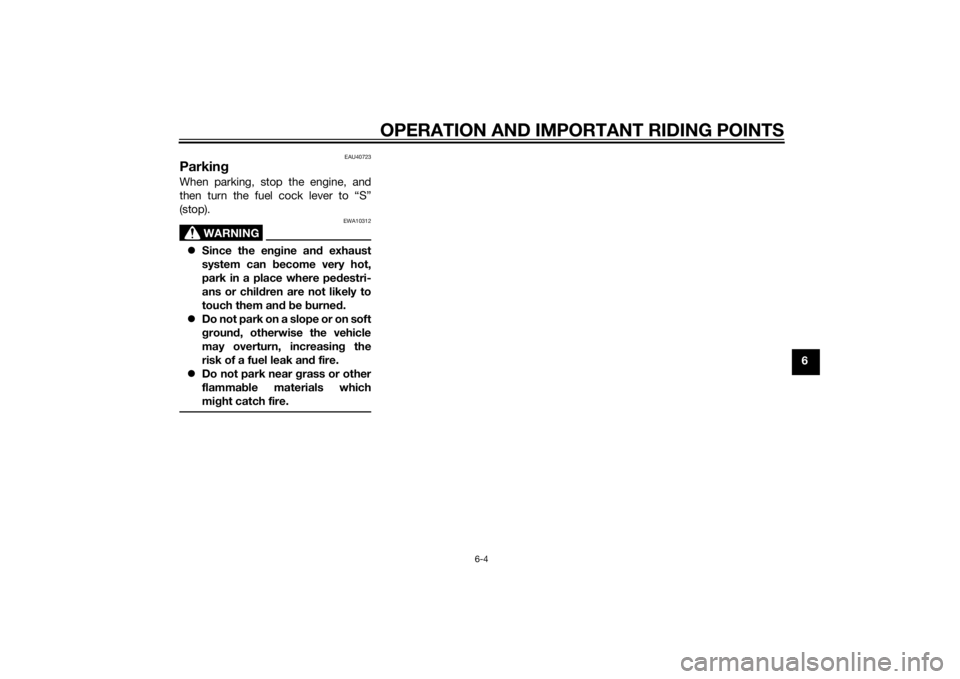
ParkingWhen parking, stop the engine, and
then turn the fuel cock lever to “S”
(stop).
WARNING
EWA10312
Since the en gine an d exhaust
system can b ecome very hot,
park in a place where pe destri-
ans or chil dren are not likely to
touch them an d b e burne d.
Do not park on a slope or on soft
groun d, otherwise the vehicle
may overturn, increasin g the
risk of a fuel leak an d fire.
Do not park near grass or other
flamma ble materials which
mi ght catch fire.
U2SA80E0.book Page 4 Monday, June 3, 2013 5:25 PM
Page 42 of 76
PERIODIC MAINTENANCE AND ADJUSTMENT
7-1
7
EAU17245
Periodic inspection, adjustment, and
lubrication will keep your vehicle in the
safest and most efficient condition
possible. Safety is an obligation of the
vehicle owner/operator. The most im-
portant points of vehicle inspection,
adjustment, and lubrication are ex-
plained on the following pages.
The intervals given in the periodic
maintenance charts should be simply
considered as a general guide under
normal riding conditions. However, de-
pending on the weather, terrain, geo-
graphical location, and individual use,
the maintenance intervals may need to
be shortened.
WARNING
EWA10322
Failure to properly maintain the vehi-
cle or performing maintenance ac-
tivities incorrectly may increase
your risk of injury or death durin g
service or while usin g the vehicle. If
you are not familiar with vehicle ser-
vice, have a Yamaha d ealer perform
service.
WARNING
EWA15123
Turn off the en gine when performin g
maintenance unless otherwise
specified .
A runnin g en gine has movin g
parts that can catch on body
parts or clothin g an d electrical
parts that can cause shocks or
fires.
Runnin g the en gine while ser-
vicin g can lead to eye injury,
b urns, fire, or car bon monoxi de
poisonin g – possi bly lea din g to
d eath. See pag e 2-2 for more in-
formation a bout car bon monox-
i d e.
WARNING
EWA15461
Brake discs, calipers, drums, and
linin gs can b ecome very hot d uring
use. To avoi d possi ble burns, let
b rake components cool before
touchin g them.
EAU17303
Emission controls not only function to
ensure cleaner air, but are also vital to
proper engine operation and maximum
performance. In the following periodic
maintenance charts, the services relat-
ed to emissions control are grouped
separately. These services require
specialized data, knowledge, and
equipment. Maintenance, replace-
ment, or repair of the emission control
devices and systems may be per-
formed by any repair establishment or
individual that is certified (if applicable).
Yamaha dealers are trained and equipped to perform these particular
services.
U2SA80E0.book Page 1 Monday, June 3, 2013 5:25 PM
Page 48 of 76
PERIODIC MAINTENANCE AND ADJUSTMENT
7-7
7To install the spark plu
g
1. Clean the surface of the spark plug gasket and its mating sur-
face, and then wipe off any grime
from the spark plug threads.
2. Install the spark plug with the spark plug wrench, and then tight-
en it to the specified torque.
TIPIf a torque wrench is not available
when installing a spark plug, a good
estimate of the correct torque is 1/4–
1/2 turn past finger tight. However, the
spark plug should be tightened to the
specified torque as soon as possible.3. Install the spark plug cap.
EAU41104
Removin g the power re duc-
tion plateTo obtain full engine performance ca-
pability, removing the power reduction
plate is required.
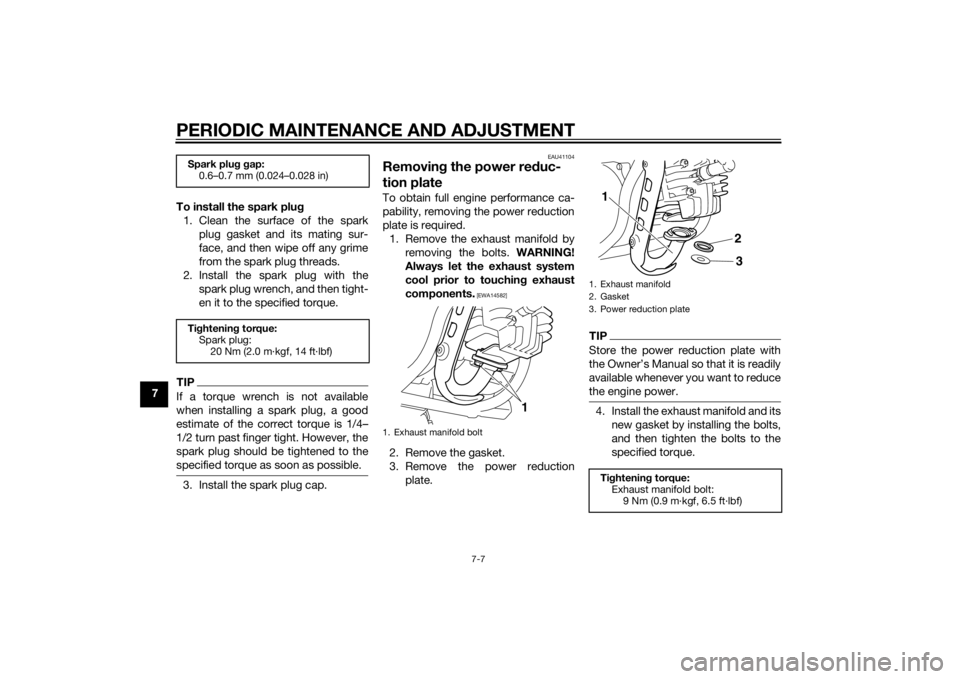
1. Remove the exhaust manifold by removing the bolts. WARNING!
Always let the exhaust system
cool prior to touching exhaust
components.
[EWA14582]
2. Remove the gasket.
3. Remove the power reduction plate.
TIPStore the power reduction plate with
the Owner’s Manual so that it is readily
available whenever you want to reduce
the engine power.4. Install the exhaust manifold and itsnew gasket by installing the bolts,
and then tighten the bolts to the
specified torque.
Spark plu g g ap:
0.6–0.7 mm (0.024–0.028 in)
Ti ghtenin g torque:
Spark plug: 20 Nm (2.0 m·kgf, 14 ft·lbf)
1. Exhaust manifold bolt
1
1. Exhaust manifold
2. Gasket
3. Power reduction plateTightenin g torque:
Exhaust manifold bolt: 9 Nm (0.9 m·kgf, 6.5 ft·lbf)1
23
U2SA80E0.book Page 7 Monday, June 3, 2013 5:25 PM
Page 51 of 76
PERIODIC MAINTENANCE AND ADJUSTMENT
7-10
7
5. Insert the sponge material into the
air filter case. NOTICE: Make
sure that the spon ge material is
properly seate d in the air filter
case. The en gine should never
b e operated without the spon ge
material installe d, otherwise the
piston(s) an d/or cylin der(s) may
b ecome excessively worn.
[ECA15622]
6. Install the air filter case cover by
installing the screw.
7. Install the seat.
EAU41222
Cleanin g the spark arresterThe spark arrester should be cleaned
at the intervals specified in the periodic
maintenance and lubrication chart.
WARNING
EWA10981
Always let the exhaust system
cool prior to touching exhaust
components.
Do not start the en gine when
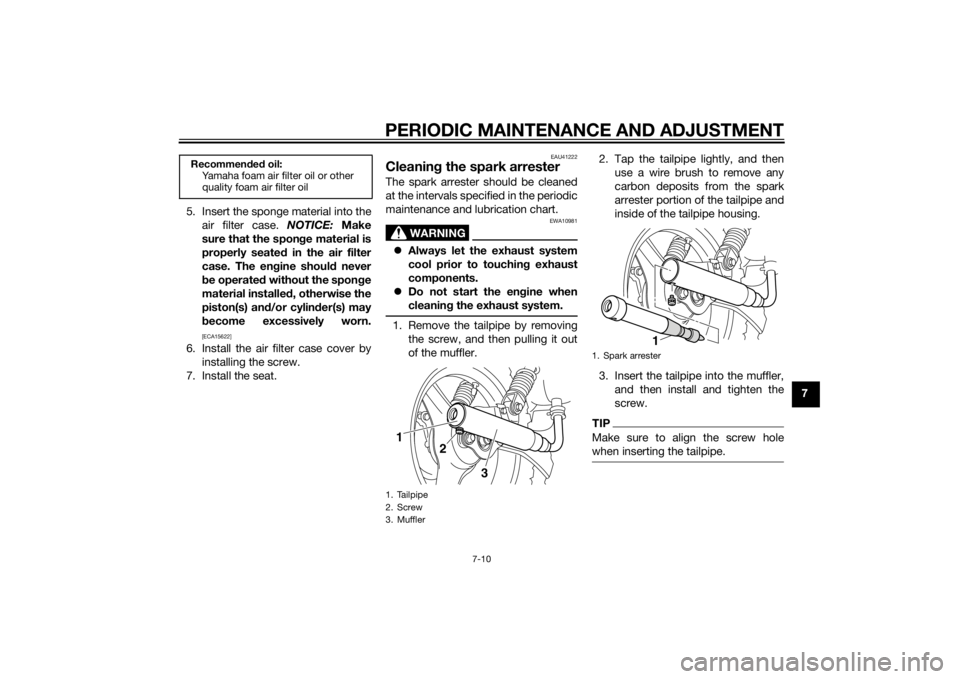
cleanin g the exhaust system.1. Remove the tailpipe by removing
the screw, and then pulling it out
of the muffler. 2. Tap the tailpipe lightly, and then
use a wire brush to remove any
carbon deposits from the spark
arrester portion of the tailpipe and
inside of the tailpipe housing.
3. Insert the tailpipe into the muffler, and then install and tighten the
screw.
TIPMake sure to align the screw hole
when inserting the tailpipe.
Recommen ded oil:
Yamaha foam air filter oil or other
quality foam air filter oil
1. Tailpipe
2. Screw
3. Muffler1
2
3
1. Spark arrester
1
U2SA80E0.book Page 10 Monday, June 3, 2013 5:25 PM
Page 53 of 76
PERIODIC MAINTENANCE AND ADJUSTMENT
7-12
7
EAU21385
Checking the throttle grip free
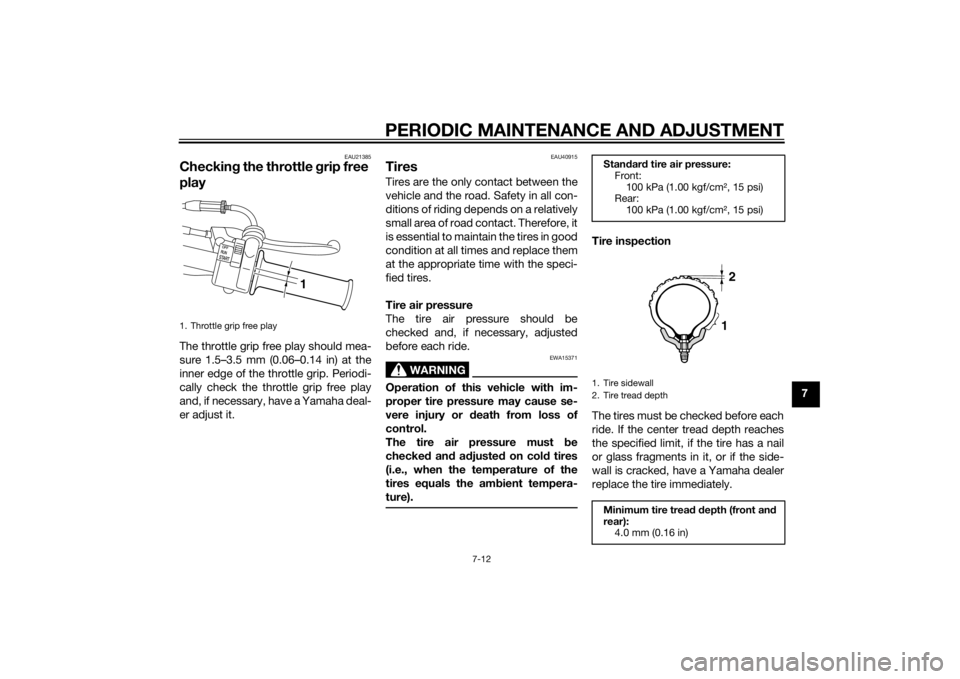
playThe throttle grip free play should mea-
sure 1.5–3.5 mm (0.06–0.14 in) at the
inner edge of the throttle grip. Periodi-
cally check the throttle grip free play
and, if necessary, have a Yamaha deal-
er adjust it.
EAU40915
TiresTires are the only contact between the
vehicle and the road. Safety in all con-
ditions of riding depends on a relatively
small area of road contact. Therefore, it
is essential to maintain the tires in good
condition at all times and replace them
at the appropriate time with the speci-
fied tires.
Tire air pressure
The tire air pressure should be
checked and, if necessary, adjusted
before each ride.
WARNING
EWA15371
Operation of this vehicle with im-
proper tire pressure may cause se-
vere injury or d eath from loss of
control.
The tire air pressure must be
checked and a djuste d on col d tires
(i.e., when the temperature of the
tires equals the am bient tempera-
ture).
Tire inspection
The tires must be checked before each
ride. If the center tread depth reaches
the specified limit, if the tire has a nail
or glass fragments in it, or if the side-
wall is cracked, have a Yamaha dealer
replace the tire immediately.
1. Throttle grip free play
1
Stan dar d tire air pressure:
Front:
100 kPa (1.00 kgf/cm², 15 psi)
Rear:
100 kPa (1.00 kgf/cm², 15 psi)
1. Tire sidewall
2. Tire tread depth
Minimum tire trea d d epth (front an d
rear): 4.0 mm (0.16 in)
12
U2SA80E0.book Page 12 Monday, June 3, 2013 5:25 PM
Page 54 of 76
PERIODIC MAINTENANCE AND ADJUSTMENT
7-13
7Tire information
This motorcycle is equipped with panel
wheels and tube tires.
Tires age, even if they have not been
used or have only been used occasion-
ally. Cracking of the tread and sidewall
rubber, sometimes accompanied by
carcass deformation, is an evidence of
ageing. Old and aged tires shall be
checked by tire specialists to ascertain
their suitability for further use.
WARNING
EWA10462
The front an
d rear tires shoul d b e of
the same make an d d esi gn, other-
wise the han dlin g characteristics of
the vehicle may be different, which
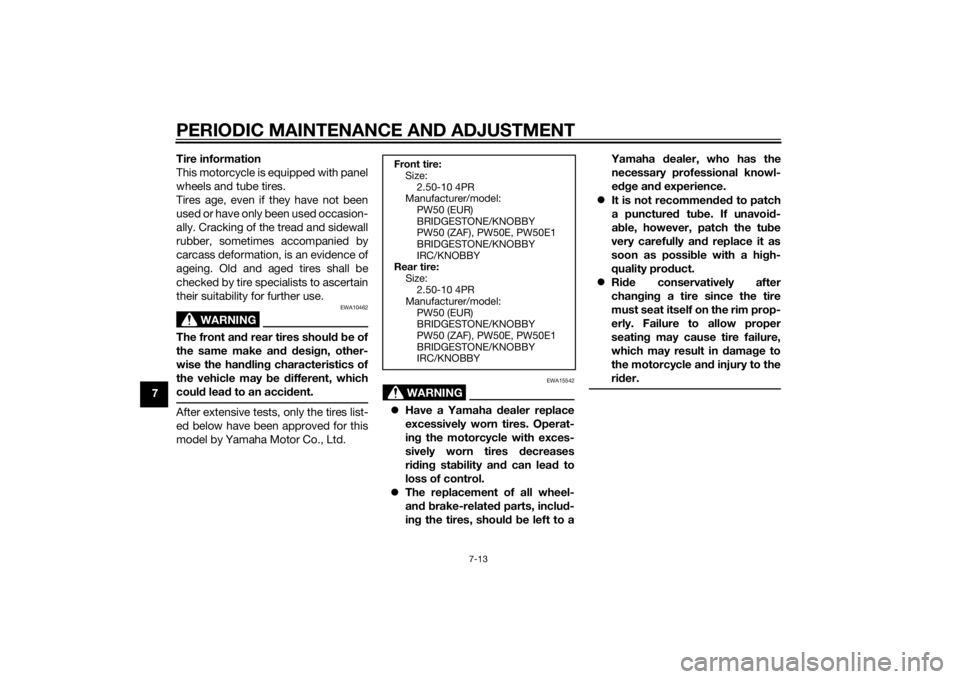
coul d lea d to an acci dent.After extensive tests, only the tires list-
ed below have been approved for this
model by Yamaha Motor Co., Ltd.
WARNING
EWA15542
Have a Yamaha dealer replace
excessively worn tires. Operat-
in g the motorcycle with exces-
sively worn tires decreases
ri din g sta bility an d can lead to
loss of control.
The replacement of all wheel-
and b rake-relate d parts, inclu d-
in g the tires, shoul d b e left to a Yamaha
dealer, who has the
necessary professional knowl-
e dge an d experience.
It is not recommen ded to patch
a punctured tube. If unavoi d-
a b le, however, patch the tu be
very carefully an d replace it as
soon as possi ble with a hi gh-
quality pro duct.
Ride conservatively after
chan gin g a tire since the tire
must seat itself on the rim prop-
erly. Failure to allow proper
seatin g may cause tire failure,
which may result in damag e to
the motorcycle an d injury to the
ri der.Front tire:
Size:
2.50-10 4PR
Manufacturer/model:
PW50 (EUR)
BRIDGESTONE/KNOBBY
PW50 (ZAF), PW50E, PW50E1
BRIDGESTONE/KNOBBY
IRC/KNOBBY
Rear tire:
Size:2.50-10 4PR
Manufacturer/model:
PW50 (EUR)
BRIDGESTONE/KNOBBY
PW50 (ZAF), PW50E, PW50E1
BRIDGESTONE/KNOBBY
IRC/KNOBBY
U2SA80E0.book Page 13 Monday, June 3, 2013 5:25 PM
Page 55 of 76
PERIODIC MAINTENANCE AND ADJUSTMENT
7-14
7
EAU40782
Panel wheels
WARNING
EWA10611
The wheels on this model are not
d esi gne d for use with tu beless tires.
Do not attempt to use tub eless tires
on this mo del.To maximize the performance, durabil-
ity, and safe operation of your motor-
cycle, note the following points
regarding the specified wheels.
The wheel rims should be
checked for cracks, bends, warp-
age or damage before each ride. If
any damage is found, have a
Yamaha dealer replace the wheel. Do not attempt even the smallest
repair to the wheel. A deformed or
cracked wheel must be replaced.
The wheel should be balanced
whenever either the tire or wheel
has been changed or replaced. An
unbalanced wheel can result in
poor performance, adverse han-
dling characteristics, and a short-
ened tire life.
EAU22153
Adjustin g the front an d rear
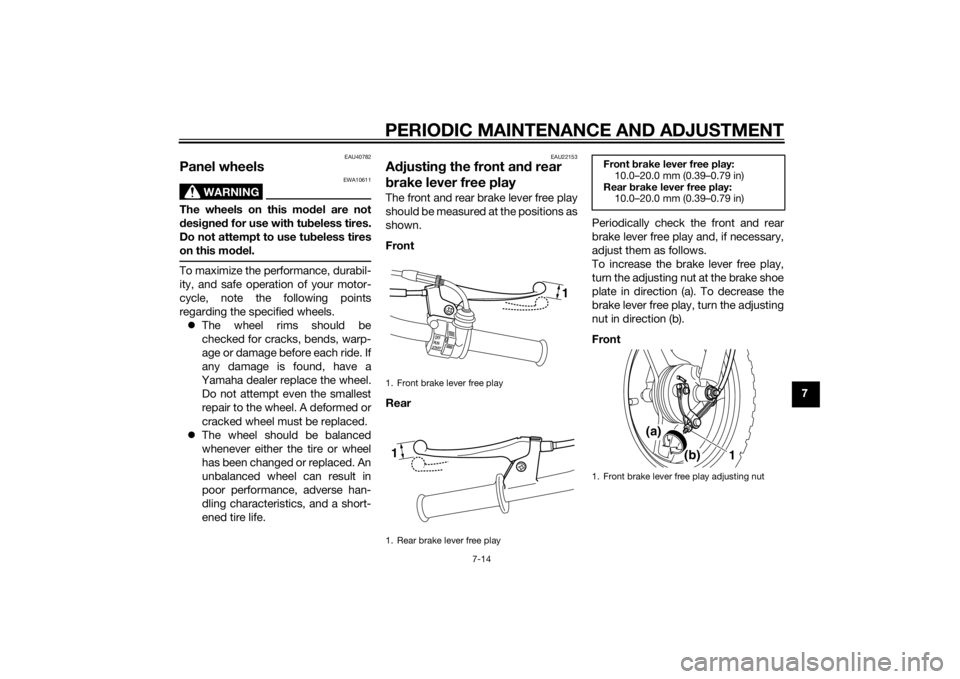
b rake lever free playThe front and rear brake lever free play
should be measured at the positions as
shown.
Front
Rear Periodically check the front and rear
brake lever free play and, if necessary,
adjust them as follows.
To increase the brake lever free play,
turn the adjusting nut at the brake shoe
plate in direction (a). To decrease the
brake lever free play, turn the adjusting
nut in direction (b).
Front1. Front brake lever free play
1. Rear brake lever free play
1
1
Front
brake lever free play:
10.0–20.0 mm (0.39–0.79 in)
Rear brake lever free play:
10.0–20.0 mm (0.39–0.79 in)
1. Front brake lever free play adjusting nut
1
(a)
(b)
U2SA80E0.book Page 14 Monday, June 3, 2013 5:25 PM