Engine oul YAMAHA RHINO 660 2007 Owner's Manual
[x] Cancel search | Manufacturer: YAMAHA, Model Year: 2007, Model line: RHINO 660, Model: YAMAHA RHINO 660 2007Pages: 422, PDF Size: 10 MB
Page 294 of 422
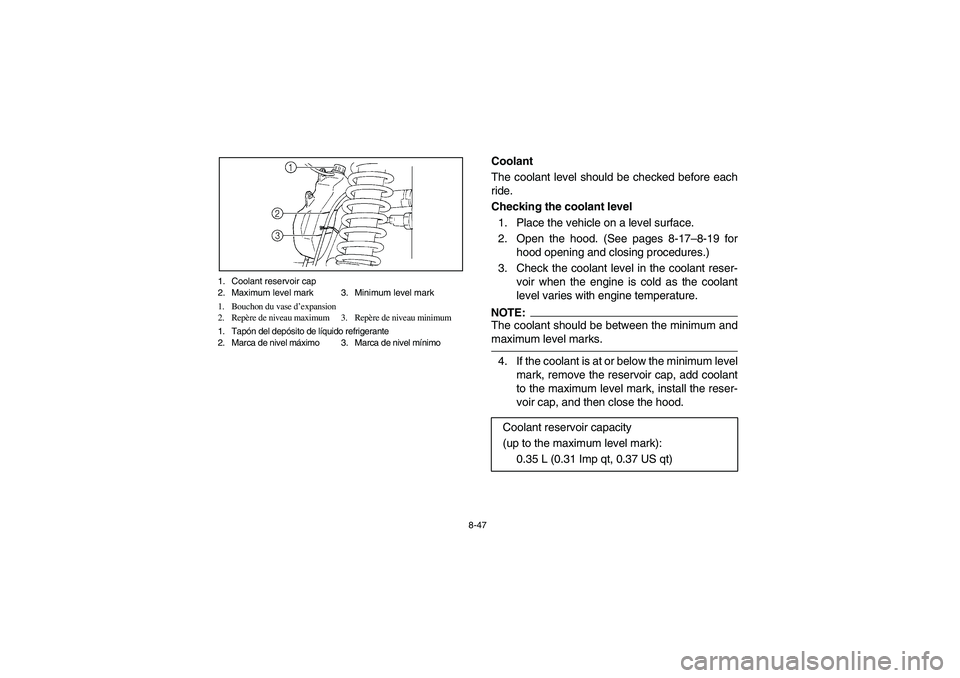
8-47 1. Coolant reservoir cap
2. Maximum level mark 3. Minimum level mark
1. Bouchon du vase d’expansion
2. Repère de niveau maximum 3. Repère de niveau minimum
1. Tapón del depósito de líquido refrigerante
2. Marca de nivel máximo 3. Marca de nivel mínimo
EVU00732
Coolant
The coolant level should be checked before each
ride.
Checking the coolant level
1. Place the vehicle on a level surface.
2. Open the hood. (See pages 8-17–8-19 for
hood opening and closing procedures.)
3. Check the coolant level in the coolant reser-
voir when the engine is cold as the coolant
level varies with engine temperature.NOTE:_ The coolant should be between the minimum and
maximum level marks. _4. If the coolant is at or below the minimum level
mark, remove the reservoir cap, add coolant
to the maximum level mark, install the reser-
voir cap, and then close the hood.
Coolant reservoir capacity
(up to the maximum level mark):
0.35 L (0.31 Imp qt, 0.37 US qt)
EE.book Page 47 Friday, August 4, 2006 12:02 PM
Page 302 of 422
8-55
Inspection
The spark plug is an important engine component
and is easy to inspect. The condition of the spark
plug can indicate the condition of the engine.
The ideal color of the porcelain insulator around
the center electrode is a medium-to-light tan for a
vehicle that is being ridden normally.
Do not attempt to diagnose such problems your-
self.
Instead, take the vehicle to a Yamaha dealer. You
should periodically remove and inspect the spark
plug because heat and deposits will cause the
spark plug to slowly break down and erode. If elec-
trode erosion becomes excessive, or if carbon and
other deposits are excessive, you should replace
the spark plug with the specified plug.
Specified spark plug:
DPR8EA-9 (NGK)
EE.book Page 55 Friday, August 4, 2006 12:02 PM
Page 314 of 422
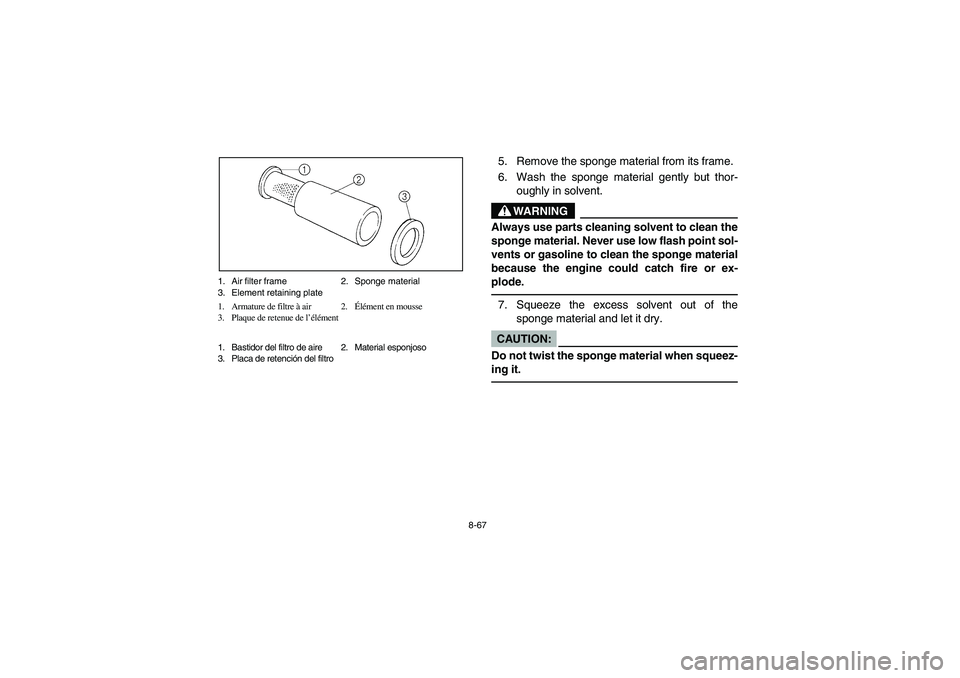
8-67 1. Air filter frame 2. Sponge material
3. Element retaining plate
1. Armature de filtre à air 2.Élément en mousse
3. Plaque de retenue de l’élément
1. Bastidor del filtro de aire 2. Material esponjoso
3. Placa de retención del filtro
5. Remove the sponge material from its frame.
6. Wash the sponge material gently but thor-
oughly in solvent.
WARNING
Always use parts cleaning solvent to clean the
sponge material. Never use low flash point sol-
vents or gasoline to clean the sponge material
because the engine could catch fire or ex-
plode.7. Squeeze the excess solvent out of the
sponge material and let it dry.CAUTION:_ Do not twist the sponge material when squeez-
ing it. _
EE.book Page 67 Friday, August 4, 2006 12:02 PM
Page 318 of 422
8-71
NOTE:_ The air filter element should be cleaned every 20–
40 hours. It should be cleaned and lubricated more
often if the vehicle is operated in extremely dusty
areas. Each time air filter element maintenance is
performed, check the air inlet to the air filter case
for obstructions. Check the air filter element rubber
joint to the carburetor and manifold fittings for an
airtight seal. Tighten all fittings securely to avoid
the possibility of unfiltered air entering the engine. _CAUTION:_ Never operate the engine with the air filter ele-
ment removed. This will allow unfiltered air to
enter, causing rapid engine wear and possible
engine damage. Additionally, operation with-
out the air filter element will affect carburetor
jetting with subsequent poor performance and
possible engine overheating.
EE.book Page 71 Friday, August 4, 2006 12:02 PM
Page 326 of 422
8-79
WARNING
Do not start the engine when cleaning the
spark arrester, otherwise it could cause injury
to the eyes, burns, carbon monoxide poison-
ing, possibly leading to death, and start a fire.
Always let the exhaust system cool prior to
touching exhaust components.
EE.book Page 79 Friday, August 4, 2006 12:02 PM
Page 328 of 422
8-81
EVU00800
Carburetor adjustment
The carburetor is a vital part of the engine and re-
quires very sophisticated adjustment. Most adjust-
ing should be left to a Yamaha dealer who has the
professional knowledge and experience to do so.
However, the idling speed may be performed by
the owner as a part of the usual maintenance rou-
tine.CAUTION:_ The carburetor was set at the Yamaha factory
after many tests. If the settings are disturbed
by someone without sufficient technical
knowledge, poor engine performance and
damage may result. _
EE.book Page 81 Friday, August 4, 2006 12:02 PM
Page 332 of 422
8-85
5. Install the console.
6. Install the seats.
EVU00821
Valve clearance
The correct valve clearance changes with use, re-
sulting in improper fuel/air supply or engine noise.
To prevent this, the valve clearance must be ad-
justed regularly. This adjustment however, should
be left to a professional Yamaha service techni-
cian.
EE.book Page 85 Friday, August 4, 2006 12:02 PM
Page 350 of 422
8-103
EVU01490
Cable inspection and lubrication
WARNING
Inspect cables frequently and replace if dam-
aged. Corrosion can result when the outer cov-
ering of control cables becomes damaged.
Cables can also become frayed or kinked. Op-
eration of controls could be restricted, which
could cause an accident or injury.Lubricate the inner cables and the cable ends. If
the cables do not operate smoothly, ask a Yamaha
dealer to replace them.
Recommended lubricant:
Engine oil
EE.book Page 103 Friday, August 4, 2006 12:02 PM
Page 387 of 422
8-140
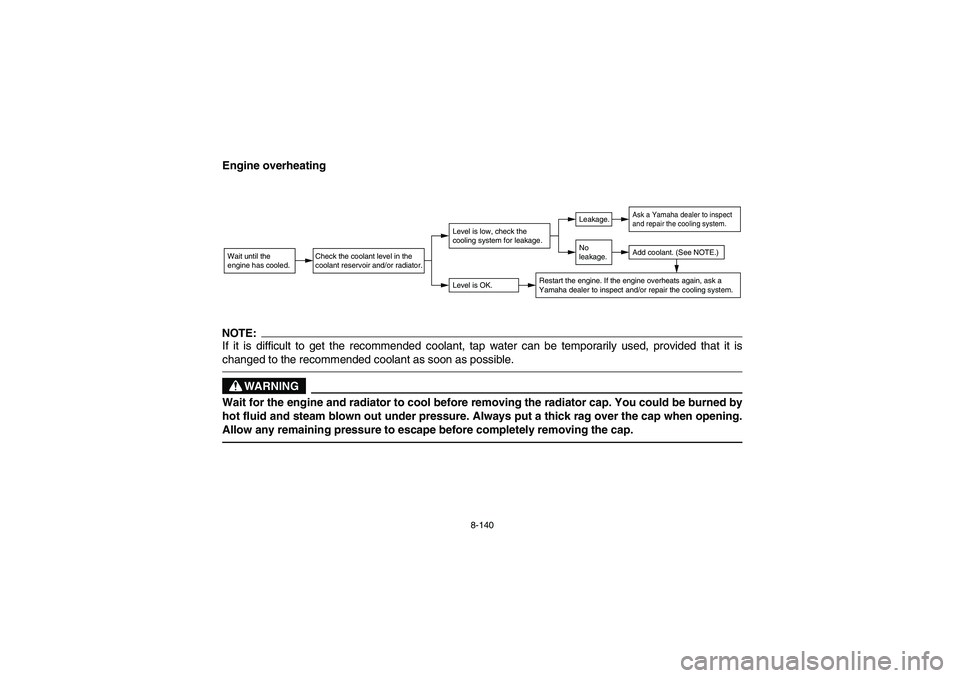
Engine overheatingNOTE:_ If it is difficult to get the recommended coolant, tap water can be temporarily used, provided that it is
changed to the recommended coolant as soon as possible. _
WARNING
Wait for the engine and radiator to cool before removing the radiator cap. You could be burned by
hot fluid and steam blown out under pressure. Always put a thick rag over the cap when opening.
Allow any remaining pressure to escape before completely removing the cap.Wait until the
engine has cooled.
Check the coolant level in the
coolant reservoir and/or radiator.
Level is OK.Level is low, check the
cooling system for leakage.
No
leakage.Leakage.
Ask a Yamaha dealer to inspect
and repair the cooling system.Add coolant. (See NOTE.)
Restart the engine. If the engine overheats again, ask a
Yamaha dealer to inspect and/or repair the cooling system.
EE.book Page 140 Friday, August 4, 2006 12:02 PM