lock YAMAHA RHINO 700 2013 User Guide
[x] Cancel search | Manufacturer: YAMAHA, Model Year: 2013, Model line: RHINO 700, Model: YAMAHA RHINO 700 2013Pages: 188, PDF Size: 4.9 MB
Page 44 of 188
4-14
●
“4WD” (four-wheel drive): Power is sup-
plied to the rear and front wheels.
●
“LOCK” (four-wheel drive with the differen-
tial gear locked): Power is supplied to the
rear and front wheels with the differential
gear locked. Unlike the “4WD” mode, all
wheels turn at the same speed regardless
of traction.
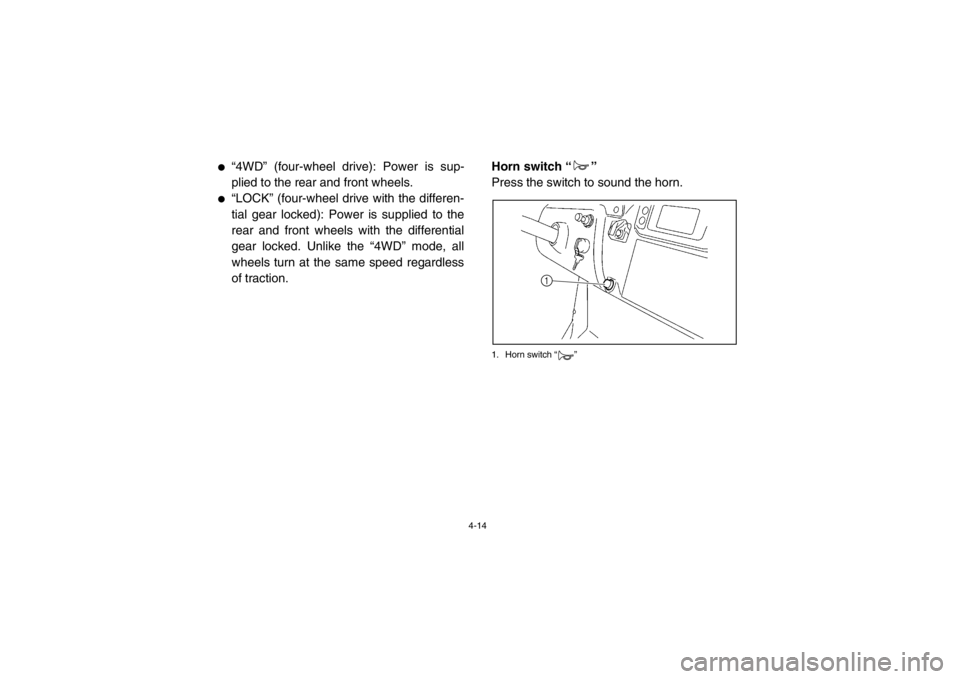
EVU01280Horn switch “ ”
Press the switch to sound the horn.1. Horn switch “ ”
1
1RB7A_EE.book Page 14 Tuesday, April 24, 2012 9:07 AM
Page 47 of 188
4-17
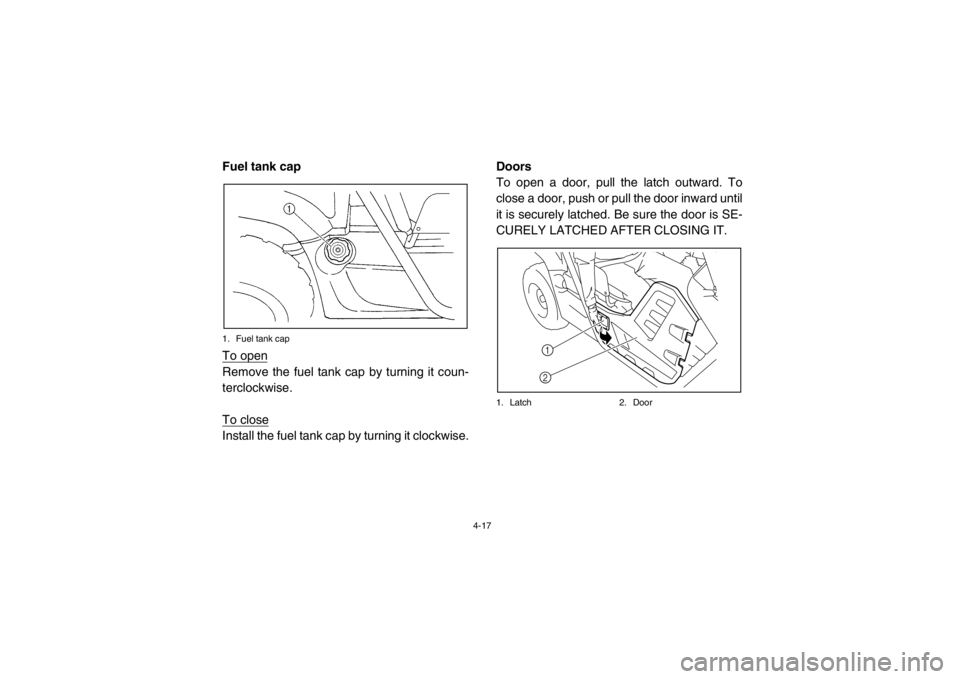
EVU00300Fuel tank cap1. Fuel tank capTo openRemove the fuel tank cap by turning it coun-
terclockwise.
To closeInstall the fuel tank cap by turning it clockwise.Doors
To open a door, pull the latch outward. To
close a door, push or pull the door inward until
it is securely latched. Be sure the door is SE-
CURELY LATCHED AFTER CLOSING IT.
1. Latch
2. Door
1
2
1RB7A_EE.book Page 17 Tuesday, April 24, 2012 9:07 AM
Page 48 of 188
4-18
EVU00330Seats
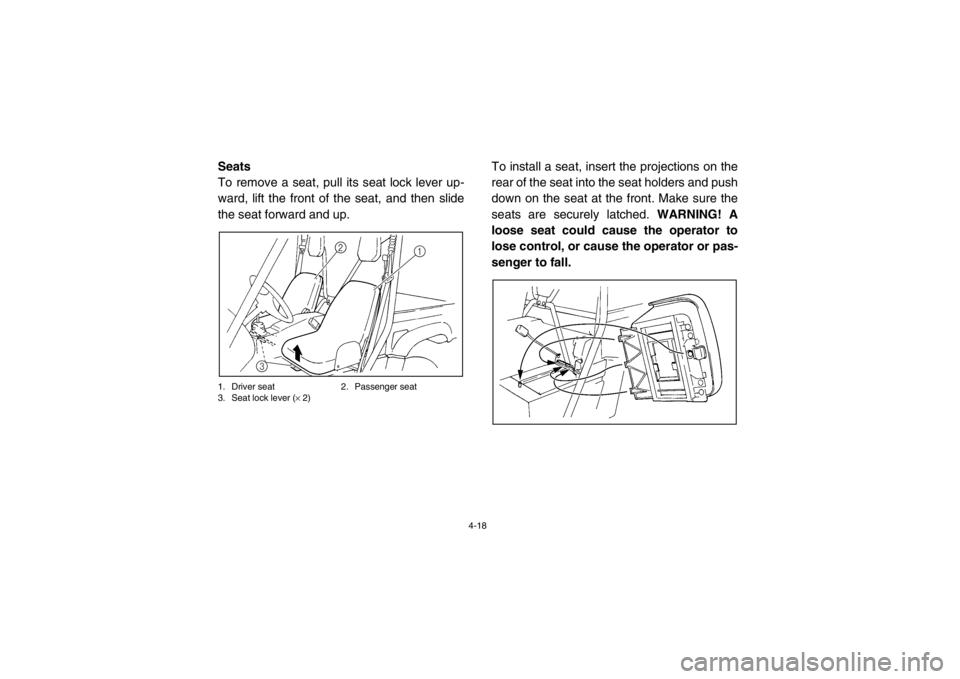
To remove a seat, pull its seat lock lever up-
ward, lift the front of the seat, and then slide
the seat forward and up.1. Driver seat2. Passenger seat
3. Seat lock lever ( × 2)
To install a seat, insert the projections on the
rear of the seat into the seat holders and push
down on the seat at the front. Make sure the
seats are securely latched. WARNING! A
loose seat could cause the operator to
lose control, or cause the operator or pas-
senger to fall.
1
3
1RB7A_EE.book Page 18 Tuesday, April 24, 2012 9:07 AM
Page 49 of 188
4-19
EVU00340Seat belts
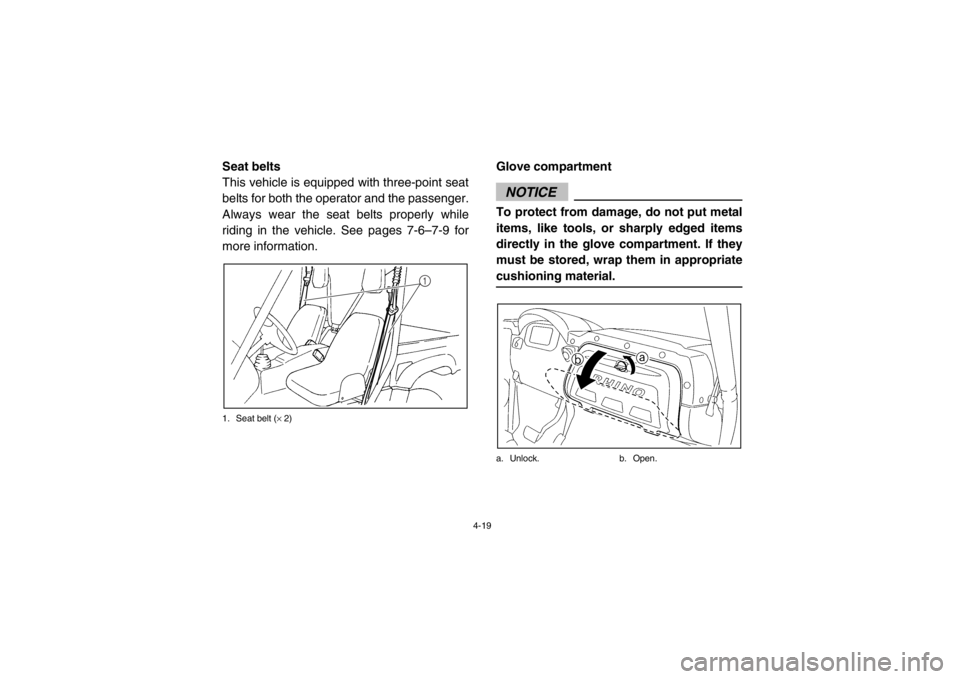
This vehicle is equipped with three-point seat
belts for both the operator and the passenger.
Always wear the seat belts properly while
riding in the vehicle. See pages 7-6–7-9 for
more information.1. Seat belt (× 2)
EVU01191Glove compartmentNOTICETo protect from damage, do not put metal
items, like tools, or sharply edged items
directly in the glove compartment. If they
must be stored, wrap them in appropriate
cushioning material.a. Unlock. b. Open.
1
1RB7A_EE.book Page 19 Tuesday, April 24, 2012 9:07 AM
Page 53 of 188
4-23
To lowerWith hands and fingers clear of pinch points,
lower the cargo bed slowly to its original posi-
tion and be sure it is locked into place.
WARNING! Keep hands, body, and other
people away from pinch points when low-
ering bed. Do not hold onto the cage/frame
while closing the bed.
5B410006Adjusting the front and rear shock
absorber assemblies
(YXR7FD/YXR700FAD)
WARNING
Always adjust the shock absorbers on the
left and right sides to the same setting. Un-
even adjustment can cause poor handling
and loss of stability, which could lead to
an accident.The spring preload can be adjusted to suit the
operating conditions. You can reduce preload
for a softer ride, or increase preload if frequent
bottoming occurs or when carrying loads.NOTICEFrequent or severe bottoming can cause
increased wear or damage to the vehicle.
1RB7A_EE.book Page 23 Tuesday, April 24, 2012 9:07 AM
Page 56 of 188
4-26
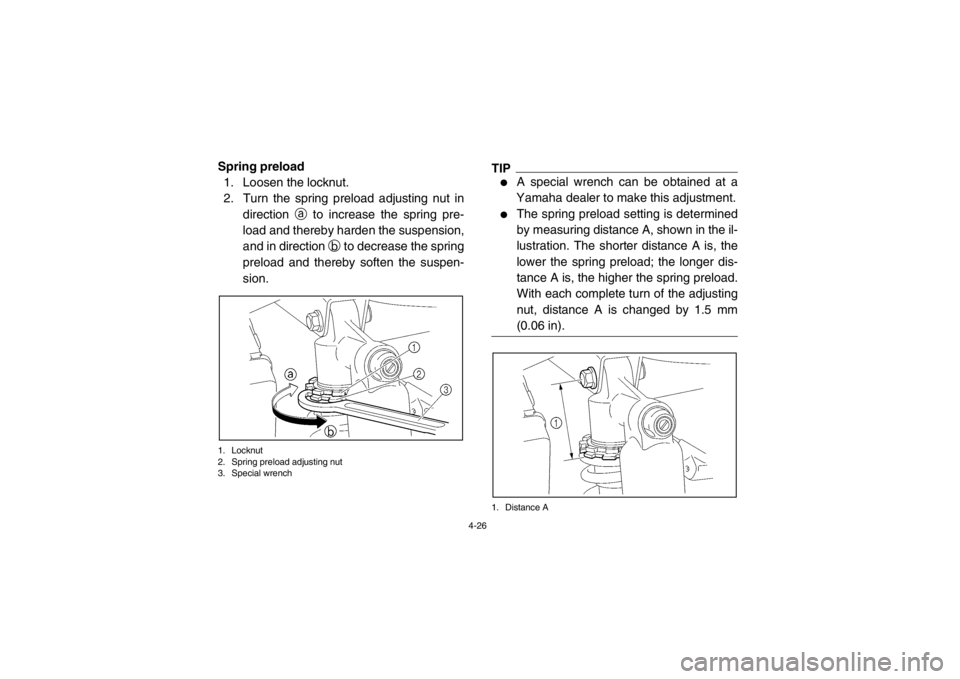
Spring preload1. Loosen the locknut.
2. Turn the spring preload adjusting nut in direction a to increase the spring pre-
load and thereby harden the suspension,
and in direction b to decrease the spring
preload and thereby soften the suspen-
sion.1. Locknut
2. Spring preload adjusting nut
3. Special wrench
TIP●
A special wrench can be obtained at a
Yamaha dealer to make this adjustment.
●
The spring preload setting is determined
by measuring distance A, shown in the il-
lustration. The shorter distance A is, the
lower the spring preload; the longer dis-
tance A is, the higher the spring preload.
With each complete turn of the adjusting
nut, distance A is changed by 1.5 mm
(0.06 in).
1. Distance A
1RB7A_EE.book Page 26 Tuesday, April 24, 2012 9:07 AM
Page 57 of 188
4-27
3. Tighten the locknut to the specifiedtorque.NOTICEAlways tighten the locknut against the ad-
justing nut, and then tighten it to the spec-
ified torque.
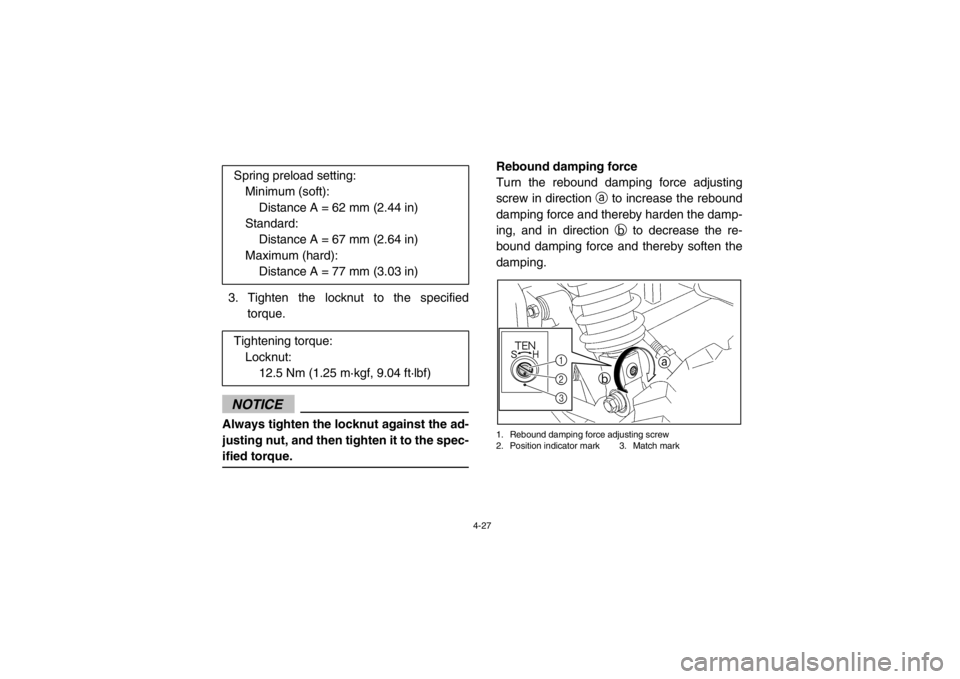
Rebound damping force
Turn the rebound damping force adjusting
screw in direction a to increase the rebound
damping force and thereby harden the damp-
ing, and in direction b to decrease the re-
bound damping force and thereby soften the
damping.1. Rebound damping force adjusting screw
2. Position indicator mark 3. Match mark
Spring preload setting: Minimum (soft):
Distance A = 62 mm (2.44 in)
Standard: Distance A = 67 mm (2.64 in)
Maximum (hard): Distance A = 77 mm (3.03 in)
Tightening torque: Locknut: 12.5 Nm (1.25 m·kgf, 9.04 ft·lbf)
123 b
a
1RB7A_EE.book Page 27 Tuesday, April 24, 2012 9:07 AM
Page 61 of 188
4-31
●
Do not deform or damage the cylin-
ders in any way. Cylinder damage will
result in poor damping performance.
●
Do not dispose of a damaged or worn
out shock absorber assembly your-
self. Take the shock absorber assem-
bly to a Yamaha dealer for any
service.
The spring preload, rebound damping and
compression damping forces of the rear
shock absorber assemblies can be adjusted
to suit the operating conditions.NOTICENever turn an adjusting mechanism be-
yond the minimum and maximum settings.
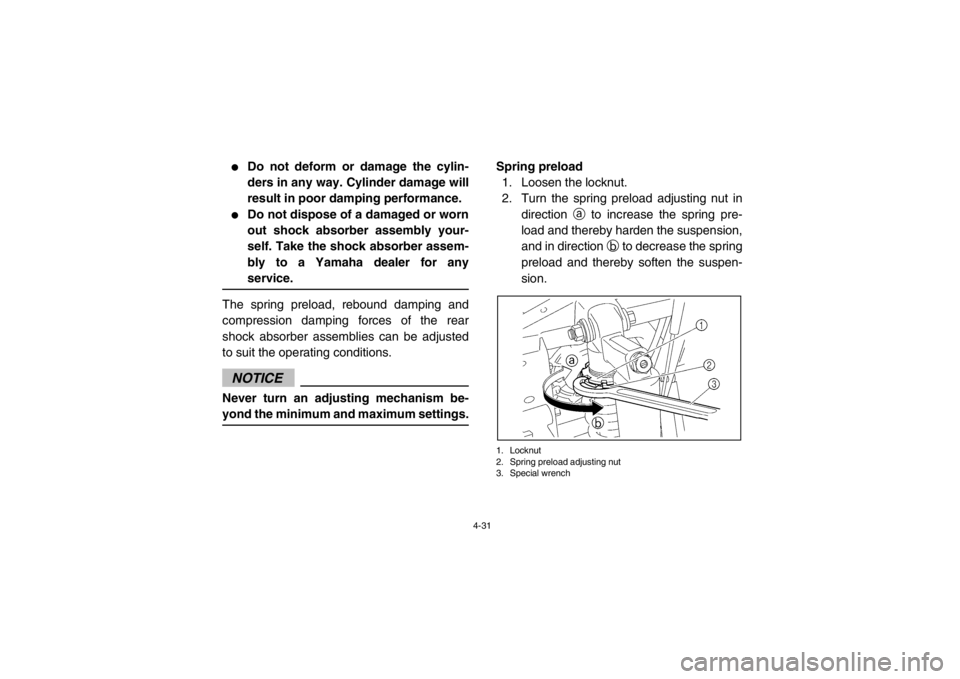
Spring preload
1. Loosen the locknut.
2. Turn the spring preload adjusting nut in direction a to increase the spring pre-
load and thereby harden the suspension,
and in direction b to decrease the spring
preload and thereby soften the suspen-
sion.1. Locknut
2. Spring preload adjusting nut
3. Special wrench
1RB7A_EE.book Page 31 Tuesday, April 24, 2012 9:07 AM
Page 62 of 188
4-32
TIP●
A special wrench can be obtained at a
Yamaha dealer to make this adjustment.
●
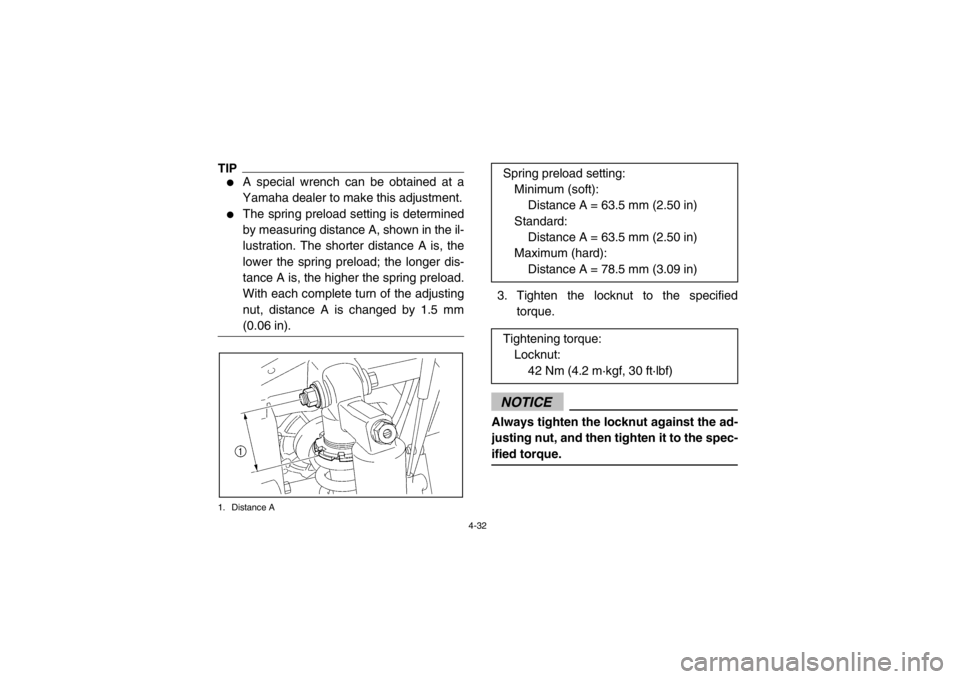
The spring preload setting is determined
by measuring distance A, shown in the il-
lustration. The shorter distance A is, the
lower the spring preload; the longer dis-
tance A is, the higher the spring preload.
With each complete turn of the adjusting
nut, distance A is changed by 1.5 mm
(0.06 in).
1. Distance A
3. Tighten the locknut to the specifiedtorque.NOTICEAlways tighten the locknut against the ad-
justing nut, and then tighten it to the spec-
ified torque.
Spring preload setting:
Minimum (soft): Distance A = 63.5 mm (2.50 in)
Standard: Distance A = 63.5 mm (2.50 in)
Maximum (hard):
Distance A = 78.5 mm (3.09 in)
Tightening torque: Locknut: 42 Nm (4.2 m·kgf, 30 ft·lbf)
1RB7A_EE.book Page 32 Tuesday, April 24, 2012 9:07 AM
Page 74 of 188
5-7
EVU00430Final gear oil
Make sure the final gear oil is at the specified
level. Add oil as necessary. (See pages 8-15–
8-18 for details.)
If desired, an SAE 80W-90 hypoid gear oil
may be used for all conditions.TIPTIPGL-4 is a quality and additive rating; GL-5 or
GL-6 rated hypoid gear oils may also be used.EVU00440Differential gear oil
Make sure the differential gear oil is at the
specified level. Add oil as necessary. (See
pages 8-18–8-21 for details.)
EVU00450Accelerator pedal
Check to see that the accelerator pedal oper-
ates correctly. It must operate smoothly and
spring back to the idle position fully when re-
leased. Have a Yamaha dealer repair as nec-
essary for proper operation.EVU00460Seat belts
Make sure that the seat belts are not frayed,
torn, stretched, or damaged. The seat belts
must move smoothly when pulled out and re-
tract on its own when released. The seat belts
must also lock up when quickly pulled out.
The latch plate should click securely into the
buckle and release when the release button is
pushed firmly. Wash off any dirt or mud that
could affect operation. Have a Yamaha dealer
repair as necessary for proper operation.
Recommended oil:
SAE 80 API GL-4 Hypoid gear oil
Recommended oil: SAE 80 API GL-4 Hypoid gear oil
1RB7A_EE.book Page 7 Tuesday, April 24, 2012 9:07 AM