10-2
1
2
3
4
5
6
7
8
910
11
12
13
14
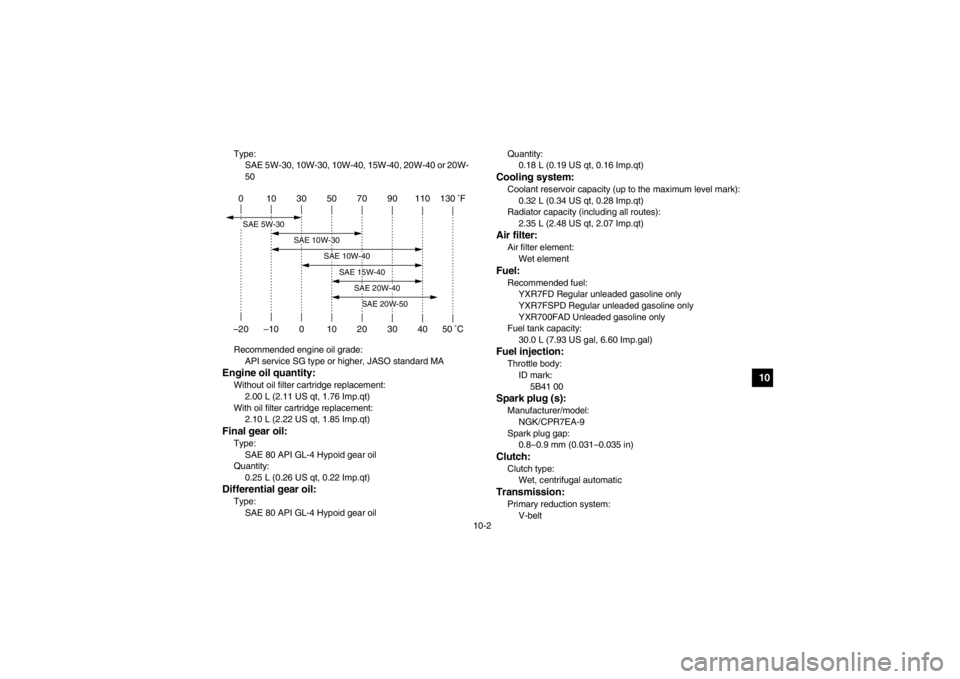
Type:SAE 5W-30, 10W-30, 10W-40, 15W-40, 20W-40 or 20W-
50
Recommended engine oil grade: API service SG type or higher, JASO standard MAEngine oil quantity:Without oil filter cartridge replacement:
2.00 L (2.11 US qt, 1.76 Imp.qt)
With oil filter cartridge replacement: 2.10 L (2.22 US qt, 1.85 Imp.qt)Final gear oil:Type:
SAE 80 API GL-4 Hypoid gear oil
Quantity: 0.25 L (0.26 US qt, 0.22 Imp.qt)Differential gear oil:Type:
SAE 80 API GL-4 Hypoid gear oil Quantity:
0.18 L (0.19 US qt, 0.16 Imp.qt)
Cooling system:Coolant reservoir capacity (up to the maximum level mark):
0.32 L (0.34 US qt, 0.28 Imp.qt)
Radiator capacity (including all routes): 2.35 L (2.48 US qt, 2.07 Imp.qt)Air filter:Air filter element:
Wet elementFuel:Recommended fuel:YXR7FD Regular unleaded gasoline only
YXR7FSPD Regular unleaded gasoline only
YXR700FAD Unleaded gasoline only
Fuel tank capacity: 30.0 L (7.93 US gal, 6.60 Imp.gal)Fuel injection:Throttle body:
ID mark:5B41 00Spark plug (s):Manufacturer/model:NGK/CPR7EA-9
Spark plug gap: 0.8–0.9 mm (0.031–0.035 in)Clutch:Clutch type:Wet, centrifugal automaticTransmission:Primary reduction system:
V-belt
0 10 30 50 70 90 110 130 ˚F
–20 –10 0 10 20 30 40 50 ˚CSAE 5W-30
SAE 10W-30
SAE 10W-40
SAE 15W-40
SAE 20W-40SAE 20W-50
1RB7A_EE.book Page 2 Tuesday, April 24, 2012 9:07 AM
10-5
Coolant temperature warning light:
LED
Engine trouble warning light: LED
Parking brake indicator light:
LED
On-Command four-wheel-drive/differential gear lock indica-
tor:
LCD
High-range indicator light: LED
Low-range indicator light: LED
Differential gear lock indicator light:
LED
Helmet/Seat belt indicator light: 14 V, 1.7 W
Fuses:Main fuse:
40.0 A
Fuel injection system fuse: 10.0 A
Headlight fuse: 15.0 A
Signaling system fuse:
10.0 A
Ignition fuse: 10.0 A
Auxiliary DC jack fuse: 10.0 A
Backup fuse:
10.0 A Four-wheel-drive motor fuse:
10.0 A
Radiator fan fuse: 25.0 A
For Europe only
The figures quoted are emission levels and are not
necessarily safe working levels. Whilst there is a
correlation between the emission and exposure
levels, this cannot be used reliably to determine
whether or not further precautions are required.
Factors that influence the actual level of exposure
of work-force include the characteristics of the
work room, the other sources of noise, etc. i.e. the
number of machines and other adjacent process-
es, and the length of time for which an operator is
exposed to the noise. Also the permissible expo-
sure level can vary from country. This information,
however, will enable the user of the machine to
make a better evaluation of the hazard and risk.
1RB7A_EE.book Page 5 Tuesday, April 24, 2012 9:07 AM