engine YAMAHA RHINO 700 2013 Service Manual
[x] Cancel search | Manufacturer: YAMAHA, Model Year: 2013, Model line: RHINO 700, Model: YAMAHA RHINO 700 2013Pages: 188, PDF Size: 4.9 MB
Page 135 of 188
8-22
5B410015Coolant
The coolant level should be checked before
each ride.
Checking the coolant level1. Park the vehicle on a level surface.
2. Check the coolant level in the coolant
reservoir when the engine is cold as the
coolant level varies with engine tempera-
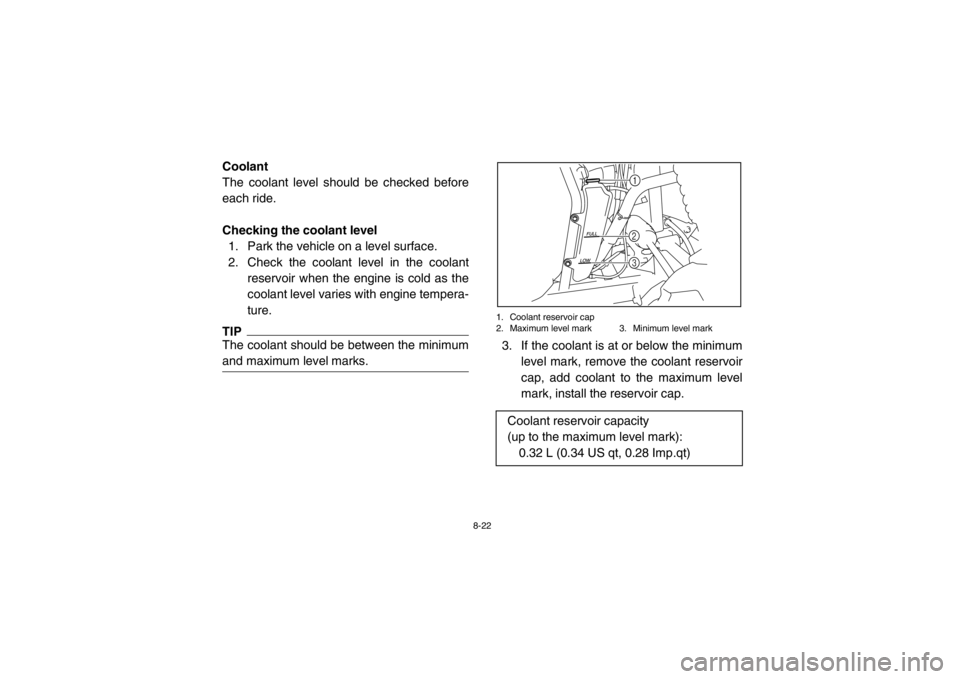
ture. TIPThe coolant should be between the minimum
and maximum level marks.
1. Coolant reservoir cap
2. Maximum level mark 3. Minimum level mark3. If the coolant is at or below the minimum level mark, remove the coolant reservoir
cap, add coolant to the maximum level
mark, install the reservoir cap.
Coolant reservoir capacity
(up to the maximum level mark): 0.32 L (0.34 US qt, 0.28 Imp.qt)
1
2
3
1RB7A_EE.book Page 22 Tuesday, April 24, 2012 9:07 AM
Page 138 of 188
8-25
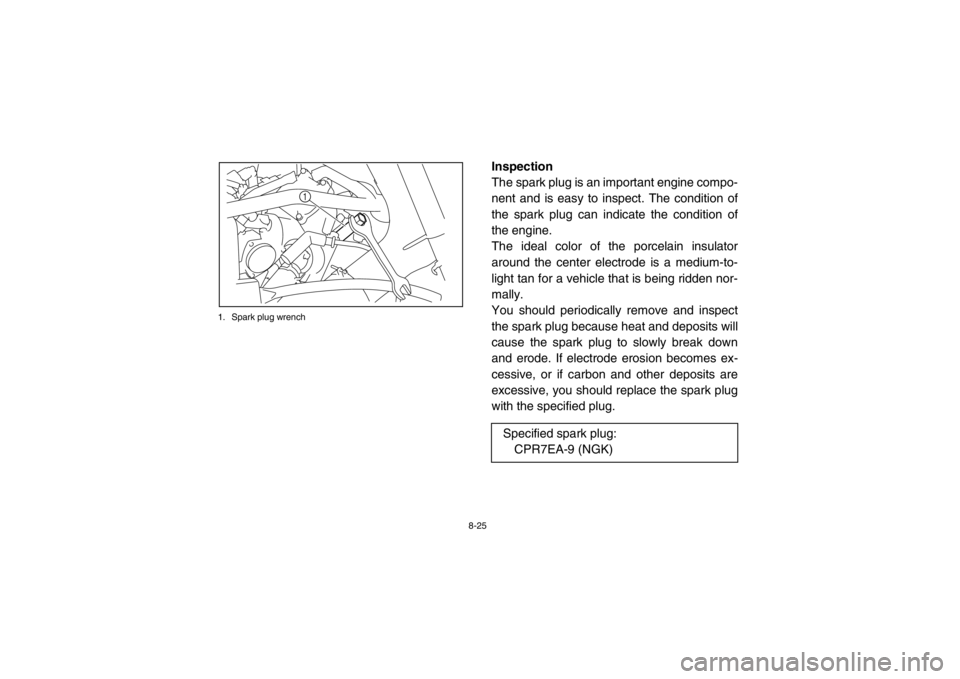
1. Spark plug wrench
Inspection
The spark plug is an important engine compo-
nent and is easy to inspect. The condition of
the spark plug can indicate the condition of
the engine.
The ideal color of the porcelain insulator
around the center electrode is a medium-to-
light tan for a vehicle that is being ridden nor-
mally.
You should periodically remove and inspect
the spark plug because heat and deposits will
cause the spark plug to slowly break down
and erode. If electrode erosion becomes ex-
cessive, or if carbon and other deposits are
excessive, you should replace the spark plug
with the specified plug.
1
Specified spark plug:
CPR7EA-9 (NGK)
1RB7A_EE.book Page 25 Tuesday, April 24, 2012 9:07 AM
Page 144 of 188
8-31
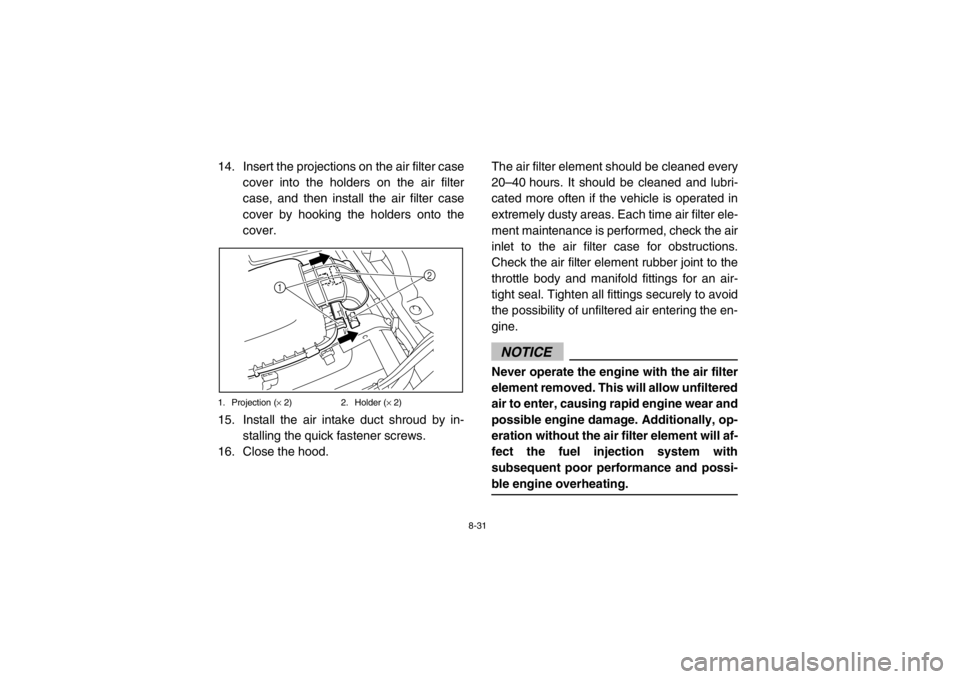
14. Insert the projections on the air filter casecover into the holders on the air filter
case, and then install the air filter case
cover by hooking the holders onto the
cover.1. Projection ( × 2) 2. Holder ( × 2)15. Install the air intake duct shroud by in-
stalling the quick fastener screws.
16. Close the hood. The air filter element should be cleaned every
20–40 hours. It should be cleaned and lubri-
cated more often if the vehicle is operated in
extremely dusty areas. Each time air filter ele-
ment maintenance is performed, check the air
inlet to the air filter case for obstructions.
Check the air filter element rubber joint to the
throttle body and manifold fittings for an air-
tight seal. Tighten all fittings securely to avoid
the possibility of unfiltered air entering the en-
gine.
NOTICENever operate the engine with the air filter
element removed. This will allow unfiltered
air to enter, causing rapid engine wear and
possible engine damage. Additionally, op-
eration without the air filter element will af-
fect the fuel injection system with
subsequent poor performance and possi-
ble engine overheating.
2
1
1RB7A_EE.book Page 31 Tuesday, April 24, 2012 9:07 AM
Page 146 of 188
8-33
EVU00780V-belt case drain plug
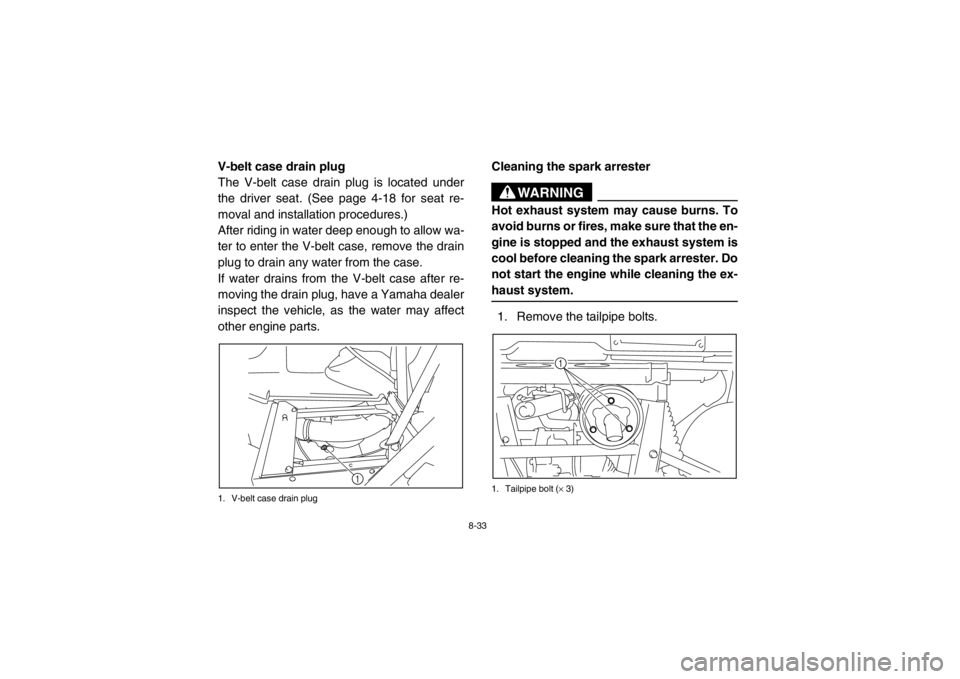
The V-belt case drain plug is located under
the driver seat. (See page 4-18 for seat re-
moval and installation procedures.)
After riding in water deep enough to allow wa-
ter to enter the V-belt case, remove the drain
plug to drain any water from the case.
If water drains from the V-belt case after re-
moving the drain plug, have a Yamaha dealer
inspect the vehicle, as the water may affect
other engine parts.1. V-belt case drain plug
5B410018Cleaning the spark arrester
WARNING
Hot exhaust system may cause burns. To
avoid burns or fires, make sure that the en-
gine is stopped and the exhaust system is
cool before cleaning the spark arrester. Do
not start the engine while cleaning the ex-
haust system.1. Remove the tailpipe bolts.1. Tailpipe bolt (× 3)
1
1
1RB7A_EE.book Page 33 Tuesday, April 24, 2012 9:07 AM
Page 147 of 188
8-34
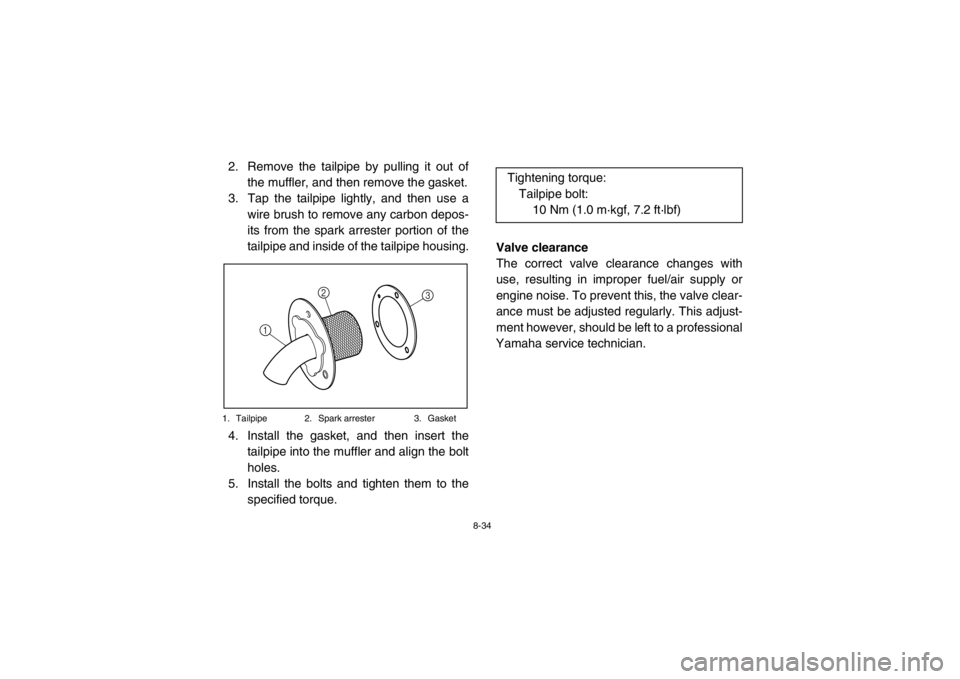
2. Remove the tailpipe by pulling it out ofthe muffler, and then remove the gasket.
3. Tap the tailpipe lightly, and then use a
wire brush to remove any carbon depos-
its from the spark arrester portion of the
tailpipe and inside of the tailpipe housing.1. Tailpipe 2. Spark arrester 3. Gasket4. Install the gasket, and then insert thetailpipe into the muffler and align the bolt
holes.
5. Install the bolts and tighten them to the specified torque. Valve clearance
The correct valve clearance changes with
use, resulting in improper fuel/air supply or
engine noise. To prevent this, the valve clear-
ance must be adjusted regularly. This adjust-
ment however, should be left to a professional
Yamaha service technician.
3
1 2
Tightening torque:
Tailpipe bolt: 10 Nm (1.0 m·kgf, 7.2 ft·lbf)
1RB7A_EE.book Page 34 Tuesday, April 24, 2012 9:07 AM
Page 165 of 188
8-52
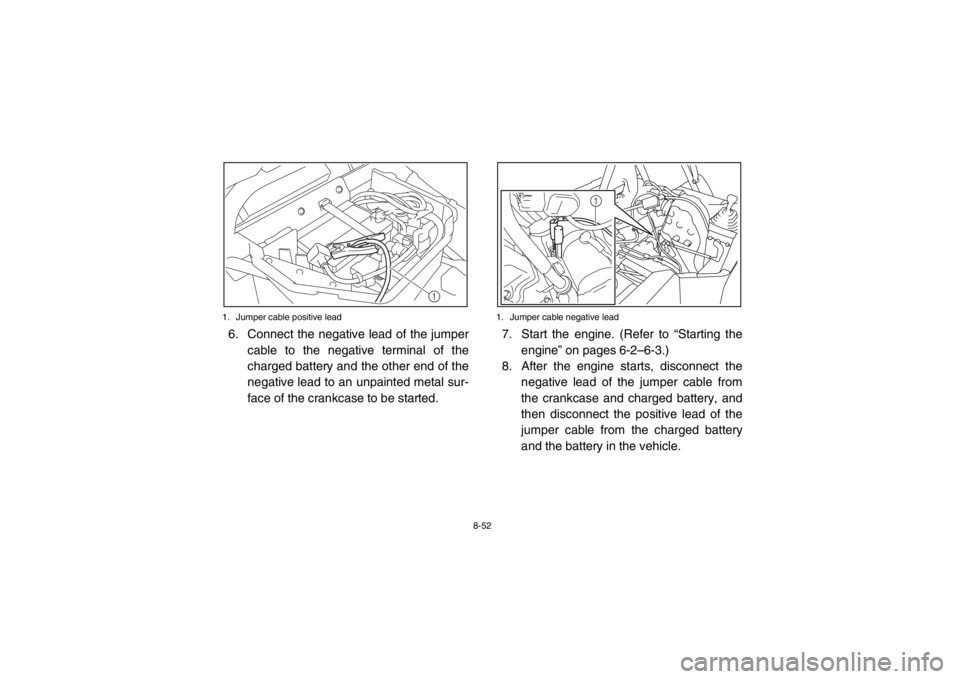
1. Jumper cable positive lead
6. Connect the negative lead of the jumper
cable to the negative terminal of the
charged battery and the other end of the
negative lead to an unpainted metal sur-
face of the crankcase to be started.
1. Jumper cable negative lead7. Start the engine. (Refer to “Starting the engine” on pages 6-2–6-3.)
8. After the engine starts, disconnect the
negative lead of the jumper cable from
the crankcase and charged battery, and
then disconnect the positive lead of the
jumper cable from the charged battery
and the battery in the vehicle.
1
1
1RB7A_EE.book Page 52 Tuesday, April 24, 2012 9:07 AM
Page 175 of 188
8-62
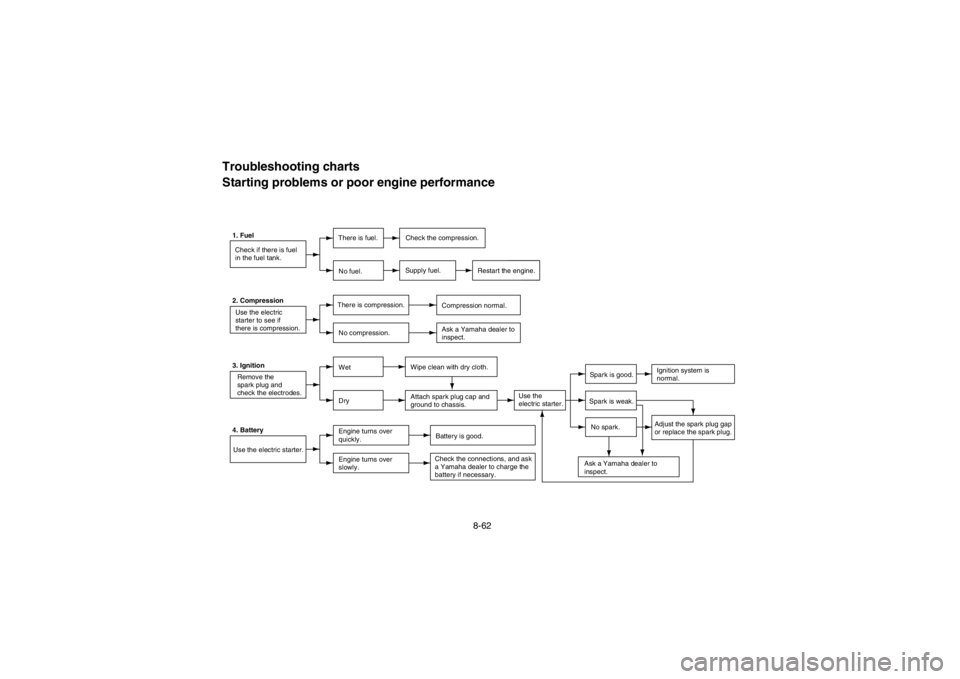
5B410024Troubleshooting charts
Starting problems or poor engine performance1. FuelCheck if there is fuel
in the fuel tank. There is fuel.
Restart the engine.
No fuel. Supply fuel.
2. Compression Use the electric
starter to see if
there is compression. There is compression.
Compression normal.
No compression. Ask a Yamaha dealer to
inspect.
3. Ignition Remove the
spark plug and
check the electrodes. Wet
Wipe clean with dry cloth.
Dry Attach spark plug cap and
ground to chassis. Use the
electric starter.Spark is good.
Ignition system is
normal.
Spark is weak.
Adjust the spark plug gap
or replace the spark plug.
No spark.
Ask a Yamaha dealer to
inspect.
4. Battery
Use the electric starter. Engine turns over
quickly.
Battery is good.
Engine turns over
slowly.
Check the compression.
Check the connections, and ask
a Yamaha dealer to charge the
battery if necessary.
1RB7A_EE.book Page 62 Tuesday, April 24, 2012 9:07 AM
Page 176 of 188
8-63
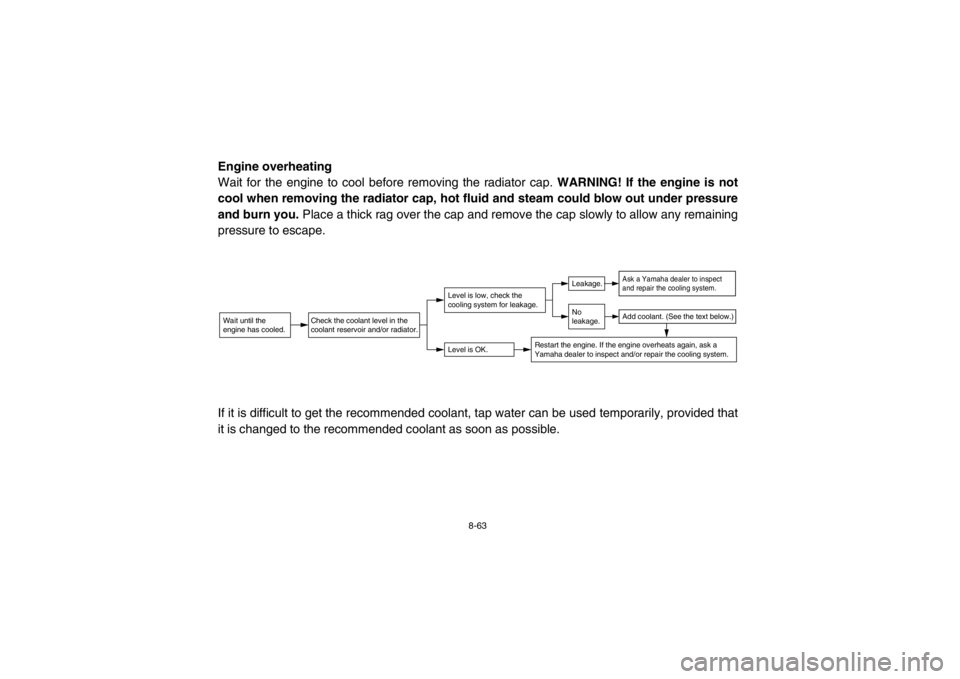
Engine overheating
Wait for the engine to cool before removing the radiator cap. WARNING! If the engine is not
cool when removing the radiator cap, hot fluid and steam could blow out under pressure
and burn you. Place a thick rag over the cap and remove the cap slowly to allow any remaining
pressure to escape.
If it is difficult to get the recommended coolant , tap water can be used temporarily, provided that
it is changed to the recommended coolant as soon as possible.Wait until the
engine has cooled.
Check the coolant level in the
coolant reservoir and/or radiator.
Level is OK.Level is low, check the
cooling system for leakage.
No
leakage.Leakage.
Ask a Yamaha dealer to inspect
and repair the cooling system.Add coolant. (See the text below.)
Restart the engine. If the engine overheats again, ask a
Yamaha dealer to inspect and/or repair the cooling system.
1RB7A_EE.book Page 63 Tuesday, April 24, 2012 9:07 AM
Page 177 of 188
9-1
1
2
3
4
5
6
7
89
10
11
12
13
14
EVU01030
1-CLEANING AND STORAGE
A. Cleaning
Frequent, thorough cleaning of your vehicle
will not only enhance its appearance but will
improve its general performance and extend
the useful life of many components.1. Before cleaning the vehicle:
a. Block off the end of the exhaust pipeto prevent water entry. A plastic bag
and strong rubber band may be used.
b. Make sure the spark plug and all filler caps are properly installed.
2. If the engine case is excessively greasy,
apply degreaser with a paint brush. Do
not apply degreaser to the wheel axles. 3. Rinse the dirt and degreaser off with a
garden hose. Use only enough pressure
to do the job. WARNING! Test the
brakes after washing. Apply the
brakes several times at slow speeds
to let friction dry out the linings. Wet
brakes may have reduced stopping
ability, increasing the chance of an ac-
cident. NOTICE: Excessive water
pressure may cause water seepage
and deterioration of wheel bearings,
brakes, transmission seals and elec-
trical devices. Many expensive repair
bills have resulted from improper
high-pressure detergent applications,
such as those available in coin-oper-
ated car washers.1RB7A_EE.book Page 1 Tuesday, April 24, 2012 9:07 AM
Page 178 of 188
9-2
4. Once the majority of the dirt has beenhosed off, wash all surfaces with warm
water and mild, detergent-type soap. An
old toothbrush or bottle brush is handy for
hard-to-get-at places.
5. Rinse the vehicle off immediately with
clean water and dry all surfaces with a
clean chamois towel or soft, absorbent
cloth.
6. Clean the seats with a vinyl upholstery cleaner to keep the covers pliable and
glossy.
7. Automotive-type wax may be applied to all painted and chrome-plated surfaces.
Avoid combination cleaner-waxes. Many
contain abrasives which may scratch the
paint or protective finish. When finished,
start the engine and let it idle for several
minutes.
5B410025B. Storage
Long term storage (60 days or more) of your
vehicle will require some preventive proce-
dures to guard against deterioration. Make
any necessary repairs before storing the vehi-
cle.
After thoroughly cleaning the vehicle, prepare
for storage as follows:1. Fill the fuel tank with fresh fuel and add
the specified amount of Yamaha Fuel
Stabilizer and Conditioner or equivalent
product. Operate the vehicle for at least
5 minutes to distribute treated fuel
through the fuel system.
Specified amount: 1 oz of stabilizer to each gallon of fuel (or
7.5 ml of stabilizer to each liter of fuel)
1RB7A_EE.book Page 2 Tuesday, April 24, 2012 9:07 AM