engine YAMAHA SLIDER 50 2013 User Guide
[x] Cancel search | Manufacturer: YAMAHA, Model Year: 2013, Model line: SLIDER 50, Model: YAMAHA SLIDER 50 2013Pages: 66, PDF Size: 1.58 MB
Page 23 of 66
INSTRUMENT AND CONTROL FUNCTIONS
3-7
3
NOTICE
ECA10701
Use only unleaded gasoline. The use
of leaded gasoline will cause unre-
pairable damage to the catalytic
converter.
EAU13453
2-stroke engine oil Make sure that there is sufficient 2-
stroke engine oil in the oil tank. Add the
recommended 2-stroke engine oil as
necessary.NOTICE
ECA16670
Make sure that the 2-stroke engine
oil tank cap is properly installed.
EAU13590
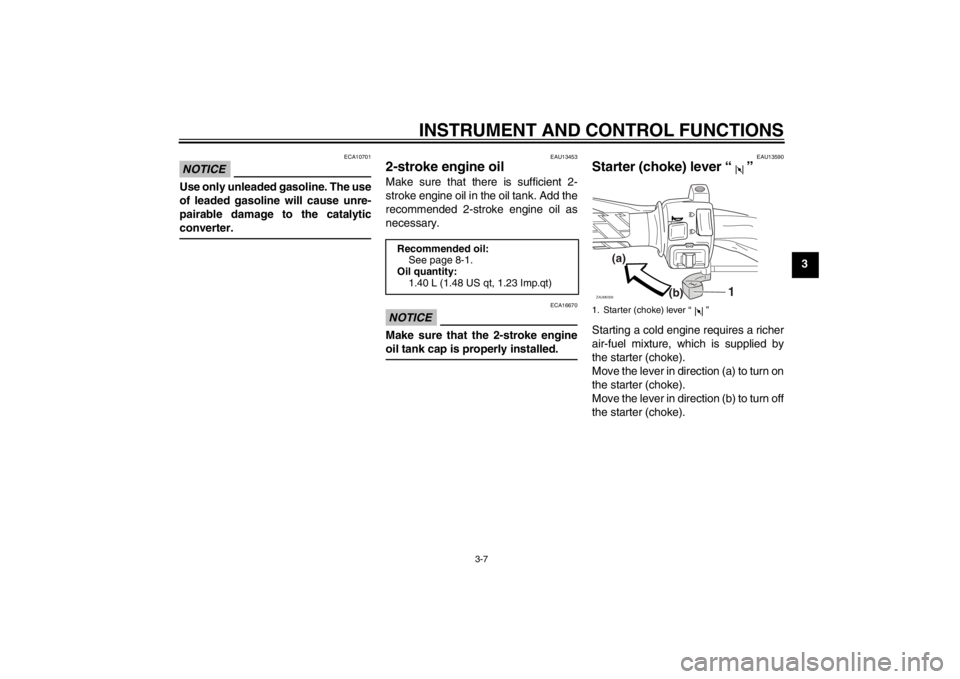
Starter (choke) lever “ ” Starting a cold engine requires a richer
air-fuel mixture, which is supplied by
the starter (choke).
Move the lever in direction (a) to turn on
the starter (choke).
Move the lever in direction (b) to turn off
the starter (choke).
Recommended oil:
See page 8-1.
Oil quantity:
1.40 L (1.48 US qt, 1.23 Imp.qt)
1. Starter (choke) lever “ ”
1
(a)
(b)
ZAUM0309
U1S0E1E0.book Page 7 Wednesday, November 7, 2012 3:32 PM
Page 24 of 66
INSTRUMENT AND CONTROL FUNCTIONS
3-8
3
EAUS1050
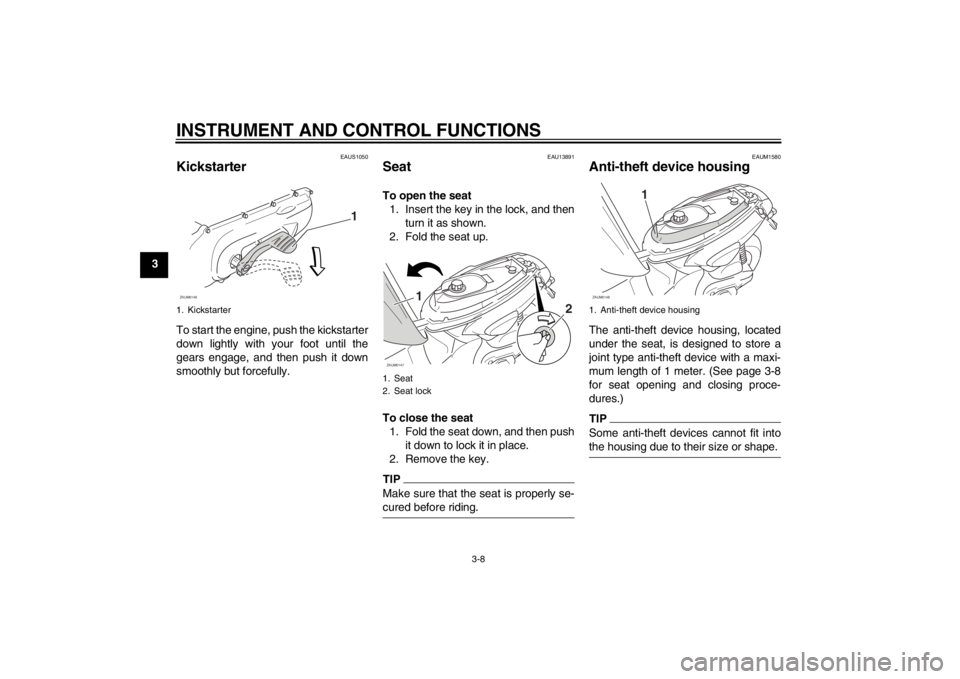
Kickstarter To start the engine, push the kickstarter
down lightly with your foot until the
gears engage, and then push it down
smoothly but forcefully.
EAU13891
Seat To open the seat
1. Insert the key in the lock, and then
turn it as shown.
2. Fold the seat up.
To close the seat
1. Fold the seat down, and then push
it down to lock it in place.
2. Remove the key.TIPMake sure that the seat is properly se-
cured before riding.
EAUM1580
Anti-theft device housing The anti-theft device housing, located
under the seat, is designed to store a
joint type anti-theft device with a maxi-
mum length of 1 meter. (See page 3-8
for seat opening and closing proce-
dures.)TIPSome anti-theft devices cannot fit into
the housing due to their size or shape.
1. Kickstarter
1
ZAUM0146
1. Seat
2. Seat lock
1
2
ZAUM0147
1. Anti-theft device housing
1
ZAUM0148
U1S0E1E0.book Page 8 Wednesday, November 7, 2012 3:32 PM
Page 26 of 66
FOR YOUR SAFETY – PRE-OPERATION CHECKS
4-1
4
EAU15597
Inspect your vehicle each time you use it to make sure the vehicle is in safe operating condition. Always follow the inspection
and maintenance procedures and schedules described in the Owner’s Manual.
WARNING
EWA11151
Failure to inspect or maintain the vehicle properly increases the possibility of an accident or equipment damage.
Do not operate the vehicle if you find any problem. If a problem cannot be corrected by the procedures provided in
this manual, have the vehicle inspected by a Yamaha dealer.Before using this vehicle, check the following points:
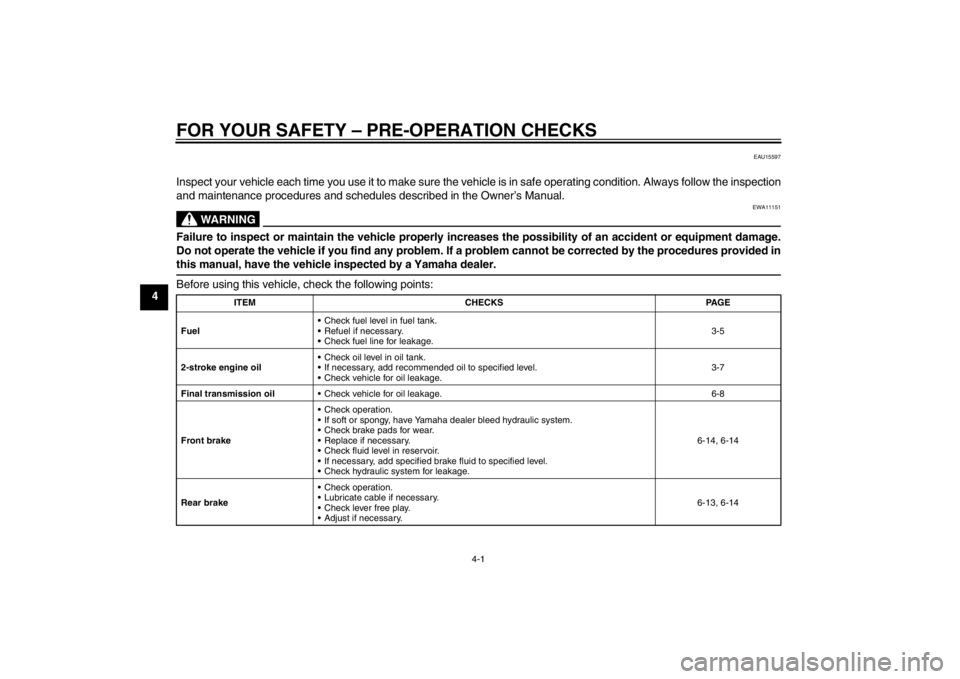
ITEM CHECKS PAGE
Fuel Check fuel level in fuel tank.
Refuel if necessary.
Check fuel line for leakage.3-5
2-stroke engine oil Check oil level in oil tank.
If necessary, add recommended oil to specified level.
Check vehicle for oil leakage.3-7
Final transmission oil Check vehicle for oil leakage. 6-8
Front brake Check operation.
If soft or spongy, have Yamaha dealer bleed hydraulic system.
Check brake pads for wear.
Replace if necessary.
Check fluid level in reservoir.
If necessary, add specified brake fluid to specified level.
Check hydraulic system for leakage.6-14, 6-14
Rear brake Check operation.
Lubricate cable if necessary.
Check lever free play.
Adjust if necessary.6-13, 6-14
U1S0E1E0.book Page 1 Wednesday, November 7, 2012 3:32 PM
Page 28 of 66
OPERATION AND IMPORTANT RIDING POINTS
5-1
5
EAU15951
Read the Owner’s Manual carefully to
become familiar with all controls. If
there is a control or function you do not
understand, ask your Yamaha dealer.
WARNING
EWA10271
Failure to familiarize yourself with
the controls can lead to loss of con-
trol, which could cause an accident
or injury.
EAUM2126
Starting a cold engine NOTICE
ECA10250
See page 5-4 for engine break-in in-
structions prior to operating the ve-
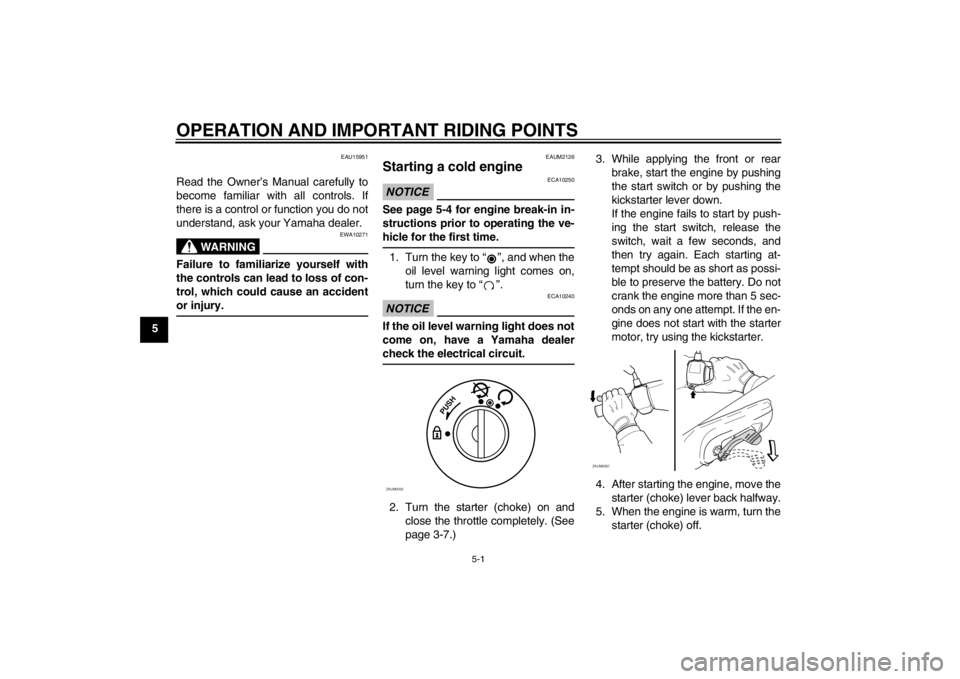
hicle for the first time.1. Turn the key to “ ”, and when the
oil level warning light comes on,
turn the key to “ ”.NOTICE
ECA10240
If the oil level warning light does not
come on, have a Yamaha dealer
check the electrical circuit.2. Turn the starter (choke) on and
close the throttle completely. (See
page 3-7.)3. While applying the front or rear
brake, start the engine by pushing
the start switch or by pushing the
kickstarter lever down.
If the engine fails to start by push-
ing the start switch, release the
switch, wait a few seconds, and
then try again. Each starting at-
tempt should be as short as possi-
ble to preserve the battery. Do not
crank the engine more than 5 sec-
onds on any one attempt. If the en-
gine does not start with the starter
motor, try using the kickstarter.
4. After starting the engine, move the
starter (choke) lever back halfway.
5. When the engine is warm, turn the
starter (choke) off.
P
U
S
H
ZAUM0332
ZAUM0367
U1S0E1E0.book Page 1 Wednesday, November 7, 2012 3:32 PM
Page 29 of 66
OPERATION AND IMPORTANT RIDING POINTS
5-2
5
TIPThe engine is warm when it responds
quickly to the throttle with the starter
(choke) turned off.NOTICE
ECA11042
For maximum engine life, never ac-
celerate hard when the engine is
cold!
EAU16640
Starting a warm engine Follow the same procedure as for start-
ing a cold engine with the exception
that the starter (choke) is not required
when the engine is warm.
EAU16761
Starting off TIPBefore starting off, allow the engine to
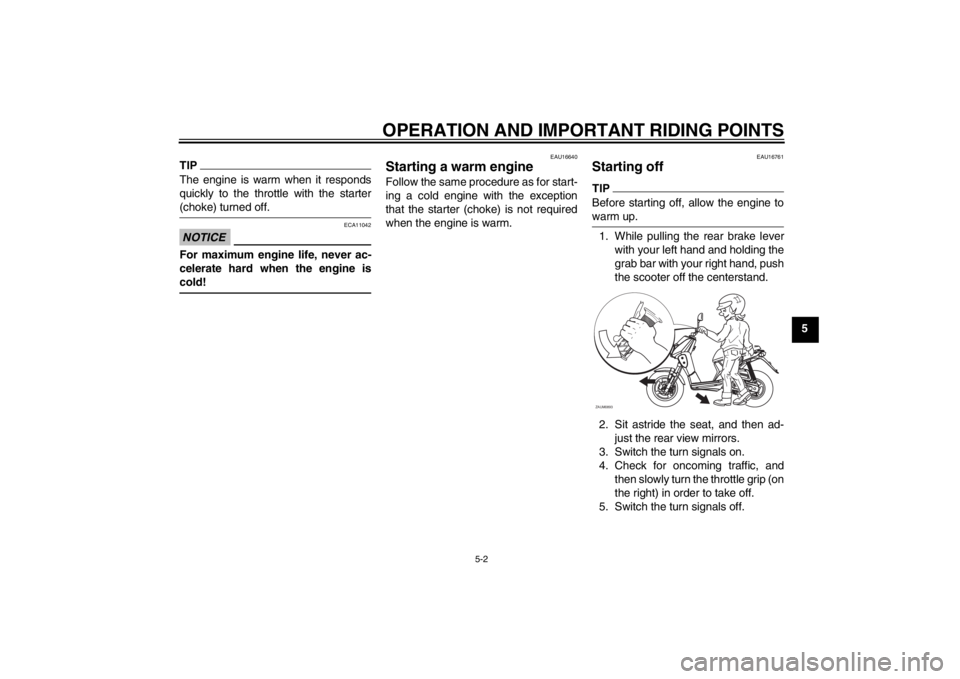
warm up.1. While pulling the rear brake lever
with your left hand and holding the
grab bar with your right hand, push
the scooter off the centerstand.
2. Sit astride the seat, and then ad-
just the rear view mirrors.
3. Switch the turn signals on.
4. Check for oncoming traffic, and
then slowly turn the throttle grip (on
the right) in order to take off.
5. Switch the turn signals off.ZAUM0893
U1S0E1E0.book Page 2 Wednesday, November 7, 2012 3:32 PM
Page 31 of 66

OPERATION AND IMPORTANT RIDING POINTS
5-4
5
EAU16820
Tips for reducing fuel con-
sumption Fuel consumption depends largely on
your riding style. Consider the following
tips to reduce fuel consumption:●
Avoid high engine speeds during
acceleration.
●
Avoid high engine speeds with no
load on the engine.
●
Turn the engine off instead of let-
ting it idle for an extended length of
time (e.g., in traffic jams, at traffic
lights or at railroad crossings).
EAU16830
Engine break-in There is never a more important period
in the life of your engine than the period
between 0 and 1000 km (600 mi). For
this reason, you should read the follow-
ing material carefully.
Since the engine is brand new, do not
put an excessive load on it for the first
1000 km (600 mi). The various parts in
the engine wear and polish themselves
to the correct operating clearances.
During this period, prolonged full-throt-
tle operation or any condition that might
result in engine overheating must be
avoided.
EAUM2091
0–150 km (0–90 mi)
Avoid prolonged operation above 1/3
throttle. Vary the speed of the scooter
from time to time. Do not operate it at
one set throttle position.
150–500 km (90–300 mi)
Avoid prolonged operation above 1/2
throttle.
500–1000 km (300–600 mi)
Avoid cruising speeds in excess of 3/4
throttle.1000 km (600 mi) and beyond
Avoid prolonged full throttle operation.
Vary speeds occasionally. NOTICE:
After 1000 km (600 mi) of operation,
the final transmission oil must be
changed.
[ECAM1071]
NOTICE
ECA10270
If any engine trouble should occur
during the engine break-in period,
immediately have a Yamaha dealer
check the vehicle.
U1S0E1E0.book Page 4 Wednesday, November 7, 2012 3:32 PM
Page 32 of 66

OPERATION AND IMPORTANT RIDING POINTS
5-5
5
EAU17213
Parking When parking, stop the engine, and
then remove the key from the main
switch.
WARNING
EWA10311
●
Since the engine and exhaust
system can become very hot,
park in a place where pedestri-
ans or children are not likely to
touch them and be burned.
●
Do not park on a slope or on soft
ground, otherwise the vehicle
may overturn, increasing the
risk of a fuel leak and fire.
●
Do not park near grass or other
flammable materials which
might catch fire.
U1S0E1E0.book Page 5 Wednesday, November 7, 2012 3:32 PM
Page 33 of 66
PERIODIC MAINTENANCE AND ADJUSTMENT
6-1
6
EAU17244
Periodic inspection, adjustment, and lu-
brication will keep your vehicle in the
safest and most efficient condition pos-
sible. Safety is an obligation of the vehi-
cle owner/operator. The most important
points of vehicle inspection, adjust-
ment, and lubrication are explained on
the following pages.
The intervals given in the periodic
maintenance charts should be simply
considered as a general guide under
normal riding conditions. However, de-
pending on the weather, terrain, geo-
graphical location, and individual use,
the maintenance intervals may need to
be shortened.
WARNING
EWA10321
Failure to properly maintain the ve-
hicle or performing maintenance ac-
tivities incorrectly may increase
your risk of injury or death during
service or while using the vehicle. If
you are not familiar with vehicle ser-
vice, have a Yamaha dealer perform
service.
WARNING
EWA15122
Turn off the engine when performing
maintenance unless otherwise
specified.●
A running engine has moving
parts that can catch on body
parts or clothing and electrical
parts that can cause shocks or
fires.
●
Running the engine while ser-
vicing can lead to eye injury,
burns, fire, or carbon monoxide
poisoning – possibly leading to
death. See page 1-3 for more in-
formation about carbon monox-
ide.WARNING
EWA15460
Brake discs, calipers, drums, and
linings can become very hot during
use. To avoid possible burns, let
brake components cool before
touching them.
EAU17302
Emission controls not only function to
ensure cleaner air, but are also vital to
proper engine operation and maximum
performance. In the following periodic
maintenance charts, the services relat-
ed to emissions control are grouped
separately. These services require
specialized data, knowledge, and
equipment. Maintenance, replacement,
or repair of the emission control devic-
es and systems may be performed by
any repair establishment or individual
that is certified (if applicable). Yamaha
dealers are trained and equipped to
perform these particular services.
U1S0E1E0.book Page 1 Wednesday, November 7, 2012 3:32 PM
Page 34 of 66

PERIODIC MAINTENANCE AND ADJUSTMENT
6-2
6
EAU46871
TIP●
The annual checks must be performed every year, except if a kilometer-based maintenance, or for the UK, a
mileage-based maintenance, is performed instead.
●
From 30000 km (17500 mi), repeat the maintenance intervals starting from 6000 km (3500 mi).
●
Items marked with an asterisk should be performed by a Yamaha dealer as they require special tools, data and technical
skills.
EAU46920
Periodic maintenance chart for the emission control system NO. ITEM CHECK OR MAINTENANCE JOBODOMETER READING
ANNUAL
CHECK 1000 km
(600 mi)6000 km
(3500 mi)12000 km
(7000 mi)18000 km
(10500 mi)24000 km
(14000 mi)
1*Fuel line Check fuel and vacuum hoses for
cracks or damage.√√√√√
2 Spark plug Replace.√√√√√
3*Carburetor Adjust engine idling speed.√√√√√√
U1S0E1E0.book Page 2 Wednesday, November 7, 2012 3:32 PM
Page 39 of 66
PERIODIC MAINTENANCE AND ADJUSTMENT
6-7
6
EAU19622
Checking the spark plug The spark plug is an important engine
component, which should be checked
periodically, preferably by a Yamaha
dealer. Since heat and deposits will
cause any spark plug to slowly erode, it
should be removed and checked in ac-
cordance with the periodic mainte-
nance and lubrication chart. In addition,
the condition of the spark plug can re-
veal the condition of the engine.
The porcelain insulator around the cen-
ter electrode of the spark plug should
be a medium-to-light tan (the ideal color
when the vehicle is ridden normally). If
the spark plug shows a distinctly differ-
ent color, the engine could be operating
improperly. Do not attempt to diagnose
such problems yourself. Instead, have
a Yamaha dealer check the vehicle.
If the spark plug shows signs of elec-
trode erosion and excessive carbon or
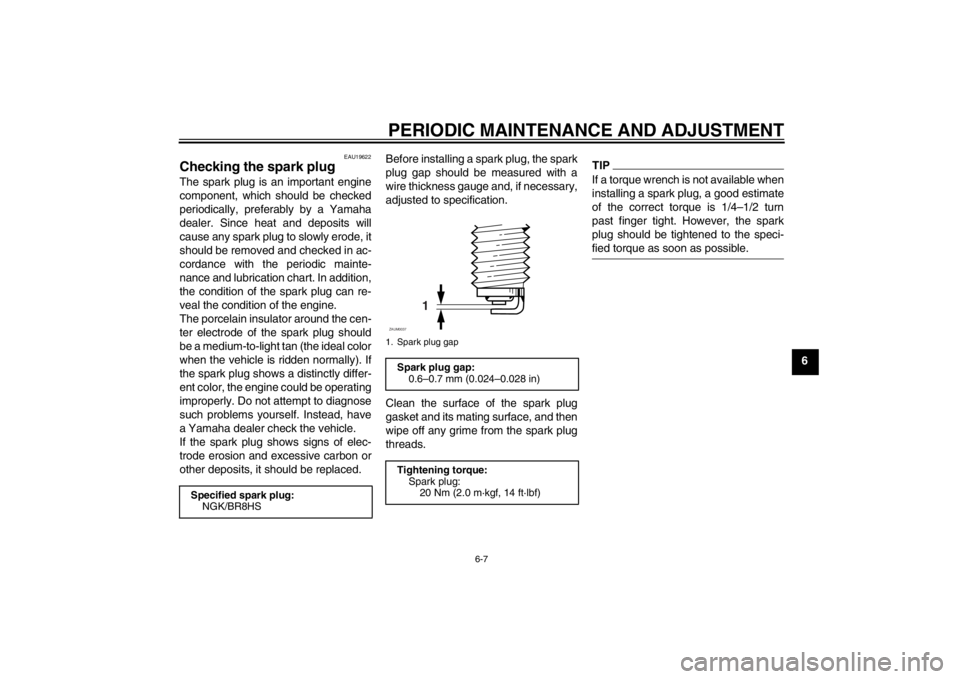
other deposits, it should be replaced.Before installing a spark plug, the spark
plug gap should be measured with a
wire thickness gauge and, if necessary,
adjusted to specification.
Clean the surface of the spark plug
gasket and its mating surface, and then
wipe off any grime from the spark plug
threads.
TIPIf a torque wrench is not available when
installing a spark plug, a good estimate
of the correct torque is 1/4–1/2 turn
past finger tight. However, the spark
plug should be tightened to the speci-
fied torque as soon as possible.
Specified spark plug:
NGK/BR8HS
1. Spark plug gap
Spark plug gap:
0.6–0.7 mm (0.024–0.028 in)
Tightening torque:
Spark plug:
20 Nm (2.0 m·kgf, 14 ft·lbf)
1
ZAUM0037
U1S0E1E0.book Page 7 Wednesday, November 7, 2012 3:32 PM