maintenance YAMAHA SLIDER 50 2013 User Guide
[x] Cancel search | Manufacturer: YAMAHA, Model Year: 2013, Model line: SLIDER 50, Model: YAMAHA SLIDER 50 2013Pages: 66, PDF Size: 1.58 MB
Page 39 of 66
PERIODIC MAINTENANCE AND ADJUSTMENT
6-7
6
EAU19622
Checking the spark plug The spark plug is an important engine
component, which should be checked
periodically, preferably by a Yamaha
dealer. Since heat and deposits will
cause any spark plug to slowly erode, it
should be removed and checked in ac-
cordance with the periodic mainte-
nance and lubrication chart. In addition,
the condition of the spark plug can re-
veal the condition of the engine.
The porcelain insulator around the cen-
ter electrode of the spark plug should
be a medium-to-light tan (the ideal color
when the vehicle is ridden normally). If
the spark plug shows a distinctly differ-
ent color, the engine could be operating
improperly. Do not attempt to diagnose
such problems yourself. Instead, have
a Yamaha dealer check the vehicle.
If the spark plug shows signs of elec-
trode erosion and excessive carbon or
other deposits, it should be replaced.Before installing a spark plug, the spark
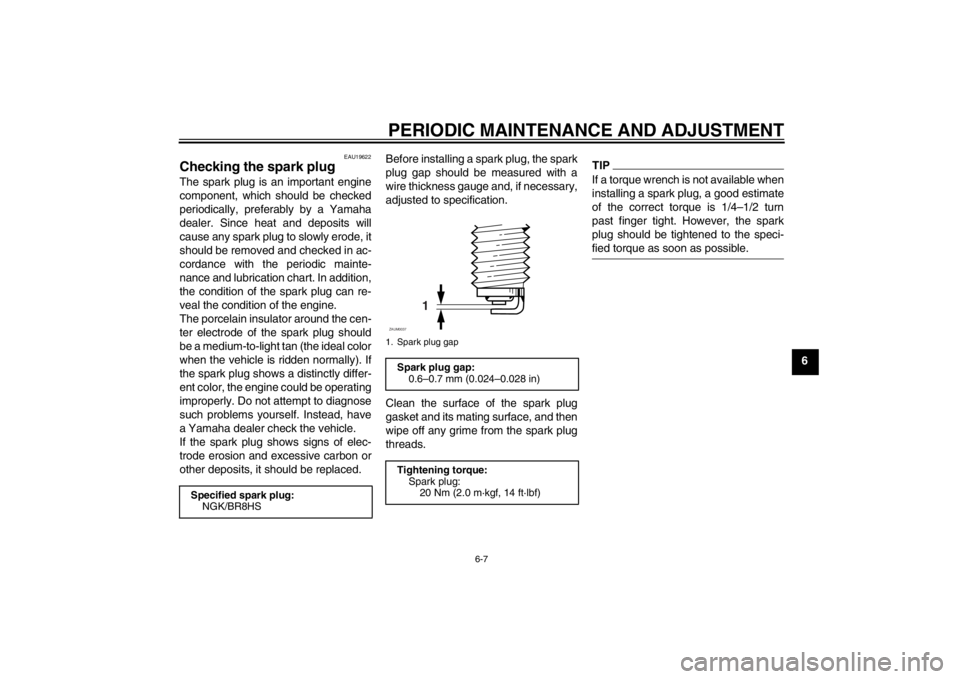
plug gap should be measured with a
wire thickness gauge and, if necessary,
adjusted to specification.
Clean the surface of the spark plug
gasket and its mating surface, and then
wipe off any grime from the spark plug
threads.
TIPIf a torque wrench is not available when
installing a spark plug, a good estimate
of the correct torque is 1/4–1/2 turn
past finger tight. However, the spark
plug should be tightened to the speci-
fied torque as soon as possible.
Specified spark plug:
NGK/BR8HS
1. Spark plug gap
Spark plug gap:
0.6–0.7 mm (0.024–0.028 in)
Tightening torque:
Spark plug:
20 Nm (2.0 m·kgf, 14 ft·lbf)
1
ZAUM0037
U1S0E1E0.book Page 7 Wednesday, November 7, 2012 3:32 PM
Page 40 of 66
PERIODIC MAINTENANCE AND ADJUSTMENT
6-8
6
EAU20066
Final transmission oil The final transmission case must be
checked for oil leakage before each
ride. If any leakage is found, have a
Yamaha dealer check and repair the
scooter. In addition, the final transmis-
sion oil must be changed as follows at
the intervals specified in the periodic
maintenance and lubrication chart.
1. Start the engine, warm up the final
transmission oil by riding the
scooter for several minutes, and
then stop the engine.
2. Place the scooter on the center-
stand.
3. Place an oil pan under the final
transmission case to collect the
used oil.
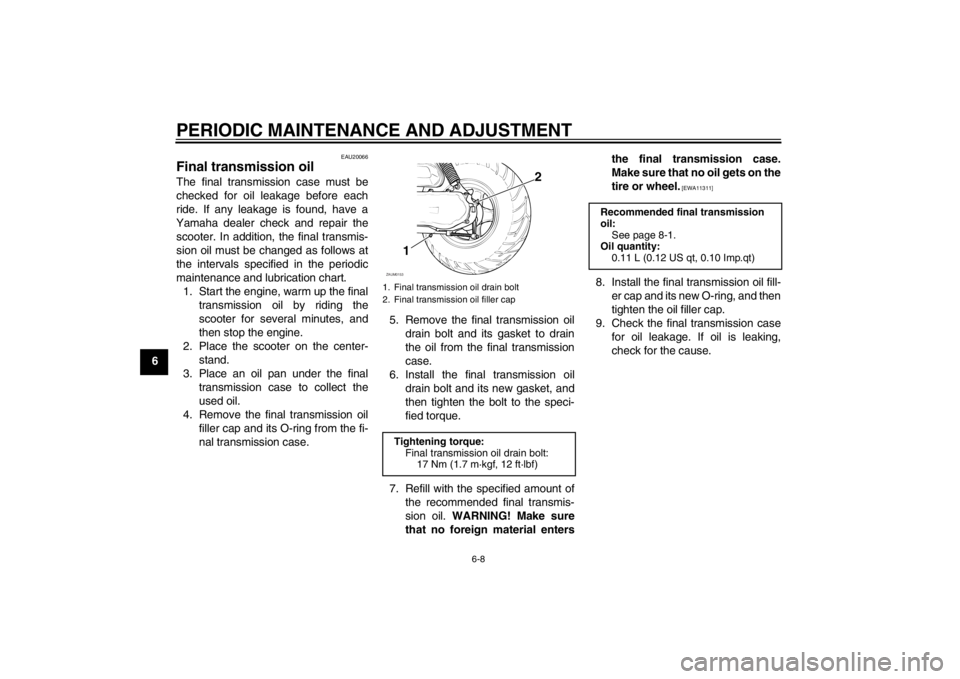
4. Remove the final transmission oil
filler cap and its O-ring from the fi-
nal transmission case.5. Remove the final transmission oil
drain bolt and its gasket to drain
the oil from the final transmission
case.
6. Install the final transmission oil
drain bolt and its new gasket, and
then tighten the bolt to the speci-
fied torque.
7. Refill with the specified amount of
the recommended final transmis-
sion oil. WARNING! Make sure
that no foreign material entersthe final transmission case.
Make sure that no oil gets on the
tire or wheel.
[EWA11311]
8. Install the final transmission oil fill-
er cap and its new O-ring, and then
tighten the oil filler cap.
9. Check the final transmission case
for oil leakage. If oil is leaking,
check for the cause.
1. Final transmission oil drain bolt
2. Final transmission oil filler capTightening torque:
Final transmission oil drain bolt:
17 Nm (1.7 m·kgf, 12 ft·lbf)12
ZAUM0153
Recommended final transmission
oil:
See page 8-1.
Oil quantity:
0.11 L (0.12 US qt, 0.10 Imp.qt)
U1S0E1E0.book Page 8 Wednesday, November 7, 2012 3:32 PM
Page 41 of 66
PERIODIC MAINTENANCE AND ADJUSTMENT
6-9
6
EAUM1642
Cleaning the air filter element The air filter element should be cleaned
at the intervals specified in the periodic
maintenance and lubrication chart.
Clean the air filter element more fre-
quently if you are riding in unusually
wet or dusty areas.
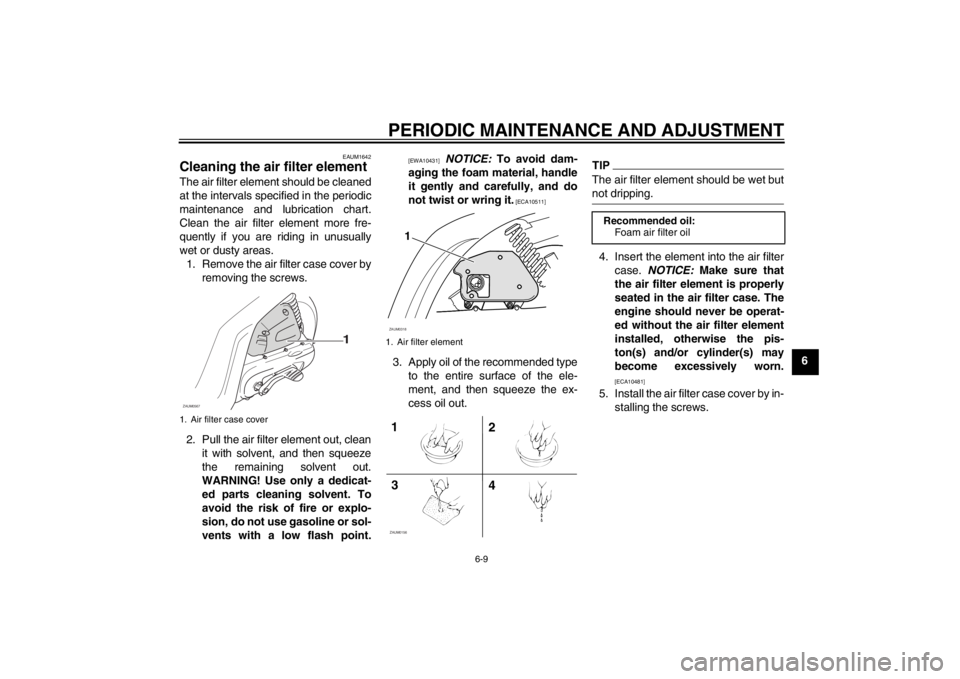
1. Remove the air filter case cover by
removing the screws.
2. Pull the air filter element out, clean
it with solvent, and then squeeze
the remaining solvent out.
WARNING! Use only a dedicat-
ed parts cleaning solvent. To
avoid the risk of fire or explo-
sion, do not use gasoline or sol-
vents with a low flash point.
[EWA10431]
NOTICE: To avoid dam-
aging the foam material, handle
it gently and carefully, and do
not twist or wring it.
[ECA10511]
3. Apply oil of the recommended type
to the entire surface of the ele-
ment, and then squeeze the ex-
cess oil out.
TIPThe air filter element should be wet but
not dripping.4. Insert the element into the air filter
case. NOTICE: Make sure that
the air filter element is properly
seated in the air filter case. The
engine should never be operat-
ed without the air filter element
installed, otherwise the pis-
ton(s) and/or cylinder(s) may
become excessively worn.
[ECA10481]
5. Install the air filter case cover by in-
stalling the screws.
1. Air filter case cover
1
ZAUM0567
1. Air filter element
1
ZAUM03181
4 32ZAUM0156
Recommended oil:
Foam air filter oil
U1S0E1E0.book Page 9 Wednesday, November 7, 2012 3:32 PM
Page 42 of 66
PERIODIC MAINTENANCE AND ADJUSTMENT
6-10
6
EAU21300
Adjusting the carburetor The carburetor is an important part of
the engine and requires very sophisti-
cated adjustment. Therefore, all carbu-
retor adjustments should be left to a
Yamaha dealer, who has the neces-
sary professional knowledge and expe-
rience.
EAU21384
Checking the throttle grip free
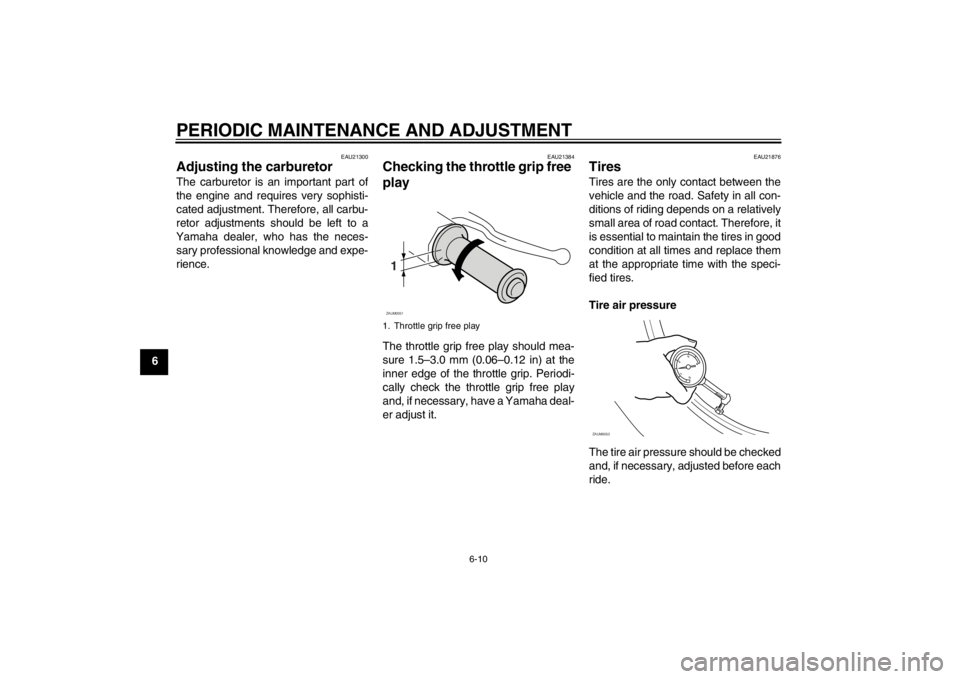
play The throttle grip free play should mea-
sure 1.5–3.0 mm (0.06–0.12 in) at the
inner edge of the throttle grip. Periodi-
cally check the throttle grip free play
and, if necessary, have a Yamaha deal-
er adjust it.
EAU21876
Tires Tires are the only contact between the
vehicle and the road. Safety in all con-
ditions of riding depends on a relatively
small area of road contact. Therefore, it
is essential to maintain the tires in good
condition at all times and replace them
at the appropriate time with the speci-
fied tires.
Tire air pressure
The tire air pressure should be checked
and, if necessary, adjusted before each
ride.
1. Throttle grip free play1ZAUM0051
ZAUM0053
U1S0E1E0.book Page 10 Wednesday, November 7, 2012 3:32 PM
Page 43 of 66
PERIODIC MAINTENANCE AND ADJUSTMENT
6-11
6
WARNING
EWA10503
Operation of this vehicle with im-
proper tire pressure may cause se-
vere injury or death from loss of
control.●
The tire air pressure must be
checked and adjusted on cold
tires (i.e., when the temperature
of the tires equals the ambient
temperature).
●
The tire air pressure must be ad-
justed in accordance with the
riding speed and with the total
weight of rider, passenger, car-
go, and accessories approved
for this model.
WARNING
EWA10511
Never overload your vehicle. Opera-
tion of an overloaded vehicle could
cause an accident.
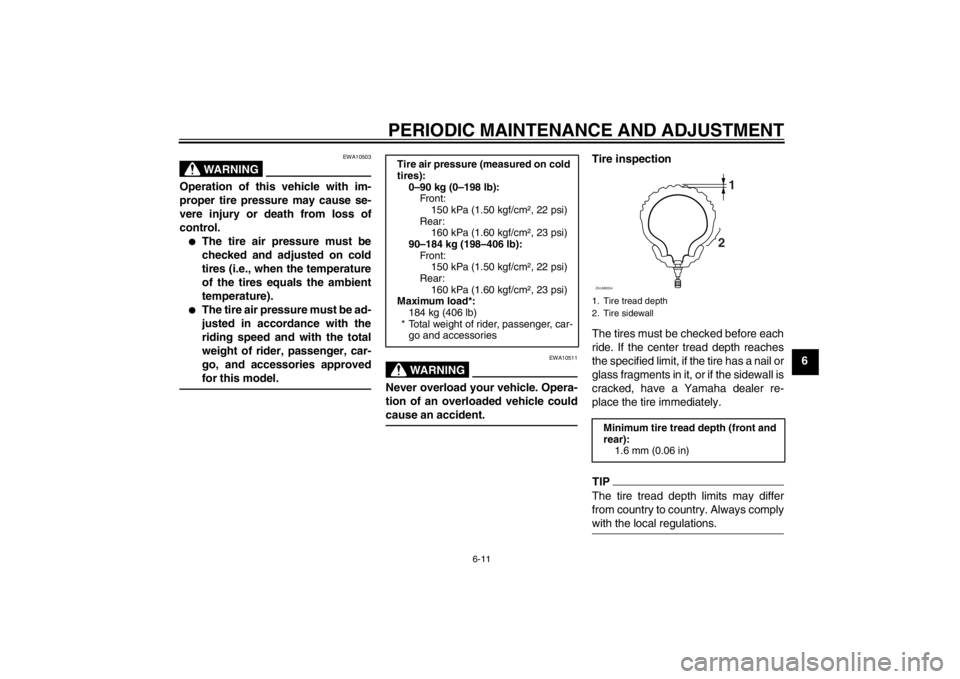
Tire inspection
The tires must be checked before each
ride. If the center tread depth reaches
the specified limit, if the tire has a nail or
glass fragments in it, or if the sidewall is
cracked, have a Yamaha dealer re-
place the tire immediately.TIPThe tire tread depth limits may differ
from country to country. Always comply
with the local regulations.
Tire air pressure (measured on cold
tires):
0–90 kg (0–198 lb):
Fr o nt :
150 kPa (1.50 kgf/cm², 22 psi)
Rear:
160 kPa (1.60 kgf/cm², 23 psi)
90–184 kg (198–406 lb):
Fr o nt :
150 kPa (1.50 kgf/cm², 22 psi)
Rear:
160 kPa (1.60 kgf/cm², 23 psi)
Maximum load*:
184 kg (406 lb)
* Total weight of rider, passenger, car-
go and accessories
1. Tire tread depth
2. Tire sidewall
Minimum tire tread depth (front and
rear):
1.6 mm (0.06 in)
1
2
ZAUM0054
U1S0E1E0.book Page 11 Wednesday, November 7, 2012 3:32 PM
Page 44 of 66
PERIODIC MAINTENANCE AND ADJUSTMENT
6-12
6Tire information
This model is equipped with tubeless
tires.
Tires age, even if they have not been
used or have only been used occasion-
ally. Cracking of the tread and sidewall
rubber, sometimes accompanied by
carcass deformation, is an evidence of
ageing. Old and aged tires shall be
checked by tire specialists to ascertain
their suitability for further use.
After extensive tests, only the tires list-
ed below have been approved for this
model by Yamaha Motor Co., Ltd.
WARNING
EWA10471
●
Have a Yamaha dealer replace
excessively worn tires. Besides
being illegal, operating the vehi-cle with excessively worn tires
decreases riding stability and
can lead to loss of control.
●
The replacement of all wheel
and brake-related parts, includ-
ing the tires, should be left to a
Yamaha dealer, who has the
necessary professional knowl-
edge and experience to do so.
●
Ride at moderate speeds after
changing a tire since the tire
surface must first be “broken
in” for it to develop its optimal
characteristics.
EAU21962
Cast wheels To maximize the performance, durabil-
ity, and safe operation of your vehicle,
note the following points regarding the
specified wheels.●
The wheel rims should be checked
for cracks, bends, warpage or oth-
er damage before each ride. If any
damage is found, have a Yamaha
dealer replace the wheel. Do not
attempt even the smallest repair to
the wheel. A deformed or cracked
wheel must be replaced.
●
The wheel should be balanced
whenever either the tire or wheel
has been changed or replaced. An
unbalanced wheel can result in
poor performance, adverse han-
dling characteristics, and a short-
ened tire life.
Front tire:
Size:
120/70-12
Manufacturer/model:
PIRELLI / EVO21 (51L)
Rear tire:
Size:
130/70-12
Manufacturer/model:
PIRELLI / EVO22 (56L)
U1S0E1E0.book Page 12 Wednesday, November 7, 2012 3:32 PM
Page 45 of 66
PERIODIC MAINTENANCE AND ADJUSTMENT
6-13
6
EAUT1221
Checking the front brake lever
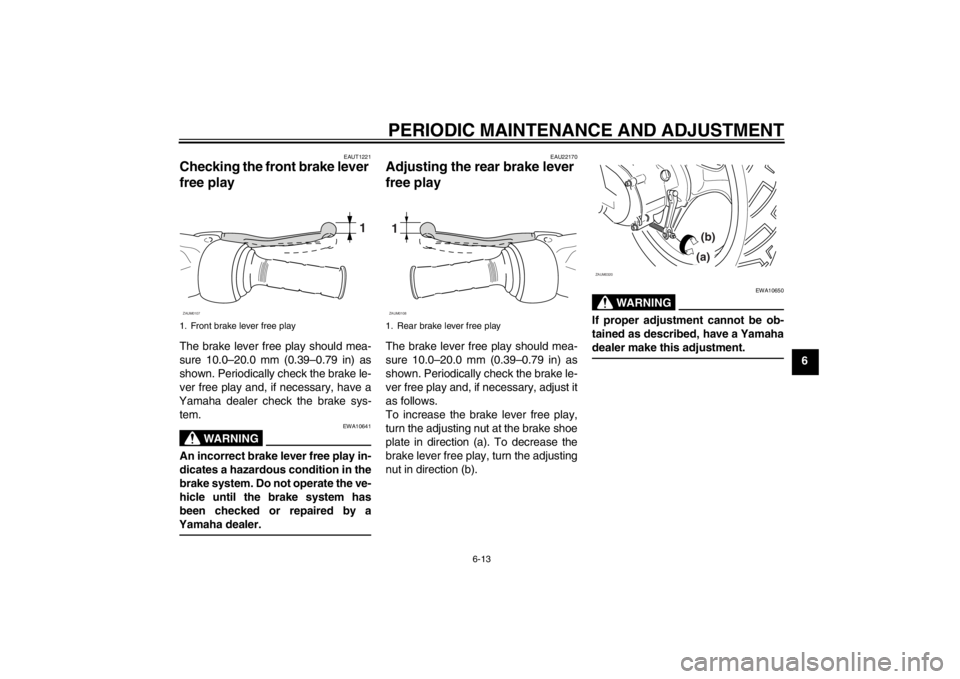
free play The brake lever free play should mea-
sure 10.0–20.0 mm (0.39–0.79 in) as
shown. Periodically check the brake le-
ver free play and, if necessary, have a
Yamaha dealer check the brake sys-
tem.
WARNING
EWA10641
An incorrect brake lever free play in-
dicates a hazardous condition in the
brake system. Do not operate the ve-
hicle until the brake system has
been checked or repaired by a
Yamaha dealer.
EAU22170
Adjusting the rear brake lever
free play The brake lever free play should mea-
sure 10.0–20.0 mm (0.39–0.79 in) as
shown. Periodically check the brake le-
ver free play and, if necessary, adjust it
as follows.
To increase the brake lever free play,
turn the adjusting nut at the brake shoe
plate in direction (a). To decrease the
brake lever free play, turn the adjusting
nut in direction (b).
WARNING
EWA10650
If proper adjustment cannot be ob-
tained as described, have a Yamaha
dealer make this adjustment.
1. Front brake lever free play
1
ZAUM0107
1. Rear brake lever free play1ZAUM0108
(a)(b)
ZAUM0320
U1S0E1E0.book Page 13 Wednesday, November 7, 2012 3:32 PM
Page 46 of 66
PERIODIC MAINTENANCE AND ADJUSTMENT
6-14
6
EAU22380
Checking the front brake pads
and rear brake shoes The front brake pads and the rear brake
shoes must be checked for wear at the
intervals specified in the periodic main-
tenance and lubrication chart.
EAU22400
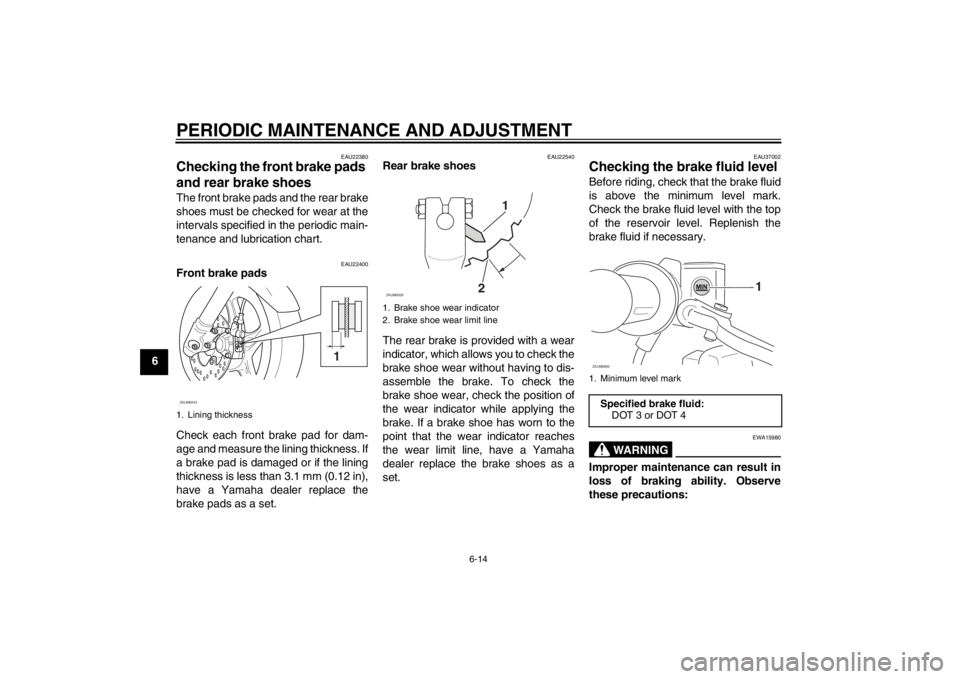
Front brake pads
Check each front brake pad for dam-
age and measure the lining thickness. If
a brake pad is damaged or if the lining
thickness is less than 3.1 mm (0.12 in),
have a Yamaha dealer replace the
brake pads as a set.
EAU22540
Rear brake shoes
The rear brake is provided with a wear
indicator, which allows you to check the
brake shoe wear without having to dis-
assemble the brake. To check the
brake shoe wear, check the position of
the wear indicator while applying the
brake. If a brake shoe has worn to the
point that the wear indicator reaches
the wear limit line, have a Yamaha
dealer replace the brake shoes as a
set.
EAU37002
Checking the brake fluid level Before riding, check that the brake fluid
is above the minimum level mark.
Check the brake fluid level with the top
of the reservoir level. Replenish the
brake fluid if necessary.
WARNING
EWA15980
Improper maintenance can result in
loss of braking ability. Observe
these precautions:
1. Lining thickness
1
ZAUM0243
1. Brake shoe wear indicator
2. Brake shoe wear limit line
1
2
ZAUM0059
1. Minimum level markSpecified brake fluid:
DOT 3 or DOT 4
1
ZAUM0900
U1S0E1E0.book Page 14 Wednesday, November 7, 2012 3:32 PM
Page 47 of 66
PERIODIC MAINTENANCE AND ADJUSTMENT
6-15
6
●
Insufficient brake fluid may al-
low air to enter the brake sys-
tem, reducing braking
performance.
●
Clean the filler cap before re-
moving. Use only DOT 3 or DOT
4 brake fluid from a sealed con-
tainer.
●
Use only the specified brake flu-
id; otherwise, the rubber seals
may deteriorate, causing leak-
age.
●
Refill with the same type of
brake fluid. Adding a brake fluid
other than DOT 3 or DOT 4 may
result in a harmful chemical re-
action.
●
Be careful that water does not
enter the brake fluid reservoir
when refilling. Water will signifi-
cantly lower the boiling point of
the fluid and may result in vapor
lock.
NOTICE
ECA17640
Brake fluid may damage painted sur-
faces or plastic parts. Always clean
up spilled fluid immediately.
As the brake pads wear, it is normal for
the brake fluid level to gradually go
down. A low brake fluid level may indi-
cate worn brake pads and/or brake sys-
tem leakage; therefore, be sure to
check the brake pads for wear and the
brake system for leakage. If the brake
fluid level goes down suddenly, have a
Yamaha dealer check the cause before
further riding.
EAUM1360
Changing the brake fluid Have a Yamaha dealer change the
brake fluid at the intervals specified in
the periodic maintenance and lubrica-
tion chart. In addition, have the brake
hose replaced every four years or
whenever it is damaged or leaking.
U1S0E1E0.book Page 15 Wednesday, November 7, 2012 3:32 PM
Page 48 of 66
PERIODIC MAINTENANCE AND ADJUSTMENT
6-16
6
EAU50800
Checking and lubricating the
cables The operation of all control cables and
the condition of the cables should be
checked before each ride, and the ca-
bles and cable ends should be lubricat-
ed if necessary. If a cable is damaged
or does not move smoothly, have a
Yamaha dealer check or replace it.
WARNING! Damage to the outer
housing of cables may result in in-
ternal rusting and cause interfer-
ence with cable movement. Replace
damaged cables as soon as possi-
ble to prevent unsafe conditions.[EWA10711]EAU23114
Checking and lubricating the
throttle grip and cable The operation of the throttle grip should
be checked before each ride. In addi-
tion, the cable should be lubricated by a
Yamaha dealer at the intervals speci-
fied in the periodic maintenance chart.
The throttle cable is equipped with a
rubber cover. Make sure that the cover
is securely installed. Even though the
cover is installed correctly, it does not
completely protect the cable from water
entry. Therefore, use care not to pour
water directly onto the cover or cable
when washing the vehicle. If the cable
or cover becomes dirty, wipe clean with
a moist cloth.
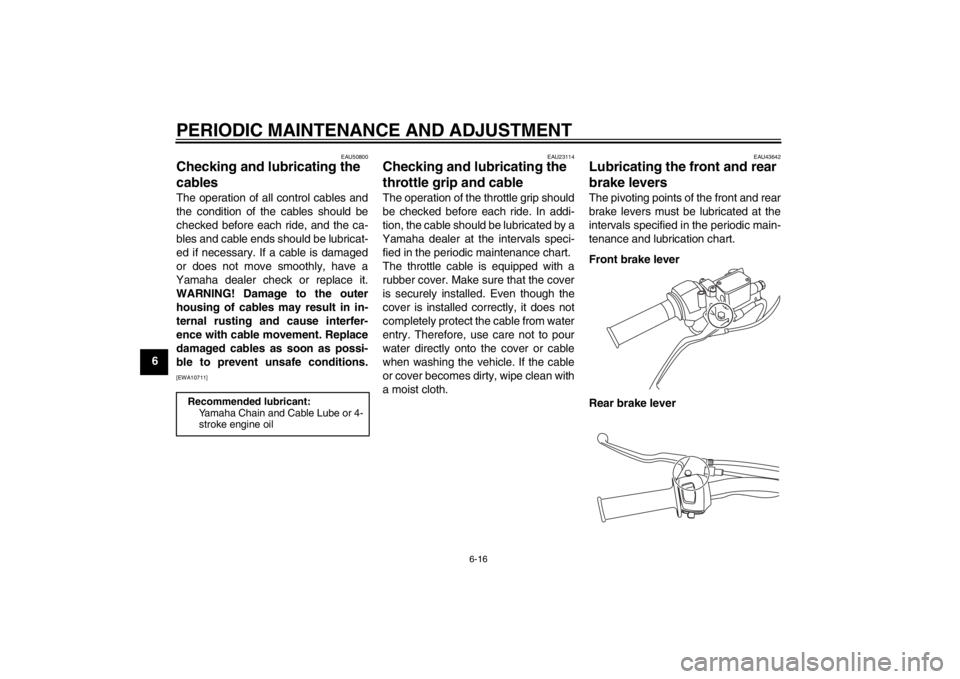
EAU43642
Lubricating the front and rear
brake levers The pivoting points of the front and rear
brake levers must be lubricated at the
intervals specified in the periodic main-
tenance and lubrication chart.
Front brake lever
Rear brake lever
Recommended lubricant:
Yamaha Chain and Cable Lube or 4-
stroke engine oil
U1S0E1E0.book Page 16 Wednesday, November 7, 2012 3:32 PM