lights YAMAHA SLIDER 50 2013 Owners Manual
[x] Cancel search | Manufacturer: YAMAHA, Model Year: 2013, Model line: SLIDER 50, Model: YAMAHA SLIDER 50 2013Pages: 66, PDF Size: 1.58 MB
Page 6 of 66

TABLE OF CONTENTSSAFETY INFORMATION ..................1-1
Further safe-riding points ................1-5
DESCRIPTION ..................................2-1
Left view ..........................................2-1
Right view ........................................2-2
Controls and instruments.................2-3
INSTRUMENT AND CONTROL
FUNCTIONS.......................................3-1
Main switch/steering lock ................3-1
Indicator lights and warning light ....3-2
Speedometer unit ...........................3-3
Handlebar switches ........................3-3
Front brake lever ............................3-4
Rear brake lever .............................3-4
Fuel and 2-stroke engine oil tank
caps .............................................3-5
Fuel .................................................3-5
Catalytic converter ..........................3-6
2-stroke engine oil ..........................3-7
Starter (choke) lever .......................3-7
Kickstarter .......................................3-8
Seat ................................................3-8
Anti-theft device housing ................3-8
Luggage hook .................................3-9FOR YOUR SAFETY –
PRE-OPERATION CHECKS............. 4-1
OPERATION AND IMPORTANT
RIDING POINTS................................. 5-1
Starting a cold engine .................... 5-1
Starting a warm engine .................. 5-2
Starting off ...................................... 5-2
Acceleration and deceleration ........ 5-3
Braking ........................................... 5-3
Tips for reducing fuel
consumption ............................... 5-4
Engine break-in .............................. 5-4
Parking ........................................... 5-5
PERIODIC MAINTENANCE AND
ADJUSTMENT................................... 6-1
Periodic maintenance chart for the
emission control system ............. 6-2
General maintenance and
lubrication chart .......................... 6-3
Removing and installing the cowling
and panel .................................... 6-6
Checking the spark plug ................. 6-7
Final transmission oil ...................... 6-8
Cleaning the air filter element ........ 6-9
Adjusting the carburetor ............... 6-10
Checking the throttle grip free
play ........................................... 6-10
Tires ............................................. 6-10
Cast wheels .................................. 6-12Checking the front brake lever free
play ........................................... 6-13
Adjusting the rear brake lever free
play ........................................... 6-13
Checking the front brake pads and
rear brake shoes ...................... 6-14
Checking the brake fluid level ...... 6-14
Changing the brake fluid .............. 6-15
Checking and lubricating the
cables ....................................... 6-16
Checking and lubricating the
throttle grip and cable ............... 6-16
Lubricating the front and rear
brake levers .............................. 6-16
Checking and lubricating the
centerstand ............................... 6-17
Checking the front fork ................. 6-18
Checking the steering .................. 6-18
Checking the wheel bearings ....... 6-19
Battery ......................................... 6-19
Replacing the fuse ....................... 6-21
Replacing the headlight bulb ....... 6-21
Replacing the tail/brake light
bulb ........................................... 6-22
Replacing a turn signal light
bulb ........................................... 6-22
Troubleshooting ........................... 6-23
Troubleshooting chart .................. 6-24
SCOOTER CARE AND STORAGE... 7-1
Matte color caution ........................ 7-1U1S0E1E0.book Page 1 Wednesday, November 7, 2012 3:32 PM
Page 11 of 66

SAFETY INFORMATION
1-4
1 Genuine Yamaha Accessories
Choosing accessories for your vehicle
is an important decision. Genuine
Yamaha accessories, which are avail-
able only from a Yamaha dealer, have
been designed, tested, and approved
by Yamaha for use on your vehicle.
Many companies with no connection to
Yamaha manufacture parts and acces-
sories or offer other modifications for
Yamaha vehicles. Yamaha is not in a
position to test the products that these
aftermarket companies produce.
Therefore, Yamaha can neither en-
dorse nor recommend the use of ac-
cessories not sold by Yamaha or
modifications not specifically recom-
mended by Yamaha, even if sold and
installed by a Yamaha dealer.
Aftermarket Parts, Accessories, and
Modifications
While you may find aftermarket prod-
ucts similar in design and quality to
genuine Yamaha accessories, recog-
nize that some aftermarket accessories
or modifications are not suitable be-
cause of potential safety hazards to you
or others. Installing aftermarket prod-ucts or having other modifications per-
formed to your vehicle that change any
of the vehicle’s design or operation
characteristics can put you and others
at greater risk of serious injury or death.
You are responsible for injuries related
to changes in the vehicle.
Keep the following guidelines in mind,
as well as those provided under “Load-
ing” when mounting accessories.
●
Never install accessories or carry
cargo that would impair the perfor-
mance of your scooter. Carefully
inspect the accessory before using
it to make sure that it does not in
any way reduce ground clearance
or cornering clearance, limit sus-
pension travel, steering travel or
control operation, or obscure lights
or reflectors.
Accessories fitted to the handle-
bar or the front fork area can
create instability due to improper
weight distribution or aerody-
namic changes. If accessories
are added to the handlebar or
front fork area, they must be as
lightweight as possible and
should be kept to a minimum. Bulky or large accessories may
seriously affect the stability of
the scooter due to aerodynamic
effects. Wind may attempt to lift
the scooter, or the scooter may
become unstable in cross
winds. These accessories may
also cause instability when
passing or being passed by
large vehicles.
Certain accessories can dis-
place the operator from his or
her normal riding position. This
improper position limits the free-
dom of movement of the opera-
tor and may limit control ability,
therefore, such accessories are
not recommended.
●
Use caution when adding electri-
cal accessories. If electrical acces-
sories exceed the capacity of the
scooter’s electrical system, an
electric failure could result, which
could cause a dangerous loss of
lights or engine power.
U1S0E1E0.book Page 4 Wednesday, November 7, 2012 3:32 PM
Page 18 of 66
INSTRUMENT AND CONTROL FUNCTIONS
3-2
3
EAU11006
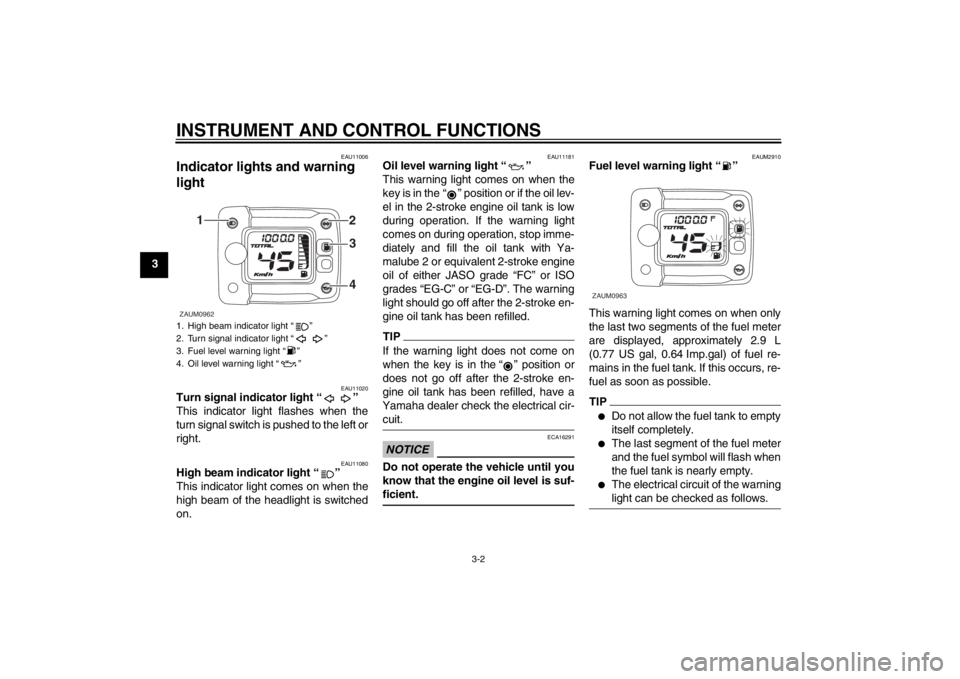
Indicator lights and warning
light
EAU11020
Turn signal indicator light “ ”
This indicator light flashes when the
turn signal switch is pushed to the left or
right.
EAU11080
High beam indicator light “ ”
This indicator light comes on when the
high beam of the headlight is switched
on.
EAU11181
Oil level warning light “ ”
This warning light comes on when the
key is in the “ ” position or if the oil lev-
el in the 2-stroke engine oil tank is low
during operation. If the warning light
comes on during operation, stop imme-
diately and fill the oil tank with Ya-
malube 2 or equivalent 2-stroke engine
oil of either JASO grade “FC” or ISO
grades “EG-C” or “EG-D”. The warning
light should go off after the 2-stroke en-
gine oil tank has been refilled.TIPIf the warning light does not come on
when the key is in the “ ” position or
does not go off after the 2-stroke en-
gine oil tank has been refilled, have a
Yamaha dealer check the electrical cir-
cuit.NOTICE
ECA16291
Do not operate the vehicle until you
know that the engine oil level is suf-
ficient.
EAUM2910
Fuel level warning light “ ”
This warning light comes on when only
the last two segments of the fuel meter
are displayed, approximately 2.9 L
(0.77 US gal, 0.64 Imp.gal) of fuel re-
mains in the fuel tank. If this occurs, re-
fuel as soon as possible.TIP●
Do not allow the fuel tank to empty
itself completely.
●
The last segment of the fuel meter
and the fuel symbol will flash when
the fuel tank is nearly empty.
●
The electrical circuit of the warning
light can be checked as follows.
1. High beam indicator light “ ”
2. Turn signal indicator light “ ”
3. Fuel level warning light “ ”
4. Oil level warning light “ ”ZAUM0962
3
42 1
ZAUM0963
U1S0E1E0.book Page 2 Wednesday, November 7, 2012 3:32 PM
Page 20 of 66
INSTRUMENT AND CONTROL FUNCTIONS
3-4
3
EAU12400
Dimmer switch “ / ”
Set this switch to “ ” for the high
beam and to “ ” for the low beam.
EAU12460
Turn signal switch “ / ”
To signal a right-hand turn, push this
switch to “ ”. To signal a left-hand
turn, push this switch to “ ”. When re-
leased, the switch returns to the center
position. To cancel the turn signal
lights, push the switch in after it has re-
turned to the center position.
EAU12500
Horn switch “ ”
Press this switch to sound the horn.
EAUM1132
Start switch “ ”
Push this switch while applying the
front or rear brake to crank the engine
with the starter. See page 5-1 for start-
ing instructions prior to starting the en-
gine.
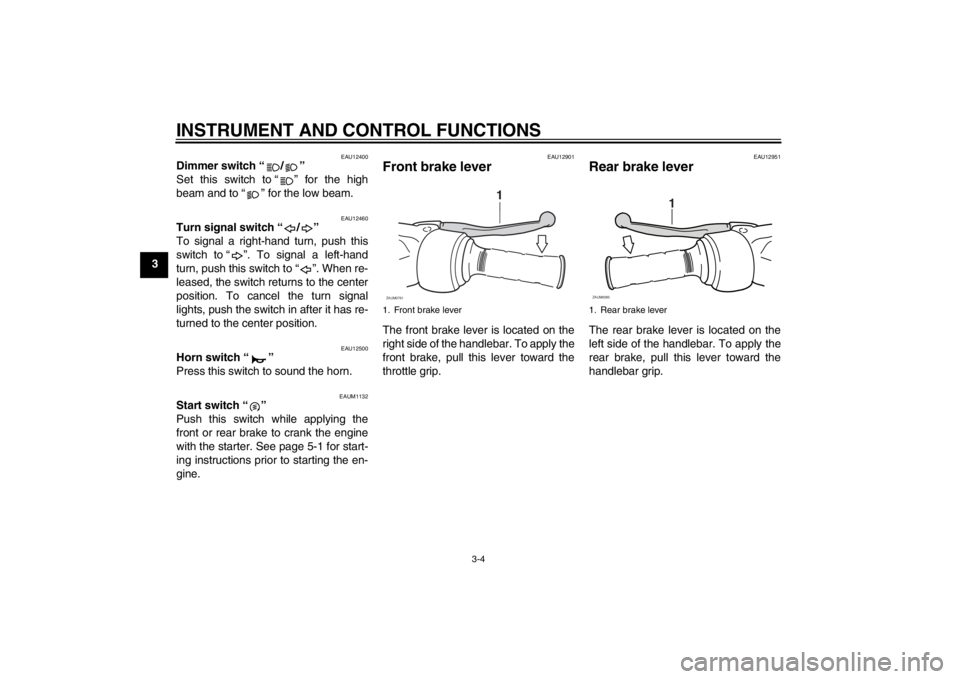
EAU12901
Front brake lever The front brake lever is located on the
right side of the handlebar. To apply the
front brake, pull this lever toward the
throttle grip.
EAU12951
Rear brake lever The rear brake lever is located on the
left side of the handlebar. To apply the
rear brake, pull this lever toward the
handlebar grip.
1. Front brake lever
1
ZAUM0791
1. Rear brake lever
1
ZAUM0085
U1S0E1E0.book Page 4 Wednesday, November 7, 2012 3:32 PM
Page 21 of 66
INSTRUMENT AND CONTROL FUNCTIONS
3-5
3
EAU13202
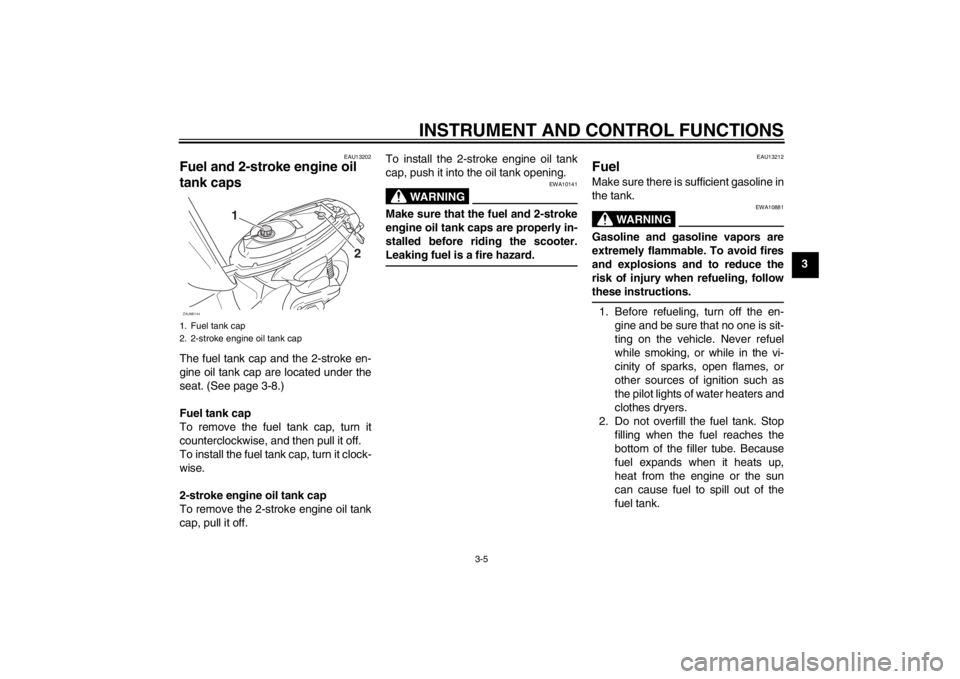
Fuel and 2-stroke engine oil
tank caps The fuel tank cap and the 2-stroke en-
gine oil tank cap are located under the
seat. (See page 3-8.)
Fuel tank cap
To remove the fuel tank cap, turn it
counterclockwise, and then pull it off.
To install the fuel tank cap, turn it clock-
wise.
2-stroke engine oil tank cap
To remove the 2-stroke engine oil tank
cap, pull it off.To install the 2-stroke engine oil tank
cap, push it into the oil tank opening.
WARNING
EWA10141
Make sure that the fuel and 2-stroke
engine oil tank caps are properly in-
stalled before riding the scooter.
Leaking fuel is a fire hazard.
EAU13212
Fuel Make sure there is sufficient gasoline in
the tank.
WARNING
EWA10881
Gasoline and gasoline vapors are
extremely flammable. To avoid fires
and explosions and to reduce the
risk of injury when refueling, follow
these instructions.1. Before refueling, turn off the en-
gine and be sure that no one is sit-
ting on the vehicle. Never refuel
while smoking, or while in the vi-
cinity of sparks, open flames, or
other sources of ignition such as
the pilot lights of water heaters and
clothes dryers.
2. Do not overfill the fuel tank. Stop
filling when the fuel reaches the
bottom of the filler tube. Because
fuel expands when it heats up,
heat from the engine or the sun
can cause fuel to spill out of the
fuel tank.
1. Fuel tank cap
2. 2-stroke engine oil tank cap
2 1
ZAUM0144
U1S0E1E0.book Page 5 Wednesday, November 7, 2012 3:32 PM
Page 27 of 66

FOR YOUR SAFETY – PRE-OPERATION CHECKS
4-2
4
Throttle grip Make sure that operation is smooth.
Check throttle grip free play.
If necessary, have Yamaha dealer adjust throttle grip free play and lubricate cable
and grip housing.6-10, 6-16
Wheels and tires Check for damage.
Check tire condition and tread depth.
Check air pressure.
Correct if necessary.6-10, 6-12
Brake levers Make sure that operation is smooth.
Lubricate lever pivoting points if necessary.6-16
Centerstand Make sure that operation is smooth.
Lubricate pivot if necessary.6-17
Chassis fasteners Make sure that all nuts, bolts and screws are properly tightened.
Tighten if necessary.—
Instruments, lights, signals
and switches Check operation.
Correct if necessary.—
Battery Check fluid level.
Fill with distilled water if necessary.6-19 ITEM CHECKS PAGE
U1S0E1E0.book Page 2 Wednesday, November 7, 2012 3:32 PM
Page 31 of 66
OPERATION AND IMPORTANT RIDING POINTS
5-4
5
EAU16820
Tips for reducing fuel con-
sumption Fuel consumption depends largely on
your riding style. Consider the following
tips to reduce fuel consumption:●
Avoid high engine speeds during
acceleration.
●
Avoid high engine speeds with no
load on the engine.
●
Turn the engine off instead of let-
ting it idle for an extended length of
time (e.g., in traffic jams, at traffic
lights or at railroad crossings).
EAU16830
Engine break-in There is never a more important period
in the life of your engine than the period
between 0 and 1000 km (600 mi). For
this reason, you should read the follow-
ing material carefully.
Since the engine is brand new, do not
put an excessive load on it for the first
1000 km (600 mi). The various parts in
the engine wear and polish themselves
to the correct operating clearances.
During this period, prolonged full-throt-
tle operation or any condition that might
result in engine overheating must be
avoided.
EAUM2091
0–150 km (0–90 mi)
Avoid prolonged operation above 1/3
throttle. Vary the speed of the scooter
from time to time. Do not operate it at
one set throttle position.
150–500 km (90–300 mi)
Avoid prolonged operation above 1/2
throttle.
500–1000 km (300–600 mi)
Avoid cruising speeds in excess of 3/4
throttle.1000 km (600 mi) and beyond
Avoid prolonged full throttle operation.
Vary speeds occasionally. NOTICE:
After 1000 km (600 mi) of operation,
the final transmission oil must be
changed.
[ECAM1071]
NOTICE
ECA10270
If any engine trouble should occur
during the engine break-in period,
immediately have a Yamaha dealer
check the vehicle.
U1S0E1E0.book Page 4 Wednesday, November 7, 2012 3:32 PM
Page 37 of 66
PERIODIC MAINTENANCE AND ADJUSTMENT
6-5
6
EAUM2070
TIP●
The air filter needs more frequent service if you are riding in unusually wet or dusty areas.
●
Hydraulic brake service
Regularly check and, if necessary, correct the brake fluid level.
Every two years change the brake fluid.
Replace the brake hoses every four years and if cracked or damaged.
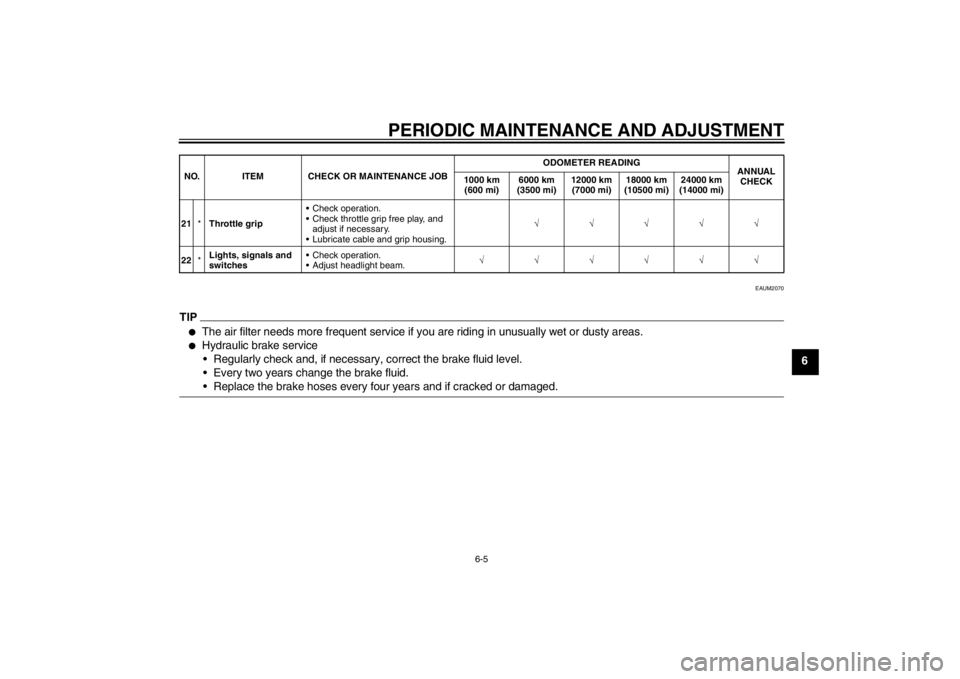
21*Throttle grip Check operation.
Check throttle grip free play, and
adjust if necessary.
Lubricate cable and grip housing.√√√√√
22*Lights, signals and
switches Check operation.
Adjust headlight beam.√√√√√√ NO. ITEM CHECK OR MAINTENANCE JOBODOMETER READING
ANNUAL
CHECK 1000 km
(600 mi)6000 km
(3500 mi)12000 km
(7000 mi)18000 km
(10500 mi)24000 km
(14000 mi)
U1S0E1E0.book Page 5 Wednesday, November 7, 2012 3:32 PM
Page 55 of 66
PERIODIC MAINTENANCE AND ADJUSTMENT
6-23
6
EAU25861
Troubleshooting Although Yamaha scooters receive a
thorough inspection before shipment
from the factory, trouble may occur dur-
ing operation. Any problem in the fuel,
compression, or ignition systems, for
example, can cause poor starting and
loss of power.
The following troubleshooting chart
represents a quick and easy procedure
for checking these vital systems your-
self. However, should your scooter re-
quire any repair, take it to a Yamaha
dealer, whose skilled technicians have
the necessary tools, experience, and
know-how to service the scooter prop-
erly.
Use only genuine Yamaha replace-
ment parts. Imitation parts may look like
Yamaha parts, but they are often inferi-
or, have a shorter service life and can
lead to expensive repair bills.
WARNING
EWA15141
When checking the fuel system, do
not smoke, and make sure there are
no open flames or sparks in the ar-
ea, including pilot lights from waterheaters or furnaces. Gasoline or
gasoline vapors can ignite or ex-
plode, causing severe injury or
property damage.
U1S0E1E0.book Page 23 Wednesday, November 7, 2012 3:32 PM
Page 58 of 66

SCOOTER CARE AND STORAGE
7-2
7off any detergent residue using
plenty of water, as it is harmful
to plastic parts.
●
Do not use any harsh chemical
products on plastic parts. Be
sure to avoid using cloths or
sponges which have been in
contact with strong or abrasive
cleaning products, solvent or
thinner, fuel (gasoline), rust re-
movers or inhibitors, brake flu-
id, antifreeze or electrolyte.
●
Do not use high-pressure wash-
ers or steam-jet cleaners since
they cause water seepage and
deterioration in the following ar-
eas: seals (of wheel and swing-
arm bearings, fork and brakes),
electric components (couplers,
connectors, instruments,
switches and lights), breather
hoses and vents.
●
For scooters equipped with a
windshield: Do not use strong
cleaners or hard sponges as
they will cause dulling or
scratching. Some cleaning com-
pounds for plastic may leave
scratches on the windshield.Test the product on a small hid-
den part of the windshield to
make sure that it does not leave
any marks. If the windshield is
scratched, use a quality plastic
polishing compound after
washing.
After normal useRemove dirt with warm water, a mild
detergent, and a soft, clean sponge,
and then rinse thoroughly with clean
water. Use a toothbrush or bottlebrush
for hard-to-reach areas. Stubborn dirt
and insects will come off more easily if
the area is covered with a wet cloth for
a few minutes before cleaning.
After riding in the rain, near the sea oron salt-sprayed roadsSince sea salt or salt sprayed on the
roads during winter are extremely cor-
rosive in combination with water, carry
out the following steps after each ride in
the rain, near the sea or on salt-
sprayed roads.
TIPSalt sprayed on roads in the winter may
remain well into spring.1. Clean the scooter with cold water
and a mild detergent after the en-
gine has cooled down. NOTICE:
Do not use warm water since it
increases the corrosive action
of the salt.
[ECA10791]
2. Apply a corrosion protection spray
on all metal, including chrome- and
nickel-plated, surfaces to prevent
corrosion.
After cleaning
1. Dry the scooter with a chamois or
an absorbing cloth.
2. Use a chrome polish to shine
chrome, aluminum and stainless-
steel parts, including the exhaust
system. (Even the thermally in-
duced discoloring of stainless-
steel exhaust systems can be re-
moved through polishing.)
U1S0E1E0.book Page 2 Wednesday, November 7, 2012 3:32 PM