warning YAMAHA SLIDER 50 2014 User Guide
[x] Cancel search | Manufacturer: YAMAHA, Model Year: 2014, Model line: SLIDER 50, Model: YAMAHA SLIDER 50 2014Pages: 68, PDF Size: 2.03 MB
Page 26 of 68
FOR YOUR SAFETY – PRE-OPERATION CHECKS
4-1
4
EAU15598
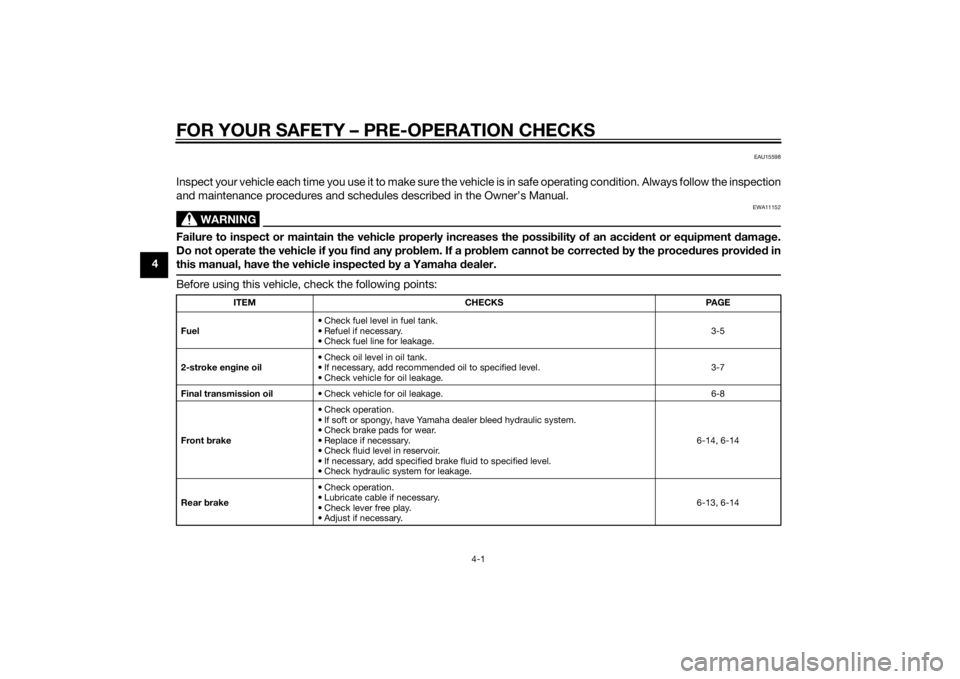
Inspect your vehicle each time you use it to make sure the vehicle is in safe operating condition. Always follow the inspection
and maintenance procedures and schedules described in the Owner’s Manual.
WARNING
EWA11152
Failure to inspect or maintain the vehicle properly increases the possibility of an accident or equipment damage.
Do not operate the vehicle if you find any problem. If a problem cannot be corrected by the procedures provided in
this manual, have the vehicle inspected by a Yamaha dealer.Before using this vehicle, check the following points:
ITEM CHECKS PAGE
Fuel• Check fuel level in fuel tank.
• Refuel if necessary.
• Check fuel line for leakage.3-5
2-stroke engine oil• Check oil level in oil tank.
• If necessary, add recommended oil to specified level.
• Check vehicle for oil leakage.3-7
Final transmission oil• Check vehicle for oil leakage. 6-8
Front brake• Check operation.
• If soft or spongy, have Yamaha dealer bleed hydraulic system.
• Check brake pads for wear.
• Replace if necessary.
• Check fluid level in reservoir.
• If necessary, add specified brake fluid to specified level.
• Check hydraulic system for leakage.6-14, 6-14
Rear brake• Check operation.
• Lubricate cable if necessary.
• Check lever free play.
• Adjust if necessary.6-13, 6-14
U1S0E2E0.book Page 1 Thursday, July 25, 2013 6:53 PM
Page 28 of 68
OPERATION AND IMPORTANT RIDING POINTS
5-1
5
EAU15952
Read the Owner’s Manual carefully to
become familiar with all controls. If
there is a control or function you do not
understand, ask your Yamaha dealer.
WARNING
EWA10272
Failure to familiarize yourself with
the controls can lead to loss of con-
trol, which could cause an accident
or injury.
EAUM3210
Starting a cold engineNOTICE
ECA10251
See page 5-4 for engine break-in in-
structions prior to operating the ve-
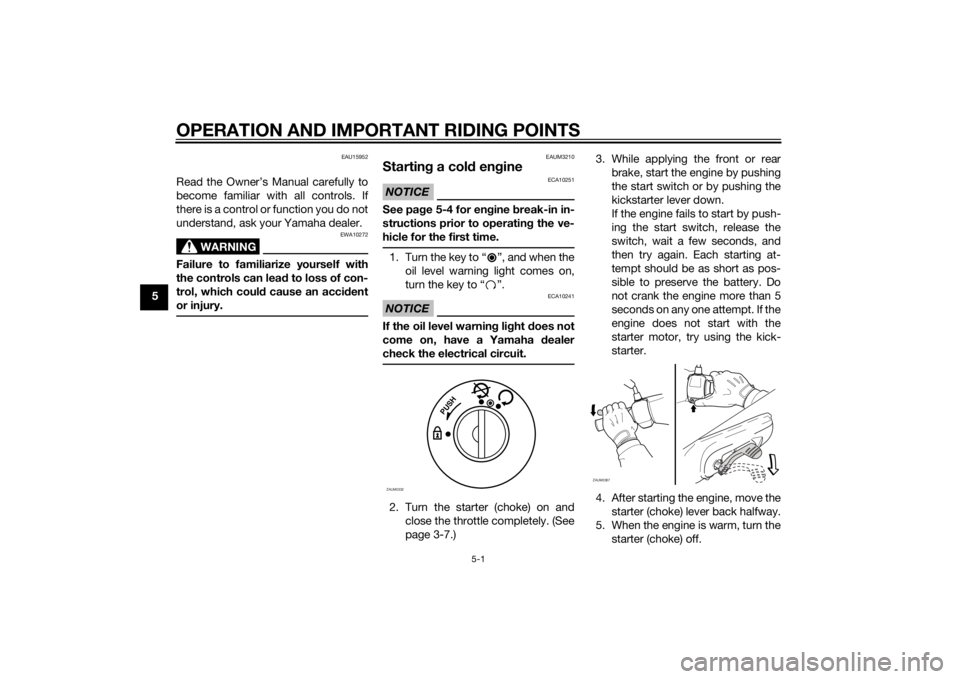
hicle for the first time.1. Turn the key to “ ”, and when the
oil level warning light comes on,
turn the key to “ ”.NOTICE
ECA10241
If the oil level warning light does not
come on, have a Yamaha dealer
check the electrical circuit.2. Turn the starter (choke) on and
close the throttle completely. (See
page 3-7.)3. While applying the front or rear
brake, start the engine by pushing
the start switch or by pushing the
kickstarter lever down.
If the engine fails to start by push-
ing the start switch, release the
switch, wait a few seconds, and
then try again. Each starting at-
tempt should be as short as pos-
sible to preserve the battery. Do
not crank the engine more than 5
seconds on any one attempt. If the
engine does not start with the
starter motor, try using the kick-
starter.
4. After starting the engine, move the
starter (choke) lever back halfway.
5. When the engine is warm, turn the
starter (choke) off.
P
U
S
H
ZAUM0332
ZAUM0367
U1S0E2E0.book Page 1 Thursday, July 25, 2013 6:53 PM
Page 30 of 68
OPERATION AND IMPORTANT RIDING POINTS
5-3
5
EAU16782
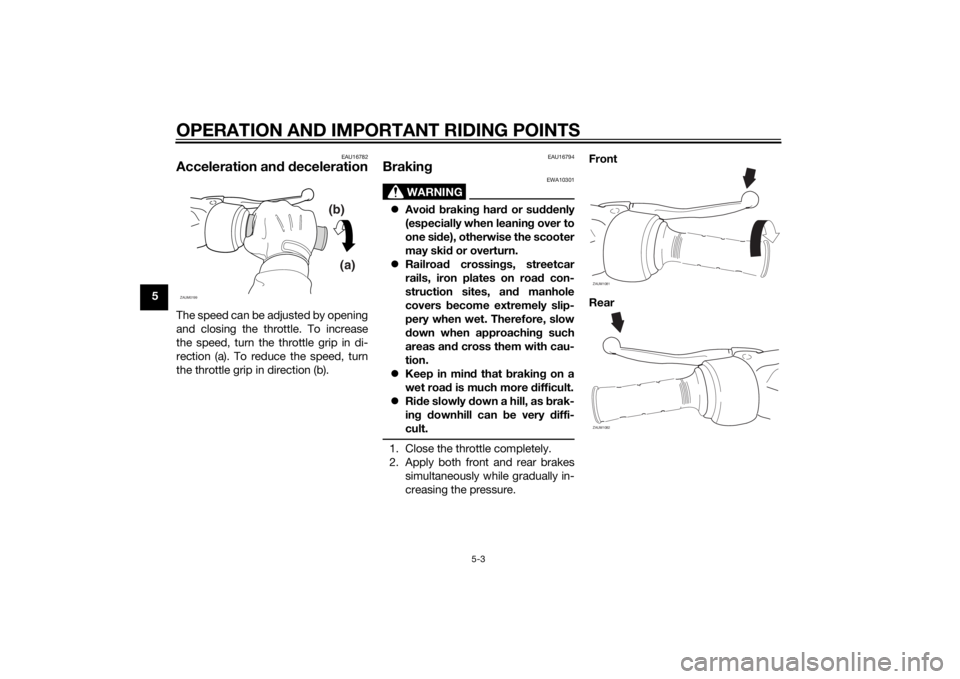
Acceleration and decelerationThe speed can be adjusted by opening
and closing the throttle. To increase
the speed, turn the throttle grip in di-
rection (a). To reduce the speed, turn
the throttle grip in direction (b).
EAU16794
Braking
WARNING
EWA10301
Avoid braking hard or suddenly
(especially when leaning over to
one side), otherwise the scooter
may skid or overturn.
Railroad crossings, streetcar
rails, iron plates on road con-
struction sites, and manhole
covers become extremely slip-
pery when wet. Therefore, slow
down when approaching such
areas and cross them with cau-
tion.
Keep in mind that braking on a
wet road is much more difficult.
Ride slowly down a hill, as brak-
ing downhill can be very diffi-
cult.1. Close the throttle completely.
2. Apply both front and rear brakes
simultaneously while gradually in-
creasing the pressure.Front
Rear
(b)
(a)
ZAUM0199
ZAUM1081ZAUM1082
U1S0E2E0.book Page 3 Thursday, July 25, 2013 6:53 PM
Page 32 of 68
OPERATION AND IMPORTANT RIDING POINTS
5-5
5
EAU17214
ParkingWhen parking, stop the engine, and
then remove the key from the main
switch.
WARNING
EWA10312
Since the engine and exhaust
system can become very hot,
park in a place where pedestri-
ans or children are not likely to
touch them and be burned.
Do not park on a slope or on soft
ground, otherwise the vehicle
may overturn, increasing the
risk of a fuel leak and fire.
Do not park near grass or other
flammable materials which
might catch fire.
U1S0E2E0.book Page 5 Thursday, July 25, 2013 6:53 PM
Page 33 of 68
PERIODIC MAINTENANCE AND ADJUSTMENT
6-1
6
EAU17245
Periodic inspection, adjustment, and
lubrication will keep your vehicle in the
safest and most efficient condition
possible. Safety is an obligation of the
vehicle owner/operator. The most im-
portant points of vehicle inspection,
adjustment, and lubrication are ex-
plained on the following pages.
The intervals given in the periodic
maintenance charts should be simply
considered as a general guide under
normal riding conditions. However, de-
pending on the weather, terrain, geo-
graphical location, and individual use,
the maintenance intervals may need to
be shortened.
WARNING
EWA10322
Failure to properly maintain the vehi-
cle or performing maintenance ac-
tivities incorrectly may increase
your risk of injury or death during
service or while using the vehicle. If
you are not familiar with vehicle ser-
vice, have a Yamaha dealer perform
service.
WARNING
EWA15123
Turn off the engine when performing
maintenance unless otherwise
specified.
A running engine has moving
parts that can catch on body
parts or clothing and electrical
parts that can cause shocks or
fires.
Running the engine while ser-
vicing can lead to eye injury,
burns, fire, or carbon monoxide
poisoning – possibly leading to
death. See page 1-3 for more in-
formation about carbon monox-
ide.
WARNING
EWA15461
Brake discs, calipers, drums, and
linings can become very hot during
use. To avoid possible burns, let
brake components cool before
touching them.
EAU17303
Emission controls not only function to
ensure cleaner air, but are also vital to
proper engine operation and maximum
performance. In the following periodic
maintenance charts, the services relat-
ed to emissions control are grouped
separately. These services require
specialized data, knowledge, and
equipment. Maintenance, replace-
ment, or repair of the emission control
devices and systems may be per-
formed by any repair establishment or
individual that is certified (if applicable).
Yamaha dealers are trained and
equipped to perform these particular
services.
U1S0E2E0.book Page 1 Thursday, July 25, 2013 6:53 PM
Page 40 of 68
PERIODIC MAINTENANCE AND ADJUSTMENT
6-8
6
EAU20067
Final transmission oilThe final transmission case must be
checked for oil leakage before each
ride. If any leakage is found, have a
Yamaha dealer check and repair the
scooter. In addition, the final transmis-
sion oil must be changed as follows at
the intervals specified in the periodic
maintenance and lubrication chart.
1. Start the engine, warm up the final
transmission oil by riding the
scooter for several minutes, and
then stop the engine.
2. Place the scooter on the center-
stand.
3. Place an oil pan under the final
transmission case to collect the
used oil.
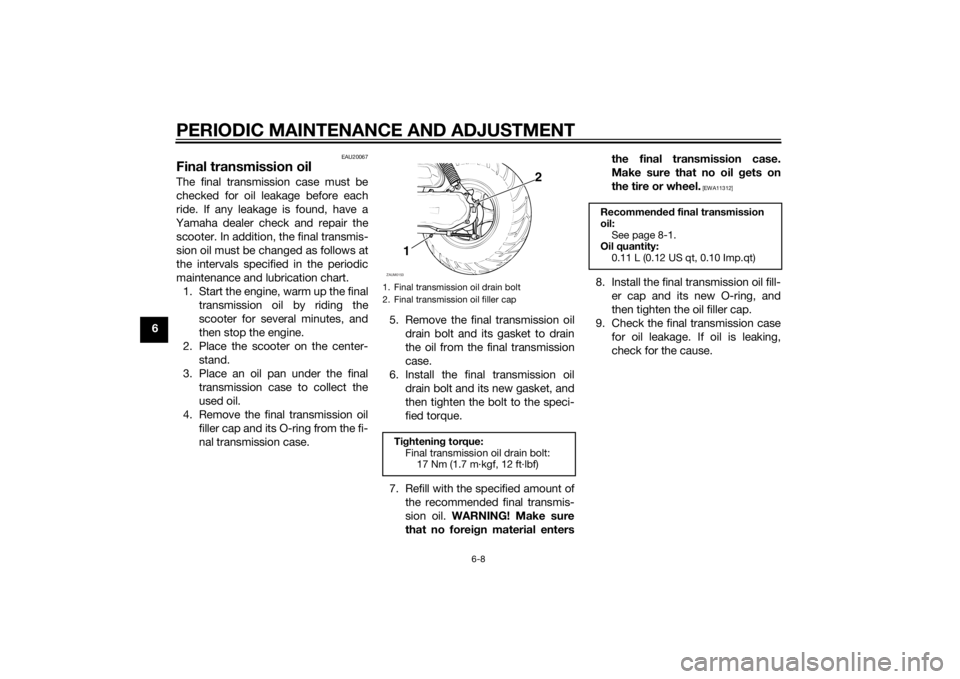
4. Remove the final transmission oil
filler cap and its O-ring from the fi-
nal transmission case.5. Remove the final transmission oil
drain bolt and its gasket to drain
the oil from the final transmission
case.
6. Install the final transmission oil
drain bolt and its new gasket, and
then tighten the bolt to the speci-
fied torque.
7. Refill with the specified amount of
the recommended final transmis-
sion oil. WARNING! Make sure
that no foreign material entersthe final transmission case.
Make sure that no oil gets on
the tire or wheel.
[EWA11312]
8. Install the final transmission oil fill-
er cap and its new O-ring, and
then tighten the oil filler cap.
9. Check the final transmission case
for oil leakage. If oil is leaking,
check for the cause.
1. Final transmission oil drain bolt
2. Final transmission oil filler capTightening torque:
Final transmission oil drain bolt:
17 Nm (1.7 m·kgf, 12 ft·lbf)12
ZAUM0153
Recommended final transmission
oil:
See page 8-1.
Oil quantity:
0.11 L (0.12 US qt, 0.10 Imp.qt)
U1S0E2E0.book Page 8 Thursday, July 25, 2013 6:53 PM
Page 41 of 68
PERIODIC MAINTENANCE AND ADJUSTMENT
6-9
6
EAUM1643
Cleaning the air filter elementThe air filter element should be cleaned
at the intervals specified in the periodic
maintenance and lubrication chart.
Clean the air filter element more fre-
quently if you are riding in unusually
wet or dusty areas.
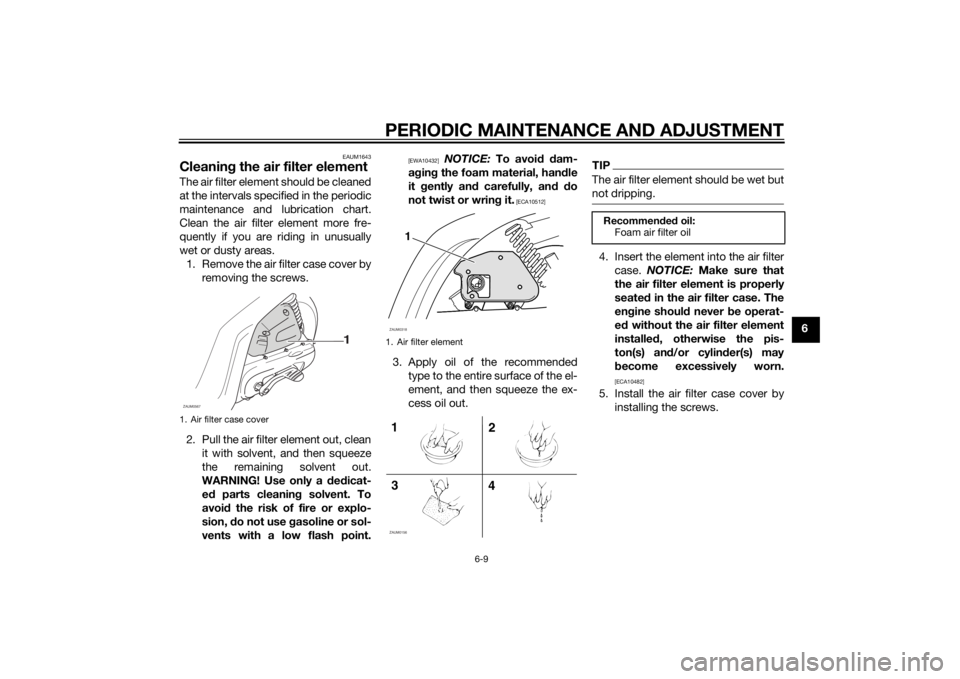
1. Remove the air filter case cover by
removing the screws.
2. Pull the air filter element out, clean
it with solvent, and then squeeze
the remaining solvent out.
WARNING! Use only a dedicat-
ed parts cleaning solvent. To
avoid the risk of fire or explo-
sion, do not use gasoline or sol-
vents with a low flash point.
[EWA10432]
NOTICE: To avoid dam-
aging the foam material, handle
it gently and carefully, and do
not twist or wring it.
[ECA10512]
3. Apply oil of the recommended
type to the entire surface of the el-
ement, and then squeeze the ex-
cess oil out.
TIPThe air filter element should be wet but
not dripping.4. Insert the element into the air filter
case. NOTICE: Make sure that
the air filter element is properly
seated in the air filter case. The
engine should never be operat-
ed without the air filter element
installed, otherwise the pis-
ton(s) and/or cylinder(s) may
become excessively worn.
[ECA10482]
5. Install the air filter case cover by
installing the screws.
1. Air filter case cover
1
ZAUM0567
1. Air filter element
1
ZAUM03181
4 32ZAUM0156
Recommended oil:
Foam air filter oil
U1S0E2E0.book Page 9 Thursday, July 25, 2013 6:53 PM
Page 43 of 68
PERIODIC MAINTENANCE AND ADJUSTMENT
6-11
6
WARNING
EWA10504
Operation of this vehicle with im-
proper tire pressure may cause se-
vere injury or death from loss of
control.
The tire air pressure must be
checked and adjusted on cold
tires (i.e., when the temperature
of the tires equals the ambient
temperature).
The tire air pressure must be
adjusted in accordance with the
riding speed and with the total
weight of rider, passenger, car-
go, and accessories approved
for this model.
WARNING
EWA10512
Never overload your vehicle. Opera-
tion of an overloaded vehicle could
cause an accident.
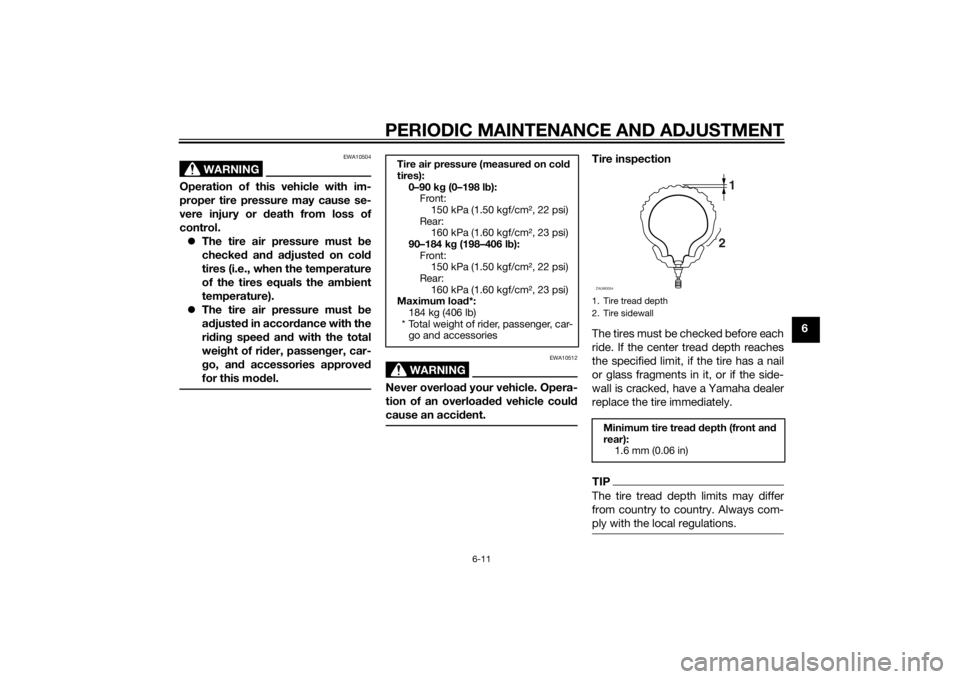
Tire inspection
The tires must be checked before each
ride. If the center tread depth reaches
the specified limit, if the tire has a nail
or glass fragments in it, or if the side-
wall is cracked, have a Yamaha dealer
replace the tire immediately.TIPThe tire tread depth limits may differ
from country to country. Always com-
ply with the local regulations.
Tire air pressure (measured on cold
tires):
0–90 kg (0–198 lb):
Front:
150 kPa (1.50 kgf/cm², 22 psi)
Rear:
160 kPa (1.60 kgf/cm², 23 psi)
90–184 kg (198–406 lb):
Front:
150 kPa (1.50 kgf/cm², 22 psi)
Rear:
160 kPa (1.60 kgf/cm², 23 psi)
Maximum load*:
184 kg (406 lb)
* Total weight of rider, passenger, car-
go and accessories
1. Tire tread depth
2. Tire sidewall
Minimum tire tread depth (front and
rear):
1.6 mm (0.06 in)
1
2
ZAUM0054
U1S0E2E0.book Page 11 Thursday, July 25, 2013 6:53 PM
Page 44 of 68
PERIODIC MAINTENANCE AND ADJUSTMENT
6-12
6Tire information
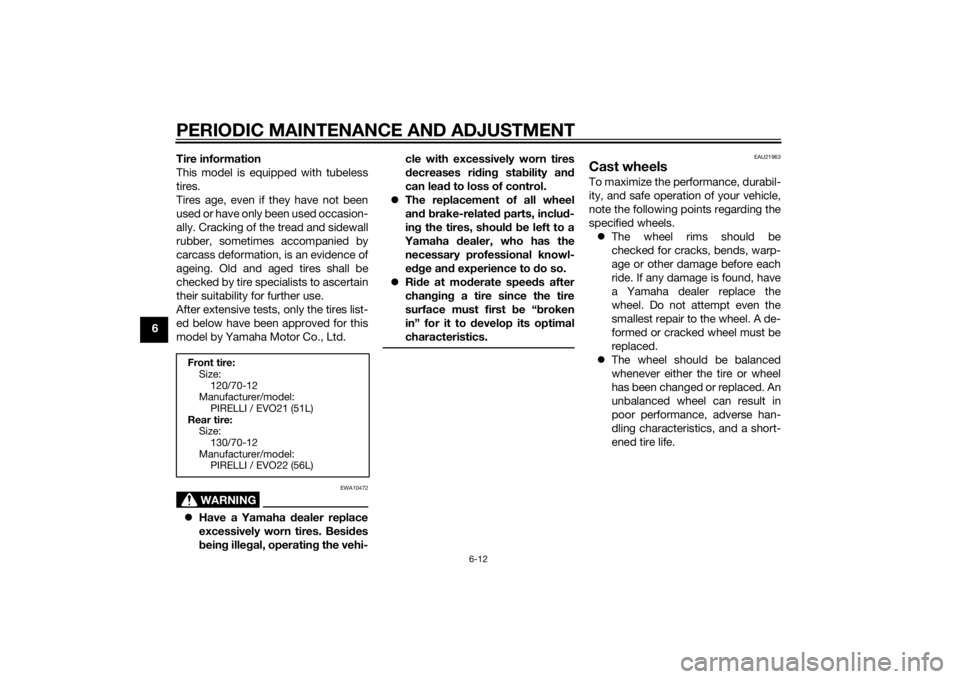
This model is equipped with tubeless
tires.
Tires age, even if they have not been
used or have only been used occasion-
ally. Cracking of the tread and sidewall
rubber, sometimes accompanied by
carcass deformation, is an evidence of
ageing. Old and aged tires shall be
checked by tire specialists to ascertain
their suitability for further use.
After extensive tests, only the tires list-
ed below have been approved for this
model by Yamaha Motor Co., Ltd.
WARNING
EWA10472
Have a Yamaha dealer replace
excessively worn tires. Besides
being illegal, operating the vehi-cle with excessively worn tires
decreases riding stability and
can lead to loss of control.
The replacement of all wheel
and brake-related parts, includ-
ing the tires, should be left to a
Yamaha dealer, who has the
necessary professional knowl-
edge and experience to do so.
Ride at moderate speeds after
changing a tire since the tire
surface must first be “broken
in” for it to develop its optimal
characteristics.
EAU21963
Cast wheelsTo maximize the performance, durabil-
ity, and safe operation of your vehicle,
note the following points regarding the
specified wheels.
The wheel rims should be
checked for cracks, bends, warp-
age or other damage before each
ride. If any damage is found, have
a Yamaha dealer replace the
wheel. Do not attempt even the
smallest repair to the wheel. A de-
formed or cracked wheel must be
replaced.
The wheel should be balanced
whenever either the tire or wheel
has been changed or replaced. An
unbalanced wheel can result in
poor performance, adverse han-
dling characteristics, and a short-
ened tire life.
Front tire:
Size:
120/70-12
Manufacturer/model:
PIRELLI / EVO21 (51L)
Rear tire:
Size:
130/70-12
Manufacturer/model:
PIRELLI / EVO22 (56L)
U1S0E2E0.book Page 12 Thursday, July 25, 2013 6:53 PM
Page 45 of 68
PERIODIC MAINTENANCE AND ADJUSTMENT
6-13
6
EAUT1222
Checking the front brake lever
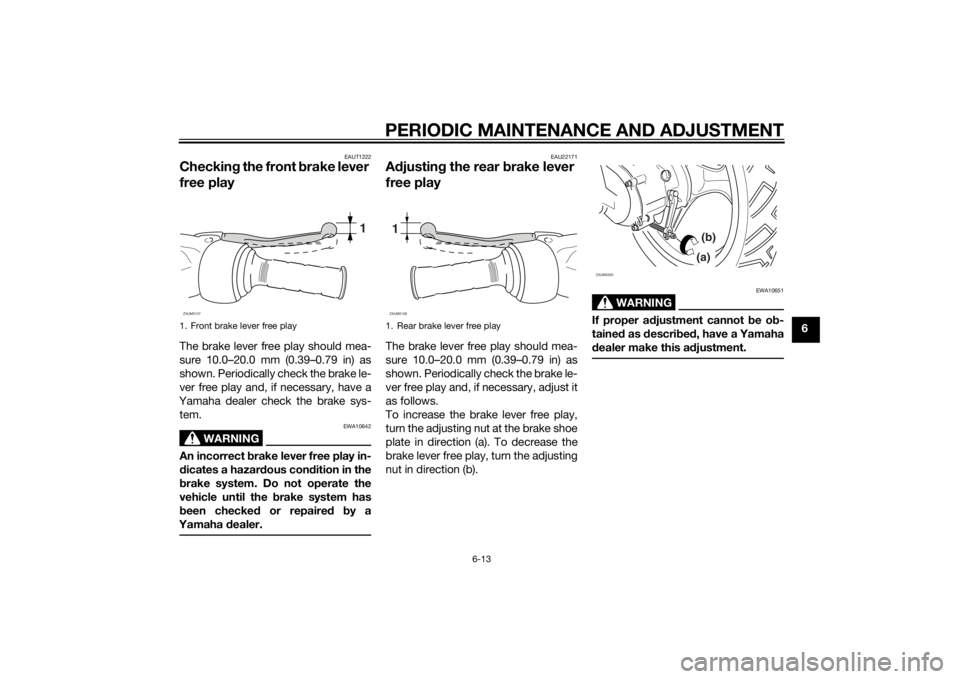
free playThe brake lever free play should mea-
sure 10.0–20.0 mm (0.39–0.79 in) as
shown. Periodically check the brake le-
ver free play and, if necessary, have a
Yamaha dealer check the brake sys-
tem.
WARNING
EWA10642
An incorrect brake lever free play in-
dicates a hazardous condition in the
brake system. Do not operate the
vehicle until the brake system has
been checked or repaired by a
Yamaha dealer.
EAU22171
Adjusting the rear brake lever
free playThe brake lever free play should mea-
sure 10.0–20.0 mm (0.39–0.79 in) as
shown. Periodically check the brake le-
ver free play and, if necessary, adjust it
as follows.
To increase the brake lever free play,
turn the adjusting nut at the brake shoe
plate in direction (a). To decrease the
brake lever free play, turn the adjusting
nut in direction (b).
WARNING
EWA10651
If proper adjustment cannot be ob-
tained as described, have a Yamaha
dealer make this adjustment.
1. Front brake lever free play
1
ZAUM0107
1. Rear brake lever free play1ZAUM0108
(a)(b)
ZAUM0320
U1S0E2E0.book Page 13 Thursday, July 25, 2013 6:53 PM