warning YAMAHA SUPERJET 2001 Owner's Guide
[x] Cancel search | Manufacturer: YAMAHA, Model Year: 2001, Model line: SUPERJET, Model: YAMAHA SUPERJET 2001Pages: 107, PDF Size: 6.2 MB
Page 83 of 107
4-14
E
NOTE:@●Wipe off any water on the spark plug or
inside the cap before installing the spark
plug cap. Push the spark plug cap down
until it clicks.
●If a torque wrench is not available when
you are fitting a new spark plug, a good
estimate of the correct torque with a new
gasket is a quarter turn to a half turn past
finger tight. Have the spark plug adjusted
to the correct torque with a torque wrench
as soon as possible.
@
WARNING@Be careful not to damage the insulator
when removing or installing a spark plug.
A damaged insulator could allow sparks
to escape, which could lead to explosion
or fire.
@
EJU00553
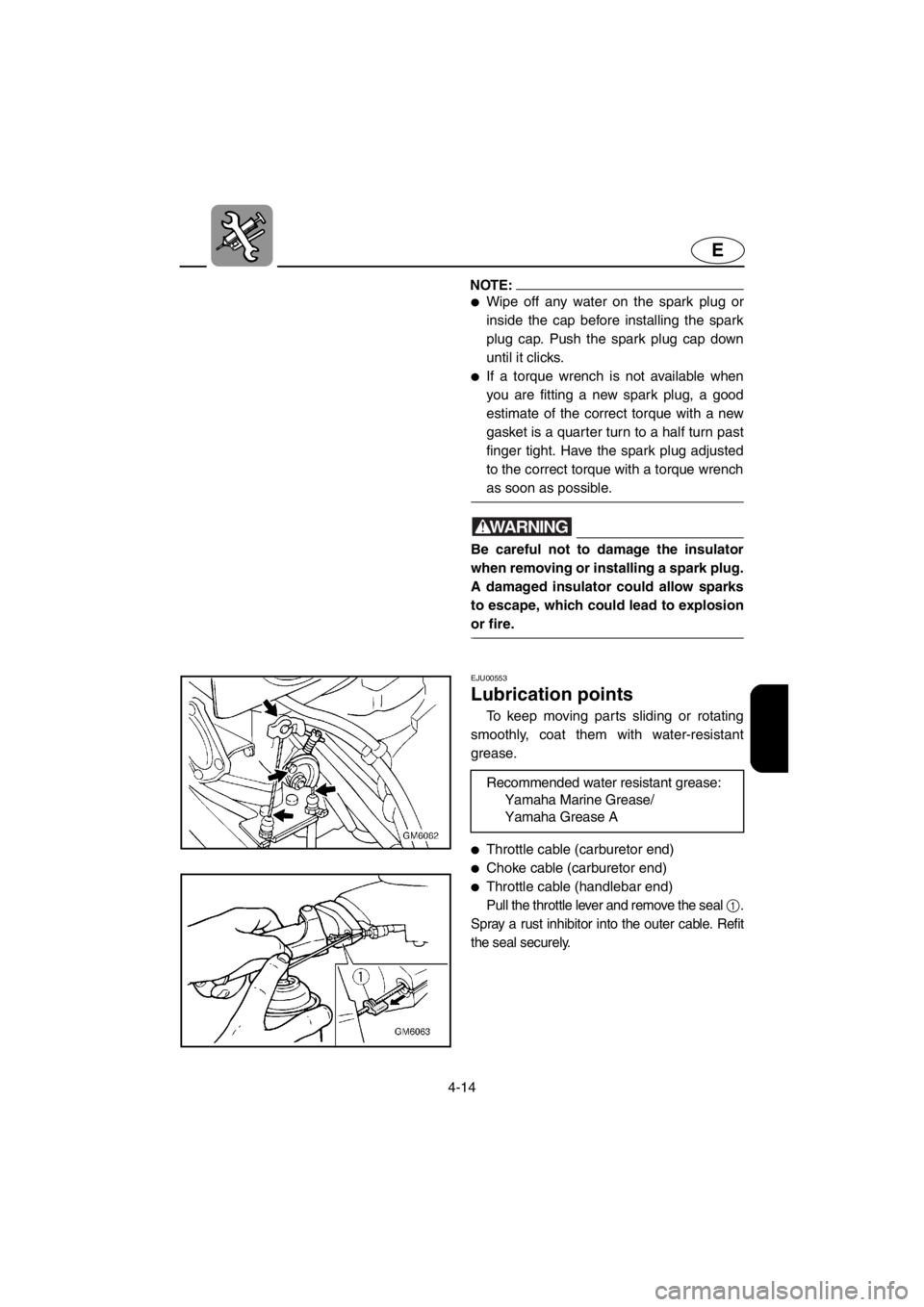
Lubrication points
To keep moving parts sliding or rotating
smoothly, coat them with water-resistant
grease.
●Throttle cable (carburetor end)
●Choke cable (carburetor end)
●Throttle cable (handlebar end)
Pull the throttle lever and remove the seal 1.
Spray a rust inhibitor into the outer cable. Refit
the seal securely.
Recommended water resistant grease:
Yamaha Marine Grease/
Yamaha Grease A
E_GM6-4.fm Page 14 Tuesday, July 11, 2000 11:28 AM
Page 86 of 107
4-17
E
EJU00572
Inspecting the battery
Check the level of the battery electrolyte
and make sure the leads are secure.
WARNING@Battery electrolyte is poisonous and dan-
gerous, causing severe burns, etc. Elec-
trolyte contains sulfuric acid. Avoid
contact with skin, eyes or clothing.
Antidotes
External: Flush with water.
Internal: Drink large quantities of water
or milk. Follow with milk of magnesia,
beaten egg or vegetable oil. Call physi-
cian immediately.
Eyes: Flush with water for 15 minutes
and get prompt medical attention.
Batteries produce explosive gases. Keep
sparks, flame, cigarettes, etc., well away.
If using or charging the battery in an
enclosed space, make sure that it is well
ventilated. Always shield your eyes when
working near batteries.
KEEP OUT OF THE REACH OF CHIL-
DREN.
@
CAUTION:
Be careful not to place the battery on its
side.
Make sure to remove the battery from the
battery compartment when adding the
battery electrolyte or charging the bat-
tery.
When checking the battery, make sure
the breather hose is connected to the
battery and not obstructed.
@
E_GM6-4.fm Page 17 Tuesday, July 11, 2000 11:28 AM
Page 87 of 107
4-18
E
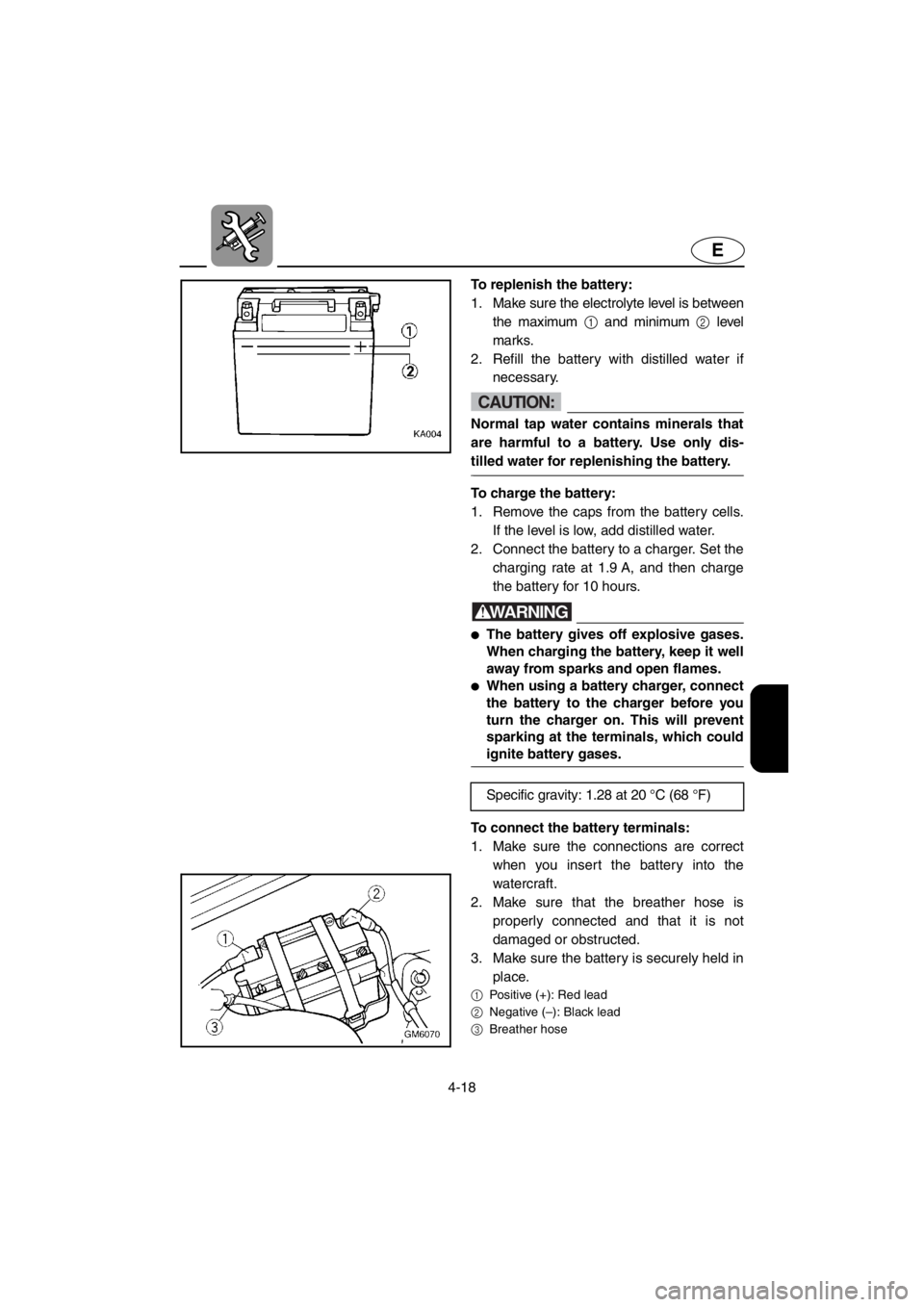
To replenish the battery:
1. Make sure the electrolyte level is between
the maximum 1 and minimum 2 level
marks.
2. Refill the battery with distilled water if
necessary.
CAUTION:@Normal tap water contains minerals that
are harmful to a battery. Use only dis-
tilled water for replenishing the battery.
@
To charge the battery:
1. Remove the caps from the battery cells.
If the level is low, add distilled water.
2. Connect the battery to a charger. Set the
charging rate at 1.9 A, and then charge
the battery for 10 hours.
WARNING@●The battery gives off explosive gases.
When charging the battery, keep it well
away from sparks and open flames.
●When using a battery charger, connect
the battery to the charger before you
turn the charger on. This will prevent
sparking at the terminals, which could
ignite battery gases.
@
To connect the battery terminals:
1. Make sure the connections are correct
when you insert the battery into the
watercraft.
2. Make sure that the breather hose is
properly connected and that it is not
damaged or obstructed.
3. Make sure the battery is securely held in
place.
1Positive (+): Red lead
2Negative (–): Black lead
3Breather hose
Specific gravity: 1.28 at 20 °C (68 °F)
E_GM6-4.fm Page 18 Tuesday, July 11, 2000 11:28 AM
Page 89 of 107
4-20
E
EJU00578
Replacing the fuse
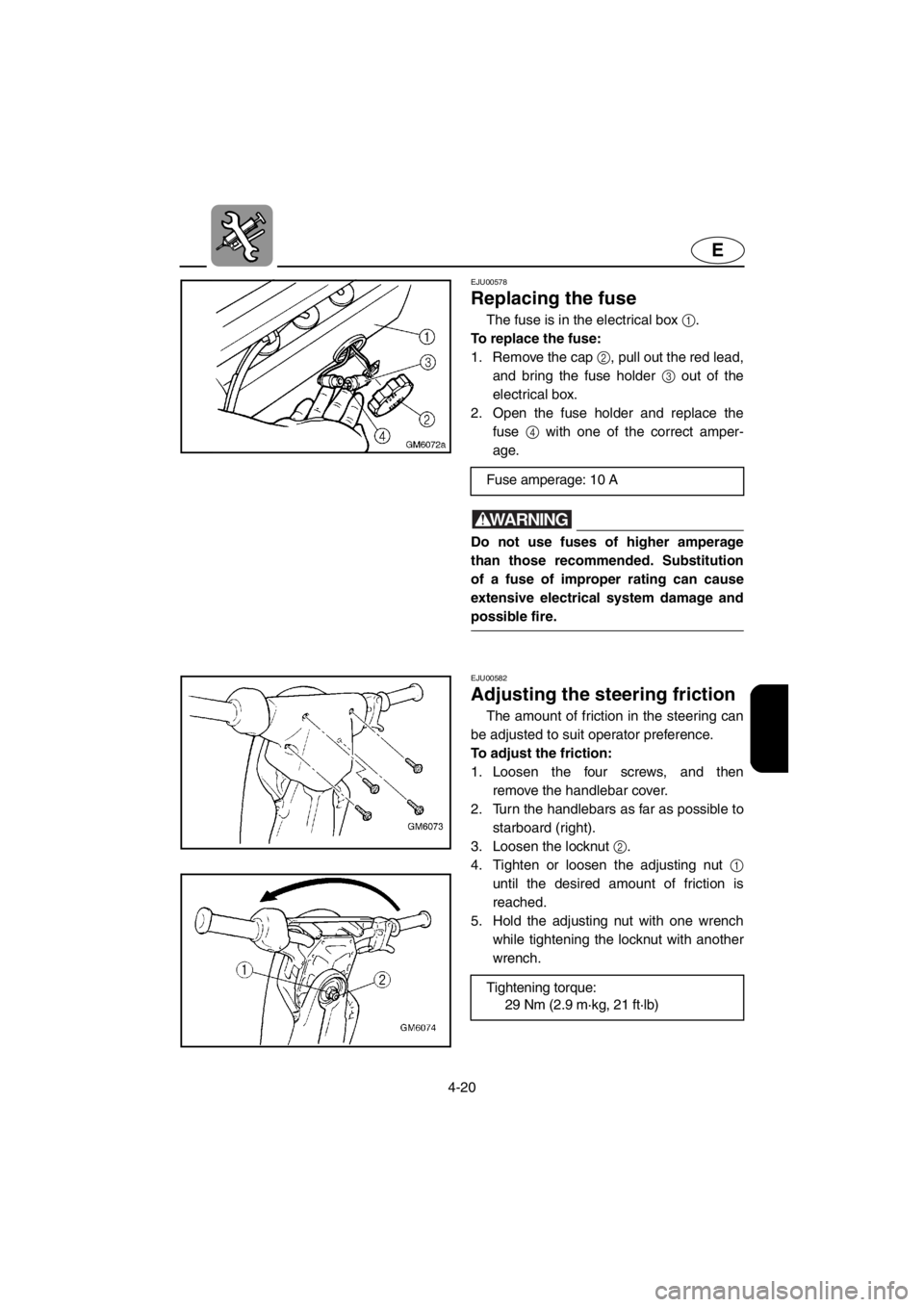
The fuse is in the electrical box 1.
To replace the fuse:
1. Remove the cap 2, pull out the red lead,
and bring the fuse holder 3 out of the
electrical box.
2. Open the fuse holder and replace the
fuse4 with one of the correct amper-
age.
WARNING@Do not use fuses of higher amperage
than those recommended. Substitution
of a fuse of improper rating can cause
extensive electrical system damage and
possible fire.
@
Fuse amperage: 10 A
EJU00582
Adjusting the steering friction
The amount of friction in the steering can
be adjusted to suit operator preference.
To adjust the friction:
1. Loosen the four screws, and then
remove the handlebar cover.
2. Turn the handlebars as far as possible to
starboard (right).
3. Loosen the locknut 2.
4. Tighten or loosen the adjusting nut 1
until the desired amount of friction is
reached.
5. Hold the adjusting nut with one wrench
while tightening the locknut with another
wrench.
Tightening torque:
29 Nm (2.9 m·kg, 21 ft·lb)
E_GM6-4.fm Page 20 Tuesday, July 11, 2000 11:28 AM
Page 96 of 107
5-3
E
EJU00597
Emergency procedures
Cleaning the jet intake and
impeller
If weeds or debris get caught in the intake
or impeller, cavitation can occur, causing jet
thrust to decrease even though engine
speed rises. If this condition is allowed to
continue, the engine will overheat and may
seize. If there is any sign that the jet intake
or impeller is clogged with weeds or debris,
beach the watercraft and check the intake
and impeller. Always stop the engine before
beaching the watercraft.
WARNING@Before attempting to remove weeds or
debris from the jet intake or impeller
areas, shut the engine off and remove
the clip from the engine shut-off switch.
Severe injury or death could result from
coming in contact with the rotating parts
of the jet pump.
@
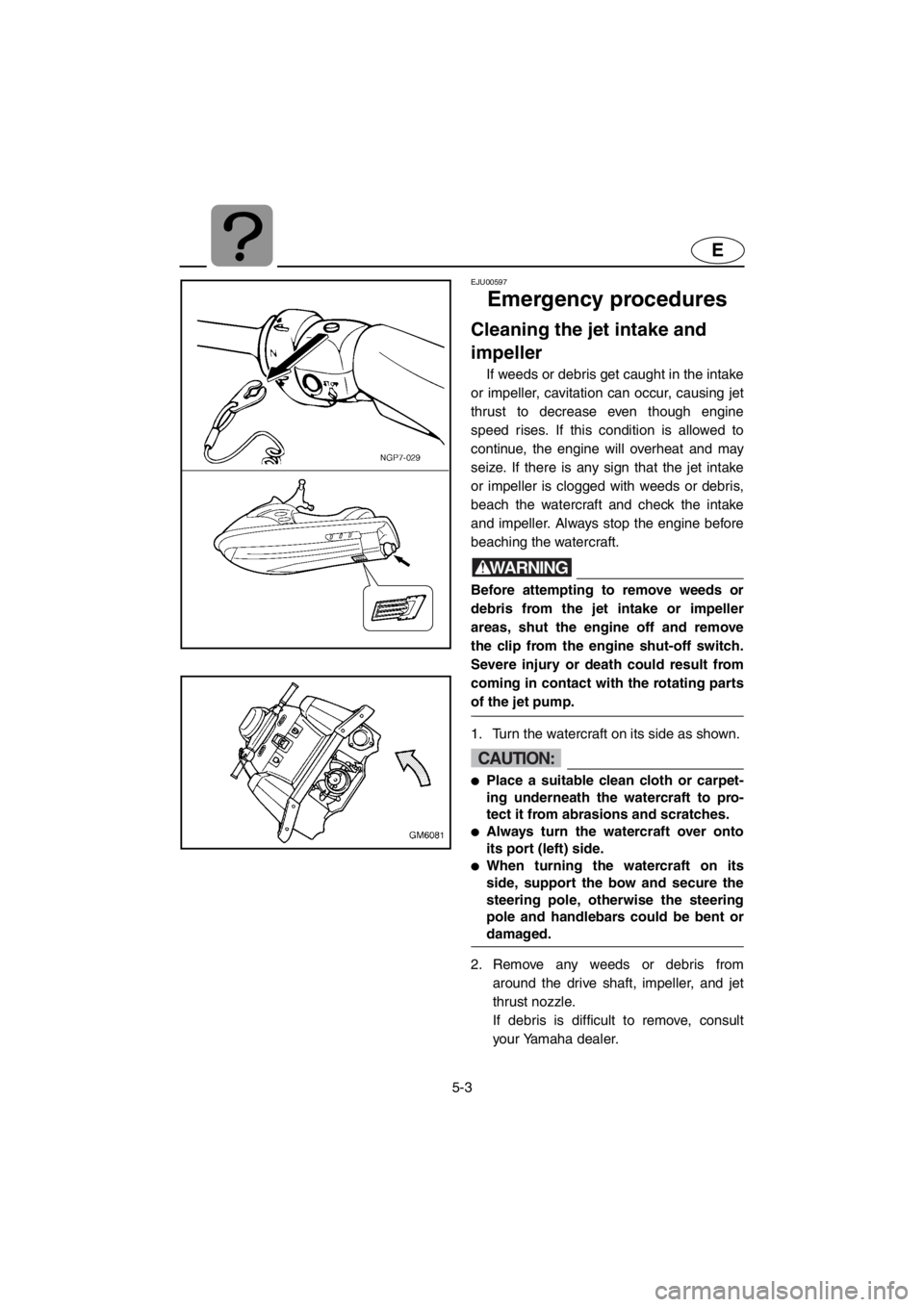
1. Turn the watercraft on its side as shown.
CAUTION:@●Place a suitable clean cloth or carpet-
ing underneath the watercraft to pro-
tect it from abrasions and scratches.
●Always turn the watercraft over onto
its port (left) side.
●When turning the watercraft on its
side, support the bow and secure the
steering pole, otherwise the steering
pole and handlebars could be bent or
damaged.
@
2. Remove any weeds or debris from
around the drive shaft, impeller, and jet
thrust nozzle.
If debris is difficult to remove, consult
your Yamaha dealer.
E_GM6-5.fm Page 3 Tuesday, July 11, 2000 11:29 AM
Page 97 of 107
5-4
E
CAUTION:@Always avoid operating your watercraft in
areas where weed growth is thick. If trav-
eling in weeded areas is unavoidable,
operate the engine alternately at partial
throttle and full throttle. Weeds tend to
accumulate more at a steady speed and
at trolling speed. If weeds clog the intake
or impeller area and cause cavitation, fol-
low the cleaning procedure above.
@
EJU00599
Jumping the battery
If the watercraft battery has run down, the
engine can be started using a 12-volt bat-
tery and jumper cables.
WARNING@Battery electrolyte is poisonous and dan-
gerous, causing severe burns, etc. Elec-
trolyte contains sulfuric acid. Avoid
contact with skin, eyes or clothing.
Antidotes
External: Flush with water.
Internal: Drink large quantities of water
or milk. Follow with milk of magnesia,
beaten egg, or vegetable oil. Call physi-
cian immediately.
Eyes: Flush with water for 15 minutes
and get prompt medical attention
Batteries give off explosive gases. Keep
sparks, flame, cigarettes, etc. well away.
If using or charging the battery in an
enclosed area, make sure that it is well
ventilated. Always shield your eyes when
working near batteries.
KEEP OUT OF THE REACH OF CHIL-
DREN
@
E_GM6-5.fm Page 4 Tuesday, July 11, 2000 11:29 AM
Page 99 of 107
5-6
E
EJU00601
Towing the watercraft
If the watercraft becomes inoperative in
the water, it can be towed to shore.
If the watercraft must be towed in an
emergency using a tow line, the operator
should ride the watercraft, holding onto the
handlebars and supporting his body weight
on the riding tray. This will help keep the bow
of the watercraft out of the water.
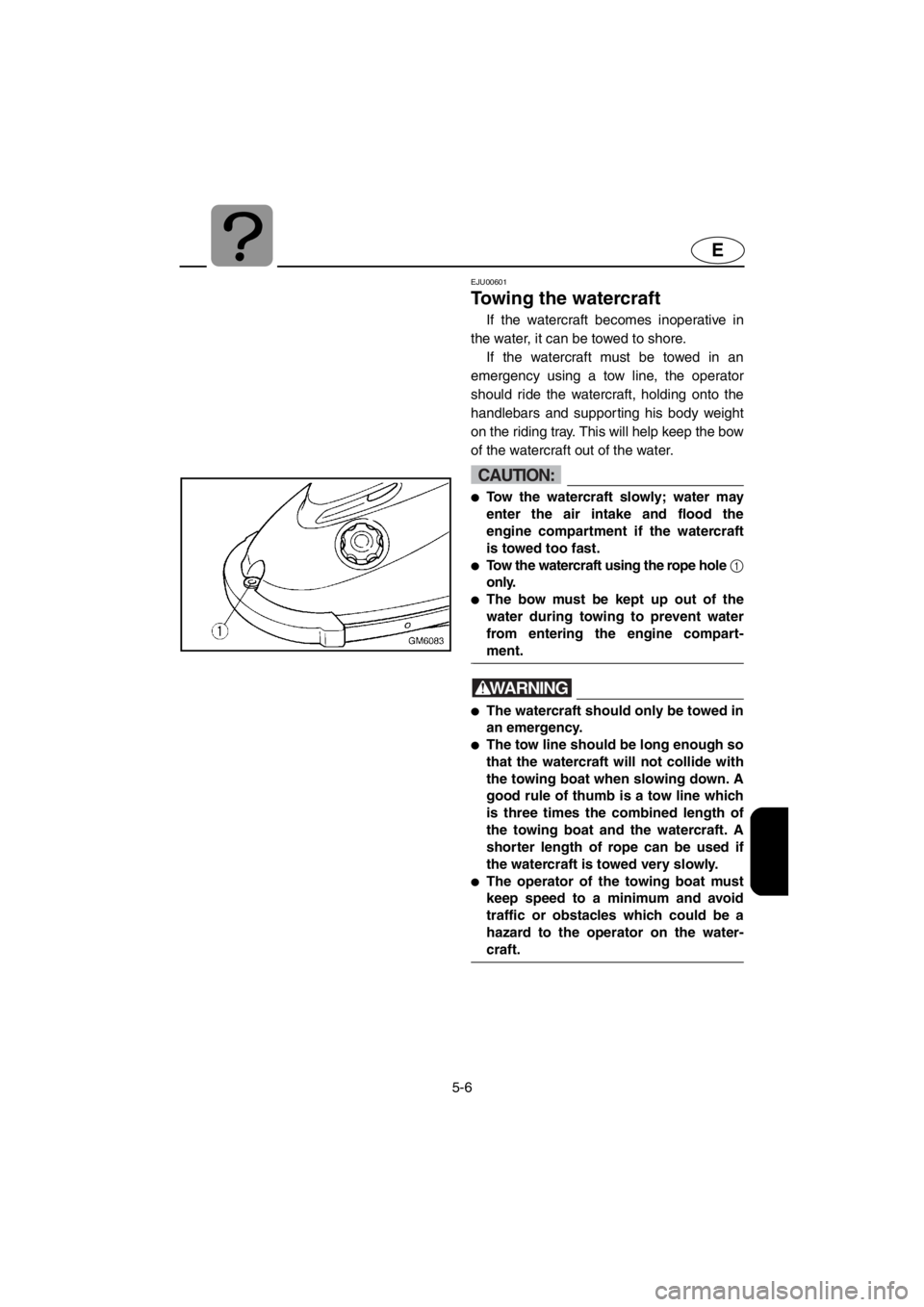
CAUTION:@●Tow the watercraft slowly; water may
enter the air intake and flood the
engine compartment if the watercraft
is towed too fast.
●Tow the watercraft using the rope hole 1
only.
●The bow must be kept up out of the
water during towing to prevent water
from entering the engine compart-
ment.
@
WARNING@●The watercraft should only be towed in
an emergency.
●The tow line should be long enough so
that the watercraft will not collide with
the towing boat when slowing down. A
good rule of thumb is a tow line which
is three times the combined length of
the towing boat and the watercraft. A
shorter length of rope can be used if
the watercraft is towed very slowly.
●The operator of the towing boat must
keep speed to a minimum and avoid
traffic or obstacles which could be a
hazard to the operator on the water-
craft.
@
E_GM6-5.fm Page 6 Tuesday, July 11, 2000 11:29 AM
Page 102 of 107

6-1
E
EJU00609
Index
2-stroke engine oil ................................... 3-2
A
Adjusting the carburetor ........................ 4-19
Adjusting the choke cable ..................... 4-16
Adjusting the jet thrust nozzle angle ..... 4-21
Adjusting the steering friction ................ 4-20
Adjusting the trolling speed ................... 4-19
Approval label of Emission control
certificate ................................................. 1-2
B
Battery .............................................. 3-8, 4-5
Beaching the watercraft ........................ 3-30
Bilge ........................................................ 3-7
Boarding and starting in deep water ..... 3-22
Boarding and starting in shallow
water ..................................................... 3-24
C
Capsized watercraft .............................. 3-26
Caution label ........................................... 1-7
Choke knob ............................................. 2-6
Cleaning and adjusting the spark
plugs...................................................... 4-13
Cleaning the jet intake and impeller ........ 5-3
Cleaning the watercraft ........................... 4-6
Connecting the jumper cables................. 5-5
Cooling water pilot outlet ................ 2-7, 3-12
Cruising limitations .................................. 1-9
E
Emergency procedures ........................... 5-3
Emission control information ................... 1-2
Engine break-in ..................................... 3-13
Engine compartment ............................... 3-6
Engine overheat warning system ............ 2-9
Engine serial number .............................. 1-1
Engine shut-off cord (lanyard) ............... 3-11
Engine shut-off switch ............................. 2-5
Engine stop switch .................................. 2-5
Enjoy your watercraft responsibly ......... 1-14
F
Filling the fuel tank .................................. 3-4Fire extinguisher ...................................... 3-9
Flushing the cooling system .................... 4-1
Fuel and oil.............................................. 3-1
Fuel cock knob ........................................ 2-4
Fuel filter ............................................... 4-11
Fuel system ......................................3-6, 4-5
Fuel tank ............................................... 4-11
Fuel tank filler cap ................................... 2-4
G
Gasohol ................................................... 3-2
Gasoline .................................................. 3-1
Getting to know your watercraft ............ 3-19
H
Hazard information ................................ 1-12
Hood........................................................ 2-3
Hull Identification Number (HIN).............. 1-1
I
Identification numbers ............................. 1-1
Important labels ....................................... 1-3
Inspecting and adjusting the throttle
cable...................................................... 4-12
Inspecting the battery ............................ 4-17
Inspecting the fuel system ..................... 4-10
Inspecting the steering cable................ 4-12
J
Jet unit................................................... 3-11
Jumping the battery ................................. 5-4
K
Kneeling ................................................ 3-25
L
Label location .......................................... 1-3
Learning to operate your watercraft ...... 3-19
Leaving the watercraft ........................... 3-18
Limitations on who may operate the
watercraft ................................................ 1-8
Location of main components ................. 2-1
Lubrication............................................... 4-3
Lubrication points .................................. 4-14
M
Maintenance and adjustments ................ 4-7
Mixing fuel and oil ................................... 3-3
O
Operating positions ............................... 3-25
E_GM6-75IX.fm Page 1 Tuesday, July 11, 2000 11:30 AM
Page 103 of 107

6-2
E
Operating your watercraft...................... 3-19
Operation .............................................. 3-13
Operation of controls and other
functions .................................................. 2-3
Operation requirements ........................ 1-10
Other labels ............................................. 1-7
Owner’s/Operator’s Manual and tool kit .. 4-8
P
Periodic maintenance chart..................... 4-9
Post-operation checks........................... 3-31
Pre-operation check list........................... 3-5
Pre-operation check points ..................... 3-6
Pre-operation checks .............................. 3-5
Primary Identification (PRI-ID) number ... 1-1
R
Replacing the fuse ................................ 4-20
Rough water operation .......................... 3-30
S
Safe boating rules ................................. 1-14
Safety information ................................... 1-8
Specifications ........................................ 4-23
Standing ................................................ 3-25
Starting the engine ................................ 3-15
Starting the watercraft ........................... 3-21
Start switch.............................................. 2-6
Steering pole .................................. 2-8, 3-10
Steering system ............................. 2-7, 3-10
Stopping the engine .............................. 3-18
Stopping the watercraft ......................... 3-29
Storage.................................................... 4-1
Storage pouch ....................................... 2-10
Submerged watercraft ............................. 5-7
Switches ................................................ 3-12
T
Throttle .................................................. 3-10
Throttle lever ........................................... 2-6
Towing the watercraft .............................. 5-6
Transporting .......................................... 3-33
Troubleshooting ...................................... 5-1
Troubleshooting chart ............................. 5-1
Turning the watercraft ........................... 3-27
W
Warning labels ........................................ 1-4Watercraft characteristics ...................... 1-13
Water separator ...................................... 3-7
E_GM6-75IX.fm Page 2 Tuesday, July 11, 2000 11:30 AM