warning YAMAHA SUPERJET 2001 User Guide
[x] Cancel search | Manufacturer: YAMAHA, Model Year: 2001, Model line: SUPERJET, Model: YAMAHA SUPERJET 2001Pages: 107, PDF Size: 6.2 MB
Page 43 of 107
3-8
E
EJU00435
Battery
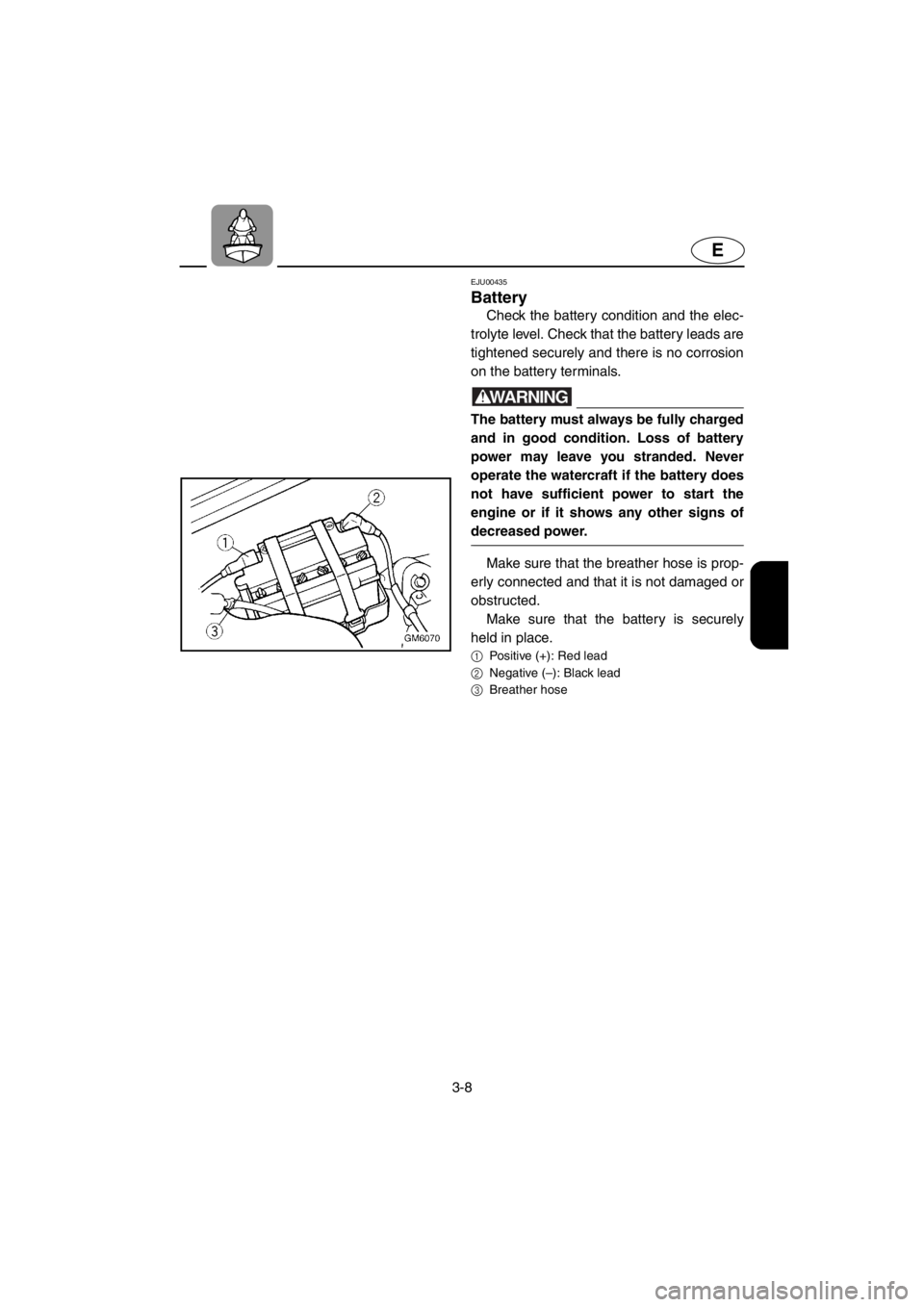
Check the battery condition and the elec-
trolyte level. Check that the battery leads are
tightened securely and there is no corrosion
on the battery terminals.
WARNING@The battery must always be fully charged
and in good condition. Loss of battery
power may leave you stranded. Never
operate the watercraft if the battery does
not have sufficient power to start the
engine or if it shows any other signs of
decreased power.
@
Make sure that the breather hose is prop-
erly connected and that it is not damaged or
obstructed.
Make sure that the battery is securely
held in place.
1
Positive (+): Red lead
2
Negative (–): Black lead
3
Breather hose
E_GM6-3.fm Page 8 Tuesday, July 11, 2000 10:52 AM
Page 45 of 107
3-10
E
EJU00447
Throttle
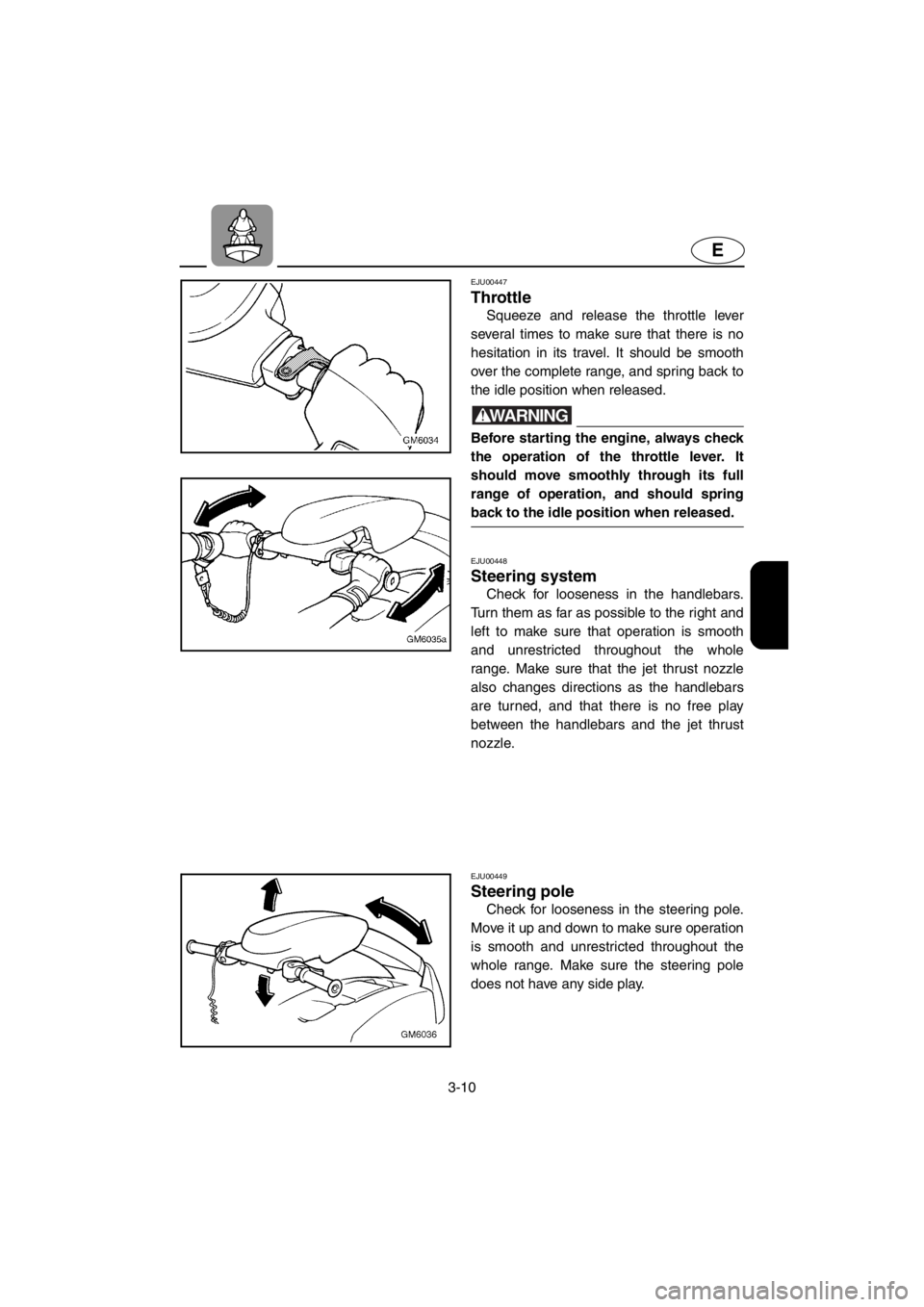
Squeeze and release the throttle lever
several times to make sure that there is no
hesitation in its travel. It should be smooth
over the complete range, and spring back to
the idle position when released.
WARNING
Before starting the engine, always check
the operation of the throttle lever. It
should move smoothly through its full
range of operation, and should spring
back to the idle position when released.
EJU00448
Steering system
Check for looseness in the handlebars.
Turn them as far as possible to the right and
left to make sure that operation is smooth
and unrestricted throughout the whole
range. Make sure that the jet thrust nozzle
also changes directions as the handlebars
are turned, and that there is no free play
between the handlebars and the jet thrust
nozzle.
EJU00449
Steering pole
Check for looseness in the steering pole.
Move it up and down to make sure operation
is smooth and unrestricted throughout the
whole range. Make sure the steering pole
does not have any side play.
E_GM6-3.fm Page 10 Tuesday, July 11, 2000 10:52 AM
Page 46 of 107
3-11
E
EJU00942
Jet unit
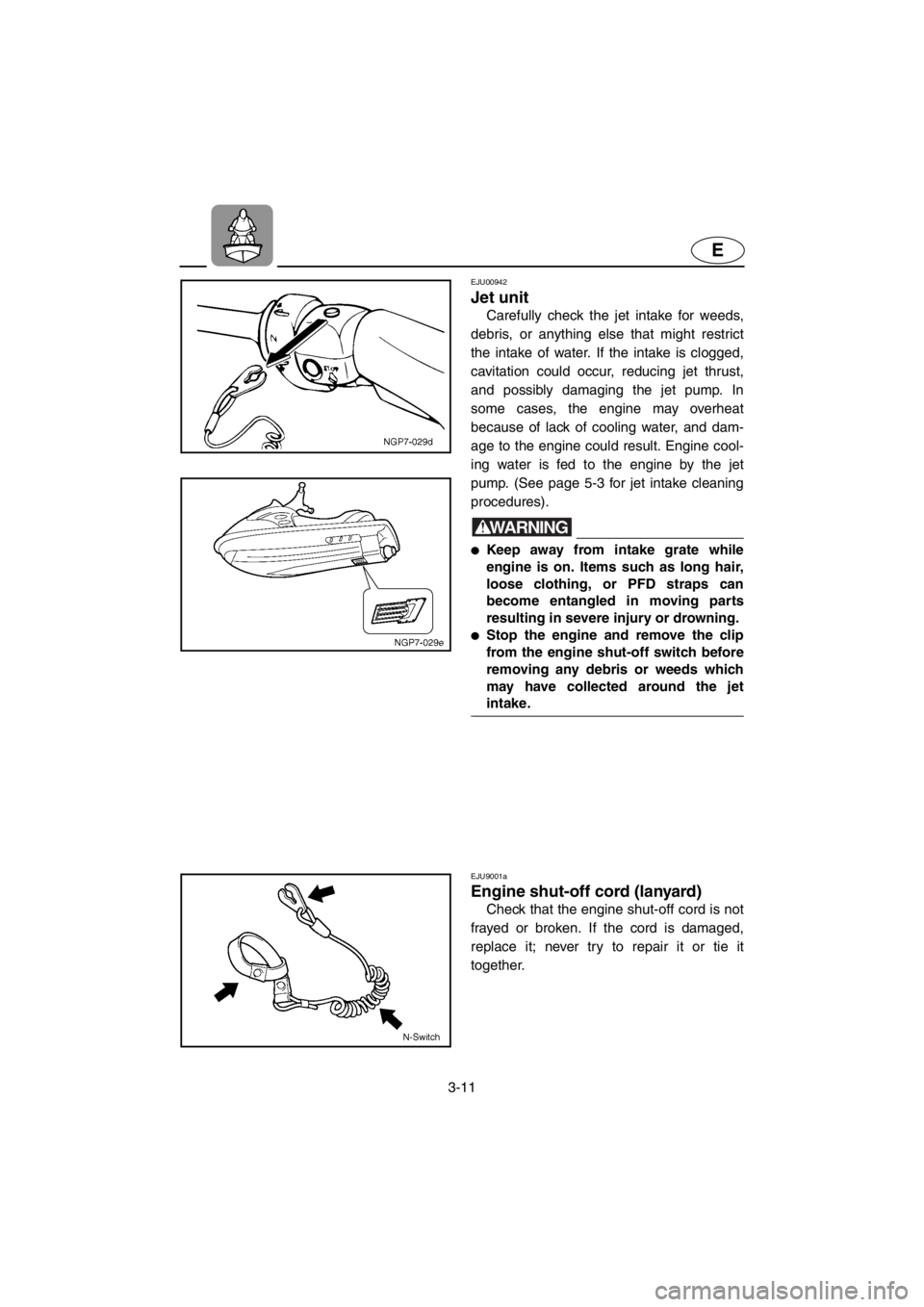
Carefully check the jet intake for weeds,
debris, or anything else that might restrict
the intake of water. If the intake is clogged,
cavitation could occur, reducing jet thrust,
and possibly damaging the jet pump. In
some cases, the engine may overheat
because of lack of cooling water, and dam-
age to the engine could result. Engine cool-
ing water is fed to the engine by the jet
pump. (See page 5-3 for jet intake cleaning
procedures).
WARNING@●Keep away from intake grate while
engine is on. Items such as long hair,
loose clothing, or PFD straps can
become entangled in moving parts
resulting in severe injury or drowning.
●Stop the engine and remove the clip
from the engine shut-off switch before
removing any debris or weeds which
may have collected around the jet
intake.
@
EJU9001a
Engine shut-off cord (lanyard)
Check that the engine shut-off cord is not
frayed or broken. If the cord is damaged,
replace it; never try to repair it or tie it
together.
E_GM6-3.fm Page 11 Tuesday, July 11, 2000 10:52 AM
Page 48 of 107
3-13
E
EJU00456
Operation
WARNING@Before operating your watercraft,
become familiar with all controls. Con-
sult your Yamaha dealer about any con-
trols or functions you do not fully
understand. Failure to understand how
controls work could cause an accident or
prevent you from avoiding an accident.
@
EJU00458
Engine break-in
The engine break-in period is essential to
allow the various components of the engine
to wear and polish themselves to the correct
operating clearances. This ensures proper
performance and promotes longer compo-
nent life.
CAUTION:@●For the first 5 hours or 2 tankfuls of
operation, premix fuel and oil in a 25:1
ratio.
●After break-in, premix fuel and oil in a
50:1 ratio for normal operation.
@
1. Launch the watercraft and start the
engine, and then board the watercraft.
2. Run the engine at the lowest possible
speed for 5 minutes.
E_GM6-3.fm Page 13 Wednesday, July 12, 2000 3:01 PM
Page 50 of 107
3-15
E
EJU00927
Starting the engine
WARNING@Never start the engine or let it run for any
length of time in an enclosed area.
Exhaust fumes contain carbon monox-
ide, a colorless, odorless gas that may
cause loss of consciousness and death
within a short time. Always operate the
watercraft in an open area.
@
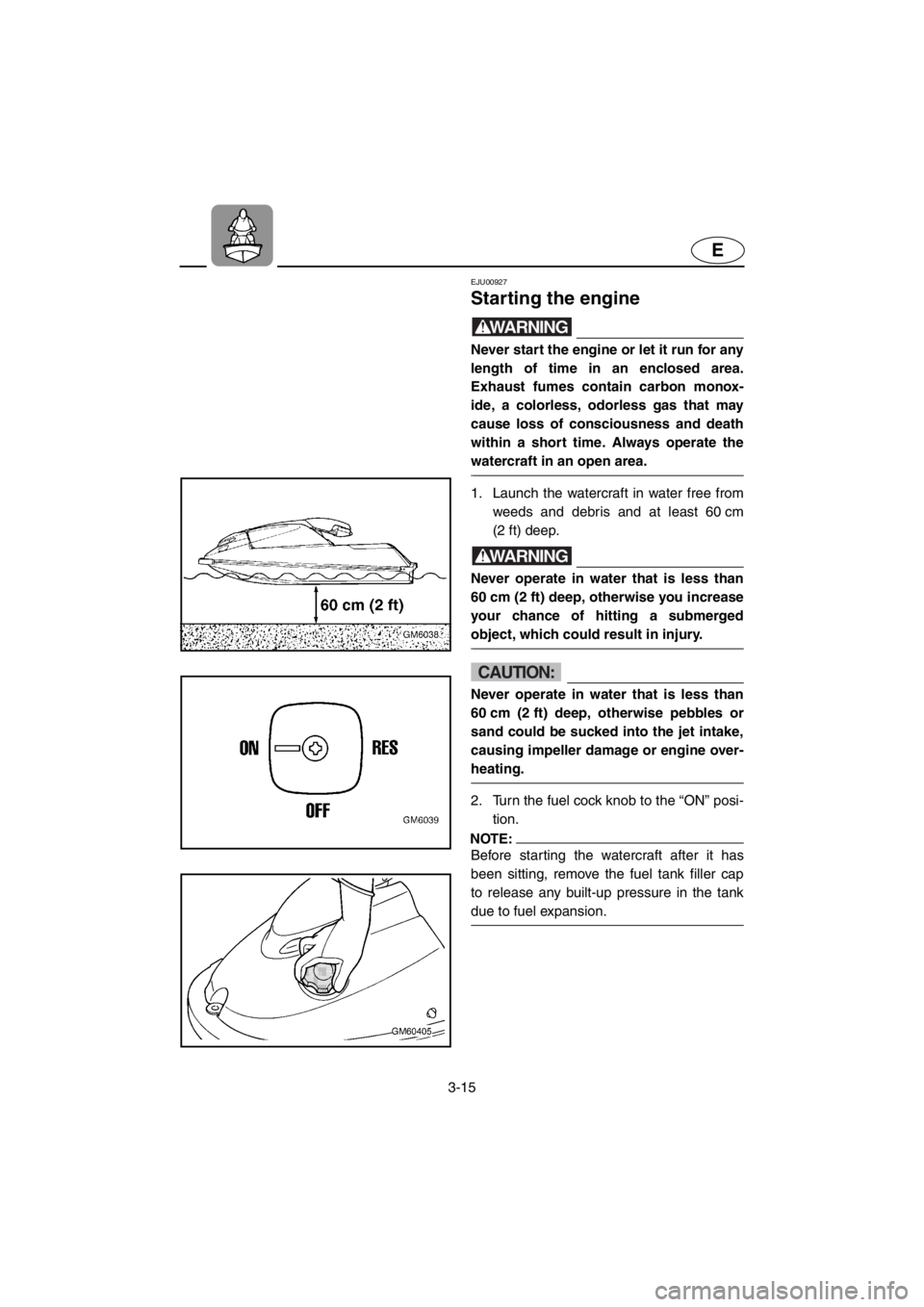
1. Launch the watercraft in water free from
weeds and debris and at least 60 cm
(2 ft) deep.
WARNING@Never operate in water that is less than
60 cm (2 ft) deep, otherwise you increase
your chance of hitting a submerged
object, which could result in injury.
@
CAUTION:@Never operate in water that is less than
60 cm (2 ft) deep, otherwise pebbles or
sand could be sucked into the jet intake,
causing impeller damage or engine over-
heating.
@
2. Turn the fuel cock knob to the “ON” posi-
tion.
NOTE:@Before starting the watercraft after it has
been sitting, remove the fuel tank filler cap
to release any built-up pressure in the tank
due to fuel expansion.
@
E_GM6-3.fm Page 15 Tuesday, July 11, 2000 10:52 AM
Page 51 of 107
3-16
E
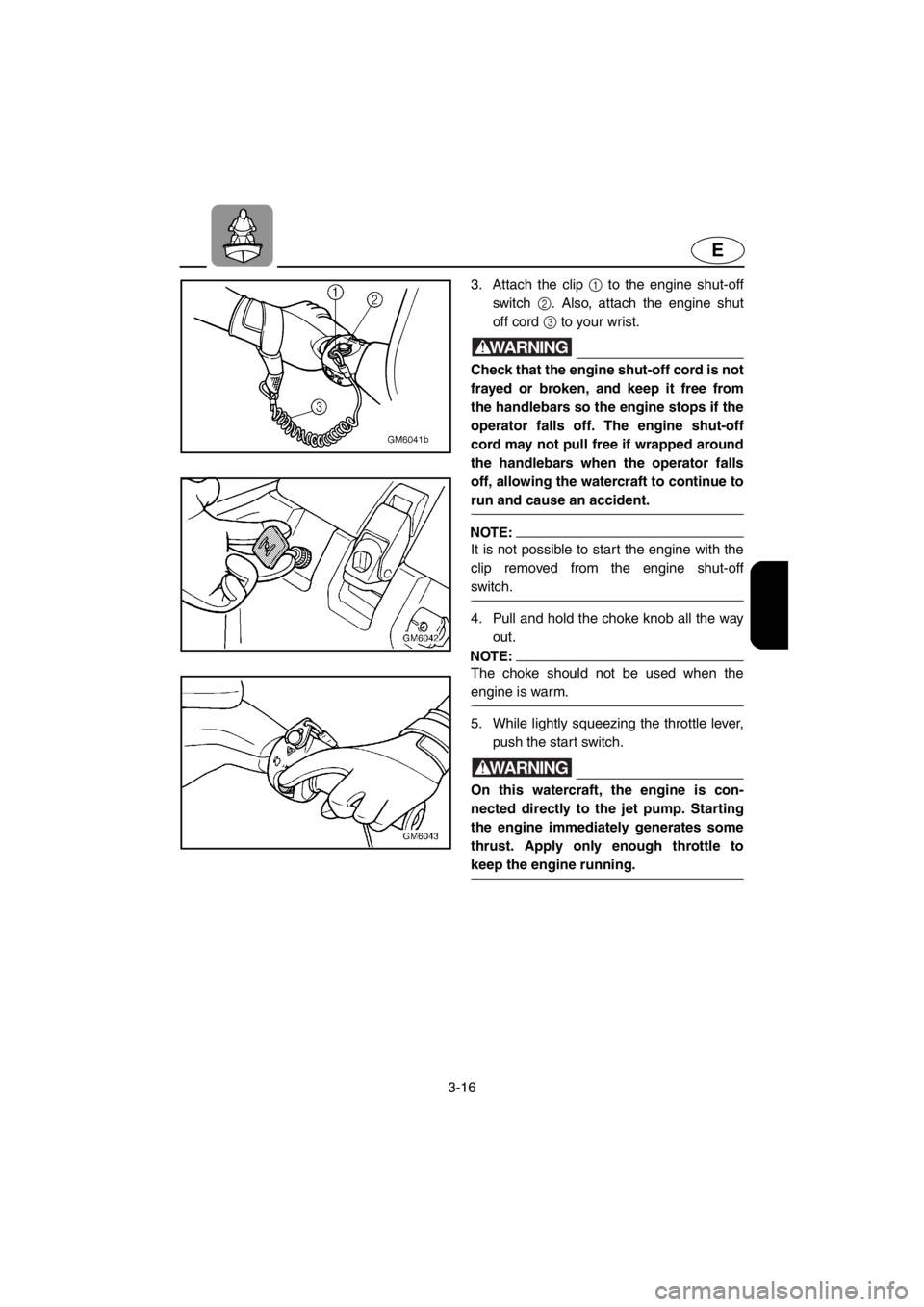
3. Attach the clip 1 to the engine shut-off
switch 2. Also, attach the engine shut
off cord 3 to your wrist.
WARNING@Check that the engine shut-off cord is not
frayed or broken, and keep it free from
the handlebars so the engine stops if the
operator falls off. The engine shut-off
cord may not pull free if wrapped around
the handlebars when the operator falls
off, allowing the watercraft to continue to
run and cause an accident.
@
NOTE:@It is not possible to start the engine with the
clip removed from the engine shut-off
switch.
@
4. Pull and hold the choke knob all the way
out.
NOTE:@The choke should not be used when the
engine is warm.
@
5. While lightly squeezing the throttle lever,
push the start switch.
WARNING@On this watercraft, the engine is con-
nected directly to the jet pump. Starting
the engine immediately generates some
thrust. Apply only enough throttle to
keep the engine running.
@
E_GM6-3.fm Page 16 Tuesday, July 11, 2000 10:52 AM
Page 53 of 107
3-18
E
EJU00928
Stopping the engine
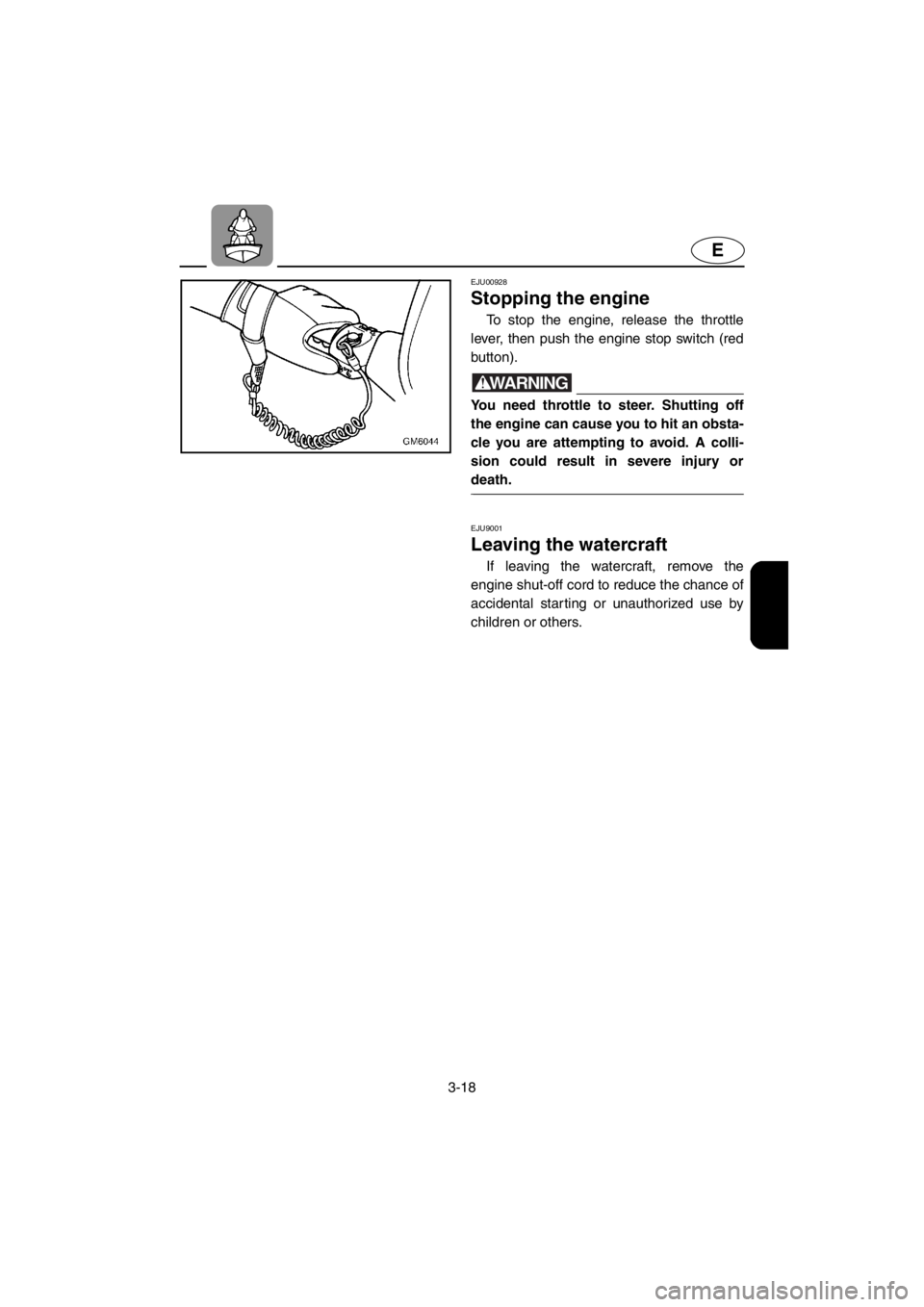
To stop the engine, release the throttle
lever, then push the engine stop switch (red
button).
WARNING@You need throttle to steer. Shutting off
the engine can cause you to hit an obsta-
cle you are attempting to avoid. A colli-
sion could result in severe injury or
death.
@
EJU9001
Leaving the watercraft
If leaving the watercraft, remove the
engine shut-off cord to reduce the chance of
accidental starting or unauthorized use by
children or others.
E_GM6-3.fm Page 18 Tuesday, July 11, 2000 10:52 AM
Page 54 of 107
3-19
E
EJU00464
Operating your watercraft
Getting to know your
watercraft
Operating your watercraft requires skills
acquired through practice over a period of
time. Take the time to learn the basic tech-
niques well before attempting more difficult
maneuvers.
Operating your new watercraft can be a
very enjoyable activity, providing you with
hours of pleasure. However, it is essential to
familiarize yourself with the operation of the
watercraft to achieve the skill necessary to
enjoy riding safely. Before operating this
watercraft, read this Owner’s/Operator’s
Manual, the Riding Practice Guide, and all
warning and caution labels on the water-
craft. Pay particular attention to the safety
information on pages 1-8 to 1-14. These
materials should give you an understanding
of the watercraft and its operation.
Remember: This watercraft is designed to
carry the operator only. Never have more
than one person on the watercraft at any
time.
EJU00470
Learning to operate your
watercraft
Before operating, always perform the pre-
operation checks listed on page 3-5. The
short time spent checking the watercraft will
reward you with added safety and reliability.
Check all local laws before operating your
watercraft.
Operate defensively at safe speeds and
keep a safe distance away from people,
objects and other watercraft. Select a wide
area to learn in, where you have good visi-
bility and light boat traffic.
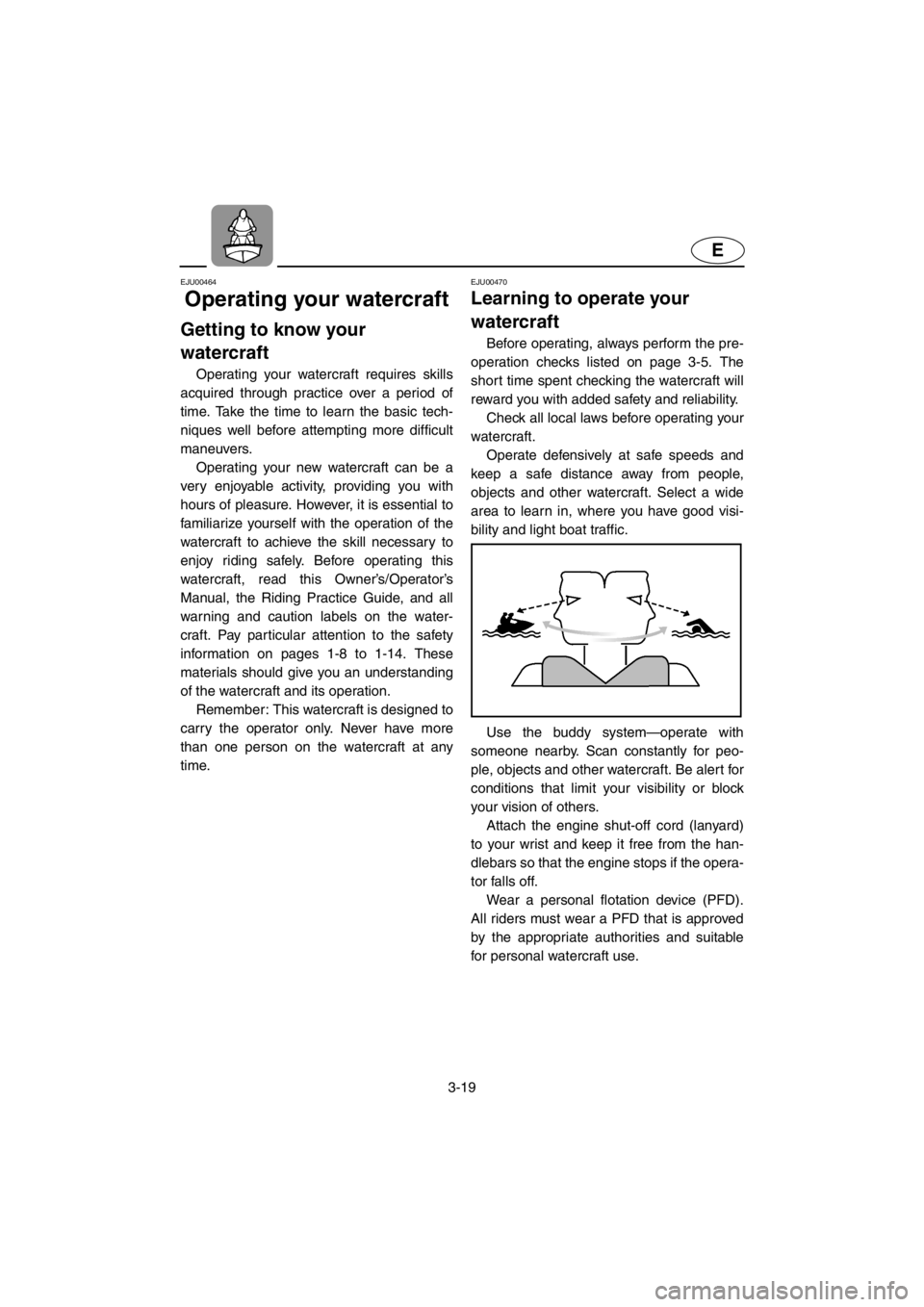
Use the buddy system—operate with
someone nearby. Scan constantly for peo-
ple, objects and other watercraft. Be alert for
conditions that limit your visibility or block
your vision of others.
Attach the engine shut-off cord (lanyard)
to your wrist and keep it free from the han-
dlebars so that the engine stops if the opera-
tor falls off.
Wear a personal flotation device (PFD).
All riders must wear a PFD that is approved
by the appropriate authorities and suitable
for personal watercraft use.
E_GM6-3.fm Page 19 Tuesday, July 11, 2000 10:52 AM
Page 55 of 107
3-20
E
Wear protective clothing. Severe internal
injuries can occur if water is forced into body
cavities as a result of falling into water or
being near the jet thrust nozzle. Normal
swimwear does not adequately protect
against forceful water entry into rectum or
vagina. All riders must wear a wetsuit bot-
tom or clothing that provides equivalent pro-
tection.
Such clothing includes thick, tightly
woven, sturdy and snug-fitting apparel such
as denim, but does not include spandex or
similar fabrics, like those used in bicycle
shorts. A full wetsuit can also protect against
hypothermia (subnormal body temperature)
and abrasions.
Footwear and gloves are recommended.
Eye protection is recommended to keep
wind, water, and glare from the sun out of
your eyes while you operate your watercraft.
Restraining straps for eyewear are made
which are designed to float should your eye-
wear fall in the water.
You should grip the handlebars firmly and
get to a standing or kneeling position
quickly. Keep both feet or knees on the
riding tray when the watercraft is in motion.
WARNING@●Do not apply throttle when others are
at rear of watercraft—turn engine off or
keep engine at idle. Water and/or
debris exiting jet thrust nozzle can
cause severe injury.
●Avoid forceful jet thrust and limited
visibility while reboarding. Get to
standing or kneeling position quickly,
but do not expose yourself to forceful
jet thrust.
@
E_GM6-3.fm Page 20 Tuesday, July 11, 2000 10:52 AM
Page 56 of 107
3-21
E
EJU00485
Starting the watercraft
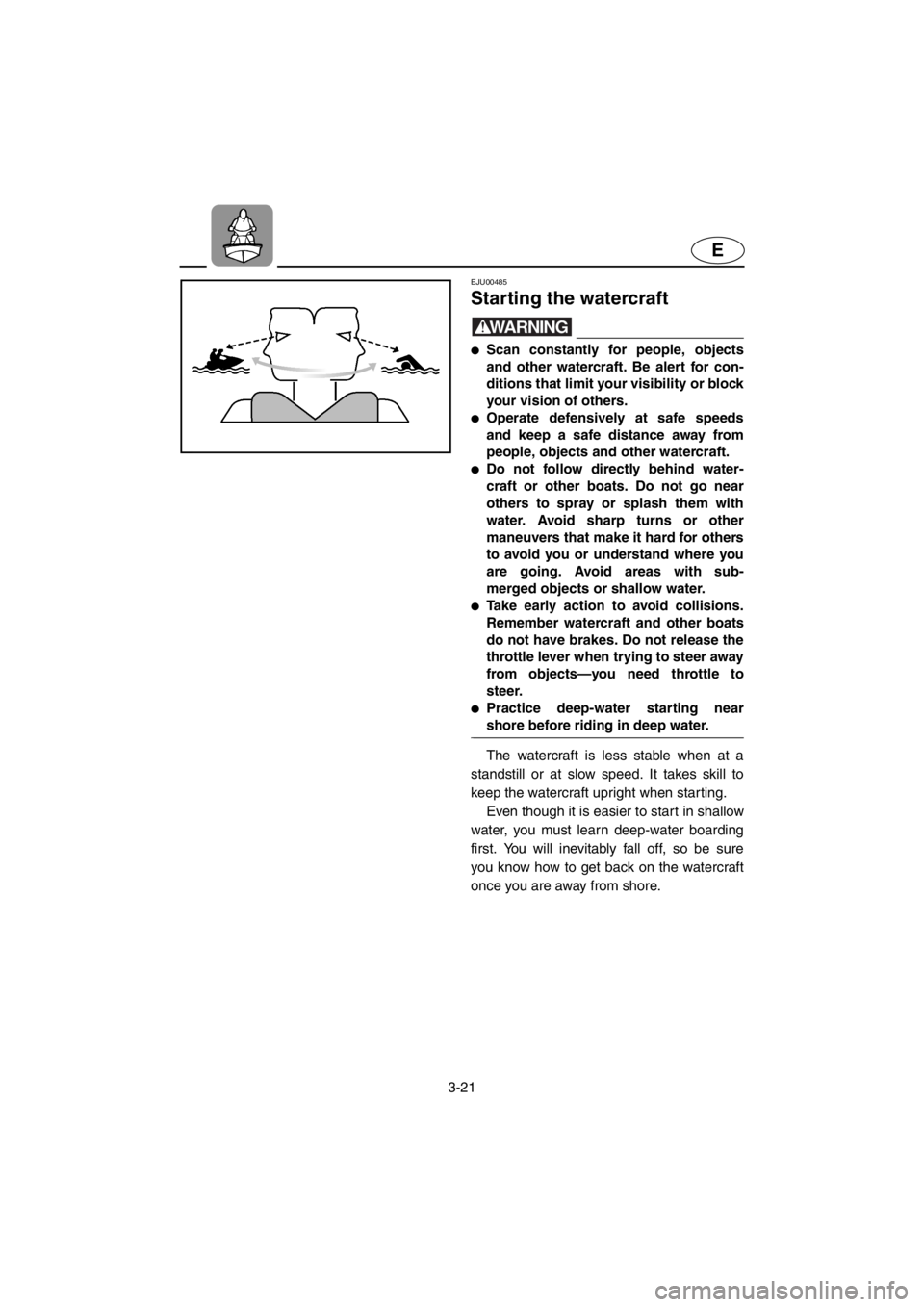
WARNING@●Scan constantly for people, objects
and other watercraft. Be alert for con-
ditions that limit your visibility or block
your vision of others.
●Operate defensively at safe speeds
and keep a safe distance away from
people, objects and other watercraft.
●Do not follow directly behind water-
craft or other boats. Do not go near
others to spray or splash them with
water. Avoid sharp turns or other
maneuvers that make it hard for others
to avoid you or understand where you
are going. Avoid areas with sub-
merged objects or shallow water.
●Take early action to avoid collisions.
Remember watercraft and other boats
do not have brakes. Do not release the
throttle lever when trying to steer away
from objects—you need throttle to
steer.
●Practice deep-water starting near
shore before riding in deep water.
@
The watercraft is less stable when at a
standstill or at slow speed. It takes skill to
keep the watercraft upright when starting.
Even though it is easier to start in shallow
water, you must learn deep-water boarding
first. You will inevitably fall off, so be sure
you know how to get back on the watercraft
once you are away from shore.
E_GM6-3.fm Page 21 Tuesday, July 11, 2000 10:52 AM