engine YAMAHA SUPERJET 2001 Owners Manual
[x] Cancel search | Manufacturer: YAMAHA, Model Year: 2001, Model line: SUPERJET, Model: YAMAHA SUPERJET 2001Pages: 107, PDF Size: 6.2 MB
Page 7 of 107
E
1
EJU00274
GENERAL AND
SAFETY
INFORMATION
Identification numbers............................. 1-1
Primary Identification (PRI-ID) number .. 1-1
Hull Identification Number (HIN)............. 1-1
Engine serial number.............................. 1-1
Emission control information................. 1-2
Approval label of Emission control
certificate ................................................. 1-2
Important labels........................................ 1-3
Label location ......................................... 1-3
Warning labels ........................................ 1-4
Caution label ........................................... 1-7
Other labels ............................................ 1-7
Safety information.............................. 1-8
Limitations on who may operate the
watercraft................................................. 1-8
Cruising limitations ................................. 1-9
Operation requirements........................ 1-10
Hazard information .............................. 1-12
Watercraft characteristics .................... 1-13
Safe boating rules.................................. 1-14
Enjoy your watercraft responsibly....... 1-14
E_GM6-1TOC.fm Page 1 Tuesday, July 11, 2000 10:49 AM
Page 8 of 107
1-1
E
EJU00699
Identification numbers
Record your Primary Identification (PRI-
ID) number, Hull Identification Number (HIN)
and engine serial number in the spaces pro-
vided, to assist you in ordering spare parts
from a Yamaha dealer. Also record and keep
these ID numbers in a separate place in
case your watercraft is stolen.
EJU00700
Primary Identification (PRI-ID)
number
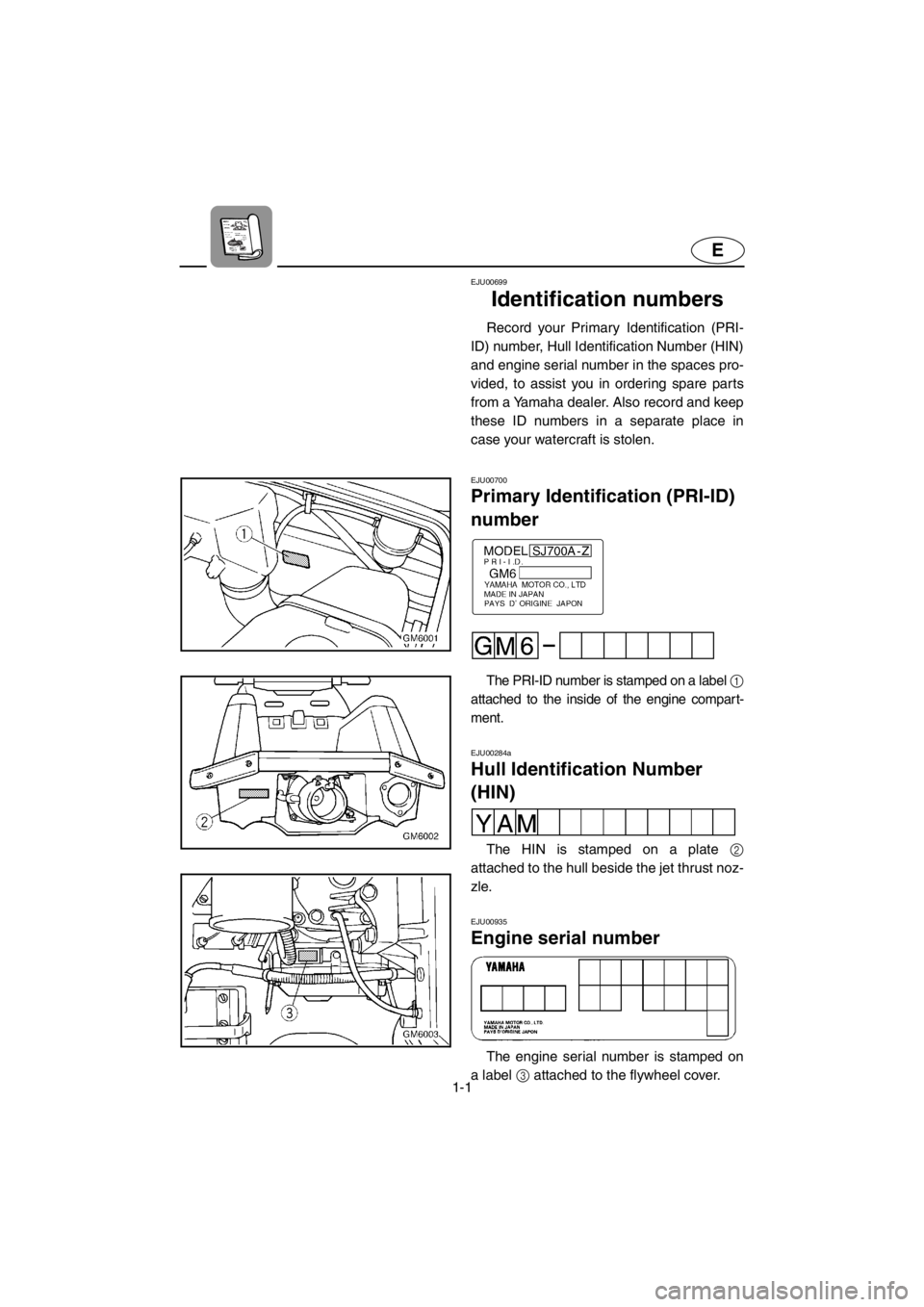
The PRI-ID number is stamped on a label 1
attached to the inside of the engine compart-
ment.
EJU00284a
Hull Identification Number
(HIN)
The HIN is stamped on a plate 2
attached to the hull beside the jet thrust noz-
zle.
EJU00935
Engine serial number
The engine serial number is stamped on
a label 3 attached to the flywheel cover.
E_GM6-1.fm Page 1 Tuesday, July 11, 2000 10:49 AM
Page 9 of 107
1-2
E
EJU00631a
Emission control
information
This engine conforms to the U.S. Environ-
mental Protection Agency (EPA) regulations
for marine SI engines for the year 2001.
Approval label of Emission
control certificate
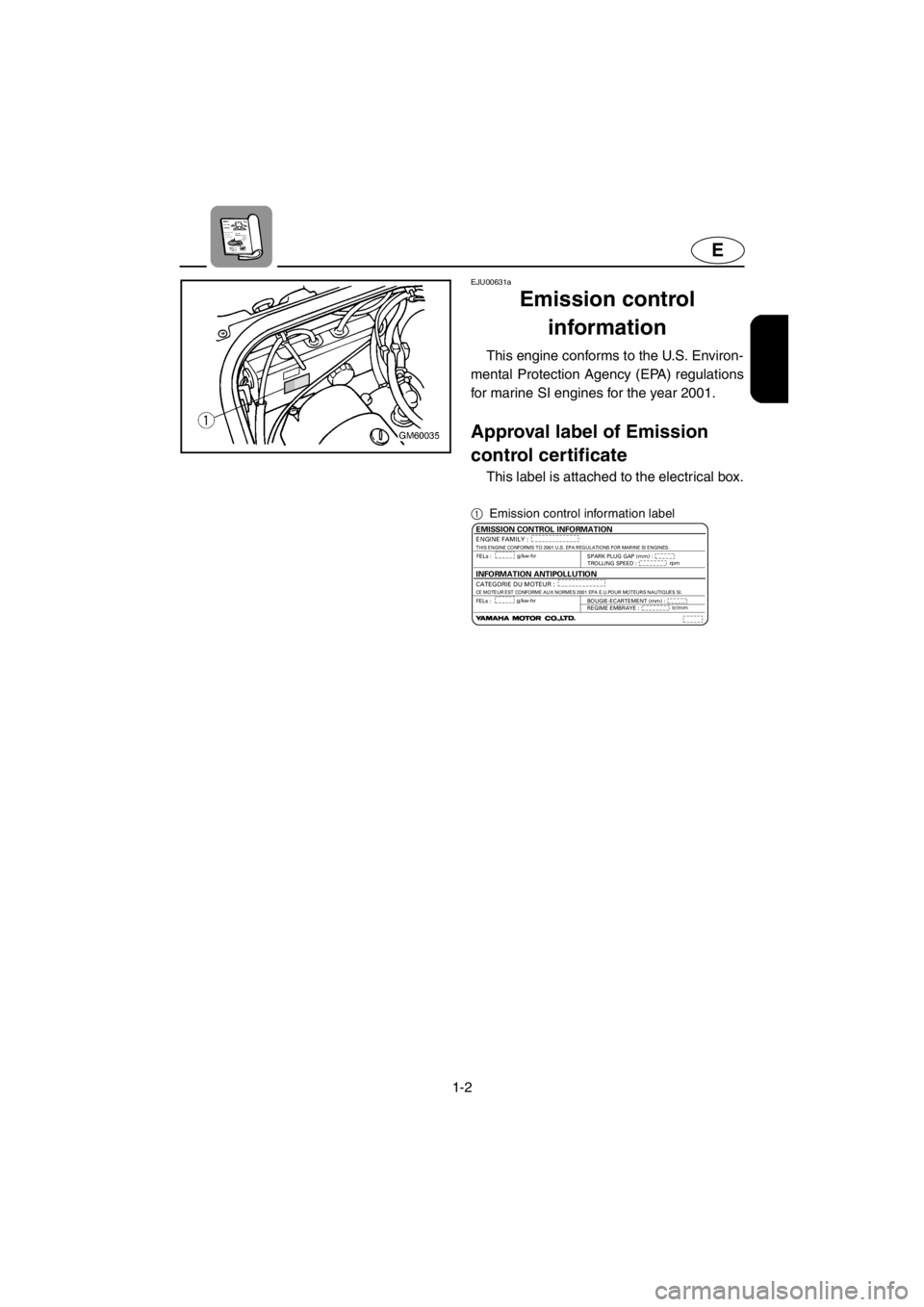
This label is attached to the electrical box.
1
Emission control information labelEMISSION CONTROL INFORMATIONENGINE FAMILY : THIS ENGINE CONFORMS TO 2001 U.S. EPA REGULATIONS FOR MARINE SI ENGINES.FELs :
TROLLING SPEED :rpm SPARK PLUG GAP (mm) :g/kw-hr
INFORMATION ANTIPOLLUTIONCATEGORIE DU MOTEUR : CE MOTEUR EST CONFORME AUX NORMES 2001 EPA E.U.POUR MOTEURS NAUTIQUES SI.FELs :
REGIME EMBRAYE :tr/mm BOUGIE-ECARTEMENT (mm) :g/kw-hr
E_GM6-1.fm Page 2 Tuesday, July 11, 2000 10:49 AM
Page 19 of 107

1-12
E
●Attach the engine shut-off cord (lanyard)
to wrist and keep it free from the handle-
bars so that the engine stops if the opera-
tor falls off. After riding, remove the
engine shut-off cord from the watercraft to
avoid accidental starting or unauthorized
use by children or others.
●Scan carefully for swimmers, and stay
away from swimming areas. Swimmers
are hard to see and you could acciden-
tally hit someone in the water.
●Avoid being hit by another boat! You
should always take the responsibility to
watch for traffic; other boaters may not be
watching for you. If they do not see you,
or you maneuver more quickly than other
boaters expect, you risk a collision.
●Maintain a safe distance from other boats
or watercraft, and also watch for boats’ ski
ropes or fishing lines. Obey the “Safe
boating rules” and be sure to check
behind you before making a turn. (See
Safe boating rules on page 1-14.)
EJU00313
Hazard information
●When transporting or storing your water-
craft, always place the fuel cock knob in
the “OFF” position, otherwise gasoline
may overflow from the carburetor.
●Never start the engine or let it run for any
length of time in an enclosed area.
Exhaust fumes contain carbon monoxide,
a colorless, odorless gas that may cause
loss of consciousness and death within a
short time. Always operate the watercraft
in an open area.
E_GM6-1.fm Page 12 Tuesday, July 11, 2000 10:49 AM
Page 20 of 107

1-13
E
EJU00922
Watercraft characteristics
●Jet thrust turns the watercraft. Releasing
the throttle lever completely produces
only minimum thrust. If you are traveling
at speeds above trolling, you will have
rapidly decreasing ability to steer without
throttle. You may still have some turning
ability immediately after releasing the
throttle, but once the engine slows down,
the watercraft will no longer respond to
handlebar input until you apply throttle
again or you reach a trolling speed. Prac-
tice turning in an open area without
obstructions until you have a good feel for
this maneuver.
●This watercraft are water-jet propelled.
The jet pump is directly connected to the
engine. This means that jet thrust will pro-
duce some movement whenever the
engine is running. There is no “neutral”
position.
●Keep away from intake grate 1 while the
engine is on. Items such as long hair,
loose clothing, or PFD straps can become
entangled in moving parts resulting in
severe injury or drowning.
●Never insert any object in the jet thrust
nozzle 2. Severe injury or death could
result from coming in contact with the
rotating parts of the jet pump.
●Stop the engine and remove the clip 3
from the engine shut-off switch 4 before
removing any debris or weeds that may
have collected around the jet intake.
●Avoid forceful jet thrust and limited visibil-
ity while reboarding. Get to standing or
kneeling position quickly, but do not
expose yourself to forceful jet thrust.
E_GM6-1.fm Page 13 Tuesday, July 11, 2000 10:49 AM
Page 23 of 107
E
2
EJU00326
FEATURES AND
FUNCTIONS
Location of main components............... 2-1
Operation of controls and other
functions ................................................... 2-3
Hood ........................................................ 2-3
Fuel tank filler cap ................................... 2-4
Fuel cock knob........................................ 2-4
Engine stop switch .................................. 2-5
Engine shut-off switch............................. 2-5
Choke knob ............................................. 2-6
Throttle lever ........................................... 2-6
Start switch.............................................. 2-6
Cooling water pilot outlet ........................ 2-7
Steering system ...................................... 2-7
Steering pole ........................................... 2-8
Engine overheat warning system ........... 2-9
Storage pouch....................................... 2-10
E_GM6-2TOC.fm Page 1 Tuesday, July 11, 2000 10:50 AM
Page 24 of 107
2-1
E
EJU00327
Location of main components
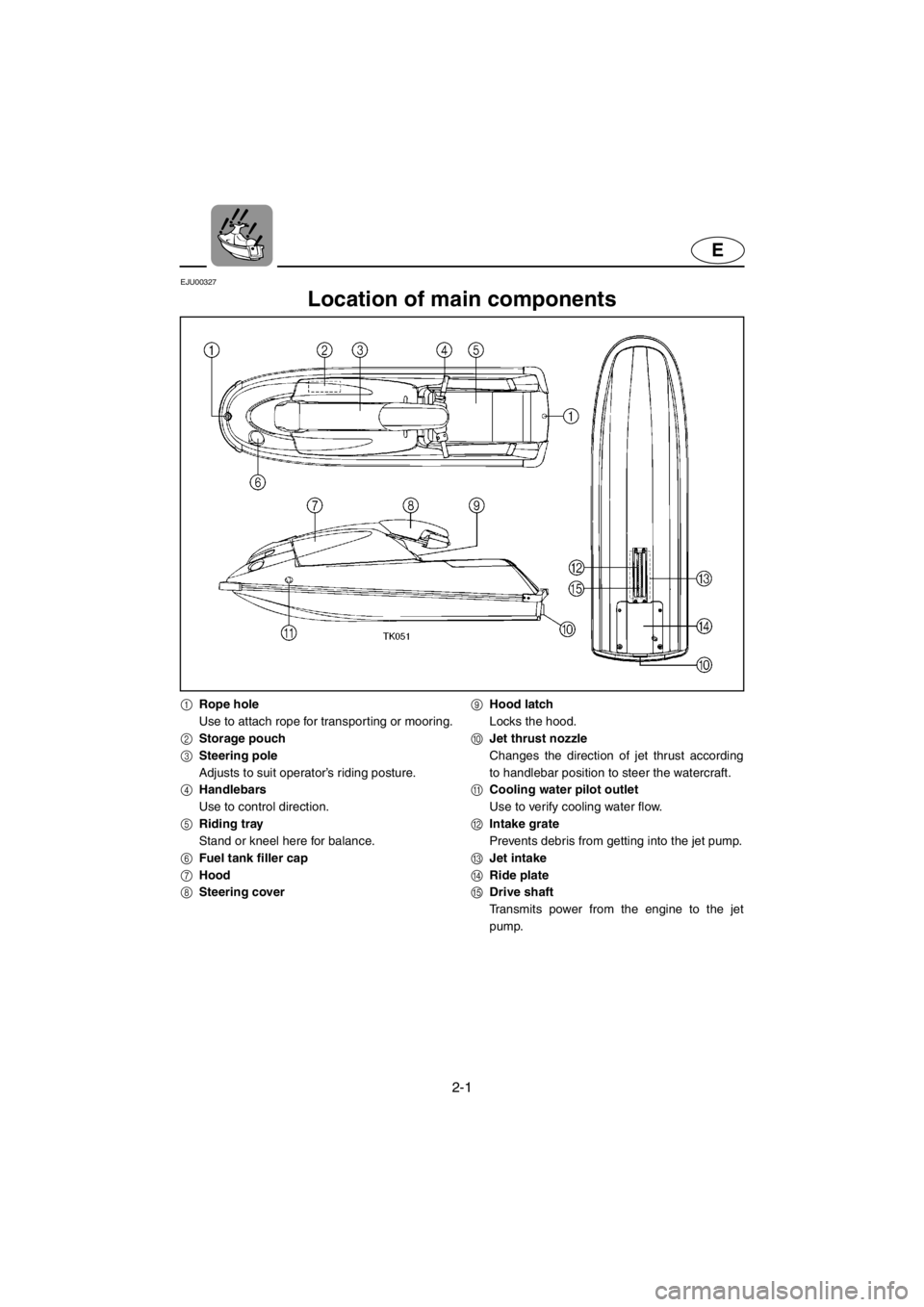
1Rope hole
Use to attach rope for transporting or mooring.
2Storage pouch
3Steering pole
Adjusts to suit operator’s riding posture.
4Handlebars
Use to control direction.
5Riding tray
Stand or kneel here for balance.
6Fuel tank filler cap
7Hood
8Steering cover9Hood latch
Locks the hood.
0Jet thrust nozzle
Changes the direction of jet thrust according
to handlebar position to steer the watercraft.
ACooling water pilot outlet
Use to verify cooling water flow.
BIntake grate
Prevents debris from getting into the jet pump.
CJet intake
DRide plate
EDrive shaft
Transmits power from the engine to the jet
pump.
E_GM6-2.fm Page 1 Tuesday, July 11, 2000 10:51 AM
Page 25 of 107
2-2
E
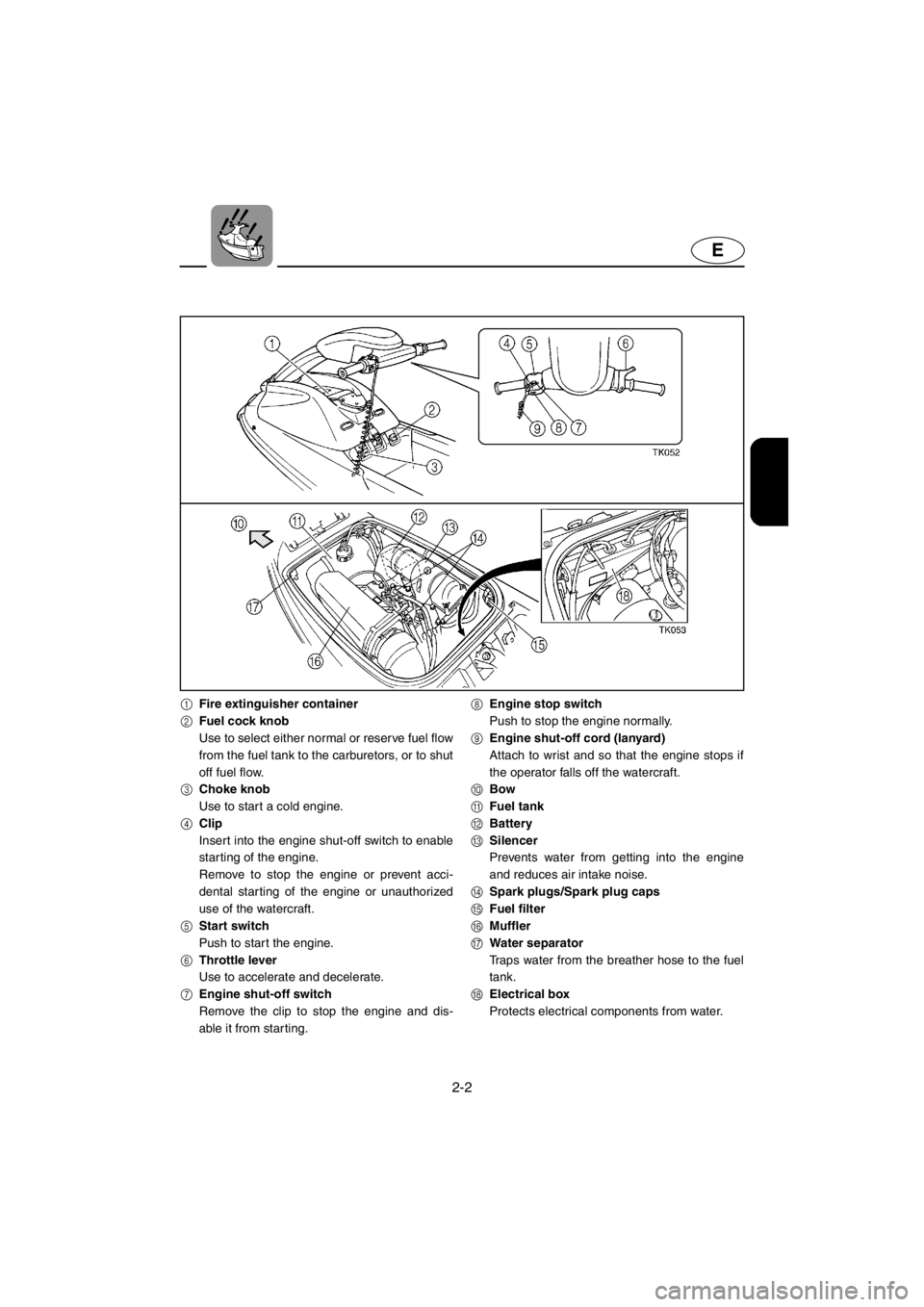
1Fire extinguisher container
2Fuel cock knob
Use to select either normal or reserve fuel flow
from the fuel tank to the carburetors, or to shut
off fuel flow.
3Choke knob
Use to start a cold engine.
4Clip
Insert into the engine shut-off switch to enable
starting of the engine.
Remove to stop the engine or prevent acci-
dental star ting of the engine or unauthorized
use of the watercraft.
5Start switch
Push to start the engine.
6Throttle lever
Use to accelerate and decelerate.
7Engine shut-off switch
Remove the clip to stop the engine and dis-
able it from starting.8Engine stop switch
Push to stop the engine normally.
9Engine shut-off cord (lanyard)
Attach to wrist and so that the engine stops if
the operator falls off the watercraft.
0Bow
AFuel tank
BBattery
CSilencer
Prevents water from getting into the engine
and reduces air intake noise.
DSpark plugs/Spark plug caps
EFuel filter
FMuffler
GWater separator
Traps water from the breather hose to the fuel
tank.
HElectrical box
Protects electrical components from water.
E_GM6-2.fm Page 2 Tuesday, July 11, 2000 10:51 AM
Page 27 of 107
2-4
E
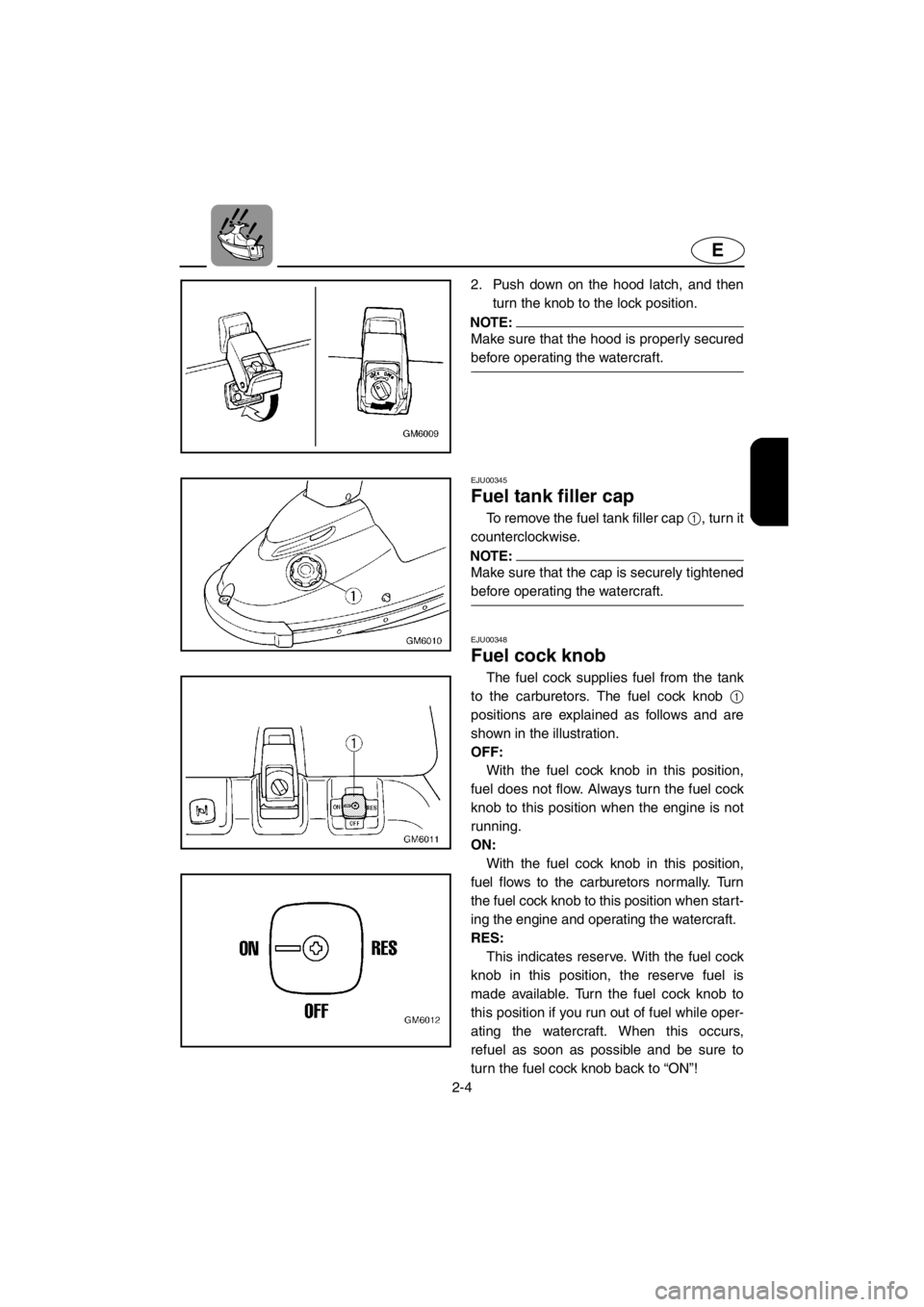
2. Push down on the hood latch, and then
turn the knob to the lock position.
NOTE:@Make sure that the hood is properly secured
before operating the watercraft.
@
EJU00345
Fuel tank filler cap
To remove the fuel tank filler cap 1, turn it
counterclockwise.
NOTE:@Make sure that the cap is securely tightened
before operating the watercraft.
@
EJU00348
Fuel cock knob
The fuel cock supplies fuel from the tank
to the carburetors. The fuel cock knob 1
positions are explained as follows and are
shown in the illustration.
OFF:
With the fuel cock knob in this position,
fuel does not flow. Always turn the fuel cock
knob to this position when the engine is not
running.
ON:
With the fuel cock knob in this position,
fuel flows to the carburetors normally. Turn
the fuel cock knob to this position when start-
ing the engine and operating the watercraft.
RES:
This indicates reserve. With the fuel cock
knob in this position, the reserve fuel is
made available. Tur n the fuel cock knob to
this position if you run out of fuel while oper-
ating the watercraft. When this occurs,
refuel as soon as possible and be sure to
turn the fuel cock knob back to “ON”!
E_GM6-2.fm Page 4 Tuesday, July 11, 2000 10:51 AM
Page 28 of 107
2-5
E
EJU00705
Engine stop switch
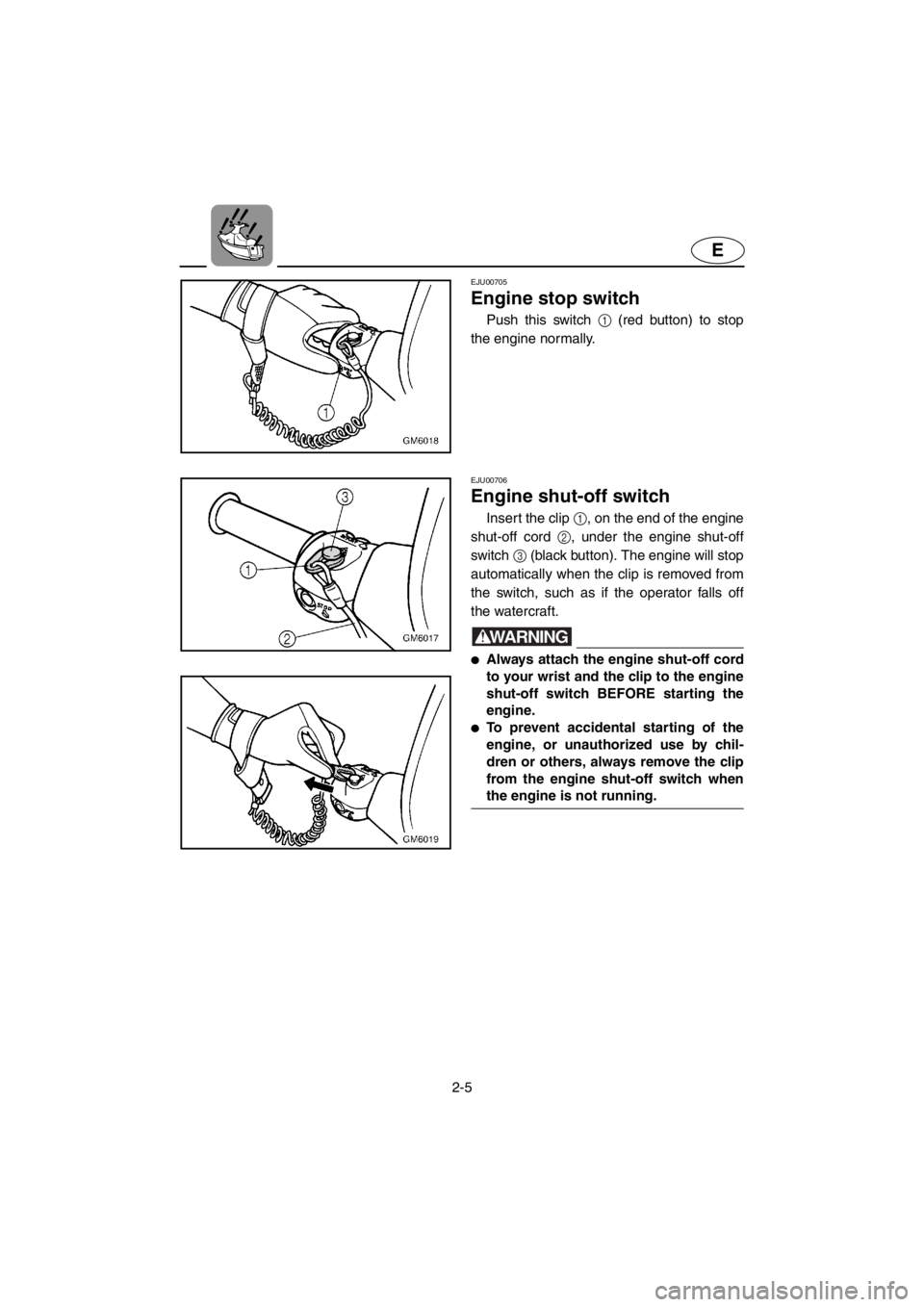
Push this switch 1 (red button) to stop
the engine normally.
EJU00706
Engine shut-off switch
Insert the clip 1, on the end of the engine
shut-off cord 2, under the engine shut-off
switch 3 (black button). The engine will stop
automatically when the clip is removed from
the switch, such as if the operator falls off
the watercraft.
WARNING@●Always attach the engine shut-off cord
to your wrist and the clip to the engine
shut-off switch BEFORE starting the
engine.
●To prevent accidental starting of the
engine, or unauthorized use by chil-
dren or others, always remove the clip
from the engine shut-off switch when
the engine is not running.
@
E_GM6-2.fm Page 5 Tuesday, July 11, 2000 10:51 AM