engine YAMAHA SUPERJET 2016 User Guide
[x] Cancel search | Manufacturer: YAMAHA, Model Year: 2016, Model line: SUPERJET, Model: YAMAHA SUPERJET 2016Pages: 78, PDF Size: 2.7 MB
Page 26 of 78
![YAMAHA SUPERJET 2016 User Guide Control function operation
20
will not start. Also, the starter motor could
be damaged.
[ECJ01041]
The engine will not start when the clip is re-
moved from the engine shut-off switch.
EJU31212Thrott](/img/51/51274/w960_51274-25.png "YAMAHA SUPERJET 2016 User Guide Control function operation
20
will not start. Also, the starter motor could
be damaged.
[ECJ01041]
The engine will not start when the clip is re-
moved from the engine shut-off switch.
EJU31212Thrott")
Control function operation
20
will not start. Also, the starter motor could
be damaged.
[ECJ01041]
The engine will not start when the clip is re-
moved from the engine shut-off switch.
EJU31212Throttle lever
The throttle lever increases the engine speed
when the lever is squeezed.
The throttle lever returns automatically to its
fully closed (idle) position when released.
EJU35933Steering system
By turning the handlebars in the direction you
wish to travel, the angle of the jet thrust noz-zle is changed, and the direction of the water-
craft is changed accordingly.
Since the strength of the jet thrust determines
the speed and degree of a turn, throttle must
always be applied when attempting a turn,
except at trolling speed.
The angle of the jet thrust nozzle can be ad-
justed to suit operator preference. (See page
57 for information on adjusting the jet thrust
nozzle angle.)
EJU31273Steering pole
The steering pole can be moved up or down
to change the height of the handlebars.
1Start switch
1Throttle lever
START
1
1Handlebar
2Jet thrust nozzle
UF4D71E0.book Page 20 Thursday, April 23, 2015 1:48 PM
Page 27 of 78
Control function operation
21
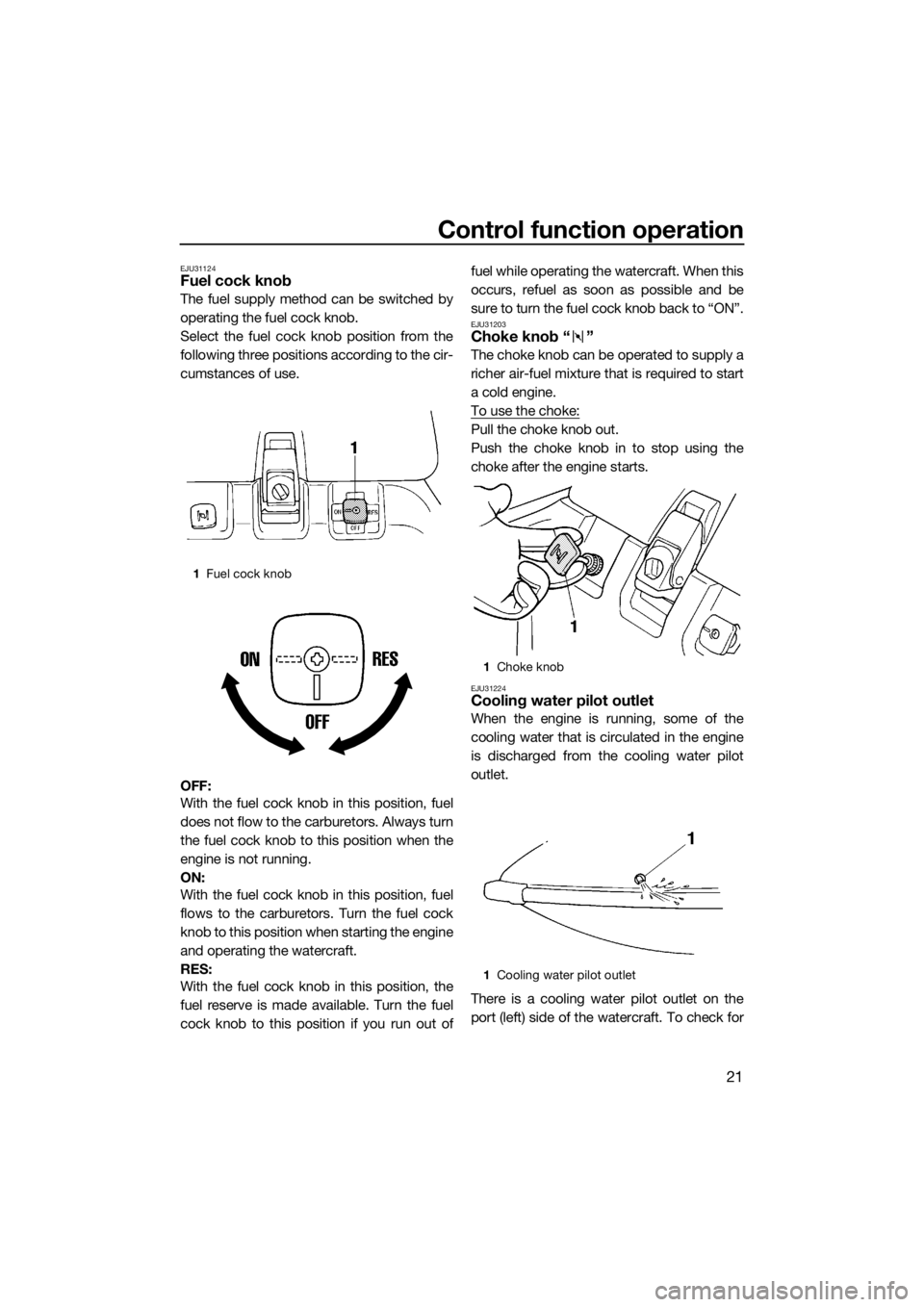
EJU31124Fuel cock knob
The fuel supply method can be switched by
operating the fuel cock knob.
Select the fuel cock knob position from the
following three positions according to the cir-
cumstances of use.
OFF:
With the fuel cock knob in this position, fuel
does not flow to the carburetors. Always turn
the fuel cock knob to this position when the
engine is not running.
ON:
With the fuel cock knob in this position, fuel
flows to the carburetors. Turn the fuel cock
knob to this position when starting the engine
and operating the watercraft.
RES:
With the fuel cock knob in this position, the
fuel reserve is made available. Turn the fuel
cock knob to this position if you run out offuel while operating the watercraft. When this
occurs, refuel as soon as possible and be
sure to turn the fuel cock knob back to “ON”.
EJU31203Choke knob “ ”
The choke knob can be operated to supply a
richer air-fuel mixture that is required to start
a cold engine.
To use the choke:
Pull the choke knob out.
Push the choke knob in to stop using the
choke after the engine starts.
EJU31224Cooling water pilot outlet
When the engine is running, some of the
cooling water that is circulated in the engine
is discharged from the cooling water pilot
outlet.
There is a cooling water pilot outlet on the
port (left) side of the watercraft. To check for
1Fuel cock knob
1Choke knob
1Cooling water pilot outlet
UF4D71E0.book Page 21 Thursday, April 23, 2015 1:48 PM
Page 28 of 78
Control function operation
22
proper operation of the cooling system, make
sure that water is being discharged from the
cooling water pilot outlet. If water is not being
discharged from the outlet, stop the engine
and check the jet intake for clogging. (See
page 66 for information on the jet intake.)
TIP:
It will take about 20 seconds for the water
to reach the outlet after the engine is start-
ed.
Water discharge may not be constant
when the engine is running at idling speed.
If this occurs, apply a little throttle to make
sure that water discharges properly.
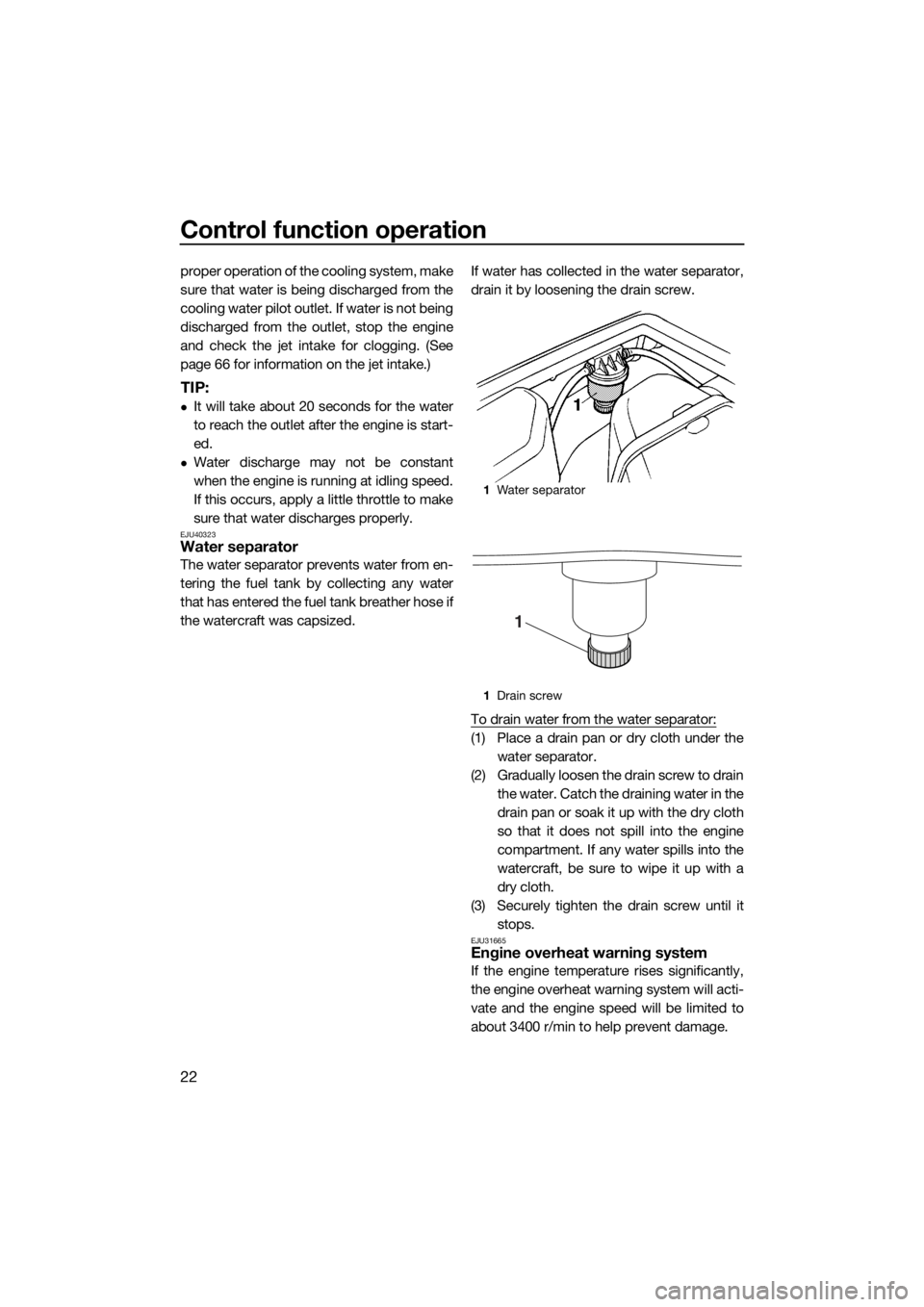
EJU40323Water separator
The water separator prevents water from en-
tering the fuel tank by collecting any water
that has entered the fuel tank breather hose if
the watercraft was capsized.If water has collected in the water separator,
drain it by loosening the drain screw.
To drain water from the water separator:
(1) Place a drain pan or dry cloth under the
water separator.
(2) Gradually loosen the drain screw to drain
the water. Catch the draining water in the
drain pan or soak it up with the dry cloth
so that it does not spill into the engine
compartment. If any water spills into the
watercraft, be sure to wipe it up with a
dry cloth.
(3) Securely tighten the drain screw until it
stops.
EJU31665Engine overheat warning system
If the engine temperature rises significantly,
the engine overheat warning system will acti-
vate and the engine speed will be limited to
about 3400 r/min to help prevent damage.
1Water separator
1Drain screw
1
UF4D71E0.book Page 22 Thursday, April 23, 2015 1:48 PM
Page 29 of 78
Control function operation
23
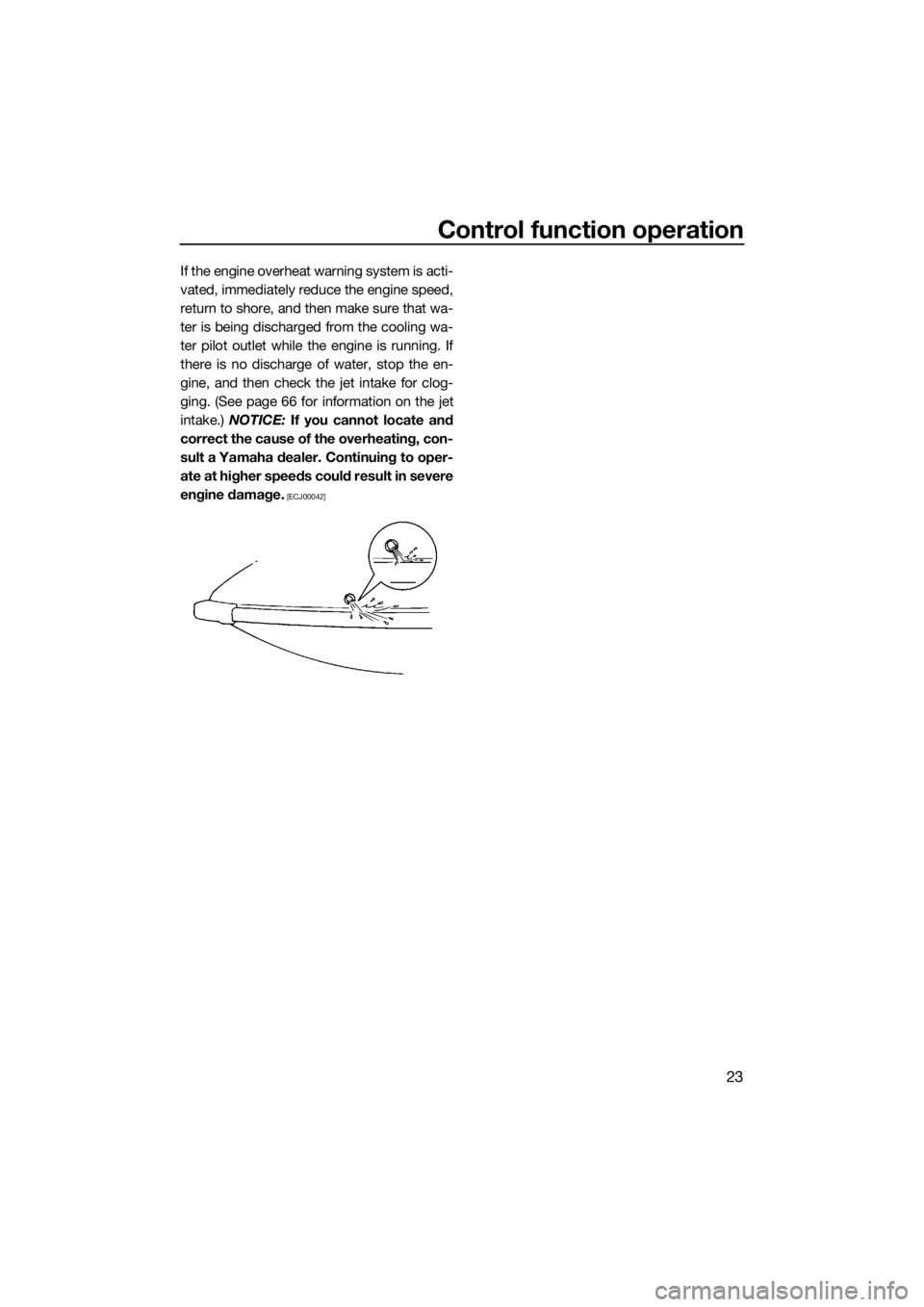
If the engine overheat warning system is acti-
vated, immediately reduce the engine speed,
return to shore, and then make sure that wa-
ter is being discharged from the cooling wa-
ter pilot outlet while the engine is running. If
there is no discharge of water, stop the en-
gine, and then check the jet intake for clog-
ging. (See page 66 for information on the jet
intake.) NOTICE: If you cannot locate and
correct the cause of the overheating, con-
sult a Yamaha dealer. Continuing to oper-
ate at higher speeds could result in severe
engine damage.
[ECJ00042]
UF4D71E0.book Page 23 Thursday, April 23, 2015 1:48 PM
Page 30 of 78
Equipment operation
24
EJU40334
EquipmentEJU31057Hood
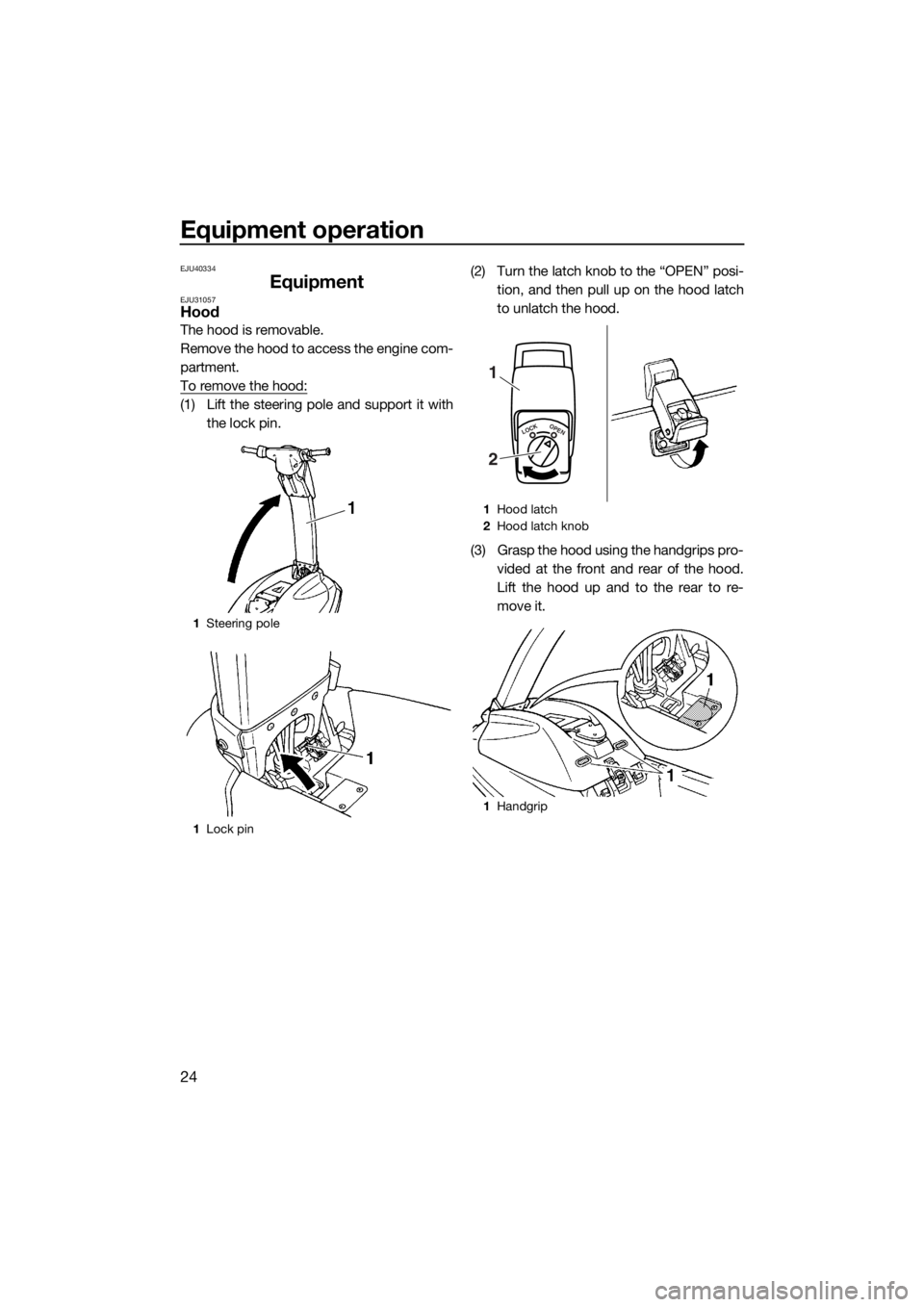
The hood is removable.
Remove the hood to access the engine com-
partment.
To remove the hood:
(1) Lift the steering pole and support it with
the lock pin.(2) Turn the latch knob to the “OPEN” posi-
tion, and then pull up on the hood latch
to unlatch the hood.
(3) Grasp the hood using the handgrips pro-
vided at the front and rear of the hood.
Lift the hood up and to the rear to re-
move it.
1Steering pole
1Lock pin
1Hood latch
2Hood latch knob
1Handgrip
LOCKOPEN
1
2
UF4D71E0.book Page 24 Thursday, April 23, 2015 1:48 PM
Page 34 of 78
Operation and handling requirements
28
EJU31793
Fuel and engine oil
requirements
EJU31834Fuel
WARNING
EWJ00283
Gasoline and gasoline vapors are ex-
tremely flammable. To avoid fires and
explosions and to reduce the risk of in-
jury when refueling, follow these in-
structions.
Gasoline is poisonous and can cause in-
jury or death. Handle gasoline with care.
Never siphon gasoline by mouth. If you
should swallow some gasoline, inhale a
lot of gasoline vapor, or get some gaso-
line in your eyes, see your doctor imme-
diately. If gasoline spills on your skin,
wash with soap and water. If gasoline
spills on your clothing, change your
clothes.
NOTICE
ECJ00322
Do not use leaded gasoline. Leaded
gasoline can seriously damage the en-
gine.
Avoid getting water and contaminants in
the fuel tank. Contaminated fuel can
cause poor performance and engine
damage. Use only fresh gasoline that
has been stored in clean containers.
Gasohol
There are two types of gasohol: gasohol con-
taining ethanol and that containing methanol.Gasohol containing ethanol can be used if
ethanol content does not exceed 10% and
the fuel meets the minimum octane ratings.
E-85 is a fuel blend containing 85% ethanol
and therefore must not be used in this water-
craft. All ethanol blends containing more than
10% ethanol can cause fuel system damage
or engine performance problems.
Yamaha does not recommend gasohol con-
taining methanol because it can cause fuel
system damage and engine performance
problems.
EJU318732-stroke engine oil
If YAMALUBE 2-W engine oil is not available,
another 2-stroke engine oil with an NMMA-
certified TC-W3 rating may be used.
EJU31903Mixing fuel and oil
NOTICE
ECJ00332
Make sure that the gasoline and oil are
thoroughly mixed in the correct ratio, oth-
erwise severe engine damage could re-
sult.
To mix gasoline and engine oil:
(1) Pour 2-stroke engine oil into a clean con-
tainer, and then add gasoline.
Recommended fuel:
Regular unleaded gasoline with a
minimum octane rating of
86
(Pump octane number) = (R + M)/2
90 (Research octane number)
Recommended engine oil:
YAMALUBE 2-W or TC-W3 outboard
motor oil or equivalent
Fuel-to-oil ratios (gasoline to oil)
Break-in period (first two tankfuls):
25:1
After break-in:
50 :1
UF4D71E0.book Page 28 Thursday, April 23, 2015 1:48 PM
Page 35 of 78
Operation and handling requirements
29
(2) To mix them thoroughly, shake the con-
tainer from side to side.
EJU31917Filling the fuel tank
To fill the fuel tank:
(1) Before refueling, stop the engine. Do not
stand or sit on the watercraft. Never refu-
el while smoking, or while in the vicinity
of sparks, open flames, or other sources
of ignition.
(2) Place the watercraft in a well-ventilated
area and in a horizontal position.
(3) Remove the hood, and then check the
fuel level. (See page 24 for hood removal
and installation procedures.)
(4) Loosen the fuel filler cap and remove it.
(5) Slowly add fuel to the fuel tank.(6) Stop filling when the fuel level just reach-
es the bottom of the filler tube. Do not fill
up the filler tube. Because fuel expands
when it heats up, heat from the engine or
the sun can cause fuel to spill out of the
fuel tank. Do not leave the watercraft
with a full tank in direct sunlight.
(7) Wipe up any spilled fuel immediately with
a dry cloth.
(8) Securely install the fuel filler cap by tight-
ening it until it stops.
(9) Securely install the hood in its original
position.
12-stroke engine oil
2Gasoline
1Fuel filler cap
Fuel tank capacity:
To t a l :
18 L (4.8 US gal, 4.0 Imp.gal)
Reserve:
5.5 L (1.5 US gal, 1.2 Imp.gal)
UF4D71E0.book Page 29 Thursday, April 23, 2015 1:48 PM
Page 36 of 78
Operation and handling requirements
30
EJU40022
Draining the bilge water
NOTICE
ECJ01302
Do not run the engine at full throttle when
bilge water remains in the engine com-
partment. The bilge water can splash into
the engine, which can result in severe
damage.
EJU40922Draining the bilge water on water
A small quantity of bilge water will remain in
the engine compartment even after the bilge
water is drained on water. To completely re-
move the bilge water, remove the watercraft
from the water and wipe up any remaining
moisture in the engine compartment with a
dry cloth.
Jet vacuum bilge draining system
While the watercraft is operating, bilge water
in the engine compartment is drawn in by the
vacuum that is generated in the jet pump and
discharged from the watercraft through the
jet thrust nozzle.
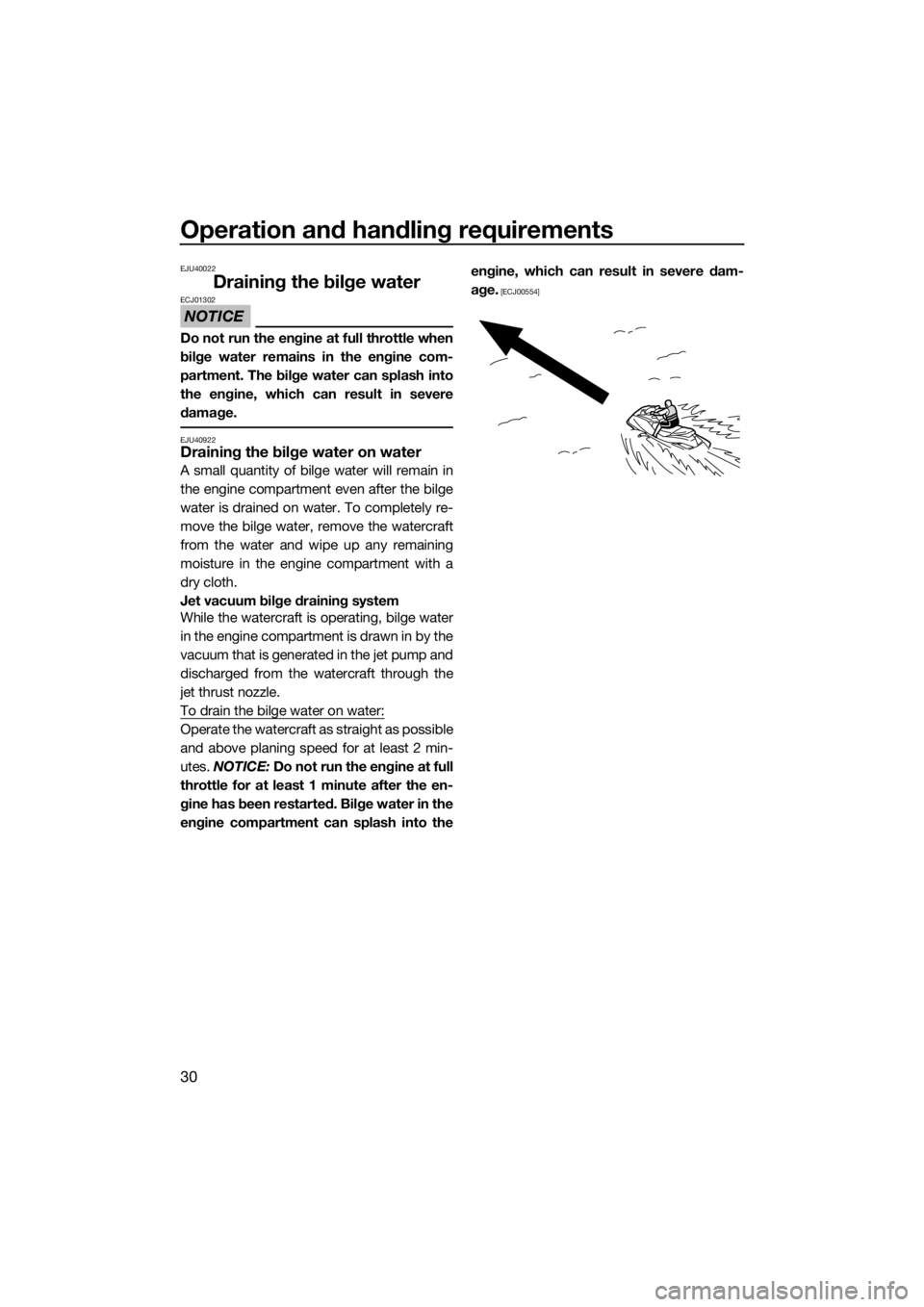
To drain the bilge water on water:
Operate the watercraft as straight as possible
and above planing speed for at least 2 min-
utes. NOTICE: Do not run the engine at full
throttle for at least 1 minute after the en-
gine has been restarted. Bilge water in the
engine compartment can splash into theengine, which can result in severe dam-
age.
[ECJ00554]
UF4D71E0.book Page 30 Thursday, April 23, 2015 1:48 PM
Page 37 of 78
Operation and handling requirements
31
EJU33424
Transporting
WARNING
EWJ00751
Always turn the fuel cock knob to “OFF”
when transporting the watercraft, other-
wise fuel could leak out into the engine or
engine compartment, which would create
a fire hazard.
When transporting the watercraft on a trailer,
secure the bow rope hole and stern of the
watercraft to the trailer with ropes or tie
downs. Use a rubber shock cord to secure
the steering pole to the watercraft. NOTICE:
Do not secure the steering pole with ropes
or tie downs and do not secure it to the
trailer. Also, do not transport the water-
craft with the steering pole up. Otherwise,
the steering pole could be damaged. Wrap
the ropes or tie downs with towels or ragswhere they touch the body of the water-
craft to avoid scratches or damage.
[ECJ00633]
1Rubber shock cord
2Tie down
UF4D71E0.book Page 31 Thursday, April 23, 2015 1:48 PM
Page 38 of 78

First-time operation
32
EJU32757
Engine break-in
NOTICE
ECJ00432
Failure to perform the engine break-in
could result in reduced engine life or even
severe engine damage.
The engine break-in is essential to allow the
various components of the engine to wear
and polish themselves to the correct operat-
ing clearances. This ensures proper perfor-
mance and promotes longer component life.
To perform the engine break-in:
(1) Fill the fuel tank with fuel in a fuel-to-oil
ratio of 25:1. (See page 28 “Mixing fuel
and oil” and “Filling the fuel tank” for in-
formation on filling the fuel tank.)
(2) Launch the watercraft and start the en-
gine. (See page 41 for information on
starting the engine.)
(3) For the first 5 minutes, operate with the
engine at idling speed.
(4) For the first tankful of fuel, squeeze the
throttle lever slowly and operate at 3/4
throttle or less.
(5) Fill the fuel tank once more with fuel in a
fuel-to-oil ratio of 25:1, and then operate
with the engine at any speed.
After the engine break-in is complete, fill the
fuel tank with fuel in a fuel-to-oil ratio of 50:1.
The watercraft can be operated normally.
UF4D71E0.book Page 32 Thursday, April 23, 2015 1:48 PM