warning YAMAHA SUPERJET 2017 Owner's Manual
[x] Cancel search | Manufacturer: YAMAHA, Model Year: 2017, Model line: SUPERJET, Model: YAMAHA SUPERJET 2017Pages: 78, PDF Size: 2.66 MB
Page 56 of 78
Care and storage
50
EJU41192
Post-operation care
WARNING
EWJ00321
Always turn the fuel cock knob to “OFF”
when storing the watercraft, otherwise
fuel could leak out into the engine or en-
gine compartment, which would create a
fire hazard.
After using the watercraft, always take it out
of the water, clean it, and store it. Leaving the
watercraft in the water for extended periods
will accelerate the rate of normal deteriora-
tion of the jet pump and hull. Marine organ-
isms and corrosion are some of the
conditions that can shorten the life of many
watercraft components.
EJU3351AFlushing the cooling water passages
NOTICE
ECJ01361
Do not run the engine for more than 15
seconds on land without supplying water,
otherwise the engine could overheat.
Flush the cooling water passages to prevent
them from clogging with salt, sand, or dirt.
(1) Place the watercraft in a horizontal posi-
tion.
(2) Remove the hood. (See page 24 for hood
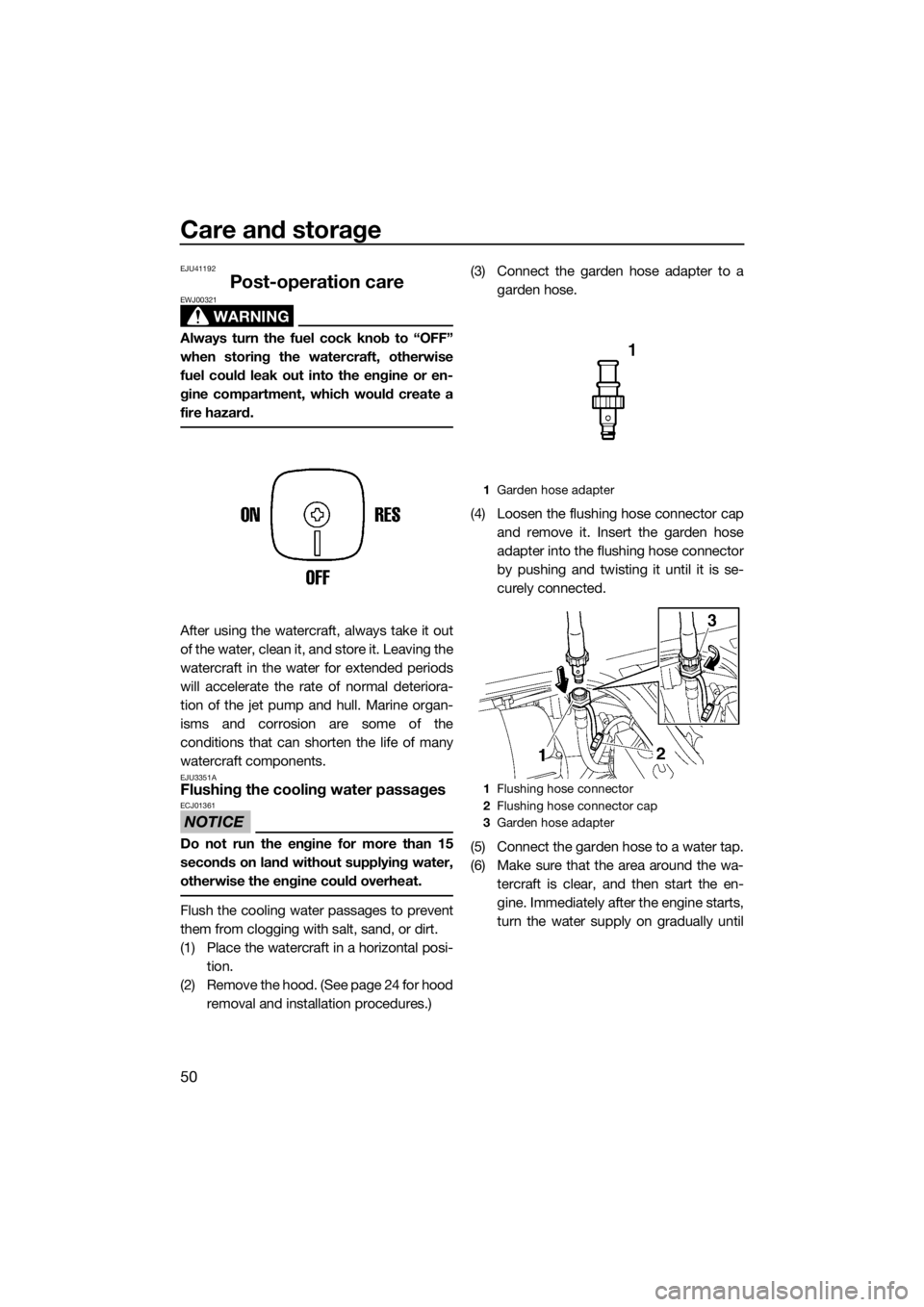
removal and installation procedures.)(3) Connect the garden hose adapter to a
garden hose.
(4) Loosen the flushing hose connector cap
and remove it. Insert the garden hose
adapter into the flushing hose connector
by pushing and twisting it until it is se-
curely connected.
(5) Connect the garden hose to a water tap.
(6) Make sure that the area around the wa-
tercraft is clear, and then start the en-
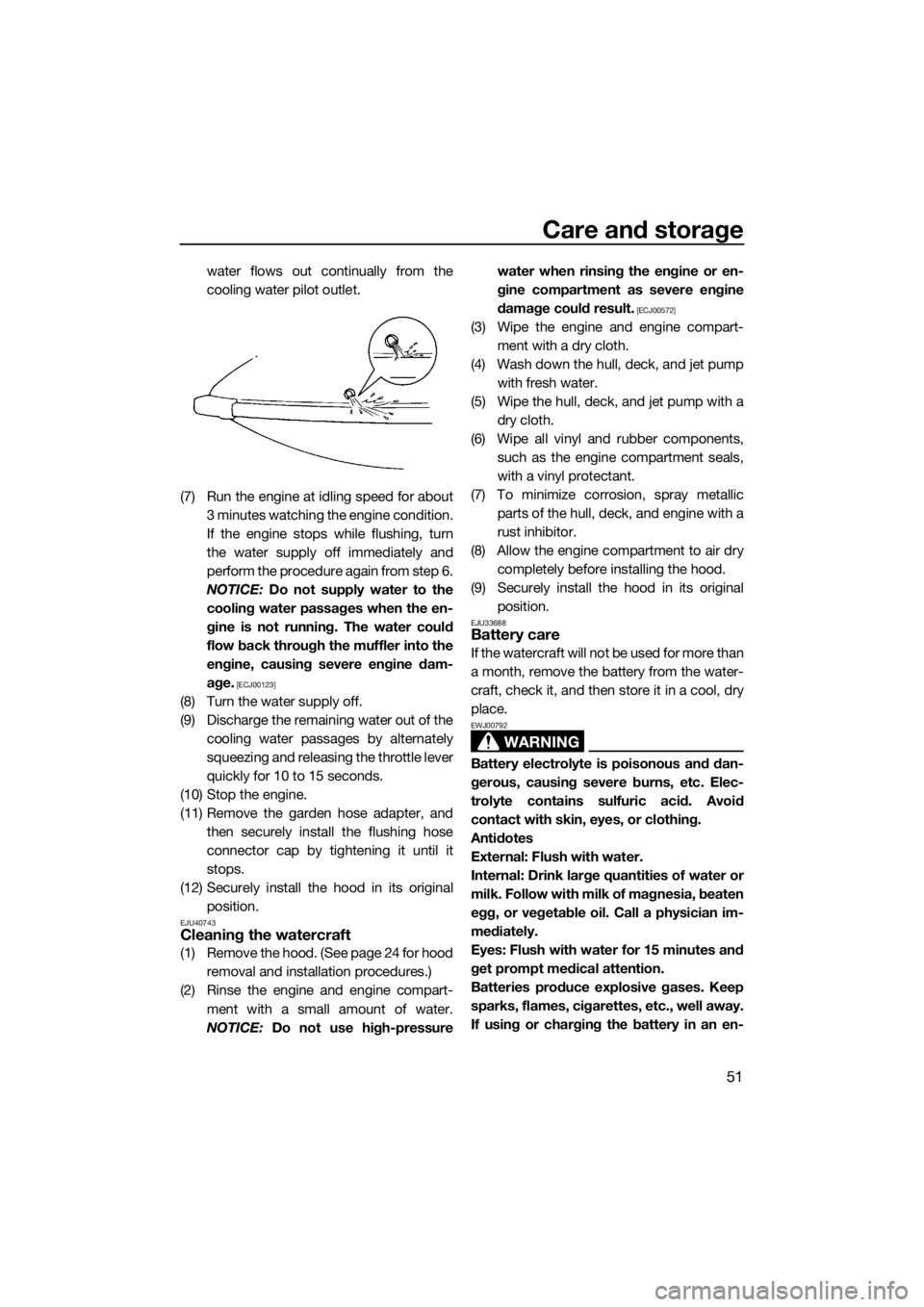
gine. Immediately after the engine starts,
turn the water supply on gradually until
1Garden hose adapter
1Flushing hose connector
2Flushing hose connector cap
3Garden hose adapter
UF4D73E0.book Page 50 Wednesday, March 23, 2016 11:40 AM
Page 57 of 78
Care and storage
51
water flows out continually from the
cooling water pilot outlet.
(7) Run the engine at idling speed for about
3 minutes watching the engine condition.
If the engine stops while flushing, turn
the water supply off immediately and
perform the procedure again from step 6.
NOTICE: Do not supply water to the
cooling water passages when the en-
gine is not running. The water could
flow back through the muffler into the
engine, causing severe engine dam-
age.
[ECJ00123]
(8) Turn the water supply off.
(9) Discharge the remaining water out of the
cooling water passages by alternately
squeezing and releasing the throttle lever
quickly for 10 to 15 seconds.
(10) Stop the engine.
(11) Remove the garden hose adapter, and
then securely install the flushing hose
connector cap by tightening it until it
stops.
(12) Securely install the hood in its original
position.
EJU40743Cleaning the watercraft
(1) Remove the hood. (See page 24 for hood
removal and installation procedures.)
(2) Rinse the engine and engine compart-
ment with a small amount of water.
NOTICE: Do not use high-pressurewater when rinsing the engine or en-
gine compartment as severe engine
damage could result.
[ECJ00572]
(3) Wipe the engine and engine compart-
ment with a dry cloth.
(4) Wash down the hull, deck, and jet pump
with fresh water.
(5) Wipe the hull, deck, and jet pump with a
dry cloth.
(6) Wipe all vinyl and rubber components,
such as the engine compartment seals,
with a vinyl protectant.
(7) To minimize corrosion, spray metallic
parts of the hull, deck, and engine with a
rust inhibitor.
(8) Allow the engine compartment to air dry
completely before installing the hood.
(9) Securely install the hood in its original
position.
EJU33688Battery care
If the watercraft will not be used for more than
a month, remove the battery from the water-
craft, check it, and then store it in a cool, dry
place.
WARNING
EWJ00792
Battery electrolyte is poisonous and dan-
gerous, causing severe burns, etc. Elec-
trolyte contains sulfuric acid. Avoid
contact with skin, eyes, or clothing.
Antidotes
External: Flush with water.
Internal: Drink large quantities of water or
milk. Follow with milk of magnesia, beaten
egg, or vegetable oil. Call a physician im-
mediately.
Eyes: Flush with water for 15 minutes and
get prompt medical attention.
Batteries produce explosive gases. Keep
sparks, flames, cigarettes, etc., well away.
If using or charging the battery in an en-
UF4D73E0.book Page 51 Wednesday, March 23, 2016 11:40 AM
Page 59 of 78
Care and storage
53
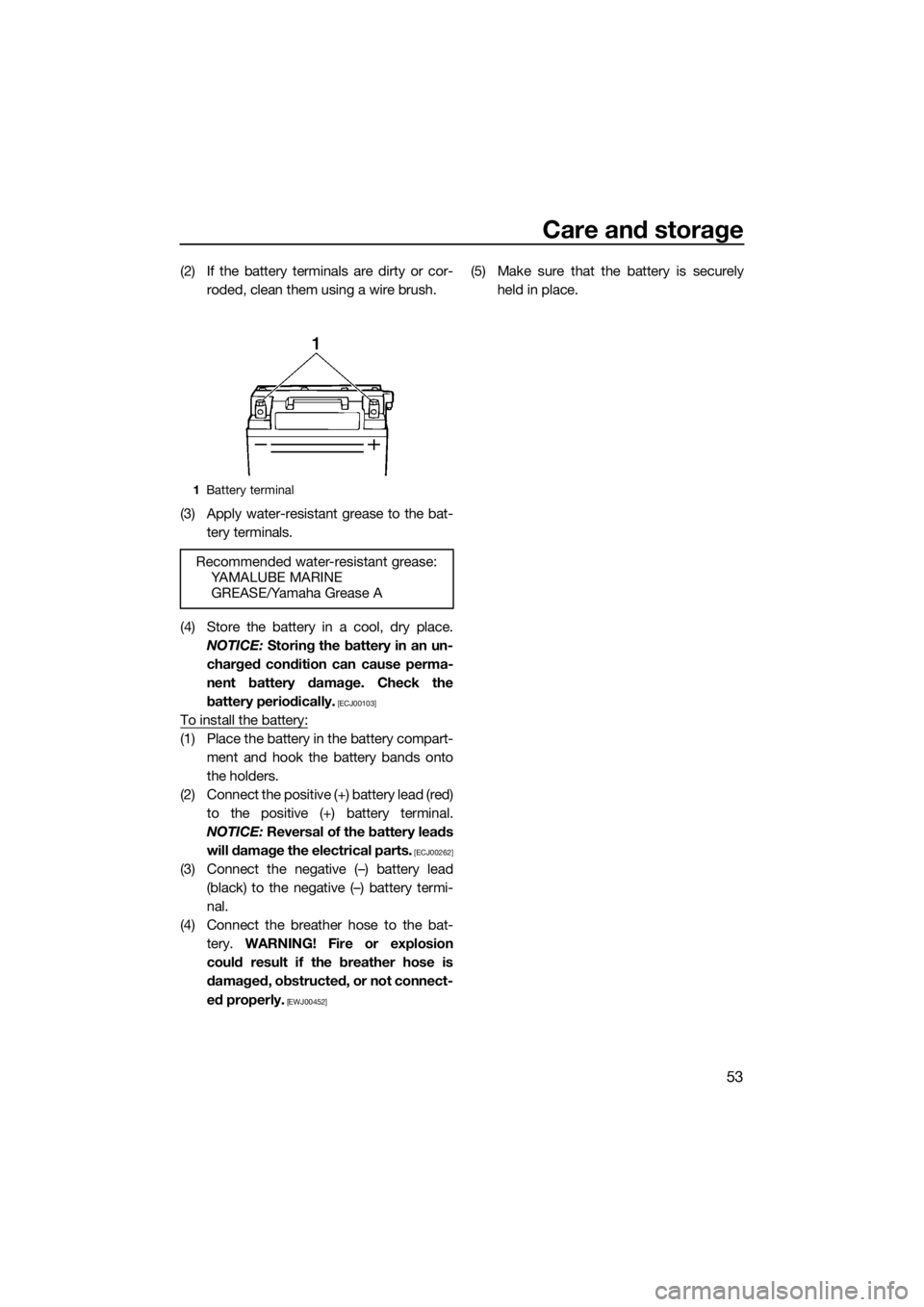
(2) If the battery terminals are dirty or cor-
roded, clean them using a wire brush.
(3) Apply water-resistant grease to the bat-
tery terminals.
(4) Store the battery in a cool, dry place.
NOTICE: Storing the battery in an un-
charged condition can cause perma-
nent battery damage. Check the
battery periodically.
[ECJ00103]
To install the battery:
(1) Place the battery in the battery compart-
ment and hook the battery bands onto
the holders.
(2) Connect the positive (+) battery lead (red)
to the positive (+) battery terminal.
NOTICE: Reversal of the battery leads
will damage the electrical parts.
[ECJ00262]
(3) Connect the negative (–) battery lead
(black) to the negative (–) battery termi-
nal.
(4) Connect the breather hose to the bat-
tery. WARNING! Fire or explosion
could result if the breather hose is
damaged, obstructed, or not connect-
ed properly.
[EWJ00452]
(5) Make sure that the battery is securely
held in place.
1Battery terminal
Recommended water-resistant grease:
YAMALUBE MARINE
GREASE/Yamaha Grease A
UF4D73E0.book Page 53 Wednesday, March 23, 2016 11:40 AM
Page 60 of 78
Care and storage
54
EJU33484
Long-term storage
WARNING
EWJ00321
Always turn the fuel cock knob to “OFF”
when storing the watercraft, otherwise
fuel could leak out into the engine or en-
gine compartment, which would create a
fire hazard.
Storage for long periods of time, such as win-
ter storage, requires preventive maintenance
to ensure against deterioration. It is advisable
to have the watercraft serviced by a Yamaha
dealer prior to storage.
However, the following procedures can be
performed easily by the owner.
EJU40763Cleaning
(1) Flush the cooling water passages. (See
page 50 for information on flushing the
cooling water passages.)
TIP:
If you will be storing the watercraft for a pro-
longed period, such as winter storage, top off
the fuel tank with fresh gasoline and add fuel
stabilizer and conditioner to the fuel tank ac-
cording to the manufacturer’s instruction be-
fore starting the engine.
(2) Clean the watercraft. (See page 51 for in-
formation on cleaning the watercraft.)
Wax the hull with a non-abrasive wax.
EJU40795Lubrication
Use a suitable marine grease applicator and
spray a rust inhibitor between the inner and
outer cables to lubricate the cables and
purge out any dirt and moisture.
To keep moving parts sliding or rotating
smoothly, lubricate them with water-resistant
grease.
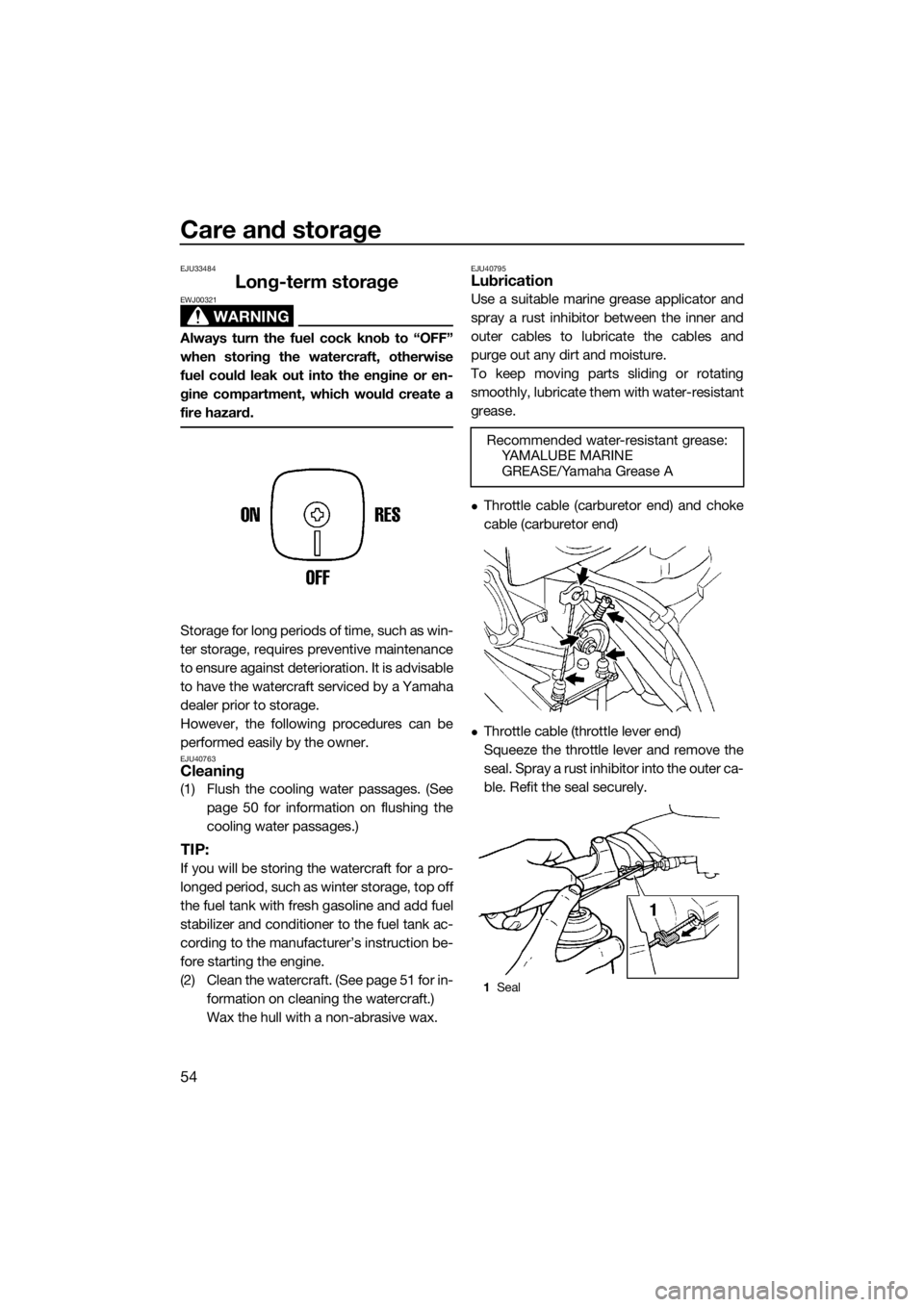
Throttle cable (carburetor end) and choke
cable (carburetor end)
Throttle cable (throttle lever end)
Squeeze the throttle lever and remove the
seal. Spray a rust inhibitor into the outer ca-
ble. Refit the seal securely.
Recommended water-resistant grease:
YAMALUBE MARINE
GREASE/Yamaha Grease A
1Seal
UF4D73E0.book Page 54 Wednesday, March 23, 2016 11:40 AM
Page 61 of 78
Care and storage
55
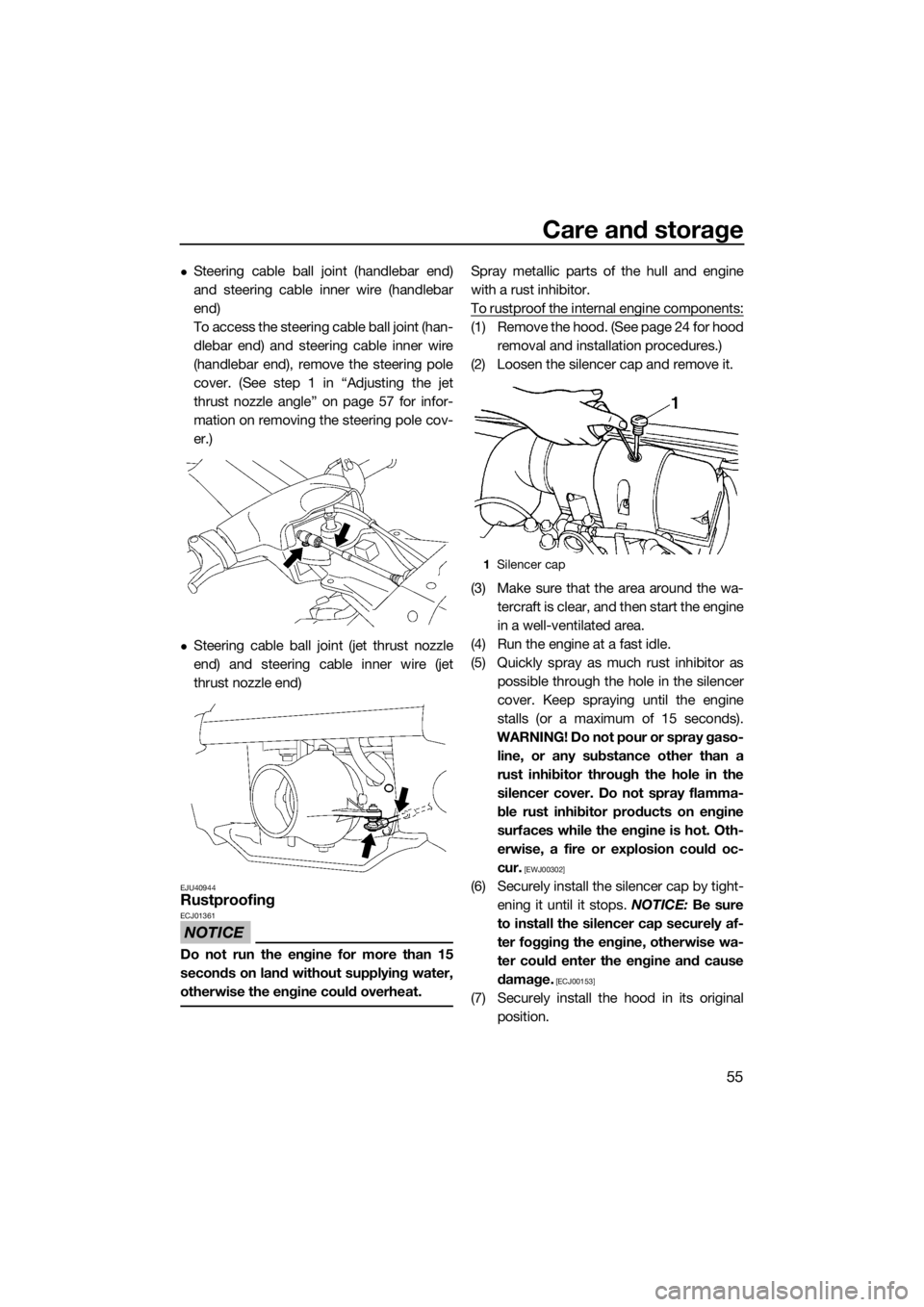
Steering cable ball joint (handlebar end)
and steering cable inner wire (handlebar
end)
To access the steering cable ball joint (han-
dlebar end) and steering cable inner wire
(handlebar end), remove the steering pole
cover. (See step 1 in “Adjusting the jet
thrust nozzle angle” on page 57 for infor-
mation on removing the steering pole cov-
er.)
Steering cable ball joint (jet thrust nozzle
end) and steering cable inner wire (jet
thrust nozzle end)
EJU40944Rustproofing
NOTICE
ECJ01361
Do not run the engine for more than 15
seconds on land without supplying water,
otherwise the engine could overheat.
Spray metallic parts of the hull and engine
with a rust inhibitor.
To rustproof the internal engine components:
(1) Remove the hood. (See page 24 for hood
removal and installation procedures.)
(2) Loosen the silencer cap and remove it.
(3) Make sure that the area around the wa-
tercraft is clear, and then start the engine
in a well-ventilated area.
(4) Run the engine at a fast idle.
(5) Quickly spray as much rust inhibitor as
possible through the hole in the silencer
cover. Keep spraying until the engine
stalls (or a maximum of 15 seconds).
WARNING! Do not pour or spray gaso-
line, or any substance other than a
rust inhibitor through the hole in the
silencer cover. Do not spray flamma-
ble rust inhibitor products on engine
surfaces while the engine is hot. Oth-
erwise, a fire or explosion could oc-
cur.
[EWJ00302]
(6) Securely install the silencer cap by tight-
ening it until it stops. NOTICE: Be sure
to install the silencer cap securely af-
ter fogging the engine, otherwise wa-
ter could enter the engine and cause
damage.
[ECJ00153]
(7) Securely install the hood in its original
position.
1Silencer cap
UF4D73E0.book Page 55 Wednesday, March 23, 2016 11:40 AM
Page 62 of 78
Maintenance
56
EJU33769
Maintenance
Periodic checks and lubrication will keep
your watercraft in the safest and most effi-
cient condition possible. Therefore, make
sure to carry out the periodic maintenance.
Safety is an obligation of the watercraft own-
er. Proper maintenance must be carried out
to keep the exhaust emission and sound lev-
els within the regulated limits. The most im-
portant points of watercraft inspection and
lubrication are explained on the following pa-
ges.
See a Yamaha dealer for genuine Yamaha re-
placement parts and optional accessories
designed for your watercraft.
Remember, failures that are the result of the
installation of parts or accessories which are
not qualitatively equivalent to genuine
Yamaha parts are not covered by the limited
warranty.
Maintenance, replacement, or repair of
the emission control devices and system
may be performed by any marine SI engine
repair establishment or individual. War-
ranty repair, however, must be performed
at an authorized Yamaha marine dealer-
ship.
WARNING
EWJ00312
Be sure to turn off the engine when you
perform maintenance unless otherwise
specified. If you are not familiar with ma-
chine servicing, this work should be done
by a Yamaha dealer or other qualified me-
chanic.
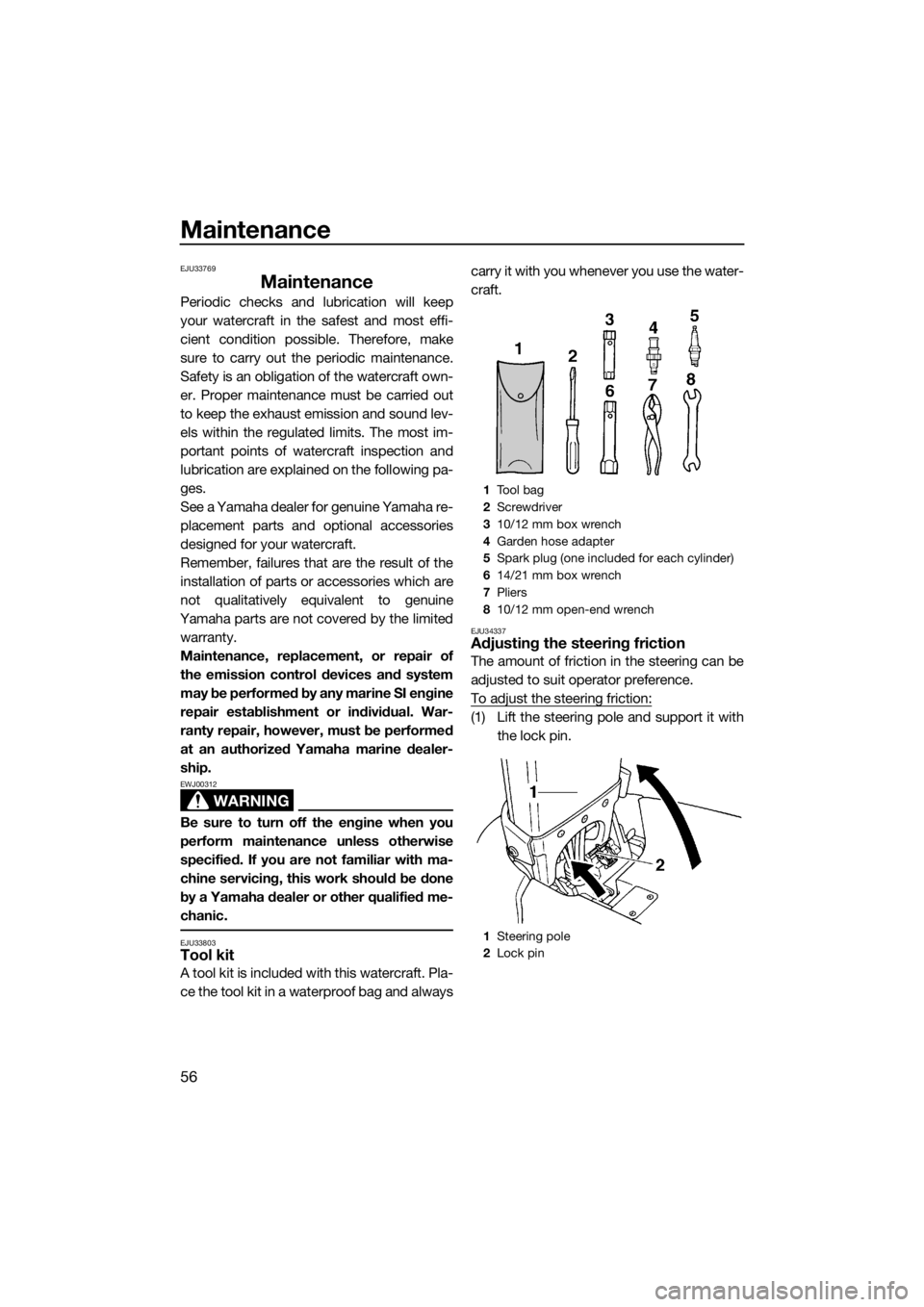
EJU33803Tool kit
A tool kit is included with this watercraft. Pla-
ce the tool kit in a waterproof bag and alwayscarry it with you whenever you use the water-
craft.
EJU34337Adjusting the steering friction
The amount of friction in the steering can be
adjusted to suit operator preference.
To adjust the steering friction:
(1) Lift the steering pole and support it with
the lock pin.
1Tool bag
2Screwdriver
310/12 mm box wrench
4Garden hose adapter
5Spark plug (one included for each cylinder)
614/21 mm box wrench
7Pliers
810/12 mm open-end wrench
1Steering pole
2Lock pin
UF4D73E0.book Page 56 Wednesday, March 23, 2016 11:40 AM
Page 66 of 78
Maintenance
60
EJU3437AChecking the spark plugs
WARNING
EWJ00351
Be careful not to damage the insulator
when removing or installing a spark plug.
A damaged insulator could allow sparks to
escape, which could result in a fire or ex-
plosion.
Remove and check the condition of the spark
plugs.
The condition of a spark plug can indicate
something about the condition of the engine.
For example, if the center electrode portion is
very white, this could indicate an intake air
leak or carburetion problem in that cylinder.
Do not attempt to diagnose any problems
yourself. Have a Yamaha dealer service the
watercraft.
To remove a spark plug:
(1) Remove the hood. (See page 24 for hood
removal and installation procedures.)
(2) Remove the spark plug cap.
(3) Remove the spark plug, and then check
the condition of the spark plug and the
spark plug gap. If the electrode portion is
significantly discolored, if electrode ero-
sion becomes excessive, if carbon and
other deposits are excessive, or if the
spark plug gap is not within the specified
range, replace the spark plug.
TIP:
When the engine is operating normally, the
color of the spark plug electrode portion will
be a medium-to-light tan.
To install a spark plug:
(1) Wipe off any dirt from the threads, insu-
lator, and gasket surface of the spark
plug.
(2) Install the spark plug, and then tighten it
to the specified torque.
TIP:
If a torque-wrench is not available when you
are reinstalling a spark plug, a good estimate
of the correct torque is 1/12 turn past finger-
tight. When you are installing a new spark
plug, a good estimate of the correct torque is
1/2 to 2/3 turn past finger-tight.
(3) Wipe off any water or dirt inside the
spark plug cap.
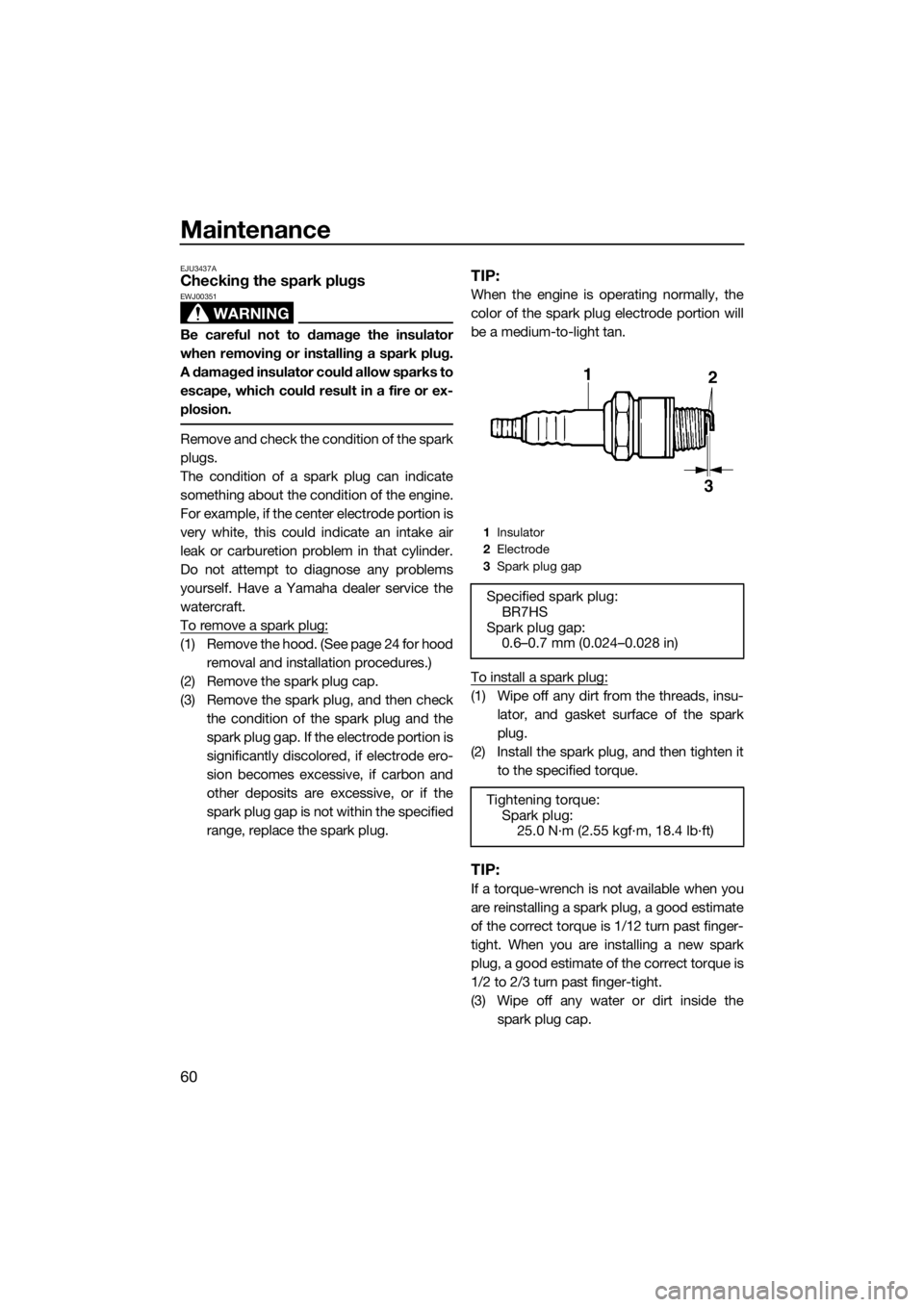
1Insulator
2Electrode
3Spark plug gap
Specified spark plug:
BR7HS
Spark plug gap:
0.6–0.7 mm (0.024–0.028 in)
Tightening torque:
Spark plug:
25.0 N·m (2.55 kgf·m, 18.4 lb·ft)
UF4D73E0.book Page 60 Wednesday, March 23, 2016 11:40 AM
Page 72 of 78
Trouble recovery
66
EJU34625
Emergency proceduresEJU34635Cleaning the jet intake and impeller
WARNING
EWJ00783
Before attempting to remove weeds or de-
bris from the jet intake or impeller area,
shut the engine off and remove the clip
from the engine shut-off switch. Severe in-
jury or death could result from coming in
contact with the rotating parts of the jet
pump.
If weeds or debris gets caught in the jet intake
or impeller, cavitation can occur, causing jet
thrust to decrease even though engine speed
rises. If this condition is allowed to continue,
the engine will overheat and may seize.
NOTICE: If weeds or debris gets caught in
the jet intake, do not operate the water-
craft above trolling speed until they have
been removed.
[ECJ00654]
If there is any sign that the jet intake or impel-
ler is clogged with weeds or debris, return to
shore and check the intake and impeller. Al-ways stop the engine before beaching the
watercraft.
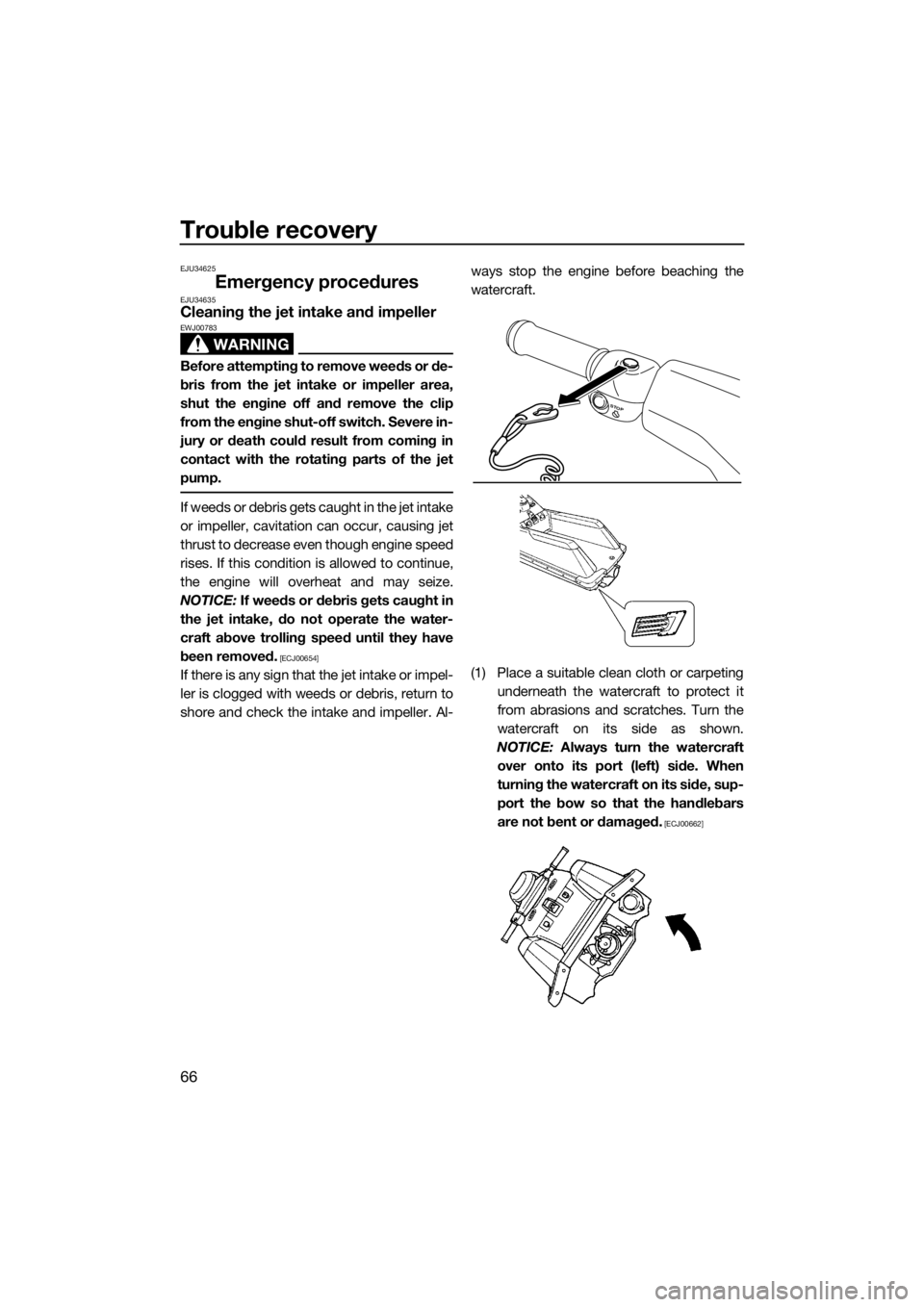
(1) Place a suitable clean cloth or carpeting
underneath the watercraft to protect it
from abrasions and scratches. Turn the
watercraft on its side as shown.
NOTICE: Always turn the watercraft
over onto its port (left) side. When
turning the watercraft on its side, sup-
port the bow so that the handlebars
are not bent or damaged.
[ECJ00662]
STOP
UF4D73E0.book Page 66 Wednesday, March 23, 2016 11:40 AM
Page 73 of 78
Trouble recovery
67
(2) Remove any weeds or debris from
around the jet intake, drive shaft, impel-
ler, jet pump housing, and jet thrust noz-
zle.
If debris is difficult to remove, consult a
Yamaha dealer.
EJU34642Jumping the battery
If the watercraft battery has run down, the en-
gine can be started using a 12-volt booster
battery and jumper cables.
EJU34654Connecting the jumper cables
WARNING
EWJ01251
To avoid battery explosion and serious
damage to the electrical system:
Do not reverse the polarity of the jumper
cables when connecting to the batter-
ies.
Do not connect the negative (–) jumper
cable to the negative (–) terminal of the
watercraft battery.
Do not touch the positive (+) jumper ca-
ble to the negative (–) jumper cable.
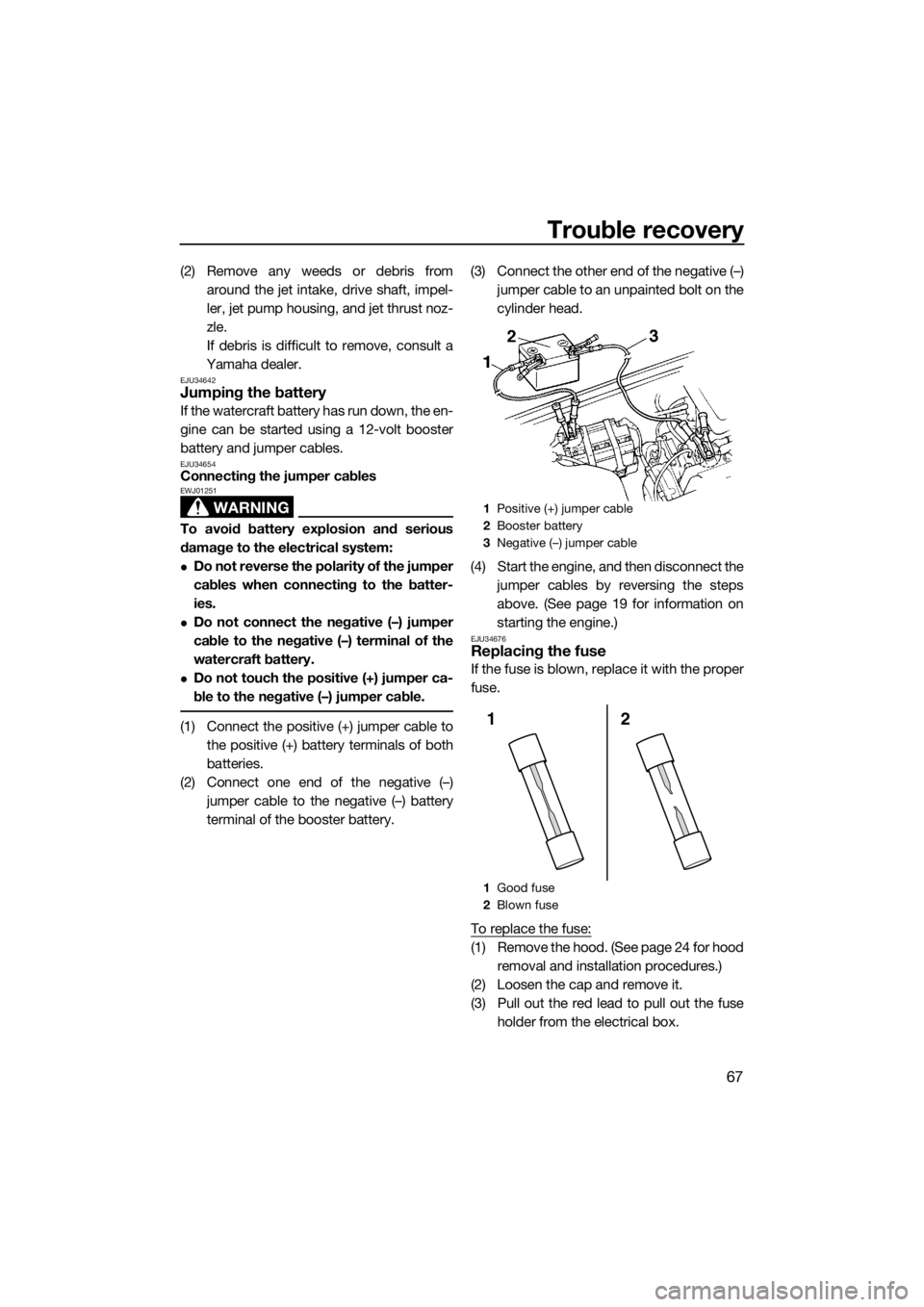
(1) Connect the positive (+) jumper cable to
the positive (+) battery terminals of both
batteries.
(2) Connect one end of the negative (–)
jumper cable to the negative (–) battery
terminal of the booster battery.(3) Connect the other end of the negative (–)
jumper cable to an unpainted bolt on the
cylinder head.
(4) Start the engine, and then disconnect the
jumper cables by reversing the steps
above. (See page 19 for information on
starting the engine.)
EJU34676Replacing the fuse
If the fuse is blown, replace it with the proper
fuse.
To replace the fuse:
(1) Remove the hood. (See page 24 for hood
removal and installation procedures.)
(2) Loosen the cap and remove it.
(3) Pull out the red lead to pull out the fuse
holder from the electrical box.
1Positive (+) jumper cable
2Booster battery
3Negative (–) jumper cable
1Good fuse
2Blown fuse
2 1
UF4D73E0.book Page 67 Wednesday, March 23, 2016 11:40 AM
Page 74 of 78
Trouble recovery
68
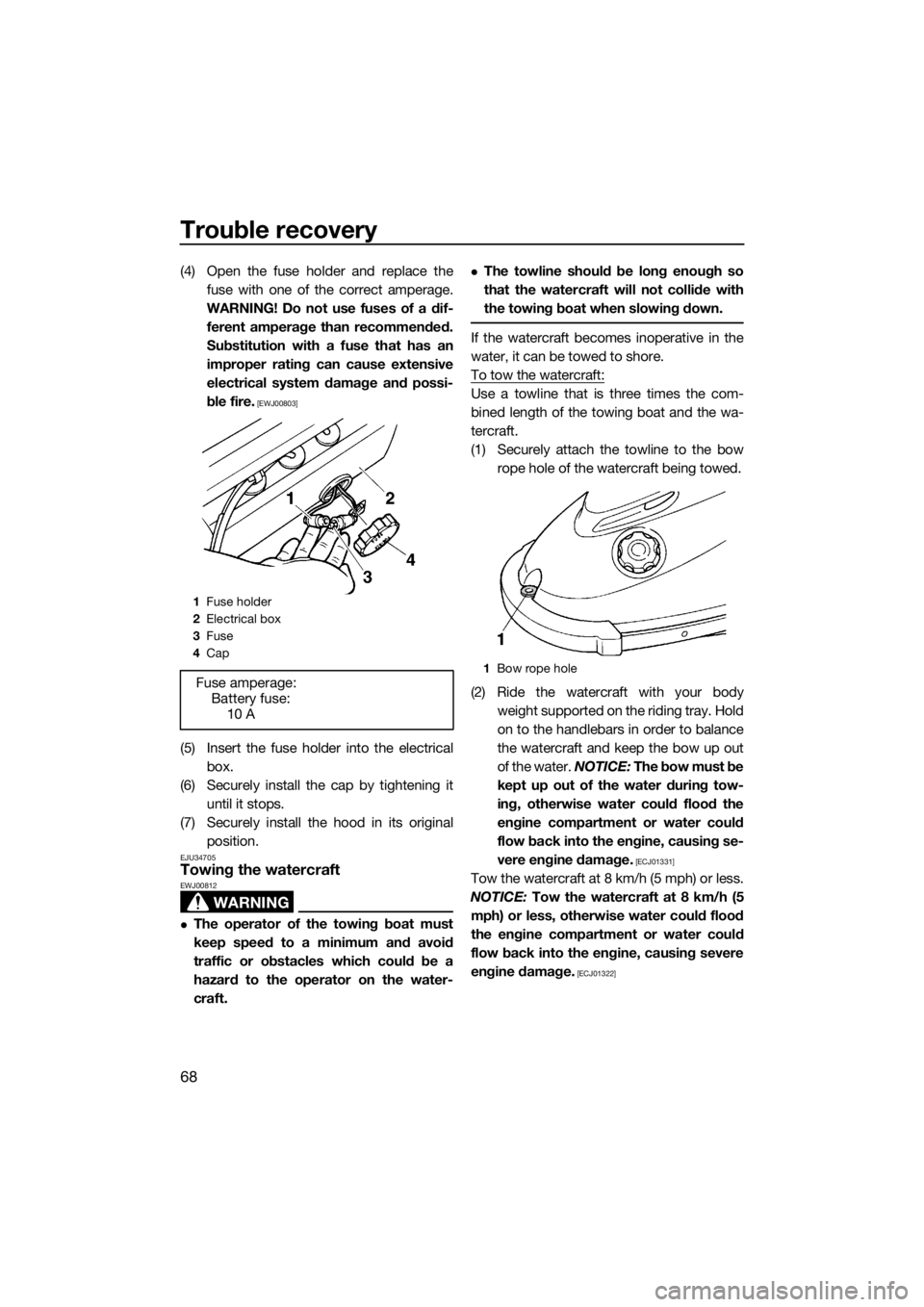
(4) Open the fuse holder and replace the
fuse with one of the correct amperage.
WARNING! Do not use fuses of a dif-
ferent amperage than recommended.
Substitution with a fuse that has an
improper rating can cause extensive
electrical system damage and possi-
ble fire.
[EWJ00803]
(5) Insert the fuse holder into the electrical
box.
(6) Securely install the cap by tightening it
until it stops.
(7) Securely install the hood in its original
position.
EJU34705Towing the watercraft
WARNING
EWJ00812
The operator of the towing boat must
keep speed to a minimum and avoid
traffic or obstacles which could be a
hazard to the operator on the water-
craft.
The towline should be long enough so
that the watercraft will not collide with
the towing boat when slowing down.
If the watercraft becomes inoperative in the
water, it can be towed to shore.
To tow the watercraft:
Use a towline that is three times the com-
bined length of the towing boat and the wa-
tercraft.
(1) Securely attach the towline to the bow
rope hole of the watercraft being towed.
(2) Ride the watercraft with your body
weight supported on the riding tray. Hold
on to the handlebars in order to balance
the watercraft and keep the bow up out
of the water. NOTICE: The bow must be
kept up out of the water during tow-
ing, otherwise water could flood the
engine compartment or water could
flow back into the engine, causing se-
vere engine damage.
[ECJ01331]
Tow the watercraft at 8 km/h (5 mph) or less.
NOTICE: Tow the watercraft at 8 km/h (5
mph) or less, otherwise water could flood
the engine compartment or water could
flow back into the engine, causing severe
engine damage.
[ECJ01322]
1Fuse holder
2Electrical box
3Fuse
4Cap
Fuse amperage:
Battery fuse:
10 A1Bow rope hole
UF4D73E0.book Page 68 Wednesday, March 23, 2016 11:40 AM