bilge YAMAHA SUPERJET 2017 Owners Manual
[x] Cancel search | Manufacturer: YAMAHA, Model Year: 2017, Model line: SUPERJET, Model: YAMAHA SUPERJET 2017Pages: 78, PDF Size: 2.66 MB
Page 5 of 78

Table of contents
General and important labels ........... 1
Identification numbers .................... 1
Primary Identification (PRI-ID)
number............................................ 1
Craft Identification Number (CIN) ....... 1
Engine serial number.......................... 1
Manufactured date label .................... 2
Important labels .............................. 3
Warning labels.................................... 4
Other labels ........................................ 7
Safety information ............................. 8
Limitations on who may operate
the watercraft ............................... 8
Cruising limitations .......................... 9
Operation requirements ................ 10
Recommended equipment ........... 12
Hazard information........................ 13
Watercraft characteristics ............. 13
Safe boating rules ......................... 14
Enjoy your watercraft
responsibly ................................. 15
Description....................................... 16
Watercraft glossary ....................... 16
Location of main components ...... 17
Control function operation ............. 19
Watercraft control functions ......... 19
Engine stop switch .......................... 19
Engine shut-off switch .................... 19
Start switch ..................................... 19
Throttle lever .................................... 20
Steering system ............................... 20
Steering pole .................................... 20
Fuel cock knob................................. 21
Choke knob ..................................... 21
Cooling water pilot outlet ................. 21
Water separator................................ 22
Engine overheat warning system ..... 22
Equipment operation ...................... 24
Equipment..................................... 24
Hood................................................. 24
Bow rope hole .................................. 25
Stern rope hole ................................. 25
Storage pouch .................................. 25
Fire extinguisher container ............... 26
Operation and handling
requirements ................................... 28
Fuel and engine oil
requirements .............................. 28
Fuel................................................... 28
2-stroke engine oil ............................ 28
Mixing fuel and oil ............................ 28
Filling the fuel tank ........................... 29
Draining the bilge water ................ 30
Draining the bilge water on water .... 30
Transporting.................................. 31
First-time operation ........................ 32
Engine break-in............................. 32
Pre-operation checks ..................... 33
Pre-operation checklist .................... 33
Pre-operation check points .......... 35
Pre-launch checks ........................... 35
Post-launch checks.......................... 39
Operation ......................................... 40
Operating your watercraft ............. 40
Getting to know your watercraft....... 40
Learning to operate your
watercraft ...................................... 40
Operating positions .......................... 40
Launching the watercraft ................. 41
Starting the engine on water ............ 41
Stopping the engine ......................... 43
Leaving the watercraft ...................... 43
Operating the watercraft .................. 43
Turning the watercraft ...................... 43
Stopping the watercraft.................... 45
Starting off........................................ 45
UF4D73E0.book Page 1 Wednesday, March 23, 2016 11:40 AM
Page 22 of 78

Description
16
EJU40653
Watercraft glossary
Trolling speed
“Trolling” is the lowest maneuvering speed. You are applying little or no throttle. The water-
craft is down in the water, and there is no wake.
Sub-planing speed
“Sub-planing” is a medium speed. The bow of the watercraft is slightly up from the water sur-
face, but you are still traveling through the water. There is a wake.
Planing speed
“Planing” is a faster speed. The watercraft is more level and is skimming on top of the water.
There is a wake.
Bow
The front end of the watercraft.
Stern
The rear end of the watercraft.
Starboard
The right side of the watercraft when facing forward.
Port
The left side of the watercraft when facing forward.
Bilge water
Water that has collected in the engine compartment.
UF4D73E0.book Page 16 Wednesday, March 23, 2016 11:40 AM
Page 36 of 78
Operation and handling requirements
30
EJU40022
Draining the bilge water
NOTICE
ECJ01302
Do not run the engine at full throttle when
bilge water remains in the engine com-
partment. The bilge water can splash into
the engine, which can result in severe
damage.
EJU40922Draining the bilge water on water
A small quantity of bilge water will remain in
the engine compartment even after the bilge
water is drained on water. To completely re-
move the bilge water, remove the watercraft
from the water and wipe up any remaining
moisture in the engine compartment with a
dry cloth.
Jet vacuum bilge draining system
While the watercraft is operating, bilge water
in the engine compartment is drawn in by the
vacuum that is generated in the jet pump and
discharged from the watercraft through the
jet thrust nozzle.
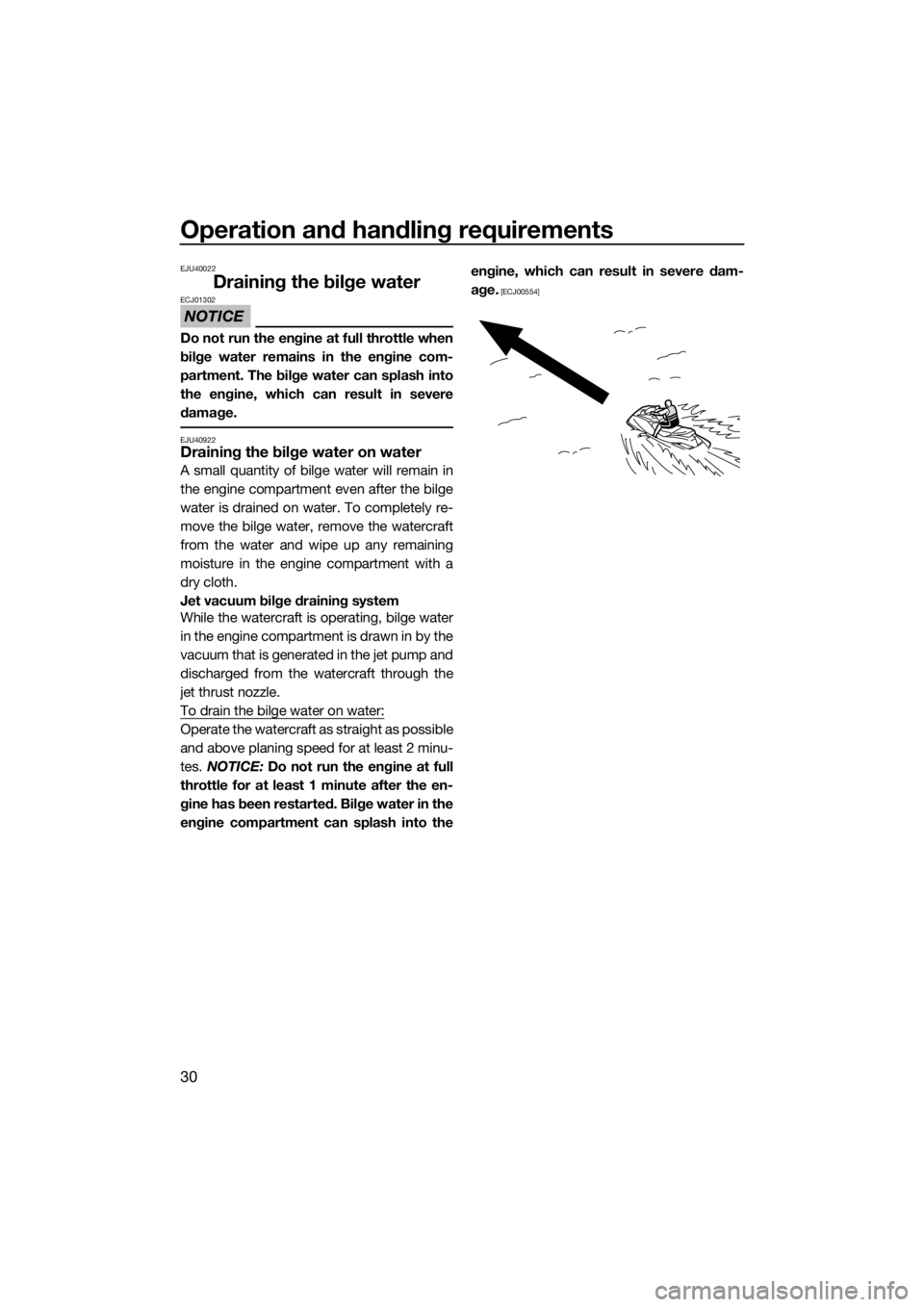
To drain the bilge water on water:
Operate the watercraft as straight as possible
and above planing speed for at least 2 minu-
tes. NOTICE: Do not run the engine at full
throttle for at least 1 minute after the en-
gine has been restarted. Bilge water in the
engine compartment can splash into theengine, which can result in severe dam-
age.
[ECJ00554]
UF4D73E0.book Page 30 Wednesday, March 23, 2016 11:40 AM
Page 39 of 78

Pre-operation checks
33
EJU31982
WARNING
EWJ00412
Failure to inspect or maintain the watercraft properly increases the possibility of an ac-
cident or damage to the watercraft. Do not operate the watercraft if you find any prob-
lem. If a problem cannot be corrected by the procedures provided in this manual, have
the watercraft inspected by a Yamaha dealer.
EJU41234Pre-operation checklist
Before using this watercraft, be sure to perform the checks in the following checklist.
ITEM ROUTINE PAGE
PRE-LAUNCH CHECKS
Engine compartmentVentilate the engine compartment.
Check inside the engine compartment for damage.35
Fuel systemCheck the fuel system for leakage.
Check the fuel level in the fuel tank.35
Water separatorCheck the water separator for water. 36
Engine unitCheck the exterior of the engine unit for damage. 36
Bilge waterCheck the engine compartment for bilge water. 36
BatteryCheck the battery connections and electrolyte level. 36
Steering systemCheck the steering system for proper operation. 36
Throttle leverCheck the throttle lever for proper operation.
Check the throttle lever free play.37
Engine shut-off cord (lan-
yard)Check the engine shut-off cord (lanyard) for dam-
age.38
SwitchesCheck the start switch, engine stop switch, and en-
gine shut-off switch for proper operation.38
Storage pouchCheck the storage pouch for damage and water.
Check that the storage pouch is securely installed.38
Fire extinguisher containerCheck the fire extinguisher container for damage. 39
Fire extinguisherCheck the condition of the fire extinguisher. 39
Safety equipmentCheck that safety equipment meeting the applica-
ble regulations is on board.39
Hull and deckCheck the hull and deck for damage. 39
Jet intakeCheck the jet intake for damage and clogging. 39
HoodCheck that the hood is securely closed. 39
UF4D73E0.book Page 33 Wednesday, March 23, 2016 11:40 AM
Page 42 of 78
Pre-operation checks
36
Add fuel if necessary. (See page 29 for infor-
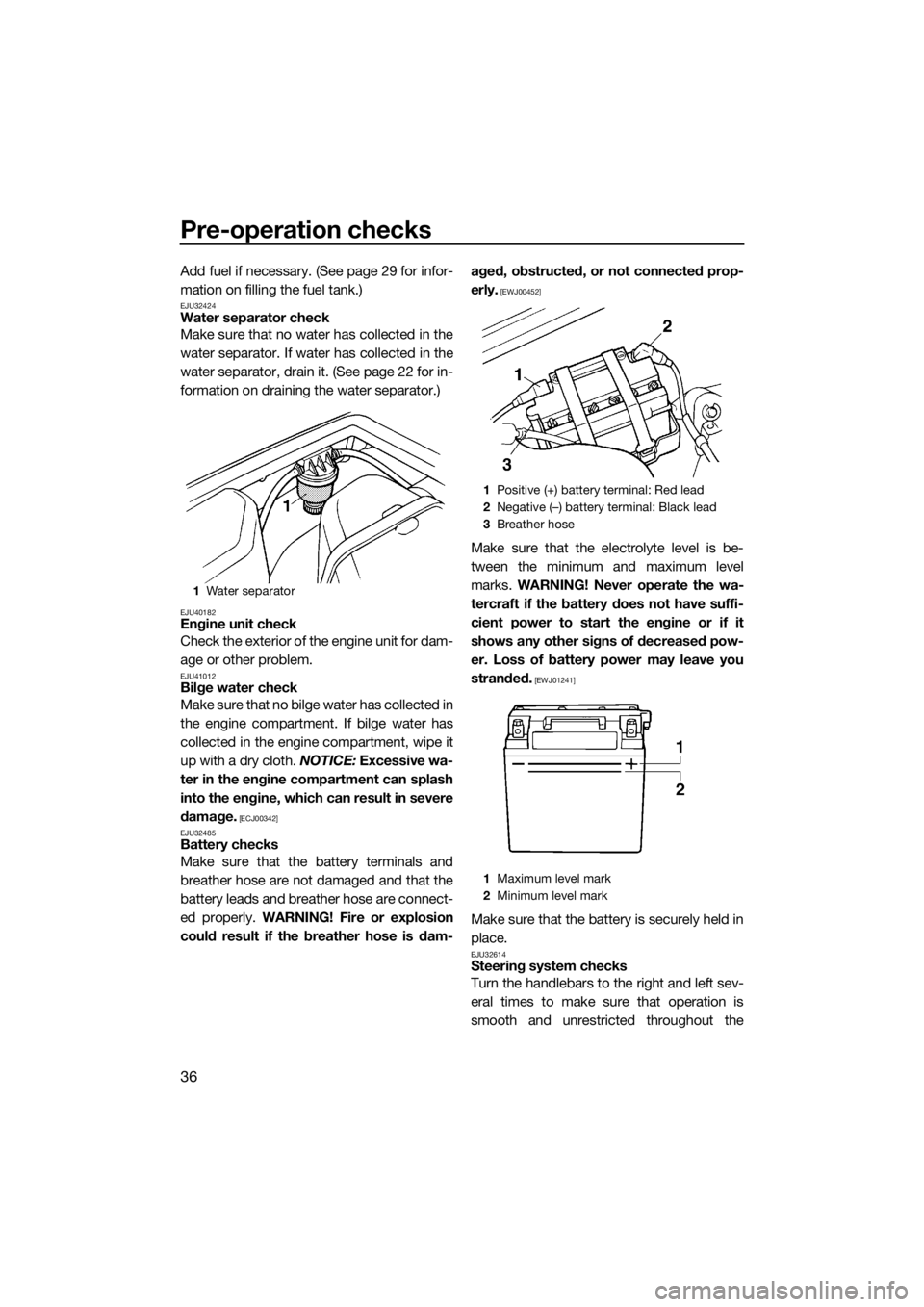
mation on filling the fuel tank.)
EJU32424Water separator check
Make sure that no water has collected in the
water separator. If water has collected in the
water separator, drain it. (See page 22 for in-
formation on draining the water separator.)
EJU40182Engine unit check
Check the exterior of the engine unit for dam-
age or other problem.
EJU41012Bilge water check
Make sure that no bilge water has collected in
the engine compartment. If bilge water has
collected in the engine compartment, wipe it
up with a dry cloth. NOTICE: Excessive wa-
ter in the engine compartment can splash
into the engine, which can result in severe
damage.
[ECJ00342]
EJU32485
Battery checks
Make sure that the battery terminals and
breather hose are not damaged and that the
battery leads and breather hose are connect-
ed properly. WARNING! Fire or explosion
could result if the breather hose is dam-aged, obstructed, or not connected prop-
erly.
[EWJ00452]
Make sure that the electrolyte level is be-
tween the minimum and maximum level
marks. WARNING! Never operate the wa-
tercraft if the battery does not have suffi-
cient power to start the engine or if it
shows any other signs of decreased pow-
er. Loss of battery power may leave you
stranded.
[EWJ01241]
Make sure that the battery is securely held in
place.
EJU32614Steering system checks
Turn the handlebars to the right and left sev-
eral times to make sure that operation is
smooth and unrestricted throughout the
1Water separator
1Positive (+) battery terminal: Red lead
2Negative (–) battery terminal: Black lead
3Breather hose
1Maximum level mark
2Minimum level mark
UF4D73E0.book Page 36 Wednesday, March 23, 2016 11:40 AM
Page 54 of 78
Operation
48
(5) Bring your knees up onto the riding tray
and change to a kneeling position as
soon as you can do so.
(6) Move as far forward as possible without
interfering with the movement of the han-
dlebars. Keep your body perpendicular
to the water, with your weight forward
and low.
(7) Once the bow drops, and the watercraft
has leveled out in the water and reached
planing speed, back off the throttle and
select your desired speed.
TIP:
The watercraft will become easier to balan-
ce as the speed increases, because jet
thrust provides stability as well as direc-
tional control.
It will take longer for a heavy operator to
reach planing speed than it will for a light
operator.
EJU33205Capsized watercraft
WARNING
EWJ00672
Improper uprighting can cause injury.
Be sure to shut the engine off by pulling
on the engine shut-off cord (lanyard) to
remove the clip from the engine shut-off
switch.
Do not put your hands in the intake
grate.
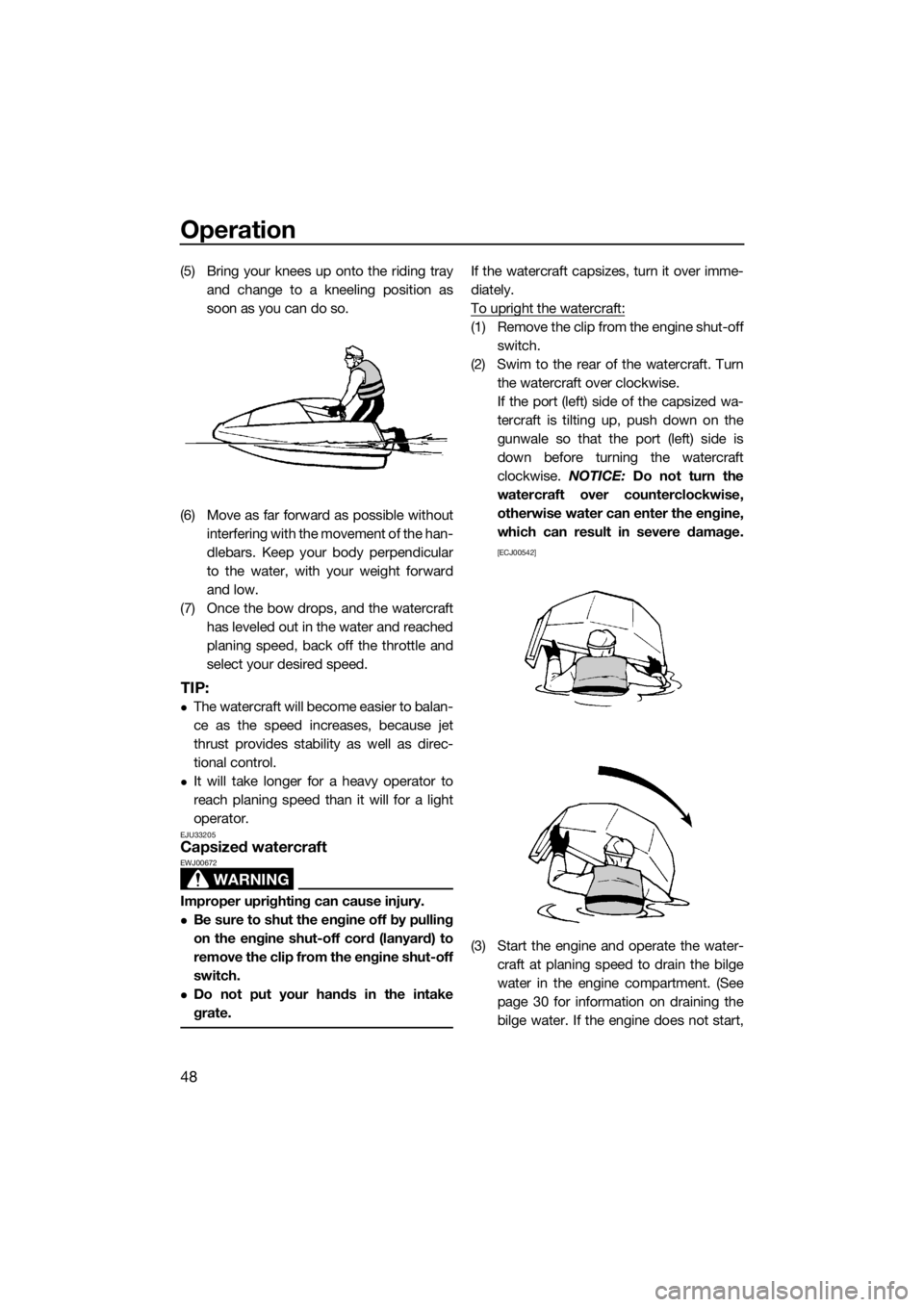
If the watercraft capsizes, turn it over imme-
diately.
To upright the watercraft:
(1) Remove the clip from the engine shut-off
switch.
(2) Swim to the rear of the watercraft. Turn
the watercraft over clockwise.
If the port (left) side of the capsized wa-
tercraft is tilting up, push down on the
gunwale so that the port (left) side is
down before turning the watercraft
clockwise. NOTICE: Do not turn the
watercraft over counterclockwise,
otherwise water can enter the engine,
which can result in severe damage.
[ECJ00542]
(3) Start the engine and operate the water-
craft at planing speed to drain the bilge
water in the engine compartment. (See
page 30 for information on draining the
bilge water. If the engine does not start,
UF4D73E0.book Page 48 Wednesday, March 23, 2016 11:40 AM
Page 55 of 78

Operation
49
see “Towing the watercraft” on page 68
or “Submerged watercraft” on page 69.)
NOTICE: Do not run the engine at full
throttle for at least 1 minute after the
engine has been restarted. Bilge wa-
ter in the engine compartment can
splash into the engine, which can re-
sult in severe damage.
[ECJ00554]
EJU33303
Beaching the watercraft
To beach the watercraft:
(1) Make sure that there are no boats, swim-
mers, or obstacles near the beach.
(2) Release the throttle lever to reduce
speed about 90 m (300 ft) before you
reach the intended beaching area.
(3) Slowly approach the beach and stop the
engine just before reaching land.
WARNING! You need throttle to steer.
Shutting the engine off can cause you
to hit an obstacle you are attempting
to avoid. A collision could result in se-
vere injury or death.
[EWJ00602] NOTICE:
Never run the engine in water that is
less than 60 cm (2 ft) deep from the
bottom of the watercraft, otherwise
pebbles or sand could be sucked into
the jet intake, causing impeller dam-
age and engine overheating.
[ECJ00473]
(4) Get off the watercraft and pull it up on the
beach.
EJU37194Operating in weeded areas
Always avoid using your watercraft in areas
where weed growth is thick. If operating in
weeded areas is unavoidable, alternately
squeeze the throttle lever and relax your grip
on the throttle lever to vary the engine speed.
Weeds tend to become clogged more when
operating at a steady speed and at trolling
speed. If weeds may have clogged the intakearea, clean the jet intake. (See page 66 for in-
formation on the jet intake.)
EJU41061After removing the watercraft from
the water
NOTICE
ECJ01361
Do not run the engine for more than 15
seconds on land without supplying water,
otherwise the engine could overheat.
After operating and removing the watercraft
from the water, promptly discharge the re-
maining water from the cooling water pas-
sages.
To discharge water from the cooling water
passages:
(1) Make sure that the area around the wa-
tercraft is clear, and then start the en-
gine.
(2) Discharge the remaining water out of the
cooling water passages by alternately
squeezing and releasing the throttle lever
quickly for 10 to 15 seconds.
(3) Stop the engine.
UF4D73E0.book Page 49 Wednesday, March 23, 2016 11:40 AM
Page 65 of 78

Maintenance
59
EJU40831Periodic maintenance chart
The periodic maintenance chart gives general guidelines for periodic maintenance. Have a
Yamaha dealer perform the checks in the following chart. However, maintenance may need
to be performed more frequently depending on your operating conditions. If you have any
questions, consult a Yamaha dealer.
This “ ” mark indicates maintenance that you may do yourself.
This “ ” mark indicates items to be checked and serviced by a Yamaha dealer.
Item OperationInitial Thereafter every
Page 10
hours50 hours100
hours200
hours
6
months12
months12
months24
months
Spark plugsCheck, clean, replace 60
Lubrication pointsLubricate 54
Intermediate
housingLubricate 61
Fuel systemCheck —
Fuel filterCheck 61
Check, replace —
Fuel tankCheck, clean —
CarburetorCheck, adjust —
Engine idling
speedCheck, adjust 62
Carburetor throttle
shaftCheck —
Bilge strainerClean —
ImpellerCheck —
Jet thrust nozzle
angleCheck, adjust —
Handlebar pivot
shaftCheck, adjust —
Steering frictionCheck, adjust —
Steering masterCheck, adjust —
Throttle cableCheck, adjust —
Choke cableCheck, adjust 61
BatteryCheck, charge —
Rubber couplingCheck —
Engine mountCheck —
Nuts and boltsCheck —
UF4D73E0.book Page 59 Wednesday, March 23, 2016 11:40 AM
Page 75 of 78

Trouble recovery
69
EJU34735Submerged watercraft
If the watercraft is submerged or flooded with
water, drain the bilge water from the engine
compartment. Then, have a Yamaha dealer
service the watercraft as soon as possible.
(1) Remove the watercraft from the water,
and then remove the hood.
(2) Turn the fuel cock knob to “OFF”.
(3) Turn the watercraft over far enough to
drain the bilge water from the engine
compartment. NOTICE: Turning the
watercraft on its side with the hood
removed could cause damage to the
steering pole. Use two people to pro-
vide enough support to make sure
that the steering pole is not damaged.
[ECJ00702]
(4) Turn the watercraft upright again.
(5) Have the watercraft serviced by a
Yamaha dealer as soon as possible.
NOTICE: Be sure to have a Yamaha
dealer inspect the watercraft. Other-
wise, serious engine damage could
result.
[ECJ00792]
UF4D73E0.book Page 69 Wednesday, March 23, 2016 11:40 AM
Page 76 of 78

70
Index
2-stroke engine oil ................................... 28
A
After removing the watercraft from the
water ..................................................... 49
B
Battery care.............................................. 51
Battery checks ......................................... 36
Battery, jumping ....................................... 67
Beaching the watercraft ........................... 49
Bilge water check..................................... 36
Bilge water, draining ................................ 30
Bilge water, draining on water ................. 30
Boarding and starting in deep water........ 47
Boarding and starting in shallow water.... 46
Bow rope hole .......................................... 25
C
Capsized watercraft ................................. 48
Carburetor, adjusting ............................... 61
Choke cable, adjusting ............................ 61
Choke knob.............................................. 21
Cleaning ................................................... 54
Cleaning the watercraft ............................ 51
Cooling water pilot outlet ......................... 21
Cooling water pilot outlet check .............. 39
Craft Identification Number (CIN)............... 1
Cruising limitations..................................... 9
E
Emergency procedures ............................ 66
Engine break-in ........................................ 32
Engine compartment check ..................... 35
Engine idling speed, adjusting ................. 62
Engine overheat warning system ............. 22
Engine serial number ................................. 1
Engine shut-off cord (lanyard) check ....... 38
Engine shut-off switch ............................. 19
Engine stop switch................................... 19
Engine unit check..................................... 36
Enjoy your watercraft responsibly............ 15
Equipment ................................................ 24
F
Fire extinguisher check ............................ 39
Fire extinguisher container....................... 26
Fire extinguisher container checks .......... 39
Flushing the cooling water passages....... 50
Fuel .......................................................... 28Fuel and engine oil requirements ............. 28
Fuel cock knob......................................... 21
Fuel filter, checking .................................. 61
Fuel level check........................................ 35
Fuel system checks ................................. 35
Fuel tank, filling ........................................ 29
Fuse, replacing ......................................... 67
G
Getting to know your watercraft .............. 40
Glossary, watercraft ................................. 16
H
Hazard information................................... 13
Hood ........................................................ 24
Hood check .............................................. 39
Hull and deck check ................................ 39
I
Identification numbers ............................... 1
J
Jet intake and impeller, cleaning.............. 66
Jet intake checks ..................................... 39
Jet thrust nozzle angle, adjusting ............ 57
Jumper cables, connecting ...................... 67
L
Labels, important ....................................... 3
Labels, other .............................................. 7
Labels, warning .......................................... 4
Launching the watercraft ......................... 41
Learning to operate your watercraft......... 40
Leaving the watercraft.............................. 43
Limitations on who may operate the
watercraft ................................................ 8
Long-term storage ................................... 54
Lubrication ............................................... 54
Lubrication points .................................... 61
M
Main components, location of ................. 17
Maintenance............................................. 56
Manufactured date label ............................ 2
Mixing fuel and oil .................................... 28
O
Operating in weeded areas ...................... 49
Operating positions .................................. 40
Operating the watercraft .......................... 43
Operating your watercraft ........................ 40
Operation requirements ........................... 10
UF4D73E0.book Page 70 Wednesday, March 23, 2016 11:40 AM