fuel YAMAHA SUPERJET 2019 Owners Manual
[x] Cancel search | Manufacturer: YAMAHA, Model Year: 2019, Model line: SUPERJET, Model: YAMAHA SUPERJET 2019Pages: 78, PDF Size: 2.75 MB
Page 3 of 78
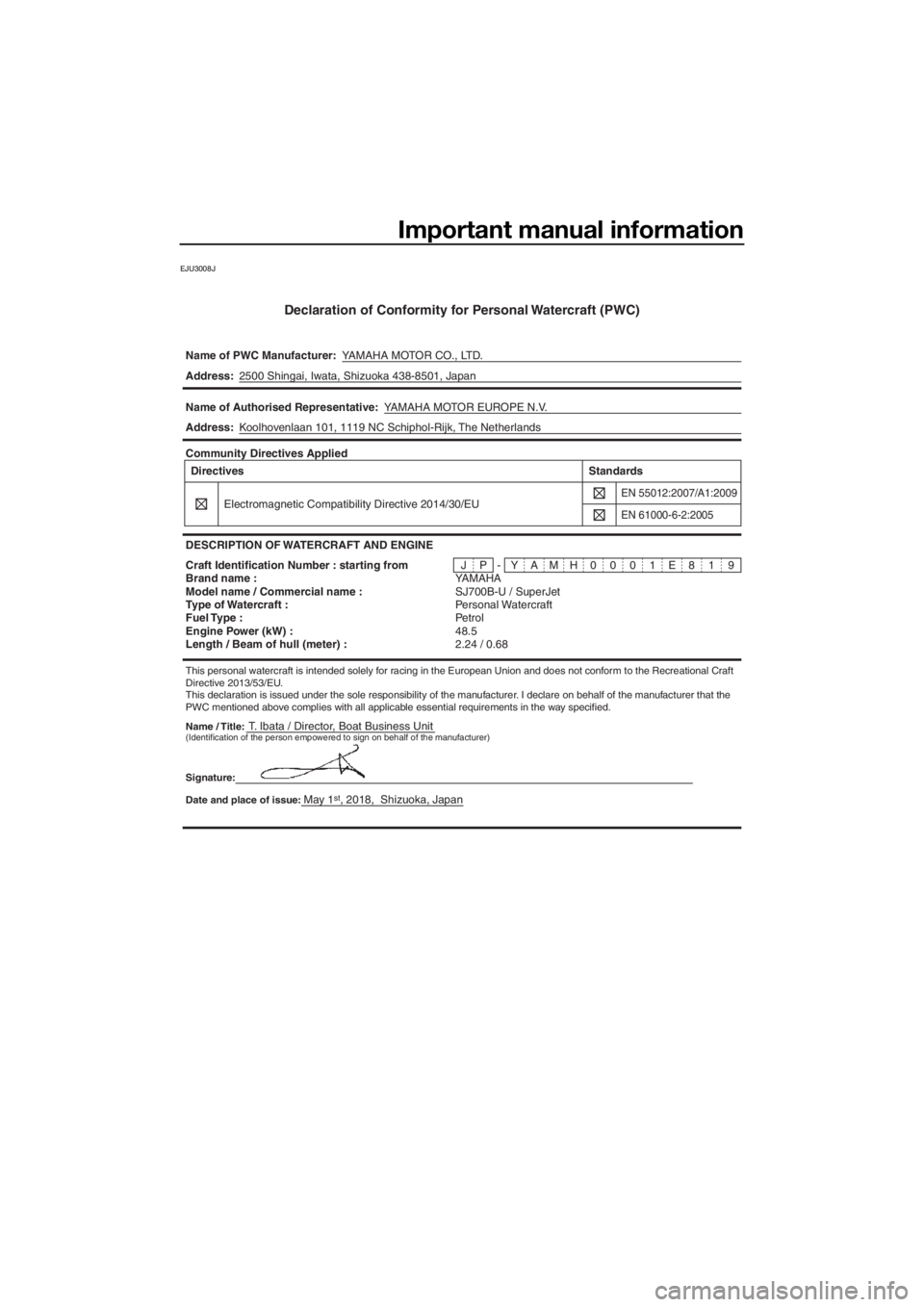
Important manual information
EJU3008J
Declaration of Conformity for Personal Watercraft (PWC)
Name of PWC Manufacturer:YAMAHA MOTOR CO., LTD.
Name / Title:T. Ibata / Director, Boat Business Unit Address:2500 Shingai, Iwata, Shizuoka 438-8501, Japan
Name of Authorised Representative:YAMAHA MOTOR EUROPE N.V.
Address:Koolhovenlaan 101, 1119 NC Schiphol-Rijk, The Netherlands
JP-YAMH0 0 0 1E8 1 9 Community Directives Applied
DESCRIPTION OF WATERCRAFT AND ENGINE
Craft Identification Number : starting from
YAMAHA Brand name :
SJ700B-U / SuperJet Model name / Commercial name :
Personal Watercraft Type of Watercraft :
Petrol Fuel Type :
48.5 Engine Power (kW) :
2.24 / 0.68 Length / Beam of hull (meter) :Directives
Electromagnetic Compatibility Directive 2014/30/EU
EN 55012:2007/A1:2009
Standards
EN 61000-6-2:2005
This personal watercraft is intended solely for racing in the European Union and does not conform to the Recreational Craft
Directive 2013/53/EU.
This declaration is issued under the sole responsibility of the manufacturer. I declare on behalf of the manufacturer that the
PWC mentioned above complies with all applicable essential requirements in the way specified.
(Identification of the person empowered to sign on behalf of the manufacturer)
Signature:
Date and place of issue:
May 1st, 2018, Shizuoka, Japan
UF4D75E0.book Page 1 Monday, March 19, 2018 3:02 PM
Page 5 of 78

Table of contents
General and important labels ........... 1
Identification numbers .................... 1
Primary Identification (PRI-ID)
number............................................ 1
Craft Identification Number (CIN) ....... 1
Engine serial number.......................... 1
Manufactured date label .................... 2
Important labels .............................. 3
Warning labels.................................... 4
Other labels ........................................ 7
Safety information ............................. 8
Limitations on who may operate
the watercraft ............................... 8
Cruising limitations .......................... 9
Operation requirements ................ 10
Recommended equipment ........... 12
Hazard information........................ 13
Watercraft characteristics ............. 13
Safe boating rules ......................... 14
Enjoy your watercraft
responsibly ................................. 15
Description....................................... 16
Watercraft glossary ....................... 16
Location of main components ...... 17
Control function operation ............. 19
Watercraft control functions ......... 19
Engine stop switch .......................... 19
Engine shut-off switch .................... 19
Start switch ..................................... 19
Throttle lever .................................... 20
Steering system ............................... 20
Steering pole .................................... 20
Fuel cock knob................................. 21
Choke knob ..................................... 21
Cooling water pilot outlet ................. 21
Water separator................................ 22
Engine overheat warning system ..... 22
Equipment operation ...................... 23
Equipment..................................... 23
Hood................................................. 23
Bow rope hole .................................. 24
Stern rope hole ................................. 24
Storage pouch .................................. 24
Fire extinguisher container ............... 25
Operation and handling
requirements ................................... 27
Fuel and engine oil
requirements .............................. 27
Fuel................................................... 27
2-stroke engine oil ............................ 28
Mixing fuel and oil ............................ 28
Filling the fuel tank ........................... 28
Draining the bilge water ................ 29
Draining the bilge water on water .... 29
Transporting.................................. 30
First-time operation ........................ 32
Engine break-in............................. 32
Pre-operation checks ..................... 33
Pre-operation checklist .................... 33
Pre-operation check points .......... 35
Pre-launch checks ........................... 35
Post-launch checks.......................... 39
Operation ......................................... 40
Operating your watercraft ............. 40
Getting to know your watercraft....... 40
Learning to operate your
watercraft ...................................... 40
Operating positions .......................... 40
Launching the watercraft ................. 41
Starting the engine on water ............ 41
Stopping the engine ......................... 43
Leaving the watercraft ...................... 43
Operating the watercraft .................. 43
Turning the watercraft ...................... 43
Stopping the watercraft.................... 45
Starting off........................................ 45
UF4D75E0.book Page 1 Monday, March 19, 2018 3:02 PM
Page 6 of 78

Table of contents
Capsized watercraft ......................... 48
Beaching the watercraft ................... 49
Operating in weeded areas .............. 49
After removing the watercraft
from the water............................... 49
Care and storage............................. 50
Post-operation care ...................... 50
Flushing the cooling water
passages....................................... 50
Cleaning the watercraft .................... 51
Battery care ...................................... 51
Long-term storage ........................ 54
Cleaning ........................................... 54
Lubrication ....................................... 54
Rustproofing..................................... 55
Maintenance .................................... 56
Maintenance.................................. 56
Tool kit.............................................. 56
Adjusting the steering friction .......... 56
Adjusting the jet thrust nozzle
angle ............................................. 57
Periodic maintenance chart ............. 59
Checking the spark plugs ................ 60
Lubrication points ............................ 61
Checking the fuel filter ..................... 61
Adjusting the choke cable................ 61
Adjusting the carburetor................... 61
Specifications .................................. 63
Specifications................................ 63
Trouble recovery ............................. 64
Troubleshooting ............................ 64
Troubleshooting chart ...................... 64
Emergency procedures ................. 66
Cleaning the jet intake and
impeller ......................................... 66
Jumping the battery ......................... 67
Replacing the fuse ........................... 67
Towing the watercraft ...................... 68
Submerged watercraft ..................... 69
Index................................................. 70
UF4D75E0.book Page 2 Monday, March 19, 2018 3:02 PM
Page 19 of 78
Safety information
13
EJU30851
Hazard information
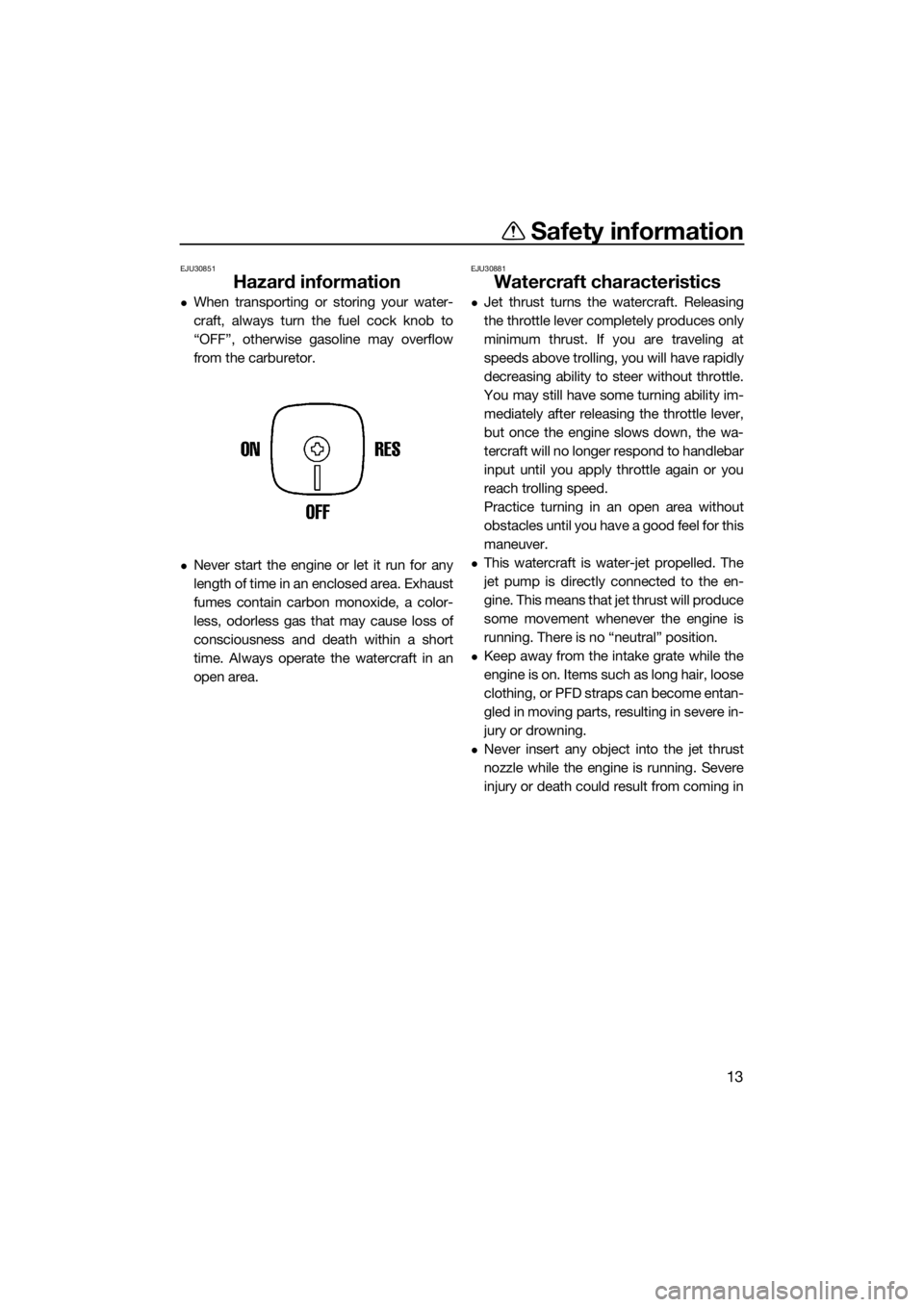
When transporting or storing your water-
craft, always turn the fuel cock knob to
“OFF”, otherwise gasoline may overflow
from the carburetor.
Never start the engine or let it run for any
length of time in an enclosed area. Exhaust
fumes contain carbon monoxide, a color-
less, odorless gas that may cause loss of
consciousness and death within a short
time. Always operate the watercraft in an
open area.
EJU30881
Watercraft characteristics
Jet thrust turns the watercraft. Releasing
the throttle lever completely produces only
minimum thrust. If you are traveling at
speeds above trolling, you will have rapidly
decreasing ability to steer without throttle.
You may still have some turning ability im-
mediately after releasing the throttle lever,
but once the engine slows down, the wa-
tercraft will no longer respond to handlebar
input until you apply throttle again or you
reach trolling speed.
Practice turning in an open area without
obstacles until you have a good feel for this
maneuver.
This watercraft is water-jet propelled. The
jet pump is directly connected to the en-
gine. This means that jet thrust will produce
some movement whenever the engine is
running. There is no “neutral” position.
Keep away from the intake grate while the
engine is on. Items such as long hair, loose
clothing, or PFD straps can become entan-
gled in moving parts, resulting in severe in-
jury or drowning.
Never insert any object into the jet thrust
nozzle while the engine is running. Severe
injury or death could result from coming in
UF4D75E0.book Page 13 Monday, March 19, 2018 3:02 PM
Page 21 of 78

Safety information
15
EJU30992
Enjoy your watercraft
responsibly
You share the areas you enjoy when riding
your watercraft with others and with nature.
So your enjoyment includes a responsibility
to treat these other people, and the lands,
waters, and wildlife with respect and courte-
sy.
Whenever and wherever you ride, think of
yourself as the guest of those around you.
Remember, for example, that the sound of
your watercraft may be music to you, but it
could be just noise to others. And the exciting
splash of your wake can make waves others
won’t enjoy.
Avoid riding close to shoreline homes and
waterfowl nesting areas or other wildlife ar-
eas, and keep a respectful distance from fish-
ermen, other boats, swimmers, and
populated beaches. When travel in areas like
these is unavoidable, ride slowly and obey all
laws.
Proper maintenance is necessary to ensure
that the exhaust emission and sound levels of
your watercraft will continue to be within reg-
ulated limits. You have the responsibility to
make sure that the recommended mainte-
nance in this owner’s/operator’s manual is
carried out.
Remember, pollution can be harmful to the
environment. Do not refuel or add oil where a
spill could cause damage to nature. Remove
your watercraft from the water and move it
away from the shoreline before refueling. Dis-
pose of water and any fuel and oil residue in
the engine compartment according to local
regulations. And keep your surroundings
pleasant for the people and wildlife that share
the waterways: don’t litter.When you ride responsibly, with respect and
courtesy for others, you help ensure that our
waterways stay open for the enjoyment of a
variety of recreational opportunities.
UF4D75E0.book Page 15 Monday, March 19, 2018 3:02 PM
Page 23 of 78
Description
17
EJU31012
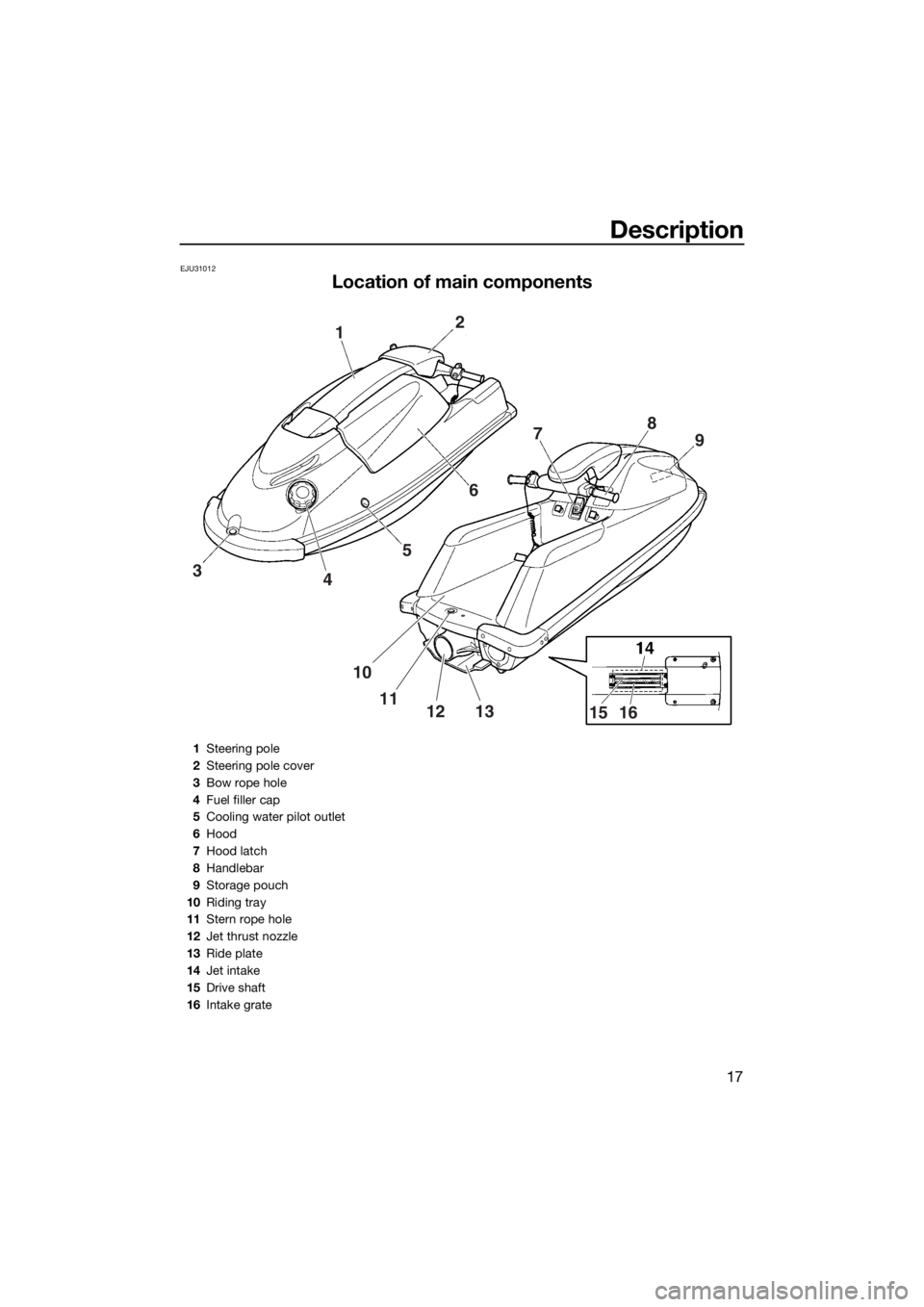
Location of main components
2
1
3
45678
9
10
11
12 13
15 16
1Steering pole
2Steering pole cover
3Bow rope hole
4Fuel filler cap
5Cooling water pilot outlet
6Hood
7Hood latch
8Handlebar
9Storage pouch
10Riding tray
11Stern rope hole
12Jet thrust nozzle
13Ride plate
14Jet intake
15Drive shaft
16Intake grate
UF4D75E0.book Page 17 Monday, March 19, 2018 3:02 PM
Page 24 of 78
Description
18
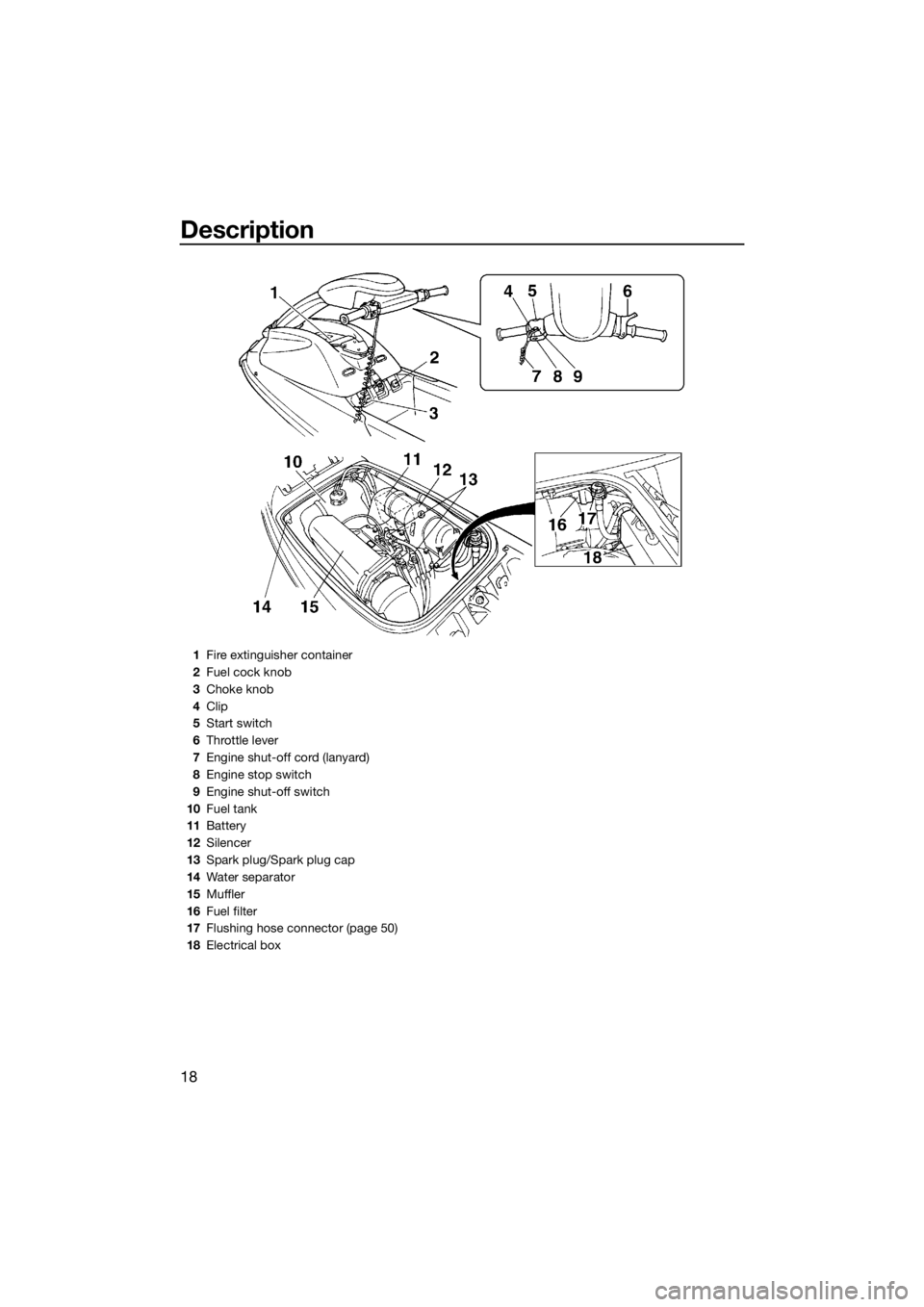
1Fire extinguisher container
2Fuel cock knob
3Choke knob
4Clip
5Start switch
6Throttle lever
7Engine shut-off cord (lanyard)
8Engine stop switch
9Engine shut-off switch
10Fuel tank
11Battery
12Silencer
13Spark plug/Spark plug cap
14Water separator
15Muffler
16Fuel filter
17Flushing hose connector (page 50)
18Electrical box
UF4D75E0.book Page 18 Monday, March 19, 2018 3:02 PM
Page 27 of 78
Control function operation
21
EJU31124Fuel cock knob
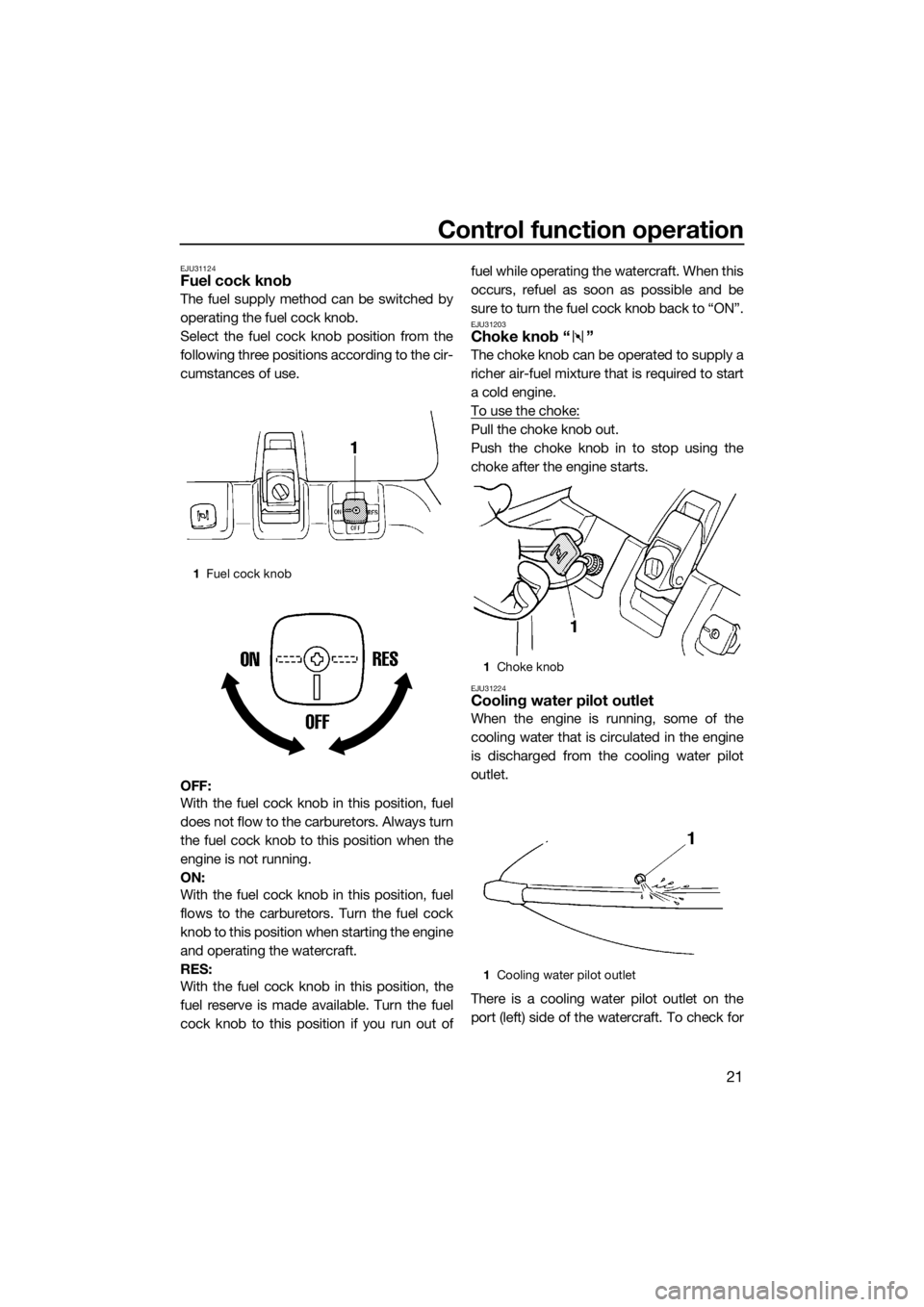
The fuel supply method can be switched by
operating the fuel cock knob.
Select the fuel cock knob position from the
following three positions according to the cir-
cumstances of use.
OFF:
With the fuel cock knob in this position, fuel
does not flow to the carburetors. Always turn
the fuel cock knob to this position when the
engine is not running.
ON:
With the fuel cock knob in this position, fuel
flows to the carburetors. Turn the fuel cock
knob to this position when starting the engine
and operating the watercraft.
RES:
With the fuel cock knob in this position, the
fuel reserve is made available. Turn the fuel
cock knob to this position if you run out offuel while operating the watercraft. When this
occurs, refuel as soon as possible and be
sure to turn the fuel cock knob back to “ON”.
EJU31203Choke knob “ ”
The choke knob can be operated to supply a
richer air-fuel mixture that is required to start
a cold engine.
To use the choke:
Pull the choke knob out.
Push the choke knob in to stop using the
choke after the engine starts.
EJU31224Cooling water pilot outlet
When the engine is running, some of the
cooling water that is circulated in the engine
is discharged from the cooling water pilot
outlet.
There is a cooling water pilot outlet on the
port (left) side of the watercraft. To check for
1Fuel cock knob
1Choke knob
1Cooling water pilot outlet
UF4D75E0.book Page 21 Monday, March 19, 2018 3:02 PM
Page 28 of 78
Control function operation
22
proper operation of the cooling system, make
sure that water is being discharged from the
cooling water pilot outlet. If water is not being
discharged from the outlet, stop the engine
and check the jet intake for clogging. (See
page 66 for information on the jet intake.)
TIP:
It will take about 20 seconds for the water
to reach the outlet after the engine is start-
ed.
Water discharge may not be constant
when the engine is running at idling speed.
If this occurs, apply a little throttle to make
sure that water discharges properly.
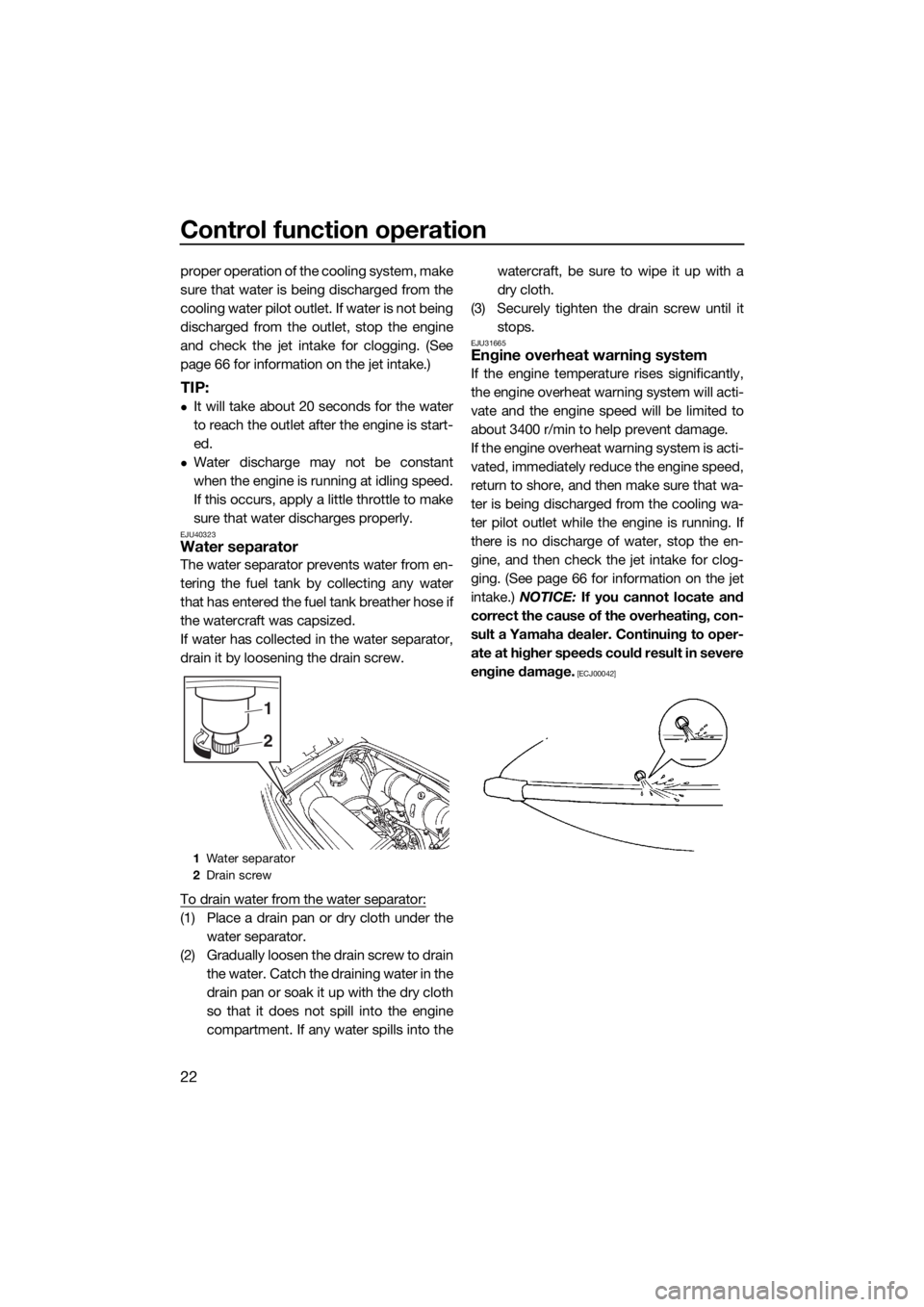
EJU40323Water separator
The water separator prevents water from en-
tering the fuel tank by collecting any water
that has entered the fuel tank breather hose if
the watercraft was capsized.
If water has collected in the water separator,
drain it by loosening the drain screw.
To drain water from the water separator:
(1) Place a drain pan or dry cloth under the
water separator.
(2) Gradually loosen the drain screw to drain
the water. Catch the draining water in the
drain pan or soak it up with the dry cloth
so that it does not spill into the engine
compartment. If any water spills into thewatercraft, be sure to wipe it up with a
dry cloth.
(3) Securely tighten the drain screw until it
stops.
EJU31665Engine overheat warning system
If the engine temperature rises significantly,
the engine overheat warning system will acti-
vate and the engine speed will be limited to
about 3400 r/min to help prevent damage.
If the engine overheat warning system is acti-
vated, immediately reduce the engine speed,
return to shore, and then make sure that wa-
ter is being discharged from the cooling wa-
ter pilot outlet while the engine is running. If
there is no discharge of water, stop the en-
gine, and then check the jet intake for clog-
ging. (See page 66 for information on the jet
intake.) NOTICE: If you cannot locate and
correct the cause of the overheating, con-
sult a Yamaha dealer. Continuing to oper-
ate at higher speeds could result in severe
engine damage.
[ECJ00042]
1Water separator
2Drain screw
2
1
UF4D75E0.book Page 22 Monday, March 19, 2018 3:02 PM
Page 33 of 78
Operation and handling requirements
27
EJU31793
Fuel and engine oil
requirements
EJU44841Fuel
WARNING
EWJ00283
Gasoline and gasoline vapors are ex-
tremely flammable. To avoid fires and
explosions and to reduce the risk of in-
jury when refueling, follow these in-
structions.
Gasoline is poisonous and can cause in-
jury or death. Handle gasoline with care.
Never siphon gasoline by mouth. If you
should swallow some gasoline, inhale a
lot of gasoline vapor, or get some gaso-
line in your eyes, see your doctor imme-
diately. If gasoline spills on your skin,
wash with soap and water. If gasoline
spills on your clothing, change your
clothes.
NOTICE
ECJ00322
Do not use leaded gasoline. Leaded
gasoline can seriously damage the en-
gine.
Avoid getting water and contaminants in
the fuel tank. Contaminated fuel can
cause poor performance and engine
damage. Use only fresh gasoline that
has been stored in clean containers.
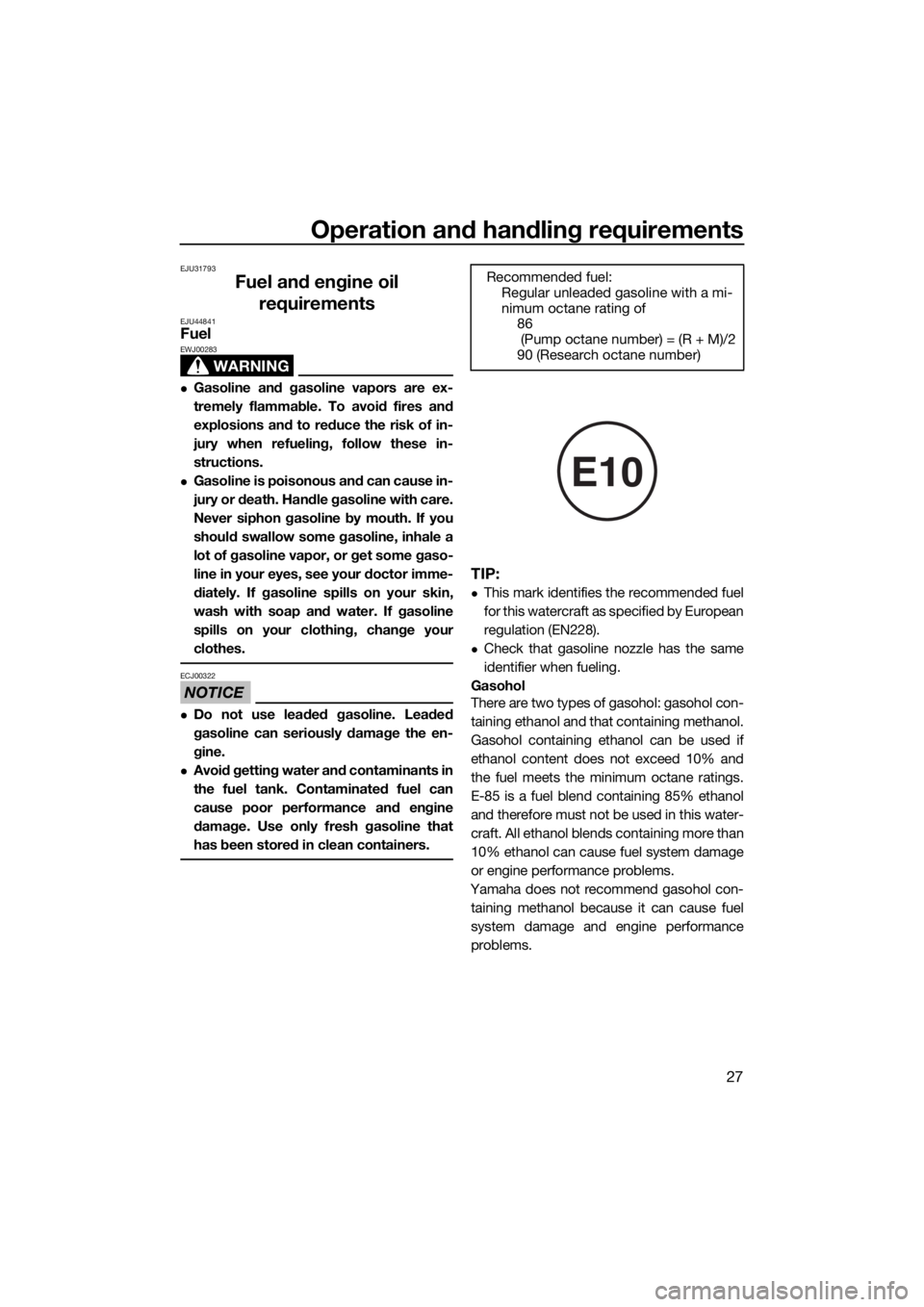
TIP:
This mark identifies the recommended fuel
for this watercraft as specified by European
regulation (EN228).
Check that gasoline nozzle has the same
identifier when fueling.
Gasohol
There are two types of gasohol: gasohol con-
taining ethanol and that containing methanol.
Gasohol containing ethanol can be used if
ethanol content does not exceed 10% and
the fuel meets the minimum octane ratings.
E-85 is a fuel blend containing 85% ethanol
and therefore must not be used in this water-
craft. All ethanol blends containing more than
10% ethanol can cause fuel system damage
or engine performance problems.
Yamaha does not recommend gasohol con-
taining methanol because it can cause fuel
system damage and engine performance
problems.Recommended fuel:
Regular unleaded gasoline with a mi-
nimum octane rating of
86
(Pump octane number) = (R + M)/2
90 (Research octane number)
E10
UF4D75E0.book Page 27 Monday, March 19, 2018 3:02 PM