maintenance YAMAHA TDM 850 2000 Owner's Guide
[x] Cancel search | Manufacturer: YAMAHA, Model Year: 2000, Model line: TDM 850, Model: YAMAHA TDM 850 2000Pages: 99, PDF Size: 10.69 MB
Page 74 of 99
PERIODIC MAINTENANCE AND MINOR REPAIR
6-28
6
EAU01144
Wheel bearingsIf there is play in the front or rear wheel
hub or if the wheel does not turn
smoothly, have a Yamaha dealer in-
spect the wheel bearings.
EAU00800
BatteryThis motorcycle is equipped with a
sealed-type battery. Therefore it is not
necessary to check the electrolyte or fill
the battery with distilled water.l
If the battery seems to have dis-
charged, consult a Yamaha deal-
er.
l
If the motorcycle is equipped with
optional electrical accessories, the
battery tends to discharge more
quickly, so be sure to recharge it
periodically.
EC000101
CAUTION:@ Never try to remove the sealing caps
of the battery cells. The battery will
be damaged. @
EW000116
WARNING
@ Battery electrolyte is poisonous and
dangerous, causing severe burns,
etc. It contains sulfuric acid. Avoid
contact with skin, eyes or clothing.
ANTIDOTE:l
EXTERNAL: Flush with water.
l
INTERNAL: Drink large quanti-
ties of water or milk. Follow with
milk of magnesia, beaten egg,
or vegetable oil. Call a physi-
cian immediately.
l
EYES: Flush with water for
15 minutes and get prompt
medical attention.
Batteries produce explosive gases.
Keep sparks, flame, cigarettes etc.,
away. Ventilate when charging or
using in an enclosed space. Always
shield your eyes when working near
batteries.
KEEP OUT OF REACH OF CHIL-
DREN.
@
E_4tx_Periodic.fm Page 28 Saturday, October 16, 1999 9:37 AM
Page 75 of 99
PERIODIC MAINTENANCE AND MINOR REPAIR
6-29
6Battery storage
When the motorcycle is not used for a
month or longer, remove the battery,
fully charge it and store it in a cool, dry
place.
EC000102
CAUTION:@ l
Completely recharge the bat-
tery before storing. Storing a
discharged battery can cause
permanent battery damage.
l
Use a battery charger designed
for a sealed-type (MF) battery.
Using a conventional battery
charger will cause battery dam-
age. If you do not have a sealed-
type battery charger, contact
your Yamaha dealer.
l
Always make sure the connec-
tions are correct when reinstall-
ing the battery.
@
EAU01670
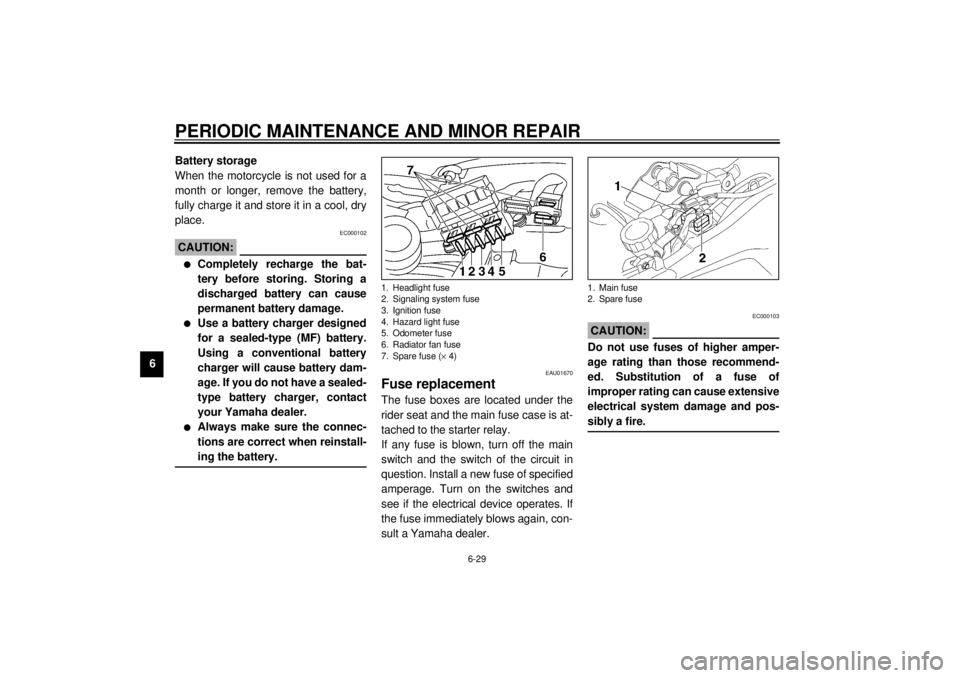
Fuse replacementThe fuse boxes are located under the
rider seat and the main fuse case is at-
tached to the starter relay.
If any fuse is blown, turn off the main
switch and the switch of the circuit in
question. Install a new fuse of specified
amperage. Turn on the switches and
see if the electrical device operates. If
the fuse immediately blows again, con-
sult a Yamaha dealer.
EC000103
CAUTION:@ Do not use fuses of higher amper-
age rating than those recommend-
ed. Substitution of a fuse of
improper rating can cause extensive
electrical system damage and pos-
sibly a fire. @
1. Headlight fuse
2. Signaling system fuse
3. Ignition fuse
4. Hazard light fuse
5. Odometer fuse
6. Radiator fan fuse
7. Spare fuse (´ 4)
1. Main fuse
2. Spare fuse
E_4tx_Periodic.fm Page 29 Saturday, October 16, 1999 9:37 AM
Page 76 of 99
PERIODIC MAINTENANCE AND MINOR REPAIR
6-30
6
EAU00827
Headlight bulb replacementThis motorcycle is equipped with a
quartz bulb headlight. If the headlight
bulb burns out, replace the bulb as fol-
lows:
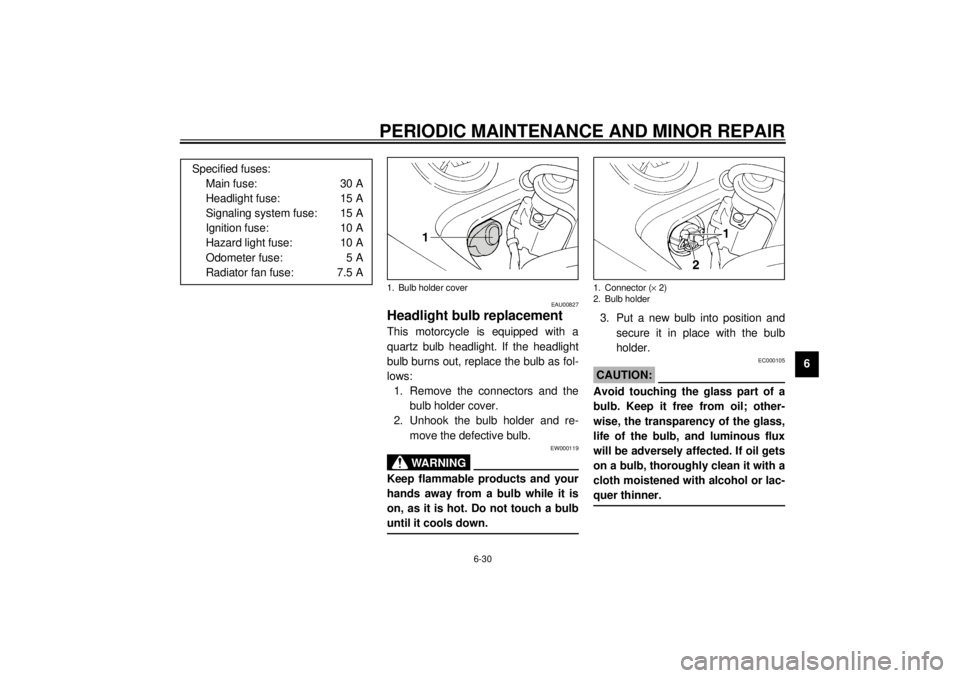
1. Remove the connectors and the
bulb holder cover.
2. Unhook the bulb holder and re-
move the defective bulb.
EW000119
WARNING
@ Keep flammable products and your
hands away from a bulb while it is
on, as it is hot. Do not touch a bulb
until it cools down. @
3. Put a new bulb into position and
secure it in place with the bulb
holder.
EC000105
CAUTION:@ Avoid touching the glass part of a
bulb. Keep it free from oil; other-
wise, the transparency of the glass,
life of the bulb, and luminous flux
will be adversely affected. If oil gets
on a bulb, thoroughly clean it with a
cloth moistened with alcohol or lac-
quer thinner. @
Specified fuses:
Main fuse: 30 A
Headlight fuse: 15 A
Signaling system fuse: 15 A
Ignition fuse: 10 A
Hazard light fuse: 10 A
Odometer fuse: 5 A
Radiator fan fuse: 7.5 A
1. Bulb holder cover
1. Connector (´ 2)
2. Bulb holder
E_4tx_Periodic.fm Page 30 Saturday, October 16, 1999 9:37 AM
Page 77 of 99
PERIODIC MAINTENANCE AND MINOR REPAIR
6-31
64. Install the bulb holder cover and
reconnect the headlight connec-
tors. If the headlight beam adjust-
ment is necessary, ask a Yamaha
dealer to make that adjustment.
EAU01623*
Tail/brake light bulb
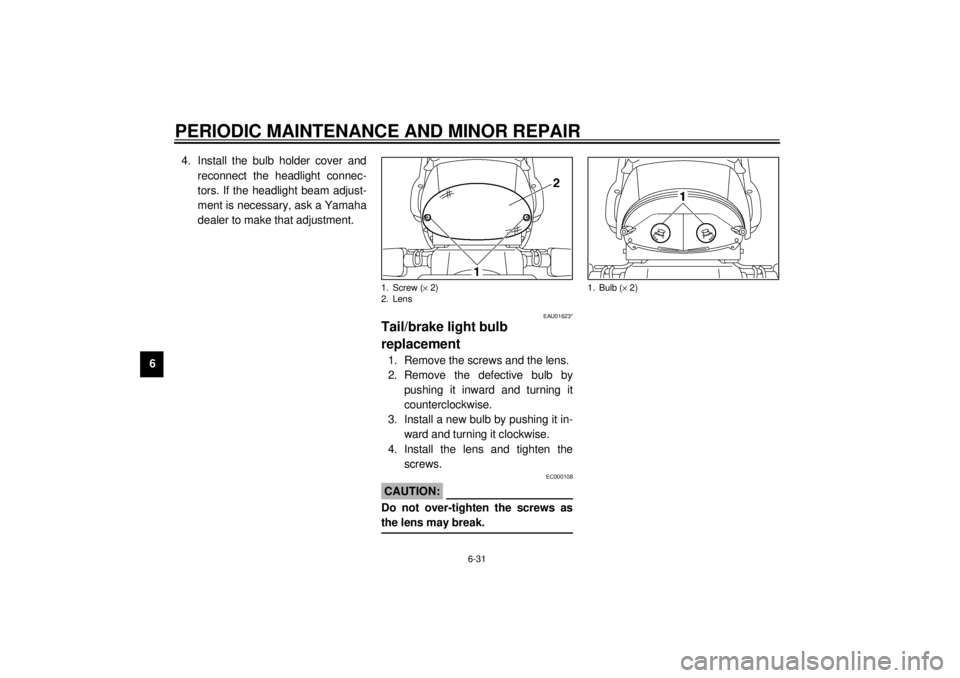
replacement1. Remove the screws and the lens.
2. Remove the defective bulb by
pushing it inward and turning it
counterclockwise.
3. Install a new bulb by pushing it in-
ward and turning it clockwise.
4. Install the lens and tighten the
screws.
EC000108
CAUTION:@ Do not over-tighten the screws as
the lens may break. @1. Screw (´ 2)
2. Lens
1. Bulb (´ 2)
E_4tx_Periodic.fm Page 31 Saturday, October 16, 1999 9:37 AM
Page 78 of 99
PERIODIC MAINTENANCE AND MINOR REPAIR
6-32
6
EAU01095
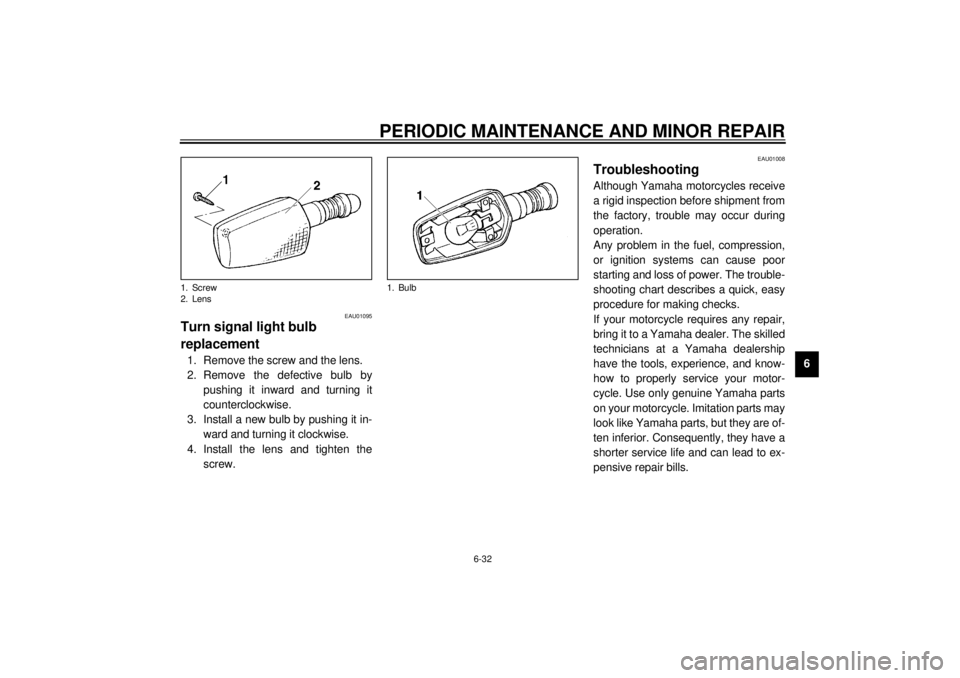
Turn signal light bulb
replacement1. Remove the screw and the lens.
2. Remove the defective bulb by
pushing it inward and turning it
counterclockwise.
3. Install a new bulb by pushing it in-
ward and turning it clockwise.
4. Install the lens and tighten the
screw.
EAU01008
TroubleshootingAlthough Yamaha motorcycles receive
a rigid inspection before shipment from
the factory, trouble may occur during
operation.
Any problem in the fuel, compression,
or ignition systems can cause poor
starting and loss of power. The trouble-
shooting chart describes a quick, easy
procedure for making checks.
If your motorcycle requires any repair,
bring it to a Yamaha dealer. The skilled
technicians at a Yamaha dealership
have the tools, experience, and know-
how to properly service your motor-
cycle. Use only genuine Yamaha parts
on your motorcycle. Imitation parts may
look like Yamaha parts, but they are of-
ten inferior. Consequently, they have a
shorter service life and can lead to ex-
pensive repair bills.
1. Screw
2. Lens
1. Bulb
E_4tx_Periodic.fm Page 32 Saturday, October 16, 1999 9:37 AM
Page 79 of 99
PERIODIC MAINTENANCE AND MINOR REPAIR
6-33
6
EAU02990*
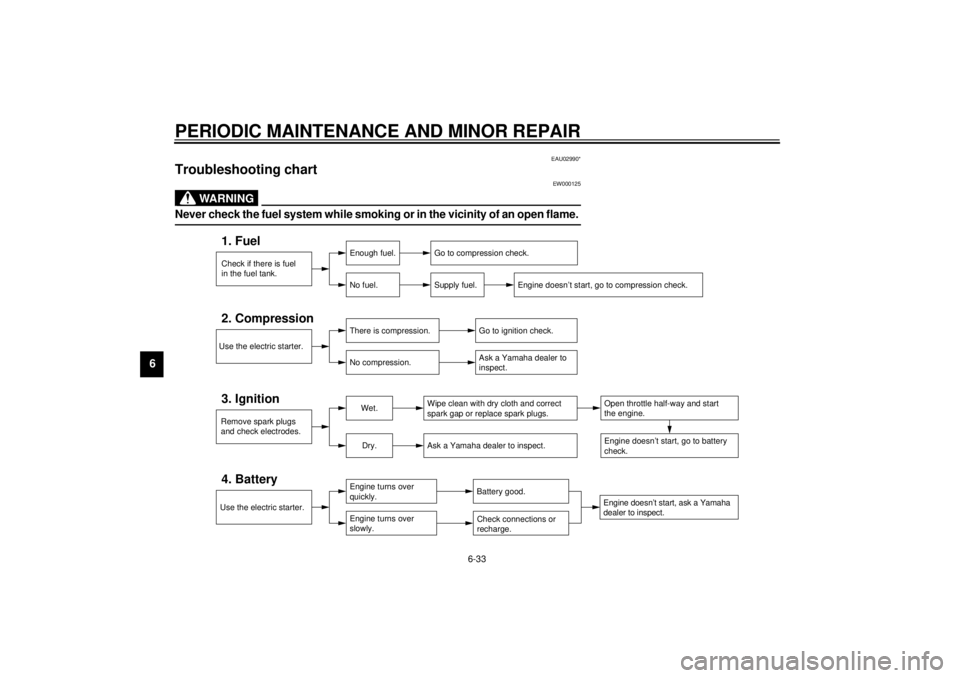
Troubleshooting chart
EW000125
WARNING
@ Never check the fuel system while smoking or in the vicinity of an open flame. @
Check if there is fuel
in the fuel tank.1. Fuel
Enough fuel.
No fuel.
Go to compression check.
Supply fuel.
Engine doesn’t start, go to compression check.
Use the electric starter.2. Compression
There is compression.
No compression.
Go to ignition check.
Ask a Yamaha dealer to
inspect.
Remove spark plugs
and check electrodes.3. Ignition
Wet.
Dry.
Wipe clean with dry cloth and correct
spark gap or replace spark plugs.
Ask a Yamaha dealer to inspect.
Engine doesn’t start, ask a Yamaha
dealer to inspect.Engine doesn’t start, go to battery
check.Open throttle half-way and start
the engine.
Use the electric starter.4. Battery
Engine turns over
quickly.
Engine turns over
slowly.
Battery good.Check connections or
recharge.
E_4tx_Periodic.fm Page 33 Saturday, October 16, 1999 9:37 AM
Page 80 of 99
PERIODIC MAINTENANCE AND MINOR REPAIR
6-34
6
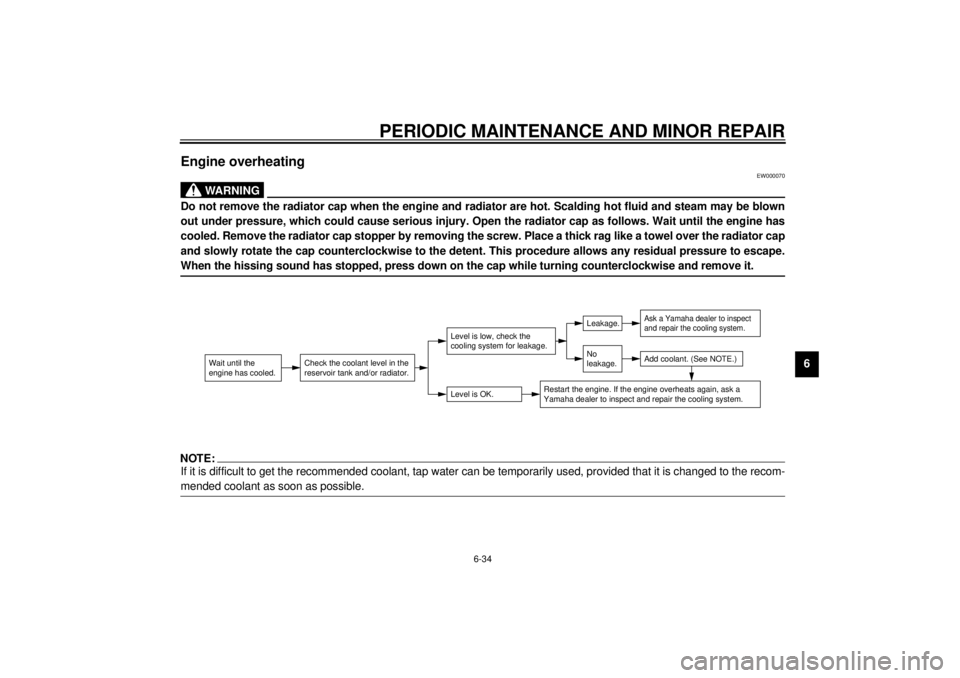
Engine overheating
EW000070
WARNING
@ Do not remove the radiator cap when the engine and radiator are hot. Scalding hot fluid and steam may be blown
out under pressure, which could cause serious injury. Open the radiator cap as follows. Wait until the engine has
cooled. Remove the radiator cap stopper by removing the screw. Place a thick rag like a towel over the radiator cap
and slowly rotate the cap counterclockwise to the detent. This procedure allows any residual pressure to escape.
When the hissing sound has stopped, press down on the cap while turning counterclockwise and remove it. @NOTE:@ If it is difficult to get the recommended coolant, tap water can be temporarily used, provided that it is changed to the recom-
mended coolant as soon as possible. @
Wait until the
engine has cooled.
Check the coolant level in the
reservoir tank and/or radiator.
Level is OK.Level is low, check the
cooling system for leakage.
No
leakage.Leakage.
Ask a Yamaha dealer to inspect
and repair the cooling system.Add coolant. (See NOTE.)
Restart the engine. If the engine overheats again, ask a
Yamaha dealer to inspect and repair the cooling system.
E_4tx_Periodic.fm Page 34 Saturday, October 16, 1999 9:37 AM
Page 87 of 99
MOTORCYCLE CARE AND STORAGE
7-5
7a. Remove the spark plug caps and
spark plugs.
b. Pour a teaspoonful of engine oil
into each spark plug bore.
c. Install the spark plug caps onto the
spark plugs and place the spark
plugs on the cylinder head so that
the electrodes are grounded. (This
will limit sparking during the next
step.)
d. Turn the engine over several times
with the starter. (This will coat the
cylinder walls with oil.)
e. Remove the spark plug caps from
the spark plugs, install the spark
plugs and then the spark plug
caps.
EWA00003
WARNING
@ When turning the engine over, be
sure to ground the spark plug elec-
trodes to prevent damage or injury
from sparking. @
6. Lubricate all control cables and
the pivoting points of all levers and
pedals as well as of the sidestand/
centerstand.
7. Check and, if necessary, correct
the tire air pressure, then raise the
motorcycle so that both of its
wheels are off the ground. Alterna-
tively, turn the wheels a little every
month in order to prevent the tires
from becoming degraded in one
spot.
8. Cover up the muffler outlets with
plastic bags to prevent moisture
from entering.9. Remove the battery and fully
charge it. Store it in a cool, dry
place and recharge it once a
month. Do not store the battery in
an excessively cold or warm place
(less than 0 °C or more than
30 °C). For more information, see
“Battery storage” in the chapter
“PERIODIC MAINTENANCE AND
MINOR REPAIRS”.
NOTE:@ Make any necessary repairs before
storing the motorcycle. @
E_4tx_Cleaning.fm Page 5 Saturday, October 16, 1999 9:38 AM
Page 97 of 99

10-INDEXAAir filter .................................................. 6-13
Antitheft alarm (optional) ..........................3-5BBattery ................................................... 6-28
Brake and clutch lever lubrication........... 6-25
Brake and shift pedal lubrication ............ 6-25
Brake fluid replacement ......................... 6-23
Brake light switch adjustment ................. 6-21CCable inspection and lubrication ............ 6-24
Carburetor adjustment ........................... 6-15
Care.........................................................7-1
Changing the coolant ............................. 6-11
Checking the front and
rear brake pads ................................... 6-21
Clutch lever ..............................................3-8
Clutch lever free play adjustment ........... 6-19
Controls/Instruments ................................2-3
Coolant temperature indicator light...........3-2
Cooling system ...................................... 6-10
Cowling and panel removal and
installation .............................................6-5
Cowlings A and B ....................................6-5DDiagnosis device......................................3-5
Dimmer switch .........................................3-6
Drive chain lubrication ............................ 6-24
Drive chain slack adjustment.................. 6-23
Drive chain slack check.......................... 6-23
EEngine break-in ....................................... 5-5
Engine oil ................................................ 6-8
Engine overheating ................................. 6-34
Engine stop switch................................... 3-7FFront brake lever ..................................... 3-9
Front fork adjustment............................. 3-14
Front fork inspection .............................. 6-27
Fuel ....................................................... 3-11
Fuel gauge .............................................. 3-5
Fuel indicator light ................................... 3-3
Fuel tank breather hose
(for Germany only) .............................. 3-12
Fuel tank cap ......................................... 3-10
Fuse replacement.................................. 6-29GGive safety the right of way ..................... 1-1HHandlebar switches ................................. 3-6
Dimmer switch ................................... 3-6
Engine stop switch ............................. 3-7
Hazard switch .................................... 3-6
Horn switch ........................................ 3-6
Lights switch ...................................... 3-7
Pass switch ........................................ 3-6
Start switch ........................................ 3-7
Turn signal switch .............................. 3-6
Hazard switch .......................................... 3-6
Headlight bulb replacement ................... 6-30
Helmet holder ........................................ 3-13
High beam indicator light ..........................3-2
Horn switch ..............................................3-6IIdentification number records ...................9-1
Idle speed adjustment ............................6-15
Indicator lights ..........................................3-2
Coolant temperature indicator light .....3-2
Fuel indicator light...............................3-3
High beam indicator light ....................3-2
Neutral indicator light ..........................3-2
Turn indicator lights ............................3-2
Inspecting the brake fluid level ...............6-22KKey identification number .........................9-1LLeft view...................................................2-1
Lights switch ............................................3-7
Luggage strap holders ...........................3-17MMain switch/steering lock .........................3-1
Model label ..............................................9-2NNeutral indicator light ...............................3-2PPanels A and B ........................................6-6
Parking.....................................................5-6
Pass switch ..............................................3-6
Periodic maintenance and lubrication .......6-2
Pre-operation check list ............................4-1
E_4txIX.fm Page 1 Saturday, October 16, 1999 9:38 AM